Unit 2
Structural
Geology
Prepared by Prof.S.S.Naik CED GHRIEMJ
Structural Geology
• Deals with morphology, classification, mechanism
and causes of development of rock structures
• Structural features that are developed in body of
rock during its formation stage called primary
structures
• All the modification of original structures and
development of form, shapes etc. in rocks after
formation called secondary structures.
Prepared by Prof.S.S.Naik CED GHRIEMJ
Outcrop
• Exposure of a solid rock on the surface of the
earth
• Solid rocks are not exposed everywhere on
the surface of earth mostly covered with thick
or thin loose deposits called alluvium
Prepared by Prof.S.S.Naik CED GHRIEMJ
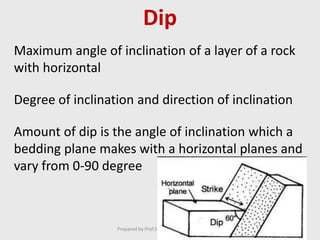
Dip
Maximum angle of inclination of a layer of a rock
with horizontal
Degree of inclination and direction of inclination
Amount of dip is the angle of inclination which a
bedding plane makes with a horizontal planes and
vary from 0-90 degree
Prepared by Prof.S.S.Naik CED GHRIEMJ
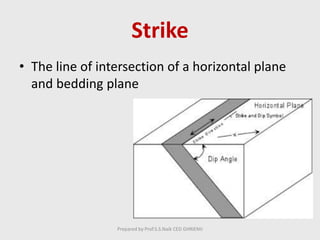
Strike
• The line of intersection of a horizontal plane
and bedding plane
Prepared by Prof.S.S.Naik CED GHRIEMJ
True dip
• When dip of a layer is measured in a direction
that is essentially that is at right angles to the
strike of particular layer
Prepared by Prof.S.S.Naik CED GHRIEMJ
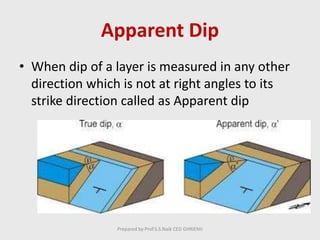
Apparent Dip
• When dip of a layer is measured in any other
direction which is not at right angles to its
strike direction called as Apparent dip
Prepared by Prof.S.S.Naik CED GHRIEMJ
Types of dip
1. Primary Dip –
Original slope of deposition is between 5-10˚
2. Secondary Dip –
May range in value up to vertical
3. Local and regional dip –
Rocks exposed in limited area of observations may
be primary or secondary dip
Prepared by Prof.S.S.Naik CED GHRIEMJ
FOLDS
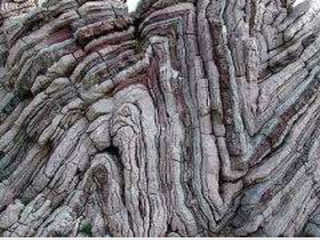
• Undulations or bends or curvatures in rock crust
• Develop in any type of rock, any shape simply
bend or curvature
• Depends on nature, magnitude, direction and
duration of force
• Vey slow geological process
• Ductile type of deformation
Prepared by Prof.S.S.Naik CED GHRIEMJ
Parts of Folds
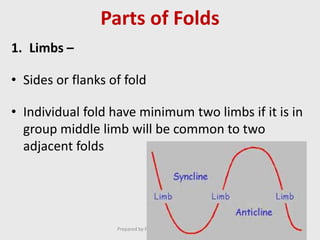
1. Limbs –
• Sides or flanks of fold
• Individual fold have minimum two limbs if it is in
group middle limb will be common to two
adjacent folds
Prepared by Prof.S.S.Naik CED GHRIEMJ
2. Hinge, Axial surface, Axial plane –
• Point can be found where curvature is maximum
one limb end and other is start is called hinge
point
• All hinged points joined together they make a
line called hinge line
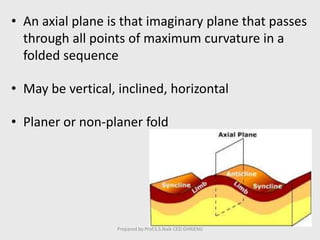
• An axial plane is that imaginary plane that passes
through all points of maximum curvature in a
folded sequence
• May be vertical, inclined, horizontal
• Planer or non-planer fold
Prepared by Prof.S.S.Naik CED GHRIEMJ
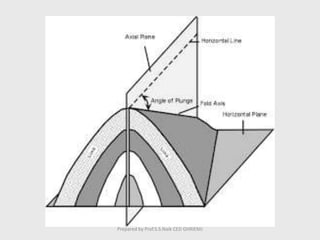
3. Axis of fold –
• Line drawn parallel to hinge line of a fold
• Axis of a fold would be line representing
• intersection of axial plane with any bed fold
• Folded sequence is made up of number of layers
• May be horizontal, vertical or inclined
Prepared by Prof.S.S.Naik CED GHRIEMJ
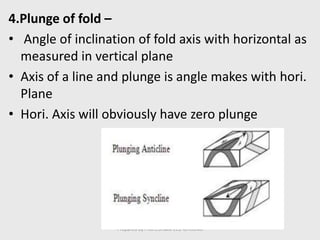
4.Plunge of fold –
• Angle of inclination of fold axis with horizontal as
measured in vertical plane
• Axis of a line and plunge is angle makes with hori.
Plane
• Hori. Axis will obviously have zero plunge
Prepared by Prof.S.S.Naik CED GHRIEMJ
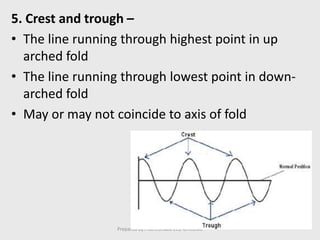
5. Crest and trough –
• The line running through highest point in up
arched fold
• The line running through lowest point in down-
arched fold
• May or may not coincide to axis of fold
Prepared by Prof.S.S.Naik CED GHRIEMJ
Types of fold
• Two basic types of folds –
1. Anticlines
2. Synclines
Prepared by Prof.S.S.Naik CED GHRIEMJ
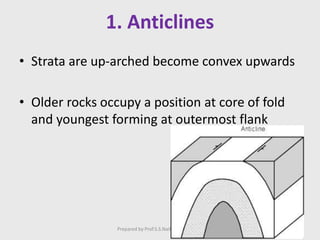
1. Anticlines
• Strata are up-arched become convex upwards
• Older rocks occupy a position at core of fold
and youngest forming at outermost flank
Prepared by Prof.S.S.Naik CED GHRIEMJ
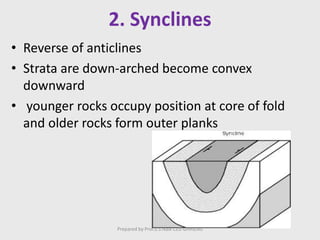
2. Synclines
• Reverse of anticlines
• Strata are down-arched become convex
downward
• younger rocks occupy position at core of fold
and older rocks form outer planks
Prepared by Prof.S.S.Naik CED GHRIEMJ
• Position of axial plane may be vertical, inclined
or even horizontal
• Main types are recognized on basis of axial
plane
Prepared by Prof.S.S.Naik CED GHRIEMJ
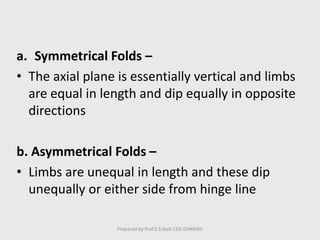
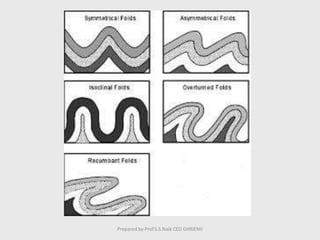
a. Symmetrical Folds –
• The axial plane is essentially vertical and limbs
are equal in length and dip equally in opposite
directions
b. Asymmetrical Folds –
• Limbs are unequal in length and these dip
unequally or either side from hinge line
Prepared by Prof.S.S.Naik CED GHRIEMJ
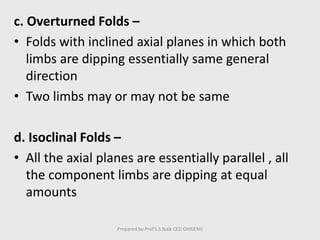
c. Overturned Folds –
• Folds with inclined axial planes in which both
limbs are dipping essentially same general
direction
• Two limbs may or may not be same
d. Isoclinal Folds –
• All the axial planes are essentially parallel , all
the component limbs are dipping at equal
amounts
Prepared by Prof.S.S.Naik CED GHRIEMJ
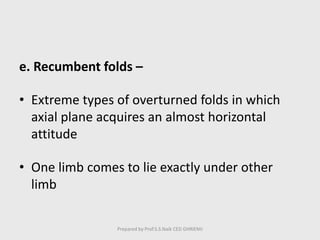
e. Recumbent folds –
• Extreme types of overturned folds in which
axial plane acquires an almost horizontal
attitude
• One limb comes to lie exactly under other
limb
Prepared by Prof.S.S.Naik CED GHRIEMJ
Joints
• Invariably show joint structures to lesser or
greater extent
• It is not only genetic of rocks which is responsible
for this but also forces to which rocks have been
subjected to formation
• Deals with sites, materials of construction,
minerals etc.
Prepared by Prof.S.S.Naik CED GHRIEMJ
Classification
1. Spatial relationship –
a. Systematic joints –
• Distinct regularity in their occurrence
• Joints occur in parallel or sub-parallel joint sets
that are repeated in rocks at regular intervals
Prepared by Prof.S.S.Naik CED GHRIEMJ
b. Non-systematic joints –
• These joints do not possess any regularity in
their occurrence and distribution
• Non-systematic joints may show no
relationship with systematic joints and their
curved and rough surface may even cut
Prepared by Prof.S.S.Naik CED GHRIEMJ
2. Geometry –
• Basis of relationship of their attitude with that of
the rocks in which they occur
i. Strike joints sets strike parallel to strike of rocks
ii. Dip joints sets strike parallel to dip direction of
rocks
iii. Oblique joints are strike of joints is at any angle
between dip and strike of layers
Prepared by Prof.S.S.Naik CED GHRIEMJ
3. Genetic –
Joints are very common and sometime very
complex
i. Tension joints –
• Developed due to tensile forces acting on rock
• Location is outer margin of crests and trough
• Produced in igneous rocks also by cooling
Prepared by Prof.S.S.Naik CED GHRIEMJ
ii. Compression joints –
• Compressed by crushing and various joints
may result due to compressive forces
• In core region of folds joints are formed may
be related to compressive force
Prepared by Prof.S.S.Naik CED GHRIEMJ
iii. Shear joints –
• Relationship with shearing forces is clearly
established
• Located in axial region
Prepared by Prof.S.S.Naik CED GHRIEMJ
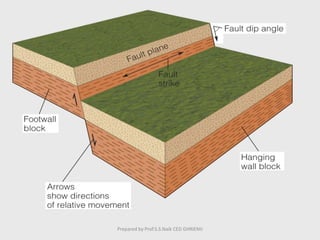
Faults
• Fractures along which there has been relative
movement of blocks past each other
• Entire process of development of fractures
and displacement of blocks against each other
Prepared by Prof.S.S.Naik CED GHRIEMJ
• Factors are considered –
i. Apparent movement of disrupted blocks along
fault plane
ii. Direction of slip
iii. Relation of fault attitude with attitude of displaced
beds
iv. Amount of dip of fault
v. Mode of occurrence
Prepared by Prof.S.S.Naik CED GHRIEMJ
Classification
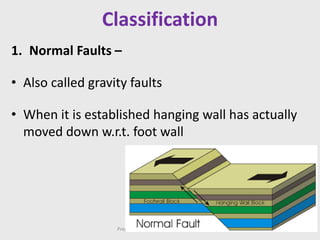
1. Normal Faults –
• Also called gravity faults
• When it is established hanging wall has actually
moved down w.r.t. foot wall
Prepared by Prof.S.S.Naik CED GHRIEMJ
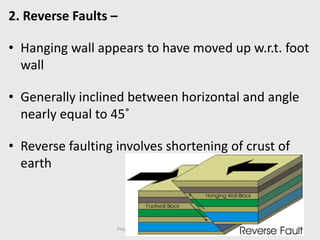
2. Reverse Faults –
• Hanging wall appears to have moved up w.r.t. foot
wall
• Generally inclined between horizontal and angle
nearly equal to 45˚
• Reverse faulting involves shortening of crust of
earth
Prepared by Prof.S.S.Naik CED GHRIEMJ
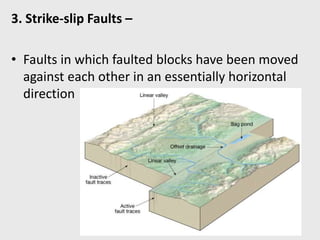
3. Strike-slip Faults –
• Faults in which faulted blocks have been moved
against each other in an essentially horizontal
direction
Prepared by Prof.S.S.Naik CED GHRIEMJ
4. Hinge Faults –
• Hinge fault is characterized by a movement of
disrupted blocks along medial point called
hinge point
Prepared by Prof.S.S.Naik CED GHRIEMJ
Prepared by- Prof. S.S.Naik CED GHRIEM
THANK
YOU

Structural geology

  • 1.
    Unit 2 Structural Geology Prepared byProf.S.S.Naik CED GHRIEMJ
  • 2.
    Structural Geology • Dealswith morphology, classification, mechanism and causes of development of rock structures • Structural features that are developed in body of rock during its formation stage called primary structures • All the modification of original structures and development of form, shapes etc. in rocks after formation called secondary structures. Prepared by Prof.S.S.Naik CED GHRIEMJ
  • 3.
    Outcrop • Exposure ofa solid rock on the surface of the earth • Solid rocks are not exposed everywhere on the surface of earth mostly covered with thick or thin loose deposits called alluvium Prepared by Prof.S.S.Naik CED GHRIEMJ
  • 4.
    Dip Maximum angle ofinclination of a layer of a rock with horizontal Degree of inclination and direction of inclination Amount of dip is the angle of inclination which a bedding plane makes with a horizontal planes and vary from 0-90 degree Prepared by Prof.S.S.Naik CED GHRIEMJ
  • 5.
    Strike • The lineof intersection of a horizontal plane and bedding plane Prepared by Prof.S.S.Naik CED GHRIEMJ
  • 6.
    True dip • Whendip of a layer is measured in a direction that is essentially that is at right angles to the strike of particular layer Prepared by Prof.S.S.Naik CED GHRIEMJ
  • 7.
    Apparent Dip • Whendip of a layer is measured in any other direction which is not at right angles to its strike direction called as Apparent dip Prepared by Prof.S.S.Naik CED GHRIEMJ
  • 8.
    Types of dip 1.Primary Dip – Original slope of deposition is between 5-10˚ 2. Secondary Dip – May range in value up to vertical 3. Local and regional dip – Rocks exposed in limited area of observations may be primary or secondary dip Prepared by Prof.S.S.Naik CED GHRIEMJ
  • 9.
    FOLDS • Undulations orbends or curvatures in rock crust • Develop in any type of rock, any shape simply bend or curvature • Depends on nature, magnitude, direction and duration of force • Vey slow geological process • Ductile type of deformation Prepared by Prof.S.S.Naik CED GHRIEMJ
  • 10.
  • 11.
    Parts of Folds 1.Limbs – • Sides or flanks of fold • Individual fold have minimum two limbs if it is in group middle limb will be common to two adjacent folds Prepared by Prof.S.S.Naik CED GHRIEMJ
  • 12.
    Prepared by Prof.S.S.NaikCED GHRIEMJ 2. Hinge, Axial surface, Axial plane – • Point can be found where curvature is maximum one limb end and other is start is called hinge point • All hinged points joined together they make a line called hinge line
  • 13.
    • An axialplane is that imaginary plane that passes through all points of maximum curvature in a folded sequence • May be vertical, inclined, horizontal • Planer or non-planer fold Prepared by Prof.S.S.Naik CED GHRIEMJ
  • 14.
    3. Axis offold – • Line drawn parallel to hinge line of a fold • Axis of a fold would be line representing • intersection of axial plane with any bed fold • Folded sequence is made up of number of layers • May be horizontal, vertical or inclined Prepared by Prof.S.S.Naik CED GHRIEMJ
  • 15.
  • 16.
    4.Plunge of fold– • Angle of inclination of fold axis with horizontal as measured in vertical plane • Axis of a line and plunge is angle makes with hori. Plane • Hori. Axis will obviously have zero plunge Prepared by Prof.S.S.Naik CED GHRIEMJ
  • 17.
    5. Crest andtrough – • The line running through highest point in up arched fold • The line running through lowest point in down- arched fold • May or may not coincide to axis of fold Prepared by Prof.S.S.Naik CED GHRIEMJ
  • 18.
    Types of fold •Two basic types of folds – 1. Anticlines 2. Synclines Prepared by Prof.S.S.Naik CED GHRIEMJ
  • 19.
    1. Anticlines • Strataare up-arched become convex upwards • Older rocks occupy a position at core of fold and youngest forming at outermost flank Prepared by Prof.S.S.Naik CED GHRIEMJ
  • 20.
    2. Synclines • Reverseof anticlines • Strata are down-arched become convex downward • younger rocks occupy position at core of fold and older rocks form outer planks Prepared by Prof.S.S.Naik CED GHRIEMJ
  • 21.
    • Position ofaxial plane may be vertical, inclined or even horizontal • Main types are recognized on basis of axial plane Prepared by Prof.S.S.Naik CED GHRIEMJ
  • 22.
    a. Symmetrical Folds– • The axial plane is essentially vertical and limbs are equal in length and dip equally in opposite directions b. Asymmetrical Folds – • Limbs are unequal in length and these dip unequally or either side from hinge line Prepared by Prof.S.S.Naik CED GHRIEMJ
  • 23.
    c. Overturned Folds– • Folds with inclined axial planes in which both limbs are dipping essentially same general direction • Two limbs may or may not be same d. Isoclinal Folds – • All the axial planes are essentially parallel , all the component limbs are dipping at equal amounts Prepared by Prof.S.S.Naik CED GHRIEMJ
  • 24.
    e. Recumbent folds– • Extreme types of overturned folds in which axial plane acquires an almost horizontal attitude • One limb comes to lie exactly under other limb Prepared by Prof.S.S.Naik CED GHRIEMJ
  • 25.
  • 26.
    Joints • Invariably showjoint structures to lesser or greater extent • It is not only genetic of rocks which is responsible for this but also forces to which rocks have been subjected to formation • Deals with sites, materials of construction, minerals etc. Prepared by Prof.S.S.Naik CED GHRIEMJ
  • 27.
    Classification 1. Spatial relationship– a. Systematic joints – • Distinct regularity in their occurrence • Joints occur in parallel or sub-parallel joint sets that are repeated in rocks at regular intervals Prepared by Prof.S.S.Naik CED GHRIEMJ
  • 28.
    b. Non-systematic joints– • These joints do not possess any regularity in their occurrence and distribution • Non-systematic joints may show no relationship with systematic joints and their curved and rough surface may even cut Prepared by Prof.S.S.Naik CED GHRIEMJ
  • 29.
    2. Geometry – •Basis of relationship of their attitude with that of the rocks in which they occur i. Strike joints sets strike parallel to strike of rocks ii. Dip joints sets strike parallel to dip direction of rocks iii. Oblique joints are strike of joints is at any angle between dip and strike of layers Prepared by Prof.S.S.Naik CED GHRIEMJ
  • 30.
    3. Genetic – Jointsare very common and sometime very complex i. Tension joints – • Developed due to tensile forces acting on rock • Location is outer margin of crests and trough • Produced in igneous rocks also by cooling Prepared by Prof.S.S.Naik CED GHRIEMJ
  • 31.
    ii. Compression joints– • Compressed by crushing and various joints may result due to compressive forces • In core region of folds joints are formed may be related to compressive force Prepared by Prof.S.S.Naik CED GHRIEMJ
  • 32.
    iii. Shear joints– • Relationship with shearing forces is clearly established • Located in axial region Prepared by Prof.S.S.Naik CED GHRIEMJ
  • 33.
    Faults • Fractures alongwhich there has been relative movement of blocks past each other • Entire process of development of fractures and displacement of blocks against each other Prepared by Prof.S.S.Naik CED GHRIEMJ
  • 34.
  • 35.
    • Factors areconsidered – i. Apparent movement of disrupted blocks along fault plane ii. Direction of slip iii. Relation of fault attitude with attitude of displaced beds iv. Amount of dip of fault v. Mode of occurrence Prepared by Prof.S.S.Naik CED GHRIEMJ
  • 36.
    Classification 1. Normal Faults– • Also called gravity faults • When it is established hanging wall has actually moved down w.r.t. foot wall Prepared by Prof.S.S.Naik CED GHRIEMJ
  • 37.
    2. Reverse Faults– • Hanging wall appears to have moved up w.r.t. foot wall • Generally inclined between horizontal and angle nearly equal to 45˚ • Reverse faulting involves shortening of crust of earth Prepared by Prof.S.S.Naik CED GHRIEMJ
  • 38.
    3. Strike-slip Faults– • Faults in which faulted blocks have been moved against each other in an essentially horizontal direction Prepared by Prof.S.S.Naik CED GHRIEMJ
  • 39.
    4. Hinge Faults– • Hinge fault is characterized by a movement of disrupted blocks along medial point called hinge point Prepared by Prof.S.S.Naik CED GHRIEMJ
  • 40.
    Prepared by- Prof.S.S.Naik CED GHRIEM THANK YOU