GEOMETRICAL CLASSIFICATION OF FOLD
 This includes classification based on :-
1. Sense of curvature
2. Diection of younging relative to axes of fold closure
3. Symmetry of fold
4. Nature of hinge line
5. Amount of plunge of fold axis
6. Orientation of axial planes
7. Interlimb angle
8. Thickness of the fold
9. Shape of the hinge
10. Number of hinge
11. Geometrical relation among neighbouring structure
1. Based on sense of curvature
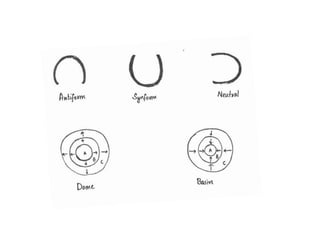
 Antiform – a fold that closes upward
 Synform – a fold that closes downward
 Neutral – a fold that closes sideways.
 Dome – an antiformal structure. It is a group of strata that is centrally
uplifted and dips away in all direction from the centre.
 Basin – a synformal structure. It is centrally depressed structure which dip
towards a common central point.
2. Based on the direction of younging relative to the
sense of fold closure
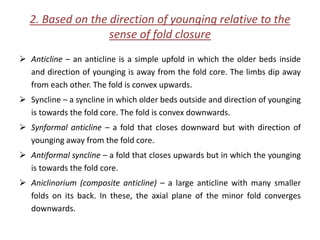
 Anticline – an anticline is a simple upfold in which the older beds inside
and direction of younging is away from the fold core. The limbs dip away
from each other. The fold is convex upwards.
 Syncline – a syncline in which older beds outside and direction of younging
is towards the fold core. The fold is convex downwards.
 Synformal anticline – a fold that closes downward but with direction of
younging away from the fold core.
 Antiformal syncline – a fold that closes upwards but in which the younging
is towards the fold core.
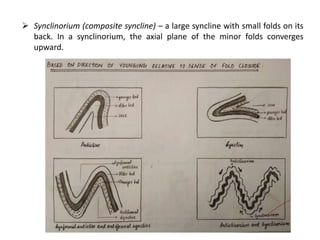
 Aniclinorium (composite anticline) – a large anticline with many smaller
folds on its back. In these, the axial plane of the minor fold converges
downwards.
 Synclinorium (composite syncline) – a large syncline with small folds on its
back. In a synclinorium, the axial plane of the minor folds converges
upward.
3. Based on the symmetry of the fold
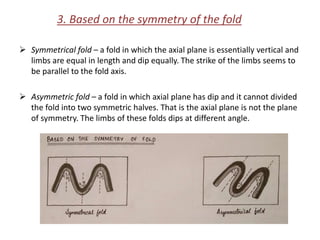
 Symmetrical fold – a fold in which the axial plane is essentially vertical and
limbs are equal in length and dip equally. The strike of the limbs seems to
be parallel to the fold axis.
 Asymmetric fold – a fold in which axial plane has dip and it cannot divided
the fold into two symmetric halves. That is the axial plane is not the plane
of symmetry. The limbs of these folds dips at different angle.
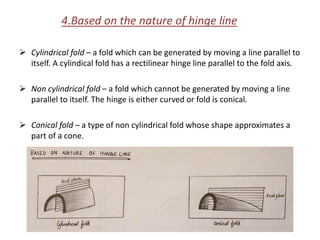
4.Based on the nature of hinge line
 Cylindrical fold – a fold which can be generated by moving a line parallel to
itself. A cylindical fold has a rectilinear hinge line parallel to the fold axis.
 Non cylindrical fold – a fold which cannot be generated by moving a line
parallel to itself. The hinge is either curved or fold is conical.
 Conical fold – a type of non cylindrical fold whose shape approximates a
part of a cone.
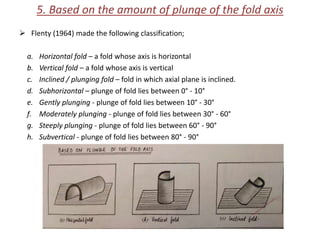
5. Based on the amount of plunge of the fold axis
 Flenty (1964) made the following classification;
a. Horizontal fold – a fold whose axis is horizontal
b. Vertical fold – a fold whose axis is vertical
c. Inclined / plunging fold – fold in which axial plane is inclined.
d. Subhorizontal – plunge of fold lies between 0° - 10°
e. Gently plunging - plunge of fold lies between 10° - 30°
f. Moderately plunging - plunge of fold lies between 30° - 60°
g. Steeply plunging - plunge of fold lies between 60° - 90°
h. Subvertical - plunge of fold lies between 80° - 90°
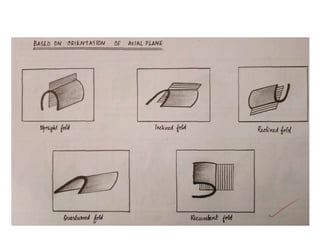
6. Based on the orientation of axial plane
1. Upright fold – fold with vertical or near vertical axial plane
2. Inclined fold – fold with inclined axial planes
3. Reclined fold – an inclined fold in which the fold axis is inclined. The axis
plunges directly down the dip of the axial surface.
4. Overturned fold – in overturned fold/ overfold, the axial plane is overlined
and both limbs dip in the same direction, usually at different angles. The
overturned/ reversed limb is the limb which has been rotated through
more than 90°.
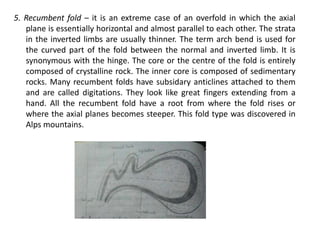
5. Recumbent fold – it is an extreme case of an overfold in which the axial
plane is essentially horizontal and almost parallel to each other. The strata
in the inverted limbs are usually thinner. The term arch bend is used for
the curved part of the fold between the normal and inverted limb. It is
synonymous with the hinge. The core or the centre of the fold is entirely
composed of crystalline rock. The inner core is composed of sedimentary
rocks. Many recumbent folds have subsidary anticlines attached to them
and are called digitations. They look like great fingers extending from a
hand. All the recumbent fold have a root from where the fold rises or
where the axial planes becomes steeper. This fold type was discovered in
Alps mountains.
7. Based on the interlimb angle
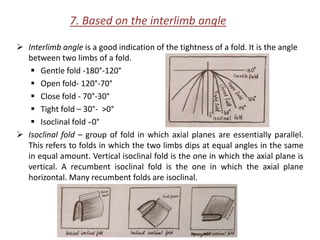
 Interlimb angle is a good indication of the tightness of a fold. It is the angle
between two limbs of a fold.
 Gentle fold -180°-120°
 Open fold- 120°-70°
 Close fold - 70°-30°
 Tight fold – 30°- >0°
 Isoclinal fold ̴0°
 Isoclinal fold – group of fold in which axial planes are essentially parallel.
This refers to folds in which the two limbs dips at equal angles in the same
in equal amount. Vertical isoclinal fold is the one in which the axial plane is
vertical. A recumbent isoclinal fold is the one in which the axial plane
horizontal. Many recumbent folds are isoclinal.
8. Based on thickness of the fold
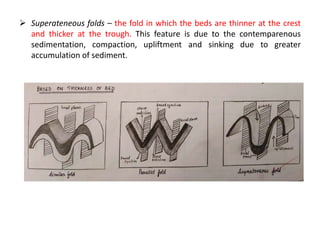
 Similar fold – this fold propagate in definitely upward and downward
direction. In this type, every bed is thin in the limbs and thicker in the
hinges. Thus the axial regions are thicker than limb regions. This indicates a
plastic type of movements of the material of rocks from the limb regions to
the axial region due to the process of folding, the limb region of the
isoclinal fold will show variation in thickness from one point to the other. It
usually develop one weaker and incompetent beds or soft strata under
overburden.
 Parallel fold – also known as concentric fold, the thickness of the strata
remains uniform and constant even after folding. However, the form of the
fold changes upward and downwards. The anticlines become sharper and
synclines become boarder Thus, their particular mechanism of folding is
responsible for typical character of concentric fold.
 Superateneous folds – the fold in which the beds are thinner at the crest
and thicker at the trough. This feature is due to the contemparenous
sedimentation, compaction, upliftment and sinking due to greater
accumulation of sediment.
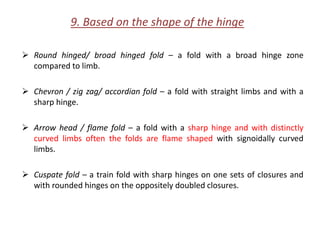
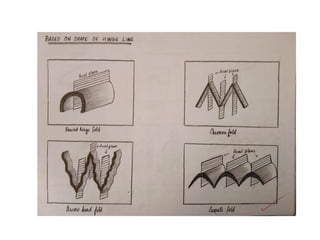
9. Based on the shape of the hinge
 Round hinged/ broad hinged fold – a fold with a broad hinge zone
compared to limb.
 Chevron / zig zag/ accordian fold – a fold with straight limbs and with a
sharp hinge.
 Arrow head / flame fold – a fold with a sharp hinge and with distinctly
curved limbs often the folds are flame shaped with signoidally curved
limbs.
 Cuspate fold – a train fold with sharp hinges on one sets of closures and
with rounded hinges on the oppositely doubled closures.
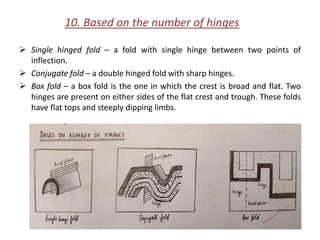
10. Based on the number of hinges
 Single hinged fold – a fold with single hinge between two points of
inflection.
 Conjugate fold – a double hinged fold with sharp hinges.
 Box fold – a box fold is the one in which the crest is broad and flat. Two
hinges are present on either sides of the flat crest and trough. These folds
have flat tops and steeply dipping limbs.
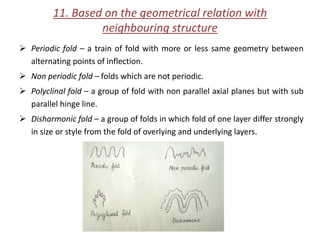
11. Based on the geometrical relation with
neighbouring structure
 Periodic fold – a train of fold with more or less same geometry between
alternating points of inflection.
 Non periodic fold – folds which are not periodic.
 Polyclinal fold – a group of fold with non parallel axial planes but with sub
parallel hinge line.
 Disharmonic fold – a group of folds in which fold of one layer differ strongly
in size or style from the fold of overlying and underlying layers.
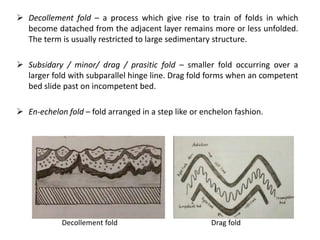
 Decollement fold – a process which give rise to train of folds in which
become datached from the adjacent layer remains more or less unfolded.
The term is usually restricted to large sedimentary structure.
 Subsidary / minor/ drag / prasitic fold – smaller fold occurring over a
larger fold with subparallel hinge line. Drag fold forms when an competent
bed slide past on incompetent bed.
 En-echelon fold – fold arranged in a step like or enchelon fashion.
Decollement fold Drag fold

GEOMETRICAL CLASSIFICATION OF FOLD.pptx

  • 2.
    GEOMETRICAL CLASSIFICATION OFFOLD  This includes classification based on :- 1. Sense of curvature 2. Diection of younging relative to axes of fold closure 3. Symmetry of fold 4. Nature of hinge line 5. Amount of plunge of fold axis 6. Orientation of axial planes 7. Interlimb angle 8. Thickness of the fold 9. Shape of the hinge 10. Number of hinge 11. Geometrical relation among neighbouring structure
  • 3.
    1. Based onsense of curvature  Antiform – a fold that closes upward  Synform – a fold that closes downward  Neutral – a fold that closes sideways.  Dome – an antiformal structure. It is a group of strata that is centrally uplifted and dips away in all direction from the centre.  Basin – a synformal structure. It is centrally depressed structure which dip towards a common central point.
  • 5.
    2. Based onthe direction of younging relative to the sense of fold closure  Anticline – an anticline is a simple upfold in which the older beds inside and direction of younging is away from the fold core. The limbs dip away from each other. The fold is convex upwards.  Syncline – a syncline in which older beds outside and direction of younging is towards the fold core. The fold is convex downwards.  Synformal anticline – a fold that closes downward but with direction of younging away from the fold core.  Antiformal syncline – a fold that closes upwards but in which the younging is towards the fold core.  Aniclinorium (composite anticline) – a large anticline with many smaller folds on its back. In these, the axial plane of the minor fold converges downwards.
  • 6.
     Synclinorium (compositesyncline) – a large syncline with small folds on its back. In a synclinorium, the axial plane of the minor folds converges upward.
  • 7.
    3. Based onthe symmetry of the fold  Symmetrical fold – a fold in which the axial plane is essentially vertical and limbs are equal in length and dip equally. The strike of the limbs seems to be parallel to the fold axis.  Asymmetric fold – a fold in which axial plane has dip and it cannot divided the fold into two symmetric halves. That is the axial plane is not the plane of symmetry. The limbs of these folds dips at different angle.
  • 8.
    4.Based on thenature of hinge line  Cylindrical fold – a fold which can be generated by moving a line parallel to itself. A cylindical fold has a rectilinear hinge line parallel to the fold axis.  Non cylindrical fold – a fold which cannot be generated by moving a line parallel to itself. The hinge is either curved or fold is conical.  Conical fold – a type of non cylindrical fold whose shape approximates a part of a cone.
  • 9.
    5. Based onthe amount of plunge of the fold axis  Flenty (1964) made the following classification; a. Horizontal fold – a fold whose axis is horizontal b. Vertical fold – a fold whose axis is vertical c. Inclined / plunging fold – fold in which axial plane is inclined. d. Subhorizontal – plunge of fold lies between 0° - 10° e. Gently plunging - plunge of fold lies between 10° - 30° f. Moderately plunging - plunge of fold lies between 30° - 60° g. Steeply plunging - plunge of fold lies between 60° - 90° h. Subvertical - plunge of fold lies between 80° - 90°
  • 10.
    6. Based onthe orientation of axial plane 1. Upright fold – fold with vertical or near vertical axial plane 2. Inclined fold – fold with inclined axial planes 3. Reclined fold – an inclined fold in which the fold axis is inclined. The axis plunges directly down the dip of the axial surface. 4. Overturned fold – in overturned fold/ overfold, the axial plane is overlined and both limbs dip in the same direction, usually at different angles. The overturned/ reversed limb is the limb which has been rotated through more than 90°.
  • 12.
    5. Recumbent fold– it is an extreme case of an overfold in which the axial plane is essentially horizontal and almost parallel to each other. The strata in the inverted limbs are usually thinner. The term arch bend is used for the curved part of the fold between the normal and inverted limb. It is synonymous with the hinge. The core or the centre of the fold is entirely composed of crystalline rock. The inner core is composed of sedimentary rocks. Many recumbent folds have subsidary anticlines attached to them and are called digitations. They look like great fingers extending from a hand. All the recumbent fold have a root from where the fold rises or where the axial planes becomes steeper. This fold type was discovered in Alps mountains.
  • 13.
    7. Based onthe interlimb angle  Interlimb angle is a good indication of the tightness of a fold. It is the angle between two limbs of a fold.  Gentle fold -180°-120°  Open fold- 120°-70°  Close fold - 70°-30°  Tight fold – 30°- >0°  Isoclinal fold ̴0°  Isoclinal fold – group of fold in which axial planes are essentially parallel. This refers to folds in which the two limbs dips at equal angles in the same in equal amount. Vertical isoclinal fold is the one in which the axial plane is vertical. A recumbent isoclinal fold is the one in which the axial plane horizontal. Many recumbent folds are isoclinal.
  • 14.
    8. Based onthickness of the fold  Similar fold – this fold propagate in definitely upward and downward direction. In this type, every bed is thin in the limbs and thicker in the hinges. Thus the axial regions are thicker than limb regions. This indicates a plastic type of movements of the material of rocks from the limb regions to the axial region due to the process of folding, the limb region of the isoclinal fold will show variation in thickness from one point to the other. It usually develop one weaker and incompetent beds or soft strata under overburden.  Parallel fold – also known as concentric fold, the thickness of the strata remains uniform and constant even after folding. However, the form of the fold changes upward and downwards. The anticlines become sharper and synclines become boarder Thus, their particular mechanism of folding is responsible for typical character of concentric fold.
  • 15.
     Superateneous folds– the fold in which the beds are thinner at the crest and thicker at the trough. This feature is due to the contemparenous sedimentation, compaction, upliftment and sinking due to greater accumulation of sediment.
  • 16.
    9. Based onthe shape of the hinge  Round hinged/ broad hinged fold – a fold with a broad hinge zone compared to limb.  Chevron / zig zag/ accordian fold – a fold with straight limbs and with a sharp hinge.  Arrow head / flame fold – a fold with a sharp hinge and with distinctly curved limbs often the folds are flame shaped with signoidally curved limbs.  Cuspate fold – a train fold with sharp hinges on one sets of closures and with rounded hinges on the oppositely doubled closures.
  • 18.
    10. Based onthe number of hinges  Single hinged fold – a fold with single hinge between two points of inflection.  Conjugate fold – a double hinged fold with sharp hinges.  Box fold – a box fold is the one in which the crest is broad and flat. Two hinges are present on either sides of the flat crest and trough. These folds have flat tops and steeply dipping limbs.
  • 19.
    11. Based onthe geometrical relation with neighbouring structure  Periodic fold – a train of fold with more or less same geometry between alternating points of inflection.  Non periodic fold – folds which are not periodic.  Polyclinal fold – a group of fold with non parallel axial planes but with sub parallel hinge line.  Disharmonic fold – a group of folds in which fold of one layer differ strongly in size or style from the fold of overlying and underlying layers.
  • 20.
     Decollement fold– a process which give rise to train of folds in which become datached from the adjacent layer remains more or less unfolded. The term is usually restricted to large sedimentary structure.  Subsidary / minor/ drag / prasitic fold – smaller fold occurring over a larger fold with subparallel hinge line. Drag fold forms when an competent bed slide past on incompetent bed.  En-echelon fold – fold arranged in a step like or enchelon fashion. Decollement fold Drag fold