Geological Faults
Objective: By the end of this
session you should be able to use
    diagrams and examples to
describe and explain the different
    types of geological faults
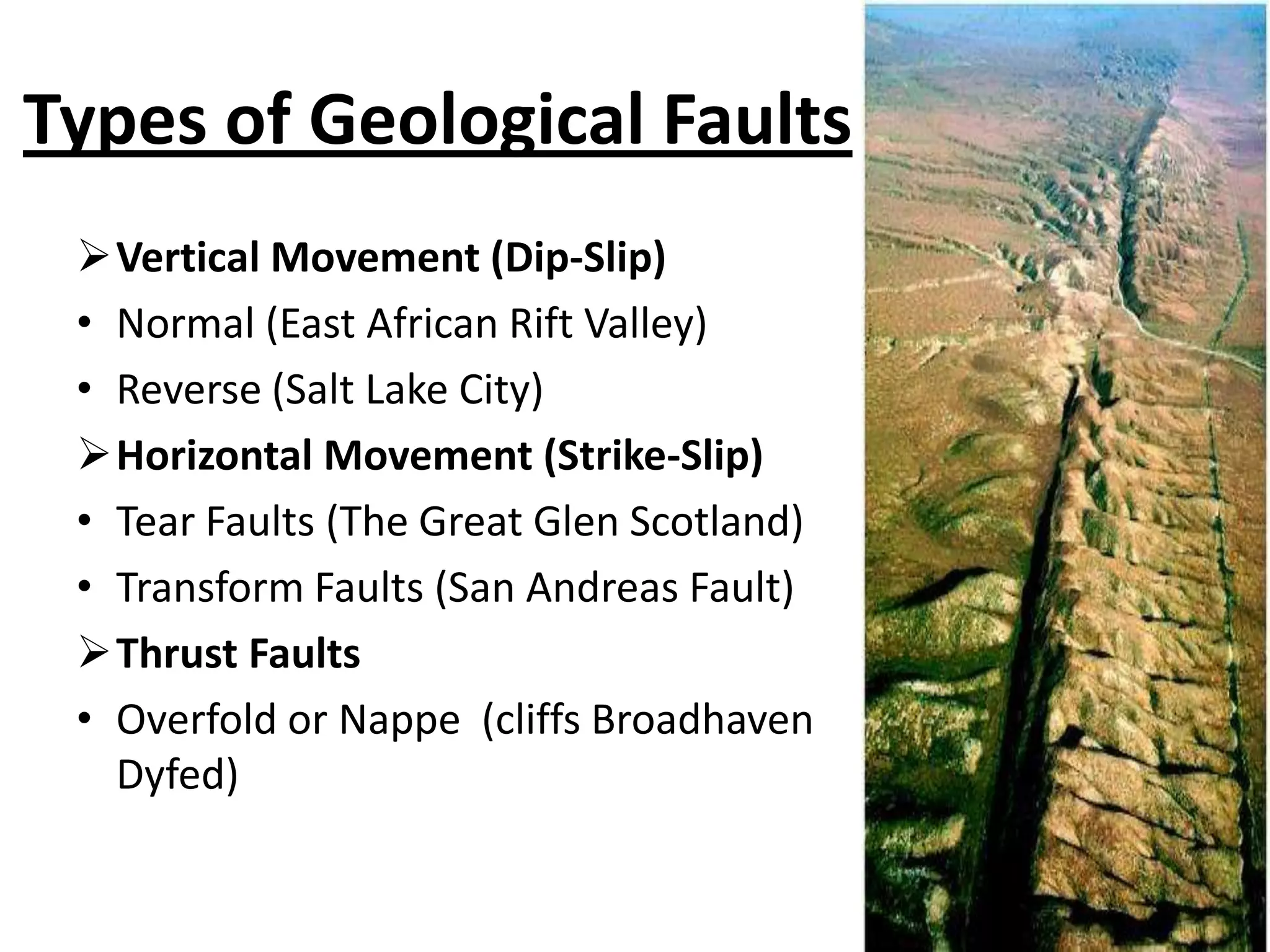
Types of Geological Faults
 Vertical Movement (Dip-Slip)
 • Normal (East African Rift Valley)
 • Reverse (Salt Lake City)
 Horizontal Movement (Strike-Slip)
 • Tear Faults (The Great Glen Scotland)
 • Transform Faults (San Andreas Fault)
 Thrust Faults
 • Overfold or Nappe (cliffs Broadhaven
   Dyfed)
You have one minute to draw and label
           a normal fault
Normal Faults
TENSION / Pulling motion = LENGTHENING

                H
                      Throw = Vertical Displacement
                    T Heave = Horizontal Displacement


  Fault
  Scarp


      Fault Plane
Upthrow and Downthrow
                                  Give five ways that the blocks could
                                  have moved?


       A
    UPTHROW


                                       B
                                   DOWNTHROW
1. A moved up while B moved down
2.
3.
4.
5.

Throw is therefore a RELATIVE position
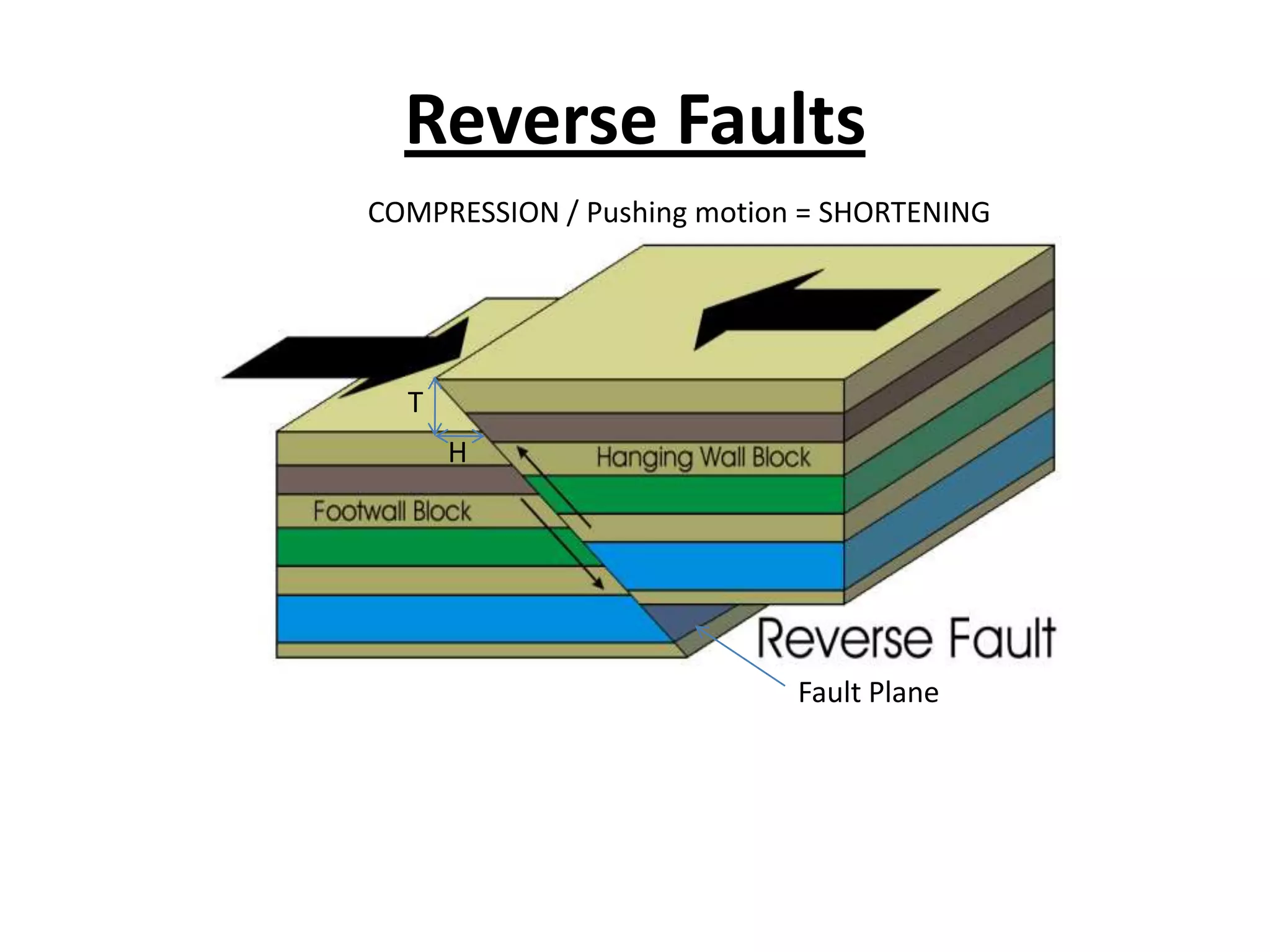
Reverse Faults
COMPRESSION / Pushing motion = SHORTENING


  T
      H


                            Fault Plane
Rift Valleys
                            Fault Scarp


Graben or Rift Valleys are the result of subsidence between Normal Faults
(i.e. TENSION/pulling) Horsts are left upstanding after subsidence on either side.

Name a famous rift valley:________________________________________
Strike-slip faults (horizontal faults)
• Tear Faults - the result of shearing forces applied to
  rocks this can be famously seen at the Great Glen
  Fault where there is SINISTRAL movement (to the
  left) of a Granite Intrusion split in two. The opposite
  of sinistral movement is DEXTRAL movement (to the
  r_____).
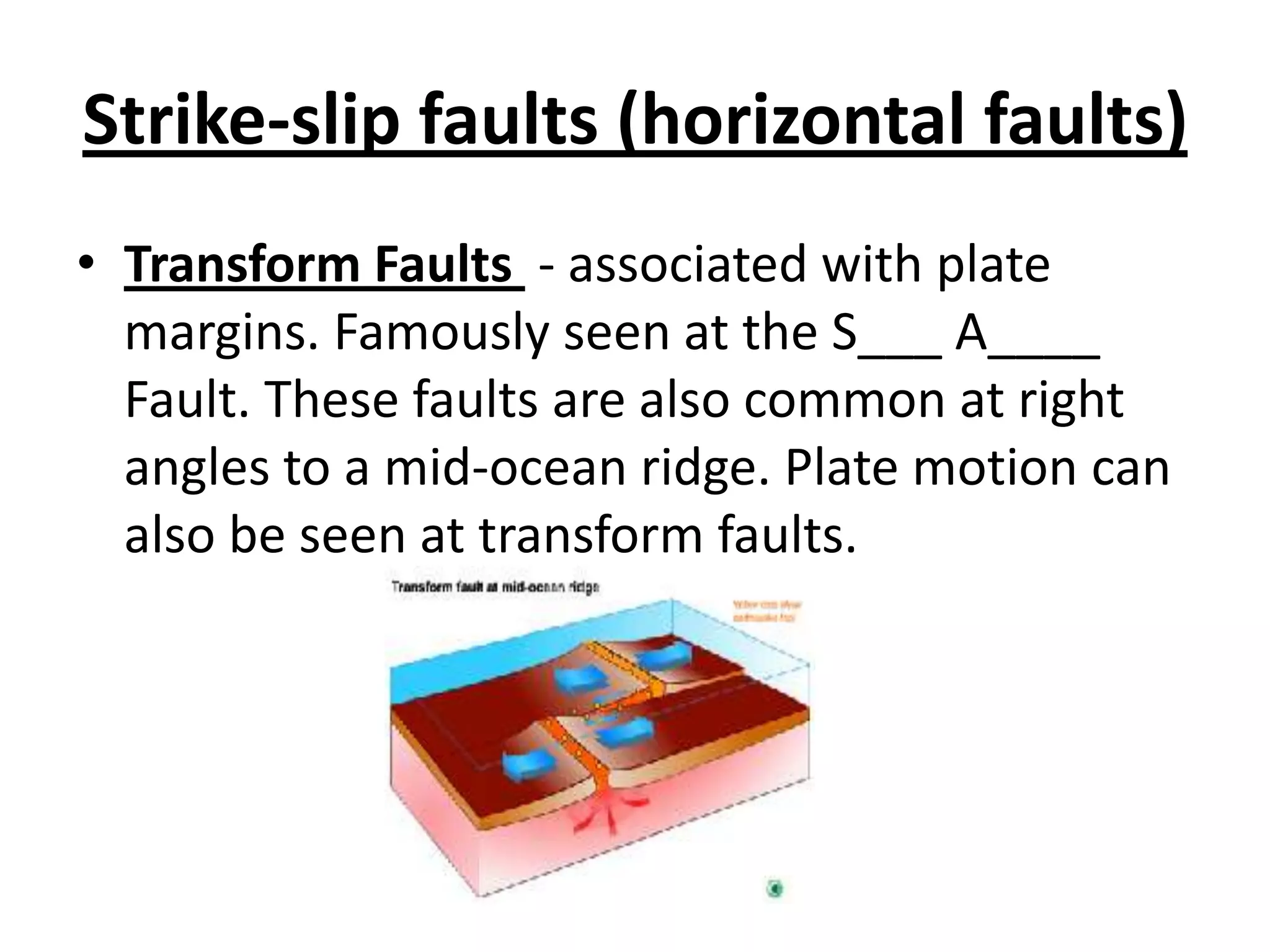
Strike-slip faults (horizontal faults)
• Transform Faults - associated with plate
  margins. Famously seen at the S___ A____
  Fault. These faults are also common at right
  angles to a mid-ocean ridge. Plate motion can
  also be seen at transform faults.
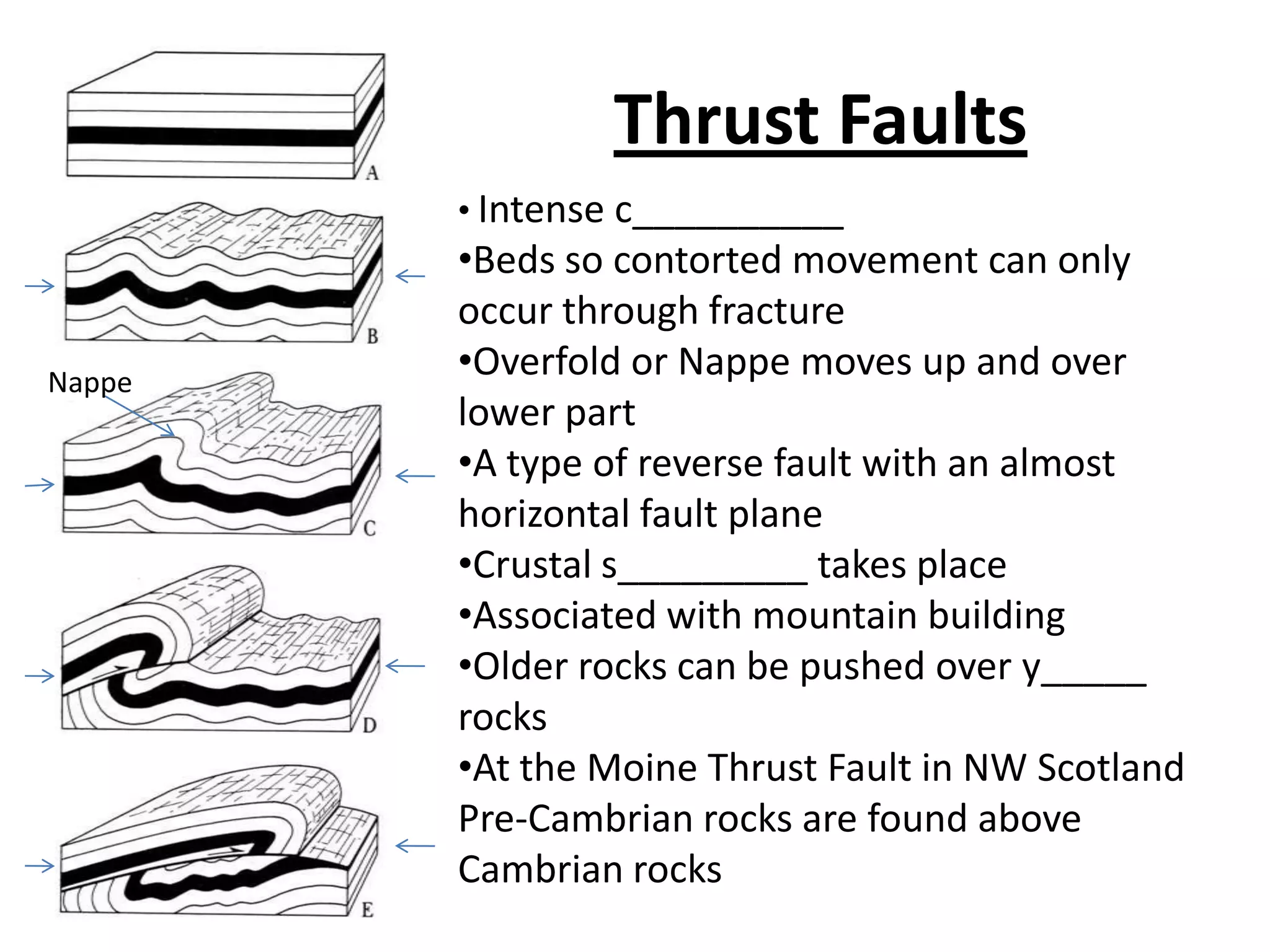
Thrust Faults
        • Intense c__________
        •Beds so contorted movement can only
        occur through fracture
Nappe
        •Overfold or Nappe moves up and over
        lower part
        •A type of reverse fault with an almost
        horizontal fault plane
        •Crustal s_________ takes place
        •Associated with mountain building
        •Older rocks can be pushed over y_____
        rocks
        •At the Moine Thrust Fault in NW Scotland
        Pre-Cambrian rocks are found above
        Cambrian rocks
Other Fault Features
• Fault Breccia: crushed and broken fragments along
  fault planes
• Slickenslides: deep grooves along fault planes
  showing direction of movement
• Gaps along fault planes: often filled with fluids such
  as magma giving rise to dykes or hydrothermal
  solutions carrying minerals (such as veins of galena
  and fluorite found in the Pennines)
• Erosion: valleys can form along weak fault lines;
  upthrow can be eroded to the same level as
  downthrow which can leave misleading geological
  patterns
What have you remembered?
(Blank paper, two minutes!!!)

1.   Draw and label a Dip-Slip Fault
2.   Name a specific example of a Normal
     Fault
3.   Is dextral movement to the left or
     right?
4.   What types of faults involve Nappes?
What have you remembered?
Exam Question from Summer 2007
Mark Scheme for Exam Question
• Specific type of fold/fault e.g. "reverse
  fault", "anticline" (1)
•             Quality of diagram/description (2)
•             Reference to appropriate scale (1)
•             Specific location of feature (1)

•            Correct name of stress involved (1) R
•            e.g. Extension/Tension for normal fault,
•            Compression for reverse/thrust fault or fold
•            Shear for tear fault

Geological faults student copy

  • 1.
  • 2.
    Objective: By theend of this session you should be able to use diagrams and examples to describe and explain the different types of geological faults
  • 3.
    Types of GeologicalFaults Vertical Movement (Dip-Slip) • Normal (East African Rift Valley) • Reverse (Salt Lake City) Horizontal Movement (Strike-Slip) • Tear Faults (The Great Glen Scotland) • Transform Faults (San Andreas Fault) Thrust Faults • Overfold or Nappe (cliffs Broadhaven Dyfed)
  • 4.
    You have oneminute to draw and label a normal fault
  • 5.
    Normal Faults TENSION /Pulling motion = LENGTHENING H Throw = Vertical Displacement T Heave = Horizontal Displacement Fault Scarp Fault Plane
  • 6.
    Upthrow and Downthrow Give five ways that the blocks could have moved? A UPTHROW B DOWNTHROW 1. A moved up while B moved down 2. 3. 4. 5. Throw is therefore a RELATIVE position
  • 7.
    Reverse Faults COMPRESSION /Pushing motion = SHORTENING T H Fault Plane
  • 8.
    Rift Valleys Fault Scarp Graben or Rift Valleys are the result of subsidence between Normal Faults (i.e. TENSION/pulling) Horsts are left upstanding after subsidence on either side. Name a famous rift valley:________________________________________
  • 9.
    Strike-slip faults (horizontalfaults) • Tear Faults - the result of shearing forces applied to rocks this can be famously seen at the Great Glen Fault where there is SINISTRAL movement (to the left) of a Granite Intrusion split in two. The opposite of sinistral movement is DEXTRAL movement (to the r_____).
  • 10.
    Strike-slip faults (horizontalfaults) • Transform Faults - associated with plate margins. Famously seen at the S___ A____ Fault. These faults are also common at right angles to a mid-ocean ridge. Plate motion can also be seen at transform faults.
  • 11.
    Thrust Faults • Intense c__________ •Beds so contorted movement can only occur through fracture Nappe •Overfold or Nappe moves up and over lower part •A type of reverse fault with an almost horizontal fault plane •Crustal s_________ takes place •Associated with mountain building •Older rocks can be pushed over y_____ rocks •At the Moine Thrust Fault in NW Scotland Pre-Cambrian rocks are found above Cambrian rocks
  • 12.
    Other Fault Features •Fault Breccia: crushed and broken fragments along fault planes • Slickenslides: deep grooves along fault planes showing direction of movement • Gaps along fault planes: often filled with fluids such as magma giving rise to dykes or hydrothermal solutions carrying minerals (such as veins of galena and fluorite found in the Pennines) • Erosion: valleys can form along weak fault lines; upthrow can be eroded to the same level as downthrow which can leave misleading geological patterns
  • 13.
    What have youremembered? (Blank paper, two minutes!!!) 1. Draw and label a Dip-Slip Fault 2. Name a specific example of a Normal Fault 3. Is dextral movement to the left or right? 4. What types of faults involve Nappes?
  • 14.
    What have youremembered?
  • 15.
    Exam Question fromSummer 2007
  • 16.
    Mark Scheme forExam Question • Specific type of fold/fault e.g. "reverse fault", "anticline" (1) • Quality of diagram/description (2) • Reference to appropriate scale (1) • Specific location of feature (1) • Correct name of stress involved (1) R • e.g. Extension/Tension for normal fault, • Compression for reverse/thrust fault or fold • Shear for tear fault