TECTONITES
TECTONITES
Tectonites are deformed rocks, the fabric
of which is due to the systematic movement
of the individual units under a common
external force.
Fabric of tectonites reflects the history of
their deformation, or rocks with fabric that
clearly displays coordinated geometric
features that indicate continuous solid
(ductile) flow during formation.
FABRIC
The geometric arrangement of component
features in the rock, seen on a large scale enough
to include many samples of each feature.
The features themselves are called fabric
elements.
Fabric elements include mineral grains, clasts,
compositional layers, fold hinges, and planes of
parting.
CLASSIFICATION
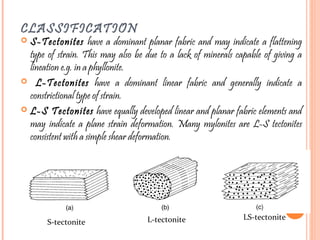
 S-Tectonites have a dominant planar fabric and may indicate a flattening
type of strain. This may also be due to a lack of minerals capable of giving a
lineation e.g. in a phyllonite.
 L-Tectonites have a dominant linear fabric and generally indicate a
constrictional type of strain.
 L-S Tectonites have equally developed linear and planar fabric elements and
may indicate a plane strain deformation. Many mylonites are L-S tectonites
consistent with a simple shear deformation.
S-tectonite L-tectonite LS-tectonite
 A planar fabric, or foliation is one in which the fabric element is a
planar or tabular feature( meaning it is shorter in one dimension than in
the other two).
 A linear fabric, or lineation is one in which the fabric element is
effectively a linear feature ( i.e. it is longer in one dimension relative to the
other dimensions).
A random
fabric
Foliation a planar
two dimensional fabric
lineation
A one dimensional
preferred fabric
FOLIATION
 The property of rocks whereby they break along approximately parallel
surfaces.
 Bedding fissility
 Cleavage (rock cleavage)
 Schistosity
 Gneissosity
CLEAVAGE
 Secondary fabric element, formed under low-temperature conditions, that
imparts on the rock on a tendency to split along planes.
 Four main categories of cleavages that are differentiated from one another
by their morphological characteristics.
 Disjunctive cleavage
 Pencil cleavage
 Slaty cleavage
 Crenulation cleavage
DISJUNCTIVE CLEAVAGE
 Is a foliation that forms mostly in sedimentary rocks that have been
subjected to a tectonic differential stress under sub-greenschist facies
conditions.
 It is defined by an array of sub parallel fabric elements called cleavage
domains in which the original rock fabric and composition have been
markedly changed by the process of pressure solution.
 Domains are separated from one another by intervals called microlithons.
FRACTURE CLEAVAGE
 Is essentially closely spaced jointing. The minerals in the rock are not parallel to
the cleavage.
 The distance between the individual planes of cleavage can be measured and is
commonly a matter of millimeters or centimeters.
 If the distance between the fractures exceeds a few centimeters, the term ‘jointing’ is
more appropriately used.
 The term spaced cleavage has been suggested to include all cleavages that are
separated by a finite distance. It would include fracture cleavage, slip cleavage,
and shear cleavage.
SHEAR CLEAVAGE
 The term has been used a synonymous with slip cleavage,.
 These are closely fractures along which there has been some displacement.
 It is essentially a fracture cleavage along which there has been
displacement.
SLIP CLEAVAGE
 Also called strain-slip cleavage and crenulation cleavage.
 In many metamorphic terranes the schistosity may be crinkled into small
folds with a wavelength of a fraction of an inch. One limb of these small
folds becomes a zone of weakness. The rock tend to break parallel to these
zones.
BEDDING CLEAVAGE
 Cleavage or schistosity that is parallel to the bedding is commonly referred
to as bedding cleavage or bedding schistosity.
 It is commonly similar to slaty cleavage in that it is caused by parallel
platy minerals.
AXIAL PLANE CLEAVAGE
 Cleavage or schistosity essentially parallel to the axial planes of the folds is
called axial plane cleavage.
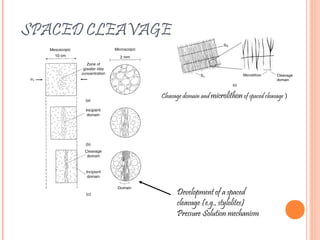
SPACED CLEAVAGE
Development of a spaced
cleavage (e.g., stylolites)
Pressure Solution mechanism
Cleavage domain and microlithonof spaced cleavage )
STYLOLITES
 Weak cleavage
 Moderate cleavage
 Strong cleavage
 Continuous cleavage
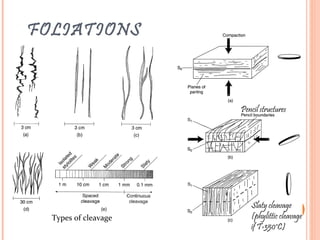
FOLIATIONS
Types of cleavage
Slaty cleavage
(phylittic cleavage
if T>350°C)
Pencil structures
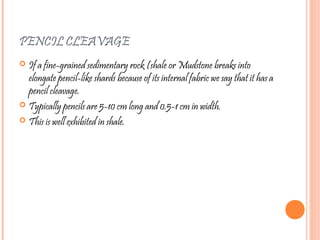
PENCIL CLEAVAGE
 If a fine-grained sedimentary rock (shale or Mudstone breaks into
elongate pencil-like shards because of its internal fabric we say that it has a
pencil cleavage.
 Typically pencils are 5-10 cm long and 0.5-1 cm in width.
 This is well exhibited in shale.
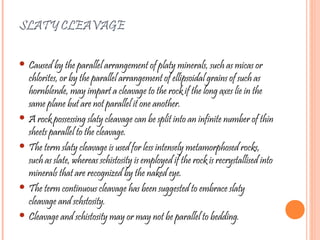
SLATY CLEAVAGE
 Caused by the parallel arrangement of platy minerals, such as micas or
chlorites, or by the parallel arrangement of ellipsoidal grains of such as
hornblende, may impart a cleavage to the rock if the long axes lie in the
same plane but are not parallel it one another.
 A rock possessing slaty cleavage can be split into an infinite number of thin
sheets parallel to the cleavage.
 The term slaty cleavage is used for less intensely metamorphosed rocks,
such as slate, whereas schistosity is employed if the rock is recrystallised into
minerals that are recognized by the naked eye.
 The term continuous cleavage has been suggested to embrace slaty
cleavage and schstosity.
 Cleavage and schistosity may or may not be parallel to bedding.
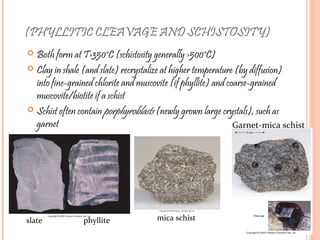
(PHYLLITIC CLEAVAGE AND SCHISTOSITY)
 Both form at T>350°C (schistosity generally >500°C)
 Clay in shale (and slate) recrystalize at higher temperature (by diffusion)
into fine-grained chlorite and muscovite (if phyllite) and coarse-grained
muscovite/biotite if a schist
 Schist often contain porphyroblasts (newly grown large crystals), such as
garnet
slate phyllite mica schist
Garnet-mica schist
GNEISSOSITY
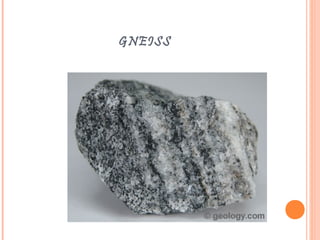
 Foliation is defined by compositional banding.
 Commonly light and dark bands of felsic and mafic mineralogy alternate.
 The light coloured layers are rich in quartz and feldspar whereas darker
layers contain more of the minerals amphibole/pyroxene (and or biotite).
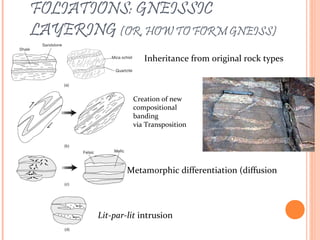
FOLIATIONS: GNEISSIC
LAYERING (OR, HOW TO FORM GNEISS)
Inheritance from original rock types
Creation of new
compositional
banding
via Transposition
Metamorphic differentiation (diffusion
Lit-par-lit intrusion
GNEISS
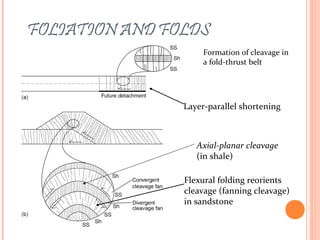
FOLIATIONS IN FOLDS AND FAULT ZONES
 Cleavage fans change from convergent in competent beds (sand stone,
limestone ) to divergent or axial planar in incompetent beds (shale, marl)
cleavage changes orientation from bed to bed, a pattern that is called
cleavage refraction.
 Cleavage refraction is the change in cleavage attitude that occurs where
cleavage domains cross from one lithology into another of different
competency, and reflects variation in the local strain field between beds.
FOLIATION AND FOLDS
Formation of cleavage in
a fold-thrust belt
Layer-parallel shortening
Flexural folding reorients
cleavage (fanning cleavage)
in sandstone
Axial-planar cleavage
(in shale)
LINEATION
 Parallelism of some directional property in the rock
 Form lineations
 Surface lineations
 Mineral lineations
FORM LINEATIONS
 Fold axes
 Boudins
 Quartz rods
 Mullion structure
FOLD AXES
 Attitude of the fold axes is often the reference to which other lineations are
compared.
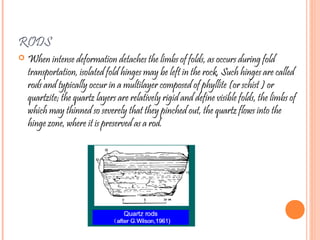
RODS
 When intense deformation detaches the limbs of folds, as occurs during fold
transportation, isolated fold hinges may be left in the rock. Such hinges are called
rods and typically occur in a multilayer composed of phyllite (or schist ) or
quartzite; the quartz layers are relatively rigid and define visible folds, the limbs of
which may thinned so severely that they pinched out, the quartz flows into the
hinge zone, where it is preserved as a rod.
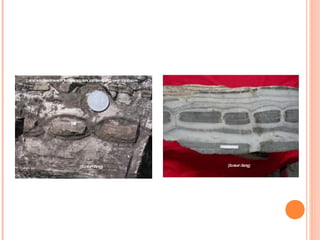
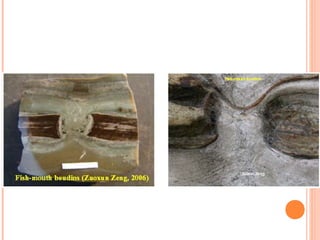
MULLIONS AND BOUNDINS
 Are cusplike corrugations that form at the contact between units of
different competencies in a deformed multilayered sequence; the axes of
mullions are a lineation.
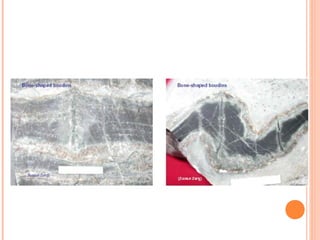
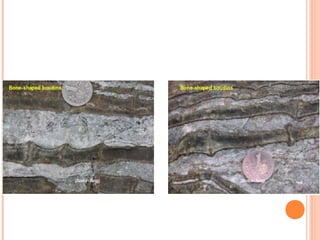
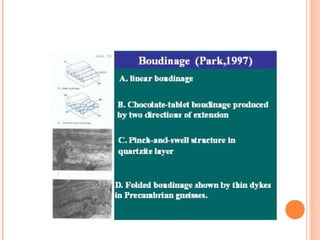
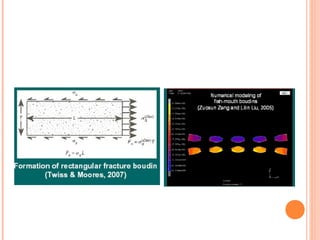
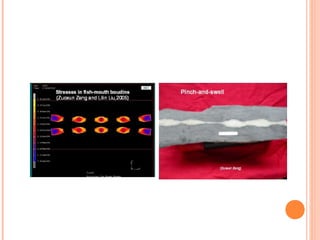
 Boundins are tablet-shaped lenses of relatively rigid lithology, embedded
in a weaker matrix, that have correctly undergone layer-parallel
stretching.
 These boundins are are separated by narrow boundin necks that are
linear objects.
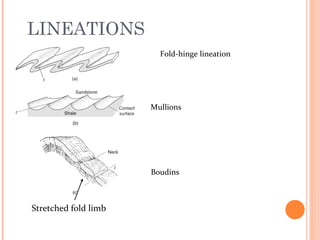
LINEATIONS
Fold-hinge lineation
Boudins
Stretched fold limb
Mullions
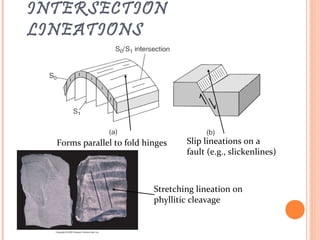
SURFACE LINEATIONS
 Slickenlines
 Intersection lineations
INTERSECTION
LINEATIONS
Forms parallel to fold hinges Slip lineations on a
fault (e.g., slickenlines)
Stretching lineation on
phyllitic cleavage
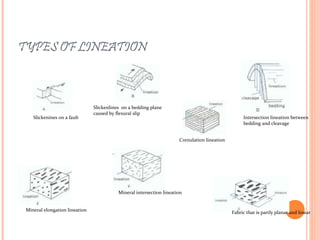
TYPES OF LINEATION
Slickenines on a fault
Fabric that is partly planar and linear
Mineral intersection lineation
Mineral elongation lineation
Intersection lineation between
bedding and cleavage
Crenulation lineation
Slickenlines on a bedding plane
caused by flexural slip
Tecotnites
Tecotnites
Tecotnites
Tecotnites
Tecotnites
Tecotnites
Tecotnites

Tecotnites

  • 1.
  • 2.
    TECTONITES Tectonites are deformedrocks, the fabric of which is due to the systematic movement of the individual units under a common external force.
  • 3.
    Fabric of tectonitesreflects the history of their deformation, or rocks with fabric that clearly displays coordinated geometric features that indicate continuous solid (ductile) flow during formation.
  • 4.
    FABRIC The geometric arrangementof component features in the rock, seen on a large scale enough to include many samples of each feature. The features themselves are called fabric elements. Fabric elements include mineral grains, clasts, compositional layers, fold hinges, and planes of parting.
  • 5.
    CLASSIFICATION  S-Tectonites havea dominant planar fabric and may indicate a flattening type of strain. This may also be due to a lack of minerals capable of giving a lineation e.g. in a phyllonite.  L-Tectonites have a dominant linear fabric and generally indicate a constrictional type of strain.  L-S Tectonites have equally developed linear and planar fabric elements and may indicate a plane strain deformation. Many mylonites are L-S tectonites consistent with a simple shear deformation. S-tectonite L-tectonite LS-tectonite
  • 6.
     A planarfabric, or foliation is one in which the fabric element is a planar or tabular feature( meaning it is shorter in one dimension than in the other two).  A linear fabric, or lineation is one in which the fabric element is effectively a linear feature ( i.e. it is longer in one dimension relative to the other dimensions).
  • 7.
    A random fabric Foliation aplanar two dimensional fabric lineation A one dimensional preferred fabric
  • 8.
    FOLIATION  The propertyof rocks whereby they break along approximately parallel surfaces.  Bedding fissility  Cleavage (rock cleavage)  Schistosity  Gneissosity
  • 9.
    CLEAVAGE  Secondary fabricelement, formed under low-temperature conditions, that imparts on the rock on a tendency to split along planes.  Four main categories of cleavages that are differentiated from one another by their morphological characteristics.  Disjunctive cleavage  Pencil cleavage  Slaty cleavage  Crenulation cleavage
  • 10.
    DISJUNCTIVE CLEAVAGE  Isa foliation that forms mostly in sedimentary rocks that have been subjected to a tectonic differential stress under sub-greenschist facies conditions.  It is defined by an array of sub parallel fabric elements called cleavage domains in which the original rock fabric and composition have been markedly changed by the process of pressure solution.  Domains are separated from one another by intervals called microlithons.
  • 11.
    FRACTURE CLEAVAGE  Isessentially closely spaced jointing. The minerals in the rock are not parallel to the cleavage.  The distance between the individual planes of cleavage can be measured and is commonly a matter of millimeters or centimeters.  If the distance between the fractures exceeds a few centimeters, the term ‘jointing’ is more appropriately used.  The term spaced cleavage has been suggested to include all cleavages that are separated by a finite distance. It would include fracture cleavage, slip cleavage, and shear cleavage.
  • 12.
    SHEAR CLEAVAGE  Theterm has been used a synonymous with slip cleavage,.  These are closely fractures along which there has been some displacement.  It is essentially a fracture cleavage along which there has been displacement.
  • 13.
    SLIP CLEAVAGE  Alsocalled strain-slip cleavage and crenulation cleavage.  In many metamorphic terranes the schistosity may be crinkled into small folds with a wavelength of a fraction of an inch. One limb of these small folds becomes a zone of weakness. The rock tend to break parallel to these zones.
  • 14.
    BEDDING CLEAVAGE  Cleavageor schistosity that is parallel to the bedding is commonly referred to as bedding cleavage or bedding schistosity.  It is commonly similar to slaty cleavage in that it is caused by parallel platy minerals.
  • 15.
    AXIAL PLANE CLEAVAGE Cleavage or schistosity essentially parallel to the axial planes of the folds is called axial plane cleavage.
  • 16.
    SPACED CLEAVAGE Development ofa spaced cleavage (e.g., stylolites) Pressure Solution mechanism Cleavage domain and microlithonof spaced cleavage )
  • 17.
    STYLOLITES  Weak cleavage Moderate cleavage  Strong cleavage  Continuous cleavage
  • 18.
    FOLIATIONS Types of cleavage Slatycleavage (phylittic cleavage if T>350°C) Pencil structures
  • 19.
    PENCIL CLEAVAGE  Ifa fine-grained sedimentary rock (shale or Mudstone breaks into elongate pencil-like shards because of its internal fabric we say that it has a pencil cleavage.  Typically pencils are 5-10 cm long and 0.5-1 cm in width.  This is well exhibited in shale.
  • 20.
    SLATY CLEAVAGE  Causedby the parallel arrangement of platy minerals, such as micas or chlorites, or by the parallel arrangement of ellipsoidal grains of such as hornblende, may impart a cleavage to the rock if the long axes lie in the same plane but are not parallel it one another.  A rock possessing slaty cleavage can be split into an infinite number of thin sheets parallel to the cleavage.  The term slaty cleavage is used for less intensely metamorphosed rocks, such as slate, whereas schistosity is employed if the rock is recrystallised into minerals that are recognized by the naked eye.  The term continuous cleavage has been suggested to embrace slaty cleavage and schstosity.  Cleavage and schistosity may or may not be parallel to bedding.
  • 21.
    (PHYLLITIC CLEAVAGE ANDSCHISTOSITY)  Both form at T>350°C (schistosity generally >500°C)  Clay in shale (and slate) recrystalize at higher temperature (by diffusion) into fine-grained chlorite and muscovite (if phyllite) and coarse-grained muscovite/biotite if a schist  Schist often contain porphyroblasts (newly grown large crystals), such as garnet slate phyllite mica schist Garnet-mica schist
  • 22.
    GNEISSOSITY  Foliation isdefined by compositional banding.  Commonly light and dark bands of felsic and mafic mineralogy alternate.  The light coloured layers are rich in quartz and feldspar whereas darker layers contain more of the minerals amphibole/pyroxene (and or biotite).
  • 23.
    FOLIATIONS: GNEISSIC LAYERING (OR,HOW TO FORM GNEISS) Inheritance from original rock types Creation of new compositional banding via Transposition Metamorphic differentiation (diffusion Lit-par-lit intrusion
  • 24.
  • 25.
    FOLIATIONS IN FOLDSAND FAULT ZONES  Cleavage fans change from convergent in competent beds (sand stone, limestone ) to divergent or axial planar in incompetent beds (shale, marl) cleavage changes orientation from bed to bed, a pattern that is called cleavage refraction.  Cleavage refraction is the change in cleavage attitude that occurs where cleavage domains cross from one lithology into another of different competency, and reflects variation in the local strain field between beds.
  • 26.
    FOLIATION AND FOLDS Formationof cleavage in a fold-thrust belt Layer-parallel shortening Flexural folding reorients cleavage (fanning cleavage) in sandstone Axial-planar cleavage (in shale)
  • 27.
    LINEATION  Parallelism ofsome directional property in the rock  Form lineations  Surface lineations  Mineral lineations
  • 28.
    FORM LINEATIONS  Foldaxes  Boudins  Quartz rods  Mullion structure
  • 29.
    FOLD AXES  Attitudeof the fold axes is often the reference to which other lineations are compared.
  • 30.
    RODS  When intensedeformation detaches the limbs of folds, as occurs during fold transportation, isolated fold hinges may be left in the rock. Such hinges are called rods and typically occur in a multilayer composed of phyllite (or schist ) or quartzite; the quartz layers are relatively rigid and define visible folds, the limbs of which may thinned so severely that they pinched out, the quartz flows into the hinge zone, where it is preserved as a rod.
  • 31.
    MULLIONS AND BOUNDINS Are cusplike corrugations that form at the contact between units of different competencies in a deformed multilayered sequence; the axes of mullions are a lineation.  Boundins are tablet-shaped lenses of relatively rigid lithology, embedded in a weaker matrix, that have correctly undergone layer-parallel stretching.  These boundins are are separated by narrow boundin necks that are linear objects.
  • 32.
  • 33.
  • 34.
    INTERSECTION LINEATIONS Forms parallel tofold hinges Slip lineations on a fault (e.g., slickenlines) Stretching lineation on phyllitic cleavage
  • 35.
    TYPES OF LINEATION Slickenineson a fault Fabric that is partly planar and linear Mineral intersection lineation Mineral elongation lineation Intersection lineation between bedding and cleavage Crenulation lineation Slickenlines on a bedding plane caused by flexural slip