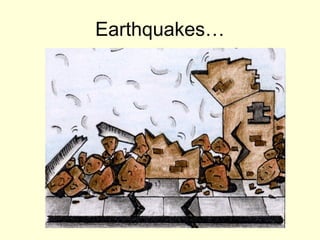
Earthquakes…
What are earthquakes and where do they occur?
                           Earthquakes are
    DESTRUCTIVE            vibrations caused by
                           earth movements at plate
                           boundaries and at major
                           fault lines (cracks in the
                           earth’s surface).

   CONSERVATIVE            They can occur at all 4
                           major plate boundaries
                           but the most severe
                           earthquakes are normally
                           found at CONSERVATIVE
                           and DESTRUCTIVE
                           boundaries.
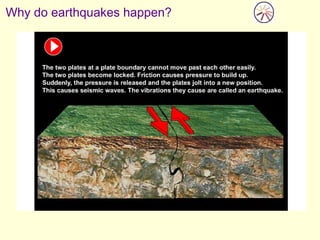
Why do earthquakes happen?
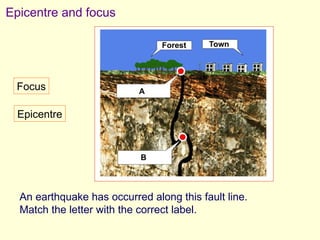
Epicentre and focus
Epicentre and focus


 Focus

  Epicentre


  An earthquake has occurred along this fault line.
  Match the letter with the correct label.
Epicentre and focus


  An earthquake has occurred in this area.
  Which area (the town or the forest) will receive the stronger
  earthquake?
  Which area will receive more damage from the earthquake?
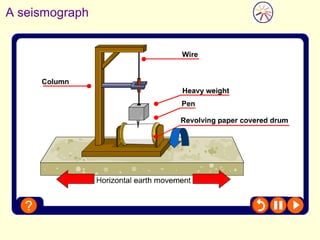
A seismograph
How can we measure earthquakes?

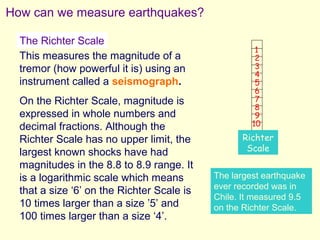
  The Richter Scale
                                                      1
  This measures the magnitude of a                    2
  tremor (how powerful it is) using an                3
                                                      4
  instrument called a seismograph.                    5
                                                      6
  On the Richter Scale, magnitude is                  7
                                                      8
  expressed in whole numbers and                      9
  decimal fractions. Although the                    10

  Richter Scale has no upper limit, the           Richter
  largest known shocks have had                    Scale
  magnitudes in the 8.8 to 8.9 range. It
  is a logarithmic scale which means        The largest earthquake
                                            ever recorded was in
  that a size ‘6’ on the Richter Scale is
                                            Chile. It measured 9.5
  10 times larger than a size ’5’ and       on the Richter Scale.
  100 times larger than a size ‘4’.
• http://www.iris.edu/seismon/

• http://www.earthquakes.bgs.ac.uk/recent_
  events/recent_events.html
Why do we get earthquakes in Britain?
 • We actually have 50-60 small earthquakes every year!
 • These occur along ‘fault lines’ (cracks in the main plates deep
   beneath the ground).
 • As our plate is moving very slowly to the east every now and
   then there are small movements along faults.
 • The most Britain can expect to see, in terms of damage, is
   chimney pots falling down and windows cracking.

 Why don’t we ever get BIG earthquakes?
 Because we are not near a plate boundary but inside the
   Eurasian plate.
How can we measure earthquakes?


  The Japanese earthquake in Kobe
                                                     1
  (September 1995) measured 7.2 on the               2
  Richter Scale.                                     3
                                                     4
                                                     5
                                                     6
  The Greek earthquake (June 1995)                   7
                                                     8
  measured 6.2 on the Richter Scale.                 9
                                                    10
                                                  Richter
                                                   Scale

  How many times greater was the Japanese earthquake?
Mercalli Scale
                 This measures
                 how much
                 damage is
                 caused by the
                 earthquake
Mercalli Scale
                 based on
                 observations. It
                 is measured on a
                 scale between I
                 and XII.
Activity
  Design your own cartoon based on the Mercalli Scale
  descriptions below.
  I      Felt by almost no one.
  II     Felt by very few people.
  III    Tremor noticed by many, but they often do not realise it is an
  earthquake.
  IV     Felt indoors by many. Feels like a truck has struck the building.
  V      Felt by everyone; many people are awakened. Swaying trees and
         poles may be observed.
  VI     Felt by all; many people run outdoors. Furniture is moved.
  VII    Everyone runs outdoors. Poorly built structures considerably
  damaged. Slight damage elsewhere.
  VII    Specially designed structures damaged slightly, others collapsed.
  IX     All buildings considerably damaged, many shift off foundations.
  Noticeable cracks in the ground.
  X      Many structures destroyed. Ground badly cracked.
  XI     Almost all structures fall. Bridges wrecked.
  XII    Total destruction. Waves seen on ground surfaces, objects are
  tumbled and tossed.
Your task:
1.   In your own words, explain why earthquakes happen
     (include a diagram). What type of plate boundary are
     they mainly found at?
2.   What are the focus and epicentre? Draw a diagram to
     illustrate this.
3.   What are seismic waves?
4.   What instrument do scientists use to measure the
     strength and duration of an earthquake? Explain how it
     works.
5.   What is the richter scale?
6.   What was the largest earthquake ever recorded?
     Where was it?
How can we limit earthquake damage?
       predict             plan              protect

                                      water levels can rise in
   a tiltmeter can check any          wells and lakes because
   movement within the rocks          of cracks in the rock

                         1. predict


                                  animals can act
   foreshocks before the main     strangely before the
   quake can be detected by a     earthquake
   seismometer
How can we limit earthquake damage?

 advise people to plan for an
 earthquake (eg tell them to
 turn off the gas, find a ‘safe’
 place in their homes, pack             make an emergency plan
 an emergency kit)

                              2. plan

 enforce regulations to                 organize regular
 make some buildings                    ‘earthquake practices’
 earthquake proof                       for offices and schools

 What should people pack in their emergency kit?
 Design a poster reminding people what to do in an earthquake.
DROP COVER HOLD-ON…
• http://news.bbc.co.uk/1/hi/world/americas/
  7726924.stm
http://www.youtube.com/watch?
  v=j8mUZFeMwhE
http://www.youtube.com/watch?
  v=bAHNhtRT50A earthquake drill at
  school

• http://news.bbc.co.uk/1/hi/world/americas/
  7726031.stm simulation
This is San Francisco in the USA.
Why does this skyscraper have a wide base?
Building regulations in earthquake zones


            overlapping bricks


                                        strong lintels


                    deep foundations

  What other measures would make buildings less likely to
  collapse in an earthquake?
Which shape of building would be most ‘earthquake proof’?
Sky’s the limit!

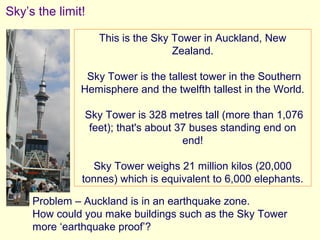
                   This is the Sky Tower in Auckland, New
                                   Zealand.

                Sky Tower is the tallest tower in the Southern
               Hemisphere and the twelfth tallest in the World.

               Sky Tower is 328 metres tall (more than 1,076
                feet); that's about 37 buses standing end on
                                     end!

                 Sky Tower weighs 21 million kilos (20,000
               tonnes) which is equivalent to 6,000 elephants.

     Problem – Auckland is in an earthquake zone.
     How could you make buildings such as the Sky Tower
     more ‘earthquake proof’?
What they did…
   Sky Tower is constructed from a high strength, high
   performance concrete.
   The main structure of Sky Tower is a reinforced concrete
   shaft measuring 12 metres in diameter. It is supported by
   eight reinforced concrete 'legs' at the base, connected to
   the shaft by a concrete collar and designed to spread force
   load.
   Sky Tower's foundations go down more than 15 metres.
   The tower was tested to see if it would withstand
   earthquakes. Analysis shows that an earthquake
   measuring 7.0 on the Richter scale, located 40 kilometres
   from Sky Tower on the Kerepehi Fault, would leave Sky
   Tower essentially undamaged. In the extreme event of a
   magnitude 8.0 earthquake occurring within 20 kilometres of
   the tower, analysis shows that Sky Tower would remain
   standing.
Your task…
7. How can we limit earthquake damage? Mention ways of
    predicting, planning and protecting.
8. What is the best shape for a building in an earthquake
    zone? Draw a diagram. What other measures can be
    taken to protect a building?
9. What should people do in an earthquake? Design a
    poster to be put up in public buildings, informing
    people what they should do.
10. What’s the Mercalli scale? Divide a page into 12 boxes
    and illustrate the twelve stages.

Lesson 4 earthquakes

  • 1.
  • 2.
    What are earthquakesand where do they occur? Earthquakes are DESTRUCTIVE vibrations caused by earth movements at plate boundaries and at major fault lines (cracks in the earth’s surface). CONSERVATIVE They can occur at all 4 major plate boundaries but the most severe earthquakes are normally found at CONSERVATIVE and DESTRUCTIVE boundaries.
  • 3.
  • 4.
  • 5.
    Epicentre and focus Focus Epicentre An earthquake has occurred along this fault line. Match the letter with the correct label.
  • 6.
    Epicentre and focus An earthquake has occurred in this area. Which area (the town or the forest) will receive the stronger earthquake? Which area will receive more damage from the earthquake?
  • 7.
  • 8.
    How can wemeasure earthquakes? The Richter Scale 1 This measures the magnitude of a 2 tremor (how powerful it is) using an 3 4 instrument called a seismograph. 5 6 On the Richter Scale, magnitude is 7 8 expressed in whole numbers and 9 decimal fractions. Although the 10 Richter Scale has no upper limit, the Richter largest known shocks have had Scale magnitudes in the 8.8 to 8.9 range. It is a logarithmic scale which means The largest earthquake ever recorded was in that a size ‘6’ on the Richter Scale is Chile. It measured 9.5 10 times larger than a size ’5’ and on the Richter Scale. 100 times larger than a size ‘4’.
  • 9.
  • 10.
    Why do weget earthquakes in Britain? • We actually have 50-60 small earthquakes every year! • These occur along ‘fault lines’ (cracks in the main plates deep beneath the ground). • As our plate is moving very slowly to the east every now and then there are small movements along faults. • The most Britain can expect to see, in terms of damage, is chimney pots falling down and windows cracking. Why don’t we ever get BIG earthquakes? Because we are not near a plate boundary but inside the Eurasian plate.
  • 11.
    How can wemeasure earthquakes? The Japanese earthquake in Kobe 1 (September 1995) measured 7.2 on the 2 Richter Scale. 3 4 5 6 The Greek earthquake (June 1995) 7 8 measured 6.2 on the Richter Scale. 9 10 Richter Scale How many times greater was the Japanese earthquake?
  • 12.
    Mercalli Scale This measures how much damage is caused by the earthquake Mercalli Scale based on observations. It is measured on a scale between I and XII.
  • 13.
    Activity Designyour own cartoon based on the Mercalli Scale descriptions below. I Felt by almost no one. II Felt by very few people. III Tremor noticed by many, but they often do not realise it is an earthquake. IV Felt indoors by many. Feels like a truck has struck the building. V Felt by everyone; many people are awakened. Swaying trees and poles may be observed. VI Felt by all; many people run outdoors. Furniture is moved. VII Everyone runs outdoors. Poorly built structures considerably damaged. Slight damage elsewhere. VII Specially designed structures damaged slightly, others collapsed. IX All buildings considerably damaged, many shift off foundations. Noticeable cracks in the ground. X Many structures destroyed. Ground badly cracked. XI Almost all structures fall. Bridges wrecked. XII Total destruction. Waves seen on ground surfaces, objects are tumbled and tossed.
  • 14.
    Your task: 1. In your own words, explain why earthquakes happen (include a diagram). What type of plate boundary are they mainly found at? 2. What are the focus and epicentre? Draw a diagram to illustrate this. 3. What are seismic waves? 4. What instrument do scientists use to measure the strength and duration of an earthquake? Explain how it works. 5. What is the richter scale? 6. What was the largest earthquake ever recorded? Where was it?
  • 15.
    How can welimit earthquake damage? predict plan protect water levels can rise in a tiltmeter can check any wells and lakes because movement within the rocks of cracks in the rock 1. predict animals can act foreshocks before the main strangely before the quake can be detected by a earthquake seismometer
  • 16.
    How can welimit earthquake damage? advise people to plan for an earthquake (eg tell them to turn off the gas, find a ‘safe’ place in their homes, pack make an emergency plan an emergency kit) 2. plan enforce regulations to organize regular make some buildings ‘earthquake practices’ earthquake proof for offices and schools What should people pack in their emergency kit? Design a poster reminding people what to do in an earthquake.
  • 17.
    DROP COVER HOLD-ON… •http://news.bbc.co.uk/1/hi/world/americas/ 7726924.stm http://www.youtube.com/watch? v=j8mUZFeMwhE http://www.youtube.com/watch? v=bAHNhtRT50A earthquake drill at school • http://news.bbc.co.uk/1/hi/world/americas/ 7726031.stm simulation
  • 18.
    This is SanFrancisco in the USA. Why does this skyscraper have a wide base?
  • 19.
    Building regulations inearthquake zones overlapping bricks strong lintels deep foundations What other measures would make buildings less likely to collapse in an earthquake?
  • 20.
    Which shape ofbuilding would be most ‘earthquake proof’?
  • 21.
    Sky’s the limit! This is the Sky Tower in Auckland, New Zealand. Sky Tower is the tallest tower in the Southern Hemisphere and the twelfth tallest in the World. Sky Tower is 328 metres tall (more than 1,076 feet); that's about 37 buses standing end on end! Sky Tower weighs 21 million kilos (20,000 tonnes) which is equivalent to 6,000 elephants. Problem – Auckland is in an earthquake zone. How could you make buildings such as the Sky Tower more ‘earthquake proof’?
  • 22.
    What they did… Sky Tower is constructed from a high strength, high performance concrete. The main structure of Sky Tower is a reinforced concrete shaft measuring 12 metres in diameter. It is supported by eight reinforced concrete 'legs' at the base, connected to the shaft by a concrete collar and designed to spread force load. Sky Tower's foundations go down more than 15 metres. The tower was tested to see if it would withstand earthquakes. Analysis shows that an earthquake measuring 7.0 on the Richter scale, located 40 kilometres from Sky Tower on the Kerepehi Fault, would leave Sky Tower essentially undamaged. In the extreme event of a magnitude 8.0 earthquake occurring within 20 kilometres of the tower, analysis shows that Sky Tower would remain standing.
  • 23.
    Your task… 7. Howcan we limit earthquake damage? Mention ways of predicting, planning and protecting. 8. What is the best shape for a building in an earthquake zone? Draw a diagram. What other measures can be taken to protect a building? 9. What should people do in an earthquake? Design a poster to be put up in public buildings, informing people what they should do. 10. What’s the Mercalli scale? Divide a page into 12 boxes and illustrate the twelve stages.