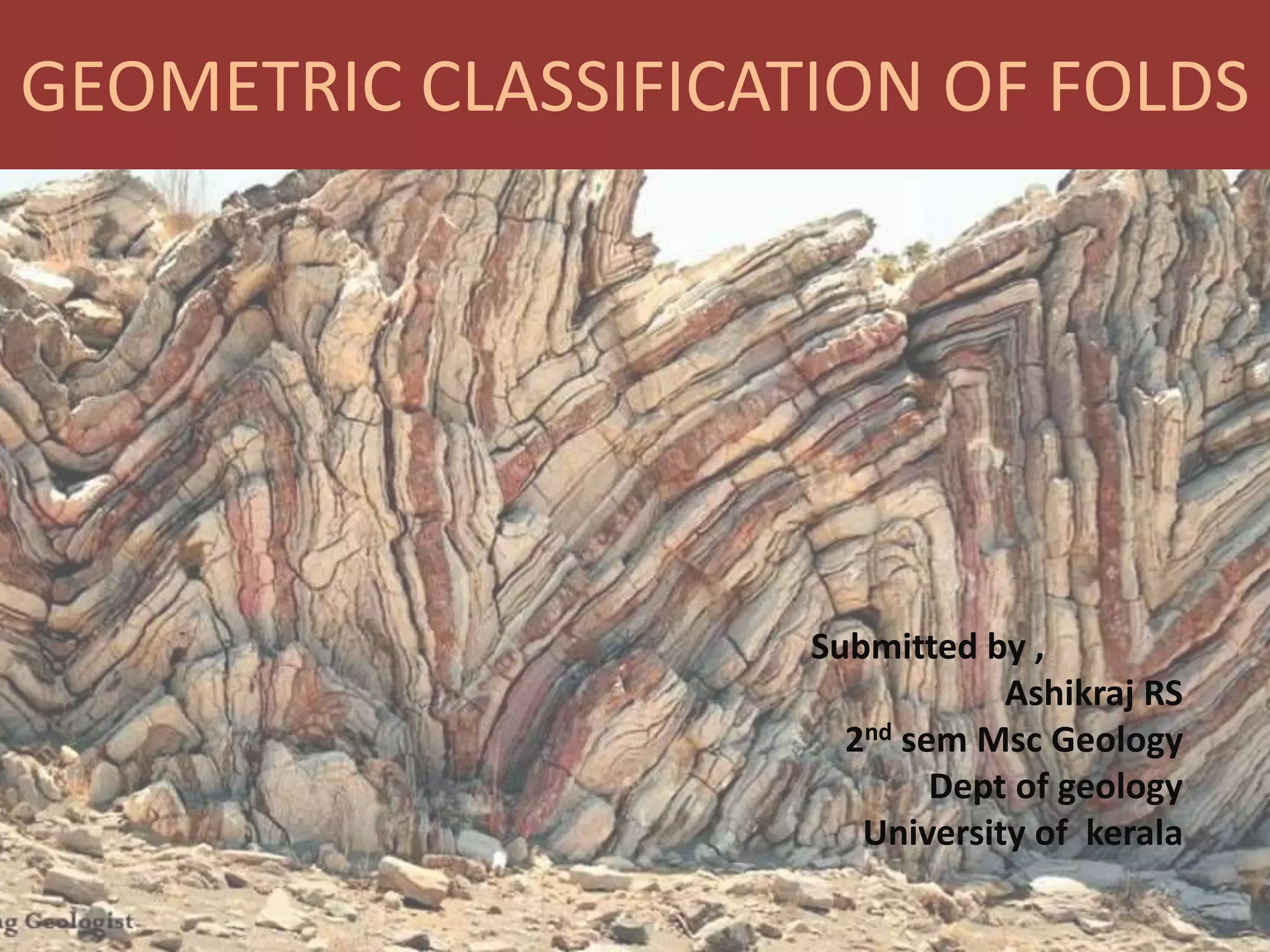
GEOMETRIC CLASSIFICATION OF FOLDS
Submitted by ,
Ashikraj RS
2nd sem Msc Geology
Dept of geology
University of kerala
FOLDS
• Folds are wave like structures that result from
deformation of bedding , foliation ,or other
originally planar surfaces in rocks .
• Such as sedimentary beds become bent or curved
as a result of plastic (i.e. permanent) and ductile
deformation .
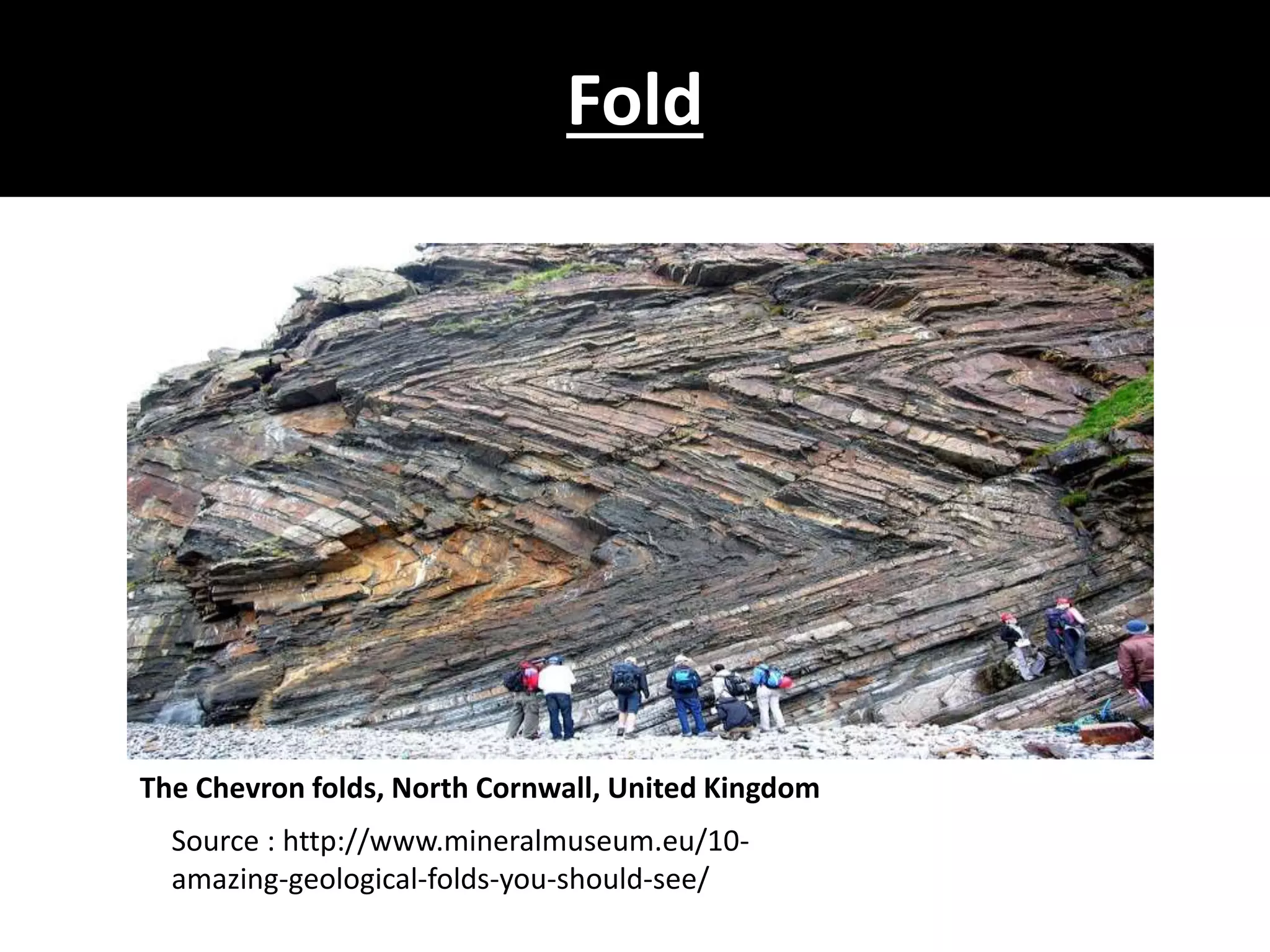
Fold
The Chevron folds, North Cornwall, United Kingdom
Source : http://www.mineralmuseum.eu/10-
amazing-geological-folds-you-should-see/
• Scale
– Microscopic
– Mesoscopic
– Megascopic
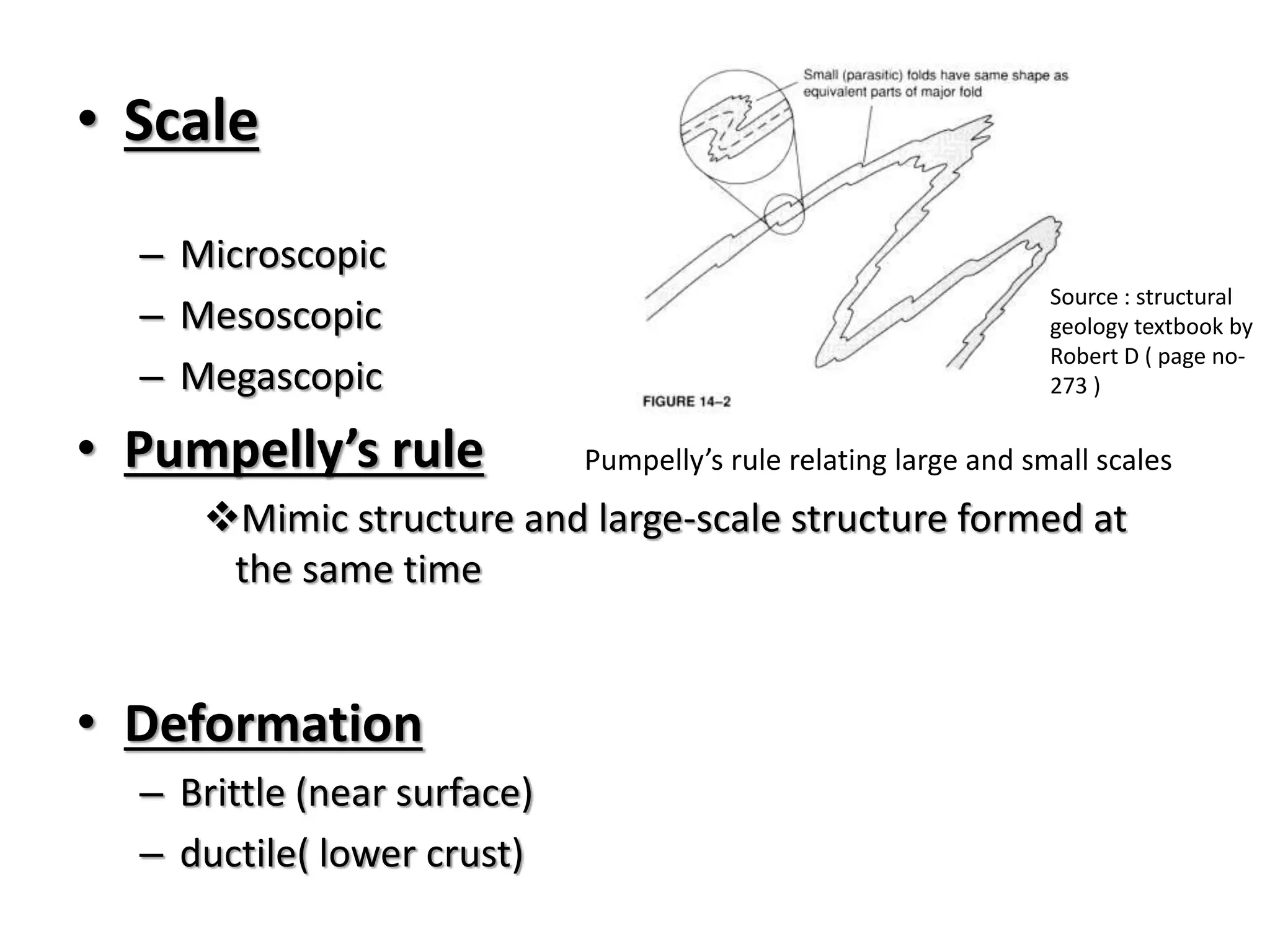
• Pumpelly’s rule
Mimic structure and large-scale structure formed at
the same time
• Deformation
– Brittle (near surface)
– ductile( lower crust)
Source : structural
geology textbook by
Robert D ( page no-
273 )
Pumpelly’s rule relating large and small scales
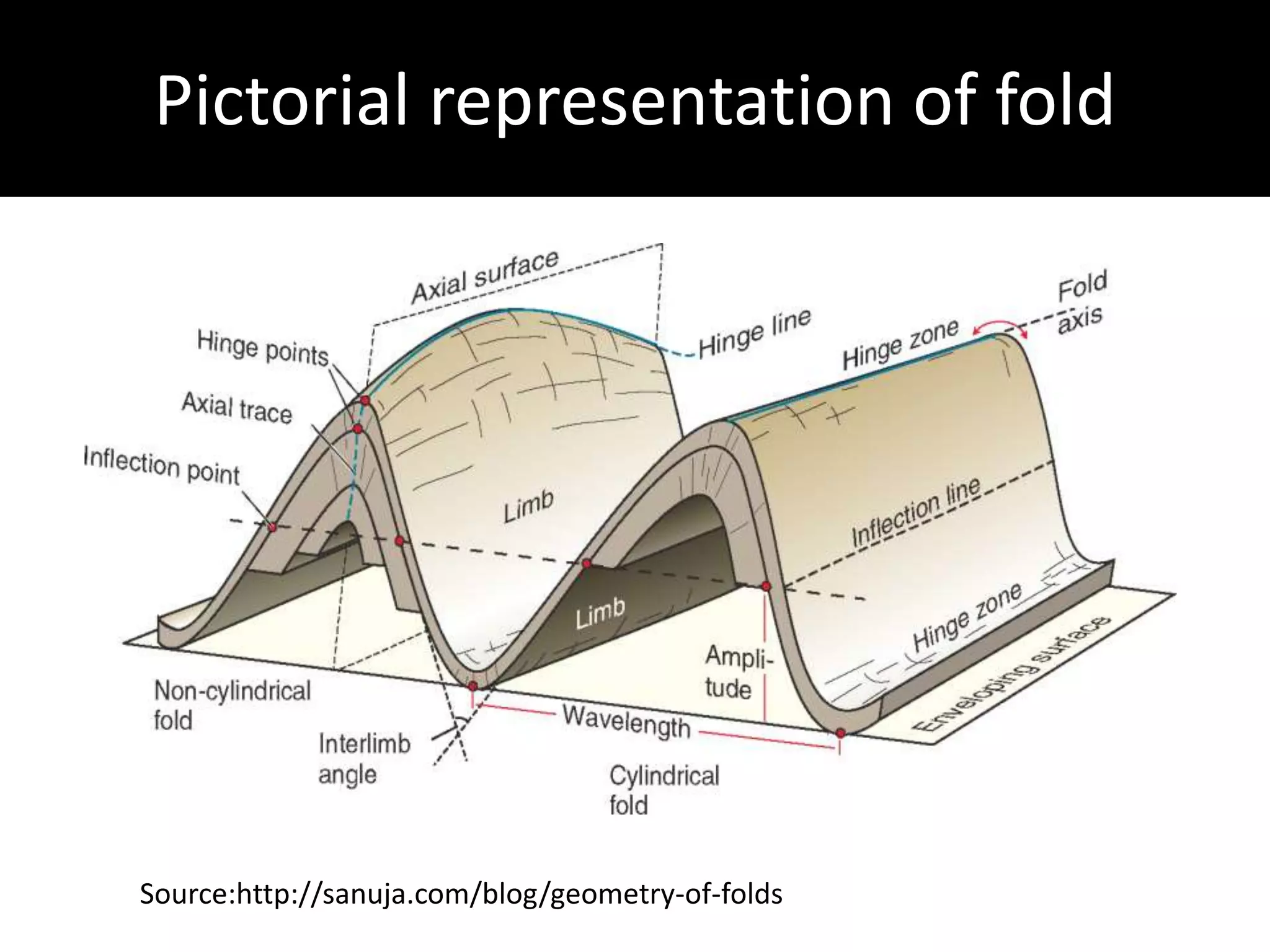
Pictorial representation of fold
Source:http://sanuja.com/blog/geometry-of-folds
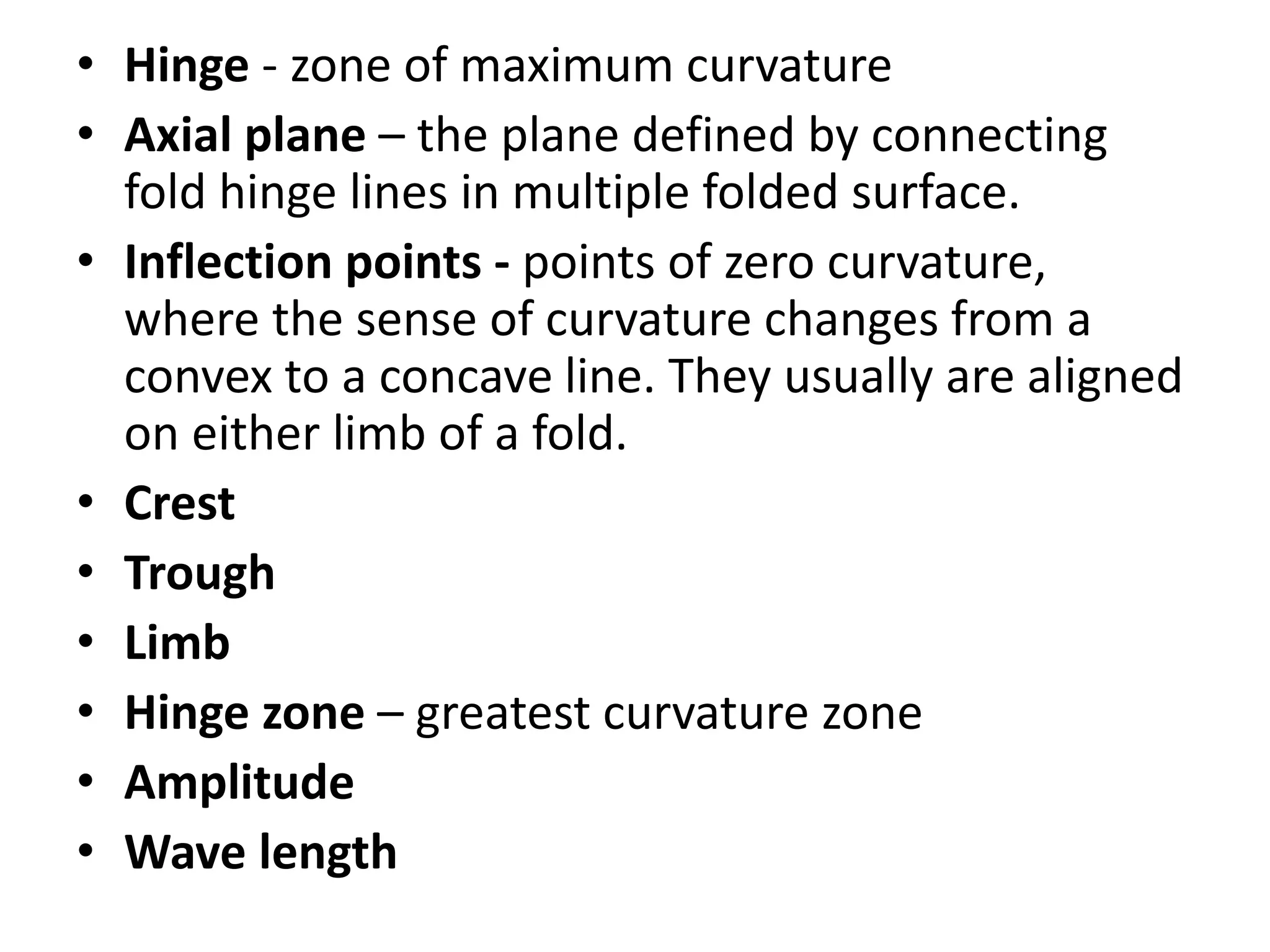
• Hinge - zone of maximum curvature
• Axial plane – the plane defined by connecting
fold hinge lines in multiple folded surface.
• Inflection points - points of zero curvature,
where the sense of curvature changes from a
convex to a concave line. They usually are aligned
on either limb of a fold.
• Crest
• Trough
• Limb
• Hinge zone – greatest curvature zone
• Amplitude
• Wave length
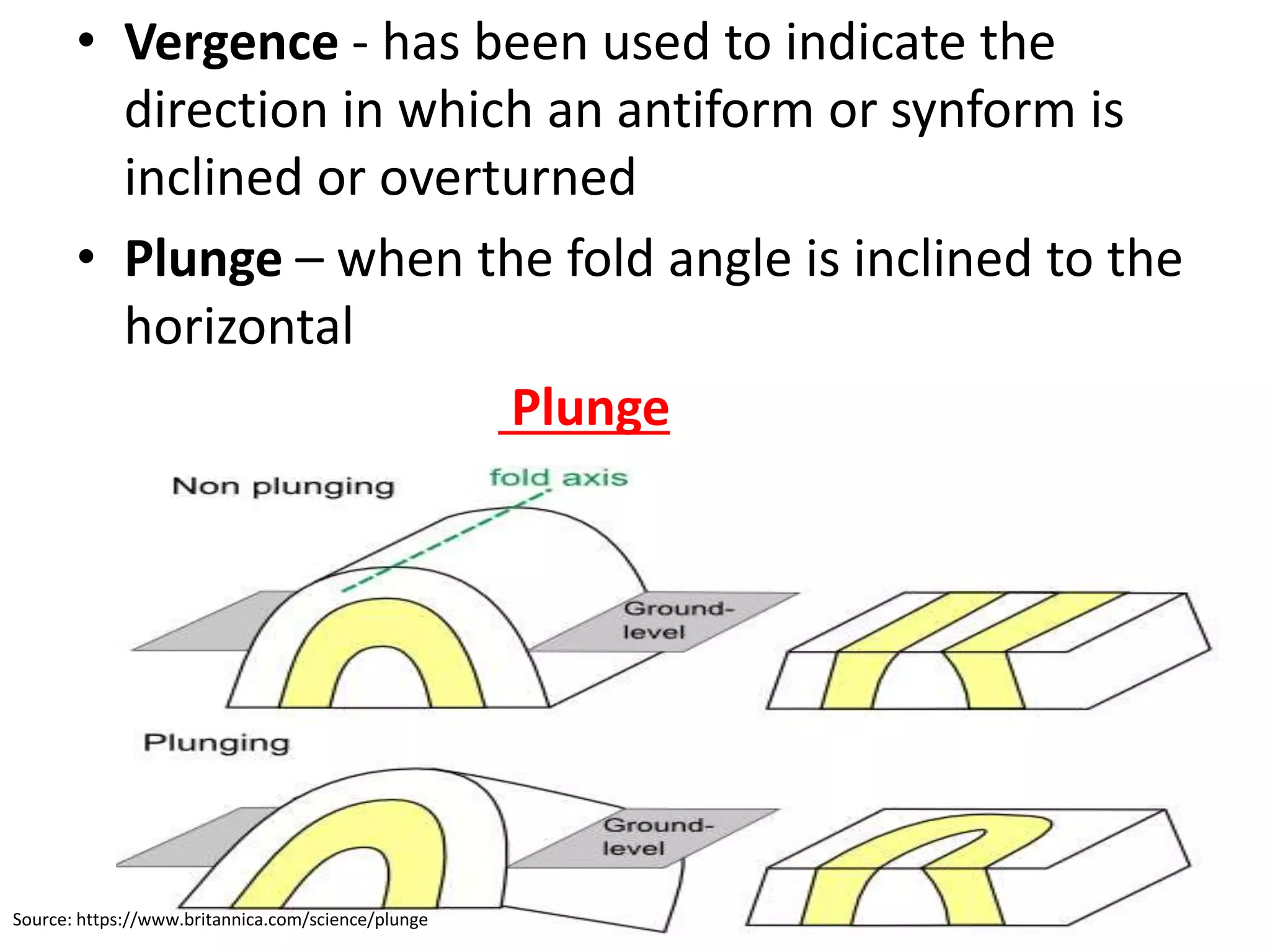
• Vergence - has been used to indicate the
direction in which an antiform or synform is
inclined or overturned
• Plunge – when the fold angle is inclined to the
horizontal
Plunge
Source: https://www.britannica.com/science/plunge
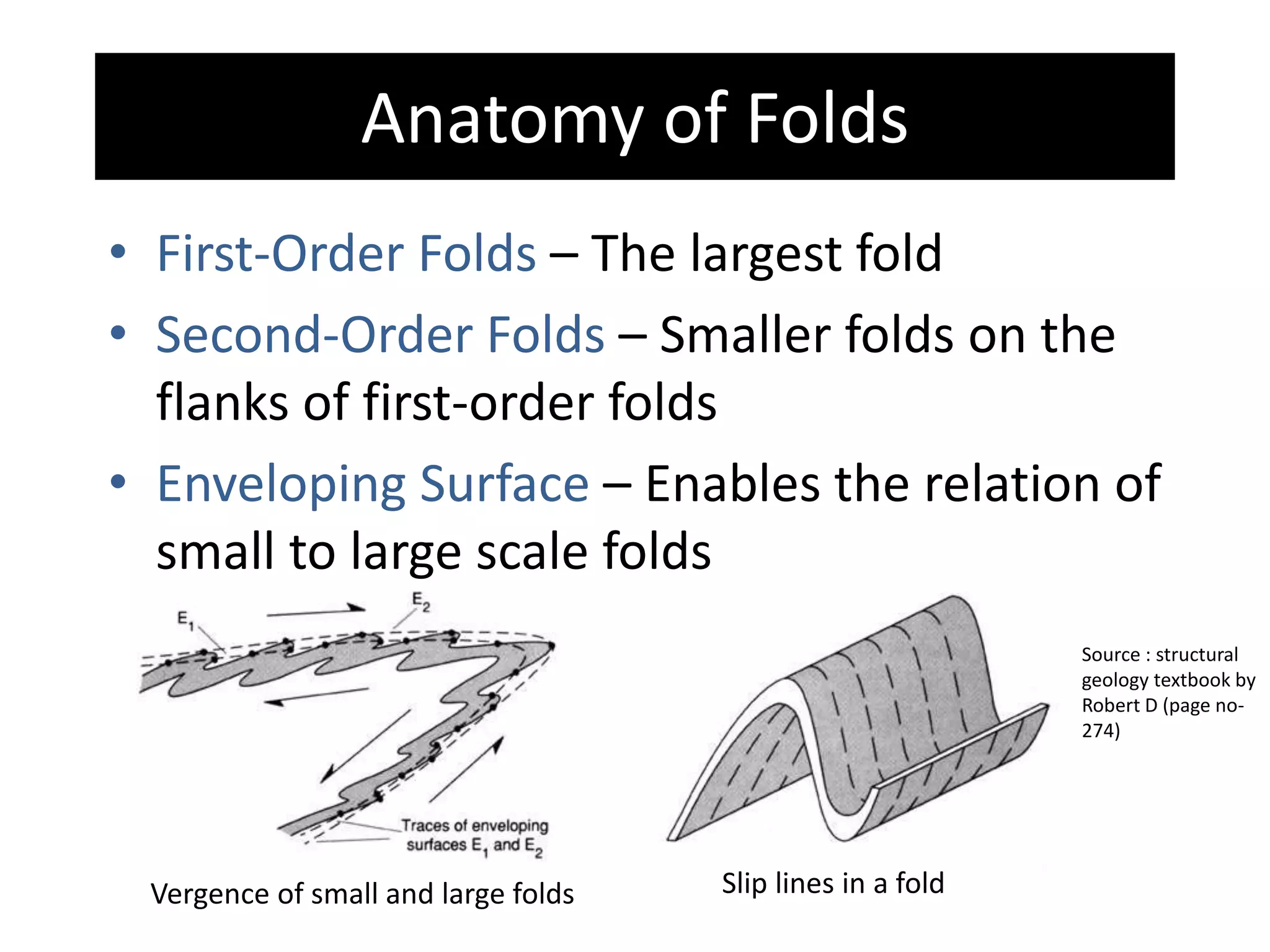
Anatomy of Folds
• First-Order Folds – The largest fold
• Second-Order Folds – Smaller folds on the
flanks of first-order folds
• Enveloping Surface – Enables the relation of
small to large scale folds
Source : structural
geology textbook by
Robert D (page no-
274)
Vergence of small and large folds Slip lines in a fold
GEOMETRIC CLASSIFICATION OF FOLD
Based on ……
1. Sense of curvature
2. Direction of younging relative to sense of fold closure
3. the symmetry of fold
4. the nature of hinge line
5. the plunge of fold axis
6. the inter limb angle
7. the thickness of the bed
8. the orientation of axial plane
9. the shape of hinge
10. Miscellaneous fold
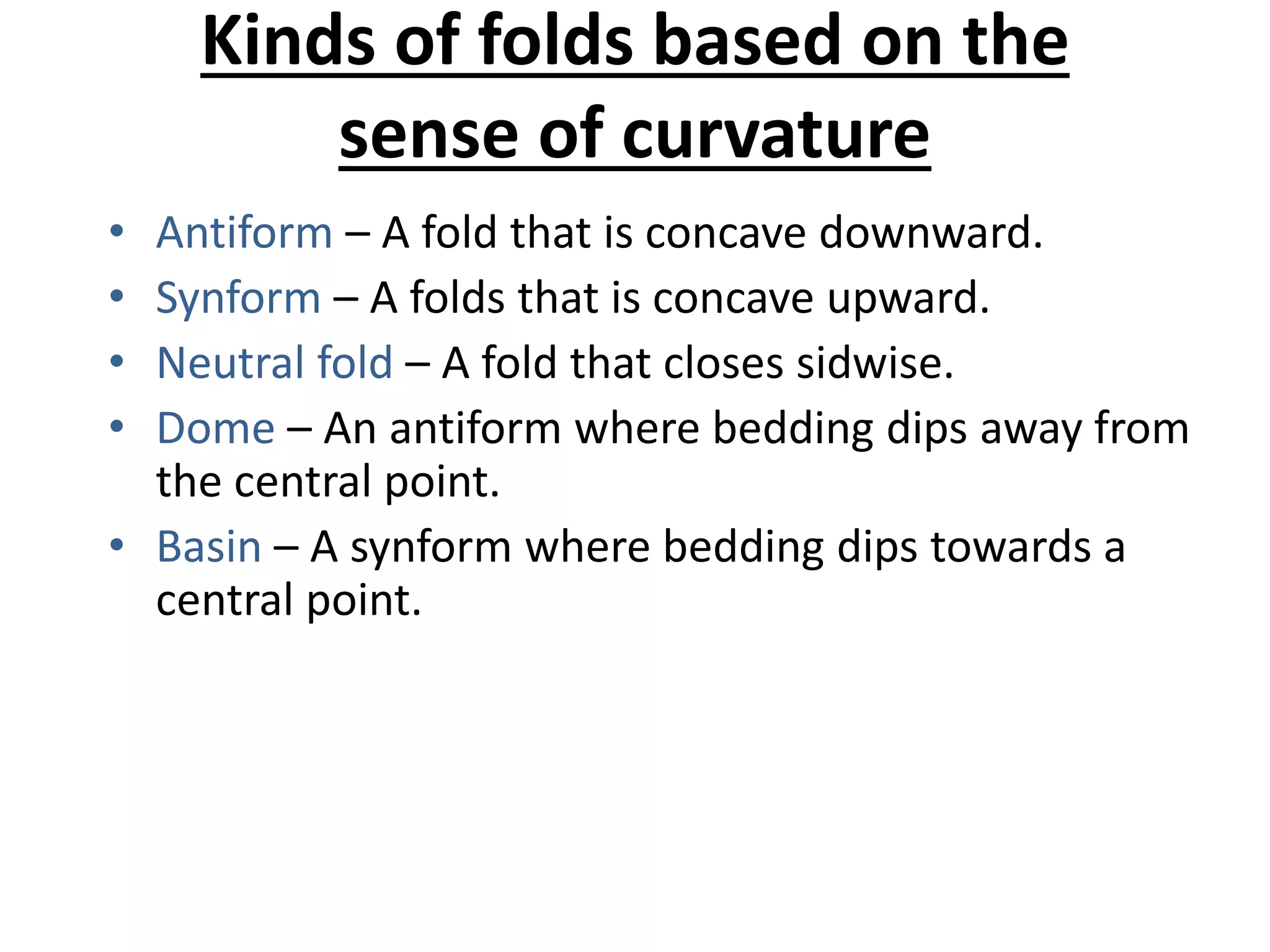
Kinds of folds based on the
sense of curvature
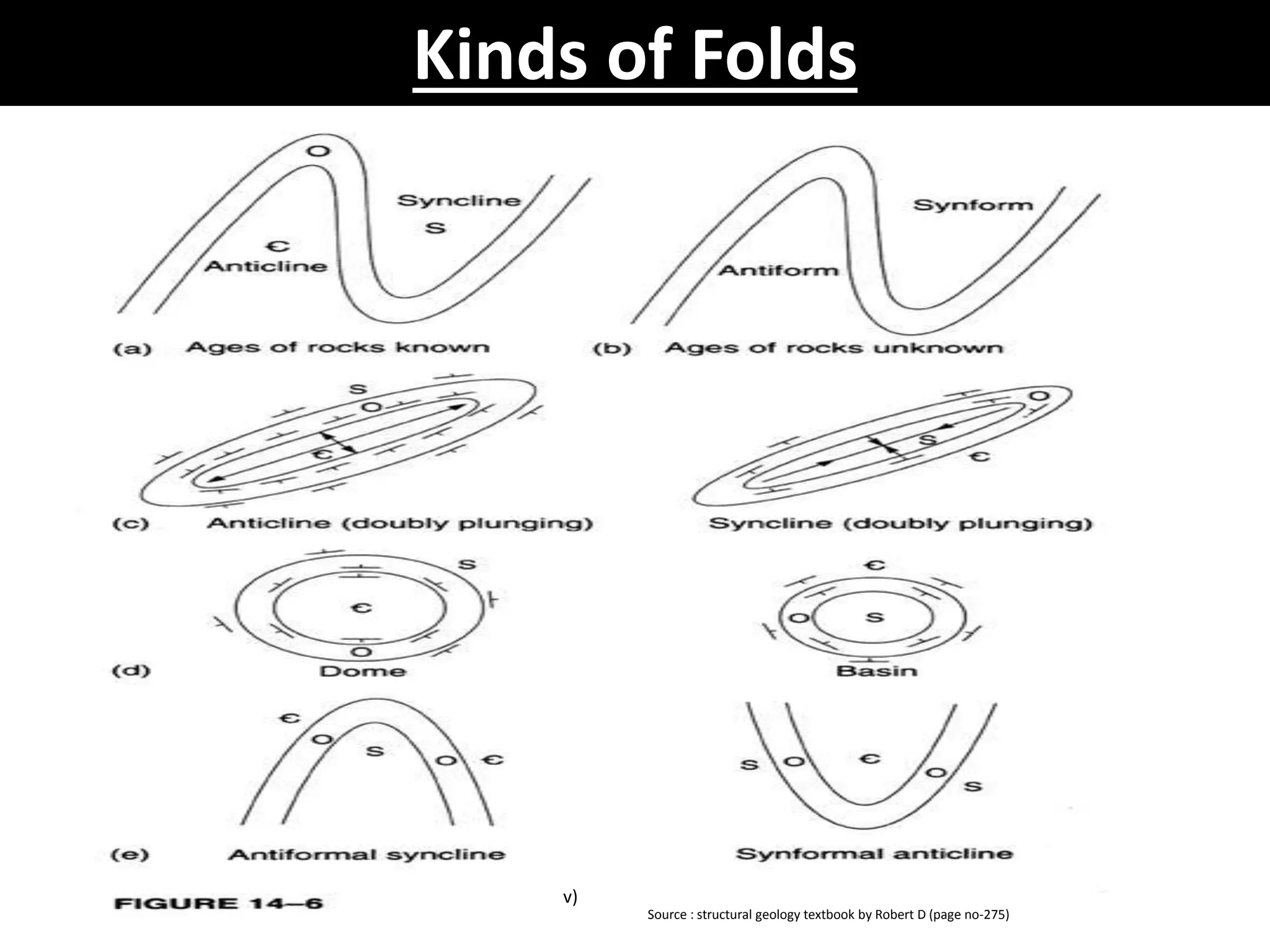
• Antiform – A fold that is concave downward.
• Synform – A folds that is concave upward.
• Neutral fold – A fold that closes sidwise.
• Dome – An antiform where bedding dips away from
the central point.
• Basin – A synform where bedding dips towards a
central point.
Kinds of Folds
v)
Source : structural geology textbook by Robert D (page no-275)
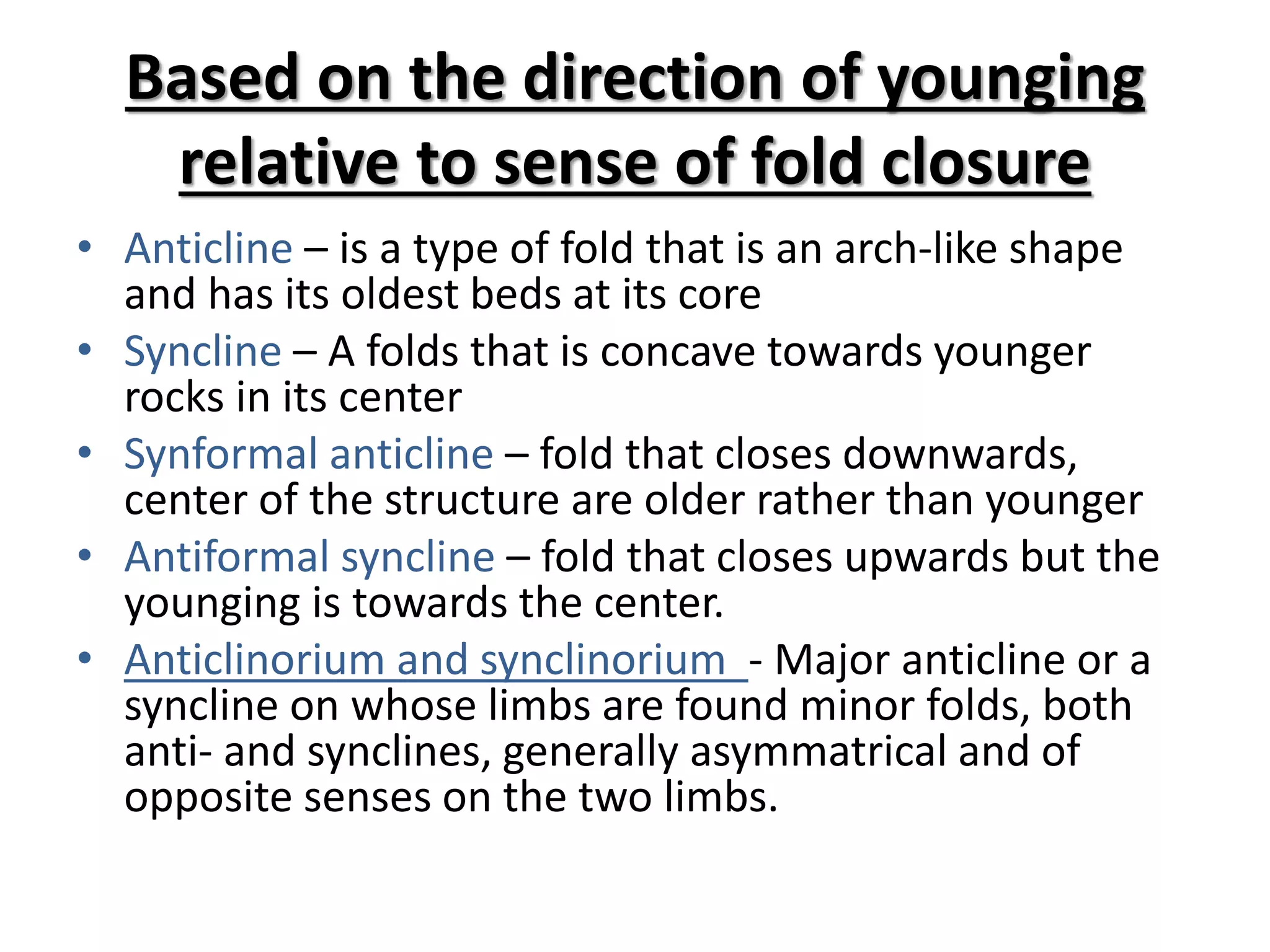
Based on the direction of younging
relative to sense of fold closure
• Anticline – is a type of fold that is an arch-like shape
and has its oldest beds at its core
• Syncline – A folds that is concave towards younger
rocks in its center
• Synformal anticline – fold that closes downwards,
center of the structure are older rather than younger
• Antiformal syncline – fold that closes upwards but the
younging is towards the center.
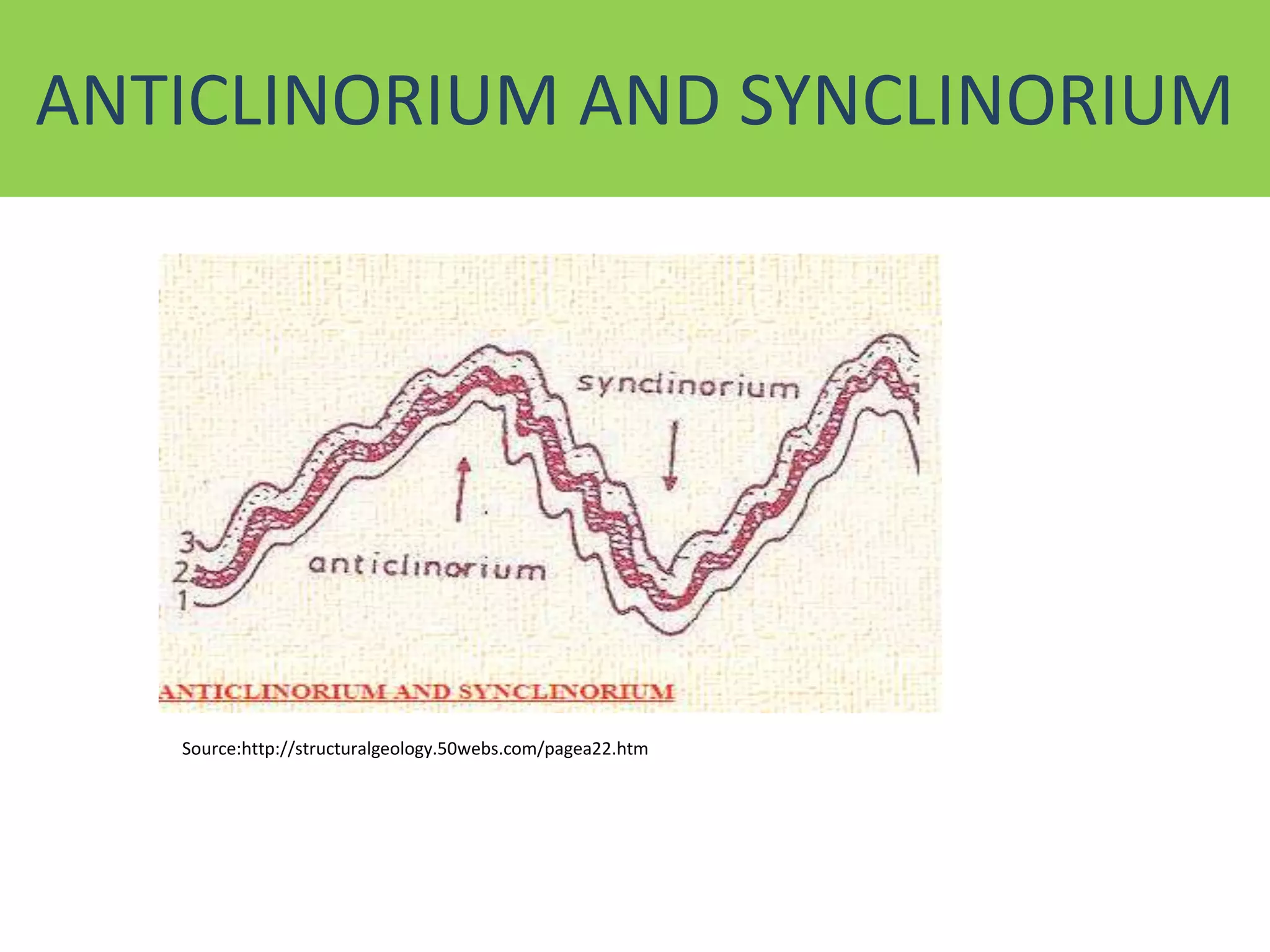
• Anticlinorium and synclinorium - Major anticline or a
syncline on whose limbs are found minor folds, both
anti- and synclines, generally asymmatrical and of
opposite senses on the two limbs.
ANTICLINORIUM AND SYNCLINORIUM
Source:http://structuralgeology.50webs.com/pagea22.htm
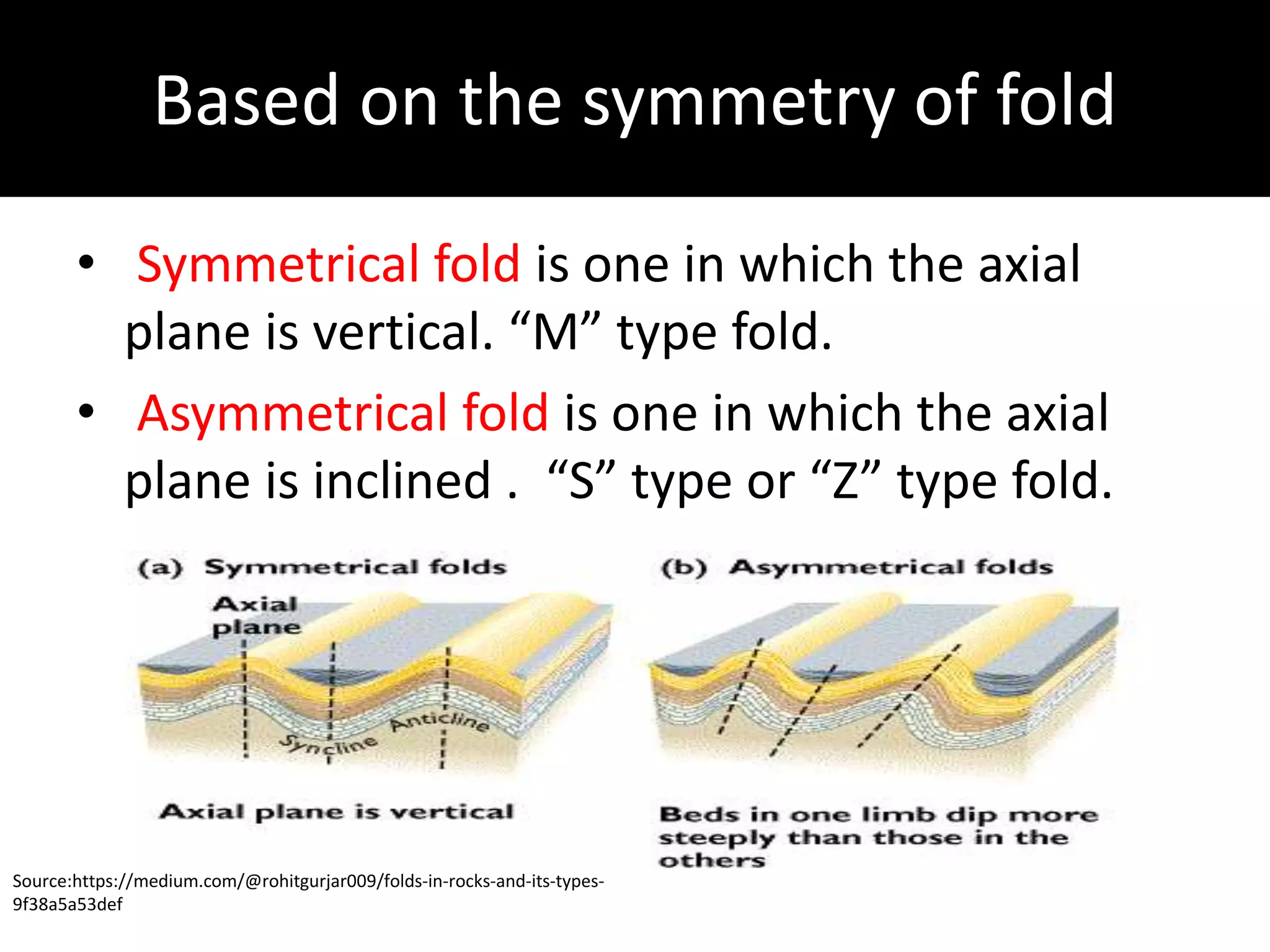
Based on the symmetry of fold
• Symmetrical fold is one in which the axial
plane is vertical. “M” type fold.
• Asymmetrical fold is one in which the axial
plane is inclined . “S” type or “Z” type fold.
Source:https://medium.com/@rohitgurjar009/folds-in-rocks-and-its-types-
9f38a5a53def
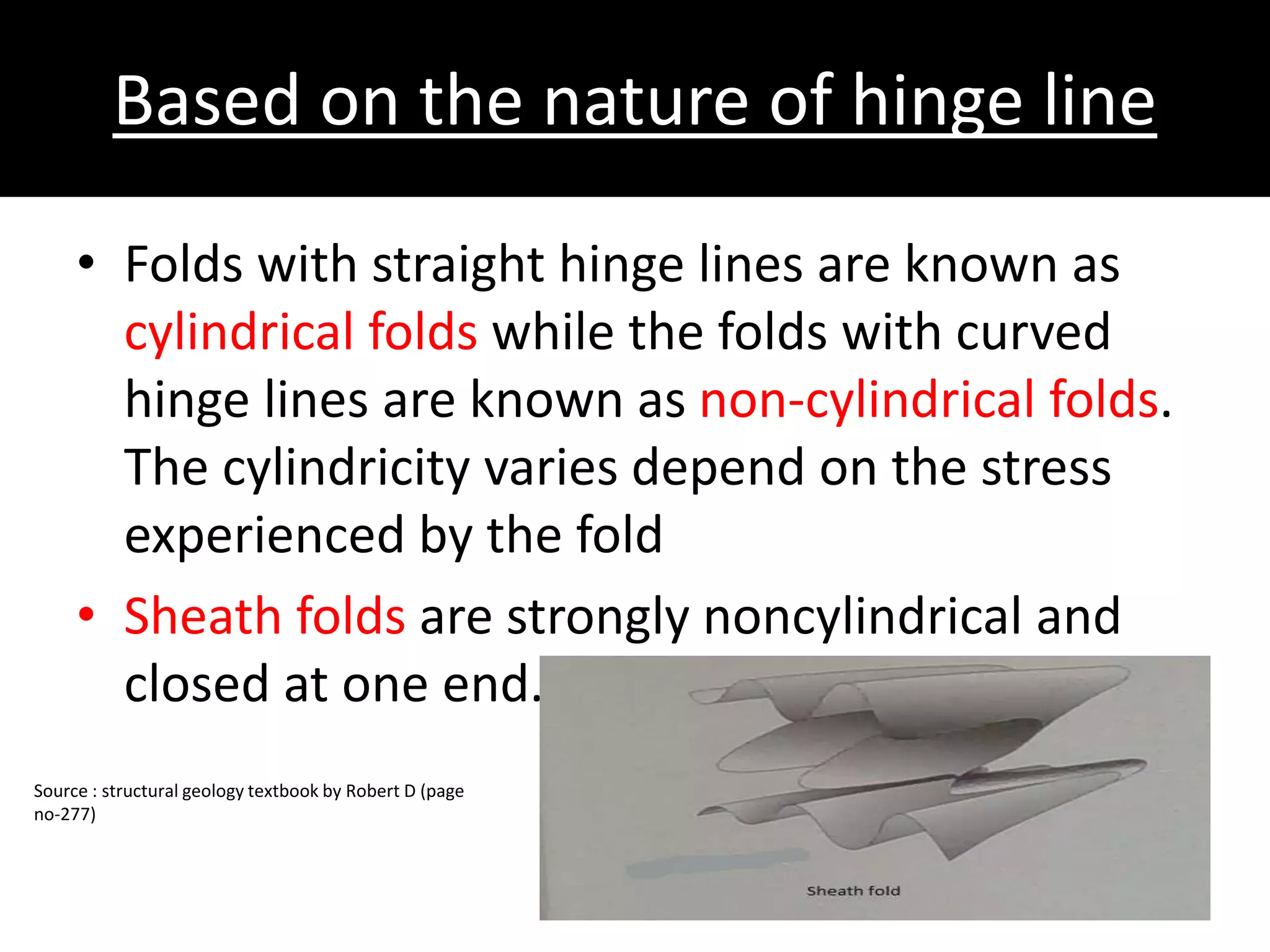
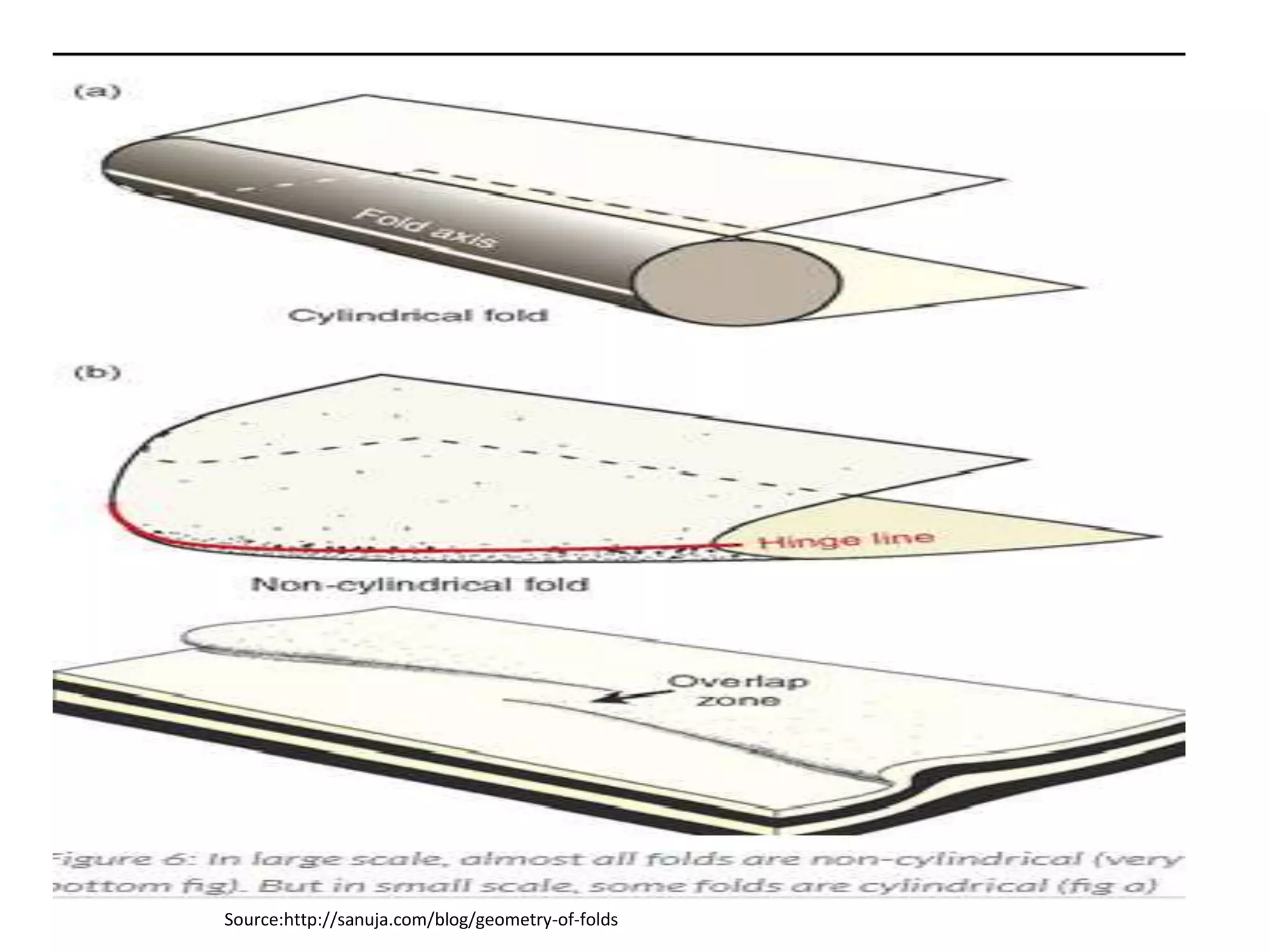
Based on the nature of hinge line
• Folds with straight hinge lines are known as
cylindrical folds while the folds with curved
hinge lines are known as non-cylindrical folds.
The cylindricity varies depend on the stress
experienced by the fold
• Sheath folds are strongly noncylindrical and
closed at one end.
Source : structural geology textbook by Robert D (page
no-277)
Source:http://sanuja.com/blog/geometry-of-folds
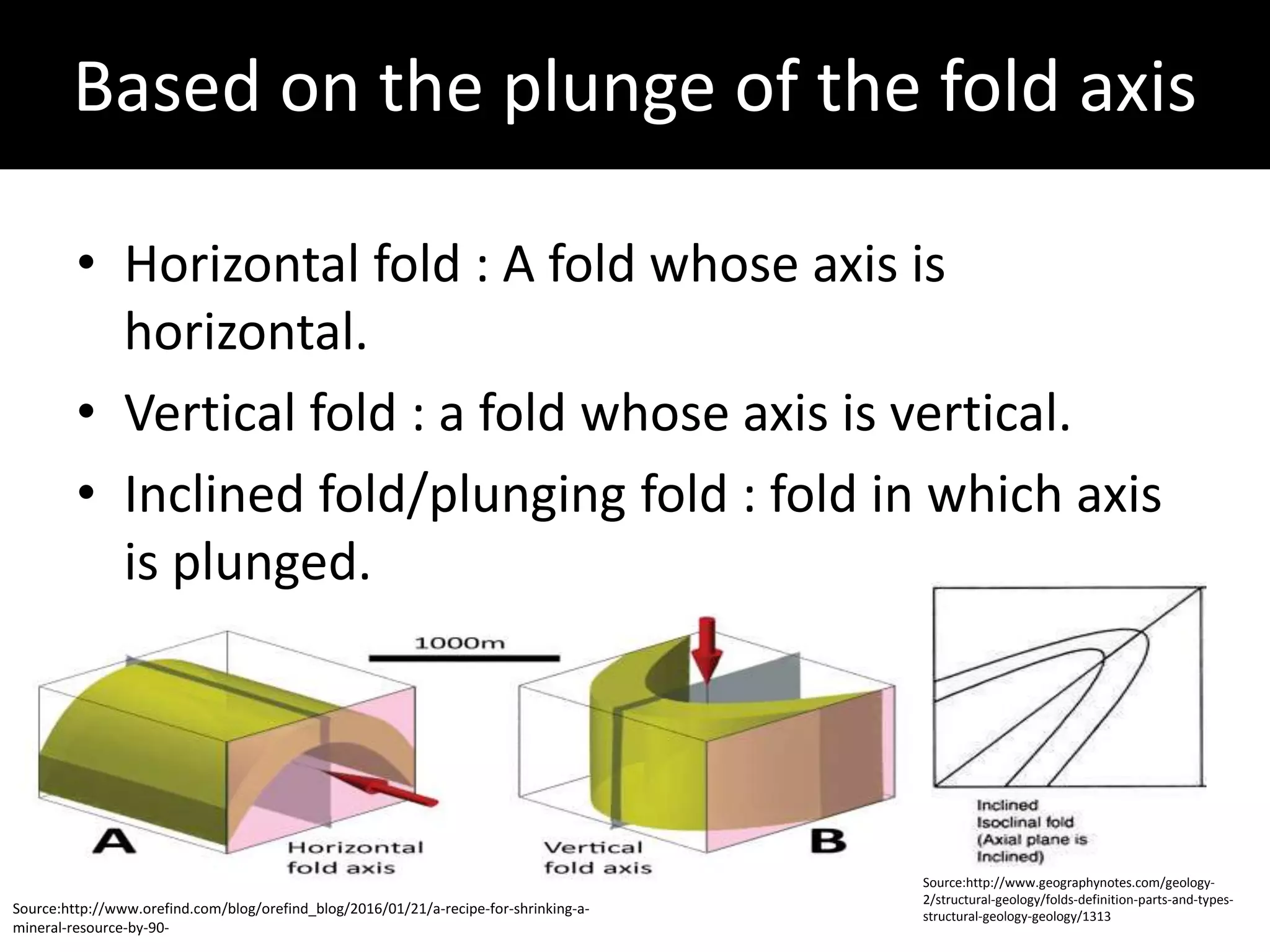
Based on the plunge of the fold axis
• Horizontal fold : A fold whose axis is
horizontal.
• Vertical fold : a fold whose axis is vertical.
• Inclined fold/plunging fold : fold in which axis
is plunged.
Source:http://www.orefind.com/blog/orefind_blog/2016/01/21/a-recipe-for-shrinking-a-
mineral-resource-by-90-
Source:http://www.geographynotes.com/geology-
2/structural-geology/folds-definition-parts-and-types-
structural-geology-geology/1313
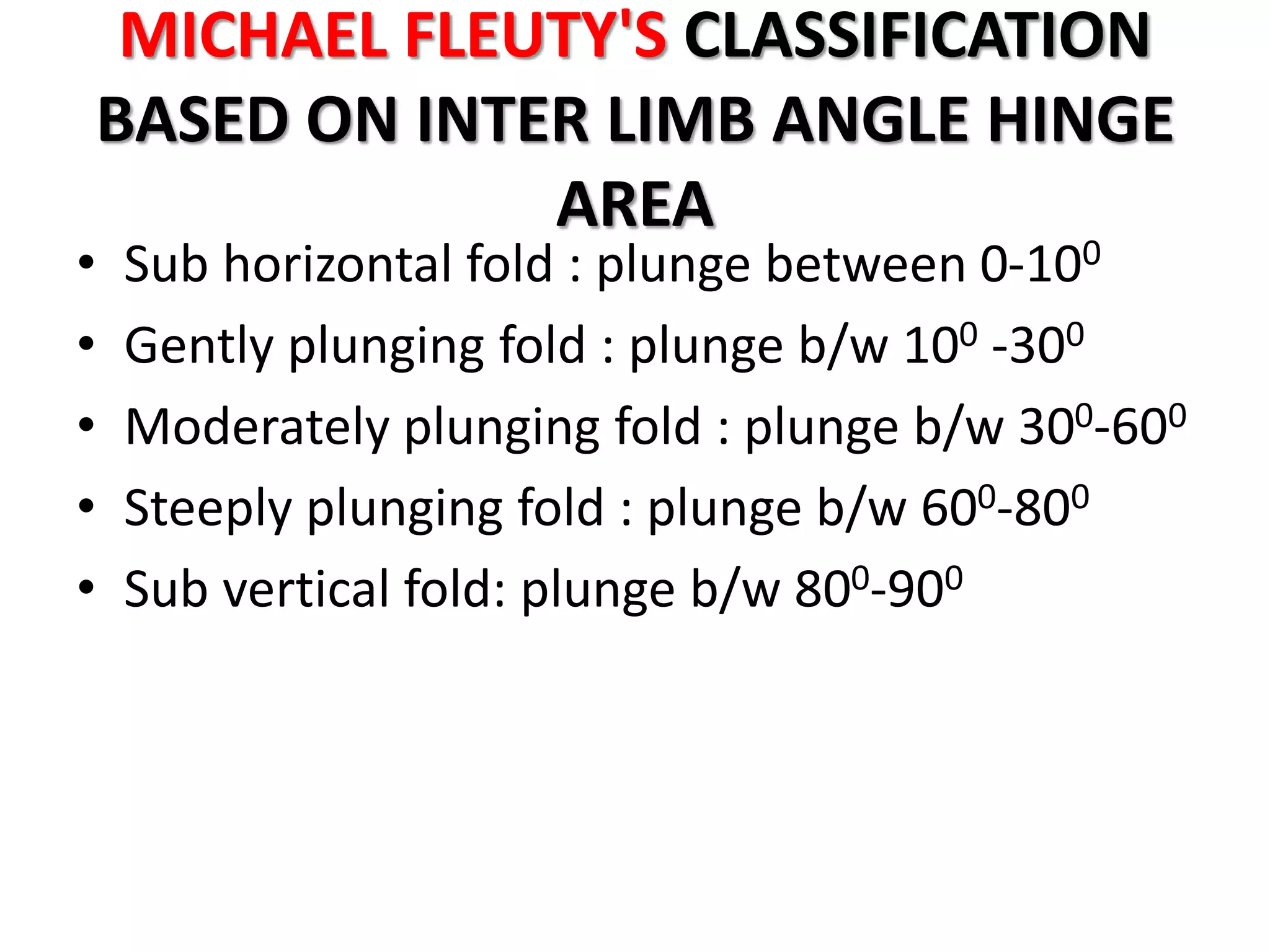
MICHAEL FLEUTY'S CLASSIFICATION
BASED ON INTER LIMB ANGLE HINGE
AREA
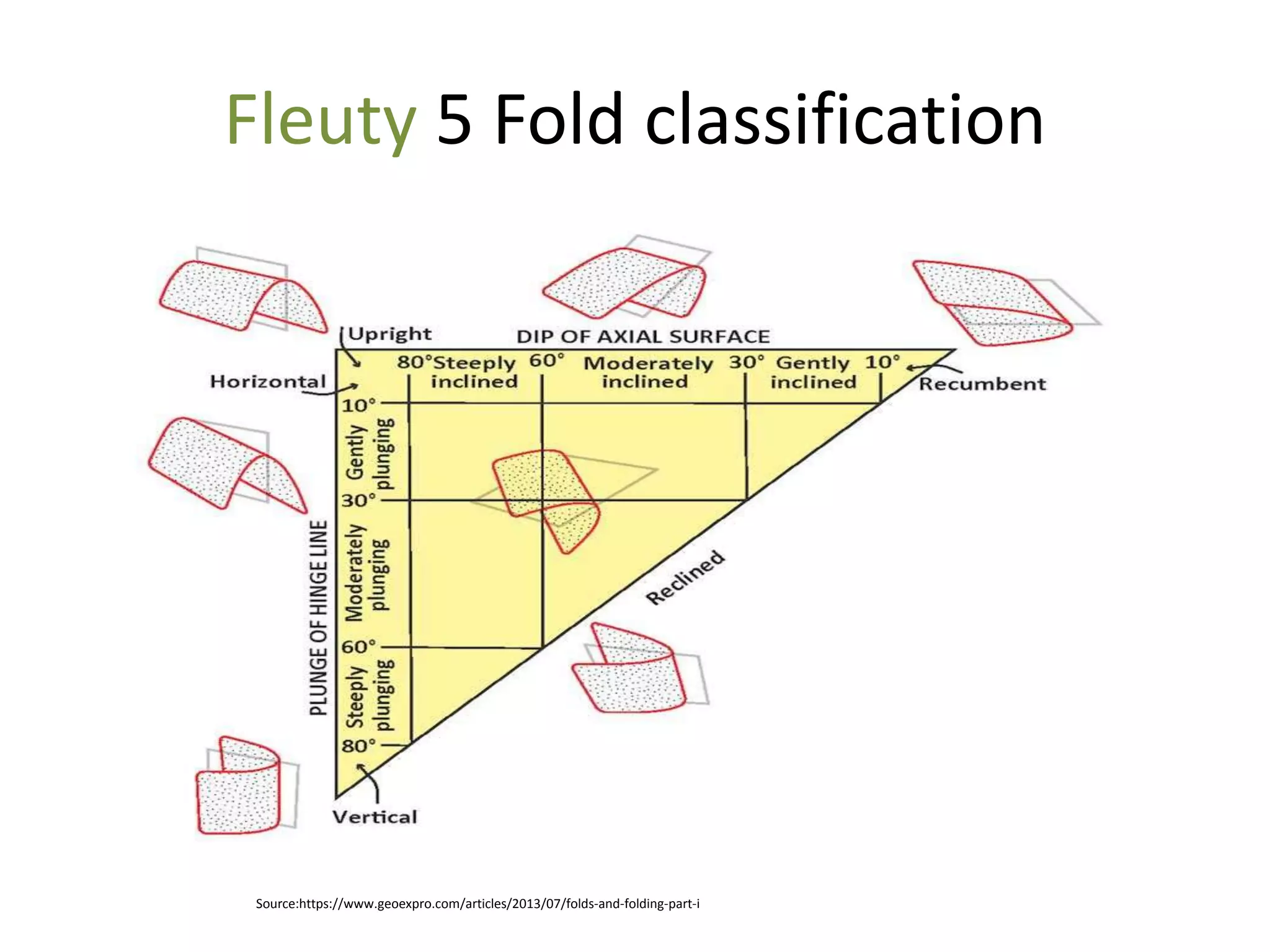
• Sub horizontal fold : plunge between 0-100
• Gently plunging fold : plunge b/w 100 -300
• Moderately plunging fold : plunge b/w 300-600
• Steeply plunging fold : plunge b/w 600-800
• Sub vertical fold: plunge b/w 800-900
Fleuty 5 Fold classification
Source:https://www.geoexpro.com/articles/2013/07/folds-and-folding-part-i
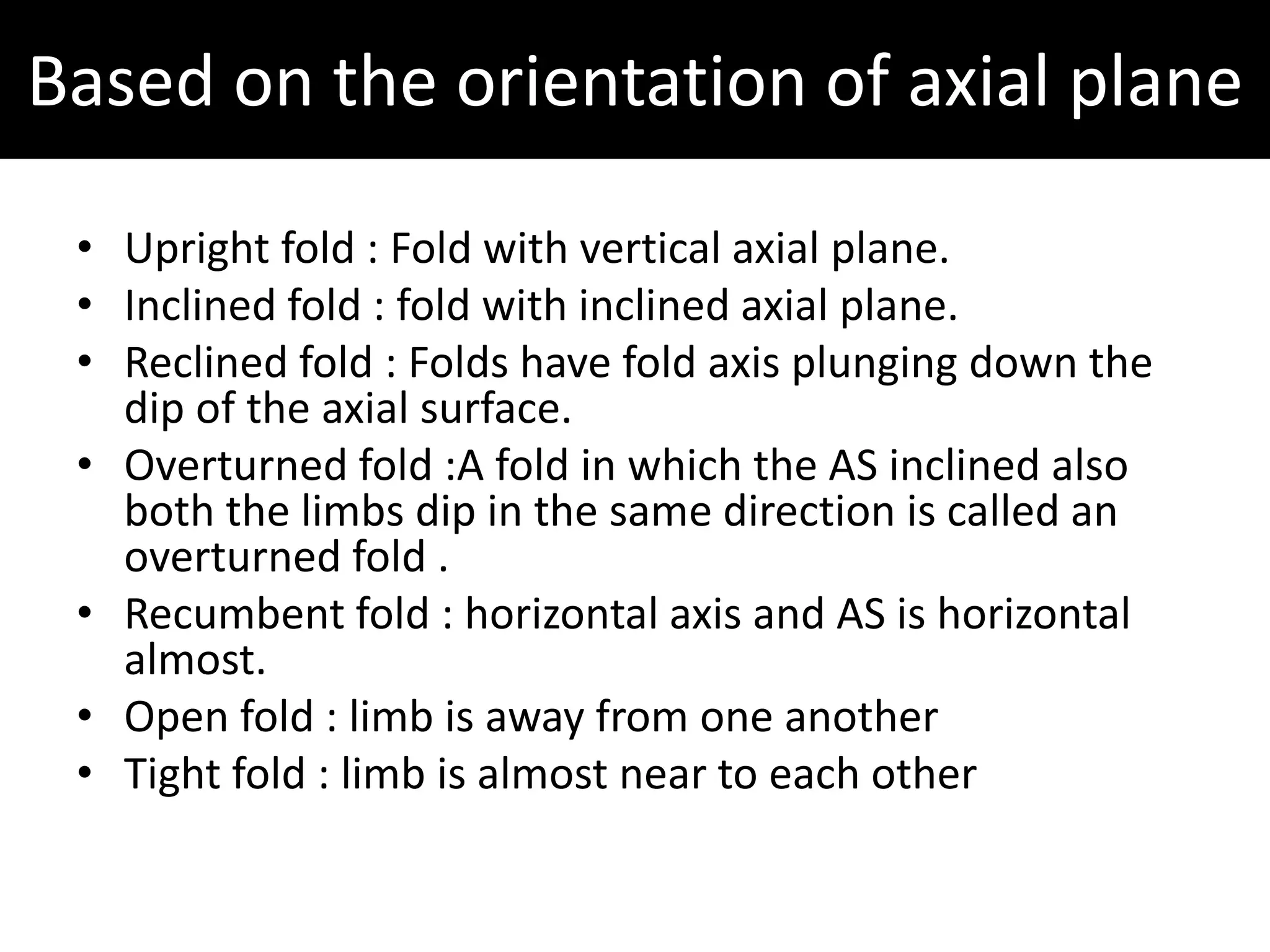
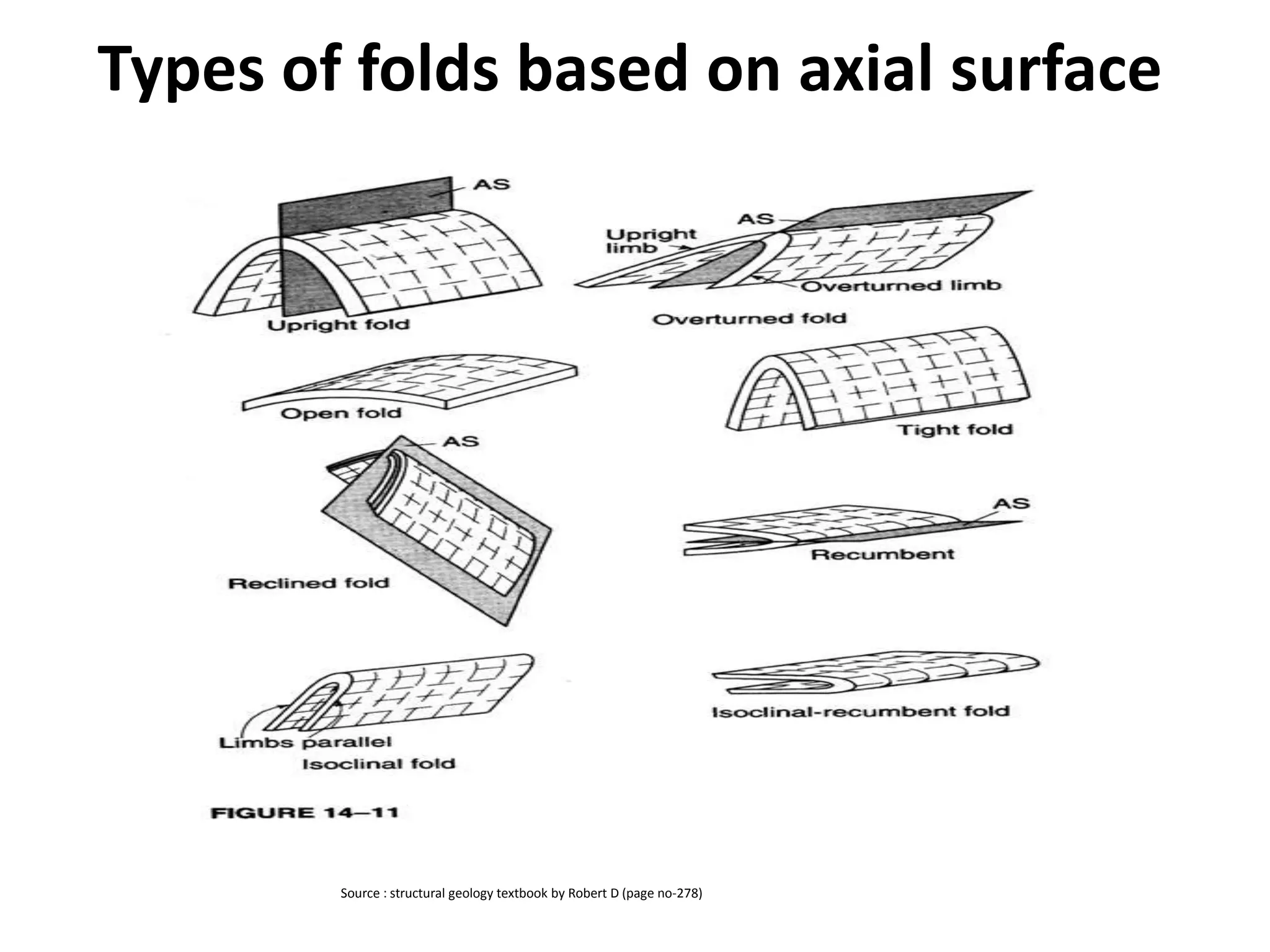
Based on the orientation of axial plane
• Upright fold : Fold with vertical axial plane.
• Inclined fold : fold with inclined axial plane.
• Reclined fold : Folds have fold axis plunging down the
dip of the axial surface.
• Overturned fold :A fold in which the AS inclined also
both the limbs dip in the same direction is called an
overturned fold .
• Recumbent fold : horizontal axis and AS is horizontal
almost.
• Open fold : limb is away from one another
• Tight fold : limb is almost near to each other
Types of folds based on axial surface
Source : structural geology textbook by Robert D (page no-278)
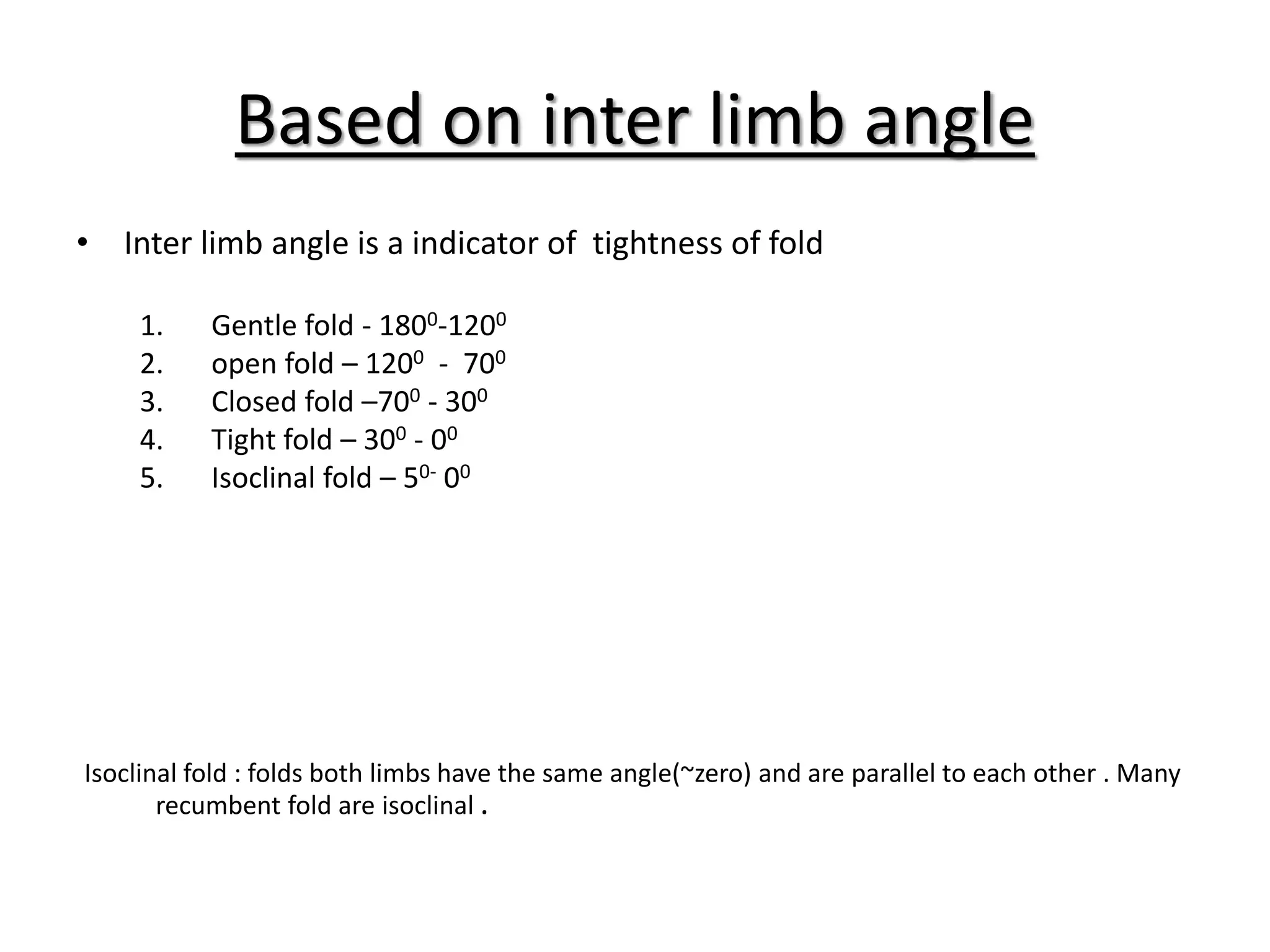
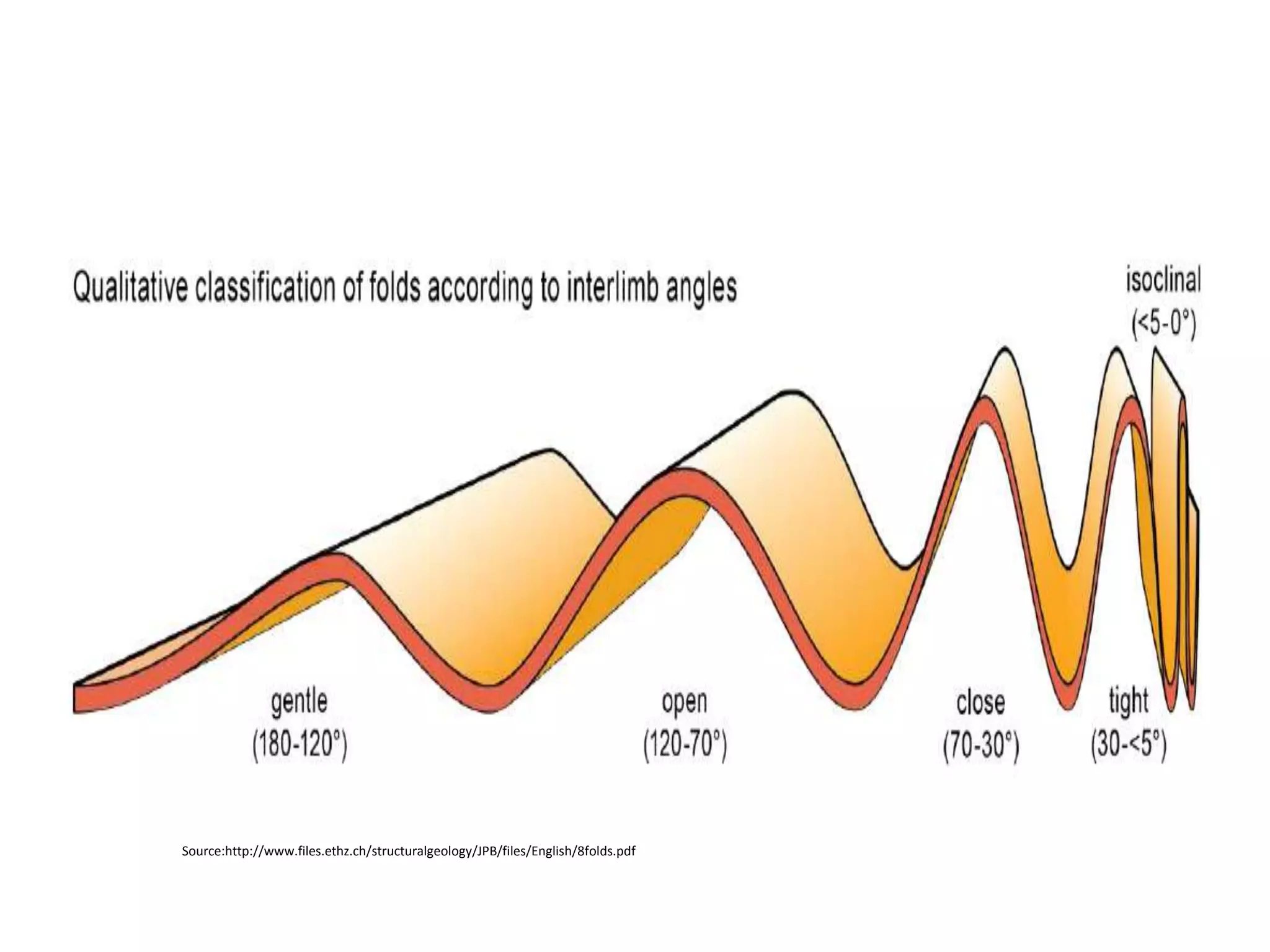
Based on inter limb angle
• Inter limb angle is a indicator of tightness of fold
1. Gentle fold - 1800-1200
2. open fold – 1200 - 700
3. Closed fold –700 - 300
4. Tight fold – 300 - 00
5. Isoclinal fold – 50- 00
Isoclinal fold : folds both limbs have the same angle(~zero) and are parallel to each other . Many
recumbent fold are isoclinal .
Source:http://www.files.ethz.ch/structuralgeology/JPB/files/English/8folds.pdf
Based on the thickness of bed
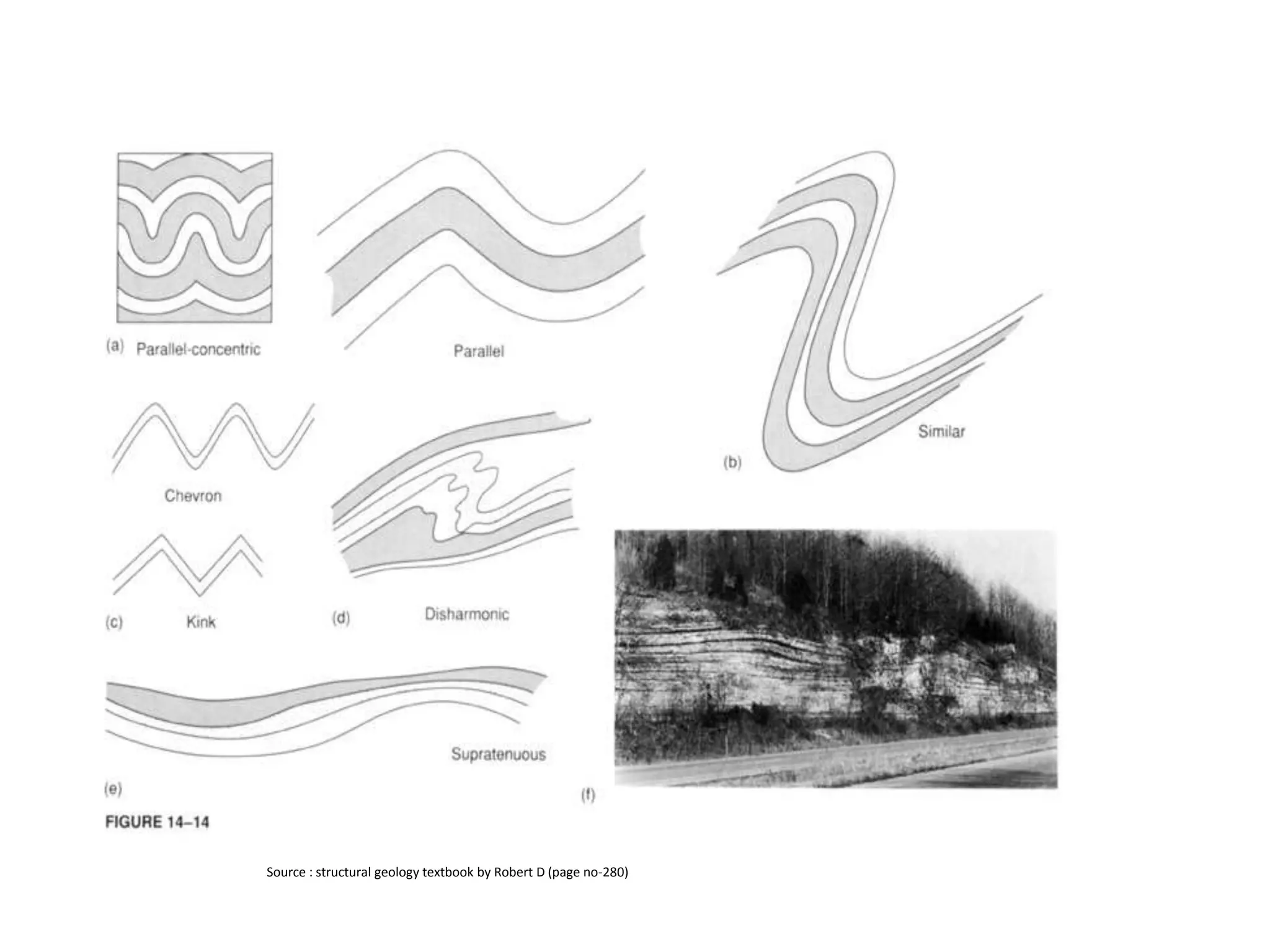
• Parallel Folds – Maintain constant layer
thickness
• Concentric Folds – Parallel folds in which the
folded surfaces define circular arcs
• Ptygmatic Folds – Have a lobate shape and
look like intestines
• Similar Folds – Maintain their shape
throughout the section and do not die out
vertically
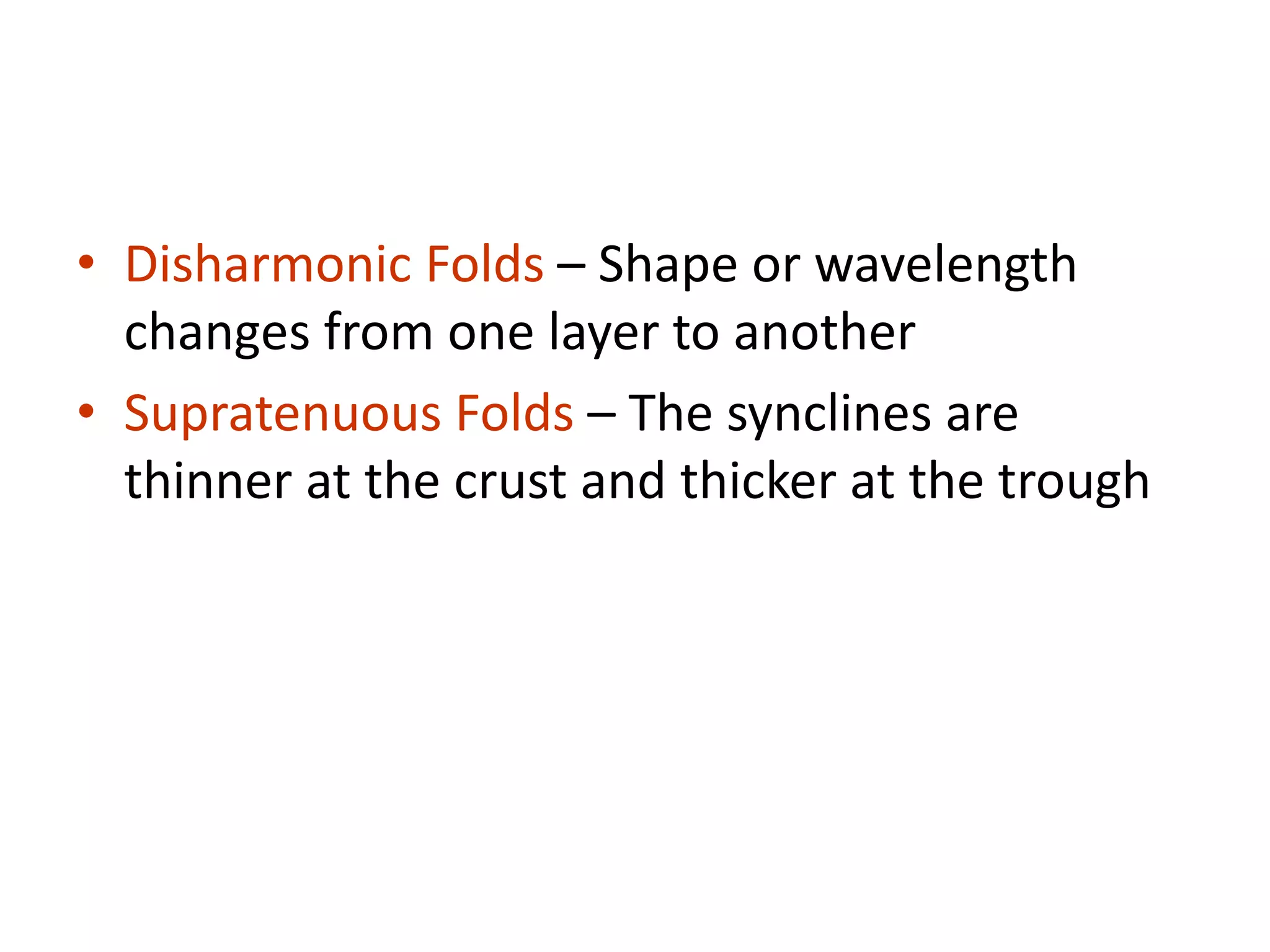
• Disharmonic Folds – Shape or wavelength
changes from one layer to another
• Supratenuous Folds – The synclines are
thinner at the crust and thicker at the trough
Source : structural geology textbook by Robert D (page no-280)
Based on the shape of the hinge
• Round Hinged / broad hinge fold : A fold with
broad hinge zone compared to limb
• Chevron and Kink Folds – Have straight limbs
and sharp angular hinges
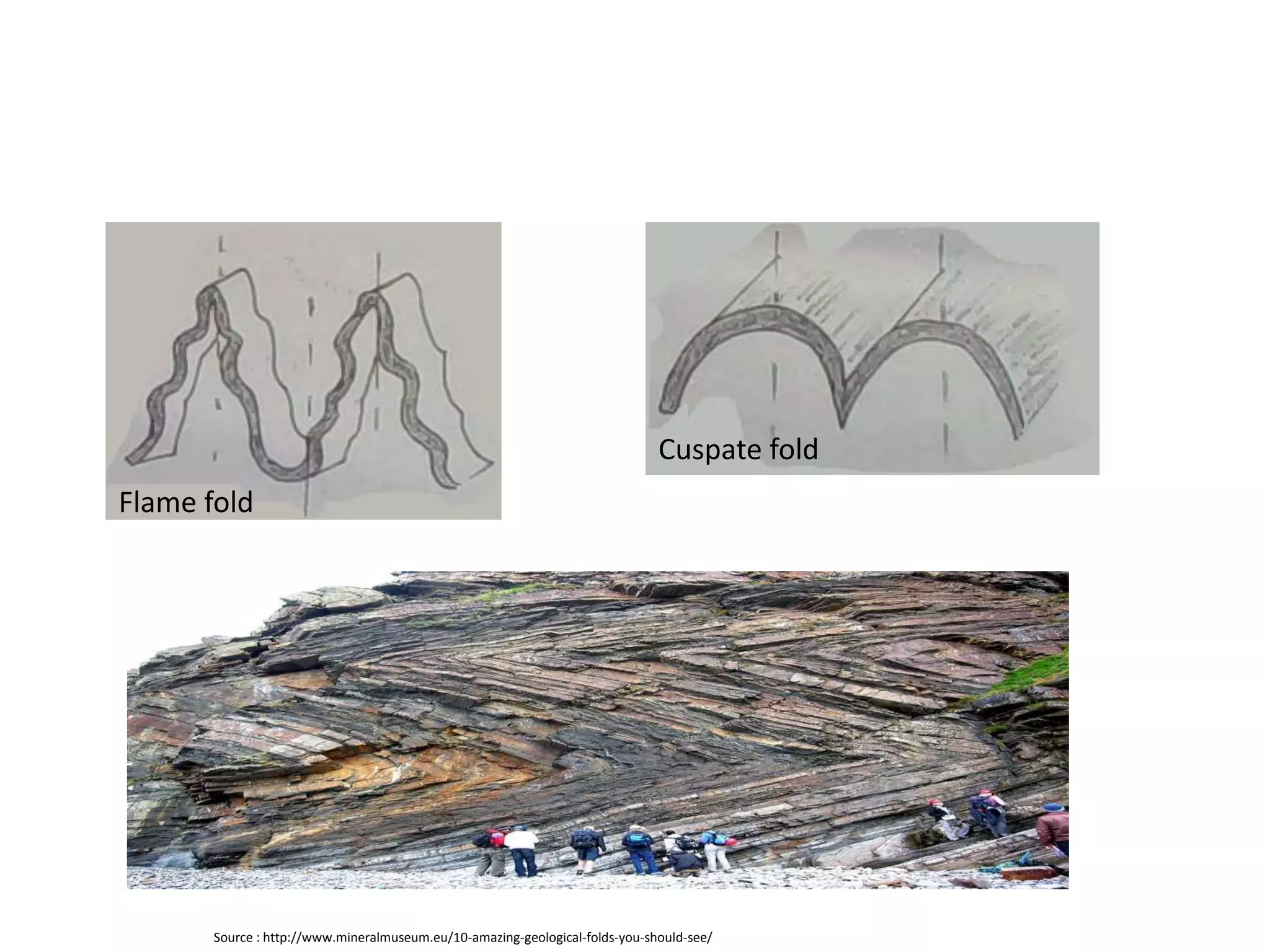
• Arrowhead Fold- A fold with a sharp hinge and
distinctly curved limbs (flame fold)
• Cuspate fold : sharp hinge on one closure and
rounded closure on oppositivelly directed
closure
Source : http://www.mineralmuseum.eu/10-amazing-geological-folds-you-should-see/
Flame fold
Cuspate fold
Based on the number of Hinge
• Single hinge fold
• Multiple hinged fold
Based on the geometrical relation
among neighbouring structure
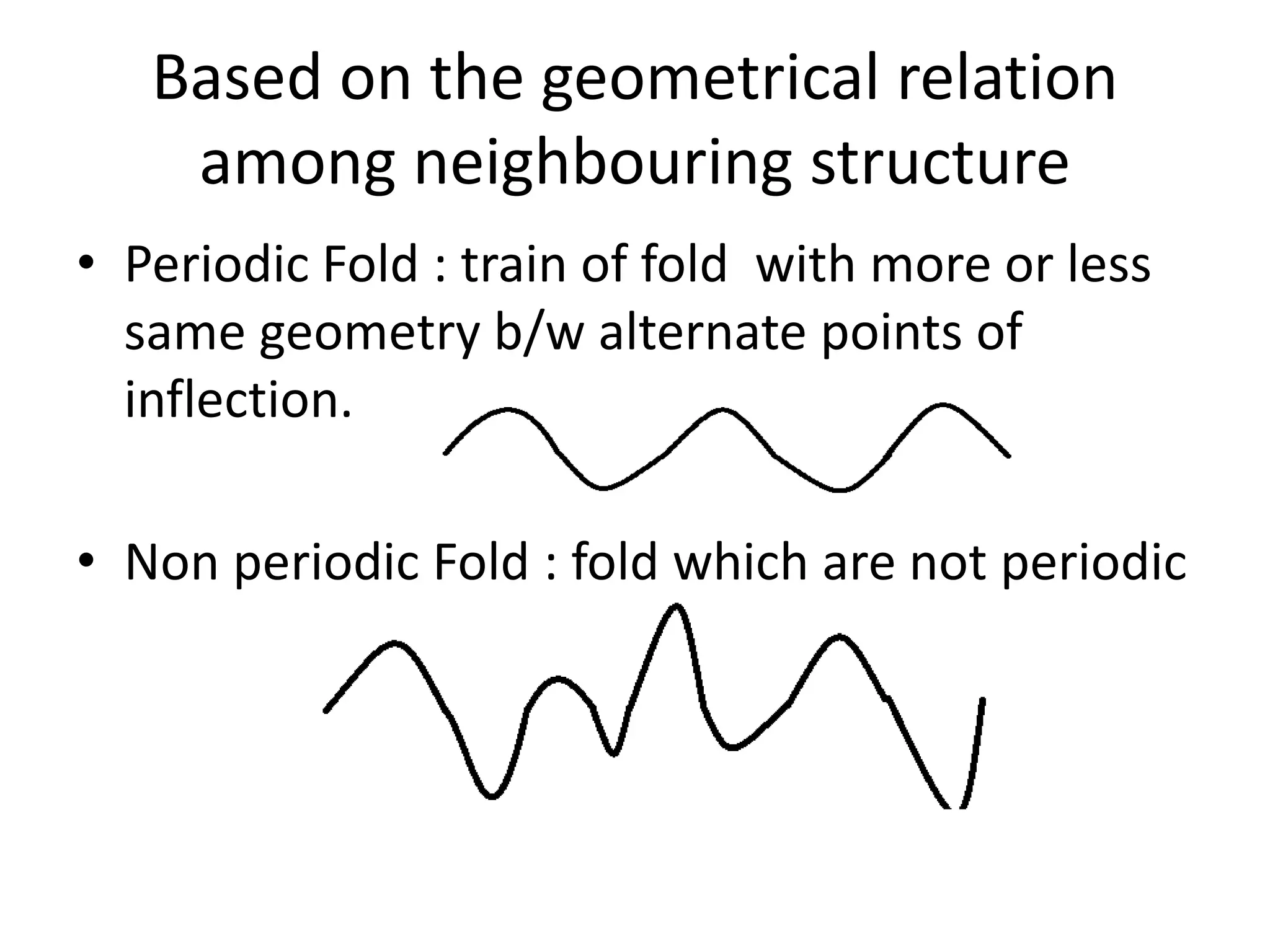
• Periodic Fold : train of fold with more or less
same geometry b/w alternate points of
inflection.
• Non periodic Fold : fold which are not periodic
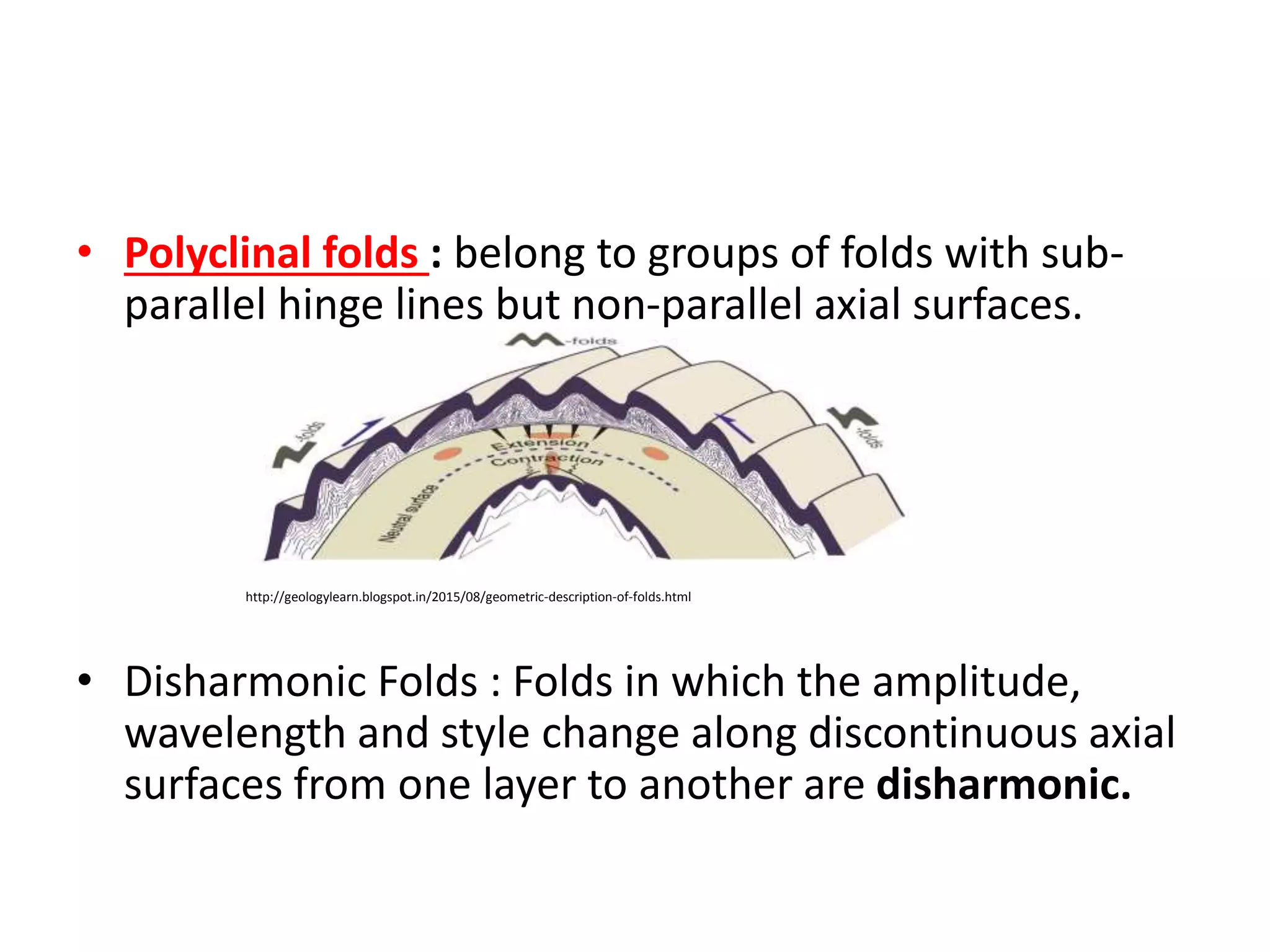
• Polyclinal folds : belong to groups of folds with sub-
parallel hinge lines but non-parallel axial surfaces.
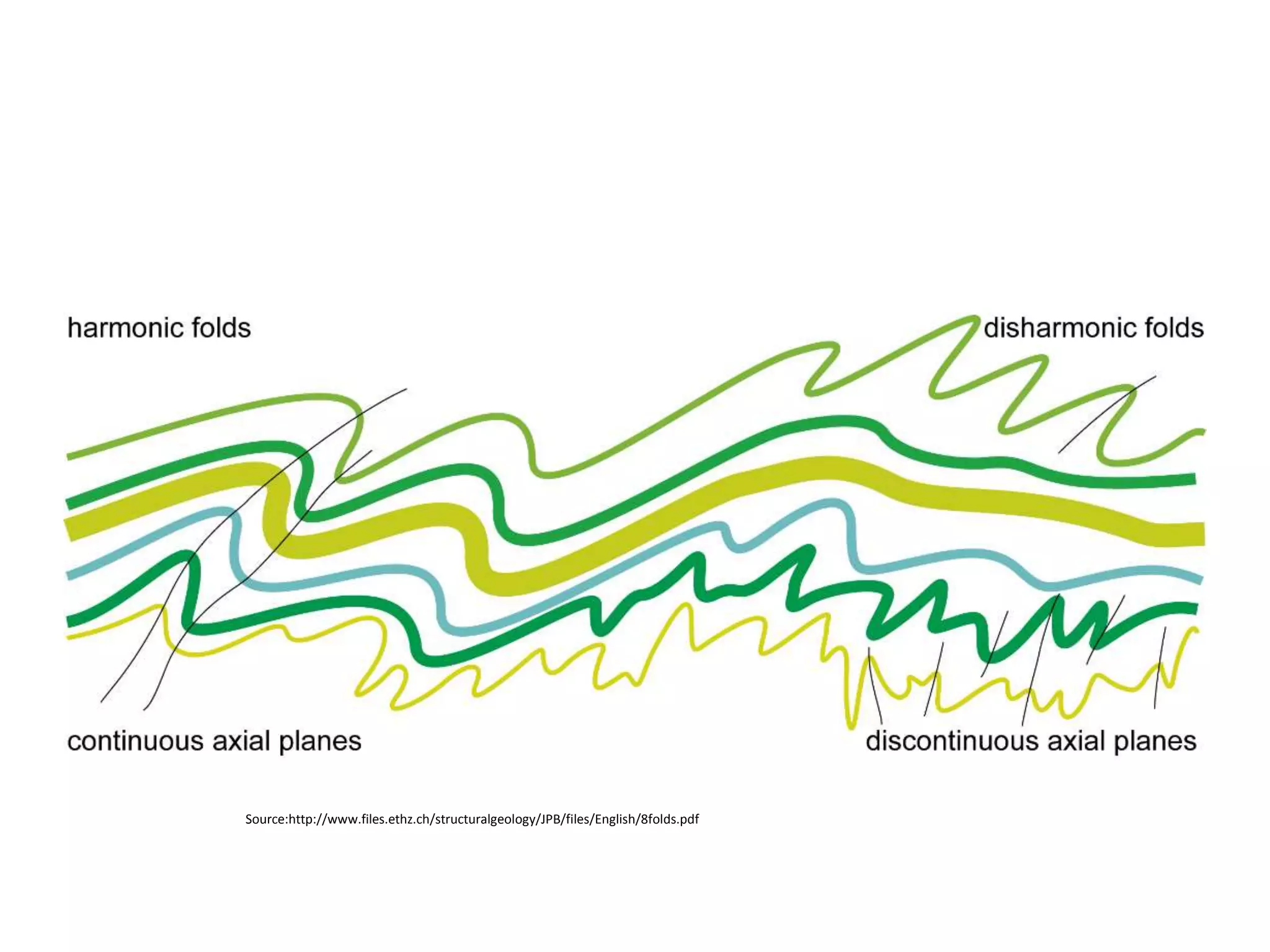
• Disharmonic Folds : Folds in which the amplitude,
wavelength and style change along discontinuous axial
surfaces from one layer to another are disharmonic.
http://geologylearn.blogspot.in/2015/08/geometric-description-of-folds.html
Source:http://www.files.ethz.ch/structuralgeology/JPB/files/English/8folds.pdf
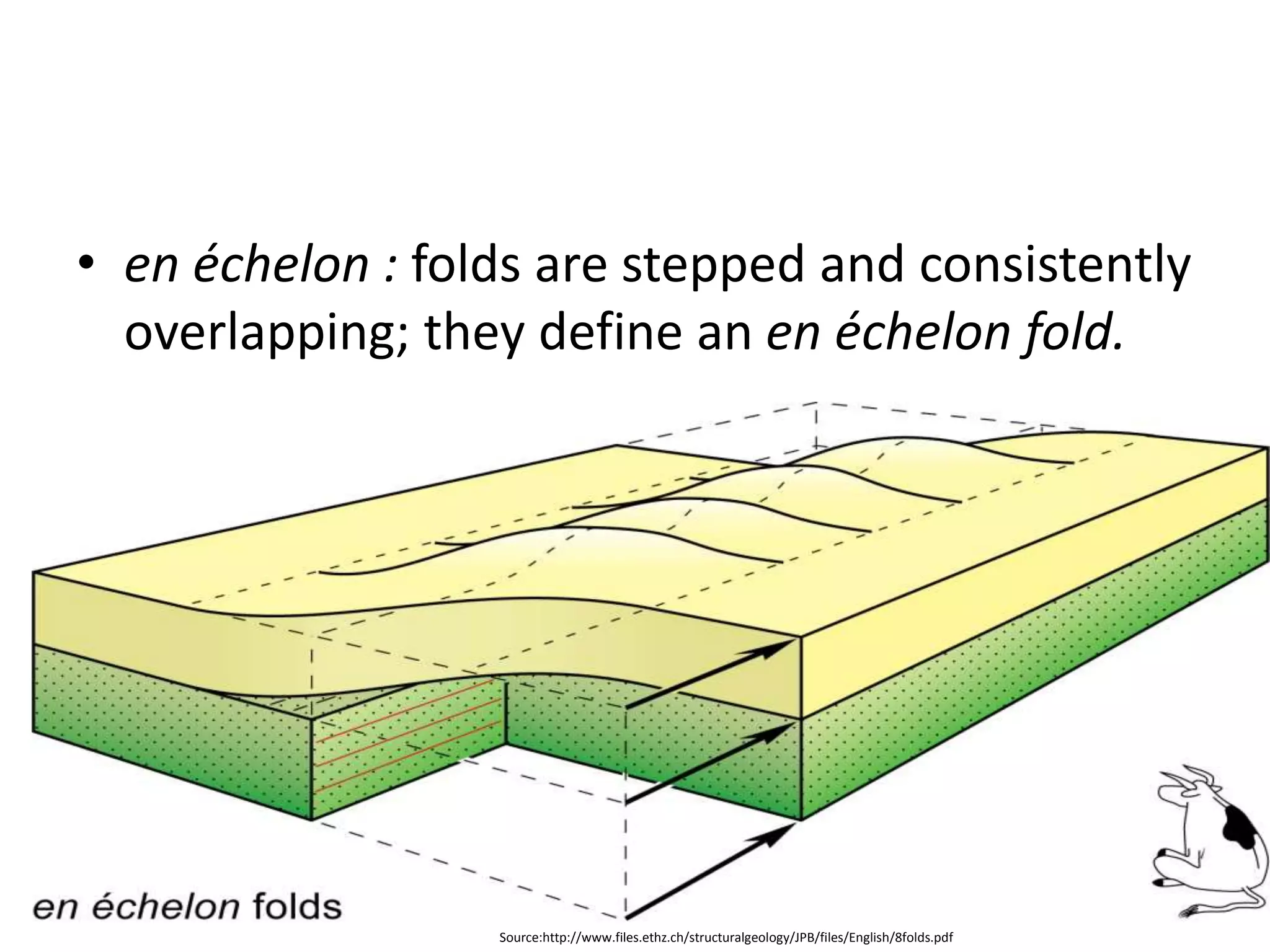
• en échelon : folds are stepped and consistently
overlapping; they define an en échelon fold.
Source:http://www.files.ethz.ch/structuralgeology/JPB/files/English/8folds.pdf
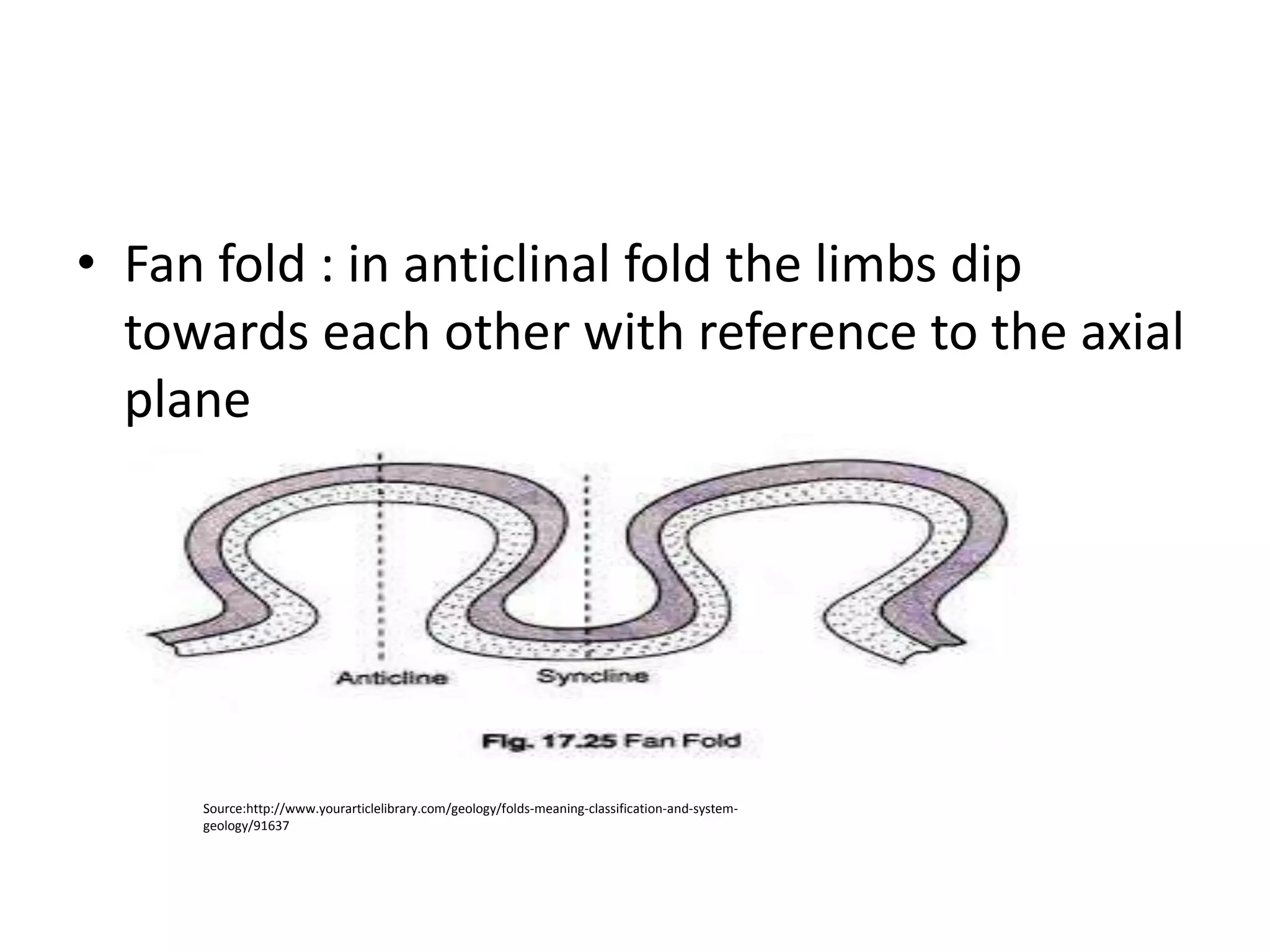
• Fan fold : in anticlinal fold the limbs dip
towards each other with reference to the axial
plane
Source:http://www.yourarticlelibrary.com/geology/folds-meaning-classification-and-system-
geology/91637
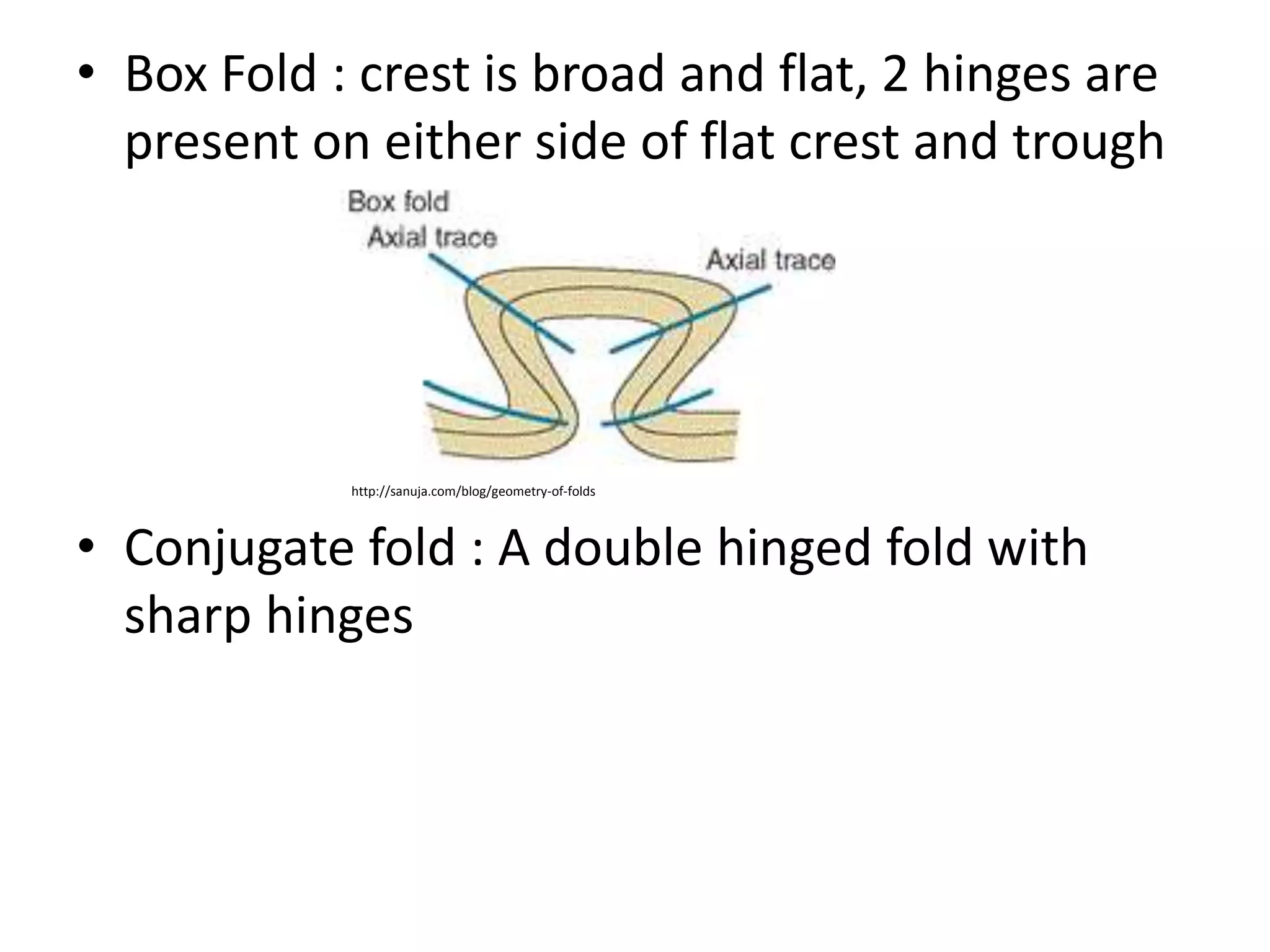
• Box Fold : crest is broad and flat, 2 hinges are
present on either side of flat crest and trough
• Conjugate fold : A double hinged fold with
sharp hinges
http://sanuja.com/blog/geometry-of-folds
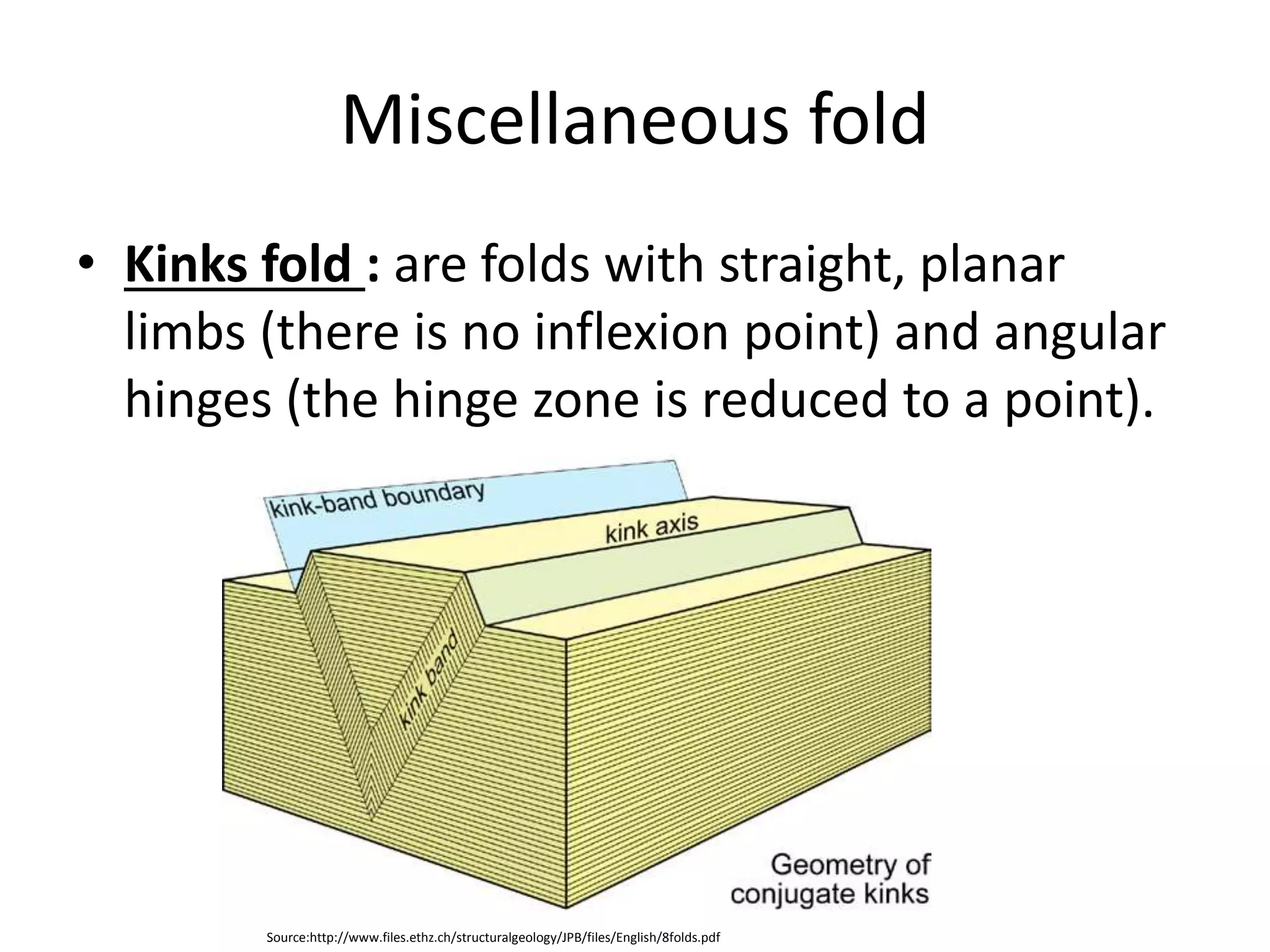
Miscellaneous fold
• Kinks fold : are folds with straight, planar
limbs (there is no inflexion point) and angular
hinges (the hinge zone is reduced to a point).
Source:http://www.files.ethz.ch/structuralgeology/JPB/files/English/8folds.pdf
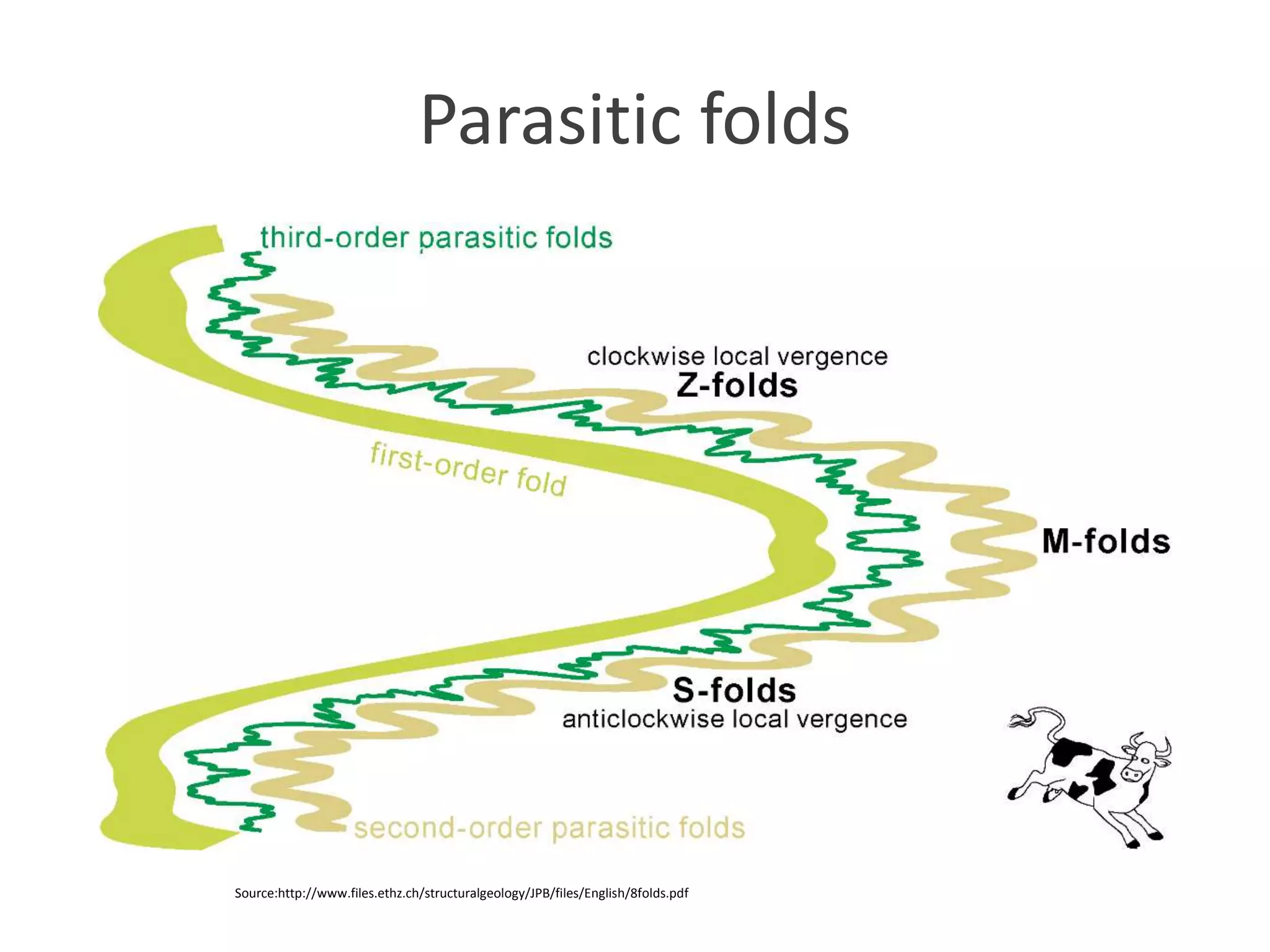
Parasitic folds
• Hinge zones and limbs of large folds often
display folds of smaller wavelength and
amplitude: larger and smaller folds are
together polyharmonic. The small folds are
called parasitic or subsidiary folds with
respect to the larger ones. The largest folds
are termed first-order folds, the next largest
are called second-order folds and so forth.
Parasitic folds
Source:http://www.files.ethz.ch/structuralgeology/JPB/files/English/8folds.pdf
REFERENCE
• Hatcher ,Robert D., Jr (1995), Structural geology:
principle concept and problems , second edition ,
Prentice-Hall Englewood Cliffs, NJ 07632, P. 272- 298
• Ramsay , J.G, and Huber, M.I., 1983, The Techniques of
modern structural geology,V.2: Folds and Fractures:
London, Academic press, p.347-361
• Davis, G.H, and Reynolds, J.H., 1984,Structural geology
of rocks and regions: New York, John Willey & Sons, p.
372-423
• http://www.files.ethz.ch/structuralgeology/JPB/files/E
nglish/8folds.pdf
Geometric classification of folds

Geometric classification of folds

  • 1.
    GEOMETRIC CLASSIFICATION OFFOLDS Submitted by , Ashikraj RS 2nd sem Msc Geology Dept of geology University of kerala
  • 2.
    FOLDS • Folds arewave like structures that result from deformation of bedding , foliation ,or other originally planar surfaces in rocks . • Such as sedimentary beds become bent or curved as a result of plastic (i.e. permanent) and ductile deformation .
  • 3.
    Fold The Chevron folds,North Cornwall, United Kingdom Source : http://www.mineralmuseum.eu/10- amazing-geological-folds-you-should-see/
  • 4.
    • Scale – Microscopic –Mesoscopic – Megascopic • Pumpelly’s rule Mimic structure and large-scale structure formed at the same time • Deformation – Brittle (near surface) – ductile( lower crust) Source : structural geology textbook by Robert D ( page no- 273 ) Pumpelly’s rule relating large and small scales
  • 5.
    Pictorial representation offold Source:http://sanuja.com/blog/geometry-of-folds
  • 6.
    • Hinge -zone of maximum curvature • Axial plane – the plane defined by connecting fold hinge lines in multiple folded surface. • Inflection points - points of zero curvature, where the sense of curvature changes from a convex to a concave line. They usually are aligned on either limb of a fold. • Crest • Trough • Limb • Hinge zone – greatest curvature zone • Amplitude • Wave length
  • 7.
    • Vergence -has been used to indicate the direction in which an antiform or synform is inclined or overturned • Plunge – when the fold angle is inclined to the horizontal Plunge Source: https://www.britannica.com/science/plunge
  • 8.
    Anatomy of Folds •First-Order Folds – The largest fold • Second-Order Folds – Smaller folds on the flanks of first-order folds • Enveloping Surface – Enables the relation of small to large scale folds Source : structural geology textbook by Robert D (page no- 274) Vergence of small and large folds Slip lines in a fold
  • 9.
    GEOMETRIC CLASSIFICATION OFFOLD Based on …… 1. Sense of curvature 2. Direction of younging relative to sense of fold closure 3. the symmetry of fold 4. the nature of hinge line 5. the plunge of fold axis 6. the inter limb angle 7. the thickness of the bed 8. the orientation of axial plane 9. the shape of hinge 10. Miscellaneous fold
  • 10.
    Kinds of foldsbased on the sense of curvature • Antiform – A fold that is concave downward. • Synform – A folds that is concave upward. • Neutral fold – A fold that closes sidwise. • Dome – An antiform where bedding dips away from the central point. • Basin – A synform where bedding dips towards a central point.
  • 11.
    Kinds of Folds v) Source: structural geology textbook by Robert D (page no-275)
  • 12.
    Based on thedirection of younging relative to sense of fold closure • Anticline – is a type of fold that is an arch-like shape and has its oldest beds at its core • Syncline – A folds that is concave towards younger rocks in its center • Synformal anticline – fold that closes downwards, center of the structure are older rather than younger • Antiformal syncline – fold that closes upwards but the younging is towards the center. • Anticlinorium and synclinorium - Major anticline or a syncline on whose limbs are found minor folds, both anti- and synclines, generally asymmatrical and of opposite senses on the two limbs.
  • 13.
  • 14.
    Based on thesymmetry of fold • Symmetrical fold is one in which the axial plane is vertical. “M” type fold. • Asymmetrical fold is one in which the axial plane is inclined . “S” type or “Z” type fold. Source:https://medium.com/@rohitgurjar009/folds-in-rocks-and-its-types- 9f38a5a53def
  • 15.
    Based on thenature of hinge line • Folds with straight hinge lines are known as cylindrical folds while the folds with curved hinge lines are known as non-cylindrical folds. The cylindricity varies depend on the stress experienced by the fold • Sheath folds are strongly noncylindrical and closed at one end. Source : structural geology textbook by Robert D (page no-277)
  • 16.
  • 17.
    Based on theplunge of the fold axis • Horizontal fold : A fold whose axis is horizontal. • Vertical fold : a fold whose axis is vertical. • Inclined fold/plunging fold : fold in which axis is plunged. Source:http://www.orefind.com/blog/orefind_blog/2016/01/21/a-recipe-for-shrinking-a- mineral-resource-by-90- Source:http://www.geographynotes.com/geology- 2/structural-geology/folds-definition-parts-and-types- structural-geology-geology/1313
  • 18.
    MICHAEL FLEUTY'S CLASSIFICATION BASEDON INTER LIMB ANGLE HINGE AREA • Sub horizontal fold : plunge between 0-100 • Gently plunging fold : plunge b/w 100 -300 • Moderately plunging fold : plunge b/w 300-600 • Steeply plunging fold : plunge b/w 600-800 • Sub vertical fold: plunge b/w 800-900
  • 19.
    Fleuty 5 Foldclassification Source:https://www.geoexpro.com/articles/2013/07/folds-and-folding-part-i
  • 20.
    Based on theorientation of axial plane • Upright fold : Fold with vertical axial plane. • Inclined fold : fold with inclined axial plane. • Reclined fold : Folds have fold axis plunging down the dip of the axial surface. • Overturned fold :A fold in which the AS inclined also both the limbs dip in the same direction is called an overturned fold . • Recumbent fold : horizontal axis and AS is horizontal almost. • Open fold : limb is away from one another • Tight fold : limb is almost near to each other
  • 21.
    Types of foldsbased on axial surface Source : structural geology textbook by Robert D (page no-278)
  • 22.
    Based on interlimb angle • Inter limb angle is a indicator of tightness of fold 1. Gentle fold - 1800-1200 2. open fold – 1200 - 700 3. Closed fold –700 - 300 4. Tight fold – 300 - 00 5. Isoclinal fold – 50- 00 Isoclinal fold : folds both limbs have the same angle(~zero) and are parallel to each other . Many recumbent fold are isoclinal .
  • 23.
  • 24.
    Based on thethickness of bed • Parallel Folds – Maintain constant layer thickness • Concentric Folds – Parallel folds in which the folded surfaces define circular arcs • Ptygmatic Folds – Have a lobate shape and look like intestines • Similar Folds – Maintain their shape throughout the section and do not die out vertically
  • 25.
    • Disharmonic Folds– Shape or wavelength changes from one layer to another • Supratenuous Folds – The synclines are thinner at the crust and thicker at the trough
  • 26.
    Source : structuralgeology textbook by Robert D (page no-280)
  • 27.
    Based on theshape of the hinge • Round Hinged / broad hinge fold : A fold with broad hinge zone compared to limb • Chevron and Kink Folds – Have straight limbs and sharp angular hinges • Arrowhead Fold- A fold with a sharp hinge and distinctly curved limbs (flame fold) • Cuspate fold : sharp hinge on one closure and rounded closure on oppositivelly directed closure
  • 28.
  • 29.
    Based on thenumber of Hinge • Single hinge fold • Multiple hinged fold
  • 30.
    Based on thegeometrical relation among neighbouring structure • Periodic Fold : train of fold with more or less same geometry b/w alternate points of inflection. • Non periodic Fold : fold which are not periodic
  • 31.
    • Polyclinal folds: belong to groups of folds with sub- parallel hinge lines but non-parallel axial surfaces. • Disharmonic Folds : Folds in which the amplitude, wavelength and style change along discontinuous axial surfaces from one layer to another are disharmonic. http://geologylearn.blogspot.in/2015/08/geometric-description-of-folds.html
  • 32.
  • 33.
    • en échelon: folds are stepped and consistently overlapping; they define an en échelon fold. Source:http://www.files.ethz.ch/structuralgeology/JPB/files/English/8folds.pdf
  • 34.
    • Fan fold: in anticlinal fold the limbs dip towards each other with reference to the axial plane Source:http://www.yourarticlelibrary.com/geology/folds-meaning-classification-and-system- geology/91637
  • 35.
    • Box Fold: crest is broad and flat, 2 hinges are present on either side of flat crest and trough • Conjugate fold : A double hinged fold with sharp hinges http://sanuja.com/blog/geometry-of-folds
  • 36.
    Miscellaneous fold • Kinksfold : are folds with straight, planar limbs (there is no inflexion point) and angular hinges (the hinge zone is reduced to a point). Source:http://www.files.ethz.ch/structuralgeology/JPB/files/English/8folds.pdf
  • 37.
    Parasitic folds • Hingezones and limbs of large folds often display folds of smaller wavelength and amplitude: larger and smaller folds are together polyharmonic. The small folds are called parasitic or subsidiary folds with respect to the larger ones. The largest folds are termed first-order folds, the next largest are called second-order folds and so forth.
  • 38.
  • 39.
    REFERENCE • Hatcher ,RobertD., Jr (1995), Structural geology: principle concept and problems , second edition , Prentice-Hall Englewood Cliffs, NJ 07632, P. 272- 298 • Ramsay , J.G, and Huber, M.I., 1983, The Techniques of modern structural geology,V.2: Folds and Fractures: London, Academic press, p.347-361 • Davis, G.H, and Reynolds, J.H., 1984,Structural geology of rocks and regions: New York, John Willey & Sons, p. 372-423 • http://www.files.ethz.ch/structuralgeology/JPB/files/E nglish/8folds.pdf

Editor's Notes

  • #5 pumpellys rule relating large and small scales
  • #9 Slip lines
  • #29 Flame fold