Amit Kumar Mishra
Schoolof Earth Sciences
BanasthaliVidyapith
Rajasthan304022
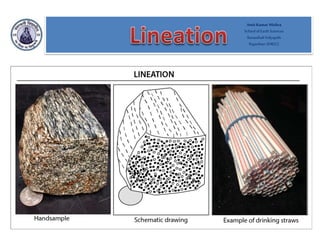
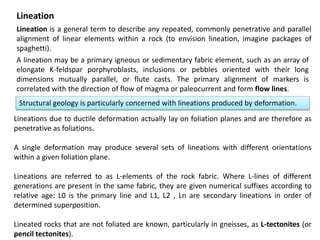
Lineation is a general term to describe any repeated, commonly penetrative and parallel
alignment of linear elements within a rock (to envision lineation, imagine packages of
spaghetti).
Lineation
A lineation may be a primary igneous or sedimentary fabric element, such as an array of
elongate K-feldspar porphyroblasts, inclusions or pebbles oriented with their long
dimensions mutually parallel, or flute casts. The primary alignment of markers is
correlated with the direction of flow of magma or paleocurrent and form flow lines.
Structural geology is particularly concerned with lineations produced by deformation.
Lineations due to ductile deformation actually lay on foliation planes and are therefore as
penetrative as foliations.
A single deformation may produce several sets of lineations with different orientations
within a given foliation plane.
Lineations are referred to as L-elements of the rock fabric. Where L-lines of different
generations are present in the same fabric, they are given numerical suffixes according to
relative age: L0 is the primary line and L1, L2 , Ln are secondary lineations in order of
determined superposition.
Lineated rocks that are not foliated are known, particularly in gneisses, as L-tectonites (or
pencil tectonites).
Description
The attitude of a linear structure is described by its trend, which is the compass direction of
the lineation projected on a horizontal plane, and its plunge. The plunge is the angle made
by the linear structure with the horizontal, in the vertical plane parallel to its trend. The
rake (or pitch) is the angle between a line lying in a plane with the horizontal strike of the
same plane. Therefore it is an angle not measured in a vertical or horizontal plane but in
the plane that contains the linear structure. This angle is often used to measure slickenside
striations on a fault plane.
Orientation
Non-penetrative lineation
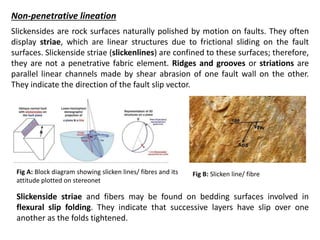
Slickensides are rock surfaces naturally polished by motion on faults. They often
display striae, which are linear structures due to frictional sliding on the fault
surfaces. Slickenside striae (slickenlines) are confined to these surfaces; therefore,
they are not a penetrative fabric element. Ridges and grooves or striations are
parallel linear channels made by shear abrasion of one fault wall on the other.
They indicate the direction of the fault slip vector.
Slickenside striae and fibers may be found on bedding surfaces involved in
flexural slip folding. They indicate that successive layers have slip over one
another as the folds tightened.
Fig A: Block diagram showing slicken lines/ fibres and its
attitude plotted on stereonet
Fig B: Slicken line/ fibre
Intersection lineations
Since any two planar surfaces intersect in a line, most rocks that are folded with
concomitant development of an axial plane foliation display the intersection
lineation between bedding and the axial plane foliation.
The trace of bedding on an
intersecting foliation plane commonly
appears as colour stripes generally
parallel to local fold axes (hence it is
sometimes called striping lineation to
avoid using a genetic term)
Two non-parallel foliations can also produce an
intersection lineation; for example, the
intersection of a crenulation cleavage and the
earlier foliation.
Note : The linear trace of any plane on a random joint surface has no significance
in structural analysis; a lineation must be measured on and only on the foliation
plane of the same deformation episode. Intersection lineation, however, may
also be measured on the bedding plane.
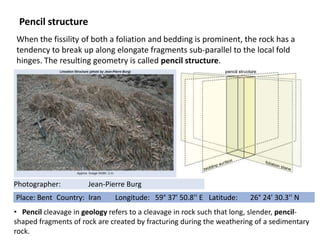
When the fissility of both a foliation and bedding is prominent, the rock has a
tendency to break up along elongate fragments sub-parallel to the local fold
hinges. The resulting geometry is called pencil structure.
Pencil structure
Place: Bent Country: Iran Longitude: 59° 37' 50.8'' E Latitude: 26° 24' 30.3'' N
Photographer: Jean-Pierre Burg
• Pencil cleavage in geology refers to a cleavage in rock such that long, slender, pencil-
shaped fragments of rock are created by fracturing during the weathering of a sedimentary
rock.
Axes of folds as lineations
Hinges of cylindrical folds are linear structures.
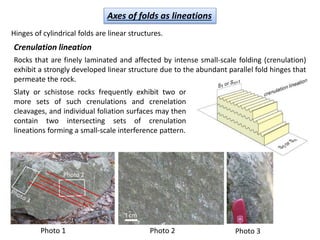
Crenulation lineation
Rocks that are finely laminated and affected by intense small-scale folding (crenulation)
exhibit a strongly developed linear structure due to the abundant parallel fold hinges that
permeate the rock.
Slaty or schistose rocks frequently exhibit two or
more sets of such crenulations and crenelation
cleavages, and individual foliation surfaces may then
contain two intersecting sets of crenulation
lineations forming a small-scale interference pattern.
Photo 2Photo 1 Photo 3
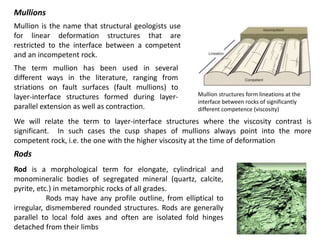
Mullions
Mullion is the name that structural geologists use
for linear deformation structures that are
restricted to the interface between a competent
and an incompetent rock.
The term mullion has been used in several
different ways in the literature, ranging from
striations on fault surfaces (fault mullions) to
layer-interface structures formed during layer-
parallel extension as well as contraction.
Mullion structures form lineations at the
interface between rocks of significantly
different competence (viscosity)
We will relate the term to layer-interface structures where the viscosity contrast is
significant. In such cases the cusp shapes of mullions always point into the more
competent rock, i.e. the one with the higher viscosity at the time of deformation
Rods
Rod is a morphological term for elongate, cylindrical and
monomineralic bodies of segregated mineral (quartz, calcite,
pyrite, etc.) in metamorphic rocks of all grades.
Rods may have any profile outline, from elliptical to
irregular, dismembered rounded structures. Rods are generally
parallel to local fold axes and often are isolated fold hinges
detached from their limbs
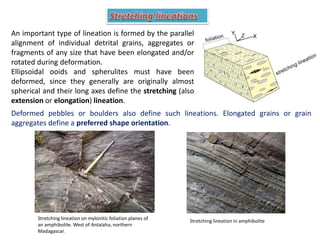
An important type of lineation is formed by the parallel
alignment of individual detrital grains, aggregates or
fragments of any size that have been elongated and/or
rotated during deformation.
Ellipsoidal ooids and spherulites must have been
deformed, since they generally are originally almost
spherical and their long axes define the stretching (also
extension or elongation) lineation.
Deformed pebbles or boulders also define such lineations. Elongated grains or grain
aggregates define a preferred shape orientation.
Stretching lineation on mylonitic foliation planes of
an amphibolite. West of Antalaha, northern
Madagascar.
Stretching lineation in amphibolite
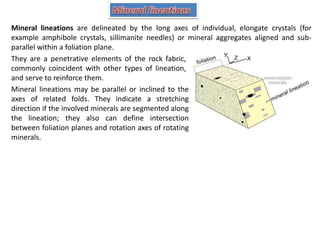
Mineral lineations are delineated by the long axes of individual, elongate crystals (for
example amphibole crystals, sillimanite needles) or mineral aggregates aligned and sub-
parallel within a foliation plane.
They are a penetrative elements of the rock fabric,
commonly coincident with other types of lineation,
and serve to reinforce them.
Mineral lineations may be parallel or inclined to the
axes of related folds. They indicate a stretching
direction if the involved minerals are segmented along
the lineation; they also can define intersection
between foliation planes and rotation axes of rotating
minerals.
1. Cloos E. - 1946. Lineation: A critical review and annoted bibliography. Geological
Society of America Memoir 18, 1-122.
2. Fossen, H. (2016). Structural geology. Cambridge University Press.
3. Ghosh, S. K. (2013). Structural geology: Fundamentals and modern developments.
Elsevier.
4. Park, R. G. (2013). Foundation of structural geology. Routledge.
5. Passchier C.W. & Trouw R.A.J. - 1996. Microtectonics. Springer-Verlag, Berlin, 289 p.
6. Sanderson D.J. - 1974. Patterns of boudinage and apparent stretching lineation
developped in folded rocks. Journal of Geology 82 (5), 651-661.
7. Schwerdtner W.M. - 1973. Schistosity and penetrative mineral lineation as indicators of
paleostrain directions. Canadian Journal of Earth Sciences 10 (8), 1233-1243

Lineation

  • 1.
    Amit Kumar Mishra SchoolofEarth Sciences BanasthaliVidyapith Rajasthan304022
  • 2.
    Lineation is ageneral term to describe any repeated, commonly penetrative and parallel alignment of linear elements within a rock (to envision lineation, imagine packages of spaghetti). Lineation A lineation may be a primary igneous or sedimentary fabric element, such as an array of elongate K-feldspar porphyroblasts, inclusions or pebbles oriented with their long dimensions mutually parallel, or flute casts. The primary alignment of markers is correlated with the direction of flow of magma or paleocurrent and form flow lines. Structural geology is particularly concerned with lineations produced by deformation. Lineations due to ductile deformation actually lay on foliation planes and are therefore as penetrative as foliations. A single deformation may produce several sets of lineations with different orientations within a given foliation plane. Lineations are referred to as L-elements of the rock fabric. Where L-lines of different generations are present in the same fabric, they are given numerical suffixes according to relative age: L0 is the primary line and L1, L2 , Ln are secondary lineations in order of determined superposition. Lineated rocks that are not foliated are known, particularly in gneisses, as L-tectonites (or pencil tectonites).
  • 3.
    Description The attitude ofa linear structure is described by its trend, which is the compass direction of the lineation projected on a horizontal plane, and its plunge. The plunge is the angle made by the linear structure with the horizontal, in the vertical plane parallel to its trend. The rake (or pitch) is the angle between a line lying in a plane with the horizontal strike of the same plane. Therefore it is an angle not measured in a vertical or horizontal plane but in the plane that contains the linear structure. This angle is often used to measure slickenside striations on a fault plane. Orientation
  • 4.
    Non-penetrative lineation Slickensides arerock surfaces naturally polished by motion on faults. They often display striae, which are linear structures due to frictional sliding on the fault surfaces. Slickenside striae (slickenlines) are confined to these surfaces; therefore, they are not a penetrative fabric element. Ridges and grooves or striations are parallel linear channels made by shear abrasion of one fault wall on the other. They indicate the direction of the fault slip vector. Slickenside striae and fibers may be found on bedding surfaces involved in flexural slip folding. They indicate that successive layers have slip over one another as the folds tightened. Fig A: Block diagram showing slicken lines/ fibres and its attitude plotted on stereonet Fig B: Slicken line/ fibre
  • 5.
    Intersection lineations Since anytwo planar surfaces intersect in a line, most rocks that are folded with concomitant development of an axial plane foliation display the intersection lineation between bedding and the axial plane foliation. The trace of bedding on an intersecting foliation plane commonly appears as colour stripes generally parallel to local fold axes (hence it is sometimes called striping lineation to avoid using a genetic term) Two non-parallel foliations can also produce an intersection lineation; for example, the intersection of a crenulation cleavage and the earlier foliation. Note : The linear trace of any plane on a random joint surface has no significance in structural analysis; a lineation must be measured on and only on the foliation plane of the same deformation episode. Intersection lineation, however, may also be measured on the bedding plane.
  • 6.
    When the fissilityof both a foliation and bedding is prominent, the rock has a tendency to break up along elongate fragments sub-parallel to the local fold hinges. The resulting geometry is called pencil structure. Pencil structure Place: Bent Country: Iran Longitude: 59° 37' 50.8'' E Latitude: 26° 24' 30.3'' N Photographer: Jean-Pierre Burg • Pencil cleavage in geology refers to a cleavage in rock such that long, slender, pencil- shaped fragments of rock are created by fracturing during the weathering of a sedimentary rock.
  • 7.
    Axes of foldsas lineations Hinges of cylindrical folds are linear structures. Crenulation lineation Rocks that are finely laminated and affected by intense small-scale folding (crenulation) exhibit a strongly developed linear structure due to the abundant parallel fold hinges that permeate the rock. Slaty or schistose rocks frequently exhibit two or more sets of such crenulations and crenelation cleavages, and individual foliation surfaces may then contain two intersecting sets of crenulation lineations forming a small-scale interference pattern. Photo 2Photo 1 Photo 3
  • 8.
    Mullions Mullion is thename that structural geologists use for linear deformation structures that are restricted to the interface between a competent and an incompetent rock. The term mullion has been used in several different ways in the literature, ranging from striations on fault surfaces (fault mullions) to layer-interface structures formed during layer- parallel extension as well as contraction. Mullion structures form lineations at the interface between rocks of significantly different competence (viscosity) We will relate the term to layer-interface structures where the viscosity contrast is significant. In such cases the cusp shapes of mullions always point into the more competent rock, i.e. the one with the higher viscosity at the time of deformation Rods Rod is a morphological term for elongate, cylindrical and monomineralic bodies of segregated mineral (quartz, calcite, pyrite, etc.) in metamorphic rocks of all grades. Rods may have any profile outline, from elliptical to irregular, dismembered rounded structures. Rods are generally parallel to local fold axes and often are isolated fold hinges detached from their limbs
  • 9.
    An important typeof lineation is formed by the parallel alignment of individual detrital grains, aggregates or fragments of any size that have been elongated and/or rotated during deformation. Ellipsoidal ooids and spherulites must have been deformed, since they generally are originally almost spherical and their long axes define the stretching (also extension or elongation) lineation. Deformed pebbles or boulders also define such lineations. Elongated grains or grain aggregates define a preferred shape orientation. Stretching lineation on mylonitic foliation planes of an amphibolite. West of Antalaha, northern Madagascar. Stretching lineation in amphibolite
  • 10.
    Mineral lineations aredelineated by the long axes of individual, elongate crystals (for example amphibole crystals, sillimanite needles) or mineral aggregates aligned and sub- parallel within a foliation plane. They are a penetrative elements of the rock fabric, commonly coincident with other types of lineation, and serve to reinforce them. Mineral lineations may be parallel or inclined to the axes of related folds. They indicate a stretching direction if the involved minerals are segmented along the lineation; they also can define intersection between foliation planes and rotation axes of rotating minerals.
  • 11.
    1. Cloos E.- 1946. Lineation: A critical review and annoted bibliography. Geological Society of America Memoir 18, 1-122. 2. Fossen, H. (2016). Structural geology. Cambridge University Press. 3. Ghosh, S. K. (2013). Structural geology: Fundamentals and modern developments. Elsevier. 4. Park, R. G. (2013). Foundation of structural geology. Routledge. 5. Passchier C.W. & Trouw R.A.J. - 1996. Microtectonics. Springer-Verlag, Berlin, 289 p. 6. Sanderson D.J. - 1974. Patterns of boudinage and apparent stretching lineation developped in folded rocks. Journal of Geology 82 (5), 651-661. 7. Schwerdtner W.M. - 1973. Schistosity and penetrative mineral lineation as indicators of paleostrain directions. Canadian Journal of Earth Sciences 10 (8), 1233-1243

Editor's Notes

  • #7 Intersection lineations and pencil structures are often utilised to determine the orientation of the fold axes where they are not exposed.
  • #8 The lineation is developed perpendicular to original maximum stress direction σ1 and parallel to σ3 (minimum stress direction).
  • #11 Metamorphic minerals often grow with a preferred crystallographic and dimensional orientation, i.e. with their long axes in parallel alignment. "Pressure shadow" or ''pressure fringe'' structures generally comprise spindle-shaped aggregates of new grains formed on opposed sides of a host porphyroblast or competent, clastic objects. The new grains crystallize when material dissolved by pressure solution is re-precipitated, occasionally as fibres, in the regions sheltered from strain on either side of the rigid grains. The fibres form tails filling openings in the extending direction between grain and matrix, during deformation. The central grain and the tails produce an elongate structure generally contained in the foliation; this structure and the fibre crystals thus define a lineation. Circular fringes with radial fibres on the foliation however characterize pure shear without stretching direction (pan-cake finite strain ellipsoid). In a similar way, the oriented growth of mineral fibres in tensions gashes and veins indicates the local extension direction and may record incremental strain directions.