


Ore Forming
Process
By
Abdul Bari Qanit
M.Sc. Geology
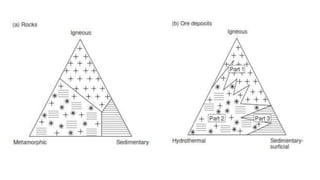
The processes of formation of mineral deposits
are grouped into three main types:
a. Magmatic Process
b. Sedimentary Process
c. Metamorphic Process.
Mineral deposits formed due to the various
processes associated with magmatic activities are
called 'Primary-Mineral Deposits'.
Mineral deposits arising out of the processes
of weathering, and activities of several geological
agents are called 'Secondary Mineral Deposits'.
These are closely associated with the sedimentary
processes of formation.
Metamorphic mineral deposits are the out-
come of metamorphic processes acting upon an
earlier formed mineral deposits or rocks.
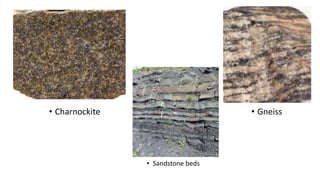
• Charnockite • Gneiss
• Sandstone beds
Magmatic Ore Forming
Process
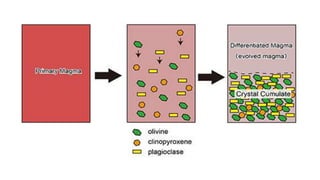
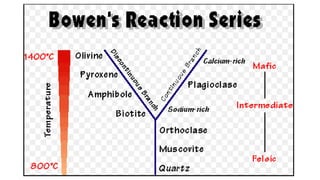
As we know, magma consists of a multitude of
constituents, which are in mutual solution. As the magma
approaches the earth's surface its temperature and the
external pressure drop, with the result of crystallization
and differentiation of minerals in a definite sequence. The
formation temperature of different magmatic deposits
varies from 1500'C to 300C°.
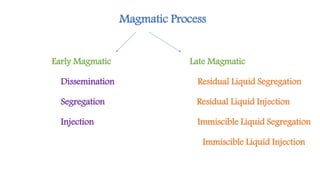
Magmatic Process
Early Magmatic Late Magmatic
Dissemination Residual Liquid Segregation
Segregation Residual Liquid Injection
Injection Immiscible Liquid Segregation
Immiscible Liquid Injection
Early Magmatic Process
The early magmatic deposits are believed to
have been formed simultaneously with the
host-rock. (or)
Where the Ore Deposits formed in the Early
stage of Magmatic periods.
Late Magmatic Process
The late magmatic deposits are
formed towards the close of the
magmatic deposits.
For example Titaniferous magnetite,
Magmatic Dissemination
Magmatic Dissemination (Simple
crystallization without concentration). It
involves simple crystallization whereby
early formed crystals are found
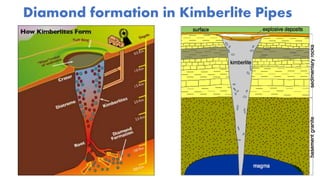
Diamond formation in Kimberlite Pipes
Magmatic Segregation
This type of magmatic concentration is
often due to the gravitative
crystallization of early formed heavy
minerals for, e.g., Bushveld chromite
deposits (South Africa), chromite
deposits of Keonjhar (Orissa).
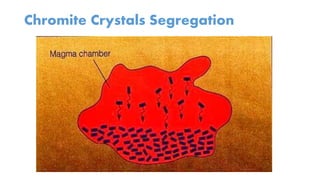
Chromite Crystals Segregation
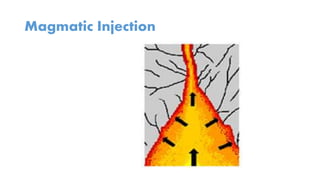
Magmatic Injection
In this case, the metallic concentrates
instead of remaining -at the place of
their original accumulation, get injected
into the adjacent solid rock-masses It
occurs at the residual magmatic stage,
e.g., Magnetite deposits of Kiruna
(Sweden).
Magmatic Injection
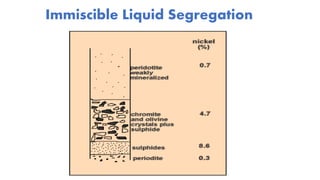
Immiscible Liquid Segregation
Sometimes magma of an ore-and-
silicate composition breaks down
during cooling into two immiscible
fractions which accumulate to form
liquid segregation deposits e.g.
Sulphide minerals Deposits.
Immiscible Liquid Segregation
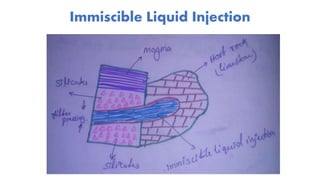
Immiscible Liquid Injection
The immiscible liquid accumulations
before consolidation when subjected to
disturbances, get injected into the
surrounding rocks, forming immiscible
liquid-injection. A nickeliferous
Sulphide deposit of Sudbury (U.S.A.) is
Immiscible Liquid Injection
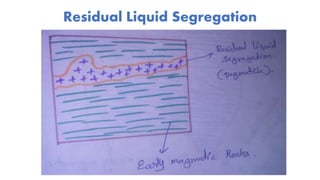
Residual Liquid Segregation
Basic magmas undergoing differentiation may
sometimes become enriched in iron and
titanium. This heavy residual liquid may
segregate and crystallize within the parent
igneous mass. Such ore bodies commonly
occur in form of parallel bands. The host rocks
are usually anorthosite, norite, gabbro
etc, e.g.. Titaniferous magnetite bands of
Residual Liquid Segregation
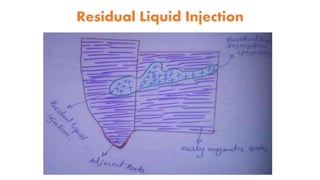
Residual Liquid Injection
In such cases, residual liquid be squeezed
out towards places of less pressure into
the neighboring rock mass forming late
magmatic injections, e.g., Titaniferous
magnetite deposits Adirondack region of
New York.
Residual Liquid Injection
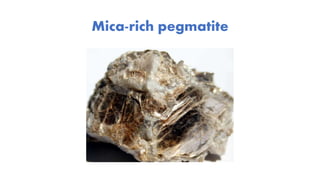
Pegmatite
These are formed towards the very end of
consolidation of the magma, in which the
residual fraction is highly enriched with
volatile constituents. Pegmatitic liquids
may be squeezed out to fill in the cracks
and fissures in the parent igneous body or
the adjoining country rocks, and form
pegmatite veins or dykes. These are
usually formed between 500°C to 800"C.
Deposits of mica, feldspar, beryl,
lithium minerals, Gemstones and tin
mineral like cassiterite are included in
the pegmatite deposits.
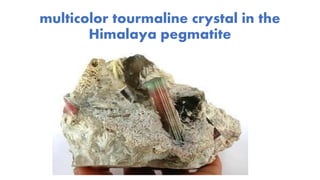
multicolor tourmaline crystal in the
Himalaya pegmatite
Mica-rich pegmatite
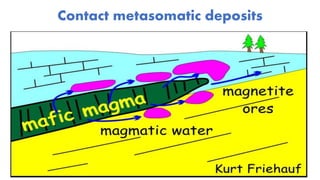
Contact metasomatic
deposits
In the neighborhood of invading magmas,
alteration and replacement of the country
rocks due to invasion of magmatic
emanations may sometimes lead to the
development of mineral deposits of
economic importance.
In this case, the enclosing country rock is
altered by the heat and other chemical
constituents of the invading intrusive
magma forming new minerals under
conditions of high temperature and
pressure. The deposits are usually
resulted in calcareous rocks. The
temperature of formation ranges from
400°C to 1000°C.
Contact metasomatic deposits
Ore forming process

Ore forming process

  • 1.
  • 2.
    The processes offormation of mineral deposits are grouped into three main types: a. Magmatic Process b. Sedimentary Process c. Metamorphic Process.
  • 3.
    Mineral deposits formeddue to the various processes associated with magmatic activities are called 'Primary-Mineral Deposits'. Mineral deposits arising out of the processes of weathering, and activities of several geological agents are called 'Secondary Mineral Deposits'. These are closely associated with the sedimentary processes of formation. Metamorphic mineral deposits are the out- come of metamorphic processes acting upon an earlier formed mineral deposits or rocks.
  • 5.
    • Charnockite •Gneiss • Sandstone beds
  • 6.
  • 7.
    As we know,magma consists of a multitude of constituents, which are in mutual solution. As the magma approaches the earth's surface its temperature and the external pressure drop, with the result of crystallization and differentiation of minerals in a definite sequence. The formation temperature of different magmatic deposits varies from 1500'C to 300C°.
  • 10.
    Magmatic Process Early MagmaticLate Magmatic Dissemination Residual Liquid Segregation Segregation Residual Liquid Injection Injection Immiscible Liquid Segregation Immiscible Liquid Injection
  • 11.
    Early Magmatic Process Theearly magmatic deposits are believed to have been formed simultaneously with the host-rock. (or) Where the Ore Deposits formed in the Early stage of Magmatic periods.
  • 12.
    Late Magmatic Process Thelate magmatic deposits are formed towards the close of the magmatic deposits. For example Titaniferous magnetite,
  • 13.
    Magmatic Dissemination Magmatic Dissemination(Simple crystallization without concentration). It involves simple crystallization whereby early formed crystals are found
  • 14.
    Diamond formation inKimberlite Pipes
  • 15.
    Magmatic Segregation This typeof magmatic concentration is often due to the gravitative crystallization of early formed heavy minerals for, e.g., Bushveld chromite deposits (South Africa), chromite deposits of Keonjhar (Orissa).
  • 16.
  • 17.
    Magmatic Injection In thiscase, the metallic concentrates instead of remaining -at the place of their original accumulation, get injected into the adjacent solid rock-masses It occurs at the residual magmatic stage, e.g., Magnetite deposits of Kiruna (Sweden).
  • 18.
  • 19.
    Immiscible Liquid Segregation Sometimesmagma of an ore-and- silicate composition breaks down during cooling into two immiscible fractions which accumulate to form liquid segregation deposits e.g. Sulphide minerals Deposits.
  • 20.
  • 21.
    Immiscible Liquid Injection Theimmiscible liquid accumulations before consolidation when subjected to disturbances, get injected into the surrounding rocks, forming immiscible liquid-injection. A nickeliferous Sulphide deposit of Sudbury (U.S.A.) is
  • 22.
  • 23.
    Residual Liquid Segregation Basicmagmas undergoing differentiation may sometimes become enriched in iron and titanium. This heavy residual liquid may segregate and crystallize within the parent igneous mass. Such ore bodies commonly occur in form of parallel bands. The host rocks are usually anorthosite, norite, gabbro etc, e.g.. Titaniferous magnetite bands of
  • 24.
  • 25.
    Residual Liquid Injection Insuch cases, residual liquid be squeezed out towards places of less pressure into the neighboring rock mass forming late magmatic injections, e.g., Titaniferous magnetite deposits Adirondack region of New York.
  • 26.
  • 27.
  • 28.
    These are formedtowards the very end of consolidation of the magma, in which the residual fraction is highly enriched with volatile constituents. Pegmatitic liquids may be squeezed out to fill in the cracks and fissures in the parent igneous body or the adjoining country rocks, and form pegmatite veins or dykes. These are usually formed between 500°C to 800"C.
  • 29.
    Deposits of mica,feldspar, beryl, lithium minerals, Gemstones and tin mineral like cassiterite are included in the pegmatite deposits.
  • 30.
    multicolor tourmaline crystalin the Himalaya pegmatite
  • 31.
  • 32.
  • 33.
    In the neighborhoodof invading magmas, alteration and replacement of the country rocks due to invasion of magmatic emanations may sometimes lead to the development of mineral deposits of economic importance.
  • 34.
    In this case,the enclosing country rock is altered by the heat and other chemical constituents of the invading intrusive magma forming new minerals under conditions of high temperature and pressure. The deposits are usually resulted in calcareous rocks. The temperature of formation ranges from 400°C to 1000°C.
  • 35.