Submitted by
Nishanth S
Introduction
 Ramachandran plot – to visualize the backbone of aminoacid
residues (1963 - Collagen)
 Used for structural validation and to calculate the possible phi
and psi angles that accounts for the aminoacid residues.
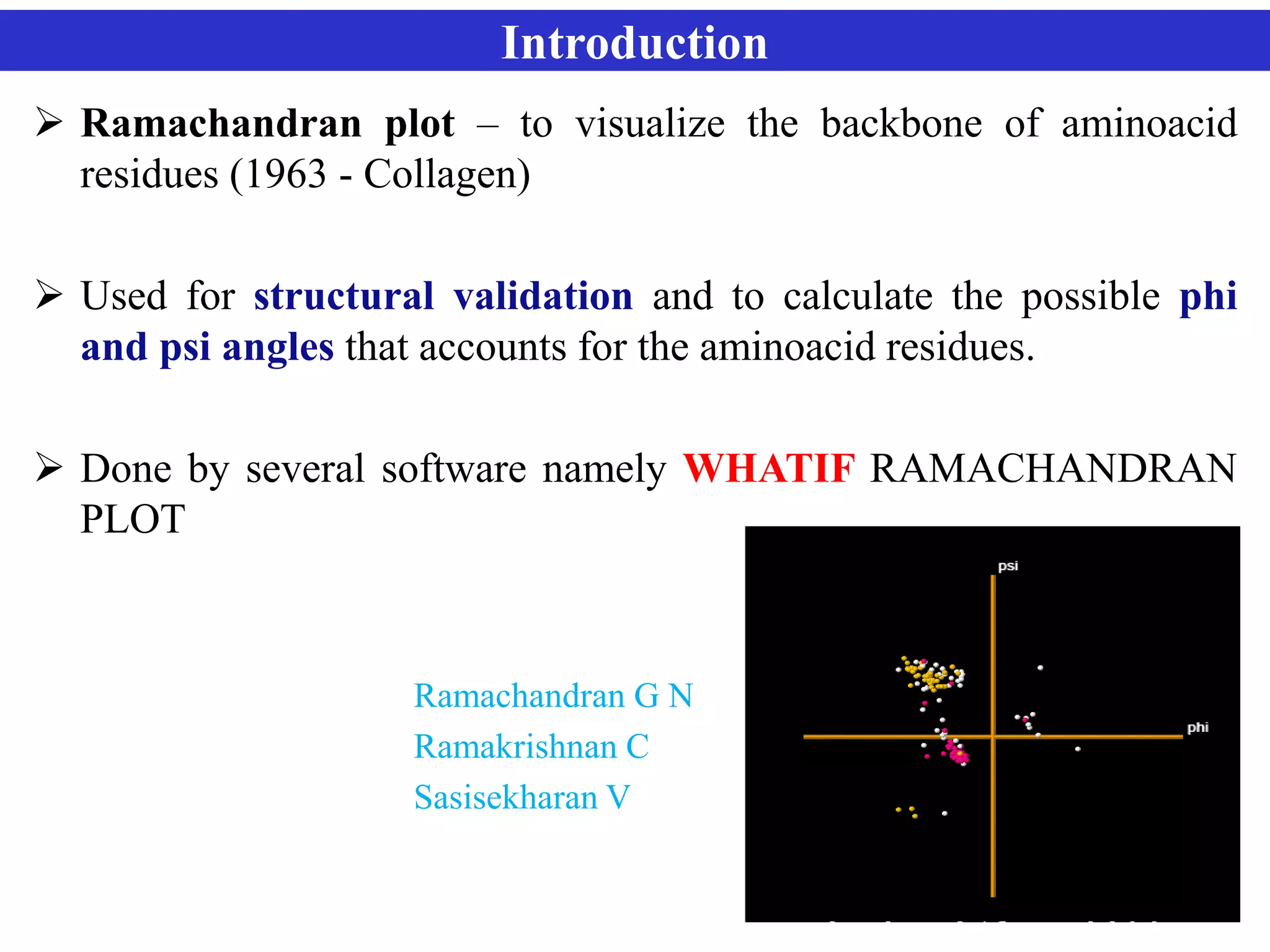
 Done by several software namely WHATIF RAMACHANDRAN
PLOT
Ramachandran G N
Ramakrishnan C
Sasisekharan V
Softwares
MolProbity
SAVES
STING
Pymol
VMD
WHATCHECK
UCSF Chimera
Sirius
Swiss PDB Viewer
TALOS
Zeus molecular
viewer
Procheck
R
A
M
A
C
H
A
N
D
R
A
N
P
L
O
T
S
O
F
T
W
A
R
E
S
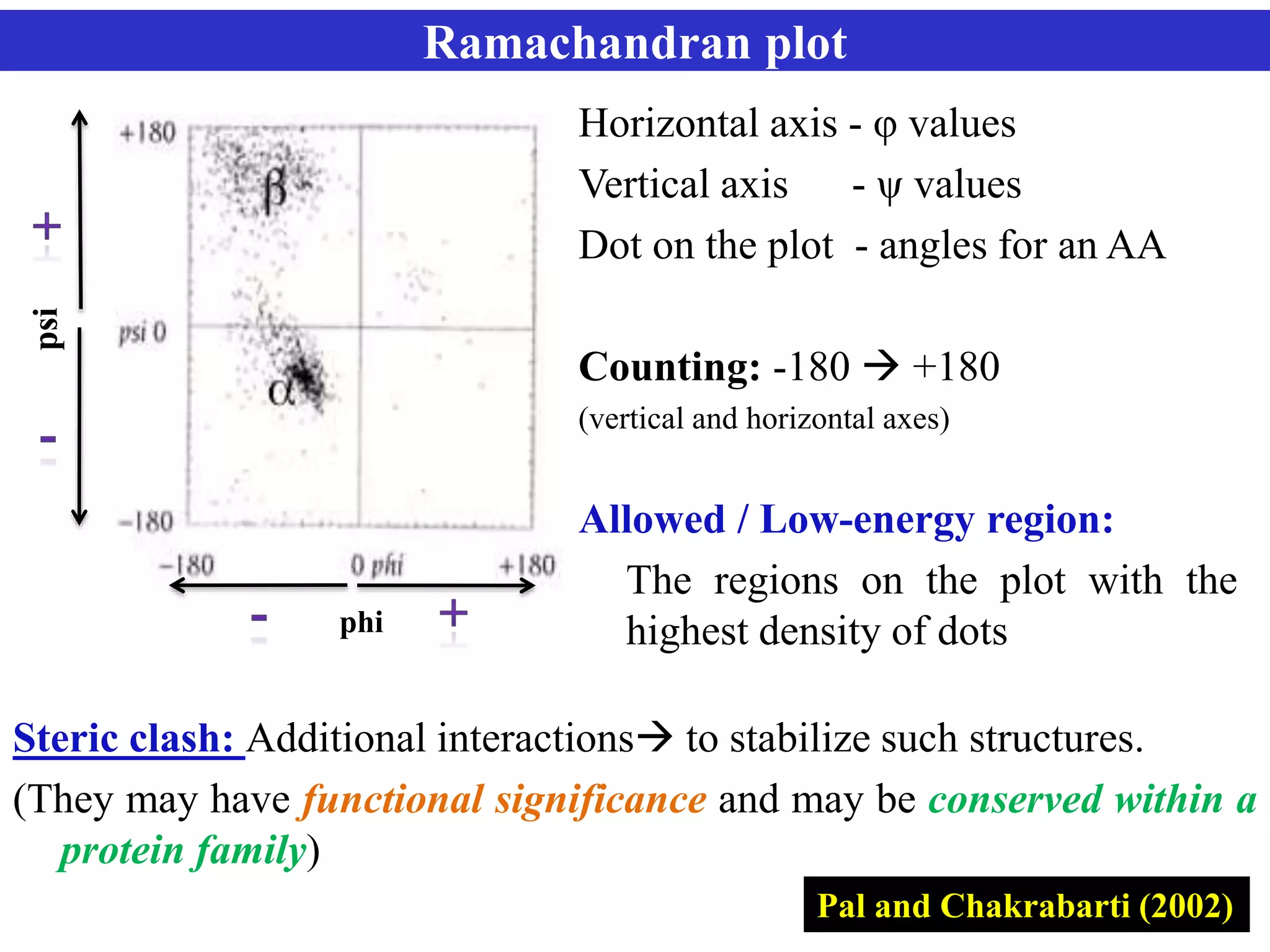
Ramachandran plot
Horizontal axis - φ values
Vertical axis - ψ values
Dot on the plot - angles for an AA
Counting: -180  +180
(vertical and horizontal axes)
Allowed / Low-energy region:
The regions on the plot with the
highest density of dots
psi
phi
Steric clash: Additional interactions to stabilize such structures.
(They may have functional significance and may be conserved within a
protein family)
Pal and Chakrabarti (2002)
Distribution over the map
The distribution of phi and psi angles for a total of 9,156 AA
residues from 4,413 protein chains – crystallographic data.
Two areas where the density of points are high:
1. Around phi= -60 and psi= -60  alpha helix
2. Around phi= -90 and psi= 120  beta structure
-60
-60
-90
120
How to calculate phi and psi angles?
A simple tripeptide
Φ - angle ψ - angle ω - angle
Proteins have three types of backbone dihedral angles
3N overlaps the 3Cα
φ - angle made between the 2C-3N
bond and the 3Cα-3C bond.
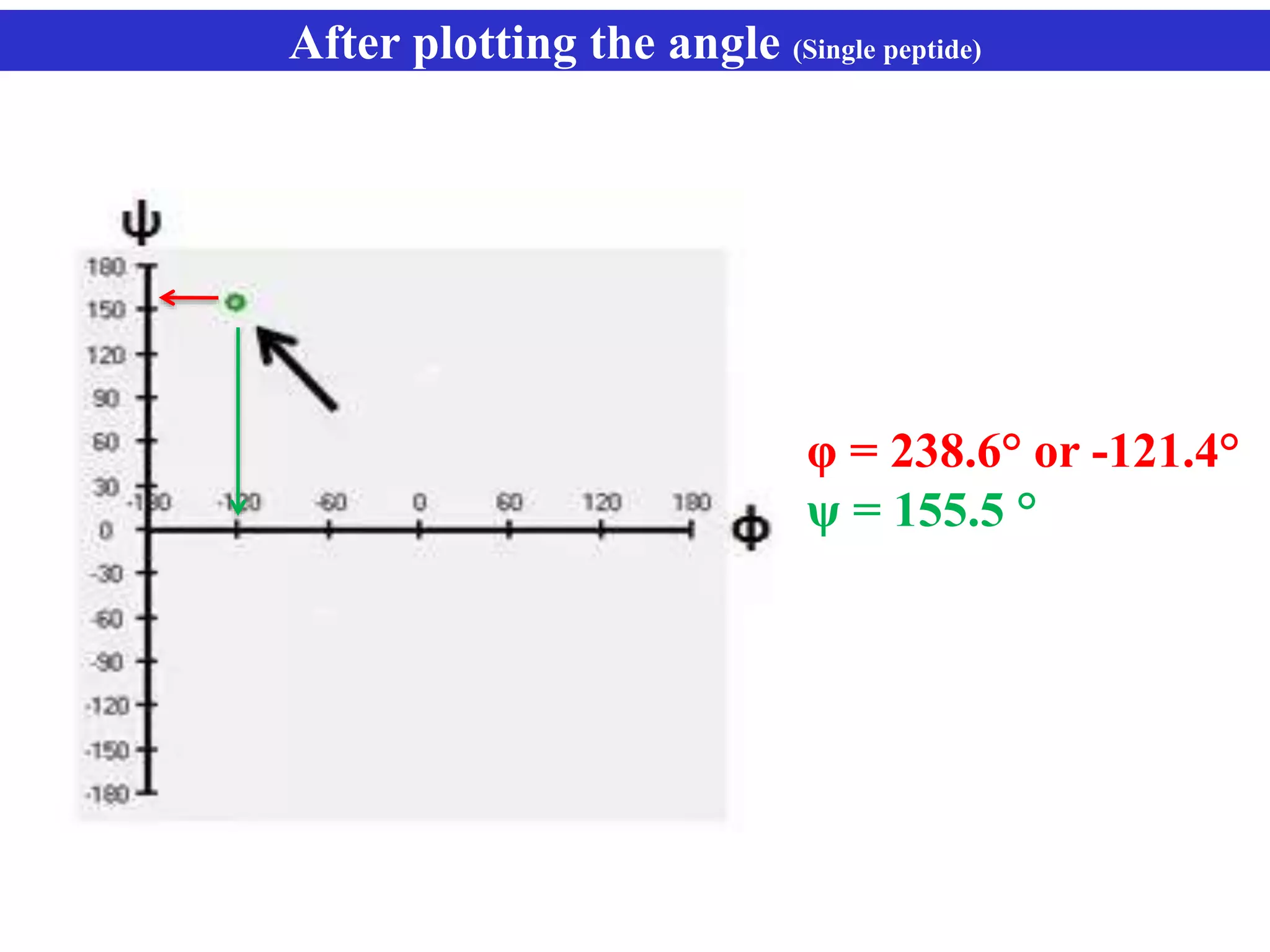
The value of φ is 238.6° or -121.4°
Calculate Φ - angle
3Cα overlaps the 3C
ψ - angle made between the 3N-
3Cα bond and the 3C-4N bond.
The value of ψ is 155.5 °
Calculate ψ - angle
ω - represents the peptide bond
Its value is usually close to 180°
(trans) or 0° (cis)
Calculate ω - angle
After plotting the angle (Single peptide)
φ = 238.6° or -121.4°
ψ = 155.5 °
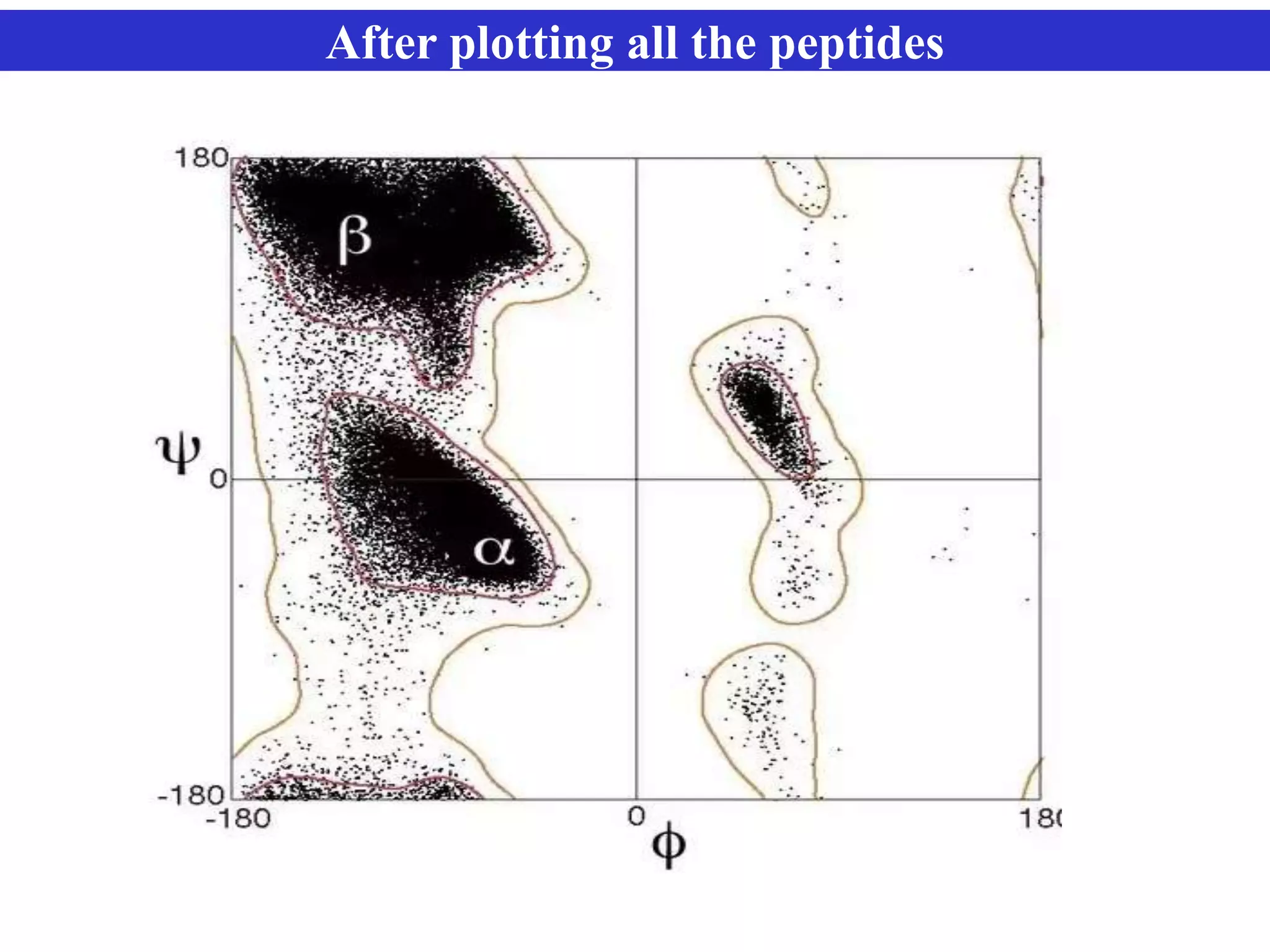
After plotting all the peptides
Regions of the plot
Red  favored region
Brown  allowed region
 generously allowed region
(defined by ProCheck)
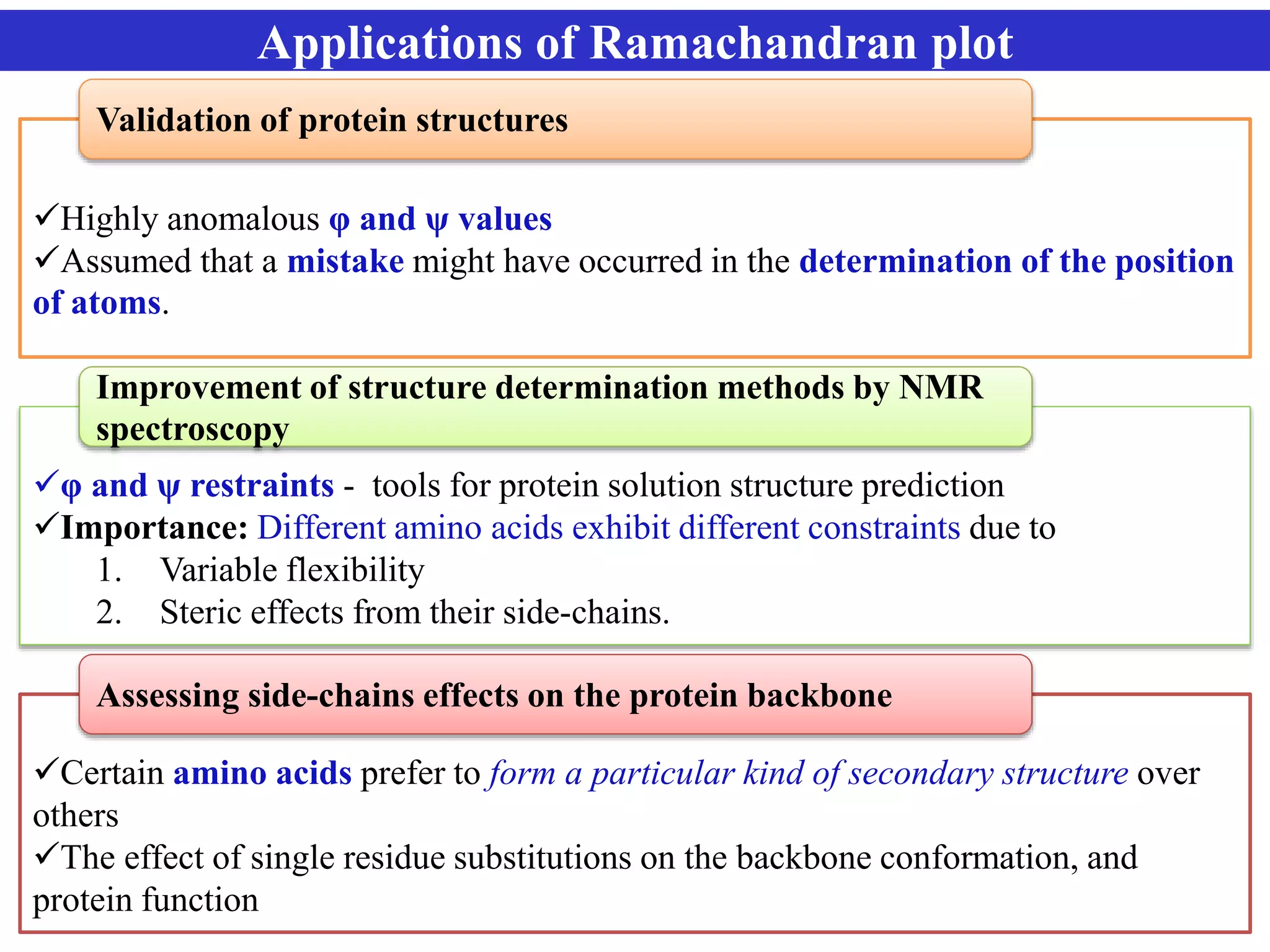
Applications of Ramachandran plot
Highly anomalous φ and ψ values
Assumed that a mistake might have occurred in the determination of the position
of atoms.
Validation of protein structures
φ and ψ restraints - tools for protein solution structure prediction
Importance: Different amino acids exhibit different constraints due to
1. Variable flexibility
2. Steric effects from their side-chains.
Improvement of structure determination methods by NMR
spectroscopy
Certain amino acids prefer to form a particular kind of secondary structure over
others
The effect of single residue substitutions on the backbone conformation, and
protein function
Assessing side-chains effects on the protein backbone
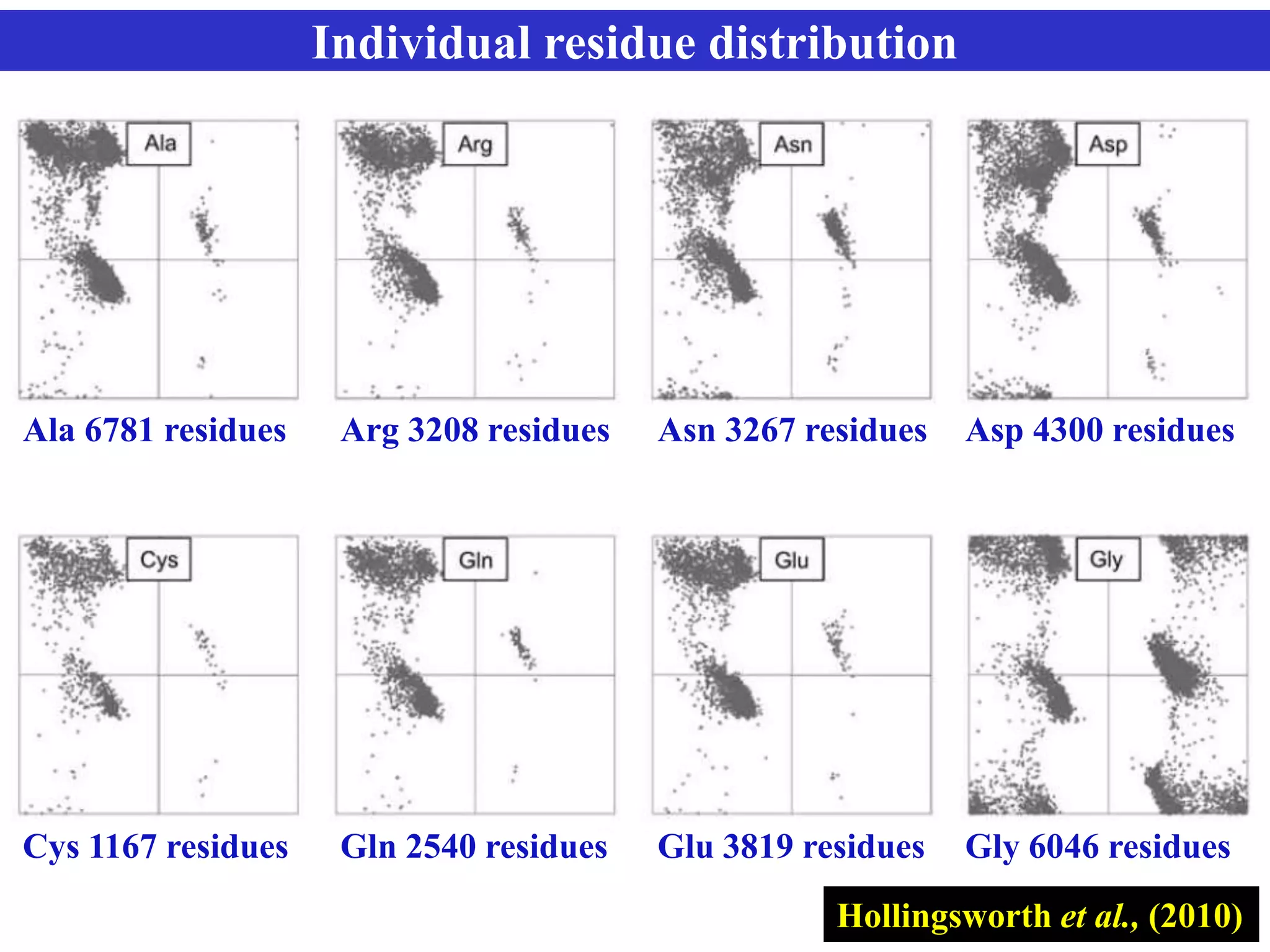
Individual residue distribution
Ala 6781 residues Arg 3208 residues Asn 3267 residues Asp 4300 residues
Cys 1167 residues Gln 2540 residues Glu 3819 residues Gly 6046 residues
Hollingsworth et al., (2010)
Cont.,
His 1748 residues Ile 4128 residues Lue 6334 residues Lys 3287 residues
Met 1342 residues Phe 2904 residues Pro 3185 residues Ser 4340 residues
Hollingsworth et al., (2010)
Cont.,
A
Thr 4545 residues Trp 1197 residues Tyr 2764 residues Val 5474 residues
Xpr 3185 residues
Hollingsworth et al., (2010)
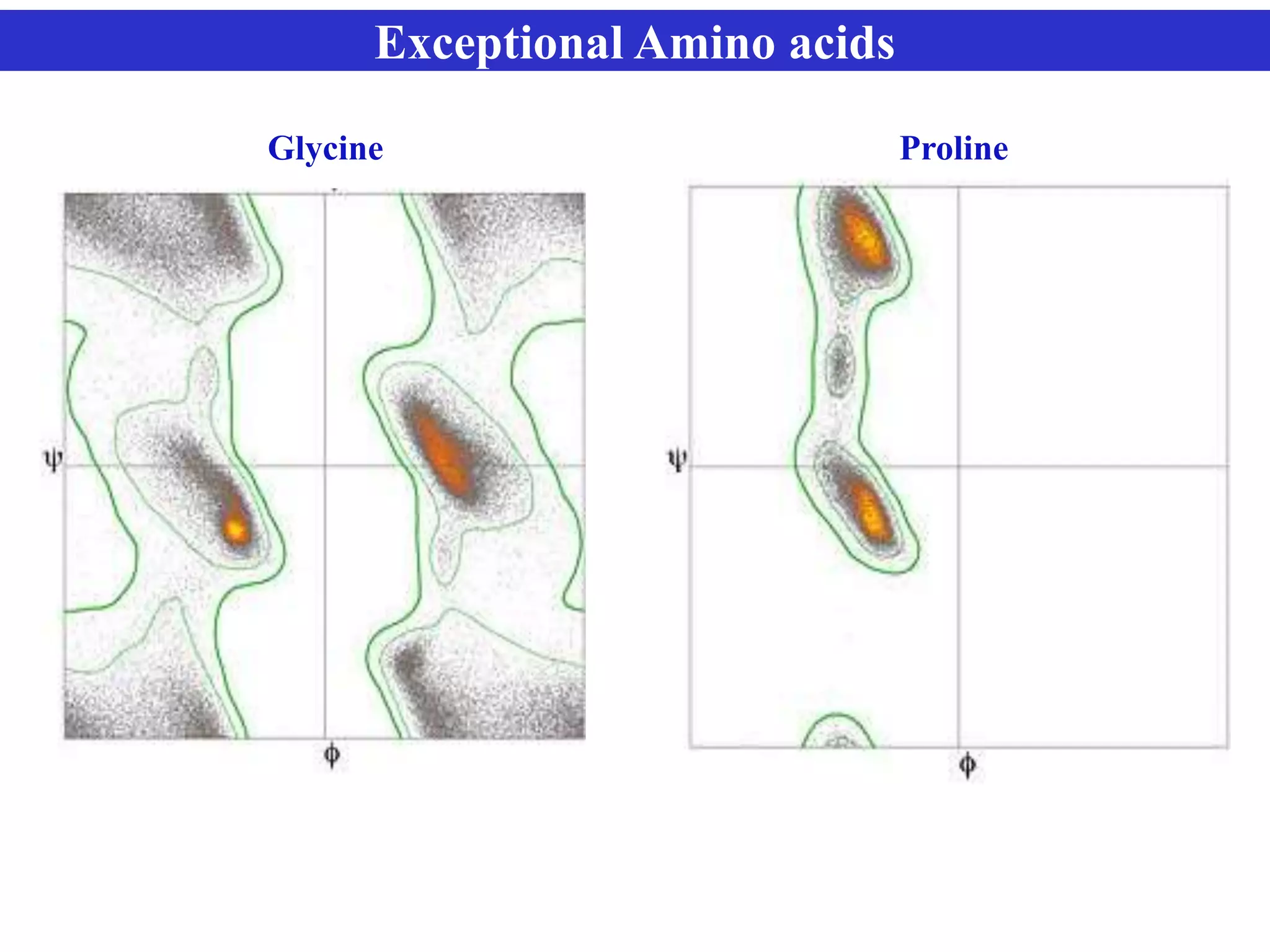
Exceptional Amino acids
Glycine Proline
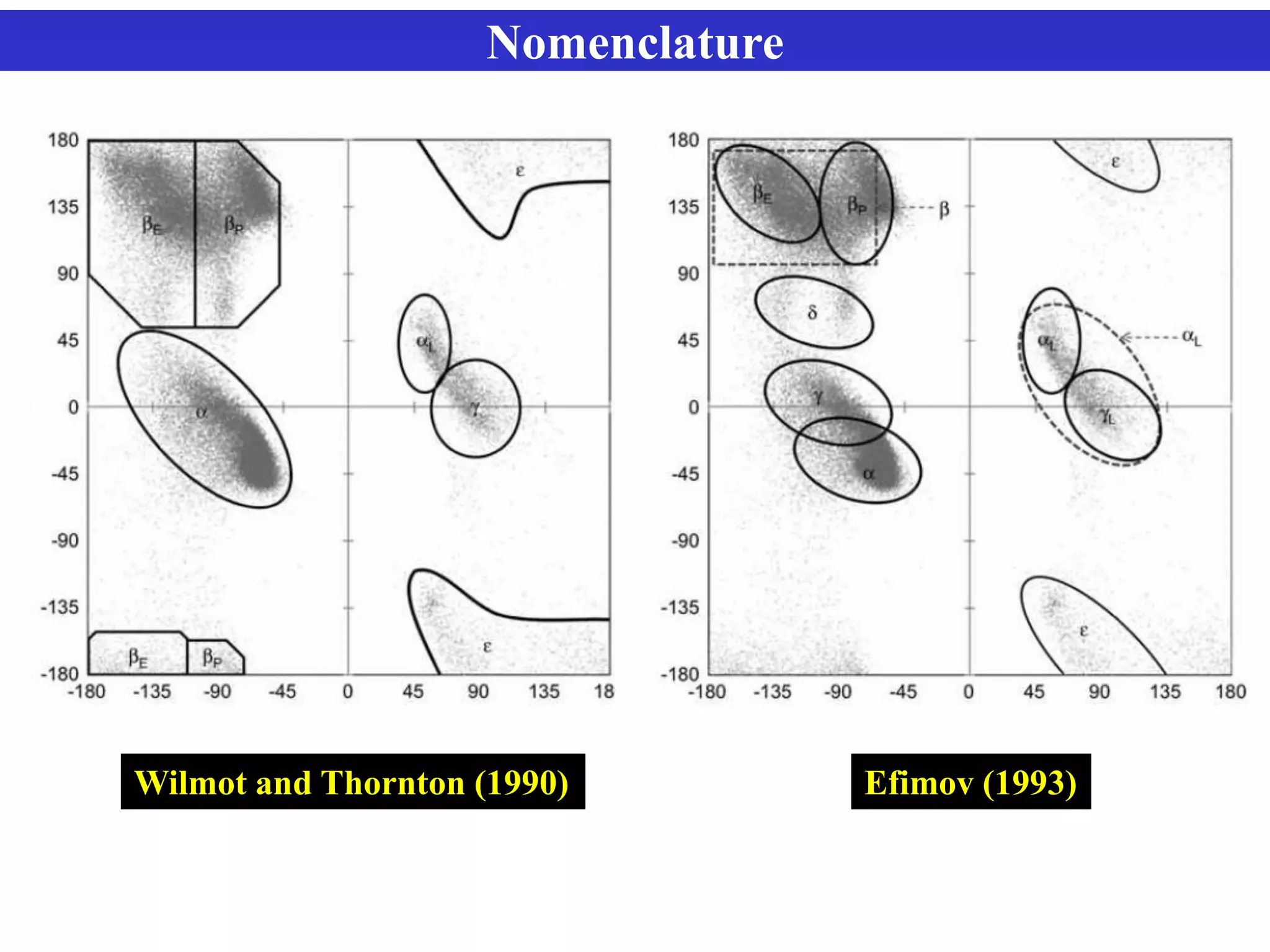
Nomenclature
Wilmot and Thornton (1990) Efimov (1993)
Nomenclature
Oliva et al., (1997) Perskie et al., (2008)
Wrapped Ramachandran plot
63,149 Ala-like residues
(non-Gly, non-Pro)
6046 Gly residues
3D view of Ramachandran plot
References
Articles and review papers:
1. Efimov A V (1993). Standard structures in proteins. Prog Biophysics
Molecular Biology 60: 201–39.
2. Hollingsworth et al., (2010). A fresh look at the Ramachandran plot and
the occurrence of standard structures in proteins. Biological Molecular
Concepts, 1: 271–283.
3. Oliva et al., (1997). An automated classification of the structure of
protein loops. Journal of Molecular Biology 266: 814–30.
4. Perskie LL, Street TO, Rose GD (2008). Structures, basins, and energies:
a deconstruction of the Protein Coil Library. Protein Science 17: 1151–
61.
5. Wilmot C M, Thornton J M (1990). Beta-turns and their distortions: a
proposed new nomenclature. Protein Eng 3: 479–93.
References
Websites:
6. http://www.proteinstructures.com/Structure/Structure/Ramachandran-
plot.html
7. http://skuld.bmsc.washington.edu/~merritt/bc530/local_copies/Ramacha
ndran_article.pdf
8. http://www.greeley.org/~hod/papers/Unsorted/Ramachandran.doc.pdf
Ramachandran Plot

Ramachandran Plot

  • 1.
  • 2.
    Introduction  Ramachandran plot– to visualize the backbone of aminoacid residues (1963 - Collagen)  Used for structural validation and to calculate the possible phi and psi angles that accounts for the aminoacid residues.  Done by several software namely WHATIF RAMACHANDRAN PLOT Ramachandran G N Ramakrishnan C Sasisekharan V
  • 3.
    Softwares MolProbity SAVES STING Pymol VMD WHATCHECK UCSF Chimera Sirius Swiss PDBViewer TALOS Zeus molecular viewer Procheck R A M A C H A N D R A N P L O T S O F T W A R E S
  • 4.
    Ramachandran plot Horizontal axis- φ values Vertical axis - ψ values Dot on the plot - angles for an AA Counting: -180  +180 (vertical and horizontal axes) Allowed / Low-energy region: The regions on the plot with the highest density of dots psi phi Steric clash: Additional interactions to stabilize such structures. (They may have functional significance and may be conserved within a protein family) Pal and Chakrabarti (2002)
  • 5.
    Distribution over themap The distribution of phi and psi angles for a total of 9,156 AA residues from 4,413 protein chains – crystallographic data. Two areas where the density of points are high: 1. Around phi= -60 and psi= -60  alpha helix 2. Around phi= -90 and psi= 120  beta structure -60 -60 -90 120
  • 6.
    How to calculatephi and psi angles? A simple tripeptide Φ - angle ψ - angle ω - angle Proteins have three types of backbone dihedral angles
  • 7.
    3N overlaps the3Cα φ - angle made between the 2C-3N bond and the 3Cα-3C bond. The value of φ is 238.6° or -121.4° Calculate Φ - angle
  • 8.
    3Cα overlaps the3C ψ - angle made between the 3N- 3Cα bond and the 3C-4N bond. The value of ψ is 155.5 ° Calculate ψ - angle
  • 9.
    ω - representsthe peptide bond Its value is usually close to 180° (trans) or 0° (cis) Calculate ω - angle
  • 10.
    After plotting theangle (Single peptide) φ = 238.6° or -121.4° ψ = 155.5 °
  • 11.
    After plotting allthe peptides
  • 12.
    Regions of theplot Red  favored region Brown  allowed region  generously allowed region (defined by ProCheck)
  • 13.
    Applications of Ramachandranplot Highly anomalous φ and ψ values Assumed that a mistake might have occurred in the determination of the position of atoms. Validation of protein structures φ and ψ restraints - tools for protein solution structure prediction Importance: Different amino acids exhibit different constraints due to 1. Variable flexibility 2. Steric effects from their side-chains. Improvement of structure determination methods by NMR spectroscopy Certain amino acids prefer to form a particular kind of secondary structure over others The effect of single residue substitutions on the backbone conformation, and protein function Assessing side-chains effects on the protein backbone
  • 14.
    Individual residue distribution Ala6781 residues Arg 3208 residues Asn 3267 residues Asp 4300 residues Cys 1167 residues Gln 2540 residues Glu 3819 residues Gly 6046 residues Hollingsworth et al., (2010)
  • 15.
    Cont., His 1748 residuesIle 4128 residues Lue 6334 residues Lys 3287 residues Met 1342 residues Phe 2904 residues Pro 3185 residues Ser 4340 residues Hollingsworth et al., (2010)
  • 16.
    Cont., A Thr 4545 residuesTrp 1197 residues Tyr 2764 residues Val 5474 residues Xpr 3185 residues Hollingsworth et al., (2010)
  • 17.
  • 18.
  • 19.
    Nomenclature Oliva et al.,(1997) Perskie et al., (2008)
  • 20.
    Wrapped Ramachandran plot 63,149Ala-like residues (non-Gly, non-Pro) 6046 Gly residues
  • 21.
    3D view ofRamachandran plot
  • 22.
    References Articles and reviewpapers: 1. Efimov A V (1993). Standard structures in proteins. Prog Biophysics Molecular Biology 60: 201–39. 2. Hollingsworth et al., (2010). A fresh look at the Ramachandran plot and the occurrence of standard structures in proteins. Biological Molecular Concepts, 1: 271–283. 3. Oliva et al., (1997). An automated classification of the structure of protein loops. Journal of Molecular Biology 266: 814–30. 4. Perskie LL, Street TO, Rose GD (2008). Structures, basins, and energies: a deconstruction of the Protein Coil Library. Protein Science 17: 1151– 61. 5. Wilmot C M, Thornton J M (1990). Beta-turns and their distortions: a proposed new nomenclature. Protein Eng 3: 479–93.
  • 23.