• Presentation on
Genetic Code
Institute of Agriculture Sciences
Presented by:-
UTTAM KUMAR PATEL
B.Sc. Agriculture (1st Year)
What is Genetic Code ?
• The Genetic Code is the set of rules
by which information encoded in
genetic material (DNA or RNA
sequences) is translated into
proteins by living cells.
• The letters A, G, T and C correspond
to the nucleotides found in DNA.
They are organized into codons
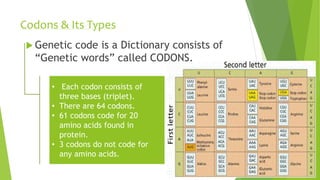
Codons & Its Types
 Genetic code is a Dictionary consists of
“Genetic words” called CODONS.
• Each codon consists of
three bases (triplet).
• There are 64 codons.
• 61 codons code for 20
amino acids found in
protein.
• 3 codons do not code for
any amino acids.
Sense codon:
The codon that code
for amino acid are
called sense codon.
Signal codon:
Those codons that code for signal
during protein synthesis are
called signal codons.
For Example: AUG, UAA, UAG &
UGA.
There are Two types of signal
codons.
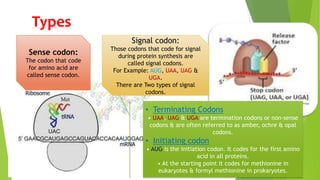
• Terminating Codons
• UAA, UAG & UGA are termination codons or non-sense
codons & are often referred to as amber, ochre & opal
codons.
• Initiating codon
• AUG is the initiation codon. It codes for the first amino
acid in all proteins.
• At the starting point it codes for methionine in
eukaryotes & formyl methionine in prokaryotes.
Types
Anticodon
• The base sequence of tRNA
which pairs with codon of
mRNA during translation is
called anticodon.
• The codon of the mRNA is
recognized by the anticodon
of tRNA.
• They pair with each other in
antiparallel direction (5’- 3’
of mRNA with 3’- 5’of tRNA).
Properties of Genetic Code
UNIVERSALITY
• The genetic code is universal.
• AUA is the codon for methionine
in mitochondria.The same codon
(AUA) codes for isoleucine in
cytoplasm.With some exceptions
noted the genetic code is
universal.
NON-
OVERLAPPING
• One base cannot
participate in the
formation of more
than one codon.
• This means that the
code is non-
overlapping.
DEGENERACY
• There are more than one
codon for one amino acid.
• This is called degeneracy
of genetic code.
Wobble Hypothesis
• Francis Crick proposed the wobble hypothesis in
1966 to explain the pattern of degeneracy.
• Though there are 61 codons coding for amino acids, we
do not need 61 types of tRNA.
• The 3rd nucleotide in the anticodon is often less
important than the first two (binds weakly / not specific).
• The third nucleotide is in the “wobble” position
• Uttam Kumar Patel
E-mail:-uttampatel494@gmail.com

Genetic code

  • 1.
    • Presentation on GeneticCode Institute of Agriculture Sciences Presented by:- UTTAM KUMAR PATEL B.Sc. Agriculture (1st Year)
  • 2.
    What is GeneticCode ? • The Genetic Code is the set of rules by which information encoded in genetic material (DNA or RNA sequences) is translated into proteins by living cells. • The letters A, G, T and C correspond to the nucleotides found in DNA. They are organized into codons
  • 3.
    Codons & ItsTypes  Genetic code is a Dictionary consists of “Genetic words” called CODONS. • Each codon consists of three bases (triplet). • There are 64 codons. • 61 codons code for 20 amino acids found in protein. • 3 codons do not code for any amino acids.
  • 4.
    Sense codon: The codonthat code for amino acid are called sense codon. Signal codon: Those codons that code for signal during protein synthesis are called signal codons. For Example: AUG, UAA, UAG & UGA. There are Two types of signal codons. • Terminating Codons • UAA, UAG & UGA are termination codons or non-sense codons & are often referred to as amber, ochre & opal codons. • Initiating codon • AUG is the initiation codon. It codes for the first amino acid in all proteins. • At the starting point it codes for methionine in eukaryotes & formyl methionine in prokaryotes. Types
  • 5.
    Anticodon • The basesequence of tRNA which pairs with codon of mRNA during translation is called anticodon. • The codon of the mRNA is recognized by the anticodon of tRNA. • They pair with each other in antiparallel direction (5’- 3’ of mRNA with 3’- 5’of tRNA).
  • 6.
    Properties of GeneticCode UNIVERSALITY • The genetic code is universal. • AUA is the codon for methionine in mitochondria.The same codon (AUA) codes for isoleucine in cytoplasm.With some exceptions noted the genetic code is universal. NON- OVERLAPPING • One base cannot participate in the formation of more than one codon. • This means that the code is non- overlapping.
  • 7.
    DEGENERACY • There aremore than one codon for one amino acid. • This is called degeneracy of genetic code.
  • 8.
    Wobble Hypothesis • FrancisCrick proposed the wobble hypothesis in 1966 to explain the pattern of degeneracy. • Though there are 61 codons coding for amino acids, we do not need 61 types of tRNA. • The 3rd nucleotide in the anticodon is often less important than the first two (binds weakly / not specific). • The third nucleotide is in the “wobble” position
  • 9.
    • Uttam KumarPatel E-mail:-uttampatel494@gmail.com