TOPIC : TRANSPOSABLE ELEMENTS IN BACTERIA
PRESENTED BY
TEJASWINI PETKAR
CONTENTS
 INTRODUCTION
 HISTORY
 TRANSPOSABLE ELEMENTS IN BACTERIA
 INSERTION SEQUENCES OR IS ELEMENTS
 PROKARYOTIC TRANSPOSON ELEMENT
 STRUCTURE OF A TRANSPOSON
 MECHANISM OF TRANSPOSITION
 IMPACTS OF TRANSPOSITION
 APPLICATIONS
 CONCLUSION
 REFERENCES
INTRODUCTION
 Almost half of genomes are comprised of a class of repeat DNA
sequences known as transposable elements (TEs) where some TEs have
the ability to mobilize and change locations in the genome.
 A transposable element (TE or transposon) is a DNA sequence that
moves (or jumps) from one location in the genome to another.
 It can change its position within a genome, sometimes creating or
reversing mutations and altering the cell’s genetic identity and genome
size.
 Transposition often results in duplication of the TE.
 Transposable elements in bacteria, in simplest forms are called insertion
sequences -cause premature transcriptional termination in bacteria
operons.
 Bacterial transposons are common and varied. Normal E. coli strains
carry more than one copy of transposons- IS1, IS2, IS3, and IS4.
 In bacteria, transposons can jump from chromosomal DNA to plasmid
DNA and back, allowing for the transfer and permanent addition of
genes.
 The smaller transposons such as the IS elements do not encode
additional functions to transposition.
 Larger transposons often carry genes that confer selective advantage
to the transposon-carrying cell: resistance to antibiotics is most common
while resistance to Hg, toxin production and fermentation genes are also
found.
HISTORY
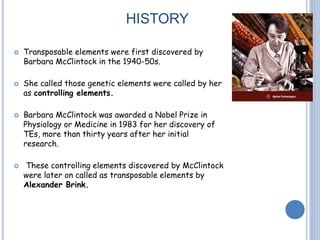
 Transposable elements were first discovered by
Barbara McClintock in the 1940-50s.
 She called those genetic elements were called by her
as controlling elements.
 Barbara McClintock was awarded a Nobel Prize in
Physiology or Medicine in 1983 for her discovery of
TEs, more than thirty years after her initial
research.
 These controlling elements discovered by McClintock
were later on called as transposable elements by
Alexander Brink.
TYPES OF TRANSPOSONS
 The transposable elements of bacteria are diverse in size,
functional arrangement, DNA sequence, and in their modes of
transposition.
 Different transposons may change their sites by following
different transposition mechanisms.
 On the basis of their transposition mechanism, transposons may
be categorized into following types:
(i) Simple (cut and paste) transposons
(ii) Replicative transposons
(iii) Retro transposons
TRANSPOSABLE ELEMENTS IN BACTERIA:
 Although the presence of transposons was predicted in
eukaryotes , the first observation at molecular level was
done in bacteria- a prokaryote.
 Bacterial transposable elements are of the following
types:
(a) Insertion Sequences or IS Elements
(b) Prokaryotic Transposon Element
INSERTION SEQUENCES OR
IS ELEMENTS
 They are the transposable sequences which can insert at different sites
in the bacterial chromosomes.
 IS-elements contain ITRs (Inverted Terminal Repeats).They were first
observed in E.coli. IS elements are relatively short usually not
exceeding 2500 bp.
 The ITRs present at the ends of IS-elements are an important feature
which enables their mobility. The ITRs present in the IS-elements of
E.coli usually range between 18-40 bp.
 In E.coli chromosome, a number of copies of several IS-elements like
IS1, IS2, IS3, IS4 and IS5 are present.
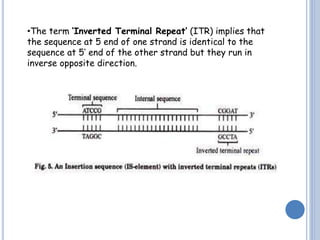
•The term ‘Inverted Terminal Repeat’ (ITR) implies that
the sequence at 5 end of one strand is identical to the
sequence at 5′ end of the other strand but they run in
inverse opposite direction.
PROKARYOTIC TRANSPOSON ELEMENT
 These are also called composite transposons and are shown by
the symbol Tn.
 They are made up of two IS elements, one present at each end
of a DNA sequence which contains genes whose functions are not
related to the transposition process.
 These transposons have been found to have inverted repeats at
the ends.
 The length of these inverted repeats ranges from a few
nucleotides to about 1500 bp.
 It can be said that these are the large transposons which are
formed by capturing of an immobile DNA sequence within two
insertion sequences thus enabling it to move.
 Examples of such transposons include the members of Tn series
like Tn1, Tn5, Tn9, Tn10, etc.
STRUCTURE OF A TRANSPOSON
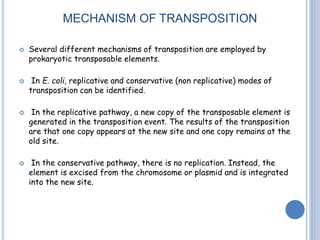
 Transposons are stretches of DNA that have repeated DNA segments
at either end.
 A transposon consists of a central sequence that has transposes gene
and additional genes.
 This is flanked on both sides by short repeated DNA segments.
 The repeated segments may be direct repeats or inverted repeats.
 These terminal repeats help in identifying transposons.
 The number of repeated nucleotides is uneven 5 or 7 or 9 nucleotides
are due to its method of insertion at the target site.
MECHANISM OF TRANSPOSITION
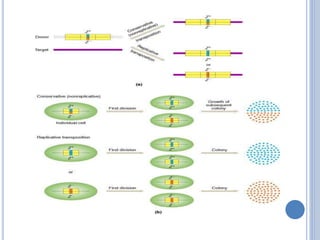
 Several different mechanisms of transposition are employed by
prokaryotic transposable elements.
 In E. coli, replicative and conservative (non replicative) modes of
transposition can be identified.
 In the replicative pathway, a new copy of the transposable element is
generated in the transposition event. The results of the transposition
are that one copy appears at the new site and one copy remains at the
old site.
 In the conservative pathway, there is no replication. Instead, the
element is excised from the chromosome or plasmid and is integrated
into the new site.
REPLICATIVE MECHANISM
 It was proposed by James A.Shapiro in 1979.
 It is a type of transposition in which two copies of the transposon are
generated; one in the original site and another at a new location.
 In this mechanism, the donor and receptor DNA sequences form a
characteristic intermediate "theta" configuration, sometimes called a "Shapiro
intermediate".
 Replicative transposition is characteristic to retrotransposon (transposable
element that uses reverse transcriptase to convert the RNA form of its
genome to a DNA copy).
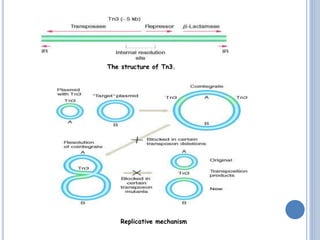
 The plasmid containing the transposon (the donor plasmid) fuses with a host
plasmid (the target plasmid). In the process, the transposon and a short section
of host DNA are replicated.
 The end product is a 'cointegrate' plasmid containing two copies of the
transposon.
 An example of this mechanism is the transposon-Tn3; a 4957 base pair
mobile genetic element, found in prokaryotes.
The structure of Tn3.
Replicative mechanism
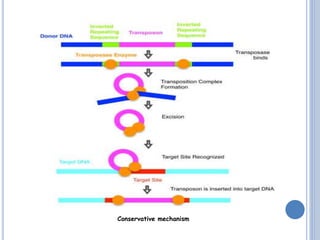
CONSERVATIVE MECHANISM
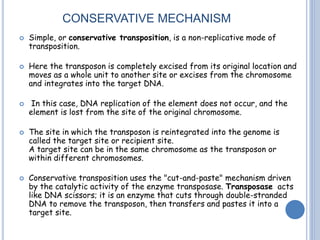
 Simple, or conservative transposition, is a non-replicative mode of
transposition.
 Here the transposon is completely excised from its original location and
moves as a whole unit to another site or excises from the chromosome
and integrates into the target DNA.
 In this case, DNA replication of the element does not occur, and the
element is lost from the site of the original chromosome.
 The site in which the transposon is reintegrated into the genome is
called the target site or recipient site.
A target site can be in the same chromosome as the transposon or
within different chromosomes.
 Conservative transposition uses the "cut-and-paste" mechanism driven
by the catalytic activity of the enzyme transposase. Transposase acts
like DNA scissors; it is an enzyme that cuts through double-stranded
DNA to remove the transposon, then transfers and pastes it into a
target site.
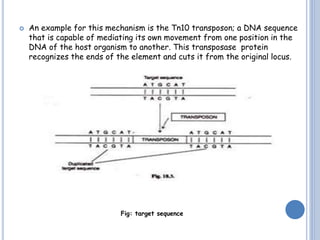
 An example for this mechanism is the Tn10 transposon; a DNA sequence
that is capable of mediating its own movement from one position in the
DNA of the host organism to another. This transposase protein
recognizes the ends of the element and cuts it from the original locus.
Fig: target sequence
Conservative mechanism
IMPACTS OF TRANSPOSITION
 Mutations by insertion or deletion : Transposons inserted
within genes affect the latter’s function, thus causing
disruptions. When inserted within the regulatory sequence of
genes, they cause change in their expression. They are most
common source of mutation. Transposons may insert stop codons
thus producing truncated (shortened) proteins.
 They serve as recombination hot spots.
 They can act as a probe for cloning genes that are mutated by
insertion of a particular element.
 Transposable elements on plasmids carry genes for proteins that
nullify the effects of antibacterial drugs and toxins.
 Transposons introduce great genome flexibility. Sometimes
duplicated genes and other transposons do not succeed in making
a functional gene and therefore they turn into pseudogenes.
 Transposons make positive contribution in evolution as they have
tremendous impact on the alteration of genetic organisation of
organisms.
 Transposon-mediated gene tagging is done for searching and
isolation of a particular gene.
 Transposons may also be used as genetic markers while mapping
the genomes.
APPLICATIONS
 The insertion of a TE into a gene can disrupt that gene’s function in a reversible
manner, in a process called insertional mutagenesis.
Transposase-mediated excision (removal) of the DNA transposon restores gene
function. This produces organisms in which neighboring cells have different
genotypes. This feature allows researchers to distinguish between genes that
must be present inside of a cell in order to function (cell-autonomous) and genes
that produce observable effects in cells other than those where the gene is
expressed.
 TEs are also a widely used tool for mutagenesis of most experimentally tractable
organisms. The Sleeping Beauty transposon system has been used extensively as
an insertional tag for identifying cancer genes.
CONCLUSION
 Transposable elements in bacteria, in simplest forms called insertion sequences
do not encode additional functions to transposition.
 Transposable elements were first discovered by Barbara McClintock in the 1940-
50s and recognized as genetic elements which cause unstable mutations producing
chromosomal aberrations (including breaks) and which change location in the
genome.
 The molecular consequences of transposition reveal an additional piece of
evidence concerning the mechanism of transposition: on integration into a new
target site, transposable elements generate a repeated sequence of the target
DNA in both replicative and conservative transposition.
 Since transposons are semi-parasitic DNA sequences which can replicate and
spread through the host's genome, they can be harnessed as a genetic tool for
analysis of gene and protein function.
 Currently transposons can be used in genetic research and recombinant genetic
engineering for insertional mutagenesis. Given their relatively simple design and
inherent ability to move DNA sequences, transposons are highly compatible at
transducing genetic material making them ideal genetic tools.
REFERENCES
 Miriam Vizvaryova et al., (2004); Transposons – the useful genetic tools; Biologia
59/ 3: 309-318.
 Berg DE (1985); Mechanisms of transposition in bacteria ; basic life science
30:33 -34
 Griffiths AJF, Miller JH, Suzuki DT et al., (2000); An introduction to genetic
analysis; 7th edition.
 Gary Roberts and Timothy Paustian (2000) ; Uses of transposons, University of
Wisconins-Madison
 Harika Gupta ; Transposons – definition and types ( www.biodiscussion.com).
 Rikin Shah; Transposons or jumping genes: types, structures, mechanisms and
function ( www.biodiscussion.com).
 http://www.bio.brandeis.edu/classes/bio1122a/transposition.htm
 Martin Munoz- lopez et al., (2010) ; DNA transposons- nature and applications in
genomics, 11-115-128.

Bacterial transposable elements

  • 1.
    TOPIC : TRANSPOSABLEELEMENTS IN BACTERIA PRESENTED BY TEJASWINI PETKAR
  • 2.
    CONTENTS  INTRODUCTION  HISTORY TRANSPOSABLE ELEMENTS IN BACTERIA  INSERTION SEQUENCES OR IS ELEMENTS  PROKARYOTIC TRANSPOSON ELEMENT  STRUCTURE OF A TRANSPOSON  MECHANISM OF TRANSPOSITION  IMPACTS OF TRANSPOSITION  APPLICATIONS  CONCLUSION  REFERENCES
  • 3.
    INTRODUCTION  Almost halfof genomes are comprised of a class of repeat DNA sequences known as transposable elements (TEs) where some TEs have the ability to mobilize and change locations in the genome.  A transposable element (TE or transposon) is a DNA sequence that moves (or jumps) from one location in the genome to another.  It can change its position within a genome, sometimes creating or reversing mutations and altering the cell’s genetic identity and genome size.  Transposition often results in duplication of the TE.  Transposable elements in bacteria, in simplest forms are called insertion sequences -cause premature transcriptional termination in bacteria operons.
  • 4.
     Bacterial transposonsare common and varied. Normal E. coli strains carry more than one copy of transposons- IS1, IS2, IS3, and IS4.  In bacteria, transposons can jump from chromosomal DNA to plasmid DNA and back, allowing for the transfer and permanent addition of genes.  The smaller transposons such as the IS elements do not encode additional functions to transposition.  Larger transposons often carry genes that confer selective advantage to the transposon-carrying cell: resistance to antibiotics is most common while resistance to Hg, toxin production and fermentation genes are also found.
  • 5.
    HISTORY  Transposable elementswere first discovered by Barbara McClintock in the 1940-50s.  She called those genetic elements were called by her as controlling elements.  Barbara McClintock was awarded a Nobel Prize in Physiology or Medicine in 1983 for her discovery of TEs, more than thirty years after her initial research.  These controlling elements discovered by McClintock were later on called as transposable elements by Alexander Brink.
  • 6.
    TYPES OF TRANSPOSONS The transposable elements of bacteria are diverse in size, functional arrangement, DNA sequence, and in their modes of transposition.  Different transposons may change their sites by following different transposition mechanisms.  On the basis of their transposition mechanism, transposons may be categorized into following types: (i) Simple (cut and paste) transposons (ii) Replicative transposons (iii) Retro transposons
  • 7.
    TRANSPOSABLE ELEMENTS INBACTERIA:  Although the presence of transposons was predicted in eukaryotes , the first observation at molecular level was done in bacteria- a prokaryote.  Bacterial transposable elements are of the following types: (a) Insertion Sequences or IS Elements (b) Prokaryotic Transposon Element
  • 8.
    INSERTION SEQUENCES OR ISELEMENTS  They are the transposable sequences which can insert at different sites in the bacterial chromosomes.  IS-elements contain ITRs (Inverted Terminal Repeats).They were first observed in E.coli. IS elements are relatively short usually not exceeding 2500 bp.  The ITRs present at the ends of IS-elements are an important feature which enables their mobility. The ITRs present in the IS-elements of E.coli usually range between 18-40 bp.  In E.coli chromosome, a number of copies of several IS-elements like IS1, IS2, IS3, IS4 and IS5 are present.
  • 9.
    •The term ‘InvertedTerminal Repeat’ (ITR) implies that the sequence at 5 end of one strand is identical to the sequence at 5′ end of the other strand but they run in inverse opposite direction.
  • 10.
    PROKARYOTIC TRANSPOSON ELEMENT These are also called composite transposons and are shown by the symbol Tn.  They are made up of two IS elements, one present at each end of a DNA sequence which contains genes whose functions are not related to the transposition process.  These transposons have been found to have inverted repeats at the ends.  The length of these inverted repeats ranges from a few nucleotides to about 1500 bp.  It can be said that these are the large transposons which are formed by capturing of an immobile DNA sequence within two insertion sequences thus enabling it to move.  Examples of such transposons include the members of Tn series like Tn1, Tn5, Tn9, Tn10, etc.
  • 11.
    STRUCTURE OF ATRANSPOSON  Transposons are stretches of DNA that have repeated DNA segments at either end.  A transposon consists of a central sequence that has transposes gene and additional genes.  This is flanked on both sides by short repeated DNA segments.  The repeated segments may be direct repeats or inverted repeats.  These terminal repeats help in identifying transposons.  The number of repeated nucleotides is uneven 5 or 7 or 9 nucleotides are due to its method of insertion at the target site.
  • 12.
    MECHANISM OF TRANSPOSITION Several different mechanisms of transposition are employed by prokaryotic transposable elements.  In E. coli, replicative and conservative (non replicative) modes of transposition can be identified.  In the replicative pathway, a new copy of the transposable element is generated in the transposition event. The results of the transposition are that one copy appears at the new site and one copy remains at the old site.  In the conservative pathway, there is no replication. Instead, the element is excised from the chromosome or plasmid and is integrated into the new site.
  • 13.
    REPLICATIVE MECHANISM  Itwas proposed by James A.Shapiro in 1979.  It is a type of transposition in which two copies of the transposon are generated; one in the original site and another at a new location.  In this mechanism, the donor and receptor DNA sequences form a characteristic intermediate "theta" configuration, sometimes called a "Shapiro intermediate".  Replicative transposition is characteristic to retrotransposon (transposable element that uses reverse transcriptase to convert the RNA form of its genome to a DNA copy).  The plasmid containing the transposon (the donor plasmid) fuses with a host plasmid (the target plasmid). In the process, the transposon and a short section of host DNA are replicated.  The end product is a 'cointegrate' plasmid containing two copies of the transposon.  An example of this mechanism is the transposon-Tn3; a 4957 base pair mobile genetic element, found in prokaryotes.
  • 14.
    The structure ofTn3. Replicative mechanism
  • 15.
    CONSERVATIVE MECHANISM  Simple,or conservative transposition, is a non-replicative mode of transposition.  Here the transposon is completely excised from its original location and moves as a whole unit to another site or excises from the chromosome and integrates into the target DNA.  In this case, DNA replication of the element does not occur, and the element is lost from the site of the original chromosome.  The site in which the transposon is reintegrated into the genome is called the target site or recipient site. A target site can be in the same chromosome as the transposon or within different chromosomes.  Conservative transposition uses the "cut-and-paste" mechanism driven by the catalytic activity of the enzyme transposase. Transposase acts like DNA scissors; it is an enzyme that cuts through double-stranded DNA to remove the transposon, then transfers and pastes it into a target site.
  • 16.
     An examplefor this mechanism is the Tn10 transposon; a DNA sequence that is capable of mediating its own movement from one position in the DNA of the host organism to another. This transposase protein recognizes the ends of the element and cuts it from the original locus. Fig: target sequence
  • 17.
  • 19.
    IMPACTS OF TRANSPOSITION Mutations by insertion or deletion : Transposons inserted within genes affect the latter’s function, thus causing disruptions. When inserted within the regulatory sequence of genes, they cause change in their expression. They are most common source of mutation. Transposons may insert stop codons thus producing truncated (shortened) proteins.  They serve as recombination hot spots.  They can act as a probe for cloning genes that are mutated by insertion of a particular element.  Transposable elements on plasmids carry genes for proteins that nullify the effects of antibacterial drugs and toxins.  Transposons introduce great genome flexibility. Sometimes duplicated genes and other transposons do not succeed in making a functional gene and therefore they turn into pseudogenes.
  • 20.
     Transposons makepositive contribution in evolution as they have tremendous impact on the alteration of genetic organisation of organisms.  Transposon-mediated gene tagging is done for searching and isolation of a particular gene.  Transposons may also be used as genetic markers while mapping the genomes.
  • 21.
    APPLICATIONS  The insertionof a TE into a gene can disrupt that gene’s function in a reversible manner, in a process called insertional mutagenesis. Transposase-mediated excision (removal) of the DNA transposon restores gene function. This produces organisms in which neighboring cells have different genotypes. This feature allows researchers to distinguish between genes that must be present inside of a cell in order to function (cell-autonomous) and genes that produce observable effects in cells other than those where the gene is expressed.  TEs are also a widely used tool for mutagenesis of most experimentally tractable organisms. The Sleeping Beauty transposon system has been used extensively as an insertional tag for identifying cancer genes.
  • 22.
    CONCLUSION  Transposable elementsin bacteria, in simplest forms called insertion sequences do not encode additional functions to transposition.  Transposable elements were first discovered by Barbara McClintock in the 1940- 50s and recognized as genetic elements which cause unstable mutations producing chromosomal aberrations (including breaks) and which change location in the genome.  The molecular consequences of transposition reveal an additional piece of evidence concerning the mechanism of transposition: on integration into a new target site, transposable elements generate a repeated sequence of the target DNA in both replicative and conservative transposition.  Since transposons are semi-parasitic DNA sequences which can replicate and spread through the host's genome, they can be harnessed as a genetic tool for analysis of gene and protein function.  Currently transposons can be used in genetic research and recombinant genetic engineering for insertional mutagenesis. Given their relatively simple design and inherent ability to move DNA sequences, transposons are highly compatible at transducing genetic material making them ideal genetic tools.
  • 23.
    REFERENCES  Miriam Vizvaryovaet al., (2004); Transposons – the useful genetic tools; Biologia 59/ 3: 309-318.  Berg DE (1985); Mechanisms of transposition in bacteria ; basic life science 30:33 -34  Griffiths AJF, Miller JH, Suzuki DT et al., (2000); An introduction to genetic analysis; 7th edition.  Gary Roberts and Timothy Paustian (2000) ; Uses of transposons, University of Wisconins-Madison  Harika Gupta ; Transposons – definition and types ( www.biodiscussion.com).  Rikin Shah; Transposons or jumping genes: types, structures, mechanisms and function ( www.biodiscussion.com).  http://www.bio.brandeis.edu/classes/bio1122a/transposition.htm  Martin Munoz- lopez et al., (2010) ; DNA transposons- nature and applications in genomics, 11-115-128.