Gene Mapping Tools
1
Gene mapping
• The graphic representation of arrangement of genes or
DNA sequences on a chromosome.
• Sequence of gene.
• Position of a gene.
• Relative distances in linkage units or physical units,
between genes.
2
Physical mapping
• A physical map is an ordered set of DNA
fragments expressed in physical units
(basepairs)
Physical mapping uses molecular biology
techniques to examine DNA molecules directly
in order to construct maps showing the
positions of genes.
3
4
Genetic Maps
A genetic map is based on the frequencies of
recombination between adjacent genes
during crossover of homologous chromosomes
• The lower the recombination frequency, the greater
the probability of inheriting two genes together.
• Linkage mapping is critical for identifying the location
of genes that cause genetic diseases.
5
Centimorgan unit
• A measure for the distance between the
genes. This distance is expressed in terms of
a genetic map unit (m.u.), or a centimorgan
• Defined as the distance between genes for
which one product of meiosis in 100 is
recombinant. 1 centimorgan is equivalent to 1
percent recombination frequency
6
7
DIFFERENT TYPES OF DNA
MARKERS
• DNA sequence differences between polymorphic
lines may create differences in the length
ofrestriction fragments derived from genomic DNA.
• Southern blot using as probe a DNA fragment
corresponding to that region. The polymorphic bands
can then be used as genetic markers to distinguish
the Multiple RFLP markers can be identified and
assembled into maps.
8
Restriction Fragment Length Polymorphisms
(RFLPs)
RFLP
• Identify the order and/or location of sequence landmarks on the DNA
BamH1 – GGATCC
Restriction Enzyme
Digests
10
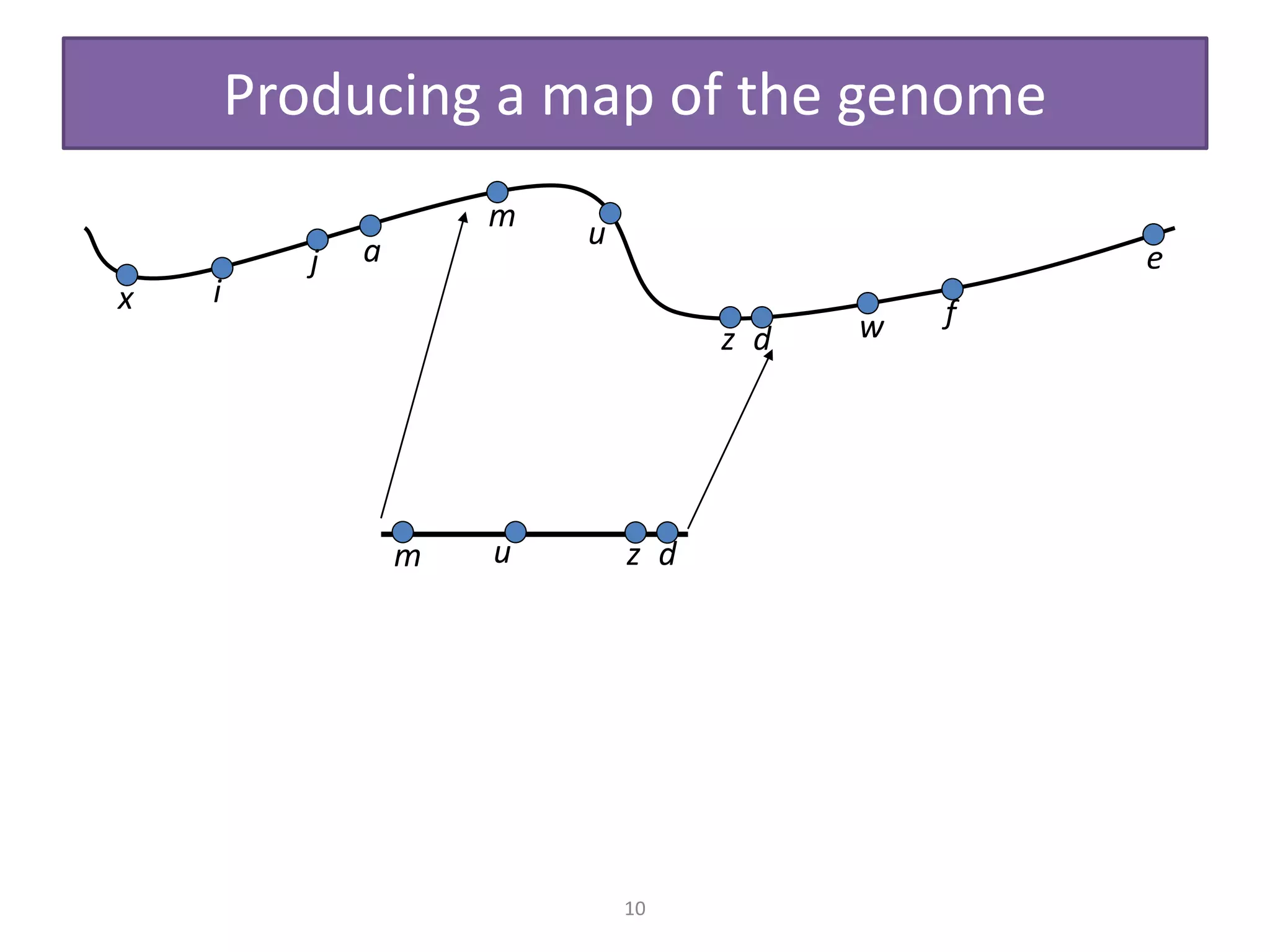
Producing a map of the genome
x i
j a
m u
z d w f
e
m u z d
Single nucleotide polymorphisms
(SNPs).
• These are positions in a genome where some
individuals have one nucleotide (e.g. a G) and
others have a different nucleotide (e.g. a C)
• There are vast numbers of SNPs in every
genome, some of which also give rise to RFLPs,
but many of which do not because the sequence
in which they lie is not recognized by any
restriction enzyme.
• In the human genome there are at least 1.42
million SNPs, only 100 000 of which result in an
RFLP
11
• An oligonucleotide is a short single-stranded DNA
molecule, usually less than 50 nucleotides in length,
that is synthesized in the test tube.
If the conditions are just right, then an oligonucleotide
will hybridize with another DNA molecule only if the
oligonucleotide forms a completely base-paired
structure with the second molecule.
• If there is a single mismatch - a single position within
the oligonucleotide that does not form a base pair -
then hybridization does not occur.
12
OLIGONUCLEOTIDE HYBRIDIZATION ANALYSIS.
Sequence length polymorphisms (SSLPs)
• SSLPs are arrays of repeat sequences that display length
variations, different alleles containing different numbers of
repeat units
• Unlike RFLPs that can have only two alleles, SSLPs can be
multi-allelic as each SSLP can have a number of different
length variants. There are two types of SSLP, both of which
were described in
• Minisatellites, also known as variable number of tandem
repeats (VNTRs), in which the repeat unit is up to 25 bp in
length;
• Microsatellites or simple tandem repeats (STRs), whose
repeats are shorter, usually dinucleotide or tetranucleotide
units.
13
MICROSATELLITES
• Microsatellites are short segments of DNA that have a
repeated sequence such as CACACACA, and they tend to
occur in non-coding DNA. In some microsatellites, the
repeated unit (e.g. CA) may occur four times, in others it may
be seven, or two, or thirty.
The most common way to detect microsatellites is to design PCR
primers that are unique to one locus in the genome and that
base pair on either side of the repeated portion (See the
Figure below). Therefore, a single pair of PCR primers will
work for every individual in the species and produce different
sized products for each of the different length microsatellites
14
Fluorescent in situ hybridization (FISH)
FISH enables the position of a marker on a
chromosome or extended DNA molecule to be
directly visualized.
In optical mapping the marker is a restriction site and it
is visualized as a gap in an extended DNA fiber.
In FISH, the marker is a DNA sequence that is visualized
by hybridization with a fluorescent probe.
15
FISH
16
Sequence Tagged Sites (STSs)
• An STS is a short region of DNA about 200-300
bases long whose exact sequence is found
nowhere else in the genome. Two or more
clones containing the same STS must overlap
and the overlap must include the STS.
Advantages: Rapid and simple
Disadvantages: Still very labor intensive and
high expensive for primer synthesis.
17
Applications
• Mapping helps identify mutant genes that cause
genetic disorders.
Gene map is the anatomy of human genome. It is a
prerequisite to understand functioning of human
genome.
Helps in analysis of the heterogeneity and segregation
of human genetic diseases.
Helps to develop methods for gene therapy.
Provides clinically useful information about linkage
18
19

Gene mapping tools

  • 1.
  • 2.
    Gene mapping • Thegraphic representation of arrangement of genes or DNA sequences on a chromosome. • Sequence of gene. • Position of a gene. • Relative distances in linkage units or physical units, between genes. 2
  • 3.
    Physical mapping • Aphysical map is an ordered set of DNA fragments expressed in physical units (basepairs) Physical mapping uses molecular biology techniques to examine DNA molecules directly in order to construct maps showing the positions of genes. 3
  • 4.
  • 5.
    Genetic Maps A geneticmap is based on the frequencies of recombination between adjacent genes during crossover of homologous chromosomes • The lower the recombination frequency, the greater the probability of inheriting two genes together. • Linkage mapping is critical for identifying the location of genes that cause genetic diseases. 5
  • 6.
    Centimorgan unit • Ameasure for the distance between the genes. This distance is expressed in terms of a genetic map unit (m.u.), or a centimorgan • Defined as the distance between genes for which one product of meiosis in 100 is recombinant. 1 centimorgan is equivalent to 1 percent recombination frequency 6
  • 7.
  • 8.
    • DNA sequencedifferences between polymorphic lines may create differences in the length ofrestriction fragments derived from genomic DNA. • Southern blot using as probe a DNA fragment corresponding to that region. The polymorphic bands can then be used as genetic markers to distinguish the Multiple RFLP markers can be identified and assembled into maps. 8 Restriction Fragment Length Polymorphisms (RFLPs)
  • 9.
    RFLP • Identify theorder and/or location of sequence landmarks on the DNA BamH1 – GGATCC Restriction Enzyme Digests
  • 10.
    10 Producing a mapof the genome x i j a m u z d w f e m u z d
  • 11.
    Single nucleotide polymorphisms (SNPs). •These are positions in a genome where some individuals have one nucleotide (e.g. a G) and others have a different nucleotide (e.g. a C) • There are vast numbers of SNPs in every genome, some of which also give rise to RFLPs, but many of which do not because the sequence in which they lie is not recognized by any restriction enzyme. • In the human genome there are at least 1.42 million SNPs, only 100 000 of which result in an RFLP 11
  • 12.
    • An oligonucleotideis a short single-stranded DNA molecule, usually less than 50 nucleotides in length, that is synthesized in the test tube. If the conditions are just right, then an oligonucleotide will hybridize with another DNA molecule only if the oligonucleotide forms a completely base-paired structure with the second molecule. • If there is a single mismatch - a single position within the oligonucleotide that does not form a base pair - then hybridization does not occur. 12 OLIGONUCLEOTIDE HYBRIDIZATION ANALYSIS.
  • 13.
    Sequence length polymorphisms(SSLPs) • SSLPs are arrays of repeat sequences that display length variations, different alleles containing different numbers of repeat units • Unlike RFLPs that can have only two alleles, SSLPs can be multi-allelic as each SSLP can have a number of different length variants. There are two types of SSLP, both of which were described in • Minisatellites, also known as variable number of tandem repeats (VNTRs), in which the repeat unit is up to 25 bp in length; • Microsatellites or simple tandem repeats (STRs), whose repeats are shorter, usually dinucleotide or tetranucleotide units. 13
  • 14.
    MICROSATELLITES • Microsatellites areshort segments of DNA that have a repeated sequence such as CACACACA, and they tend to occur in non-coding DNA. In some microsatellites, the repeated unit (e.g. CA) may occur four times, in others it may be seven, or two, or thirty. The most common way to detect microsatellites is to design PCR primers that are unique to one locus in the genome and that base pair on either side of the repeated portion (See the Figure below). Therefore, a single pair of PCR primers will work for every individual in the species and produce different sized products for each of the different length microsatellites 14
  • 15.
    Fluorescent in situhybridization (FISH) FISH enables the position of a marker on a chromosome or extended DNA molecule to be directly visualized. In optical mapping the marker is a restriction site and it is visualized as a gap in an extended DNA fiber. In FISH, the marker is a DNA sequence that is visualized by hybridization with a fluorescent probe. 15
  • 16.
  • 17.
    Sequence Tagged Sites(STSs) • An STS is a short region of DNA about 200-300 bases long whose exact sequence is found nowhere else in the genome. Two or more clones containing the same STS must overlap and the overlap must include the STS. Advantages: Rapid and simple Disadvantages: Still very labor intensive and high expensive for primer synthesis. 17
  • 18.
    Applications • Mapping helpsidentify mutant genes that cause genetic disorders. Gene map is the anatomy of human genome. It is a prerequisite to understand functioning of human genome. Helps in analysis of the heterogeneity and segregation of human genetic diseases. Helps to develop methods for gene therapy. Provides clinically useful information about linkage 18
  • 19.