Author(s): David Ginsburg, 2009

License: Unless otherwise noted, this material is made available under the terms of
the Creative Commons Attribution–Non-commercial–Share Alike 3.0 License:
http://creativecommons.org/licenses/by-nc-sa/3.0/
 We have reviewed this material in accordance with U.S. Copyright Law and have tried to maximize your
 ability to use, share, and adapt it. The citation key on the following slide provides information about how you
 may share and adapt this material.

 Copyright holders of content included in this material should contact open.michigan@umich.edu with any
 questions, corrections, or clarification regarding the use of content.

 For more information about how to cite these materials visit http://open.umich.edu/education/about/terms-of-use.

 Any medical information in this material is intended to inform and educate and is not a tool for self-diagnosis
 or a replacement for medical evaluation, advice, diagnosis or treatment by a healthcare professional. Please
 speak to your physician if you have questions about your medical condition.

 Viewer discretion is advised: Some medical content is graphic and may not be suitable for all viewers.
Citation Key
                          for more information see: http://open.umich.edu/wiki/CitationPolicy


Use + Share + Adapt
  { Content the copyright holder, author, or law permits you to use, share and adapt. }
               Public Domain – Government: Works that are produced by the U.S. Government. (USC 17 § 105)
               Public Domain – Expired: Works that are no longer protected due to an expired copyright term.
               Public Domain – Self Dedicated: Works that a copyright holder has dedicated to the public domain.

               Creative Commons – Zero Waiver

               Creative Commons – Attribution License
               Creative Commons – Attribution Share Alike License
               Creative Commons – Attribution Noncommercial License
               Creative Commons – Attribution Noncommercial Share Alike License
               GNU – Free Documentation License

Make Your Own Assessment
  { Content Open.Michigan believes can be used, shared, and adapted because it is ineligible for copyright. }
               Public Domain – Ineligible: Works that are ineligible for copyright protection in the U.S. (USC 17 § 102(b)) *laws in
               your jurisdiction may differ
   { Content Open.Michigan has used under a Fair Use determination. }
               Fair Use: Use of works that is determined to be Fair consistent with the U.S. Copyright Act. (USC 17 § 107) *laws in your
               jurisdiction may differ
               Our determination DOES NOT mean that all uses of this 3rd-party content are Fair Uses and we DO NOT guarantee that
               your use of the content is Fair.
               To use this content you should do your own independent analysis to determine whether or not your use will be Fair.
DNA Sequence Variation
            M1 Patients and Populations
              David Ginsburg, MD
                August 13, 2008


Fall 2008
Learning Objectives

•  Understand the meaning of DNA sequence and
   amino acid polymorphisms.
•  Recognize the different types of DNA sequence
   polymorphisms:
   –  RFLP, VNTR, STR, SNP, CNV
•  Know the different classes of DNA mutation:
   –  Point mutations (silent, missense, nonsense, frameshift,
      splicing, regulatory) insertion/deletions, rearrangements
•  Understand how to distinguish a disease-causing
   mutation from a neutral DNA sequence variation
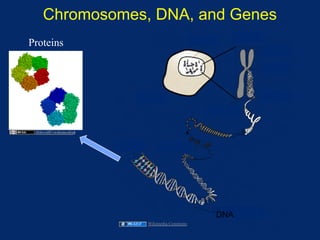
Chromosomes, DNA, and Genes
Proteins


  Jfdwolff (wikimedia)


                          Wikimedia Commons
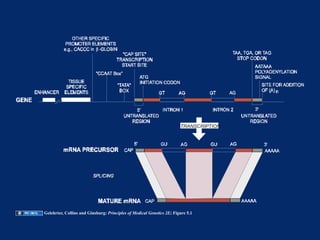
TRANSCRIPTION


Gelehrter, Collins and Ginsburg: Principles of Medical Genetics 2E; Figure 5.1
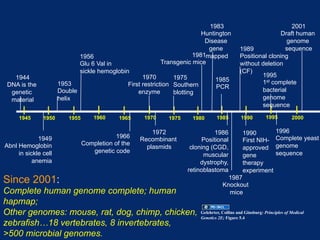
1983                                    2001
                                                                          Huntington                            Draft human
                                                                           Disease                                 genome
                                                                            gene                 1989             sequence
                               1956                                    1981mapped                Positional cloning
                               Glu 6 Val in                 Transgenic mice                      without deletion
                               sickle hemoglobin                                                 (CF)
   1944                                               1970        1975                                   1995
                                                                                    1985                 1st complete
 DNA is the           1953                      First restriction Southern          PCR
  genetic             Double                        enzyme        blotting                               bacterial
  material            helix                                                                              genome
                                                                                                         sequence

     1945      1950      1955       1960     1965    1970      1975    1980          1985         1990         1995         2000

                                                        1972                    1986              1990              1996
             1949                          1966     Recombinant                                                     Complete yeast
                                                                           Positional             First NIH-
Abnl Hemoglobin                 Completion of the                                                                   genome
                                                      plasmids         cloning (CGD,              approved
     in sickle cell                genetic code                                                                     sequence
                                                                            muscular              gene
           anemia                                                          dystrophy,             therapy
                                                                      retinoblastoma              experiment
Since 2001:                                                                               1987
                                                                                        Knockout
Complete human genome complete; human                                                     mice
hapmap;
Other genomes: mouse, rat, dog, chimp, chicken,                              Gelehrter, Collins and Ginsburg: Principles of Medical
                                                                             Genetics 2E; Figure 5.4
zebrafish…18 vertebrates, 8 invertebrates,
>500 microbial genomes.
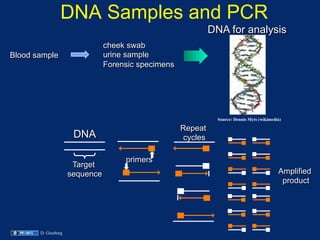
DNA Samples and PCR
                                                               DNA for analysis
                                cheek swab
Blood sample                    urine sample
                                Forensic specimens


                                                                 Source: Dennis Myts (wikimedia)

                                                     Repeat
                      DNA                             cycles

                                     primers
                      Target
                     sequence                                                                 Amplified
                                                                                               product


       D. Ginsburg
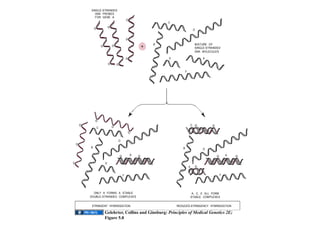
SINGLE-STRANDED
  DNA PROBES
  FOR GENE A
                                         C

                                                             D


                                  B                          MIXTURE OF
                              +                              SINGLE-STRANDED
                                                             DNA MOLECULES

                                         E                       A


                                                     F


                                                         C
    C


                  D

B                                                B               D
                          A                                                    A

         E
                                                         E

                      F                                                    F


  ONLY A FORMS A STABLE                                   A, C, E ALL FORM
DOUBLE-STRANDED COMPLEXES                                STABLE COMPLEXES


 STRINGENT HYBRIDIZATION                     REDUCED-STRINGENCY HYBRIDIZATION

        Gelehrter, Collins and Ginsburg: Principles of Medical Genetics 2E;
        Figure 5.8
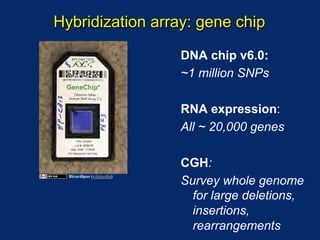
Hybridization array: gene chip

                           DNA chip v6.0:
                           ~1 million SNPs

                           RNA expression:
                           All ~ 20,000 genes

                           CGH:
                           Survey whole genome
  Ricardipus (wikipedia)


                             for large deletions,
                             insertions,
                             rearrangements
Image of DNA
  sequencing
process removed
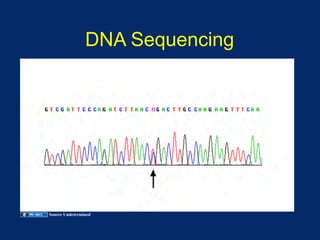
DNA Sequencing


Source Undetermined
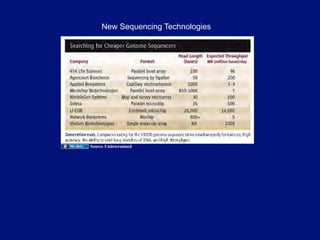
New Sequencing Technologies


Source Undetermined
Learning Objectives

•  Understand the meaning of DNA sequence and
   amino acid polymorphisms.
•  Recognize the different types of DNA sequence
   polymorphisms:
   –  RFLP, VNTR, STR, SNP, CNV
•  Know the different classes of DNA mutation:
   –  Point mutations (silent, missense, nonsense, frameshift,
      splicing, regulatory) insertion/deletions, rearrangements
•  Understand how to distinguish a disease-causing
   mutation from a neutral DNA sequence variation
DNA Sequence Variation
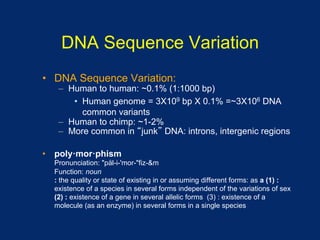
•  DNA Sequence Variation:
   –  Human to human: ~0.1% (1:1000 bp)
       •  Human genome = 3X109 bp X 0.1% =~3X10⁶ DNA
          common variants
   –  Human to chimp: ~1-2%
   –  More common in junk DNA: introns, intergenic regions

•  poly·mor·phism
  Pronunciation: "päl-i-'mor-"fiz-&m
  Function: noun
  : the quality or state of existing in or assuming different forms: as a (1) :
  existence of a species in several forms independent of the variations of sex
  (2) : existence of a gene in several allelic forms (3) : existence of a
  molecule (as an enzyme) in several forms in a single species
Mutations
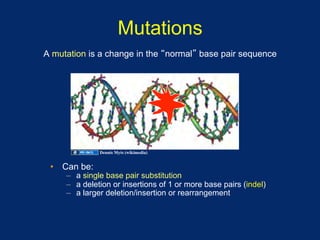
A mutation is a change in the normal base pair sequence


              Dennis Myts (wikimedia)


 •  Can be:
     –  a single base pair substitution
     –  a deletion or insertions of 1 or more base pairs (indel)
     –  a larger deletion/insertion or rearrangement
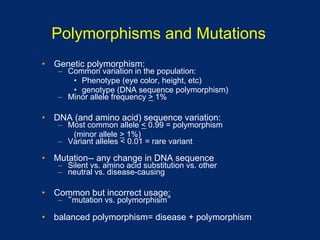
Polymorphisms and Mutations
•  Genetic polymorphism:
   –  Common variation in the population:
       •  Phenotype (eye color, height, etc)
       •  genotype (DNA sequence polymorphism)
   –  Minor allele frequency > 1%

•  DNA (and amino acid) sequence variation:
   –  Most common allele < 0.99 = polymorphism
       (minor allele > 1%)
   –  Variant alleles < 0.01 = rare variant

•  Mutation-- any change in DNA sequence
   –  Silent vs. amino acid substitution vs. other
   –  neutral vs. disease-causing

•  Common but incorrect usage:
   –    mutation vs. polymorphism

•  balanced polymorphism= disease + polymorphism
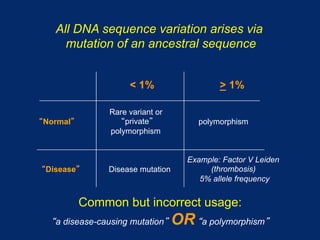
All DNA sequence variation arises via
    mutation of an ancestral sequence


                    < 1%                    > 1%

               Rare variant or
Normal             private             polymorphism
               polymorphism


                                   Example: Factor V Leiden
Disease        Disease mutation         (thrombosis)
                                      5% allele frequency


          Common but incorrect usage:
  a disease-causing mutation      OR   a polymorphism
Learning Objectives

•  Understand the meaning of DNA sequence and
   amino acid polymorphisms.
•  Recognize the different types of DNA sequence
   polymorphisms:
   –  RFLP, VNTR, STR, SNP, CNV
•  Know the different classes of DNA mutation:
   –  Point mutations (silent, missense, nonsense, frameshift,
      splicing, regulatory) insertion/deletions, rearrangements
•  Understand how to distinguish a disease-causing
   mutation from a neutral DNA sequence variation
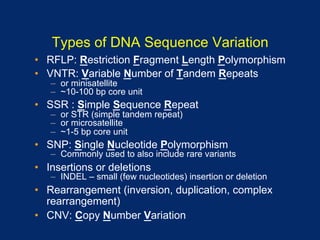
Types of DNA Sequence Variation
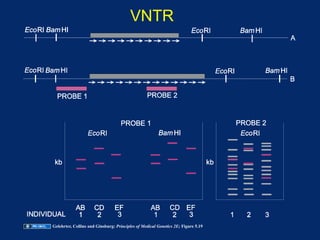
•  RFLP: Restriction Fragment Length Polymorphism
•  VNTR: Variable Number of Tandem Repeats
   –  or minisatellite
   –  ~10-100 bp core unit
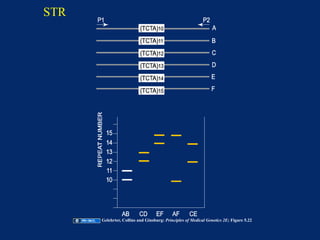
•  SSR : Simple Sequence Repeat
   –  or STR (simple tandem repeat)
   –  or microsatellite
   –  ~1-5 bp core unit
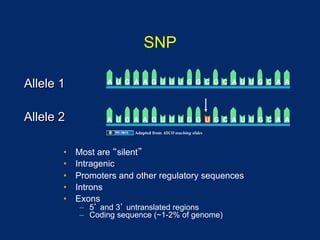
•  SNP: Single Nucleotide Polymorphism
   –  Commonly used to also include rare variants
•  Insertions or deletions
   –  INDEL – small (few nucleotides) insertion or deletion
•  Rearrangement (inversion, duplication, complex
   rearrangement)
•  CNV: Copy Number Variation
VNTR


Gelehrter, Collins and Ginsburg: Principles of Medical Genetics 2E; Figure 5.19
STR


      Gelehrter, Collins and Ginsburg: Principles of Medical Genetics 2E; Figure 5.22
SNP

Allele 1           A U G A A G U U U G G C G C A U U G C A A


Allele 2           A U G A A G U U U G G U G C A U U G C A A
                          Adapted from ASCO teaching slides


       •    Most are silent
       •    Intragenic
       •    Promoters and other regulatory sequences
       •    Introns
       •    Exons
            –  5 and 3 untranslated regions
            –  Coding sequence (~1-2% of genome)
Learning Objectives

•  Understand the meaning of DNA sequence and
   amino acid polymorphisms.
•  Recognize the different types of DNA sequence
   polymorphisms:
   –  RFLP, VNTR, STR, SNP, CNV
•  Know the different classes of DNA mutation:
   –  Point mutations (silent, missense, nonsense, frameshift,
      splicing, regulatory) insertion/deletions, rearrangements
•  Understand how to distinguish a disease-causing
   mutation from a neutral DNA sequence variation
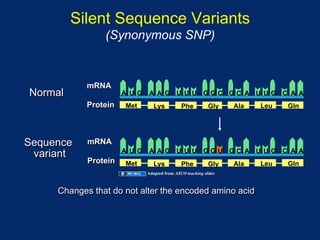
Silent Sequence Variants
                (Synonymous SNP)


            mRNA
Normal                A U G   A A G U U U GGC GC A U UG C A A
            Protein   Met        Lys          Phe          Gly    Ala   Leu   Gln


Sequence    mRNA
                      A U G   A A G U U U GGU GC A U UG C A A
 variant
            Protein   Met        Lys          Phe          Gly    Ala   Leu   Gln
                              Adapted from ASCO teaching slides


     Changes that do not alter the encoded amino acid
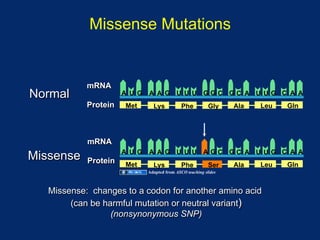
Missense Mutations


            mRNA
Normal                A U G   A A G U U U GGC GC A U UG C A A
            Protein   Met       Lys           Phe          Gly    Ala   Leu   Gln


            mRNA
                      A U G   A A G U U U AGC GC A U UG C A A
Missense    Protein   Met       Lys           Phe          Ser    Ala   Leu   Gln
                              Adapted from ASCO teaching slides


   Missense: changes to a codon for another amino acid
        (can be harmful mutation or neutral variant)
                  (nonsynonymous SNP)
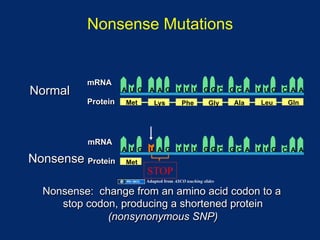
Nonsense Mutations


          mRNA
Normal              A U G    A A G U U U GGC GC A U UG C A A
          Protein   Met        Lys           Phe          Gly   Ala   Leu   Gln


          mRNA
                    A U G    U A G U U U GGC GC A U UG C A A
Nonsense Protein    Met
                            STOP
                            Adapted from ASCO teaching slides

  Nonsense: change from an amino acid codon to a
     stop codon, producing a shortened protein
              (nonsynonymous SNP)
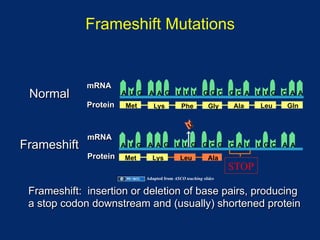
Frameshift Mutations


             mRNA
 Normal                A U G    A A G U U U GGC GC A U UG C A A
             Protein   Met        Lys           Phe          Gly   Ala    Leu   Gln


             mRNA
Frameshift             A U G A A G U U G GC G C A U UGC A A
             Protein   Met       Lys           Leu           Ala
                                                                   STOP
                               Adapted from ASCO teaching slides


 Frameshift: insertion or deletion of base pairs, producing
 a stop codon downstream and (usually) shortened protein
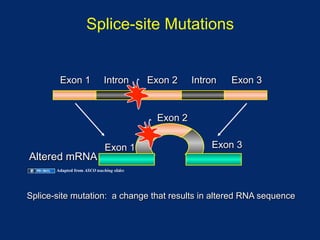
Splice-site Mutations


        Exon 1                Intron       Exon 2    Intron   Exon 3


                                            Exon 2


                              Exon 1                     Exon 3
Altered mRNA
       Adapted from ASCO teaching slides


Splice-site mutation: a change that results in altered RNA sequence
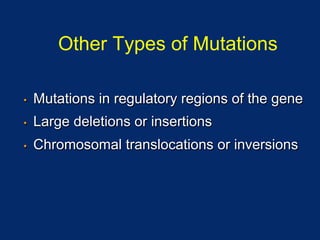
Other Types of Mutations

•    Mutations in regulatory regions of the gene
•    Large deletions or insertions
•    Chromosomal translocations or inversions
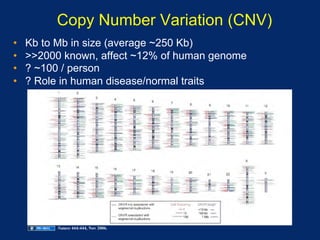
Copy Number Variation (CNV)
•    Kb to Mb in size (average ~250 Kb)
•    >>2000 known, affect ~12% of human genome
•    ? ~100 / person
•    ? Role in human disease/normal traits


          Nature 444:444, Nov 2006.
Learning Objectives

•  Understand the meaning of DNA sequence and
   amino acid polymorphisms.
•  Recognize the different types of DNA sequence
   polymorphisms:
   –  RFLP, VNTR, STR, SNP, CNV
•  Know the different classes of DNA mutation:
   –  Point mutations (silent, missense, nonsense, frameshift,
      splicing, regulatory) insertion/deletions, rearrangements
•  Understand how to distinguish a disease-causing
   mutation from a neutral DNA sequence variation
Tests to Detect Mutations

•  Many methods/technologies
•  Rapidly changing


•  DNA sequencing
  –  Most direct and informative
  –  The gold standard
  –  Targeted region (known mutation)
  –  Whole gene (unknown mutation)
  –  … Whole genome
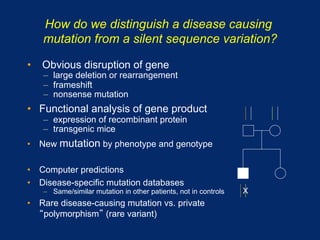
How do we distinguish a disease causing
   mutation from a silent sequence variation?

•  Obvious disruption of gene
   –  large deletion or rearrangement
   –  frameshift
   –  nonsense mutation
•  Functional analysis of gene product
   –  expression of recombinant protein
   –  transgenic mice
•  New mutation by phenotype and genotype

•  Computer predictions
•  Disease-specific mutation databases
   –  Same/similar mutation in other patients, not in controls   X
•  Rare disease-causing mutation vs. private
    polymorphism (rare variant)
Learning Objectives

•  Understand the meaning of DNA sequence and
   amino acid polymorphisms.
•  Recognize the different types of DNA sequence
   polymorphisms:
   –  RFLP, VNTR, STR, SNP, CNV
•  Know the different classes of DNA mutation:
   –  Point mutations (silent, missense, nonsense, frameshift,
      splicing, regulatory) insertion/deletions, rearrangements
•  Understand how to distinguish a disease-causing
   mutation from a neutral DNA sequence variation
Additional Source Information
                        for more information see: http://open.umich.edu/wiki/CitationPolicy


Slide 5: Jfdwolff (wikimedia) http://creativecommons.org/licenses/by-sa/3.0/;
       http://commons.wikimedia.org/wiki/File:Chromosome_zh-tw.svg
 Slide 6: Gelehrter, Collins and Ginsburg: Principles of Medical Genetics 2E, Figure 5.1
 Slide 7: Gelehrter, Collins and Ginsburg: Principles of Medical Genetics 2E, Figure 5.4
 Slide 8: D. Ginsburg
 Slide 9: Gelehrter, Collins and Ginsburg: Principles of Medical Genetics 2E, Figure 5.8
 Slide 10: CC: BY-SA: Ricardipus (wikipedia) http://creativecommons.org/licenses/by-sa/2.0/deed.en
 Slide 11: Image of DNA sequencing process removed
 Slide 12: Undetermined
 Slide 13: Undertirmined
 Slide 16: Dennis Myts (wikimedia)
 Slide 21: Gelehrter, Collins and Ginsburg: Principles of Medical Genetics 2E, Figure 5.19
 Slide 22: Gelehrter, Collins and Ginsburg: Principles of Medical Genetics 2E, Figure 5.22
 Slide 23: Adapted from ASCO teaching slides
 Slide 25: Adapted from ASCO teaching slides
 Slide 26: Adapted from ASCO teaching slides
 Slide 27: Adapted from ASCO teaching slides
 Slide 28: Adapted from ASCO teaching slides
 Slide 29: Adapted from ASCO teaching slides
 Slide 31: Nature 444:444, Nov 2006.

08.13.08: DNA Sequence Variation

  • 1.
    Author(s): David Ginsburg,2009 License: Unless otherwise noted, this material is made available under the terms of the Creative Commons Attribution–Non-commercial–Share Alike 3.0 License: http://creativecommons.org/licenses/by-nc-sa/3.0/ We have reviewed this material in accordance with U.S. Copyright Law and have tried to maximize your ability to use, share, and adapt it. The citation key on the following slide provides information about how you may share and adapt this material. Copyright holders of content included in this material should contact open.michigan@umich.edu with any questions, corrections, or clarification regarding the use of content. For more information about how to cite these materials visit http://open.umich.edu/education/about/terms-of-use. Any medical information in this material is intended to inform and educate and is not a tool for self-diagnosis or a replacement for medical evaluation, advice, diagnosis or treatment by a healthcare professional. Please speak to your physician if you have questions about your medical condition. Viewer discretion is advised: Some medical content is graphic and may not be suitable for all viewers.
  • 2.
    Citation Key for more information see: http://open.umich.edu/wiki/CitationPolicy Use + Share + Adapt { Content the copyright holder, author, or law permits you to use, share and adapt. } Public Domain – Government: Works that are produced by the U.S. Government. (USC 17 § 105) Public Domain – Expired: Works that are no longer protected due to an expired copyright term. Public Domain – Self Dedicated: Works that a copyright holder has dedicated to the public domain. Creative Commons – Zero Waiver Creative Commons – Attribution License Creative Commons – Attribution Share Alike License Creative Commons – Attribution Noncommercial License Creative Commons – Attribution Noncommercial Share Alike License GNU – Free Documentation License Make Your Own Assessment { Content Open.Michigan believes can be used, shared, and adapted because it is ineligible for copyright. } Public Domain – Ineligible: Works that are ineligible for copyright protection in the U.S. (USC 17 § 102(b)) *laws in your jurisdiction may differ { Content Open.Michigan has used under a Fair Use determination. } Fair Use: Use of works that is determined to be Fair consistent with the U.S. Copyright Act. (USC 17 § 107) *laws in your jurisdiction may differ Our determination DOES NOT mean that all uses of this 3rd-party content are Fair Uses and we DO NOT guarantee that your use of the content is Fair. To use this content you should do your own independent analysis to determine whether or not your use will be Fair.
  • 3.
    DNA Sequence Variation M1 Patients and Populations David Ginsburg, MD August 13, 2008 Fall 2008
  • 4.
    Learning Objectives •  Understandthe meaning of DNA sequence and amino acid polymorphisms. •  Recognize the different types of DNA sequence polymorphisms: –  RFLP, VNTR, STR, SNP, CNV •  Know the different classes of DNA mutation: –  Point mutations (silent, missense, nonsense, frameshift, splicing, regulatory) insertion/deletions, rearrangements •  Understand how to distinguish a disease-causing mutation from a neutral DNA sequence variation
  • 5.
    Chromosomes, DNA, andGenes Proteins Jfdwolff (wikimedia) Wikimedia Commons
  • 6.
    TRANSCRIPTION Gelehrter, Collins andGinsburg: Principles of Medical Genetics 2E; Figure 5.1
  • 7.
    1983 2001 Huntington Draft human Disease genome gene 1989 sequence 1956 1981mapped Positional cloning Glu 6 Val in Transgenic mice without deletion sickle hemoglobin (CF) 1944 1970 1975 1995 1985 1st complete DNA is the 1953 First restriction Southern PCR genetic Double enzyme blotting bacterial material helix genome sequence 1945 1950 1955 1960 1965 1970 1975 1980 1985 1990 1995 2000 1972 1986 1990 1996 1949 1966 Recombinant Complete yeast Positional First NIH- Abnl Hemoglobin Completion of the genome plasmids cloning (CGD, approved in sickle cell genetic code sequence muscular gene anemia dystrophy, therapy retinoblastoma experiment Since 2001: 1987 Knockout Complete human genome complete; human mice hapmap; Other genomes: mouse, rat, dog, chimp, chicken, Gelehrter, Collins and Ginsburg: Principles of Medical Genetics 2E; Figure 5.4 zebrafish…18 vertebrates, 8 invertebrates, >500 microbial genomes.
  • 8.
    DNA Samples andPCR DNA for analysis cheek swab Blood sample urine sample Forensic specimens Source: Dennis Myts (wikimedia) Repeat DNA cycles primers Target sequence Amplified product D. Ginsburg
  • 9.
    SINGLE-STRANDED DNAPROBES FOR GENE A C D B MIXTURE OF + SINGLE-STRANDED DNA MOLECULES E A F C C D B B D A A E E F F ONLY A FORMS A STABLE A, C, E ALL FORM DOUBLE-STRANDED COMPLEXES STABLE COMPLEXES STRINGENT HYBRIDIZATION REDUCED-STRINGENCY HYBRIDIZATION Gelehrter, Collins and Ginsburg: Principles of Medical Genetics 2E; Figure 5.8
  • 10.
    Hybridization array: genechip DNA chip v6.0: ~1 million SNPs RNA expression: All ~ 20,000 genes CGH: Survey whole genome Ricardipus (wikipedia) for large deletions, insertions, rearrangements
  • 11.
    Image of DNA sequencing process removed
  • 12.
  • 13.
  • 14.
    Learning Objectives •  Understandthe meaning of DNA sequence and amino acid polymorphisms. •  Recognize the different types of DNA sequence polymorphisms: –  RFLP, VNTR, STR, SNP, CNV •  Know the different classes of DNA mutation: –  Point mutations (silent, missense, nonsense, frameshift, splicing, regulatory) insertion/deletions, rearrangements •  Understand how to distinguish a disease-causing mutation from a neutral DNA sequence variation
  • 15.
    DNA Sequence Variation • DNA Sequence Variation: –  Human to human: ~0.1% (1:1000 bp) •  Human genome = 3X109 bp X 0.1% =~3X10⁶ DNA common variants –  Human to chimp: ~1-2% –  More common in junk DNA: introns, intergenic regions •  poly·mor·phism Pronunciation: "päl-i-'mor-"fiz-&m Function: noun : the quality or state of existing in or assuming different forms: as a (1) : existence of a species in several forms independent of the variations of sex (2) : existence of a gene in several allelic forms (3) : existence of a molecule (as an enzyme) in several forms in a single species
  • 16.
    Mutations A mutation isa change in the normal base pair sequence Dennis Myts (wikimedia) •  Can be: –  a single base pair substitution –  a deletion or insertions of 1 or more base pairs (indel) –  a larger deletion/insertion or rearrangement
  • 17.
    Polymorphisms and Mutations • Genetic polymorphism: –  Common variation in the population: •  Phenotype (eye color, height, etc) •  genotype (DNA sequence polymorphism) –  Minor allele frequency > 1% •  DNA (and amino acid) sequence variation: –  Most common allele < 0.99 = polymorphism (minor allele > 1%) –  Variant alleles < 0.01 = rare variant •  Mutation-- any change in DNA sequence –  Silent vs. amino acid substitution vs. other –  neutral vs. disease-causing •  Common but incorrect usage: –  mutation vs. polymorphism •  balanced polymorphism= disease + polymorphism
  • 18.
    All DNA sequencevariation arises via mutation of an ancestral sequence < 1% > 1% Rare variant or Normal private polymorphism polymorphism Example: Factor V Leiden Disease Disease mutation (thrombosis) 5% allele frequency Common but incorrect usage: a disease-causing mutation OR a polymorphism
  • 19.
    Learning Objectives •  Understandthe meaning of DNA sequence and amino acid polymorphisms. •  Recognize the different types of DNA sequence polymorphisms: –  RFLP, VNTR, STR, SNP, CNV •  Know the different classes of DNA mutation: –  Point mutations (silent, missense, nonsense, frameshift, splicing, regulatory) insertion/deletions, rearrangements •  Understand how to distinguish a disease-causing mutation from a neutral DNA sequence variation
  • 20.
    Types of DNASequence Variation •  RFLP: Restriction Fragment Length Polymorphism •  VNTR: Variable Number of Tandem Repeats –  or minisatellite –  ~10-100 bp core unit •  SSR : Simple Sequence Repeat –  or STR (simple tandem repeat) –  or microsatellite –  ~1-5 bp core unit •  SNP: Single Nucleotide Polymorphism –  Commonly used to also include rare variants •  Insertions or deletions –  INDEL – small (few nucleotides) insertion or deletion •  Rearrangement (inversion, duplication, complex rearrangement) •  CNV: Copy Number Variation
  • 21.
    VNTR Gelehrter, Collins andGinsburg: Principles of Medical Genetics 2E; Figure 5.19
  • 22.
    STR Gelehrter, Collins and Ginsburg: Principles of Medical Genetics 2E; Figure 5.22
  • 23.
    SNP Allele 1 A U G A A G U U U G G C G C A U U G C A A Allele 2 A U G A A G U U U G G U G C A U U G C A A Adapted from ASCO teaching slides •  Most are silent •  Intragenic •  Promoters and other regulatory sequences •  Introns •  Exons –  5 and 3 untranslated regions –  Coding sequence (~1-2% of genome)
  • 24.
    Learning Objectives •  Understandthe meaning of DNA sequence and amino acid polymorphisms. •  Recognize the different types of DNA sequence polymorphisms: –  RFLP, VNTR, STR, SNP, CNV •  Know the different classes of DNA mutation: –  Point mutations (silent, missense, nonsense, frameshift, splicing, regulatory) insertion/deletions, rearrangements •  Understand how to distinguish a disease-causing mutation from a neutral DNA sequence variation
  • 25.
    Silent Sequence Variants (Synonymous SNP) mRNA Normal A U G A A G U U U GGC GC A U UG C A A Protein Met Lys Phe Gly Ala Leu Gln Sequence mRNA A U G A A G U U U GGU GC A U UG C A A variant Protein Met Lys Phe Gly Ala Leu Gln Adapted from ASCO teaching slides Changes that do not alter the encoded amino acid
  • 26.
    Missense Mutations mRNA Normal A U G A A G U U U GGC GC A U UG C A A Protein Met Lys Phe Gly Ala Leu Gln mRNA A U G A A G U U U AGC GC A U UG C A A Missense Protein Met Lys Phe Ser Ala Leu Gln Adapted from ASCO teaching slides Missense: changes to a codon for another amino acid (can be harmful mutation or neutral variant) (nonsynonymous SNP)
  • 27.
    Nonsense Mutations mRNA Normal A U G A A G U U U GGC GC A U UG C A A Protein Met Lys Phe Gly Ala Leu Gln mRNA A U G U A G U U U GGC GC A U UG C A A Nonsense Protein Met STOP Adapted from ASCO teaching slides Nonsense: change from an amino acid codon to a stop codon, producing a shortened protein (nonsynonymous SNP)
  • 28.
    Frameshift Mutations mRNA Normal A U G A A G U U U GGC GC A U UG C A A Protein Met Lys Phe Gly Ala Leu Gln mRNA Frameshift A U G A A G U U G GC G C A U UGC A A Protein Met Lys Leu Ala STOP Adapted from ASCO teaching slides Frameshift: insertion or deletion of base pairs, producing a stop codon downstream and (usually) shortened protein
  • 29.
    Splice-site Mutations Exon 1 Intron Exon 2 Intron Exon 3 Exon 2 Exon 1 Exon 3 Altered mRNA Adapted from ASCO teaching slides Splice-site mutation: a change that results in altered RNA sequence
  • 30.
    Other Types ofMutations •  Mutations in regulatory regions of the gene •  Large deletions or insertions •  Chromosomal translocations or inversions
  • 31.
    Copy Number Variation(CNV) •  Kb to Mb in size (average ~250 Kb) •  >>2000 known, affect ~12% of human genome •  ? ~100 / person •  ? Role in human disease/normal traits Nature 444:444, Nov 2006.
  • 32.
    Learning Objectives •  Understandthe meaning of DNA sequence and amino acid polymorphisms. •  Recognize the different types of DNA sequence polymorphisms: –  RFLP, VNTR, STR, SNP, CNV •  Know the different classes of DNA mutation: –  Point mutations (silent, missense, nonsense, frameshift, splicing, regulatory) insertion/deletions, rearrangements •  Understand how to distinguish a disease-causing mutation from a neutral DNA sequence variation
  • 33.
    Tests to DetectMutations •  Many methods/technologies •  Rapidly changing •  DNA sequencing –  Most direct and informative –  The gold standard –  Targeted region (known mutation) –  Whole gene (unknown mutation) –  … Whole genome
  • 34.
    How do wedistinguish a disease causing mutation from a silent sequence variation? •  Obvious disruption of gene –  large deletion or rearrangement –  frameshift –  nonsense mutation •  Functional analysis of gene product –  expression of recombinant protein –  transgenic mice •  New mutation by phenotype and genotype •  Computer predictions •  Disease-specific mutation databases –  Same/similar mutation in other patients, not in controls X •  Rare disease-causing mutation vs. private polymorphism (rare variant)
  • 35.
    Learning Objectives •  Understandthe meaning of DNA sequence and amino acid polymorphisms. •  Recognize the different types of DNA sequence polymorphisms: –  RFLP, VNTR, STR, SNP, CNV •  Know the different classes of DNA mutation: –  Point mutations (silent, missense, nonsense, frameshift, splicing, regulatory) insertion/deletions, rearrangements •  Understand how to distinguish a disease-causing mutation from a neutral DNA sequence variation
  • 36.
    Additional Source Information for more information see: http://open.umich.edu/wiki/CitationPolicy Slide 5: Jfdwolff (wikimedia) http://creativecommons.org/licenses/by-sa/3.0/; http://commons.wikimedia.org/wiki/File:Chromosome_zh-tw.svg Slide 6: Gelehrter, Collins and Ginsburg: Principles of Medical Genetics 2E, Figure 5.1 Slide 7: Gelehrter, Collins and Ginsburg: Principles of Medical Genetics 2E, Figure 5.4 Slide 8: D. Ginsburg Slide 9: Gelehrter, Collins and Ginsburg: Principles of Medical Genetics 2E, Figure 5.8 Slide 10: CC: BY-SA: Ricardipus (wikipedia) http://creativecommons.org/licenses/by-sa/2.0/deed.en Slide 11: Image of DNA sequencing process removed Slide 12: Undetermined Slide 13: Undertirmined Slide 16: Dennis Myts (wikimedia) Slide 21: Gelehrter, Collins and Ginsburg: Principles of Medical Genetics 2E, Figure 5.19 Slide 22: Gelehrter, Collins and Ginsburg: Principles of Medical Genetics 2E, Figure 5.22 Slide 23: Adapted from ASCO teaching slides Slide 25: Adapted from ASCO teaching slides Slide 26: Adapted from ASCO teaching slides Slide 27: Adapted from ASCO teaching slides Slide 28: Adapted from ASCO teaching slides Slide 29: Adapted from ASCO teaching slides Slide 31: Nature 444:444, Nov 2006.