M. Sc. 1st Sem ( Biotechnology )
Protein Data Bank
Presented by – Karmandeep Kaur
Protein Data Bank :
unlocking the world of
structural biology
SYNOPSIS
What is PDB ?
History
Introduction
Data types
Collaborations of PDB
Fundings of PDB
How to access PDB ?
Structure Determination Techniques
Data Format
Applications
Conclusion
References
INTRODUCTION
It is an online server.
It is an archive of experimentally determined 3D structure of
biological macromolecules.
Full name – RCSB – PDB.
RCSB - Research Collaboratory for Structural Bioinformatics.
PDB - Protein Data Bank.
It is a freely accessible, publicly available and open source for all
global community.
Web address / URL - https://www.rcsb.org/
WHAT IS PDB ?
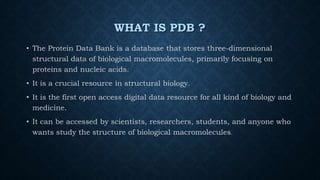
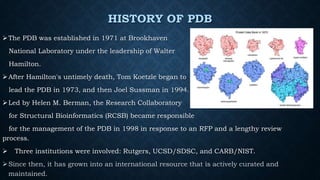
• The Protein Data Bank is a database that stores three-dimensional
structural data of biological macromolecules, primarily focusing on
proteins and nucleic acids.
• It is a crucial resource in structural biology.
• It is the first open access digital data resource for all kind of biology and
medicine.
• It can be accessed by scientists, researchers, students, and anyone who
wants study the structure of biological macromolecules.
HISTORY OF PDB
The PDB was established in 1971 at Brookhaven
National Laboratory under the leadership of Walter
Hamilton.
After Hamilton's untimely death, Tom Koetzle began to
lead the PDB in 1973, and then Joel Sussman in 1994.
Led by Helen M. Berman, the Research Collaboratory
for Structural Bioinformatics (RCSB) became responsible
for the management of the PDB in 1998 in response to an RFP and a lengthy review
process.
 Three institutions were involved: Rutgers, UCSD/SDSC, and CARB/NIST.
Since then, it has grown into an international resource that is actively curated and
maintained.
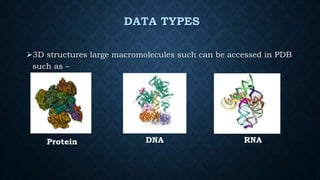
DATA TYPES
3D structures large macromolecules such can be accessed in PDB
such as –
Protein DNA RNA
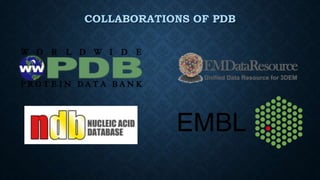
COLLABORATIONS OF PDB
FUNDINGS OF PDB
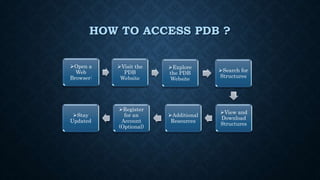
HOW TO ACCESS PDB ?
Open a
Web
Browser:
Visit the
PDB
Website
Explore
the PDB
Website
Search for
Structures
View and
Download
Structures
Additional
Resources
Register
for an
Account
(Optional)
Stay
Updated
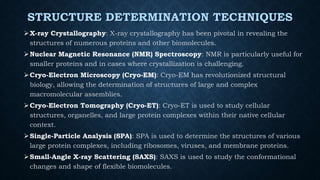
STRUCTURE DETERMINATION TECHNIQUES
X-ray Crystallography: X-ray crystallography has been pivotal in revealing the
structures of numerous proteins and other biomolecules.
Nuclear Magnetic Resonance (NMR) Spectroscopy: NMR is particularly useful for
smaller proteins and in cases where crystallization is challenging.
Cryo-Electron Microscopy (Cryo-EM): Cryo-EM has revolutionized structural
biology, allowing the determination of structures of large and complex
macromolecular assemblies.
Cryo-Electron Tomography (Cryo-ET): Cryo-ET is used to study cellular
structures, organelles, and large protein complexes within their native cellular
context.
Single-Particle Analysis (SPA): SPA is used to determine the structures of various
large protein complexes, including ribosomes, viruses, and membrane proteins.
Small-Angle X-ray Scattering (SAXS): SAXS is used to study the conformational
changes and shape of flexible biomolecules.
DATA FORMAT
PDBx/mmCIF - It is an extension of the Crystallographic Information
File (CIF) format
PDBML/XML – It plays a crucial role in advancing structural biology
research by providing a structured and machine-readable format for the
exchange and dissemination of data from the PDB.
Legacy PDB Format - It has been used since the inception of the Protein
Data Bank in the early 1970s and continues to be used alongside more
modern formats, such as PDBx/mmCIF and PDBML/XML.
APPLICATIONS
Drug Discovery
Structure-Function Relationship
Biological Research
Structural Genomics
Disease Research
Enzyme Engineering
Education and Training
Structural Bioinformatics
Protein Engineering
CONCLUSION
 Protein Data Bank is a repository of 3D structure of proteins & nucleic acids.
 It enables open access to the knowledge of 3D structures, functions & evolution of
biological macromolecules.
 Browsing on PDB is very easy and quick.
 The Protein Data Bank continues to be an invaluable tool for researchers
worldwide, enabling the exploration of the intricate structures and functions of
biological molecules and driving progress in the life sciences.
 Its ongoing expansion, improved data curation, and integration with other biological
databases promise to enhance its impact in the years to come, further accelerating
scientific discovery and innovation.
REFERENCES
https://www.rcsb.org/
http://www.youtube.com
https://www.wwpdb.org/
Thank
You

Protein Data Bank ( PDB ) - Bioinformatics

  • 1.
    M. Sc. 1stSem ( Biotechnology ) Protein Data Bank Presented by – Karmandeep Kaur
  • 2.
    Protein Data Bank: unlocking the world of structural biology
  • 3.
    SYNOPSIS What is PDB? History Introduction Data types Collaborations of PDB Fundings of PDB How to access PDB ? Structure Determination Techniques Data Format Applications Conclusion References
  • 4.
    INTRODUCTION It is anonline server. It is an archive of experimentally determined 3D structure of biological macromolecules. Full name – RCSB – PDB. RCSB - Research Collaboratory for Structural Bioinformatics. PDB - Protein Data Bank. It is a freely accessible, publicly available and open source for all global community. Web address / URL - https://www.rcsb.org/
  • 5.
    WHAT IS PDB? • The Protein Data Bank is a database that stores three-dimensional structural data of biological macromolecules, primarily focusing on proteins and nucleic acids. • It is a crucial resource in structural biology. • It is the first open access digital data resource for all kind of biology and medicine. • It can be accessed by scientists, researchers, students, and anyone who wants study the structure of biological macromolecules.
  • 6.
    HISTORY OF PDB ThePDB was established in 1971 at Brookhaven National Laboratory under the leadership of Walter Hamilton. After Hamilton's untimely death, Tom Koetzle began to lead the PDB in 1973, and then Joel Sussman in 1994. Led by Helen M. Berman, the Research Collaboratory for Structural Bioinformatics (RCSB) became responsible for the management of the PDB in 1998 in response to an RFP and a lengthy review process.  Three institutions were involved: Rutgers, UCSD/SDSC, and CARB/NIST. Since then, it has grown into an international resource that is actively curated and maintained.
  • 7.
    DATA TYPES 3D structureslarge macromolecules such can be accessed in PDB such as – Protein DNA RNA
  • 8.
  • 9.
  • 10.
    HOW TO ACCESSPDB ? Open a Web Browser: Visit the PDB Website Explore the PDB Website Search for Structures View and Download Structures Additional Resources Register for an Account (Optional) Stay Updated
  • 12.
    STRUCTURE DETERMINATION TECHNIQUES X-rayCrystallography: X-ray crystallography has been pivotal in revealing the structures of numerous proteins and other biomolecules. Nuclear Magnetic Resonance (NMR) Spectroscopy: NMR is particularly useful for smaller proteins and in cases where crystallization is challenging. Cryo-Electron Microscopy (Cryo-EM): Cryo-EM has revolutionized structural biology, allowing the determination of structures of large and complex macromolecular assemblies. Cryo-Electron Tomography (Cryo-ET): Cryo-ET is used to study cellular structures, organelles, and large protein complexes within their native cellular context. Single-Particle Analysis (SPA): SPA is used to determine the structures of various large protein complexes, including ribosomes, viruses, and membrane proteins. Small-Angle X-ray Scattering (SAXS): SAXS is used to study the conformational changes and shape of flexible biomolecules.
  • 13.
    DATA FORMAT PDBx/mmCIF -It is an extension of the Crystallographic Information File (CIF) format PDBML/XML – It plays a crucial role in advancing structural biology research by providing a structured and machine-readable format for the exchange and dissemination of data from the PDB. Legacy PDB Format - It has been used since the inception of the Protein Data Bank in the early 1970s and continues to be used alongside more modern formats, such as PDBx/mmCIF and PDBML/XML.
  • 14.
    APPLICATIONS Drug Discovery Structure-Function Relationship BiologicalResearch Structural Genomics Disease Research Enzyme Engineering Education and Training Structural Bioinformatics Protein Engineering
  • 15.
    CONCLUSION  Protein DataBank is a repository of 3D structure of proteins & nucleic acids.  It enables open access to the knowledge of 3D structures, functions & evolution of biological macromolecules.  Browsing on PDB is very easy and quick.  The Protein Data Bank continues to be an invaluable tool for researchers worldwide, enabling the exploration of the intricate structures and functions of biological molecules and driving progress in the life sciences.  Its ongoing expansion, improved data curation, and integration with other biological databases promise to enhance its impact in the years to come, further accelerating scientific discovery and innovation.
  • 16.
  • 17.