MOLECULAR MARKER
EXPRESSED SEQUENCE TAGS [EST]
By
KAUSHAL KUMAR SAHU
Assistant Professor (Ad Hoc)
Department of Biotechnology
Govt. Digvijay Autonomous P. G. College
Raj-Nandgaon ( C. G. )
SYNOPSIS
 Introduction
 History
 Why EST ?
 Generation of EST
 Errors associated with EST generation
 Improving EST
 EST data sources
 Application
 Conclusion
 Reference
2
E
x
p
r
e
s
s
e
d
S
e
q
u
e
n
c
e
T
a
g
s
INTRODUCTION
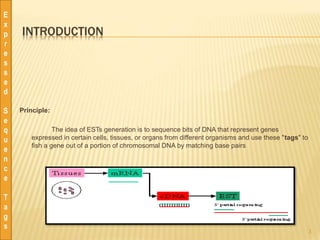
Principle:
The idea of ESTs generation is to sequence bits of DNA that represent genes
expressed in certain cells, tissues, or organs from different organisms and use these "tags" to
fish a gene out of a portion of chromosomal DNA by matching base pairs
3
E
x
p
r
e
s
s
e
d
S
e
q
u
e
n
c
e
T
a
g
s
HISTORY
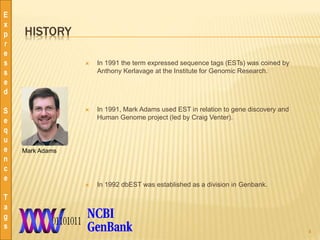
 In 1991 the term expressed sequence tags (ESTs) was coined by
Anthony Kerlavage at the Institute for Genomic Research.
 In 1991, Mark Adams used EST in relation to gene discovery and
Human Genome project (led by Craig Venter).
 In 1992 dbEST was established as a division in Genbank.
4
E
x
p
r
e
s
s
e
d
S
e
q
u
e
n
c
e
T
a
g
s
Mark Adams
WHY USE EST?
 EST collections are a relatively quick and inexpensive route for discovering new genes
(Bourdon et al., 2002; Rogaev et al., 1995),
 Confirm coding regions in genomic sequence (Adams et al., 1991)
 Facilitate the construction of genome maps (Paterson et al., 2000),
 Can sometimes be interpreted directly for transcriptome activity (Ewing et al., 1999;
Ogihara et al., 2003;Ronninget al., 2003)
 In addition, high-throughput technology and EST sequencing projects results in
identification of significant portions of an organism’s gene content and thus can serve as
a foundation for initiating genome sequencing projects (van der Hoeven et al., 2002).
5
E
x
p
r
e
s
s
e
d
S
e
q
u
e
n
c
e
T
a
g
s
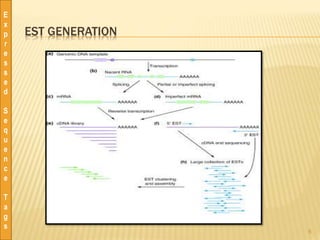
EST GENERATION
6
E
x
p
r
e
s
s
e
d
S
e
q
u
e
n
c
e
T
a
g
s
Improving EST
 • Pre-processing:
 Softwares : Repeat Masker, Phred, Vectorstrip, UniVec etc
 • Clustering and Assembling:
 Softwares for clustering and assembling: CAP3, Phrap, stackPACK etc
7
E
x
p
r
e
s
s
e
d
S
e
q
u
e
n
c
e
T
a
g
s
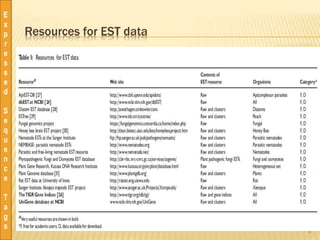
Resources for EST data
8
E
x
p
r
e
s
s
e
d
S
e
q
u
e
n
c
e
T
a
g
s
APPLICATIONS
 EST as genome landmark
 Gene discovery
 Similarity searching
 Gene structure prediction
 Transcriptome analysis
9
E
x
p
r
e
s
s
e
d
S
e
q
u
e
n
c
e
T
a
g
s
REFERENCE
 A hitchhiker’s guide to expressed sequence tag (EST) analysis -
Shivashankar H. Nagaraj, Robin B.Gasser and Shoba Ranganathan , 24th April
2006 – Vol. 8 p.no: 6-21
Site - http://bib.oxfordjournals.org
 Expressed sequence tags for genes: a review by François Hatey Gwenola
Tosser-Klopp, Catherine Clouscard-Martinato Philippe Mulsant, François
Gasser, Vol. 30, p.no. 521-541.
 Expressed sequence tags, Revised: March 29, 2004
site - http://www.ncbi.nlm.nih.gov/About/primer/est.html
 GENE CLONING AND DNA ANALYSIS: An Introduction Sixth Edition by T.A. BROWN
10
E
x
p
r
e
s
s
e
d
S
e
q
u
e
n
c
e
T
a
g
s

Expressed sequence tag (EST), molecular marker

  • 1.
    MOLECULAR MARKER EXPRESSED SEQUENCETAGS [EST] By KAUSHAL KUMAR SAHU Assistant Professor (Ad Hoc) Department of Biotechnology Govt. Digvijay Autonomous P. G. College Raj-Nandgaon ( C. G. )
  • 2.
    SYNOPSIS  Introduction  History Why EST ?  Generation of EST  Errors associated with EST generation  Improving EST  EST data sources  Application  Conclusion  Reference 2 E x p r e s s e d S e q u e n c e T a g s
  • 3.
    INTRODUCTION Principle: The idea ofESTs generation is to sequence bits of DNA that represent genes expressed in certain cells, tissues, or organs from different organisms and use these "tags" to fish a gene out of a portion of chromosomal DNA by matching base pairs 3 E x p r e s s e d S e q u e n c e T a g s
  • 4.
    HISTORY  In 1991the term expressed sequence tags (ESTs) was coined by Anthony Kerlavage at the Institute for Genomic Research.  In 1991, Mark Adams used EST in relation to gene discovery and Human Genome project (led by Craig Venter).  In 1992 dbEST was established as a division in Genbank. 4 E x p r e s s e d S e q u e n c e T a g s Mark Adams
  • 5.
    WHY USE EST? EST collections are a relatively quick and inexpensive route for discovering new genes (Bourdon et al., 2002; Rogaev et al., 1995),  Confirm coding regions in genomic sequence (Adams et al., 1991)  Facilitate the construction of genome maps (Paterson et al., 2000),  Can sometimes be interpreted directly for transcriptome activity (Ewing et al., 1999; Ogihara et al., 2003;Ronninget al., 2003)  In addition, high-throughput technology and EST sequencing projects results in identification of significant portions of an organism’s gene content and thus can serve as a foundation for initiating genome sequencing projects (van der Hoeven et al., 2002). 5 E x p r e s s e d S e q u e n c e T a g s
  • 6.
  • 7.
    Improving EST  •Pre-processing:  Softwares : Repeat Masker, Phred, Vectorstrip, UniVec etc  • Clustering and Assembling:  Softwares for clustering and assembling: CAP3, Phrap, stackPACK etc 7 E x p r e s s e d S e q u e n c e T a g s
  • 8.
    Resources for ESTdata 8 E x p r e s s e d S e q u e n c e T a g s
  • 9.
    APPLICATIONS  EST asgenome landmark  Gene discovery  Similarity searching  Gene structure prediction  Transcriptome analysis 9 E x p r e s s e d S e q u e n c e T a g s
  • 10.
    REFERENCE  A hitchhiker’sguide to expressed sequence tag (EST) analysis - Shivashankar H. Nagaraj, Robin B.Gasser and Shoba Ranganathan , 24th April 2006 – Vol. 8 p.no: 6-21 Site - http://bib.oxfordjournals.org  Expressed sequence tags for genes: a review by François Hatey Gwenola Tosser-Klopp, Catherine Clouscard-Martinato Philippe Mulsant, François Gasser, Vol. 30, p.no. 521-541.  Expressed sequence tags, Revised: March 29, 2004 site - http://www.ncbi.nlm.nih.gov/About/primer/est.html  GENE CLONING AND DNA ANALYSIS: An Introduction Sixth Edition by T.A. BROWN 10 E x p r e s s e d S e q u e n c e T a g s