GENE Mapping
Muhammad Bilal
BS(hons) Applied Microbiology
University of Veterinary and Animal sciences, Lahore, Pakistan
2018-amj-016@uvas.edu.pk Muhammad.bilal.uvas@gmail.com
Gene Mapping
• Mapping- determining the location of elements with in a genome,
with respect to identifiable land marks.
• Gene mapping describes the methods used to identify the locus of a
gene and the distances between genes.
• In simple mapping of genes to specific locations on chromosomes.
• Two types
Genetic map
Physical Map
Muhammd Bilal
Genetic map
• Graphical representation of relative distances between linked genes
of a chromosome is called genetic map, also known as gene map or
chromosome map or cross over map.
Muhammd Bilal
Genetic mapping
Uses of Genetic mapping
• They are useful in predicting results of
dihybrid and trihybrid crosses.
• It allows geneticists to understand the
overall complexity and genetic
organization of a particular species.
• Identify genes responsible for
diseases.
• Identify genes responsible for traits.
• genetic maps are useful from an
evolutionary point of view.
Purpose of Genetic mapping
• The purpose of genetic mapping is to
determine the linear order and
distance of separation among genes
that are linked to each other along the
same chromosome.
• The chromosome maps display the
exact location, arrangement and
combination of genes in a linkage
group of chromosomes.
Muhammd Bilal
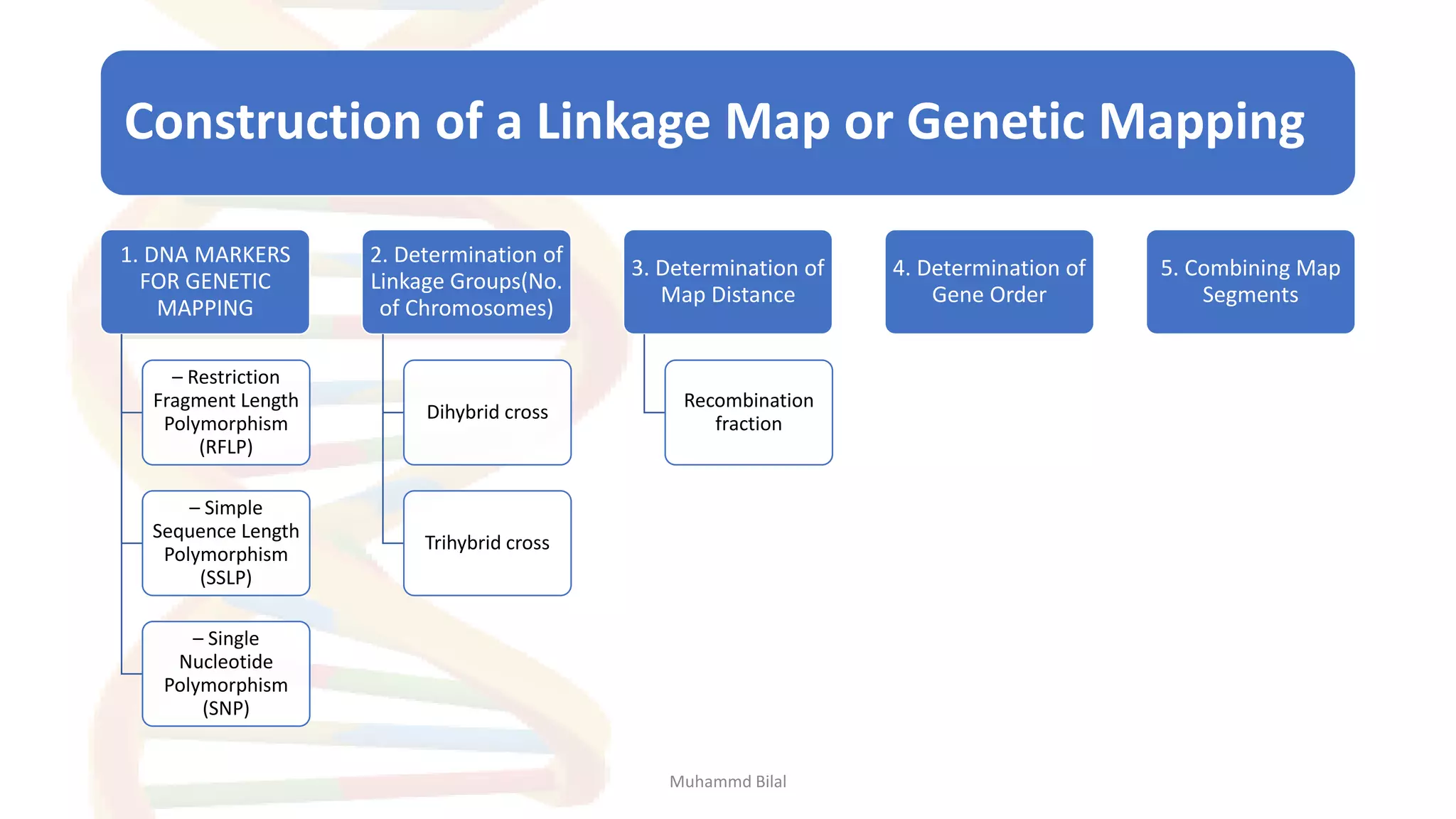
Construction of a Linkage Map or Genetic Mapping
1. DNA MARKERS
FOR GENETIC
MAPPING
– Restriction
Fragment Length
Polymorphism
(RFLP)
– Simple
Sequence Length
Polymorphism
(SSLP)
– Single
Nucleotide
Polymorphism
(SNP)
2. Determination of
Linkage Groups(No.
of Chromosomes)
Dihybrid cross
Trihybrid cross
3. Determination of
Map Distance
Recombination
fraction
4. Determination of
Gene Order
5. Combining Map
Segments
Muhammd Bilal
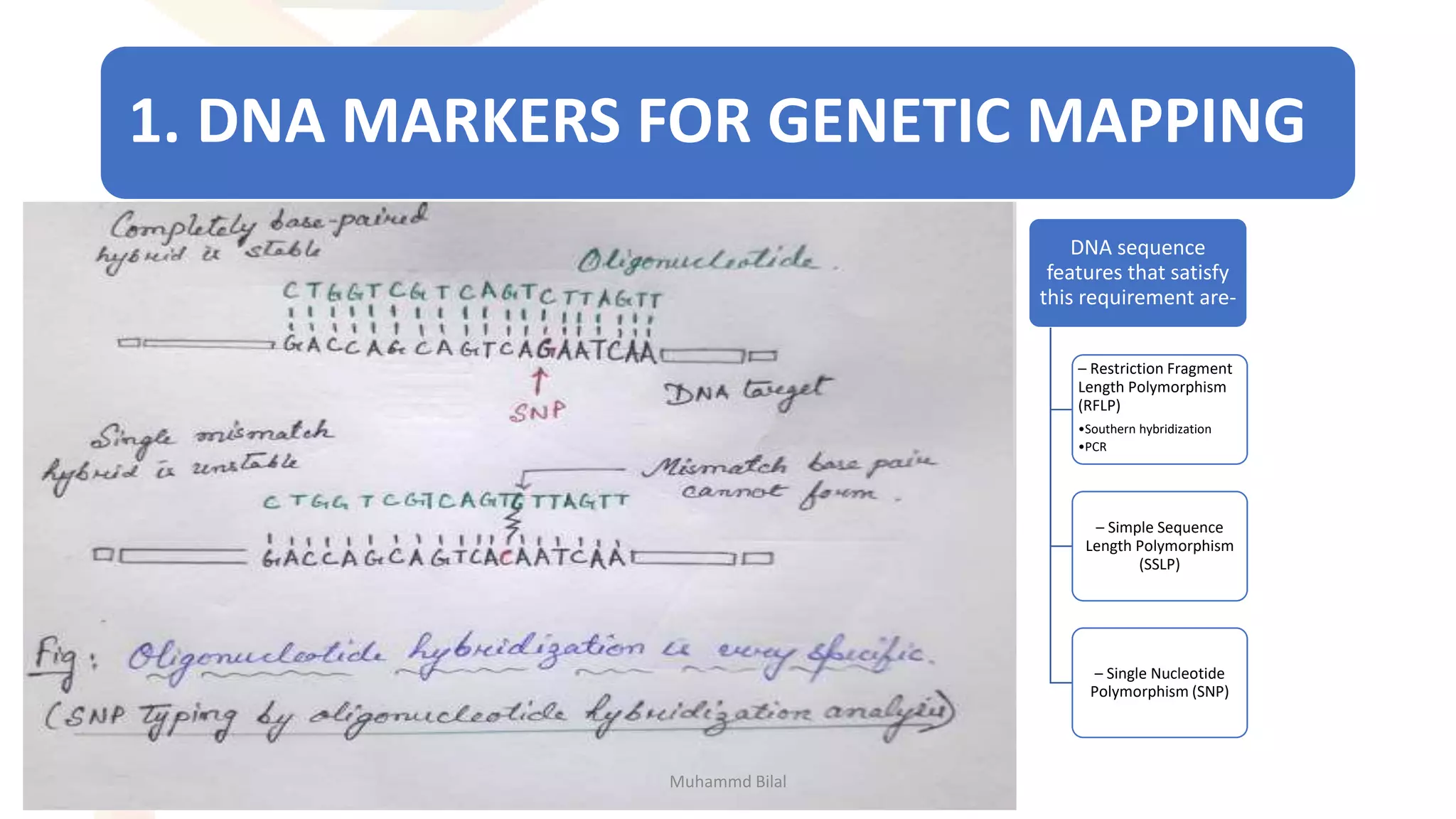
1. DNA MARKERS FOR GENETIC MAPPING
Genes are useful
markers but not ideal.
Mapped feature that
are not genes are
called DNA markers.
DNA markers must
have at least two
alleles to be useful.
DNA sequence
features that satisfy
this requirement are-
– Restriction Fragment
Length Polymorphism
(RFLP)
•Southern hybridization
•PCR
– Simple Sequence
Length Polymorphism
(SSLP)
– Single Nucleotide
Polymorphism (SNP)
Muhammd Bilal
2. Determination of Linkage Groups(No. of Chromosomes)
• Linkage analysis is the basis of genetic mapping.
• The offspring usually co-inherit either A with B or a with b, and, in this
case, the law of independent assortment is not valid.
• Thus to test for linkage between the genes for two traits, certain
types of mating's are examined and observe whether or not the
pattern of the combinations of traits exhibited by the offspring
follows the law of independent assortment.
• If not, the gene pairs for those traits must be linked, that is they
must be on the same
Muhammd Bilal
3. How do we estimate, from the offspring of a single
family, the likelihood that two gene pairs are linked?
• Recombination Frequency
• Recombination fraction is a measure of the distance between two loci.
• Two loci that show 1% recombination are defined as being 1 centimorgan
(cM) apart on a genetic map.
• 1 map unit = 1 cM (centimorgan)
• Two genes that undergo independent assortment have recombination
frequency of 50 percent and are located on nonhomologous chromosomes
or far apart on the same chromosome = unlinked
• Genes with recombination frequencies less than 50 percent are on the
same chromosome = linked
Muhammd Bilal
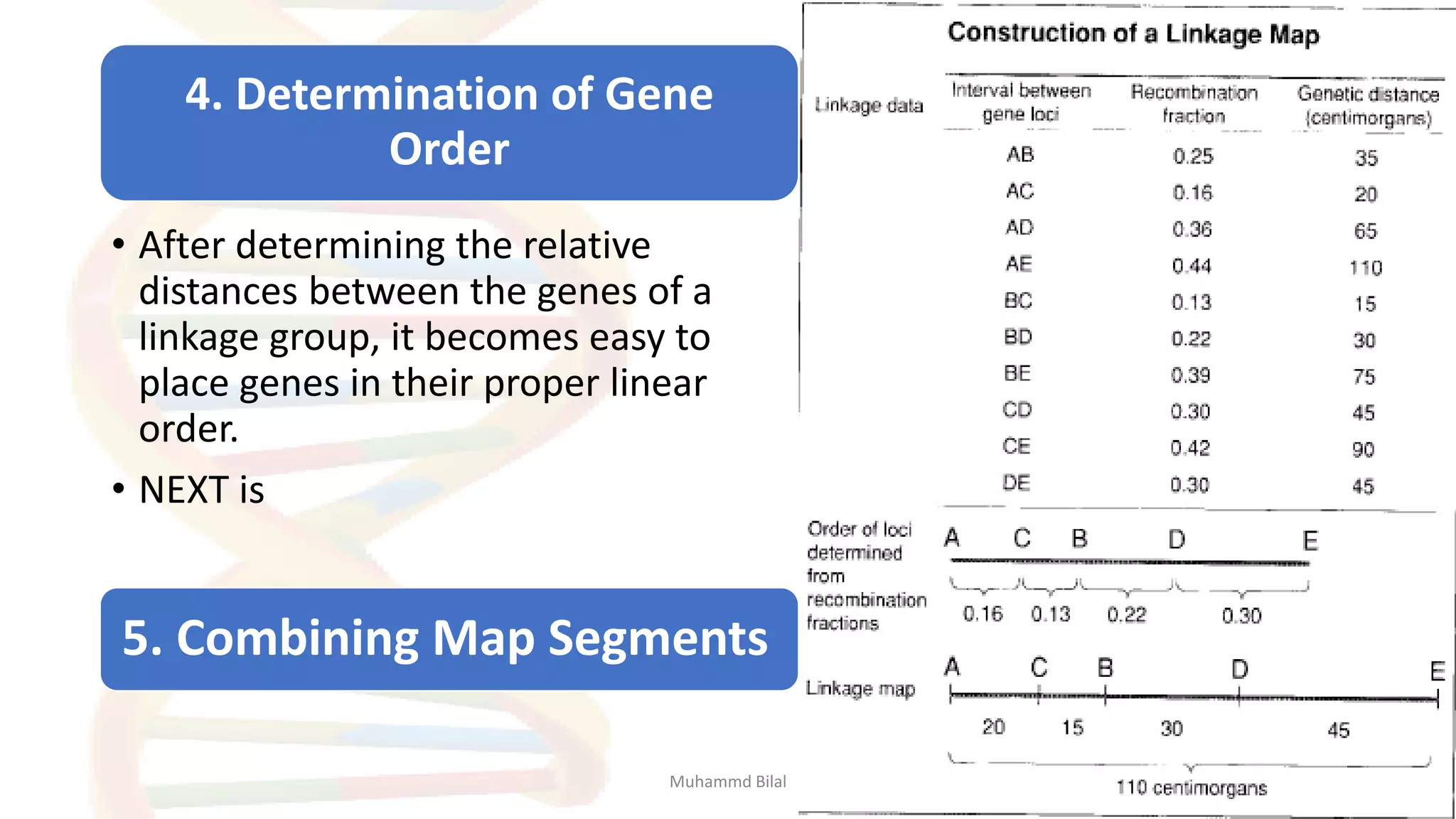
• After determining the relative
distances between the genes of a
linkage group, it becomes easy to
place genes in their proper linear
order.
• NEXT is
4. Determination of Gene
Order
5. Combining Map Segments
Muhammd Bilal
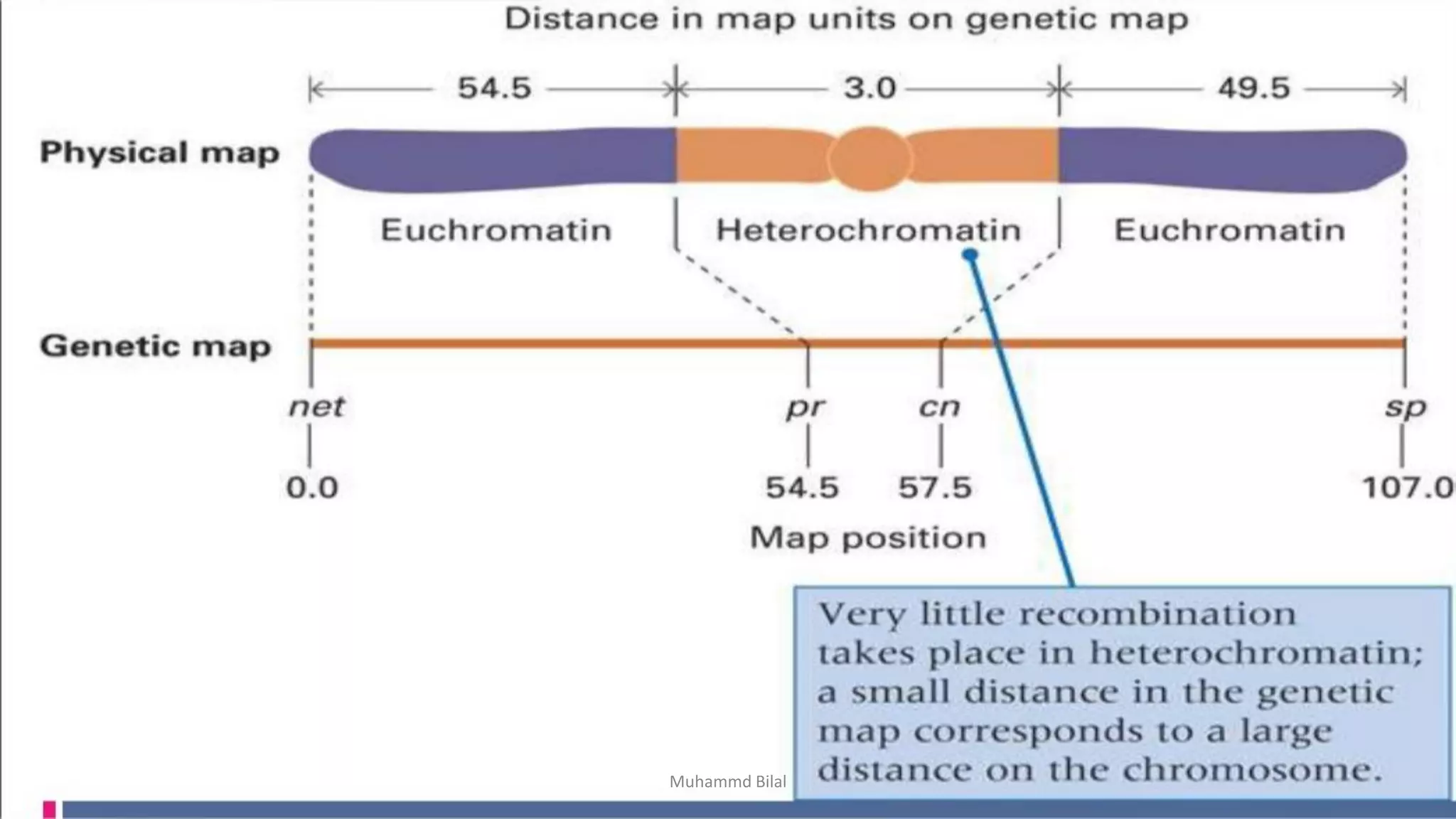
Limitations of Genetic Map
• A map generated by genetic techniques is rarely sufficient for directing the
sequencing phase of a genome project. This is for two reasons:
• The resolution of a genetic map depends on the number of crossovers that
have been scored .
• Genes that are several tens of kb apart may appear at the same position on
the genetic map.
• Genetic maps have limited accuracy .
• Presence of recombination hotspots means that crossovers are more likely
to occur at some points rather than at others.
• physical mapping techniques has been developed to address this problem.
Muhammd Bilal
Physical Map
• A physical map is generated by methods that directly locate the
positions of specific sequences on a chromosomal DNA molecule.
• Expressed sequence tags (ESTs), which are short sequences obtained
from the ends of complementary DNAs (cDNAs)
• Expressed sequence tags are therefore partial gene sequences, and
when used in map construction they provide a quick way of locating
the positions of genes, even though the identity of the gene might
not be apparent from the EST sequence.
• fluorescence in situ hybridization (FISH).
• Sequence Tagged Site (STS) Mapping.
Muhammd Bilal
Fluorescence In Situ Hybridization (FISH).
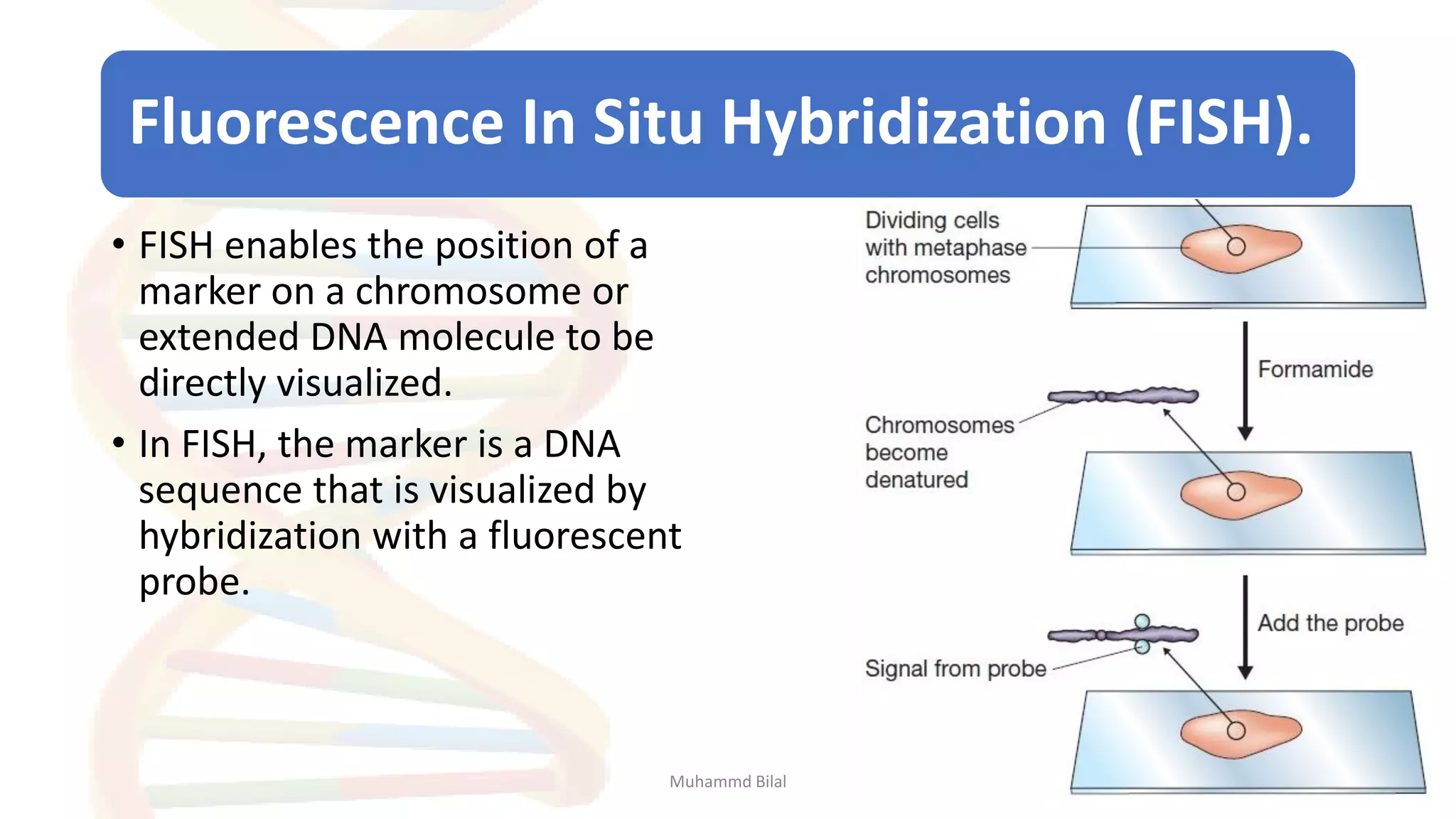
• FISH enables the position of a
marker on a chromosome or
extended DNA molecule to be
directly visualized.
• In FISH, the marker is a DNA
sequence that is visualized by
hybridization with a fluorescent
probe.
Muhammd Bilal
Sequence Tagged Site (STS) Mapping/mapping reagent
• STS mapping is the most powerful physical mapping technique.
• Detailed Maps are generated by STS mapping.
• A sequence tagged site (STS) is a short DNA sequence, generally
between 100bp and 500bp in length.
• STS is easily recognizable and occurs once in the chromosome or
genome being studied.
Muhammd Bilal
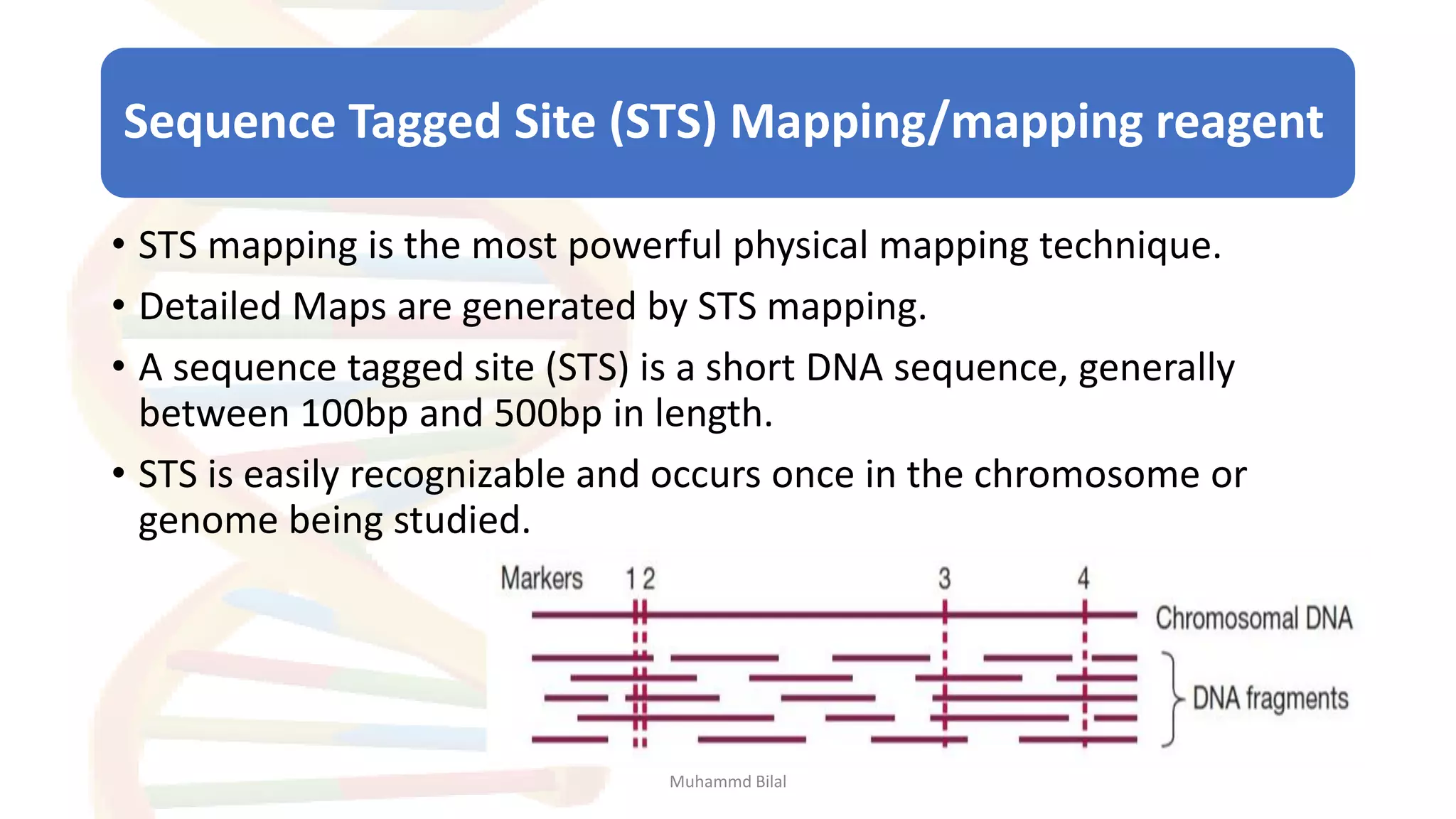
Sequence Tagged Site (STS) Mapping/mapping reagent
• A collection of overlapping DNA fragments
spanning the chromosome or genome that is
being studied.
• Pairs of markers that lie within a single fragment
must be located close to each other on the
chromosome.
• how close can be determined by measuring the
frequency with which the pair occurs together
in different fragments in the mapping reagent.
• The mapping reagent could be a clone library,
possibly one that is also being assembled into a
contig prior to DNA sequencing.
Muhammd Bilal
Muhammd Bilal
Genetic Map VS Physical Map
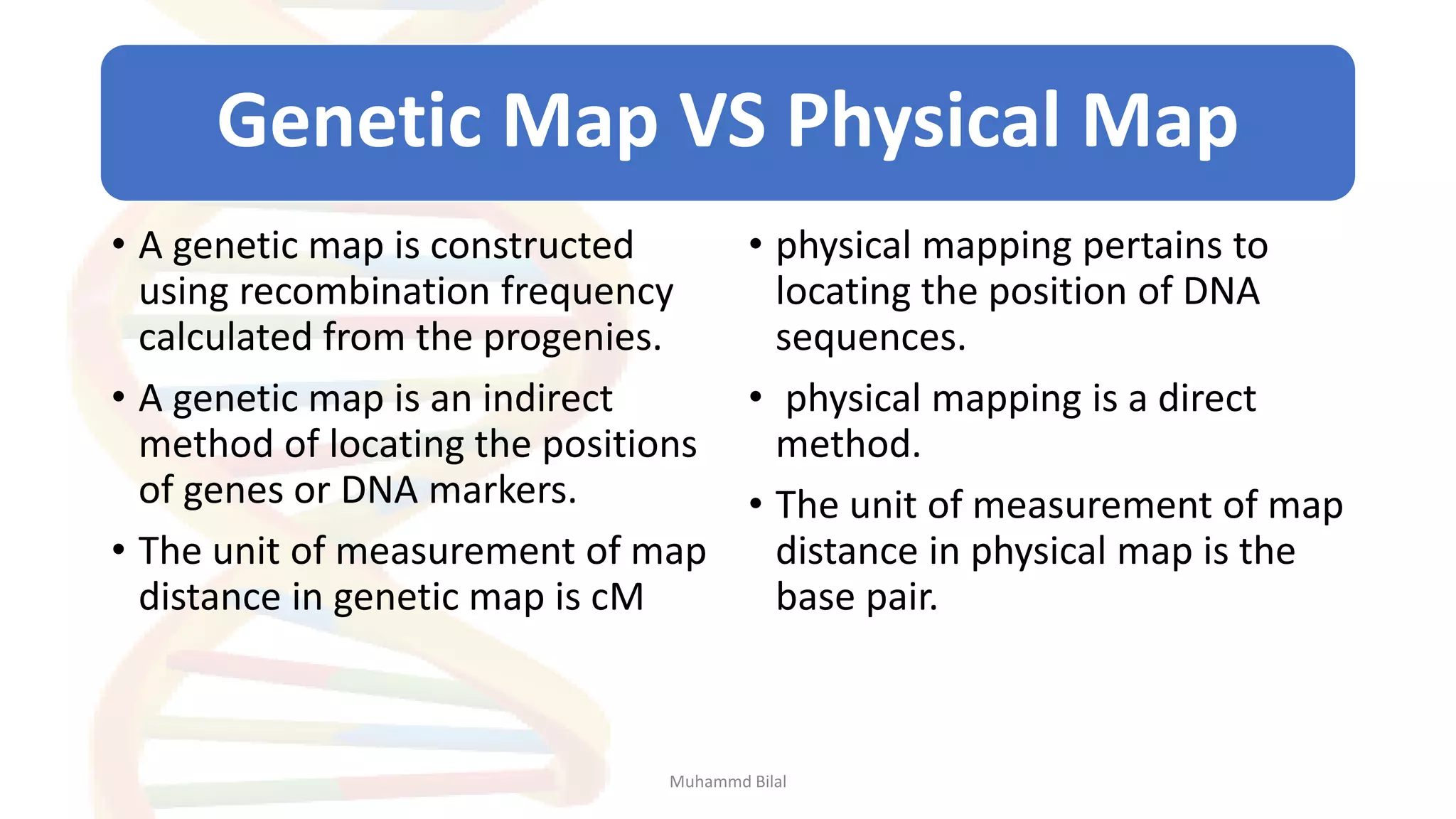
• A genetic map is constructed
using recombination frequency
calculated from the progenies.
• A genetic map is an indirect
method of locating the positions
of genes or DNA markers.
• The unit of measurement of map
distance in genetic map is cM
• physical mapping pertains to
locating the position of DNA
sequences.
• physical mapping is a direct
method.
• The unit of measurement of map
distance in physical map is the
base pair.
Muhammd Bilal
REFERENSES
✓GENE CLONING AND DNA ANALYSIS An Introduction-T.A. BROWN-Sixth
Edition---Part II The Applications of Gene Cloning and DNA Analysis in
Research---10.2.3 Using a map to aid sequence assembly
Authentic Resources
• https://www.ncbi.nlm.nih.gov/books/NBK21116/
• https://www.ncbi.nlm.nih.gov/books/NBK21962/
Additional Resources
• https://www.slideshare.net/PrashantTripathi59/gene-mapping-
ppt?from_action=save
• https://www.slideshare.net/zeeshanahmed121121/gene-mapping-ppt-
81617490?from_action=save
• https://www.slideshare.net/MEENAKSHIDAS11/gene-mapping-
methods?from_action=save
Muhammd Bilal
Muhammd Bilal
THANKS

Gene mapping / Genetic map vs Physical Map | determination of map distance and gene order

  • 1.
    GENE Mapping Muhammad Bilal BS(hons)Applied Microbiology University of Veterinary and Animal sciences, Lahore, Pakistan 2018-amj-016@uvas.edu.pk Muhammad.bilal.uvas@gmail.com
  • 2.
    Gene Mapping • Mapping-determining the location of elements with in a genome, with respect to identifiable land marks. • Gene mapping describes the methods used to identify the locus of a gene and the distances between genes. • In simple mapping of genes to specific locations on chromosomes. • Two types Genetic map Physical Map Muhammd Bilal
  • 3.
    Genetic map • Graphicalrepresentation of relative distances between linked genes of a chromosome is called genetic map, also known as gene map or chromosome map or cross over map. Muhammd Bilal
  • 4.
    Genetic mapping Uses ofGenetic mapping • They are useful in predicting results of dihybrid and trihybrid crosses. • It allows geneticists to understand the overall complexity and genetic organization of a particular species. • Identify genes responsible for diseases. • Identify genes responsible for traits. • genetic maps are useful from an evolutionary point of view. Purpose of Genetic mapping • The purpose of genetic mapping is to determine the linear order and distance of separation among genes that are linked to each other along the same chromosome. • The chromosome maps display the exact location, arrangement and combination of genes in a linkage group of chromosomes. Muhammd Bilal
  • 5.
    Construction of aLinkage Map or Genetic Mapping 1. DNA MARKERS FOR GENETIC MAPPING – Restriction Fragment Length Polymorphism (RFLP) – Simple Sequence Length Polymorphism (SSLP) – Single Nucleotide Polymorphism (SNP) 2. Determination of Linkage Groups(No. of Chromosomes) Dihybrid cross Trihybrid cross 3. Determination of Map Distance Recombination fraction 4. Determination of Gene Order 5. Combining Map Segments Muhammd Bilal
  • 6.
    1. DNA MARKERSFOR GENETIC MAPPING Genes are useful markers but not ideal. Mapped feature that are not genes are called DNA markers. DNA markers must have at least two alleles to be useful. DNA sequence features that satisfy this requirement are- – Restriction Fragment Length Polymorphism (RFLP) •Southern hybridization •PCR – Simple Sequence Length Polymorphism (SSLP) – Single Nucleotide Polymorphism (SNP) Muhammd Bilal
  • 7.
    2. Determination ofLinkage Groups(No. of Chromosomes) • Linkage analysis is the basis of genetic mapping. • The offspring usually co-inherit either A with B or a with b, and, in this case, the law of independent assortment is not valid. • Thus to test for linkage between the genes for two traits, certain types of mating's are examined and observe whether or not the pattern of the combinations of traits exhibited by the offspring follows the law of independent assortment. • If not, the gene pairs for those traits must be linked, that is they must be on the same Muhammd Bilal
  • 8.
    3. How dowe estimate, from the offspring of a single family, the likelihood that two gene pairs are linked? • Recombination Frequency • Recombination fraction is a measure of the distance between two loci. • Two loci that show 1% recombination are defined as being 1 centimorgan (cM) apart on a genetic map. • 1 map unit = 1 cM (centimorgan) • Two genes that undergo independent assortment have recombination frequency of 50 percent and are located on nonhomologous chromosomes or far apart on the same chromosome = unlinked • Genes with recombination frequencies less than 50 percent are on the same chromosome = linked Muhammd Bilal
  • 9.
    • After determiningthe relative distances between the genes of a linkage group, it becomes easy to place genes in their proper linear order. • NEXT is 4. Determination of Gene Order 5. Combining Map Segments Muhammd Bilal
  • 10.
    Limitations of GeneticMap • A map generated by genetic techniques is rarely sufficient for directing the sequencing phase of a genome project. This is for two reasons: • The resolution of a genetic map depends on the number of crossovers that have been scored . • Genes that are several tens of kb apart may appear at the same position on the genetic map. • Genetic maps have limited accuracy . • Presence of recombination hotspots means that crossovers are more likely to occur at some points rather than at others. • physical mapping techniques has been developed to address this problem. Muhammd Bilal
  • 11.
    Physical Map • Aphysical map is generated by methods that directly locate the positions of specific sequences on a chromosomal DNA molecule. • Expressed sequence tags (ESTs), which are short sequences obtained from the ends of complementary DNAs (cDNAs) • Expressed sequence tags are therefore partial gene sequences, and when used in map construction they provide a quick way of locating the positions of genes, even though the identity of the gene might not be apparent from the EST sequence. • fluorescence in situ hybridization (FISH). • Sequence Tagged Site (STS) Mapping. Muhammd Bilal
  • 12.
    Fluorescence In SituHybridization (FISH). • FISH enables the position of a marker on a chromosome or extended DNA molecule to be directly visualized. • In FISH, the marker is a DNA sequence that is visualized by hybridization with a fluorescent probe. Muhammd Bilal
  • 13.
    Sequence Tagged Site(STS) Mapping/mapping reagent • STS mapping is the most powerful physical mapping technique. • Detailed Maps are generated by STS mapping. • A sequence tagged site (STS) is a short DNA sequence, generally between 100bp and 500bp in length. • STS is easily recognizable and occurs once in the chromosome or genome being studied. Muhammd Bilal
  • 14.
    Sequence Tagged Site(STS) Mapping/mapping reagent • A collection of overlapping DNA fragments spanning the chromosome or genome that is being studied. • Pairs of markers that lie within a single fragment must be located close to each other on the chromosome. • how close can be determined by measuring the frequency with which the pair occurs together in different fragments in the mapping reagent. • The mapping reagent could be a clone library, possibly one that is also being assembled into a contig prior to DNA sequencing. Muhammd Bilal
  • 15.
  • 16.
    Genetic Map VSPhysical Map • A genetic map is constructed using recombination frequency calculated from the progenies. • A genetic map is an indirect method of locating the positions of genes or DNA markers. • The unit of measurement of map distance in genetic map is cM • physical mapping pertains to locating the position of DNA sequences. • physical mapping is a direct method. • The unit of measurement of map distance in physical map is the base pair. Muhammd Bilal
  • 17.
    REFERENSES ✓GENE CLONING ANDDNA ANALYSIS An Introduction-T.A. BROWN-Sixth Edition---Part II The Applications of Gene Cloning and DNA Analysis in Research---10.2.3 Using a map to aid sequence assembly Authentic Resources • https://www.ncbi.nlm.nih.gov/books/NBK21116/ • https://www.ncbi.nlm.nih.gov/books/NBK21962/ Additional Resources • https://www.slideshare.net/PrashantTripathi59/gene-mapping- ppt?from_action=save • https://www.slideshare.net/zeeshanahmed121121/gene-mapping-ppt- 81617490?from_action=save • https://www.slideshare.net/MEENAKSHIDAS11/gene-mapping- methods?from_action=save Muhammd Bilal
  • 18.