This document provides information about gene mapping. It discusses both genetic mapping and physical mapping. Genetic mapping involves using genetic techniques like cross-breeding experiments to construct maps showing gene positions. Physical mapping uses molecular biology techniques to directly examine DNA and construct maps showing positions of sequences like genes. Both techniques are used to identify the locus of genes and distances between genes to better understand genomes.
INTRODUCTION
Gene mappingdescribes the methods used to
identify the locus of a gene and the distances
between genes.
The essence of all genome mapping is to place a
collection of molecular markers onto their
respective positions on the genome. Molecular
markers come in all forms. Genes can be viewed
as one special type of genetic markers in the
construction of genome maps, and mapped the
same way as any other markers.
3.
GENOME MAPPING
Geneticmapping is based on the use of genetic
techniques to construct maps showing the
positions of genes and other sequence features
on a genome.
Genetic techniques include cross-breeding
experiments or,
Case of humans, the examination of family histories
(pedigrees).
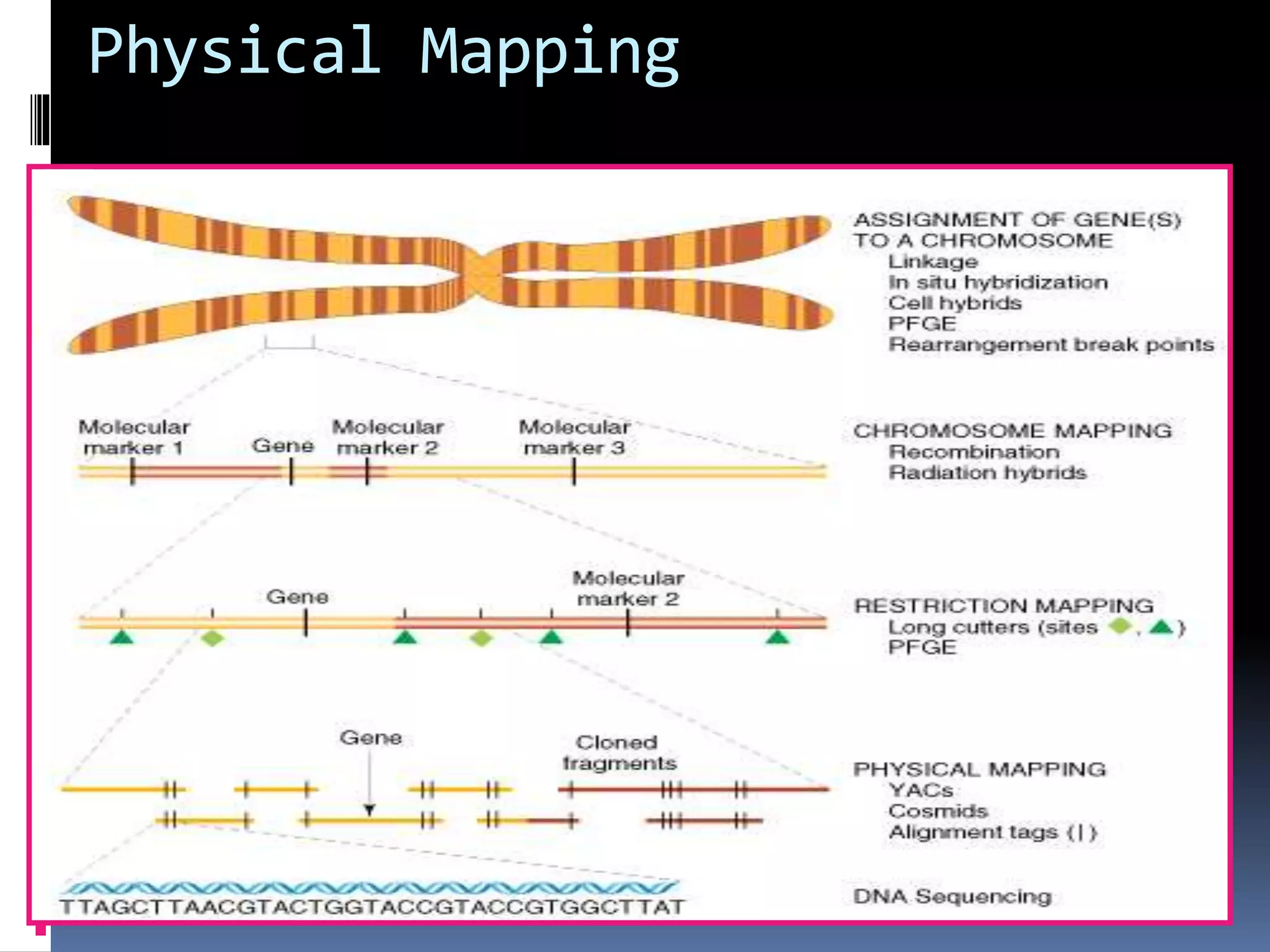
Physical mapping uses molecular biology
techniques to examine DNA molecules directly
in order to construct maps showing the
positions of sequence features, including genes.
4.
GENETIC MAPPING
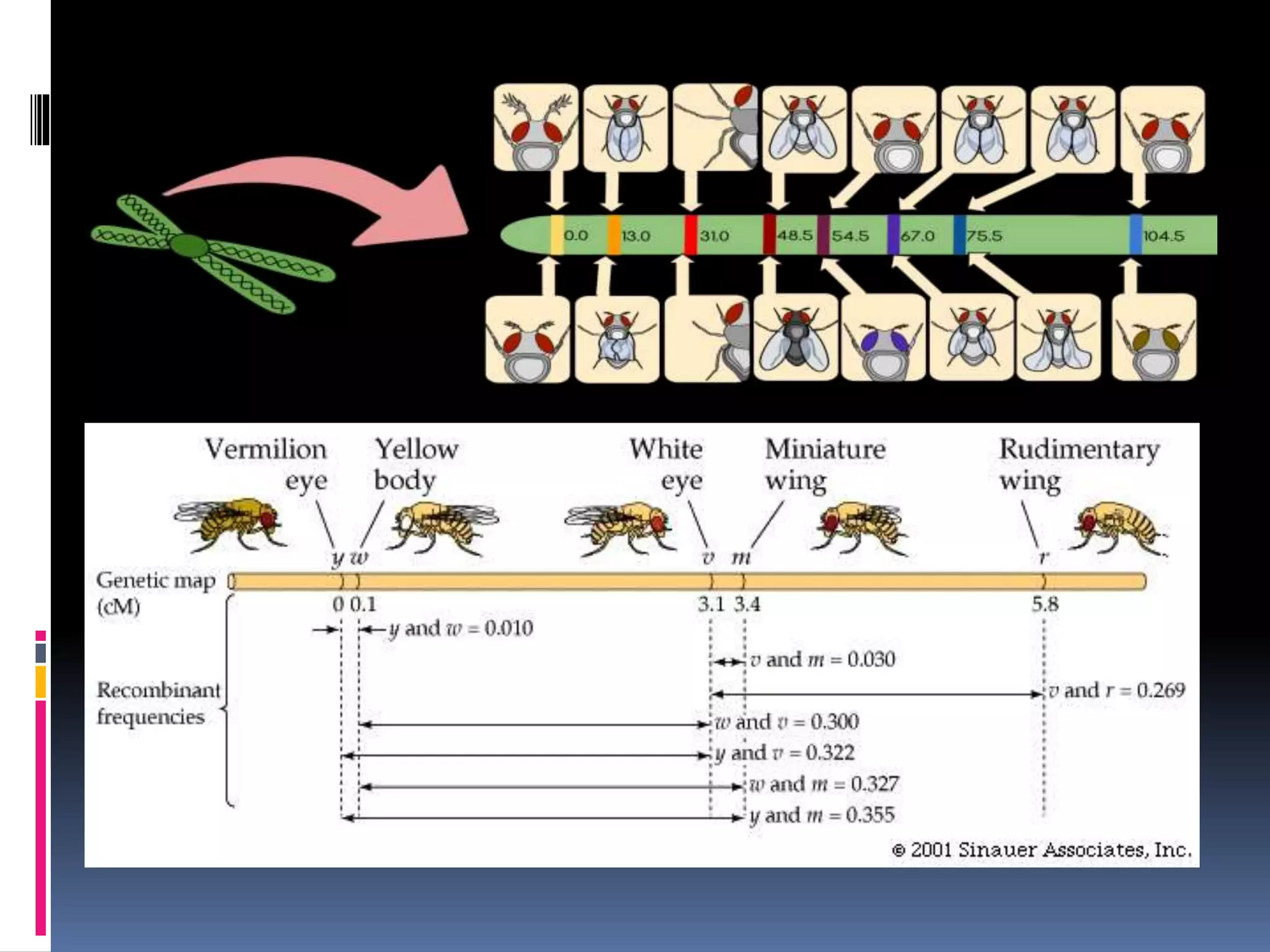
The firststeps of building a genetic map are the
development of genetic markers and a mapping
population.Since the closer the two markers are on
the chromosome, the more likely they are to be
passed on to the next generation together,
therefore the "co-segregation" patterns of all
markers can be used to reconstruct their order.The
genotypes of each genetic marker are recorded for
both parents, and in each individual in the following
generations.The quality of the genetic maps is
largely dependent upon these two factors: the
number of genetic markers on the map and the size
of the mapping population.
5.
In gene mapping,any sequence feature that can be
faithfully distinguished from the two parents can be
used as a genetic marker. Genes are represented by
"traits" that can be distinguished between two parents.
Their linkage with other genetic markers are calculated
same way as if they are common markers and the
actual gene loci are then bracketed in a region between
the two nearest neighbouring markers.The entire
process is then repeated by looking at more markers
which target that region to map the gene
neighbourhood to a higher resolution until a specific
causative locus can be identified.This process is often
referred to as "positional cloning", and it is used
extensively in the study of plant species.
7.
PHYSICAL MAPPING
Restrictionmapping, which locates the relative
positions on a DNA molecule of the recognition
sequences for restriction endonucleases;
Fluorescent in situ hybridization (FISH), in which
marker locations are mapped by hybridizing a
probe containing the marker to intact
chromosomes;
Sequence tagged site (STS) mapping, in which
the positions of short sequences are mapped by
PCR and/or hybridization analysis of genome
fragments.
8.
Physical maps
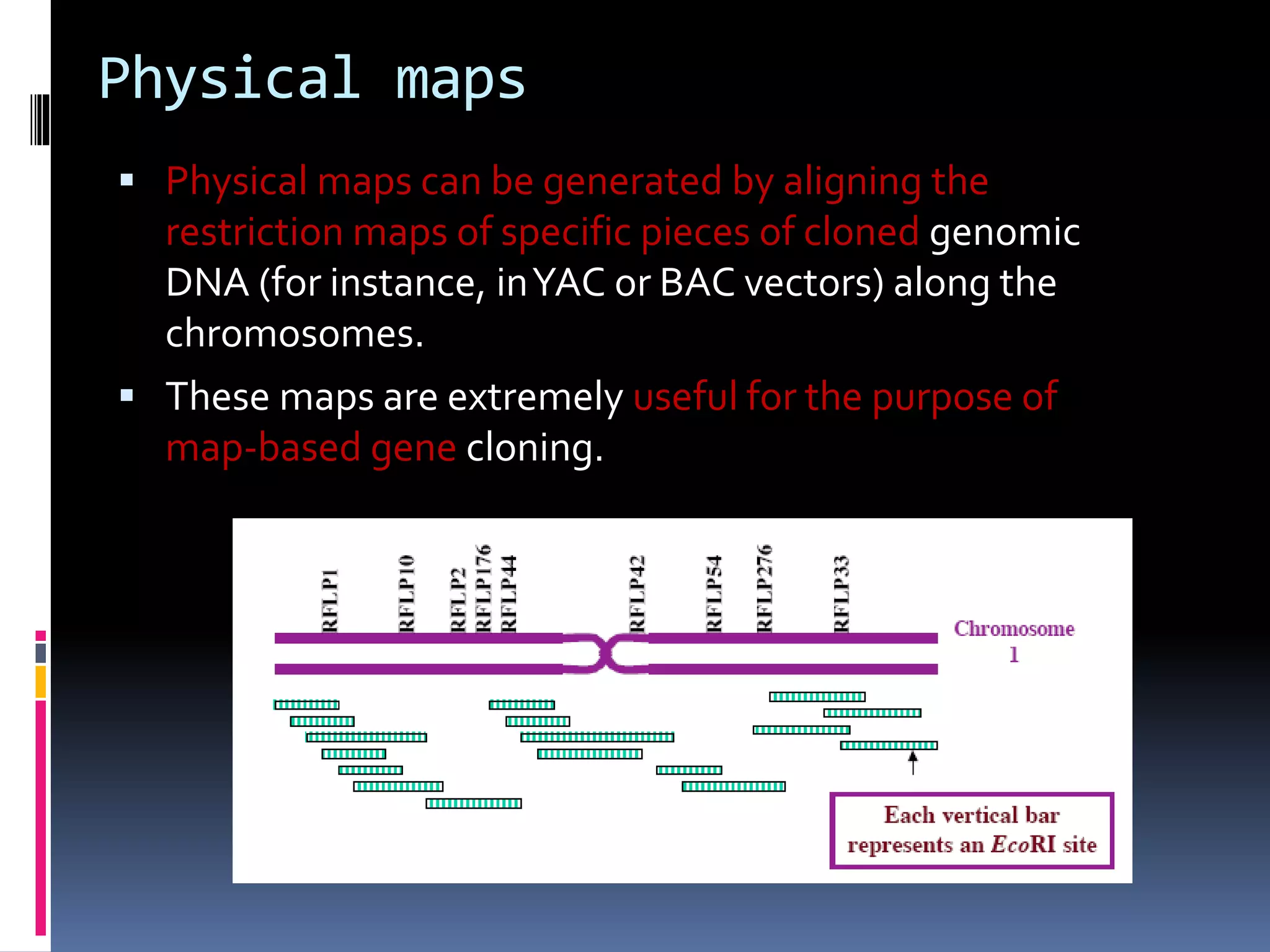
Physicalmaps can be generated by aligning the
restriction maps of specific pieces of cloned genomic
DNA (for instance, inYAC or BAC vectors) along the
chromosomes.
These maps are extremely useful for the purpose of
map-based gene cloning.
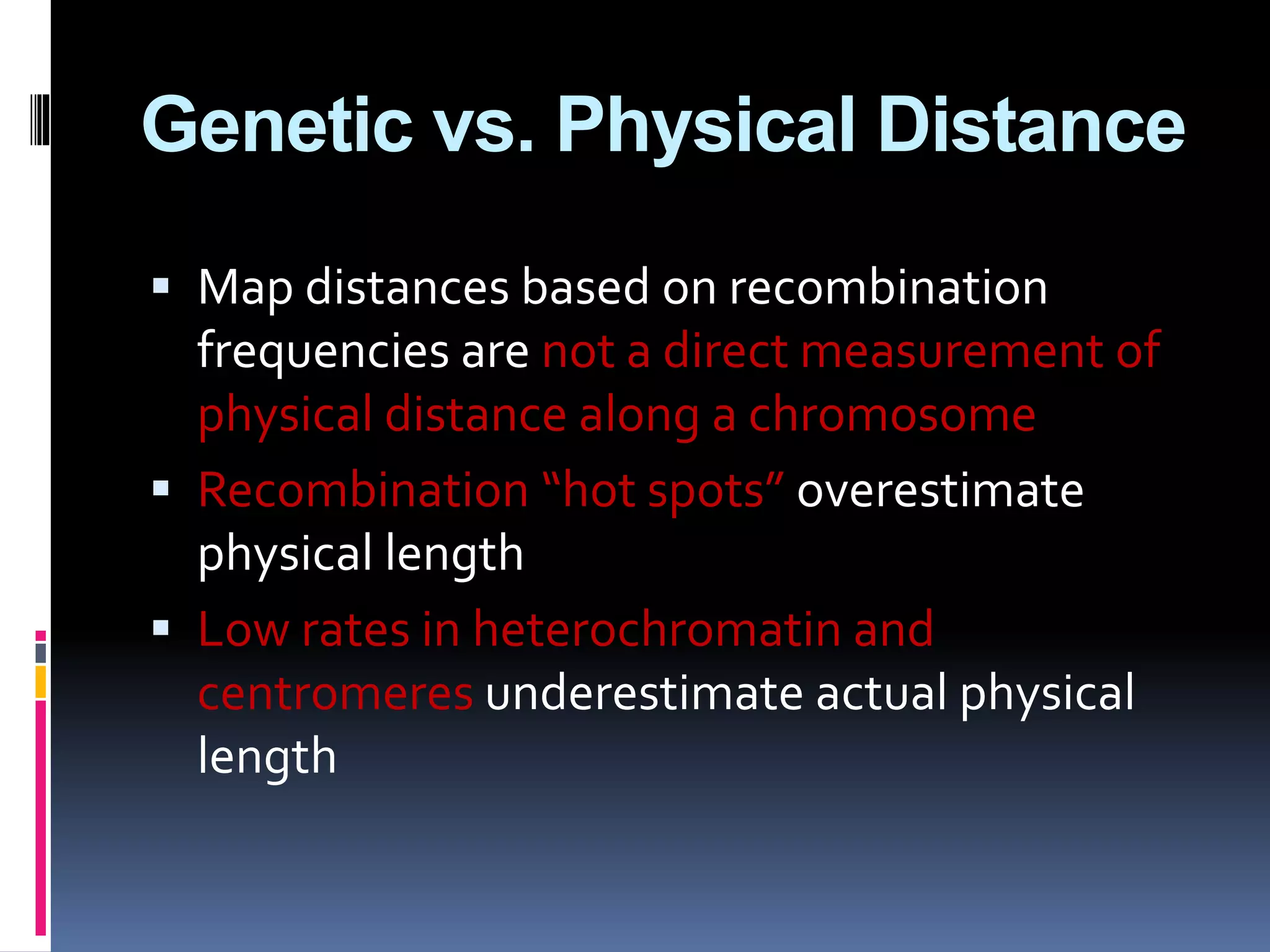
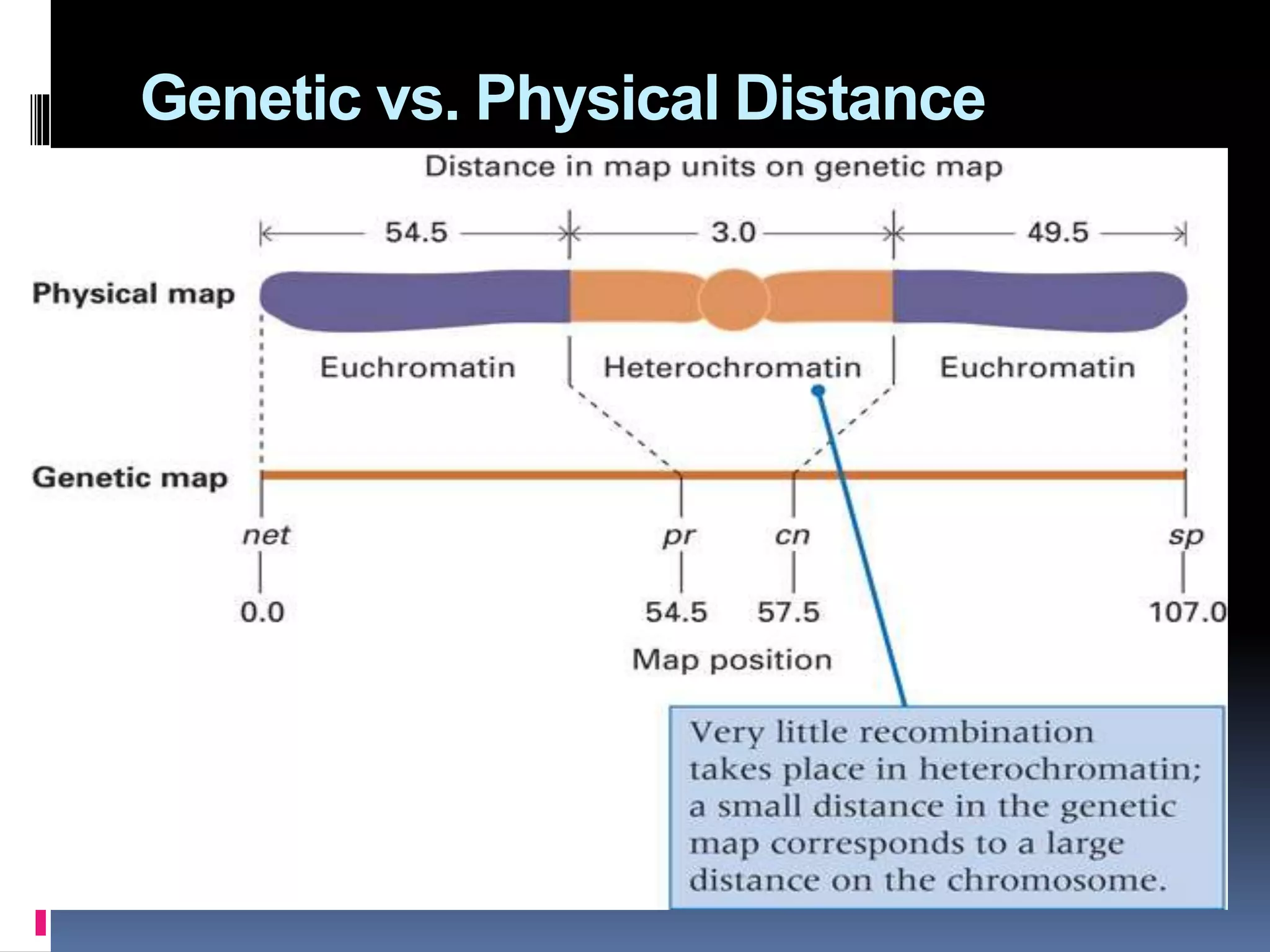
Genetic vs. PhysicalDistance
Map distances based on recombination
frequencies are not a direct measurement of
physical distance along a chromosome
Recombination “hot spots” overestimate
physical length
Low rates in heterochromatin and
centromeres underestimate actual physical
length
Uses of GeneMapping
Identify genes responsible for diseases.
Heritable diseases
Cancer
Identify genes responsible for traits.
Plants or Animals
Disease resistance
Meat or Milk Production
13.
Human Genome Project
The Human Genome Project (HGP) is an international
scientific research project with the goal of determining
the sequence of chemical base pairs which make up
human DNA, and of identifying and mapping all of the
genes of the human genome from both a physical and a
functional standpoint.
The Human Genome Project originally aimed to map
the nucleotides contained in a human haploid
reference genome (more than three billion).The
"genome" of any given individual is unique; mapping
the "human genome" involves sequencing multiple
variations of each gene. In May 2016, scientists
considered extending the HGP to include creating a
synthetic human genome.
14.
LIMITATIONS
A mapgenerated by genetic techniques is rarely
sufficient for directing the sequencing phase of a
genome project.This is for two reasons:
The resolution of a genetic map depends on the number
of crossovers that have been scored .
Genes that are several tens of kb apart may appear at
the same position on the genetic map.
Genetic maps have limited accuracy .
Presence of recombination hotspots means that
crossovers are more likely to occur at some points
rather than at others.
physical mapping techniques has been developed to
address this problem.




![Genetic%20mapping[1]](https://cdn.slidesharecdn.com/ss_thumbnails/genetic20mapping1-120524095151-phpapp02-thumbnail.jpg?width=640&height=640&fit=bounds)


