Cereal crop
 FAO's definition of cereals describes these plants as annual plants
which generally belong to the gramineous family, producing grains that
are used for food, feed, seed and production of industrial products.
 Cereal Crops:
 Rice
 Wheat,
 Corn or maize
 Barley
 Millet
 Sorghum
 Oat
 Rye
introduction
 The economic and scientific importance of the cereals has
motivated a rich history of research into their genetics,
development, and evolution.
 The nearly completed sequence of the rice genome is
emblematic of a transition to high-throughput genomics
and computational biology that has also pervaded study of
many other cereals.
 The relatively close (ca. <50 million years old)
relationships among morphologically diverse cereals
native to environments that sample much of global
geographic diversity make the cereals particularly
attractive for comparative studies of plant genome
evolution.
 Using the rapidly growing capabilities of several
informatics resources, genomic data from model
cereals are likely to be leveraged tremendously in the
study and improvement of a wide range of crop plants
that sustain much of the world's population
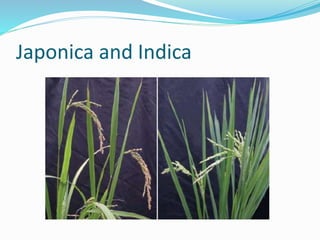
Japonica and Indica
 The sequence of the japonica cultivar Nipponbare was
recently completed by a consortium of 10 countries,
which comprised the International Rice Genome
Sequencing Project (IRGSP)
 Using the rapidly growing capabilities of several
informatics resources, genomic data from model
cereals are likely to be leveraged tremendously in the
study and improvement of a wide range of crop plants
that sustain much of the world's population
Rice:
 Rice is considered a model cereal crop because it has a
relatively small genome size as compared with other
cereals, a vast germplasm collection, an enormous
repertoire of molecular genetic resources, and an
efficient transformation system.
 The scientific value of rice is further enhanced with
the elucidation of the genome sequence of the two
major subspecies of cultivated rice, Oryza sativa ssp.
Conti…..
 For this reason and because of its small size, rice was
promoted as a model and was chosen to be the first
cereal genome sequenced.
 Further, the development of large EST collections and
the first inter- and intra-specific comparative studies
of BAC sequences from maize, sorghum, rice, wheat
and barley have increased the resolution of
comparative analyses and have shown that a number
of rearrangements disrupting microcolinearity have
occurred during the evolution of the cereal genomes in
the past 50–70 million years.
 development of molecular markers, and for
identifying the region in the model species that might
contain candidate genes responsible for a trait of
interest. Rice (2n = 24), having a small genome and
great economic significance, was the first grass species
selected for genome sequencing
© 2005 Prentice Hall Inc. / A Pearson Education
Company / Upper Saddle River, New Jersey 07458
Sequencing of crop-plant
genomes
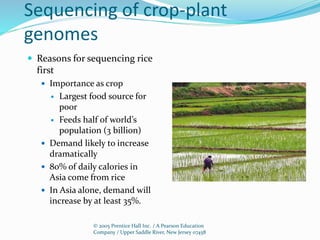
 Reasons for sequencing rice
first
 Importance as crop
 Largest food source for
poor
 Feeds half of world’s
population (3 billion)
 Demand likely to increase
dramatically
 80% of daily calories in
Asia come from rice
 In Asia alone, demand will
increase by at least 35%.
© 2005 Prentice Hall Inc. / A Pearson Education
Company / Upper Saddle River, New Jersey 07458
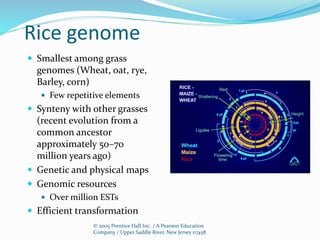
Rice genome
 Smallest among grass
genomes (Wheat, oat, rye,
Barley, corn)
 Few repetitive elements
 Synteny with other grasses
(recent evolution from a
common ancestor
approximately 50–70
million years ago)
 Genetic and physical maps
 Genomic resources
 Over million ESTs
 Efficient transformation
© 2005 Prentice Hall Inc. / A Pearson Education
Company / Upper Saddle River, New Jersey 07458
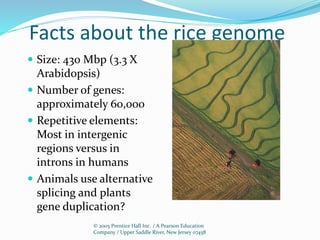
Facts about the rice genome
 Size: 430 Mbp (3.3 X
Arabidopsis)
 Number of genes:
approximately 60,000
 Repetitive elements:
Most in intergenic
regions versus in
introns in humans
 Animals use alternative
splicing and plants
gene duplication?
© 2005 Prentice Hall Inc. / A Pearson Education
Company / Upper Saddle River, New Jersey 07458
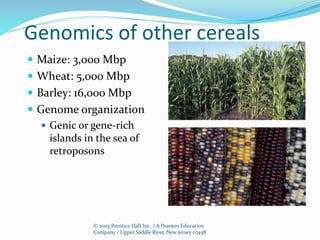
Genomics of other cereals
 Maize: 3,000 Mbp
 Wheat: 5,000 Mbp
 Barley: 16,000 Mbp
 Genome organization
 Genic or gene-rich
islands in the sea of
retroposons
© 2005 Prentice Hall Inc. / A Pearson Education
Company / Upper Saddle River, New Jersey 07458
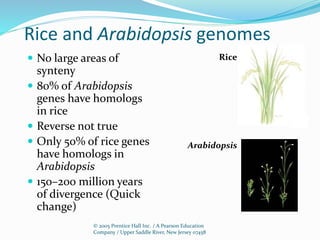
Rice and Arabidopsis genomes
 No large areas of
synteny
 80% of Arabidopsis
genes have homologs
in rice
 Reverse not true
 Only 50% of rice genes
have homologs in
Arabidopsis
 150–200 million years
of divergence (Quick
change)
Rice
Arabidopsis
Wheat genome:
 A U.S. National Science Foundation-funded wheat
expressed sequence tag (EST) project has been studying
the structure and function of the expressed portion of the
wheat genome by mapping wheat unigenes to individual
chromosome regions. Representative ESTs, each belonging
to one of the unigenes
(http://wheat.pw.usda.gov/NSF/progress_mapping.html)
were used for mapping in the wheat genome utilizing 101
wheat deletion stocks, each of which contain a deletion of a
defined part of a chromosome (Endo and Gill 1996),
referred to as deletion mapping. As of November 2002, over
100,000 ESTs from various tissues of wheat at different
stages of development have been sequenced, and 4485
wheat unigenes have been deletion mapped by this project.
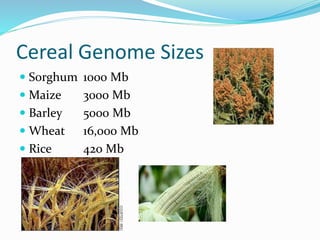
Cereal Genome Sizes
 Sorghum 1000 Mb
 Maize 3000 Mb
 Barley 5000 Mb
 Wheat 16,000 Mb
 Rice 420 Mb
Conti….
 The wheat whole genome sequence data provides
direct access to all 96,000 genes and represents an
essential step towards a systematic understanding of
biology and engineering .
 The cereal crop for valuable traits. Its implications in
cereal genetics and breeding includes the examination
of genome variation, association mapping using
natural populations.
Maize genome:
The 21st century finds maize in the process of being
sequenced. With an estimated 2300-2600 Mb of
chromosomal DNA (6× rice and 20× Arabidopsis), of
which at least 60% is retrotransposon.
• the maize genome has initially been “filtered” to
enhance its production(Rabinowicz et al. 1999) or low-
repeat (Peterson et al. 2002a; Yuan et al. 2003)
sequence—before shotgun sequencing (Whitelaw et
al. 2003)
Cont…..
 Maize (n = 10) is a recent domesticate of the tropical
grass (Doebley 2004). The most recent maize whole-
genome duplication happened approximately 12 Mya
(Gaut and Doebley 1997).
Sorghum genome:
 The most detailed sorghum sequence-tagged site (STS)-
based map is from a cross between Sorghum bicolor (SB)
and S. propinquum (SP), comprising 2512 restriction
fragment length polymorphism loci that span 1059.2 cM
(Bowers et al. 2003).
 A total of 865 heterologous probes link the sorghum map
to those of Saccharum (sugarcane: Ming et al. 1998), Zea
(maize: Bowers et al. 2003), Oryza (rice: Paterson et al.
1995, 2004), Pennisetum (millet, buffelgrass: Jessup et al.
2003), the Triticeae (wheat, barley, oat, rye), Panicum
(switchgrass: Missaoui et al. 2005), and Cynodon
(bermudagrass: C. Bethel, E. Sciara, J. Estill, W. Hanna, and
A.H. Paterson, in prep.).
 Sorghum was the first plant for which a BAC library
was reported (Woo et al. 1994). Physical maps of both
SB and SP have been constructed and genetically
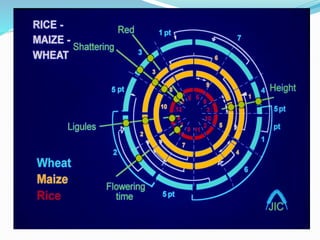
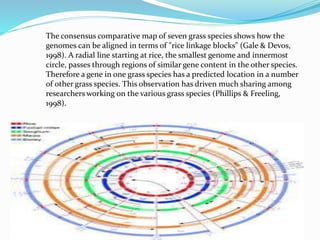
The consensus comparative map of seven grass species shows how the
genomes can be aligned in terms of "rice linkage blocks" (Gale & Devos,
1998). A radial line starting at rice, the smallest genome and innermost
circle, passes through regions of similar gene content in the other species.
Therefore a gene in one grass species has a predicted location in a number
of other grass species. This observation has driven much sharing among
researchers working on the various grass species (Phillips & Freeling,
1998).
Conclusion:
 It can help us in comparative genomics.
 Itcan also help in crop improvement.
 It can also help for maintanace of better quaity crops.
 Overall impact on the quality of life on earth.

Cereal genomics

  • 2.
    Cereal crop  FAO'sdefinition of cereals describes these plants as annual plants which generally belong to the gramineous family, producing grains that are used for food, feed, seed and production of industrial products.  Cereal Crops:  Rice  Wheat,  Corn or maize  Barley  Millet  Sorghum  Oat  Rye
  • 3.
    introduction  The economicand scientific importance of the cereals has motivated a rich history of research into their genetics, development, and evolution.  The nearly completed sequence of the rice genome is emblematic of a transition to high-throughput genomics and computational biology that has also pervaded study of many other cereals.
  • 4.
     The relativelyclose (ca. <50 million years old) relationships among morphologically diverse cereals native to environments that sample much of global geographic diversity make the cereals particularly attractive for comparative studies of plant genome evolution.
  • 5.
     Using therapidly growing capabilities of several informatics resources, genomic data from model cereals are likely to be leveraged tremendously in the study and improvement of a wide range of crop plants that sustain much of the world's population
  • 6.
  • 7.
     The sequenceof the japonica cultivar Nipponbare was recently completed by a consortium of 10 countries, which comprised the International Rice Genome Sequencing Project (IRGSP)
  • 8.
     Using therapidly growing capabilities of several informatics resources, genomic data from model cereals are likely to be leveraged tremendously in the study and improvement of a wide range of crop plants that sustain much of the world's population
  • 9.
    Rice:  Rice isconsidered a model cereal crop because it has a relatively small genome size as compared with other cereals, a vast germplasm collection, an enormous repertoire of molecular genetic resources, and an efficient transformation system.  The scientific value of rice is further enhanced with the elucidation of the genome sequence of the two major subspecies of cultivated rice, Oryza sativa ssp.
  • 10.
    Conti…..  For thisreason and because of its small size, rice was promoted as a model and was chosen to be the first cereal genome sequenced.  Further, the development of large EST collections and the first inter- and intra-specific comparative studies of BAC sequences from maize, sorghum, rice, wheat and barley have increased the resolution of comparative analyses and have shown that a number of rearrangements disrupting microcolinearity have occurred during the evolution of the cereal genomes in the past 50–70 million years.
  • 11.
     development ofmolecular markers, and for identifying the region in the model species that might contain candidate genes responsible for a trait of interest. Rice (2n = 24), having a small genome and great economic significance, was the first grass species selected for genome sequencing
  • 12.
    © 2005 PrenticeHall Inc. / A Pearson Education Company / Upper Saddle River, New Jersey 07458 Sequencing of crop-plant genomes  Reasons for sequencing rice first  Importance as crop  Largest food source for poor  Feeds half of world’s population (3 billion)  Demand likely to increase dramatically  80% of daily calories in Asia come from rice  In Asia alone, demand will increase by at least 35%.
  • 13.
    © 2005 PrenticeHall Inc. / A Pearson Education Company / Upper Saddle River, New Jersey 07458 Rice genome  Smallest among grass genomes (Wheat, oat, rye, Barley, corn)  Few repetitive elements  Synteny with other grasses (recent evolution from a common ancestor approximately 50–70 million years ago)  Genetic and physical maps  Genomic resources  Over million ESTs  Efficient transformation
  • 15.
    © 2005 PrenticeHall Inc. / A Pearson Education Company / Upper Saddle River, New Jersey 07458 Facts about the rice genome  Size: 430 Mbp (3.3 X Arabidopsis)  Number of genes: approximately 60,000  Repetitive elements: Most in intergenic regions versus in introns in humans  Animals use alternative splicing and plants gene duplication?
  • 16.
    © 2005 PrenticeHall Inc. / A Pearson Education Company / Upper Saddle River, New Jersey 07458 Genomics of other cereals  Maize: 3,000 Mbp  Wheat: 5,000 Mbp  Barley: 16,000 Mbp  Genome organization  Genic or gene-rich islands in the sea of retroposons
  • 17.
    © 2005 PrenticeHall Inc. / A Pearson Education Company / Upper Saddle River, New Jersey 07458 Rice and Arabidopsis genomes  No large areas of synteny  80% of Arabidopsis genes have homologs in rice  Reverse not true  Only 50% of rice genes have homologs in Arabidopsis  150–200 million years of divergence (Quick change) Rice Arabidopsis
  • 18.
    Wheat genome:  AU.S. National Science Foundation-funded wheat expressed sequence tag (EST) project has been studying the structure and function of the expressed portion of the wheat genome by mapping wheat unigenes to individual chromosome regions. Representative ESTs, each belonging to one of the unigenes (http://wheat.pw.usda.gov/NSF/progress_mapping.html) were used for mapping in the wheat genome utilizing 101 wheat deletion stocks, each of which contain a deletion of a defined part of a chromosome (Endo and Gill 1996), referred to as deletion mapping. As of November 2002, over 100,000 ESTs from various tissues of wheat at different stages of development have been sequenced, and 4485 wheat unigenes have been deletion mapped by this project.
  • 19.
    Cereal Genome Sizes Sorghum 1000 Mb  Maize 3000 Mb  Barley 5000 Mb  Wheat 16,000 Mb  Rice 420 Mb
  • 20.
    Conti….  The wheatwhole genome sequence data provides direct access to all 96,000 genes and represents an essential step towards a systematic understanding of biology and engineering .  The cereal crop for valuable traits. Its implications in cereal genetics and breeding includes the examination of genome variation, association mapping using natural populations.
  • 21.
    Maize genome: The 21stcentury finds maize in the process of being sequenced. With an estimated 2300-2600 Mb of chromosomal DNA (6× rice and 20× Arabidopsis), of which at least 60% is retrotransposon. • the maize genome has initially been “filtered” to enhance its production(Rabinowicz et al. 1999) or low- repeat (Peterson et al. 2002a; Yuan et al. 2003) sequence—before shotgun sequencing (Whitelaw et al. 2003)
  • 22.
    Cont…..  Maize (n= 10) is a recent domesticate of the tropical grass (Doebley 2004). The most recent maize whole- genome duplication happened approximately 12 Mya (Gaut and Doebley 1997).
  • 23.
    Sorghum genome:  Themost detailed sorghum sequence-tagged site (STS)- based map is from a cross between Sorghum bicolor (SB) and S. propinquum (SP), comprising 2512 restriction fragment length polymorphism loci that span 1059.2 cM (Bowers et al. 2003).  A total of 865 heterologous probes link the sorghum map to those of Saccharum (sugarcane: Ming et al. 1998), Zea (maize: Bowers et al. 2003), Oryza (rice: Paterson et al. 1995, 2004), Pennisetum (millet, buffelgrass: Jessup et al. 2003), the Triticeae (wheat, barley, oat, rye), Panicum (switchgrass: Missaoui et al. 2005), and Cynodon (bermudagrass: C. Bethel, E. Sciara, J. Estill, W. Hanna, and A.H. Paterson, in prep.).
  • 24.
     Sorghum wasthe first plant for which a BAC library was reported (Woo et al. 1994). Physical maps of both SB and SP have been constructed and genetically
  • 25.
    The consensus comparativemap of seven grass species shows how the genomes can be aligned in terms of "rice linkage blocks" (Gale & Devos, 1998). A radial line starting at rice, the smallest genome and innermost circle, passes through regions of similar gene content in the other species. Therefore a gene in one grass species has a predicted location in a number of other grass species. This observation has driven much sharing among researchers working on the various grass species (Phillips & Freeling, 1998).
  • 26.
    Conclusion:  It canhelp us in comparative genomics.  Itcan also help in crop improvement.  It can also help for maintanace of better quaity crops.  Overall impact on the quality of life on earth.