GENETIC ENGINEERING
What is genetic Engineering?
It is the process that involves the isolation,
manipulation and reintroduction of DNA
into model organisms, usually to express a
protein in an organism.
OR
Modifying DNA to remove, add, or alter
genetic information is called genetic
modification or genetic engineering.
• Genetic engineering works because there
is one language of life.
• Human genes work in bacteria, monkey
genes work in mice and earthworms. Tree
genes work in bananas and frog genes
work in rice.
Brief History
. The term "genetic engineering" was first
coined by Jack Williamson in his science
fiction novel Dragon's Island, published in
1951.
In the early 1980s, scientists developed
recombinant DNA techniques.
The first genetically engineered plant was
tobacco that was resistant to herbicides, it
occurred in France and the USA in 1986.
 As of 2002, over forty food crops had
been modified using recombinant DNA
technology
 including pesticide-resistant soybeans,
virus-resistant squash, frost-resistant
strawberries, corn and potatoes containing
a natural pesticide, and rice containing
beta-carotene.
• In 2010, scientists at the J. Craig Venter
Institute, created the first synthetic
bacterial genome. The resulting bacterium,
named Synthia, was the world's first
synthetic life form.
Discovery of Enzymes
• Key step in the development of genetic
engineering was the discovery of
restriction enzymes in 1968 by the Swiss
microbiologist Werner Arber.
• However, type II restriction enzymes
purified by American molecular biologist
Hamilton O. Smith, which are essential to
genetic engineering for their ability to
cleave a specific site within the DNA.
• DNA ligases are enzymes used in the
recombinant DNA technology to insert
pieces of DNA cut by restriction enzymes
into other DNA molecules submitted to the
action of the same endonucleases.
Techniques for Genetic
Engineering
• Recombinant DNA technology
• Pieces of genes from an organism are
inserted into the genetic material of another
organism producing recombinant beings; for
example, the creation of of sheep Dolly.
Biolistics:
• To inject DNA into cells by mixing the DNA
with small metal particles and then firing the
particles into the host cell at very high speeds
is biolistics
Apparatus for gene gun
Plasmid Technology:
• The plasmids are tiny ringlets of DNA,
apart from the chromosome, that may
contain 2-250 genes.
• Plasmid technology is the beginning of
modem industrial microbiology. The
plasmids can be spliced with genes from
an unrelated organism.
Plasmid
Electroporation:
• Electric shots are given to plant cells,
pores are created and foreign DNA is
entered to cell.
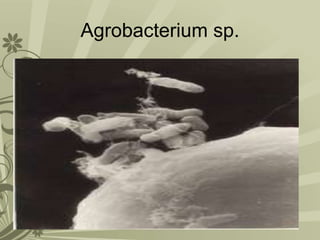
Transformation by Agrobacterium
tumefaciens
• It has tumor inducing plasmid i.e. Ti
plasmid
• Gene of interest is inserted in plasmid
Agrobacterium sp.
Ti Plasmid
• Gene of interest is then transferred to
plants get the desired character e.g.
genes or antibiotic resistance.
Microinjection:
• DNA is injected to plants by micro
syringes.
The Biology Behind Genetic
Engineering
Role of DNA:
• DNA is the backbone for continuity of life.
The order of the four subunits A, G, C and
T in the DNA strand holds a code of
information for the cell.
• DNA is a ‘universal language’, meaning
the genetic code means the same thing in
all organisms.
• When a gene for a desirable trait is taken
from one organism and inserted into
another, it gives the ‘recipient’ organism
the ability to express that same trait.
• By using genetic language it makes the
proteins for the organism.
Structure of DNA
Role of Proteins:
• They can be part of structures (such as
cell walls, organelles, etc). They can
regulate reactions that take place in the
cell. Or they can serve as enzymes, which
speed-up reactions.
How Genetic Engineering is
Done?
Process
• find an organism that naturally contains
the desired trait.
• The DNA is extracted from that organism.
• The one desired gene must be located
and copied from thousands of genes that
were extracted. This is called gene cloning
• The gene may be modified slightly to work
in a more desirable way inside the
recipient organism.
• The new gene called a transgene is
delivered into cells of the recipient
organism. This is called transformation.
• Once a transgenic organism has been
created, traditional breeding is used to
improve the characteristics of the final
product.
The first Commercial Genetic Engineered
Food
 First commercial genetically engineered
foods was a tomato in which the gene
responsible for softening was turned off.
Some Common Examples:
•Insulin genes in humans have been isolated
and inserted into bacteria . The insulin that is
then produced by these bacteria, is identical to
human insulin.
Crystals of Insulin
• Chymosin, an enzyme that is involved in
cheese manufacturing, have also been
inserted into bacteria
• Genetic engineer has created a chicken
with four legs and no wing.
• Genetic engineering has created a goat
with spider genes that creates "silk" in its
milk.
•Human cloning is a type of genetic engineering,
but is not the true genetic manipulation.
• In human cloning, the aim is to duplicate the
genes of an existing person so that an identical
set is inside a human egg.
Cotton without Insecticides
• Genetic engineers transferred the gene for
Bt toxin from Bacillus thuringiensis to
cotton.
• The bacterium produces a toxin which is
deadly to caterpillars Today, much of the
US cotton crop is genetic engineered
• The only insects which it can harm are
those which eat the plant.
 Fast Growing Fish
• Salmon take three years to grow from
fingerling size to optimum marketing size.
• In wild salmon turns on the gene for
growth hormone only in the pituitary gland
and primarily in warm water.
• So genetic engineers used a different
control gene to turn on a growth hormone
gene in cold water.
• That control gene was transferred from an
ocean pout, and it turned on a gene for a
protein that helped the pout tolerate very
cold water.
• The new creature looks like wild salmon
and its growth rate was faster than it.
Cure of Lung diseases in human:
• Genetic engineering also includes
insertion of human genes into sheep so
that they secrete alpha-1 antitrypsin in
their milk - a useful substance in treating
some cases of lung disease.
Toxic Soils
• Some soils are poor for plant growth because their
mineral content is toxic
• Recently, Florida scientists discovered a type of fern
which can extract arsenic from the soil
• But other teams have identified genes that can
enable plants to remove cadmium, zinc and mercury
from soils., especially in acidic soils.
• Building with Silk
• Silk is an extraordinarily strong material,
stronger than steel. It is composed of two
proteins, fibroin and sericin.
• The gene for fibroin has been transferred
from a silkworm to a goat, and is
expressed as a component of its milk.
Applications of Genetic
Engineering
• Agriculture:
• One of the best-known applications of genetic
engineering is the creation of genetically
modified food.
• These crops are resistant resistance to
herbicides, fungal and virus infection tolerant
against salt, cold or drought.
• Some of them are pharmaceutical crops that
contain edible vaccines and other drugs.
Dandelion
Spider Onion
Banana fish
Underground potato frog
Blue Apple
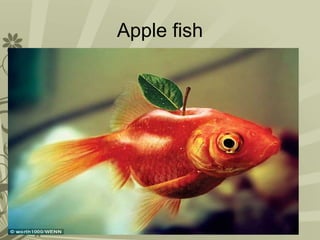
Apple fish
Commercial Importance:
• Yeasts are being engineered to yield enzymes for
cheese industry. Large scale amylase and
cellulases are obtained.
 Pollution Control:
• Nitrogen fertilisers are eliminated by incorporating
plasmids containing bacterial genes for nitrogen
fixation into the plant cells.
 Bioremediation:
• Bacteria have also been engineered to live
solely on toxic wastes in the environment.
• A gene for hair digesting enzyme is
inserted into plasmid of bacteria.
Conclusion
• Genetic engineering has given us the
power to alter the very basis of life on
earth
• Cross-breeding all work by using the same
species. In contrast genetic engineering
allows to combine different genes in same
oeganism.
• Genetic engineering therefore has few
limits, our moral or ethical code.
• The recombinant DNA technology and
cloning are extremely dangerous since
they are able to modify, in a very short
• While making changes in organisms there
is risk of creating diseases in them.
• It has application in every field of life.
• Goal of technique is to add one or more
new traits that are not already found in that
organism
Genetic engineerig

Genetic engineerig

  • 1.
  • 2.
    What is geneticEngineering? It is the process that involves the isolation, manipulation and reintroduction of DNA into model organisms, usually to express a protein in an organism. OR Modifying DNA to remove, add, or alter genetic information is called genetic modification or genetic engineering.
  • 3.
    • Genetic engineeringworks because there is one language of life. • Human genes work in bacteria, monkey genes work in mice and earthworms. Tree genes work in bananas and frog genes work in rice.
  • 4.
    Brief History . Theterm "genetic engineering" was first coined by Jack Williamson in his science fiction novel Dragon's Island, published in 1951. In the early 1980s, scientists developed recombinant DNA techniques. The first genetically engineered plant was tobacco that was resistant to herbicides, it occurred in France and the USA in 1986.
  • 5.
     As of2002, over forty food crops had been modified using recombinant DNA technology  including pesticide-resistant soybeans, virus-resistant squash, frost-resistant strawberries, corn and potatoes containing a natural pesticide, and rice containing beta-carotene.
  • 6.
    • In 2010,scientists at the J. Craig Venter Institute, created the first synthetic bacterial genome. The resulting bacterium, named Synthia, was the world's first synthetic life form.
  • 7.
    Discovery of Enzymes •Key step in the development of genetic engineering was the discovery of restriction enzymes in 1968 by the Swiss microbiologist Werner Arber. • However, type II restriction enzymes purified by American molecular biologist Hamilton O. Smith, which are essential to genetic engineering for their ability to cleave a specific site within the DNA.
  • 8.
    • DNA ligasesare enzymes used in the recombinant DNA technology to insert pieces of DNA cut by restriction enzymes into other DNA molecules submitted to the action of the same endonucleases.
  • 9.
    Techniques for Genetic Engineering •Recombinant DNA technology • Pieces of genes from an organism are inserted into the genetic material of another organism producing recombinant beings; for example, the creation of of sheep Dolly. Biolistics: • To inject DNA into cells by mixing the DNA with small metal particles and then firing the particles into the host cell at very high speeds is biolistics
  • 10.
  • 11.
    Plasmid Technology: • Theplasmids are tiny ringlets of DNA, apart from the chromosome, that may contain 2-250 genes. • Plasmid technology is the beginning of modem industrial microbiology. The plasmids can be spliced with genes from an unrelated organism.
  • 12.
  • 13.
    Electroporation: • Electric shotsare given to plant cells, pores are created and foreign DNA is entered to cell. Transformation by Agrobacterium tumefaciens • It has tumor inducing plasmid i.e. Ti plasmid • Gene of interest is inserted in plasmid
  • 14.
  • 15.
  • 16.
    • Gene ofinterest is then transferred to plants get the desired character e.g. genes or antibiotic resistance. Microinjection: • DNA is injected to plants by micro syringes.
  • 17.
    The Biology BehindGenetic Engineering Role of DNA: • DNA is the backbone for continuity of life. The order of the four subunits A, G, C and T in the DNA strand holds a code of information for the cell. • DNA is a ‘universal language’, meaning the genetic code means the same thing in all organisms.
  • 18.
    • When agene for a desirable trait is taken from one organism and inserted into another, it gives the ‘recipient’ organism the ability to express that same trait. • By using genetic language it makes the proteins for the organism.
  • 19.
  • 20.
    Role of Proteins: •They can be part of structures (such as cell walls, organelles, etc). They can regulate reactions that take place in the cell. Or they can serve as enzymes, which speed-up reactions.
  • 21.
    How Genetic Engineeringis Done? Process • find an organism that naturally contains the desired trait. • The DNA is extracted from that organism. • The one desired gene must be located and copied from thousands of genes that were extracted. This is called gene cloning
  • 22.
    • The genemay be modified slightly to work in a more desirable way inside the recipient organism. • The new gene called a transgene is delivered into cells of the recipient organism. This is called transformation.
  • 23.
    • Once atransgenic organism has been created, traditional breeding is used to improve the characteristics of the final product.
  • 24.
    The first CommercialGenetic Engineered Food  First commercial genetically engineered foods was a tomato in which the gene responsible for softening was turned off. Some Common Examples: •Insulin genes in humans have been isolated and inserted into bacteria . The insulin that is then produced by these bacteria, is identical to human insulin.
  • 25.
  • 26.
    • Chymosin, anenzyme that is involved in cheese manufacturing, have also been inserted into bacteria • Genetic engineer has created a chicken with four legs and no wing. • Genetic engineering has created a goat with spider genes that creates "silk" in its milk.
  • 27.
    •Human cloning isa type of genetic engineering, but is not the true genetic manipulation. • In human cloning, the aim is to duplicate the genes of an existing person so that an identical set is inside a human egg.
  • 28.
    Cotton without Insecticides •Genetic engineers transferred the gene for Bt toxin from Bacillus thuringiensis to cotton. • The bacterium produces a toxin which is deadly to caterpillars Today, much of the US cotton crop is genetic engineered • The only insects which it can harm are those which eat the plant.
  • 29.
     Fast GrowingFish • Salmon take three years to grow from fingerling size to optimum marketing size. • In wild salmon turns on the gene for growth hormone only in the pituitary gland and primarily in warm water.
  • 30.
    • So geneticengineers used a different control gene to turn on a growth hormone gene in cold water. • That control gene was transferred from an ocean pout, and it turned on a gene for a protein that helped the pout tolerate very cold water. • The new creature looks like wild salmon and its growth rate was faster than it.
  • 31.
    Cure of Lungdiseases in human: • Genetic engineering also includes insertion of human genes into sheep so that they secrete alpha-1 antitrypsin in their milk - a useful substance in treating some cases of lung disease.
  • 32.
    Toxic Soils • Somesoils are poor for plant growth because their mineral content is toxic • Recently, Florida scientists discovered a type of fern which can extract arsenic from the soil • But other teams have identified genes that can enable plants to remove cadmium, zinc and mercury from soils., especially in acidic soils.
  • 33.
    • Building withSilk • Silk is an extraordinarily strong material, stronger than steel. It is composed of two proteins, fibroin and sericin. • The gene for fibroin has been transferred from a silkworm to a goat, and is expressed as a component of its milk.
  • 34.
    Applications of Genetic Engineering •Agriculture: • One of the best-known applications of genetic engineering is the creation of genetically modified food. • These crops are resistant resistance to herbicides, fungal and virus infection tolerant against salt, cold or drought. • Some of them are pharmaceutical crops that contain edible vaccines and other drugs.
  • 35.
  • 36.
  • 37.
  • 38.
  • 39.
  • 40.
  • 41.
    Commercial Importance: • Yeastsare being engineered to yield enzymes for cheese industry. Large scale amylase and cellulases are obtained.  Pollution Control: • Nitrogen fertilisers are eliminated by incorporating plasmids containing bacterial genes for nitrogen fixation into the plant cells.
  • 42.
     Bioremediation: • Bacteriahave also been engineered to live solely on toxic wastes in the environment. • A gene for hair digesting enzyme is inserted into plasmid of bacteria.
  • 43.
    Conclusion • Genetic engineeringhas given us the power to alter the very basis of life on earth • Cross-breeding all work by using the same species. In contrast genetic engineering allows to combine different genes in same oeganism. • Genetic engineering therefore has few limits, our moral or ethical code. • The recombinant DNA technology and cloning are extremely dangerous since they are able to modify, in a very short
  • 44.
    • While makingchanges in organisms there is risk of creating diseases in them. • It has application in every field of life. • Goal of technique is to add one or more new traits that are not already found in that organism