• Animals that have a   Chordates
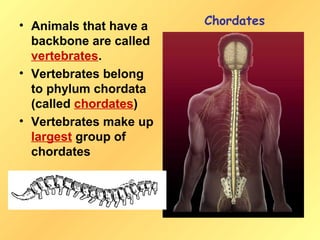
  backbone are called
  vertebrates.
• Vertebrates belong
  to phylum chordata
  (called chordates)
• Vertebrates make up
  largest group of
  chordates
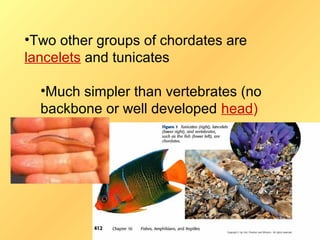
•Two other groups of chordates are
lancelets and tunicates

  •Much simpler than vertebrates (no
  backbone or well developed head)
Chordate Characteristics
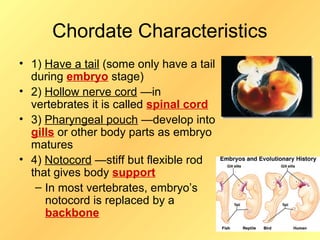
• 1) Have a tail (some only have a tail
  during embryo stage)
• 2) Hollow nerve cord —in
  vertebrates it is called spinal cord
• 3) Pharyngeal pouch —develop into
  gills or other body parts as embryo
  matures
• 4) Notocord —stiff but flexible rod
  that gives body support
   – In most vertebrates, embryo’s
     notocord is replaced by a
     backbone
Vertebrate Characteristics
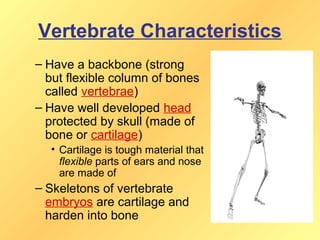
– Have a backbone (strong
  but flexible column of bones
  called vertebrae)
– Have well developed head
  protected by skull (made of
  bone or cartilage)
  • Cartilage is tough material that
    flexible parts of ears and nose
    are made of
– Skeletons of vertebrate
  embryos are cartilage and
  harden into bone
Are Vertebrates
   Warm or Cold?
• Birds and
  mammals are
  endotherms (warm
  blooded)
  – Use energy
    released by
    chemical reactions
    in the body to stay
    warm
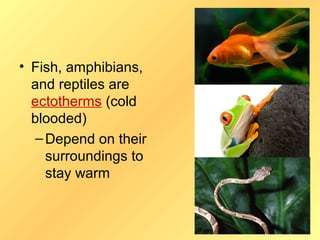
• Fish, amphibians,
  and reptiles are
  ectotherms (cold
  blooded)
   – Depend on their
     surroundings to
     stay warm
Fish Characteristics
• More than 25,000 species
  of fish
• All fishes share several
  characteristics:
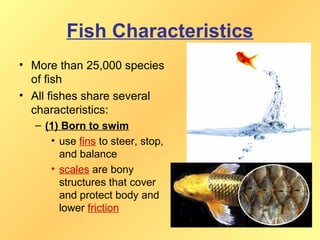
  – (1) Born to swim
     • use fins to steer, stop,
       and balance
     • scales are bony
       structures that cover
       and protect body and
       lower friction
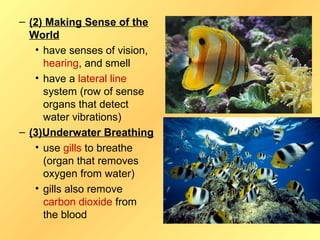
– (2) Making Sense of the
  World
   • have senses of vision,
     hearing, and smell
   • have a lateral line
     system (row of sense
     organs that detect
     water vibrations)
– (3)Underwater Breathing
   • use gills to breathe
     (organ that removes
     oxygen from water)
   • gills also remove
     carbon dioxide from
     the blood
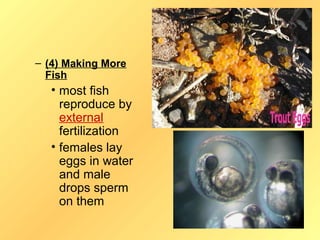
– (4) Making More
  Fish
  • most fish
    reproduce by
    external
    fertilization
  • females lay
    eggs in water
    and male
    drops sperm
    on them
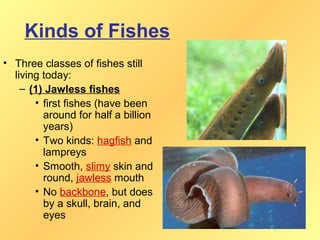
Kinds of Fishes
• Three classes of fishes still
  living today:
    – (1) Jawless fishes
       • first fishes (have been
         around for half a billion
         years)
       • Two kinds: hagfish and
         lampreys
       • Smooth, slimy skin and
         round, jawless mouth
       • No backbone, but does
         by a skull, brain, and
         eyes
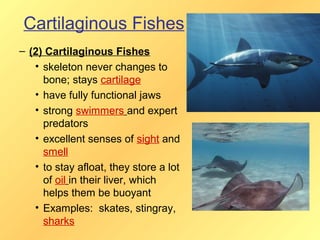
Cartilaginous Fishes
– (2) Cartilaginous Fishes
   • skeleton never changes to
     bone; stays cartilage
   • have fully functional jaws
   • strong swimmers and expert
     predators
   • excellent senses of sight and
     smell
   • to stay afloat, they store a lot
     of oil in their liver, which
     helps them be buoyant
   • Examples: skates, stingray,
     sharks
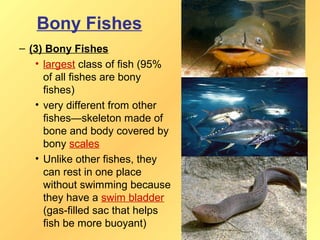
Bony Fishes
– (3) Bony Fishes
   • largest class of fish (95%
     of all fishes are bony
     fishes)
   • very different from other
     fishes—skeleton made of
     bone and body covered by
     bony scales
   • Unlike other fishes, they
     can rest in one place
     without swimming because
     they have a swim bladder
     (gas-filled sac that helps
     fish be more buoyant)
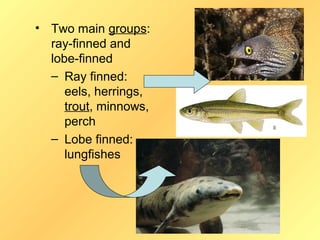
• Two main groups:
  ray-finned and
  lobe-finned
  – Ray finned:
     eels, herrings,
     trout, minnows,
     perch
  – Lobe finned:
     lungfishes
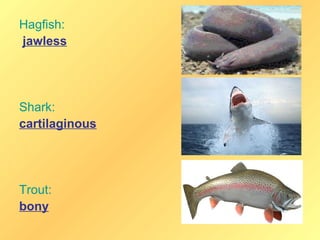
Hagfish:
jawless


Shark:
cartilaginous


Trout:
bony
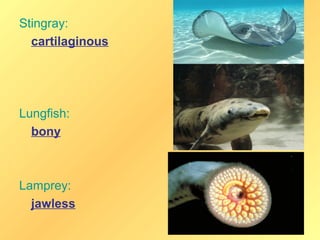
Stingray:
  cartilaginous


Lungfish:
  bony


Lamprey:
  jawless

Fishes

  • 2.
    • Animals thathave a Chordates backbone are called vertebrates. • Vertebrates belong to phylum chordata (called chordates) • Vertebrates make up largest group of chordates
  • 3.
    •Two other groupsof chordates are lancelets and tunicates •Much simpler than vertebrates (no backbone or well developed head)
  • 4.
    Chordate Characteristics • 1)Have a tail (some only have a tail during embryo stage) • 2) Hollow nerve cord —in vertebrates it is called spinal cord • 3) Pharyngeal pouch —develop into gills or other body parts as embryo matures • 4) Notocord —stiff but flexible rod that gives body support – In most vertebrates, embryo’s notocord is replaced by a backbone
  • 5.
    Vertebrate Characteristics – Havea backbone (strong but flexible column of bones called vertebrae) – Have well developed head protected by skull (made of bone or cartilage) • Cartilage is tough material that flexible parts of ears and nose are made of – Skeletons of vertebrate embryos are cartilage and harden into bone
  • 6.
    Are Vertebrates Warm or Cold? • Birds and mammals are endotherms (warm blooded) – Use energy released by chemical reactions in the body to stay warm
  • 7.
    • Fish, amphibians, and reptiles are ectotherms (cold blooded) – Depend on their surroundings to stay warm
  • 8.
    Fish Characteristics • Morethan 25,000 species of fish • All fishes share several characteristics: – (1) Born to swim • use fins to steer, stop, and balance • scales are bony structures that cover and protect body and lower friction
  • 9.
    – (2) MakingSense of the World • have senses of vision, hearing, and smell • have a lateral line system (row of sense organs that detect water vibrations) – (3)Underwater Breathing • use gills to breathe (organ that removes oxygen from water) • gills also remove carbon dioxide from the blood
  • 10.
    – (4) MakingMore Fish • most fish reproduce by external fertilization • females lay eggs in water and male drops sperm on them
  • 11.
    Kinds of Fishes •Three classes of fishes still living today: – (1) Jawless fishes • first fishes (have been around for half a billion years) • Two kinds: hagfish and lampreys • Smooth, slimy skin and round, jawless mouth • No backbone, but does by a skull, brain, and eyes
  • 12.
    Cartilaginous Fishes – (2)Cartilaginous Fishes • skeleton never changes to bone; stays cartilage • have fully functional jaws • strong swimmers and expert predators • excellent senses of sight and smell • to stay afloat, they store a lot of oil in their liver, which helps them be buoyant • Examples: skates, stingray, sharks
  • 13.
    Bony Fishes – (3)Bony Fishes • largest class of fish (95% of all fishes are bony fishes) • very different from other fishes—skeleton made of bone and body covered by bony scales • Unlike other fishes, they can rest in one place without swimming because they have a swim bladder (gas-filled sac that helps fish be more buoyant)
  • 14.
    • Two maingroups: ray-finned and lobe-finned – Ray finned: eels, herrings, trout, minnows, perch – Lobe finned: lungfishes
  • 15.
  • 16.