Fish
What is a fish? There are more differences among fish than any other vertebrate class. There are more than 30,000 different species of fish. Fish are broken up into 3 separate classes.
Fish Adaptations Gills:   Consist of fleshy filaments filled with tiny blood vessels, thus the gills look bright red in color.  Fish take water in the mouth and pass it out over the gills.  The blood vessels take in the oxygen and release carbon dioxide. Fins:   are fan like structures used for steering, balancing, and moving. Scales:   Hard, thin overlapping plates that cover and protect the fish’s body.
Origins of Fish Most scientists agree that fish evolved from small, soft-bodied, filter feeding organisms similar to present day lancelets. The earliest fish fossils are of jawless fish that lived 450 million years ago and have generally been found in streams that emptied into the sea.
390 million years ago, this new group of fish appeared placoderms appeared; 60 million years ago they disappeared from fossil records. The first modern boney fish first appeared about 190 million years ago.  Today there are over 400 families of boney fish. Boney fish are the most successful class of fish today.
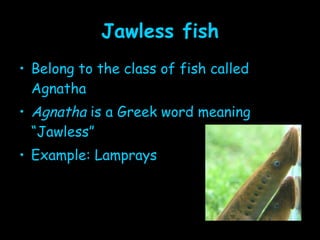
Jawless fish Belong to the class of fish called Agnatha Agnatha  is a Greek word meaning “Jawless” Example: Lamprays
Characteristics of Agnatha Round mouths Long tube like bodies Covered with a slimy skin and no scales Flexible bodies made of cartilage Cartilage:   a tough, flexible tissue that is not as hard as bone. (Your ears and tip of your nose are made of cartilage!)
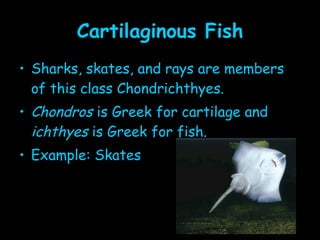
Cartilaginous Fish Sharks, skates, and rays are members of this class Chondrichthyes. Chondros  is Greek for cartilage and  ichthyes  is Greek for fish. Example: Skates
Characteristics of cartilaginous fish Have skeletons made of cartilage Have moveable jaws and scales Scales resemble vertebrate teeth and their skin feels like fine sand paper
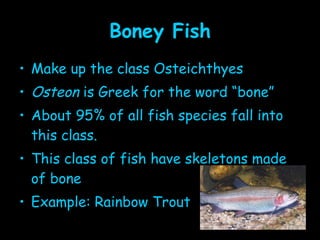
Boney Fish Make up the class Osteichthyes Osteon  is Greek for the word “bone” About 95% of all fish species fall into this class. This class of fish have skeletons made of bone Example: Rainbow Trout
Characteristics of Osteichthyes Skeletons made of bone Gills are covered and protected by gill covers Most species in this class have separate sexes To reproduce the female releases a large number of eggs, then the male swims over the eggs releasing sperm.  This is called spawning.
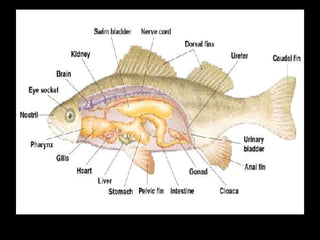
Buoyancy Is controlled by the swim bladder Swim bladders  adjusts to its density so the fish can sink or rise.  As a fish swims it inflated with gas, and the fish becomes more buoyant, as it deflates it becomes less buoyant. Glands regulate the gas content, which allows the fish to stay at a consistent depth with little effort. Deep sea fish usually have oil instead of gas in their swim bladders. Some bottom dwelling fish don’t have a swim bladder at all.
 
Kinds of Boney Fish Lobe-Finned:  fins are lobe-like and fleshy Lungfish:  Have both lings and gills for breathing.  Live in shallow waters that frequently dry up.  They burrow in the mud and cover themselves with a mucus until the water returns Ray-Finned:   have fins made of long thin bones and are covered with skin
REVIEW
What are three characteristics of chordates? Notochord Dorsal hallow nerve cord Gill slits
Name the three classes of fish and give an example of each. Class: Agnatha / Jawless Fish Example: Lamprays Class: Osteichthyes / Boney Fish Example: Rainbow trout Class: Chondrichthyes / Cartilaginous Fish Example: Skates
Explain the difference between Ectotherms and Endotherms. Ectotherms: an animal who’s body temperature changed with its surrounding (fish, reptile and amphibians) Endotherms: animals that have a consistent internal body temperature (birds and mammals)

Fish

  • 1.
  • 2.
    What is afish? There are more differences among fish than any other vertebrate class. There are more than 30,000 different species of fish. Fish are broken up into 3 separate classes.
  • 3.
    Fish Adaptations Gills: Consist of fleshy filaments filled with tiny blood vessels, thus the gills look bright red in color. Fish take water in the mouth and pass it out over the gills. The blood vessels take in the oxygen and release carbon dioxide. Fins: are fan like structures used for steering, balancing, and moving. Scales: Hard, thin overlapping plates that cover and protect the fish’s body.
  • 4.
    Origins of FishMost scientists agree that fish evolved from small, soft-bodied, filter feeding organisms similar to present day lancelets. The earliest fish fossils are of jawless fish that lived 450 million years ago and have generally been found in streams that emptied into the sea.
  • 5.
    390 million yearsago, this new group of fish appeared placoderms appeared; 60 million years ago they disappeared from fossil records. The first modern boney fish first appeared about 190 million years ago. Today there are over 400 families of boney fish. Boney fish are the most successful class of fish today.
  • 6.
    Jawless fish Belongto the class of fish called Agnatha Agnatha is a Greek word meaning “Jawless” Example: Lamprays
  • 7.
    Characteristics of AgnathaRound mouths Long tube like bodies Covered with a slimy skin and no scales Flexible bodies made of cartilage Cartilage: a tough, flexible tissue that is not as hard as bone. (Your ears and tip of your nose are made of cartilage!)
  • 8.
    Cartilaginous Fish Sharks,skates, and rays are members of this class Chondrichthyes. Chondros is Greek for cartilage and ichthyes is Greek for fish. Example: Skates
  • 9.
    Characteristics of cartilaginousfish Have skeletons made of cartilage Have moveable jaws and scales Scales resemble vertebrate teeth and their skin feels like fine sand paper
  • 10.
    Boney Fish Makeup the class Osteichthyes Osteon is Greek for the word “bone” About 95% of all fish species fall into this class. This class of fish have skeletons made of bone Example: Rainbow Trout
  • 11.
    Characteristics of OsteichthyesSkeletons made of bone Gills are covered and protected by gill covers Most species in this class have separate sexes To reproduce the female releases a large number of eggs, then the male swims over the eggs releasing sperm. This is called spawning.
  • 12.
    Buoyancy Is controlledby the swim bladder Swim bladders adjusts to its density so the fish can sink or rise. As a fish swims it inflated with gas, and the fish becomes more buoyant, as it deflates it becomes less buoyant. Glands regulate the gas content, which allows the fish to stay at a consistent depth with little effort. Deep sea fish usually have oil instead of gas in their swim bladders. Some bottom dwelling fish don’t have a swim bladder at all.
  • 13.
  • 14.
    Kinds of BoneyFish Lobe-Finned: fins are lobe-like and fleshy Lungfish: Have both lings and gills for breathing. Live in shallow waters that frequently dry up. They burrow in the mud and cover themselves with a mucus until the water returns Ray-Finned: have fins made of long thin bones and are covered with skin
  • 15.
  • 16.
    What are threecharacteristics of chordates? Notochord Dorsal hallow nerve cord Gill slits
  • 17.
    Name the threeclasses of fish and give an example of each. Class: Agnatha / Jawless Fish Example: Lamprays Class: Osteichthyes / Boney Fish Example: Rainbow trout Class: Chondrichthyes / Cartilaginous Fish Example: Skates
  • 18.
    Explain the differencebetween Ectotherms and Endotherms. Ectotherms: an animal who’s body temperature changed with its surrounding (fish, reptile and amphibians) Endotherms: animals that have a consistent internal body temperature (birds and mammals)