Measurements and Metrics
Background Information
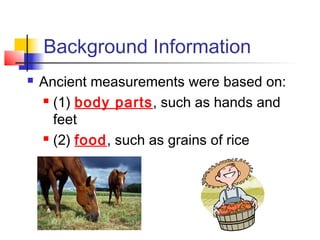
   Ancient measurements were based on:
     (1) body parts, such as hands and

      feet
     (2) food, such as grains of rice
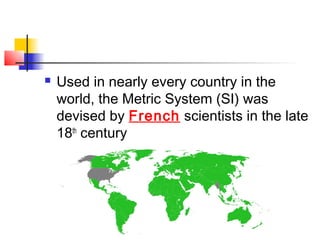
   Used in nearly every country in the
    world, the Metric System (SI) was
    devised by French scientists in the late
    18th century
Did You Know?
   1) The metric system is based on powers of 10 so it is much easier to
    convert units, often just by moving the decimal point.

    2) Once you remember the meaning of the prefixes, you can easily
    convert mass, volume and distance measurements. No further
    conversion factors need to be memorized except the specific power of 10.
    But for the English System you have to remember 5280 ft = 1 mile, 4
    quarts = 1 gallon, 3 feet = 1 yard, 16 oz. = 1 lb, etc.

    3) The metric system is a international standard used by nearly all the
    countries of the world. There are actually only *three* countries (i.e.
    United States, Liberia and Burma) that are still using the English system.
   The goal of this effort was to produce
    a system that used the decimal
    point rather than fractions
   Also wanted a single unified system
    that could be used throughout the
    world
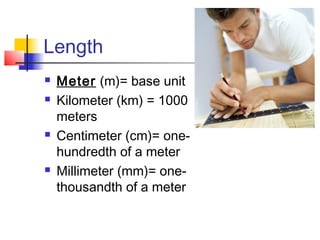
Length
   Meter (m)= base unit
   Kilometer (km) = 1000
    meters
   Centimeter (cm)= one-
    hundredth of a meter
   Millimeter (mm)= one-
    thousandth of a meter
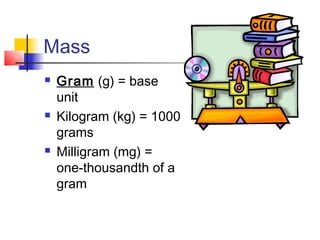
Mass
   Gram (g) = base
    unit
   Kilogram (kg) = 1000
    grams
   Milligram (mg) =
    one-thousandth of a
    gram
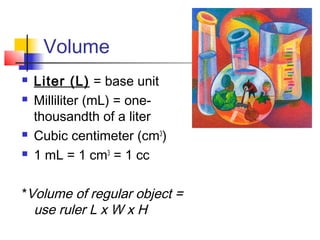
Volume
   Liter (L) = base unit
   Milliliter (mL) = one-
    thousandth of a liter
   Cubic centimeter (cm3)
   1 mL = 1 cm3 = 1 cc

*Volume of regular object =
  use ruler L x W x H
Converting with Metric System
   When converting with the
    metric system it is simply a
    measure of moving the
    decimal in the correct
    direction
   SI units are based on units
    of 10
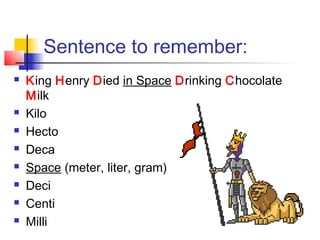
Sentence to remember:
   King Henry Died in Space Drinking Chocolate
    Milk
   Kilo
   Hecto
   Deca
   Space (meter, liter, gram)
   Deci
   Centi
   Milli
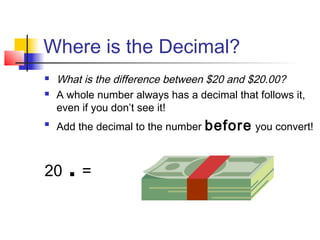
Where is the Decimal?
   What is the difference between $20 and $20.00?
   A whole number always has a decimal that follows it,
    even if you don’t see it!

    Add the decimal to the number before you convert!


20    .=
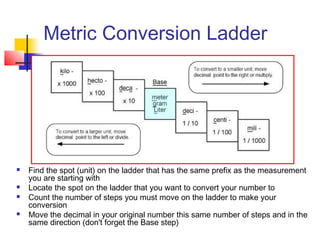
Metric Conversion Ladder


   Find the spot (unit) on the ladder that has the same prefix as the measurement
    you are starting with
   Locate the spot on the ladder that you want to convert your number to
   Count the number of steps you must move on the ladder to make your
    conversion
   Move the decimal in your original number this same number of steps and in the
    same direction (don't forget the Base step)

Metric System

  • 1.
  • 2.
    Background Information  Ancient measurements were based on:  (1) body parts, such as hands and feet  (2) food, such as grains of rice
  • 4.
    Used in nearly every country in the world, the Metric System (SI) was devised by French scientists in the late 18th century
  • 5.
    Did You Know?  1) The metric system is based on powers of 10 so it is much easier to convert units, often just by moving the decimal point. 2) Once you remember the meaning of the prefixes, you can easily convert mass, volume and distance measurements. No further conversion factors need to be memorized except the specific power of 10. But for the English System you have to remember 5280 ft = 1 mile, 4 quarts = 1 gallon, 3 feet = 1 yard, 16 oz. = 1 lb, etc. 3) The metric system is a international standard used by nearly all the countries of the world. There are actually only *three* countries (i.e. United States, Liberia and Burma) that are still using the English system.
  • 6.
    The goal of this effort was to produce a system that used the decimal point rather than fractions  Also wanted a single unified system that could be used throughout the world
  • 7.
    Length  Meter (m)= base unit  Kilometer (km) = 1000 meters  Centimeter (cm)= one- hundredth of a meter  Millimeter (mm)= one- thousandth of a meter
  • 8.
    Mass  Gram (g) = base unit  Kilogram (kg) = 1000 grams  Milligram (mg) = one-thousandth of a gram
  • 9.
    Volume  Liter (L) = base unit  Milliliter (mL) = one- thousandth of a liter  Cubic centimeter (cm3)  1 mL = 1 cm3 = 1 cc *Volume of regular object = use ruler L x W x H
  • 10.
    Converting with MetricSystem  When converting with the metric system it is simply a measure of moving the decimal in the correct direction  SI units are based on units of 10
  • 11.
    Sentence to remember:  King Henry Died in Space Drinking Chocolate Milk  Kilo  Hecto  Deca  Space (meter, liter, gram)  Deci  Centi  Milli
  • 12.
    Where is theDecimal?  What is the difference between $20 and $20.00?  A whole number always has a decimal that follows it, even if you don’t see it!  Add the decimal to the number before you convert! 20 .=
  • 13.
    Metric Conversion Ladder  Find the spot (unit) on the ladder that has the same prefix as the measurement you are starting with  Locate the spot on the ladder that you want to convert your number to  Count the number of steps you must move on the ladder to make your conversion  Move the decimal in your original number this same number of steps and in the same direction (don't forget the Base step)