ROLL NO. – CUHP18ZOO22
SUBMITTED TO – DR.VIVEK
Sharma
SUBMITTED BY - SHABNAM
PISCES- GENERAL CHARACTERS
• Fishes are first evolved in silurian period of Palaeozoic era.
• They increased their number in Devonian period.
• Devonian Period Is Called “Golden Age of Fishes”.
• Fishes are first jawed vertebrates.
• They Constitute 40% of Vertebrates.
• They are cold blooded vertebrates.
• Great variation in size
• Smallest fish- Paedocypris progenetica (7.9mm)
• Largest fish- Rhinodon typus(Whale shark)
• Ichthyology-Study of Fishes
PISCES- GENERAL
CHARACTERS
• Fishes-Characters:
• 1. Fishes are aquatic; cold-blooded/Poikilothermic/Ectotherms.
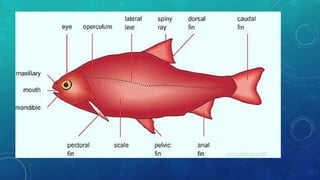
• 2. Their body is divisible into head, trunk
and tail. Neck is absent.
• 3. It has a streamlined spindle shaped
body. It is helpful in swimming.
• 4. Skin contains Multicellular Mucous glands-Lubricant
• 5. Exoskeleton- Dermal Scales/ Bony plates
• 6. Endoskeleton- Bone/Cartilage
• Vertebrae- Amphicoelous (Both sides concave)
• Ribs are present
• Pectoral and pelvic girdles- support Paired fins
• Dorsal, Anal, Caudal fins- Unpaired
• Pectoral, Pelvic fins- Paired fins
• External nostrils- paired and opens into blind nasal sacs,
Internal nostrils present in osteolepids and Dipnoi
• Coelom consists of small- Pericardial cavity and larger
Pleuroperitoneal cavity contain all viscera except kidneys, Two
are separated by Septum transversum
• Dentition- Homodont, Acrodont, Polyphyodont
• Spiral valve in intestine- increases absorptive area
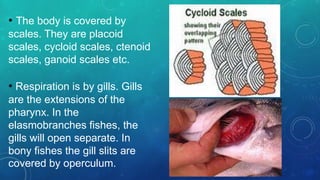
• The body is covered by
scales. They are placoid
scales, cycloid scales, ctenoid
scales, ganoid scales etc.
• Respiration is by gills. Gills
are the extensions of the
pharynx. In the
elasmobranches fishes, the
gills will open separate. In
bony fishes the gill slits are
covered by operculum.
• On the head a pair of nostrils are present internal nostril are
absent. In Dipnoi Internal nostrils are present
• On the head a pair of eyes is present.
• On the lateral sides of the body LATERAL LINE SENSE organs
are present .They detect the pressure changes of water. The body
shows paired and unpaired fins. Pelvic and pectoral fins are paired.
Dorsal and ventral fins are unpaired. They maintain balance in water.
They are useful for locomotion.
• The digestive system is well developed. In the intestine of shark scroll
valve Is present. The nervous system contains brain and spinal cord.
Brain is small & it will not occupy the entire cranial cavity.
• 10 pairs of cranial nerves are present.
• Kidneys are mesonephrlc.
• Urinary bladder is absent
• The skeleton of some fishes is made by cartilage. They are
called cartilage fishes. In some fishes the skeleton is made by
bone. They are called bony fishes.
• In some fresh water fishes accessory respiratory organs are
present. They will take up aerial respiration.
• Sexes are separate. In male sharks claspers are present.
• Many fishes are oviparous. Some fishes are viviparous.
• In the development of fishes amnion is not developed. Hence these
animals are called anamniotes
PISCES-CLASSIFICATION
The Divison Gnathostomata includes craniates, in which one pair of the
visceralarches is modified into this jaws. They show internal ear with three
semi-circular canals and provided with paired 4,appendages (fins or limbs).
Sexes are separate. The Divison is divided into two groups -
• 1) Pisces and 2) Tetrapoda.
• Pisces Include three classes-
• .1) Placodermi,
• .2) Elasmobronchi (Chondrichthyes),
• .3) Osteichthyes.
• Muller, Goodrich. Berg, Romer etc,classified the Pisces. There is no
agreement among many authors with respect to the classification of
fishes.
Class 1: Placodermi
.1) It includes extinct fishes.
• 2) They are all armored fishes. Their exoskeleton Is in the form of
bony plates or shields.
• 3) Their endoskeleton is bony:
• 4) The hyoidean gill-slits are complete. It is not reduced.
• 6) Heterocercal caudal fin is seen.
• 7) Hyoid arch will not support the jaws.
• 8) Primitive jaws are seen.
• 9) They survived up to Permian period of
Paleozoic era.
• Ex Climatius, Bothriolepis.
Climatius
,
Bothriolepis
Class 2. Chondrichthyes or
Elasmobranchi
• 1) These fishes are exclusively marine.
• 2) The exoskeleton in the form of placoid scales.
• 3) Their endoskeleton is cartilagenous and are called Cartilage
• 4) Jaw suspension is amphistylic or hyostylic.
• 5) 5-7 pairs of gills are present.
• 6) External gill openings are separate. They are not covered by
operculum.
• 7) Heterocercal caudal fin is seen.
• 8) Males show claspers for copulation.
• 9) Air-bladder is absent in these fishes.
• The Class Elasmobranchi is divided into two sub-classes-
• 1. Sub-class Selachi :-
• In these fishes the pectoral fin has cartilagenous rods. Fins are
well developed.The caudal fin is hetetocercal. This subclass
has four orders in which only two are living.
• Order 1. Proto selachi • Order 2. Euselachi
• 1) Jaws show many pointed teeth. • 1) Skin contains placoid scales.
• 2) Nasal openings are paired. • 2) These fishes are exclusively marine.
• 3) Hyostylic or Amphistylic jaw suspension. • 3) 5 pairs of gill slits. They open separately.
• It is represented by few living species. It is divided into two Sub-orders . Pleurotremata and
Hypotermata
Ex :Heteroloatas Ex :- Scoliodon
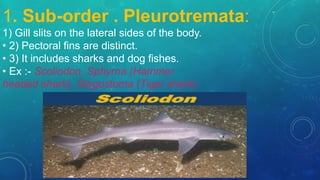
1. Sub-order . Pleurotremata:
1) Gill slits on the lateral sides of the body.
• 2) Pectoral fins are distinct.
• 3) It includes sharks and dog fishes.
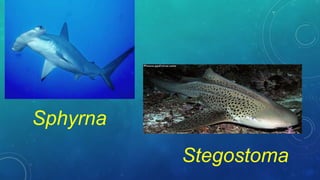
• Ex :- Scoliodon, Sphyrna (Hammer
headed shark), Stegostoma (Tiger shark).
Sphyrna
Stegostoma
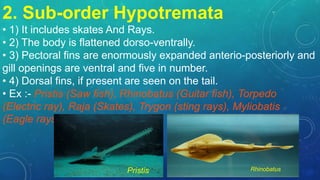
2. Sub-order Hypotremata
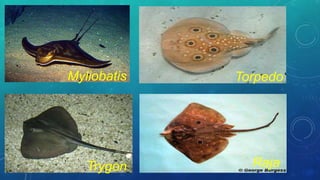
• 1) It includes skates And Rays.
• 2) The body is flattened dorso-ventrally.
• 3) Pectoral fins are enormously expanded anterio-posteriorly and
gill openings are ventral and five in number.
• 4) Dorsal fins, if present are seen on the tail.
• Ex :- Pristis (Saw fish), Rhinobatus (Guitar fish), Torpedo
(Electric ray), Raja (Skates), Trygon (sting rays), Myliobatis
(Eagle rays)
Pristis Rhinobatus
Myliobatis Torpedo
RajaTrygon
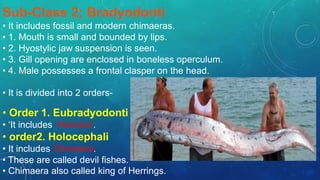
Sub-Class 2; Bradyodonti
• It includes fossil and modern chimaeras.
• 1. Mouth is small and bounded by lips.
• 2. Hyostylic jaw suspension is seen.
• 3. Gill opening are enclosed in boneless operculum.
• 4. Male possesses a frontal clasper on the head.
• It is divided into 2 orders-
• Order 1. Eubradyodonti
• ‘It includes ‘Helodus’.
• order2. Holocephali
• It includes Chimaera.
• These are called devil fishes.
• Chimaera also called king of Herrings.
Class 3.Osteichthyes/Teleostomi
• 1. These fishes are marine, fresh water and
brackish water.
• 2. Cycloid, ctenoid or ganoid scales will form the
exoskeleton.
• 3. Endoskeleton bony.
• 4. Jaws suspension is autostylic
• 5. Operculum is present.
• 6. Claspers are absent
• 7. Usually air bladder is present
• This class is divided Into two sub-classes-
• Sub-Class I. Sarcopterygii,
• Sub-Class II. Actinopterygii
•Sub-Class I: Sarcopterygii
• In this sub-class bony fishes are Included
which show lobed and massive fins. The
sub-class includes two orders-
Order -2. Dipnoi
• This order Includes living fishes. In the present day
only 3genera are living. They show discontinuous
distribution.
• Ex: 1. Neoceratodus (Australian lung fish),
• 2). Protopterus (African lung fish),
• 3. Lepidosiren (South American lung fish).
Order - 1 Crossopterygii
This order includes extinct fishes. But in 1938
one coelacanth fish was caught. This was
identified as, Rhipidistian fish by Miss. Latimer.
The fish is called Latimeria. It is the oldest living
fossil.
Sub-class II: Actinopterygii
• These fishes will live in fresh water or marine water. They not
show internal nostrils. This subclass is divided into three Infra
classes-
• Infra class I: Chondrostei
• This super order includes 3 orders, only fishes of one order are
surviving.
• Order Polypteriformes :- The fishes with ganoid scales;
Caudal fin is symmetrical.
Dorsal fin has many peculiar
fin-lets.
• Ex: Polypterus.
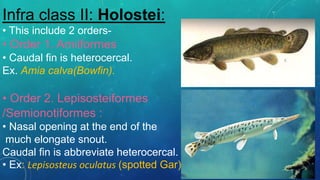
Infra class II: Holostei:
• This include 2 orders-
• Order 1. Amiiformes
• Caudal fin is heterocercal.
Ex. Amia calva(Bowfin).
• Order 2. Lepisosteiformes
/Semionotiformes :
• Nasal opening at the end of the
much elongate snout.
Caudal fin is abbreviate heterocercal.
• Ex: Lepisosteus oculatus (spotted Gar).
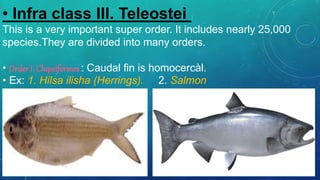
• Infra class III. Teleostei :
This is a very important super order. It includes nearly 25,000
species.They are divided into many orders.
• Order I. Clupeiformes : Caudal fin is homocercàl.
• Ex: 1. Hilsa ilisha (Herrings). 2. Salmon
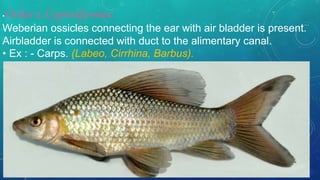
• Order 2. Cypriniformes:
Weberian ossicles connecting the ear with air bladder is present.
Airbladder is connected with duct to the alimentary canal.
• Ex : - Carps. (Labeo, Cirrhina, Barbus).
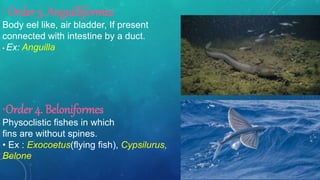
• Order 3. Anguilliformes
Body eel like, air bladder, If present
connected with intestine by a duct.
• Ex: Anguilla
•Order 4. Beloniformes
Physoclistic fishes in which
fins are without spines.
• Ex : Exocoetus(flying fish), Cypsilurus,
Belone
• Order-5. Syngnathiformes
Physoclistic fishes In which the first dorsal fin, If present, is
spinous.
• Ex- Hippocampus (Sea horse), Syngnathus (Pipefish)
• Order 6: Symbrachiformes
Eel like body, air bladder is absent
spines absent In fins.
• Ex Amphipnous
• Order 7. Perciformes:
Physoclistic fishes fins usually
With spines.
Usually two dorsal fins.
• Eg: Anabas (Climbing perch).
• Order 8. Pleuronectiformes
Both eyes are situated on one side skull
is asymmetrical. Fins usually without
spine. Adults without air bladder.
• Ex :Cynoglossus
•Order 9. Echenelformes
The spinous dorsal fin is into an
adhesive disc placed on the head.
Air bladder is absent.
• Ex: Echenis (Sucker fish).
•Order 10. Ophiocephaliformes:
Physoclistic fishes in which are Without spine, scales are cycloid,
air bladder is very long.
• Ex Channa or ophiocephalus
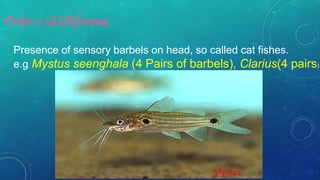
•Order 11. siLURiformes:
Presence of sensory barbels on head, so called cat fishes.
e.g. Mystus seenghala (4 Pairs of barbels), Clarius(4 pairs)
Mystus
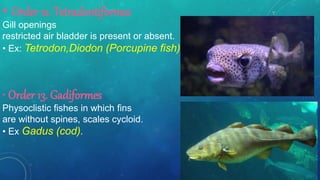
• Order 12. Tetradontiformes
Gill openings
restricted air bladder is present or absent.
• Ex: Tetrodon,Diodon (Porcupine fish).
• Order 13. Gadiformes
Physoclistic fishes in which fins
are without spines, scales cycloid.
• Ex Gadus (cod).
THANK
YOU