Fish Notes
Class:Agnatha
Jawless Fish
General Fish Information
• Fish make up half of all vertebrates on Earth.
• 15, 300 marine species
• 9,000 freshwater species
• They first appeared more than 500 million years
ago.
• 3 groups of fish
1. Jawless – Class Agnatha
2. Cartilaginous – Class Chondrichthyes
3. Bony – Class Osteichthyes
• Fish – The term “fish” refers to a single
individual or more than one of the same species.
• Fishes – the term “fishes” refers to more than
one species of fish.
3 Main Body Parts
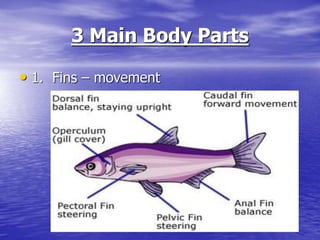
• 1. Fins – movement
3 Main Body Parts
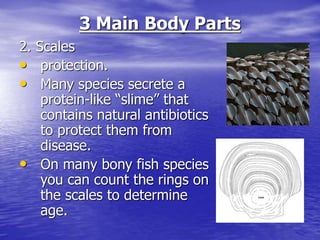
2. Scales
• protection.
• Many species secrete a
protein-like “slime” that
contains natural antibiotics
to protect them from
disease.
• On many bony fish species
you can count the rings on
the scales to determine
age.
3 Main Body Parts
3. Gills
• Oxygen exchange.
• in through the mouth
• out through the gills
• Oxygen passes out of
water into
bloodstream by
diffusion.
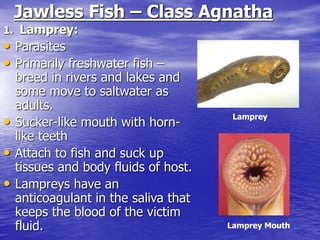
1. Lamprey:
• Parasites
• Primarily freshwater fish –
breed in rivers and lakes and
some move to saltwater as
adults.
• Sucker-like mouth with horn-
like teeth
• Attach to fish and suck up
tissues and body fluids of host.
• Lampreys have an
anticoagulant in the saliva that
keeps the blood of the victim
fluid.
Jawless Fish – Class Agnatha
Lamprey
Lamprey Mouth
Jawless Fish – Class Agnatha
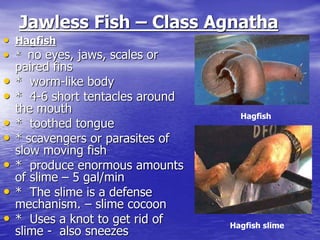
• Hagfish
• * no eyes, jaws, scales or
paired fins
• * worm-like body
• * 4-6 short tentacles around
the mouth
• * toothed tongue
• * scavengers or parasites of
slow moving fish
• * produce enormous amounts
of slime – 5 gal/min
• * The slime is a defense
mechanism. – slime cocoon
• * Uses a knot to get rid of
slime - also sneezes
Hagfish slime
Hagfish

fish powerpoint.ppt

  • 1.
  • 2.
    General Fish Information •Fish make up half of all vertebrates on Earth. • 15, 300 marine species • 9,000 freshwater species • They first appeared more than 500 million years ago. • 3 groups of fish 1. Jawless – Class Agnatha 2. Cartilaginous – Class Chondrichthyes 3. Bony – Class Osteichthyes • Fish – The term “fish” refers to a single individual or more than one of the same species. • Fishes – the term “fishes” refers to more than one species of fish.
  • 3.
    3 Main BodyParts • 1. Fins – movement
  • 4.
    3 Main BodyParts 2. Scales • protection. • Many species secrete a protein-like “slime” that contains natural antibiotics to protect them from disease. • On many bony fish species you can count the rings on the scales to determine age.
  • 5.
    3 Main BodyParts 3. Gills • Oxygen exchange. • in through the mouth • out through the gills • Oxygen passes out of water into bloodstream by diffusion.
  • 6.
    1. Lamprey: • Parasites •Primarily freshwater fish – breed in rivers and lakes and some move to saltwater as adults. • Sucker-like mouth with horn- like teeth • Attach to fish and suck up tissues and body fluids of host. • Lampreys have an anticoagulant in the saliva that keeps the blood of the victim fluid. Jawless Fish – Class Agnatha Lamprey Lamprey Mouth
  • 7.
    Jawless Fish –Class Agnatha • Hagfish • * no eyes, jaws, scales or paired fins • * worm-like body • * 4-6 short tentacles around the mouth • * toothed tongue • * scavengers or parasites of slow moving fish • * produce enormous amounts of slime – 5 gal/min • * The slime is a defense mechanism. – slime cocoon • * Uses a knot to get rid of slime - also sneezes Hagfish slime Hagfish