CHONDRICTHY
ES Group VI
Mercado,
Felix,
Reyes,
Repurido,
Bada,
Chondros’’ - Cartilages
“Ichthyos’’ - Fish
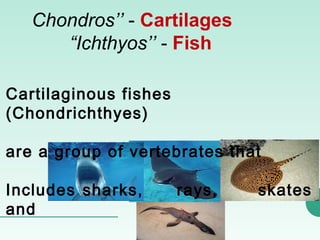
Cartilaginous fishes
(Chondrichthyes)
are a group of vertebrates that
Includes sharks, rays, skates
and
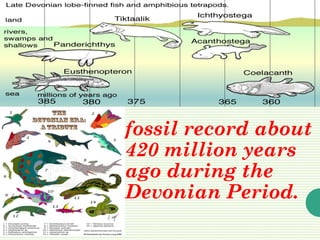
fossil record about
420 million years
ago during the
Devonian Period. 
The earliest known cartilaginous
fishes were ancient sharks that were
descended from bony-skeleton
placoderms. These primitive sharks
are older than the dinosaurs.
They swam in the world’s oceans
420 million years ago, 200 million
years before the first dinosaurs
appeared on land.
Cartilagenous fishes characterized by:
• paired nostrils
• skeleton completely cartilagenous with
no endoskeletal bone
• no swim bladder
• gill arches internal to gills
• Possess movable jaws
that usually have teeth
• Mouth is ventral,
underneath the head
• scales dermal
placoid when
present
• Paired
lateral fins
Skates & Rays
• Flattened bodies
• Dermersal – live on the bottom
• Gill slits on the ventral side (bottom)
• Pectoral fins are flat and expanded
• Head fuses with pectoral fins with
eyes on top
Ratfish / Chimaeras
• Gill slits covered by a
flap of skin
• Mostly deep-water
fish
• Eat crustaceans and
mollusks
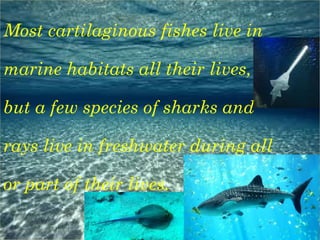
Most cartilaginous fishes live in
marine habitats all their lives,
but a few species of sharks and
rays live in freshwater during all
or part of their lives.
sharks:
bottom of coastal waters,
open sea
-needs: smaller sea animals to
hunt
rays:
bottom of saltwater or
freshwater
-needs: crustaceas, mullusks,
warmwater
Skates and rays
* warm temperature seas
Sharks
* cold deep
* the ocean floor
* move towards the coast for
feeding
There are just under 1000 living
species, all of which have
cartilaginous skeletons, even
though they are descended from
ancestors that had bone.
Megalodon
• Ancient shark
• Largest predatory fish ever
• Twice the size of a great
white
Megalodon
approximately 18m long (and with a mass
estimated at 50-100 metrics tones) it resembled
a massive great white shark and was the top
ocean predator of its era.
* Manta Ray
(about 30 feet
long)
* Basking Shark
(about 40 feet
long and 19 tons).
 paired fins and flexible bodies
making movement in water very
feasible. 
Kingdom : Animalia
Phylum : Chordata
Subphylum : Vertebrata
Infraphylum :Gnathostomata
Class : Chondrichthyes
Subclass : Elasmobranchii
Orders : Cladoselachii,
Pleuracanthodii
( extinct sharks )
Orders : Squaliformes
Order : Rajiformes
Subclass : Holocephali
External and Internal Structure
Scales
• Scales are very small and sharp
• Same composition as the teeth
Jaws
• Made of bone
• Contain the disposable teeth
• In some species capable of
extending jaw out from body
Teeth
• Same
composition as
the scales
• Continually
shed and
replaced by the
rows behind
Body Plan: Chondrichthyes have bodies made
of cartilage instead of bone. They also lack ribs.
This allows for extreme flexibility. Their bodies
are covered in a thick skin. This skin is covered
dermal teeth, often called denticles, making it
feel like sand paper.
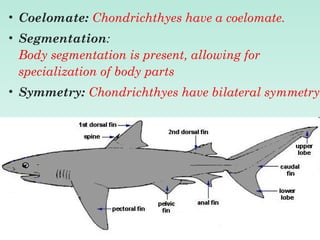
• Coelomate: Chondrichthyes have a coelomate.
• Segmentation:
Body segmentation is present, allowing for
specialization of body parts
• Symmetry: Chondrichthyes have bilateral symmetry
Skeletal System: 
Chondrichthyes have a body made of
cartilage instead of bone and they do
not have ribs or bone marrow.
ENDOSKELETON or
EXOSKELETON:
Chondrichthyans have an
endoskeleton made completely from
cartilage, thus their being called
cartilaginous fish.
Digestive System
• Very short esophogus
• Stomach can be up to 1/3 the length of the
shark
• Intestine is really small, only about a foot
Respiratory System
• Must swim to force water through their gills
• Some such as nurse sharks can get enough
oxygen so they do not need to swim
Circulatory System
 Heart is Built upon the pattern similar to other fishes.
 The Heart is consists of a sinus venosus, artrium, ventricle and
conus with three rows of valves.
Nervous System
• Lateral line used for sensing vibrations in the
water
• Ampullae of Lorenzini
• Jelly filled canals that can detect electrical
fields, magnetic fields, temperature,
salinity, water pressure, etc.
TYPE OF NERVOUS SYSTEM:
* Chondrichthyans have myelin sheaths around the
axons of their neurons.
* This permits much more rapid transmission of nerve
impulses.
* They also have a single, hollow, ectodermal, dorsal
nerve cord with a large anterior end ( which is the
brain).
* They have three main sections to their brains,
one which in controls ability to smell, another
which is responsible for vision, learning, and
motor responses, and the last which coordinates
movement, muscle tone, and balance.
Reproductive System:
Chondrichthyans reproduce by internal
fertilization
This is in order to protect young from highly
hypertonic environment, since they do not have
the ability to survive in the salty water until
later
Mating
 One clasper will rotate 90º and will be inserted into
the female’s cloaca
 Clasper will expand cartilaginous spurs to anchor in
the female
Importance:
Reference:

Cartilaginous fish

  • 1.
  • 2.
    Chondros’’ - Cartilages “Ichthyos’’- Fish Cartilaginous fishes (Chondrichthyes) are a group of vertebrates that Includes sharks, rays, skates and
  • 3.
    fossil record about 420million years ago during the Devonian Period. 
  • 4.
    The earliest knowncartilaginous fishes were ancient sharks that were descended from bony-skeleton placoderms. These primitive sharks are older than the dinosaurs.
  • 5.
    They swam inthe world’s oceans 420 million years ago, 200 million years before the first dinosaurs appeared on land.
  • 6.
    Cartilagenous fishes characterizedby: • paired nostrils • skeleton completely cartilagenous with no endoskeletal bone • no swim bladder • gill arches internal to gills
  • 7.
    • Possess movablejaws that usually have teeth • Mouth is ventral, underneath the head
  • 8.
    • scales dermal placoidwhen present • Paired lateral fins
  • 9.
    Skates & Rays •Flattened bodies • Dermersal – live on the bottom • Gill slits on the ventral side (bottom) • Pectoral fins are flat and expanded • Head fuses with pectoral fins with eyes on top
  • 10.
    Ratfish / Chimaeras •Gill slits covered by a flap of skin • Mostly deep-water fish • Eat crustaceans and mollusks
  • 11.
    Most cartilaginous fisheslive in marine habitats all their lives, but a few species of sharks and rays live in freshwater during all or part of their lives.
  • 12.
    sharks: bottom of coastalwaters, open sea -needs: smaller sea animals to hunt rays: bottom of saltwater or freshwater -needs: crustaceas, mullusks, warmwater
  • 13.
    Skates and rays *warm temperature seas Sharks * cold deep * the ocean floor * move towards the coast for feeding
  • 14.
    There are justunder 1000 living species, all of which have cartilaginous skeletons, even though they are descended from ancestors that had bone.
  • 15.
    Megalodon • Ancient shark •Largest predatory fish ever • Twice the size of a great white
  • 16.
    Megalodon approximately 18m long(and with a mass estimated at 50-100 metrics tones) it resembled a massive great white shark and was the top ocean predator of its era.
  • 17.
    * Manta Ray (about30 feet long) * Basking Shark (about 40 feet long and 19 tons).
  • 18.
     paired fins andflexible bodies making movement in water very feasible. 
  • 19.
    Kingdom : Animalia Phylum: Chordata Subphylum : Vertebrata Infraphylum :Gnathostomata Class : Chondrichthyes Subclass : Elasmobranchii Orders : Cladoselachii, Pleuracanthodii ( extinct sharks ) Orders : Squaliformes Order : Rajiformes Subclass : Holocephali
  • 20.
  • 21.
    Scales • Scales arevery small and sharp • Same composition as the teeth
  • 22.
    Jaws • Made ofbone • Contain the disposable teeth • In some species capable of extending jaw out from body
  • 23.
    Teeth • Same composition as thescales • Continually shed and replaced by the rows behind
  • 24.
    Body Plan: Chondrichthyes havebodies made of cartilage instead of bone. They also lack ribs. This allows for extreme flexibility. Their bodies are covered in a thick skin. This skin is covered dermal teeth, often called denticles, making it feel like sand paper.
  • 25.
    • Coelomate: Chondrichthyes havea coelomate. • Segmentation: Body segmentation is present, allowing for specialization of body parts • Symmetry: Chondrichthyes have bilateral symmetry
  • 26.
    Skeletal System:  Chondrichthyes havea body made of cartilage instead of bone and they do not have ribs or bone marrow.
  • 27.
    ENDOSKELETON or EXOSKELETON: Chondrichthyans havean endoskeleton made completely from cartilage, thus their being called cartilaginous fish.
  • 28.
    Digestive System • Veryshort esophogus • Stomach can be up to 1/3 the length of the shark • Intestine is really small, only about a foot
  • 29.
    Respiratory System • Mustswim to force water through their gills • Some such as nurse sharks can get enough oxygen so they do not need to swim
  • 30.
    Circulatory System  Heartis Built upon the pattern similar to other fishes.  The Heart is consists of a sinus venosus, artrium, ventricle and conus with three rows of valves.
  • 31.
    Nervous System • Lateralline used for sensing vibrations in the water
  • 32.
    • Ampullae ofLorenzini • Jelly filled canals that can detect electrical fields, magnetic fields, temperature, salinity, water pressure, etc.
  • 33.
    TYPE OF NERVOUSSYSTEM: * Chondrichthyans have myelin sheaths around the axons of their neurons. * This permits much more rapid transmission of nerve impulses. * They also have a single, hollow, ectodermal, dorsal nerve cord with a large anterior end ( which is the brain).
  • 34.
    * They havethree main sections to their brains, one which in controls ability to smell, another which is responsible for vision, learning, and motor responses, and the last which coordinates movement, muscle tone, and balance.
  • 35.
    Reproductive System: Chondrichthyans reproduceby internal fertilization This is in order to protect young from highly hypertonic environment, since they do not have the ability to survive in the salty water until later
  • 36.
    Mating  One clasperwill rotate 90º and will be inserted into the female’s cloaca  Clasper will expand cartilaginous spurs to anchor in the female
  • 37.
  • 38.