Introduction
  to Plants
   Plants have 4               Plant
    characteristics
    that they all share:    Characteristics
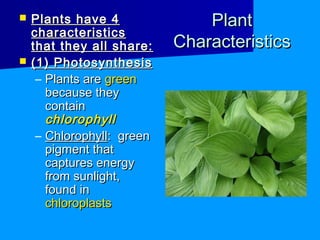
   (1) Photosynthesis
     – Plants are green
       because they
       contain
       chlorophyll
     – Chlorophyll: green
       pigment that
       captures energy
       from sunlight,
       found in
       chloroplasts
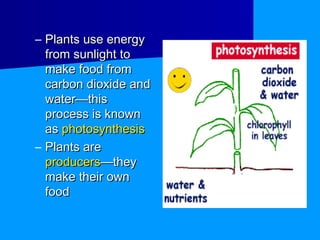
– Plants use energy
  from sunlight to
  make food from
  carbon dioxide and
  water—this
  process is known
  as photosynthesis
– Plants are
  producers—they
  make their own
  food
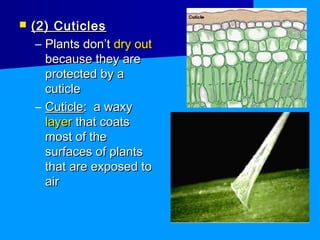
   (2) Cuticles
     – Plants don’t dry out
       because they are
       protected by a
       cuticle
     – Cuticle: a waxy
       layer that coats
       most of the
       surfaces of plants
       that are exposed to
       air
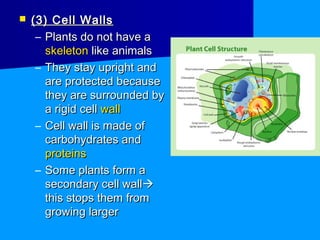
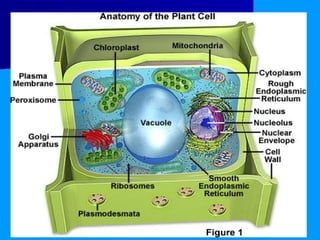
   (3) Cell Walls
     – Plants do not have a
       skeleton like animals
     – They stay upright and
       are protected because
       they are surrounded by
       a rigid cell wall
     – Cell wall is made of
       carbohydrates and
       proteins
     – Some plants form a
       secondary cell wall
       this stops them from
       growing larger
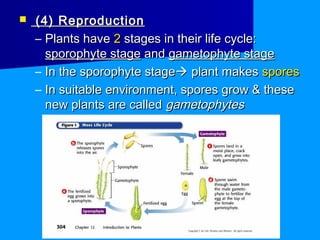
   (4) Reproduction
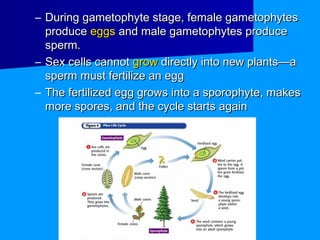
    – Plants have 2 stages in their life cycle:
      sporophyte stage and gametophyte stage
    – In the sporophyte stage plant makes spores
    – In suitable environment, spores grow & these
      new plants are called gametophytes
– During gametophyte stage, female gametophytes
  produce eggs and male gametophytes produce
  sperm.
– Sex cells cannot grow directly into new plants—a
  sperm must fertilize an egg
– The fertilized egg grows into a sporophyte, makes
  more spores, and the cycle starts again
Check for Understanding


  What are 4 characteristics that all
            plants share?
Photosynthesis, cuticle, cell wall, and
             reproduction
4 Main Groups of Plants
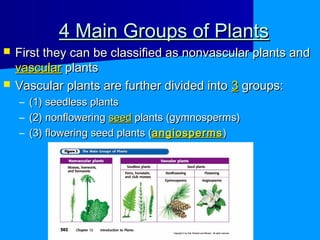
   First they can be classified as nonvascular plants and
    vascular plants
   Vascular plants are further divided into 3 groups:
    –   (1) seedless plants
    –   (2) nonflowering seed plants (gymnosperms)
    –   (3) flowering seed plants (angiosperms )
Seedless Plants
***2 groups of plants don’t make seeds:
   (1) Nonvascular Plants
    – Three groups of plants that lack specialized
      conducting tissues and true roots, stems, and leaves
    – Depend on diffusion to move materials from one part
      of plant to another
    – Most are small
    – Usually live in damp places
    – Don’t have true stems, roots, or leaves
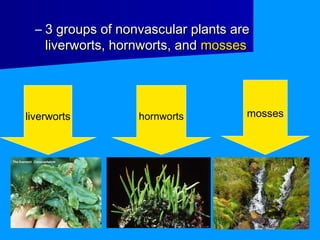
– 3 groups of nonvascular plants are
    liverworts, hornworts, and mosses


liverworts         hornworts         mosses
Mosses, Liverworts,
         and Hornworts
– Have leafy stalks and
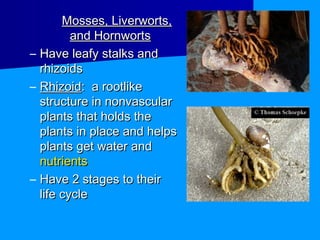
  rhizoids
– Rhizoid: a rootlike
  structure in nonvascular
  plants that holds the
  plants in place and helps
  plants get water and
  nutrients
– Have 2 stages to their
  life cycle
– Importance of Nonvascular Plants
    Usually the first plants to live in a new
     environment, such as newly exposed rock
    When they die, they form a thin layer of soil
    Hold soil in place, reducing erosion
    Some animals eat nonvascular plants
    Other animals use them for nesting
     material
    Peat mosses are important to humans
     because they can be dried out and burned
     as fuel
 (2)
    Seedless
 Vascular Plants
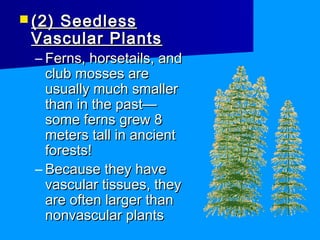
  – Ferns, horsetails, and
    club mosses are
    usually much smaller
    than in the past—
    some ferns grew 8
    meters tall in ancient
    forests!
  – Because they have
    vascular tissues, they
    are often larger than
    nonvascular plants
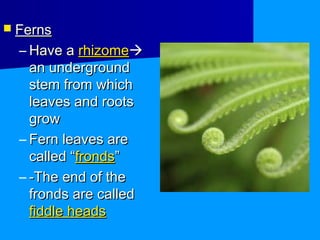
 Ferns

  – Have a rhizome
    an underground
    stem from which
    leaves and roots
    grow
  – Fern leaves are
    called “fronds”
  – -The end of the
    fronds are called
    fiddle heads
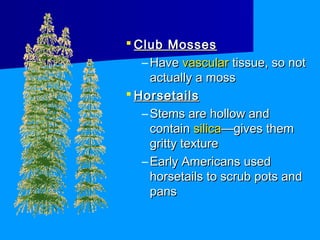
 Club Mosses
   – Have vascular tissue, so not
     actually a moss
 Horsetails
   – Stems are hollow and
     contain silica—gives them
     gritty texture
   – Early Americans used
     horsetails to scrub pots and
     pans
– Importance of Seedless Vascular Plants
   Help form soil & prevent erosion
   Ferns add to soil depth, helping other plants to
    grow
   Popular houseplants
   Fiddleheads of ferns and some horsetails can
    be eaten
   Horsetails are used in some dietary
    supplements, shampoos, and skin-care
    products
   Remains of ancient ferns, horsetails, and club
    mosses form coal, which humans rely on for
    energy
Check for Understanding


     Name & describe the 4 main groups of
                      plants
    1)nonvascular: no specialized tissues
    2) Seedless vascular: ferns, horsetails,
                   club mosses
     3) Gymnosperms: nonflowering seed
         4) Angiosperm: flowering seed
 The Origin of Plants
  – Green algae may look like a plant, but it isn’t a
    plant
  – Scientists think that green algae and plants
    share a common ancestor because of the
    following similarities:
      Both have the same kind of chlorophyll
      Have similar cell walls
      Both use photosynthesis to make own food
      Both store energy in form of starch
      Both have a two-stage life cycle
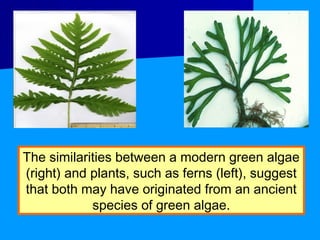
The similarities between a modern green algae
(right) and plants, such as ferns (left), suggest
that both may have originated from an ancient
            species of green algae.
Check for Understanding


      Explain the origin of plants
-scientists think that green algae and
    plants share a common ancestor

Introduction to plants

  • 1.
  • 2.
    Plants have 4 Plant characteristics that they all share: Characteristics  (1) Photosynthesis – Plants are green because they contain chlorophyll – Chlorophyll: green pigment that captures energy from sunlight, found in chloroplasts
  • 3.
    – Plants useenergy from sunlight to make food from carbon dioxide and water—this process is known as photosynthesis – Plants are producers—they make their own food
  • 4.
    (2) Cuticles – Plants don’t dry out because they are protected by a cuticle – Cuticle: a waxy layer that coats most of the surfaces of plants that are exposed to air
  • 5.
    (3) Cell Walls – Plants do not have a skeleton like animals – They stay upright and are protected because they are surrounded by a rigid cell wall – Cell wall is made of carbohydrates and proteins – Some plants form a secondary cell wall this stops them from growing larger
  • 7.
    (4) Reproduction – Plants have 2 stages in their life cycle: sporophyte stage and gametophyte stage – In the sporophyte stage plant makes spores – In suitable environment, spores grow & these new plants are called gametophytes
  • 8.
    – During gametophytestage, female gametophytes produce eggs and male gametophytes produce sperm. – Sex cells cannot grow directly into new plants—a sperm must fertilize an egg – The fertilized egg grows into a sporophyte, makes more spores, and the cycle starts again
  • 9.
    Check for Understanding  What are 4 characteristics that all plants share? Photosynthesis, cuticle, cell wall, and reproduction
  • 10.
    4 Main Groupsof Plants  First they can be classified as nonvascular plants and vascular plants  Vascular plants are further divided into 3 groups: – (1) seedless plants – (2) nonflowering seed plants (gymnosperms) – (3) flowering seed plants (angiosperms )
  • 11.
    Seedless Plants ***2 groupsof plants don’t make seeds:  (1) Nonvascular Plants – Three groups of plants that lack specialized conducting tissues and true roots, stems, and leaves – Depend on diffusion to move materials from one part of plant to another – Most are small – Usually live in damp places – Don’t have true stems, roots, or leaves
  • 12.
    – 3 groupsof nonvascular plants are liverworts, hornworts, and mosses liverworts hornworts mosses
  • 13.
    Mosses, Liverworts, and Hornworts – Have leafy stalks and rhizoids – Rhizoid: a rootlike structure in nonvascular plants that holds the plants in place and helps plants get water and nutrients – Have 2 stages to their life cycle
  • 14.
    – Importance ofNonvascular Plants  Usually the first plants to live in a new environment, such as newly exposed rock  When they die, they form a thin layer of soil  Hold soil in place, reducing erosion  Some animals eat nonvascular plants  Other animals use them for nesting material  Peat mosses are important to humans because they can be dried out and burned as fuel
  • 15.
     (2) Seedless Vascular Plants – Ferns, horsetails, and club mosses are usually much smaller than in the past— some ferns grew 8 meters tall in ancient forests! – Because they have vascular tissues, they are often larger than nonvascular plants
  • 16.
     Ferns – Have a rhizome an underground stem from which leaves and roots grow – Fern leaves are called “fronds” – -The end of the fronds are called fiddle heads
  • 17.
     Club Mosses – Have vascular tissue, so not actually a moss  Horsetails – Stems are hollow and contain silica—gives them gritty texture – Early Americans used horsetails to scrub pots and pans
  • 18.
    – Importance ofSeedless Vascular Plants  Help form soil & prevent erosion  Ferns add to soil depth, helping other plants to grow  Popular houseplants  Fiddleheads of ferns and some horsetails can be eaten  Horsetails are used in some dietary supplements, shampoos, and skin-care products  Remains of ancient ferns, horsetails, and club mosses form coal, which humans rely on for energy
  • 19.
    Check for Understanding  Name & describe the 4 main groups of plants 1)nonvascular: no specialized tissues 2) Seedless vascular: ferns, horsetails, club mosses 3) Gymnosperms: nonflowering seed 4) Angiosperm: flowering seed
  • 20.
     The Originof Plants – Green algae may look like a plant, but it isn’t a plant – Scientists think that green algae and plants share a common ancestor because of the following similarities:  Both have the same kind of chlorophyll  Have similar cell walls  Both use photosynthesis to make own food  Both store energy in form of starch  Both have a two-stage life cycle
  • 21.
    The similarities betweena modern green algae (right) and plants, such as ferns (left), suggest that both may have originated from an ancient species of green algae.
  • 22.
    Check for Understanding  Explain the origin of plants -scientists think that green algae and plants share a common ancestor