Welcome to
My
Presentation
My presentation topic is on
Swim bladder of fish
Introduction
Air bladder also called,
swim-bladder,
gas-bladder and
fish maw.
What is air bladder?
 Internal gas-filled organ
 Contributes to the ability to control their
buoyancy
 It acts as an accessory respiratory organ
 It acts as a sound receptor and sound producer.
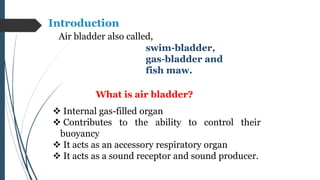
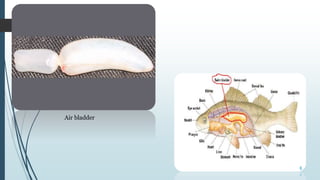
Air bladder
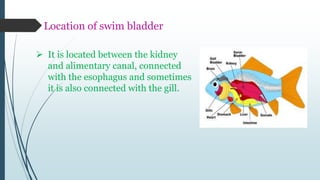
Location of swim bladder
 It is located between the kidney
and alimentary canal, connected
with the esophagus and sometimes
it is also connected with the gill.
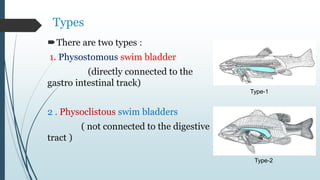
Types
There are two types :
1. Physostomous swim bladder
(directly connected to the
gastro intestinal track)
2 . Physoclistous swim bladders
( not connected to the digestive
tract )
Type-1
Type-2
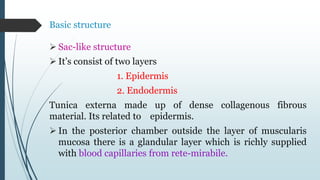
Basic structure
 Sac-like structure
 It’s consist of two layers
1. Epidermis
2. Endodermis
Tunica externa made up of dense collagenous fibrous
material. Its related to epidermis.
 In the posterior chamber outside the layer of muscularis
mucosa there is a glandular layer which is richly supplied
with blood capillaries from rete-mirabile.
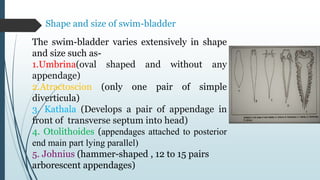
Shape and size of swim-bladder
The swim-bladder varies extensively in shape
and size such as-
1.Umbrina(oval shaped and without any
appendage)
2.Atractoscion (only one pair of simple
diverticula)
3. Kathala (Develops a pair of appendage in
front of transverse septum into head)
4. Otolithoides (appendages attached to posterior
end main part lying parallel)
5. Johnius (hammer-shaped , 12 to 15 pairs
arborescent appendages)
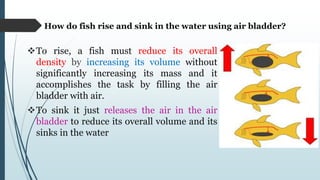
How do fish rise and sink in the water using air bladder?
To rise, a fish must reduce its overall
density by increasing its volume without
significantly increasing its mass and it
accomplishes the task by filling the air
bladder with air.
To sink it just releases the air in the air
bladder to reduce its overall volume and its
sinks in the water
Functions of swim-bladder
The swim-bladder in fishes performs a variety of functions.
1. Hydrostatic organ
2. Swim-bladder acts as adjustable float
3. Swim-bladder helps in respiration
4. Production of sound
5. Maintains proper center of gravity
Conclusion
Air bladder is very important for fish as it helps the
fish to maintain its bouncy.
The air bladder has evolved from the past ages to
the present
It is also used in making of various kinds of dishes
Swim bladder
Swim bladder

Swim bladder

  • 1.
  • 2.
    My presentation topicis on Swim bladder of fish
  • 3.
    Introduction Air bladder alsocalled, swim-bladder, gas-bladder and fish maw. What is air bladder?  Internal gas-filled organ  Contributes to the ability to control their buoyancy  It acts as an accessory respiratory organ  It acts as a sound receptor and sound producer.
  • 4.
  • 5.
    Location of swimbladder  It is located between the kidney and alimentary canal, connected with the esophagus and sometimes it is also connected with the gill.
  • 6.
    Types There are twotypes : 1. Physostomous swim bladder (directly connected to the gastro intestinal track) 2 . Physoclistous swim bladders ( not connected to the digestive tract ) Type-1 Type-2
  • 7.
    Basic structure  Sac-likestructure  It’s consist of two layers 1. Epidermis 2. Endodermis Tunica externa made up of dense collagenous fibrous material. Its related to epidermis.  In the posterior chamber outside the layer of muscularis mucosa there is a glandular layer which is richly supplied with blood capillaries from rete-mirabile.
  • 8.
    Shape and sizeof swim-bladder The swim-bladder varies extensively in shape and size such as- 1.Umbrina(oval shaped and without any appendage) 2.Atractoscion (only one pair of simple diverticula) 3. Kathala (Develops a pair of appendage in front of transverse septum into head) 4. Otolithoides (appendages attached to posterior end main part lying parallel) 5. Johnius (hammer-shaped , 12 to 15 pairs arborescent appendages)
  • 9.
    How do fishrise and sink in the water using air bladder? To rise, a fish must reduce its overall density by increasing its volume without significantly increasing its mass and it accomplishes the task by filling the air bladder with air. To sink it just releases the air in the air bladder to reduce its overall volume and its sinks in the water
  • 10.
    Functions of swim-bladder Theswim-bladder in fishes performs a variety of functions. 1. Hydrostatic organ 2. Swim-bladder acts as adjustable float 3. Swim-bladder helps in respiration 4. Production of sound 5. Maintains proper center of gravity
  • 11.
    Conclusion Air bladder isvery important for fish as it helps the fish to maintain its bouncy. The air bladder has evolved from the past ages to the present It is also used in making of various kinds of dishes