How Does Evolution
    Happen?
(Natural Selection)
First man to explain
o Charles Darwin
  o Took a five year voyage
    around the world after he
    got out of college
  o Served as a naturalist on
    the British ship HMS Beagle
  o Formed a theory of how
    evolution happened
  o Collected plant and
    animal samples on his
    travels
  o Visited the Galapagos
    islands just west of
    Ecuador (South America)
Map of the Galapagos Islands
Galapagos Island Discoveries
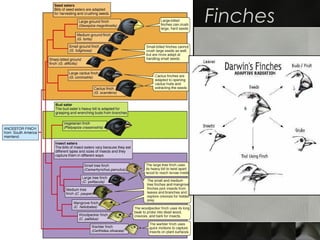
   o Found that the finches on these
     islands were similar to Ecuador’s
   o Each island was still a little
     different from the next
   o Found that the beaks of the
     finches had adapted to their
     food source on the different
     islands.
Finches
Darwin starts to think..
o How did we get these similar species?
o He had ideas about the Earth
  o He found that Earth has been formed by natural
    processes over a long period of time
o He had ideas about breeding
  o Selective breeding- breeding plants/animals to
    have desired characteristics
o He had ideas about populations
  o Realized that any species can produce many
    offspring, but they are limited by several
    factors.
What limits offspring?
o   Starvation
o   Disease
o   Competition
o   Predation

o He found that really only a limited
  amount of individuals will survive to
  reproduce.
o There is something unique about the
  survivors. They must have stronger
  genetic traits. Those are the traits that will
  pass down to their offspring.
Darwin’s thinking lead to his theory of Natural
                   Selection
   o Once he returned from his voyage, he
     thought for 20 yrs about the observations
     he had taken from the world and wrote a
     book called On the Origin of Species by
     Means of Natural Selection.
   o Darwin’s theory of natural selection is the
     process by which individuals best
     adapted to their environments survive
     and reproduce more successfully than
     less well adapted individuals
   o This theory of natural selection is broken
     into four parts.
Four Parts of Natural Selection
o 1) Overproduction
  oOrganisms will give birth to
    thousands of offspring realizing
    that some will become adults and
    others will not.
o 2) Inherited Variation
  oEvery individual has its own
    combo of traits. (similar to parents)
Continued
o 3) Struggle to Survive
  oPredators, starvation,
    diseases
o 4) Successful Reproduction
  oThe organisms best adapted
    in their environment will
    produce the most surviving
    offspring.
Think About it…
Darwin Lacked
o When Darwin was introducing his
  theory of natural selection he
  lacked two important things:
  o 1- He didn’t know how we inherit
    traits
  o 2- He didn’t know how the
    variations occurred

  o We have learned how both of these
    occurrences happen, tell me how!
Yes??
o 1) We inherit traits from our parents
  when they get passed down to the
  offspring.

o 2) Variations occur because of the
  different gene combinations that can
  be made when the mother and
  father come together to produce
  offspring.
Natural Selection in Action
o A population changes in
  response to its
  environment.
o Things that can affect an
  environments
  population are:
   o Hunting
   o Resistance
   o Competition
Hunting
o A new affect such as hunting
  can play a role in how a
  population level rises or falls.
o In 1930 Uganda’s male
  elephant population that
  contained tusks was 99% and
  only 1% of them were born
  without them. Today 85% of
  male elephant population
  contains tusks.
o Because of this, more of the
  tusk less elephants are
  surviving and reproducing.
  This trait does get passed
  down.
Resistance
o Some organisms such as insects can
  build resistance to certain chemicals.
o This can send an increase in a
  particular insects population that
  could be harmful.
o It doesn’t take long for insects to build
  up this resistance and reproduce.
o Generation time: the period between
  the birth of one generation and the
  birth of the next generation.
Competition
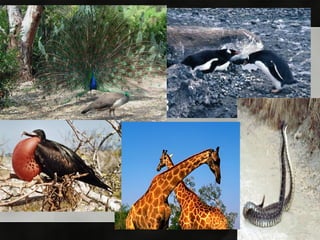
o Many species will
  have competitions for
  their mates
o Some organisms may
  over time have some
  interesting
  adaptations.
o Feather colors, smells,
  dances, sounds, etc.
Forming a New Species
o May form if the groups get separated
  from the original population.
o The two groups can adapt to their
  environments and get to a point
  where they are so different they
  can’t even mate anymore.
o A new species is a result of evolution.
   We call this speciation.
o Separation-Adaptation-Division

How does evolution happen

  • 1.
    How Does Evolution Happen? (Natural Selection)
  • 2.
    First man toexplain o Charles Darwin o Took a five year voyage around the world after he got out of college o Served as a naturalist on the British ship HMS Beagle o Formed a theory of how evolution happened o Collected plant and animal samples on his travels o Visited the Galapagos islands just west of Ecuador (South America)
  • 3.
    Map of theGalapagos Islands
  • 4.
    Galapagos Island Discoveries o Found that the finches on these islands were similar to Ecuador’s o Each island was still a little different from the next o Found that the beaks of the finches had adapted to their food source on the different islands.
  • 5.
  • 6.
    Darwin starts tothink.. o How did we get these similar species? o He had ideas about the Earth o He found that Earth has been formed by natural processes over a long period of time o He had ideas about breeding o Selective breeding- breeding plants/animals to have desired characteristics o He had ideas about populations o Realized that any species can produce many offspring, but they are limited by several factors.
  • 7.
    What limits offspring? o Starvation o Disease o Competition o Predation o He found that really only a limited amount of individuals will survive to reproduce. o There is something unique about the survivors. They must have stronger genetic traits. Those are the traits that will pass down to their offspring.
  • 8.
    Darwin’s thinking leadto his theory of Natural Selection o Once he returned from his voyage, he thought for 20 yrs about the observations he had taken from the world and wrote a book called On the Origin of Species by Means of Natural Selection. o Darwin’s theory of natural selection is the process by which individuals best adapted to their environments survive and reproduce more successfully than less well adapted individuals o This theory of natural selection is broken into four parts.
  • 9.
    Four Parts ofNatural Selection o 1) Overproduction oOrganisms will give birth to thousands of offspring realizing that some will become adults and others will not. o 2) Inherited Variation oEvery individual has its own combo of traits. (similar to parents)
  • 10.
    Continued o 3) Struggleto Survive oPredators, starvation, diseases o 4) Successful Reproduction oThe organisms best adapted in their environment will produce the most surviving offspring.
  • 11.
  • 12.
    Darwin Lacked o WhenDarwin was introducing his theory of natural selection he lacked two important things: o 1- He didn’t know how we inherit traits o 2- He didn’t know how the variations occurred o We have learned how both of these occurrences happen, tell me how!
  • 13.
    Yes?? o 1) Weinherit traits from our parents when they get passed down to the offspring. o 2) Variations occur because of the different gene combinations that can be made when the mother and father come together to produce offspring.
  • 14.
    Natural Selection inAction o A population changes in response to its environment. o Things that can affect an environments population are: o Hunting o Resistance o Competition
  • 15.
    Hunting o A newaffect such as hunting can play a role in how a population level rises or falls. o In 1930 Uganda’s male elephant population that contained tusks was 99% and only 1% of them were born without them. Today 85% of male elephant population contains tusks. o Because of this, more of the tusk less elephants are surviving and reproducing. This trait does get passed down.
  • 16.
    Resistance o Some organismssuch as insects can build resistance to certain chemicals. o This can send an increase in a particular insects population that could be harmful. o It doesn’t take long for insects to build up this resistance and reproduce. o Generation time: the period between the birth of one generation and the birth of the next generation.
  • 17.
    Competition o Many specieswill have competitions for their mates o Some organisms may over time have some interesting adaptations. o Feather colors, smells, dances, sounds, etc.
  • 19.
    Forming a NewSpecies o May form if the groups get separated from the original population. o The two groups can adapt to their environments and get to a point where they are so different they can’t even mate anymore. o A new species is a result of evolution. We call this speciation. o Separation-Adaptation-Division