The Bony Fishes
Class Osteichthyes
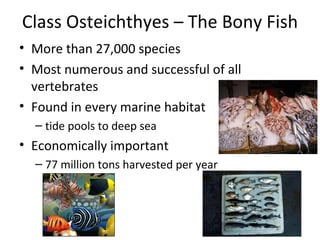
Class Osteichthyes – The Bony Fish
• More than 27,000 species
• Most numerous and successful of all
  vertebrates
• Found in every marine habitat
  – tide pools to deep sea
• Economically important
  – 77 million tons harvested per year
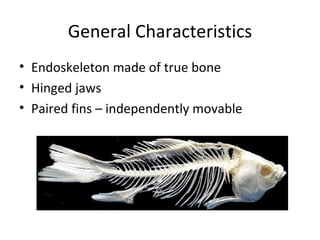
General Characteristics
• Endoskeleton made of true bone
• Hinged jaws
• Paired fins – independently movable
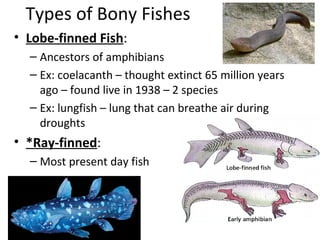
Types of Bony Fishes
• Lobe-finned Fish:
  – Ancestors of amphibians
  – Ex: coelacanth – thought extinct 65 million years
    ago – found live in 1938 – 2 species
  – Ex: lungfish – lung that can breathe air during
    droughts
• *Ray-finned:
  – Most present day fish
Movement
• Nektonic – swimmers - control
  movement against current
  –Move to food
  –Escape predator
Movement
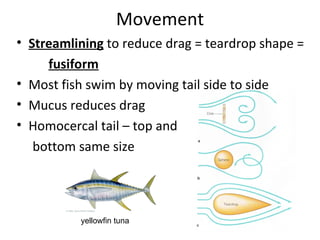
• Streamlining to reduce drag = teardrop shape =
     fusiform
• Most fish swim by moving tail side to side
• Mucus reduces drag
• Homocercal tail – top and
   bottom same size


          yellowfin tuna
Buoyancy
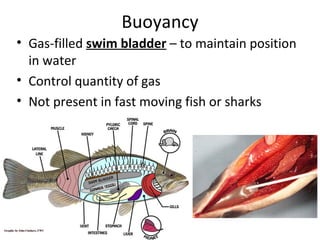
• Gas-filled swim bladder – to maintain position
  in water
• Control quantity of gas
• Not present in fast moving fish or sharks
Gas Exchange
• Gills covered by operculum
• Water pumped through mouth, over gills, out
  gill slits and operculum
• Thin membranes and high surface area in gills
• Oxygen diffuses from water into blood
• Carbon dioxide diffuses from blood to water


                               striped bass
Osmoregulation
• Maintenance of water balance
• Saltwater fish tend to lose water
• Drink seawater
• Excrete salt from gland in gills
• Produce little urine
Osmoregulation
Senses
•   To find prey and avoid being eaten
•   Good sense of sight, smell and taste
•   Good sense of hearing – inner ear
•   Lateral line system:
    – Line of pores and canals running down body
    – Detect vibrations, changes in current direction
      and water pressure
Outer Covering
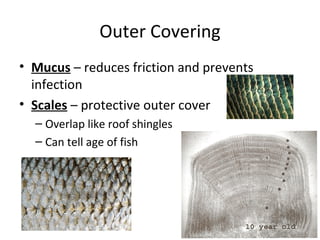
• Mucus – reduces friction and prevents
  infection
• Scales – protective outer cover
  – Overlap like roof shingles
  – Can tell age of fish
Outer Covering
Reproduction
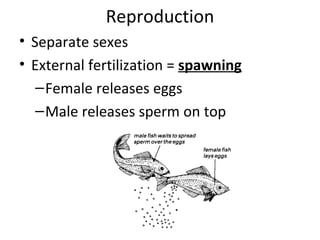
• Separate sexes
• External fertilization = spawning
   – Female releases eggs
   – Male releases sperm on top
Protection
• Camouflage
ex: flounder, sea dragon,
  sargassum fish
• Armor plating   Protection
ex: seahorses
• Size
ex: puffer fish
• Spines
ex: blow fish
Protection
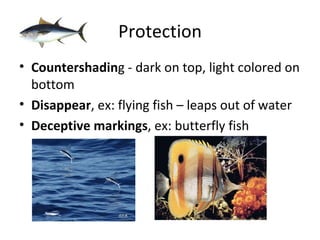
• Countershading - dark on top, light colored on
  bottom
• Disappear, ex: flying fish – leaps out of water
• Deceptive markings, ex: butterfly fish
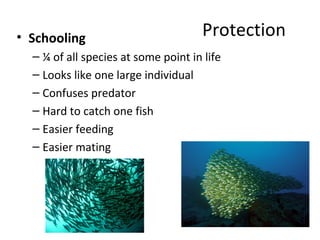
• Schooling                           Protection
  – ¼ of all species at some point in life
  – Looks like one large individual
  – Confuses predator
  – Hard to catch one fish
  – Easier feeding
  – Easier mating
Other Fish Adaptations
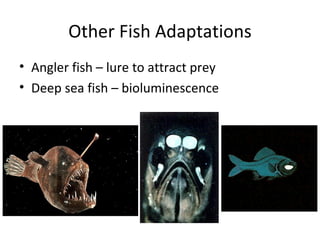
• Angler fish – lure to attract prey
• Deep sea fish – bioluminescence
Fish Oddities
• Some start life as male, change to female or
  opposite – ex: some grouper, sea bass,
  sheepheads, wrasses
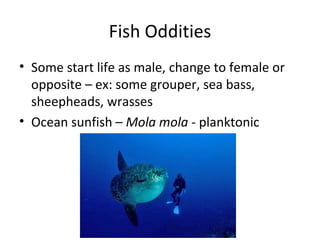
• Ocean sunfish – Mola mola - planktonic

Bony fish powerpoint

  • 1.
  • 2.
    Class Osteichthyes –The Bony Fish • More than 27,000 species • Most numerous and successful of all vertebrates • Found in every marine habitat – tide pools to deep sea • Economically important – 77 million tons harvested per year
  • 3.
    General Characteristics • Endoskeletonmade of true bone • Hinged jaws • Paired fins – independently movable
  • 4.
    Types of BonyFishes • Lobe-finned Fish: – Ancestors of amphibians – Ex: coelacanth – thought extinct 65 million years ago – found live in 1938 – 2 species – Ex: lungfish – lung that can breathe air during droughts • *Ray-finned: – Most present day fish
  • 5.
    Movement • Nektonic –swimmers - control movement against current –Move to food –Escape predator
  • 6.
    Movement • Streamlining toreduce drag = teardrop shape = fusiform • Most fish swim by moving tail side to side • Mucus reduces drag • Homocercal tail – top and bottom same size yellowfin tuna
  • 7.
    Buoyancy • Gas-filled swimbladder – to maintain position in water • Control quantity of gas • Not present in fast moving fish or sharks
  • 8.
    Gas Exchange • Gillscovered by operculum • Water pumped through mouth, over gills, out gill slits and operculum • Thin membranes and high surface area in gills • Oxygen diffuses from water into blood • Carbon dioxide diffuses from blood to water striped bass
  • 10.
    Osmoregulation • Maintenance ofwater balance • Saltwater fish tend to lose water • Drink seawater • Excrete salt from gland in gills • Produce little urine
  • 11.
  • 12.
    Senses • To find prey and avoid being eaten • Good sense of sight, smell and taste • Good sense of hearing – inner ear • Lateral line system: – Line of pores and canals running down body – Detect vibrations, changes in current direction and water pressure
  • 13.
    Outer Covering • Mucus– reduces friction and prevents infection • Scales – protective outer cover – Overlap like roof shingles – Can tell age of fish
  • 14.
  • 15.
    Reproduction • Separate sexes •External fertilization = spawning – Female releases eggs – Male releases sperm on top
  • 16.
    Protection • Camouflage ex: flounder,sea dragon, sargassum fish
  • 17.
    • Armor plating Protection ex: seahorses • Size ex: puffer fish • Spines ex: blow fish
  • 18.
    Protection • Countershading -dark on top, light colored on bottom • Disappear, ex: flying fish – leaps out of water • Deceptive markings, ex: butterfly fish
  • 19.
    • Schooling Protection – ¼ of all species at some point in life – Looks like one large individual – Confuses predator – Hard to catch one fish – Easier feeding – Easier mating
  • 20.
    Other Fish Adaptations •Angler fish – lure to attract prey • Deep sea fish – bioluminescence
  • 21.
    Fish Oddities • Somestart life as male, change to female or opposite – ex: some grouper, sea bass, sheepheads, wrasses • Ocean sunfish – Mola mola - planktonic