Amphibians
Damnjanović Ivana
Evolution
Evolution
Evolution

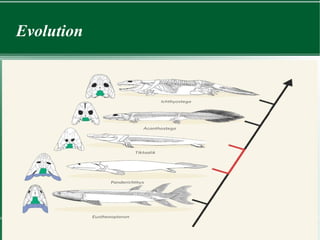
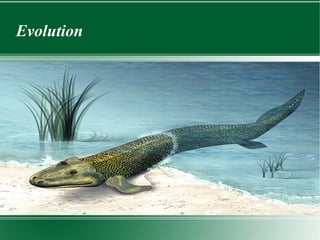
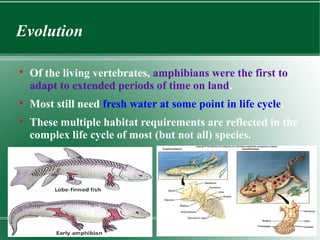
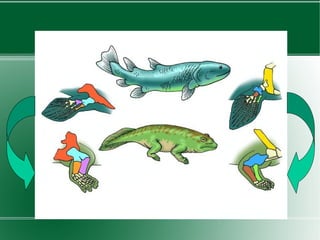
Of the living vertebrates, amphibians were the first to
adapt to extended periods of time on land.

Most still need fresh water at some point in life cycle.

These multiple habitat requirements are reflected in the
complex life cycle of most (but not all) species.
Evolution
The Complex Life Cycle
Types

Anures (without tail)

Urodels (with tail)

Gymnophions (without
legs)
General Characteristics

Have no nails or claws

Minimal number of teeth

Most have a tongue that is projectile and
sticky

Spends first stages of life in water as tadpoles

They go through drastic changes during
development (caused by changes in
hormones)

Tadpoles are herbivorous while adults are
carnivorous

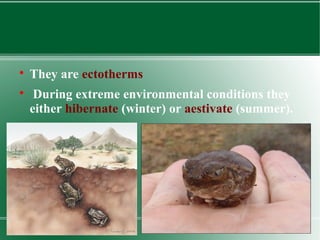
They are ectotherms

During extreme environmental conditions they
either hibernate (winter) or aestivate (summer).
Skin

Smooth, moist skin

Mucous glands (prevent desiccation /
slippery / disease-free)

Poison glands:
- Produce diverse array
of chemicals
Epibatidine
(dart-poison frogs)
Lipid-soluble Alkaloid
(Blocks Ach receptors)
Non-addictive
painkiller

Pigment cells (colour)
Respiration

Cutaneous – Gas exchange occurs across moist skin

Pulmonary – Gas exchange occurs in paired lungs (too small
for all gas exchange)

Gills – Larval forms and neotenics (neoteny = adults that
retain juvenile characteristics)
Feeding

Tadpoles are herbivorous while
adults are carnivorous
Blood system

Heart: 2 atriums and 1 ventricle
Nervous, sensory and muscular system

Well developed brain attached to the dorsal nerve cord.

They contain a well developed muscular system.

Sensory receptors located all over the skin

Good vision since these animals are mainly vision
feeders; that is, they have to use their sight to find and
capture food.
Excretion
Reproduction
Reproduction

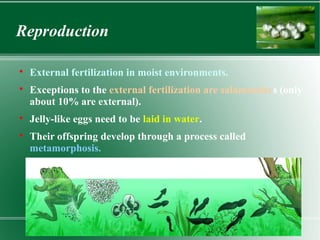
External fertilization in moist environments.

Exceptions to the external fertilization are salamanders (only
about 10% are external).

Jelly-like eggs need to be laid in water.

Their offspring develop through a process called
metamorphosis.
Vocalization

Sound production is primarily a reproductive function of
male anurans.

These calls attract females to breeding areas and to
announce to other males that a given territory is occupied.

These calls may also cause some hormonal changes internally
to occur.

Sounds are caused by air being forced from the lungs over
the vocal cords and cartilages of the larynx, causing them to
vibrate.
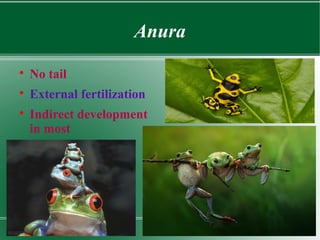
Anura
Anura

No tail

External fertilization

Indirect development
in most
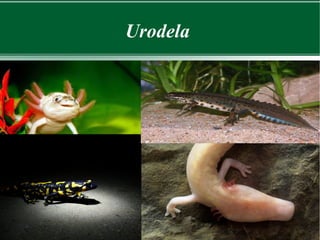
Urodela
29
Caudata (Urodela)

Have a tail

Divergence in respiratory
mechanisms

Internal fertilization
Ambystoma mexicanum
(Axolotl)
30
Gymnophiona
32
Gymnophiona

Legless

Burrowing or aquatic

Tropical

Internal fertilization

Oviparous & viviparous species
Amphibians

Amphibians