Chapt 10 Bony Fishes

      Ichthyology
   “the study of fish”
Phylum Chordata
• Class Actinopterygii
  – “modern bony fish”
  – 25,000 species or ½ of all vertebrate species
  – So diverse no one characteristic can differentiate
    them from sharks, skates, and rays (cartilaginous
    fish)
     • Taxonomy of fishes is concentrated on order or family
       rather than phylum (b/c phylum is too broad)
  – Taxonomy of fishes are still changing as new
    technology and research reveal new characteristics
Phylum Chordata
• Characteristics
  – Presence of swim bladder or lung
  – Bones
  – Bony scales
  – Fin rays
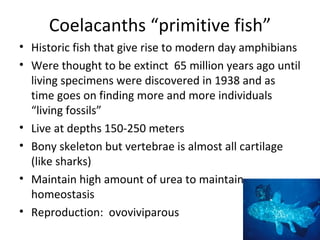
Coelacanths “primitive fish”
• Historic fish that give rise to modern day amphibians
• Were thought to be extinct 65 million years ago until
  living specimens were discovered in 1938 and as
  time goes on finding more and more individuals
  “living fossils”
• Live at depths 150-250 meters
• Bony skeleton but vertebrae is almost all cartilage
  (like sharks)
• Maintain high amount of urea to maintain
  homeostasis
• Reproduction: ovoviviparous
Ray-finned Fishes
• Most numerous and diverse of ALL
  vertebrates in ocean
• Characteristic-fins attached to body by fin ray
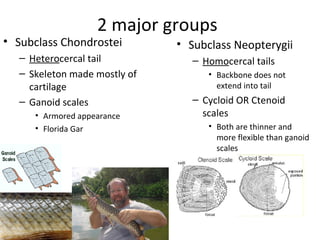
2 major groups
• Subclass Chondrostei        • Subclass Neopterygii
  – Heterocercal tail            – Homocercal tails
  – Skeleton made mostly of         • Backbone does not
    cartilage                         extend into tail
  – Ganoid scales                – Cycloid OR Ctenoid
     • Armored appearance          scales
     • Florida Gar                  • Both are thinner and
                                      more flexible than ganoid
                                      scales
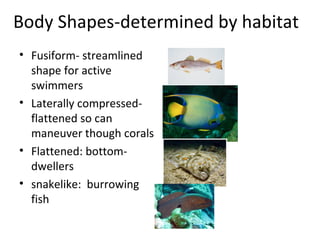
Body Shapes-determined by habitat
• Fusiform- streamlined
  shape for active
  swimmers
• Laterally compressed-
  flattened so can
  maneuver though corals
• Flattened: bottom-
  dwellers
• snakelike: burrowing
  fish
Respiration
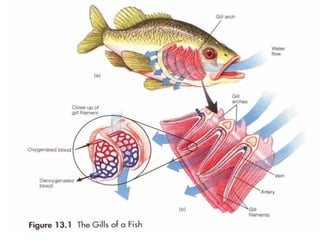
• Gills: receive oxygen and remove CO2, and
  maintain salt balance
  – Made of gill filaments: blood flows in opposite
    direction of incoming H2O
• Water must continuously pass over gills
  – Meets with blood with lower O2 and higher CO2
     • Diffusion moves from where to where?????
  – Fish actually “pump” H2O over gills
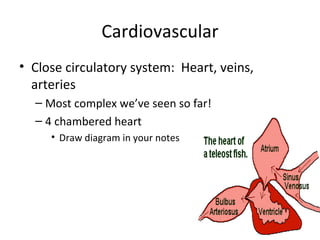
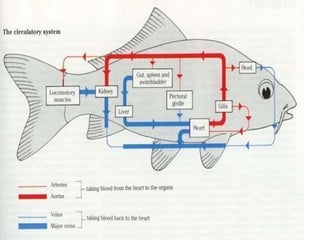
Cardiovascular
• Close circulatory system: Heart, veins,
  arteries
  – Most complex we’ve seen so far!
  – 4 chambered heart
     • Draw diagram in your notes
Staying neutrally bouyant
• Buoyancy
  – Swim bladder: gas filled sac; add and remove to
    adjust buoyancy
     • SCUBA divers must adjust air in BCD for same purpose
        – To go down: let air/gas out
        – To go up: add air/gas
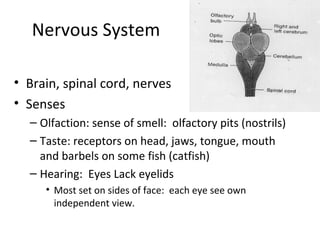
Nervous System

• Brain, spinal cord, nerves
• Senses
  – Olfaction: sense of smell: olfactory pits (nostrils)
  – Taste: receptors on head, jaws, tongue, mouth
    and barbels on some fish (catfish)
  – Hearing: Eyes Lack eyelids
     • Most set on sides of face: each eye see own
       independent view.
http://i11.p
556ed59a
13352685


                              Reproduction
      • Vast: depends on species
               – Blue headed wrasse can change sex
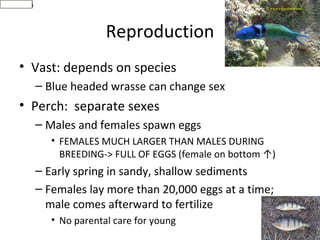
      • Perch: separate sexes
               – Males and females spawn eggs
                  • FEMALES MUCH LARGER THAN MALES DURING
                    BREEDING-> FULL OF EGGS (female on bottom ↑)
               – Early spring in sandy, shallow sediments
               – Females lay more than 20,000 eggs at a time;
                 male comes afterward to fertilize
                  • No parental care for young
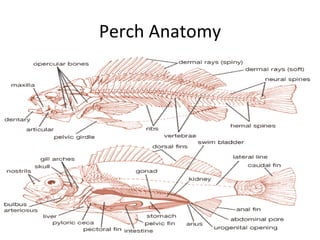
Perch Anatomy

Chapt 10 bony fishes

  • 1.
    Chapt 10 BonyFishes Ichthyology “the study of fish”
  • 2.
    Phylum Chordata • ClassActinopterygii – “modern bony fish” – 25,000 species or ½ of all vertebrate species – So diverse no one characteristic can differentiate them from sharks, skates, and rays (cartilaginous fish) • Taxonomy of fishes is concentrated on order or family rather than phylum (b/c phylum is too broad) – Taxonomy of fishes are still changing as new technology and research reveal new characteristics
  • 3.
    Phylum Chordata • Characteristics – Presence of swim bladder or lung – Bones – Bony scales – Fin rays
  • 4.
    Coelacanths “primitive fish” •Historic fish that give rise to modern day amphibians • Were thought to be extinct 65 million years ago until living specimens were discovered in 1938 and as time goes on finding more and more individuals “living fossils” • Live at depths 150-250 meters • Bony skeleton but vertebrae is almost all cartilage (like sharks) • Maintain high amount of urea to maintain homeostasis • Reproduction: ovoviviparous
  • 5.
    Ray-finned Fishes • Mostnumerous and diverse of ALL vertebrates in ocean • Characteristic-fins attached to body by fin ray
  • 6.
    2 major groups •Subclass Chondrostei • Subclass Neopterygii – Heterocercal tail – Homocercal tails – Skeleton made mostly of • Backbone does not cartilage extend into tail – Ganoid scales – Cycloid OR Ctenoid • Armored appearance scales • Florida Gar • Both are thinner and more flexible than ganoid scales
  • 7.
    Body Shapes-determined byhabitat • Fusiform- streamlined shape for active swimmers • Laterally compressed- flattened so can maneuver though corals • Flattened: bottom- dwellers • snakelike: burrowing fish
  • 8.
    Respiration • Gills: receiveoxygen and remove CO2, and maintain salt balance – Made of gill filaments: blood flows in opposite direction of incoming H2O • Water must continuously pass over gills – Meets with blood with lower O2 and higher CO2 • Diffusion moves from where to where????? – Fish actually “pump” H2O over gills
  • 10.
    Cardiovascular • Close circulatorysystem: Heart, veins, arteries – Most complex we’ve seen so far! – 4 chambered heart • Draw diagram in your notes
  • 12.
    Staying neutrally bouyant •Buoyancy – Swim bladder: gas filled sac; add and remove to adjust buoyancy • SCUBA divers must adjust air in BCD for same purpose – To go down: let air/gas out – To go up: add air/gas
  • 13.
    Nervous System • Brain,spinal cord, nerves • Senses – Olfaction: sense of smell: olfactory pits (nostrils) – Taste: receptors on head, jaws, tongue, mouth and barbels on some fish (catfish) – Hearing: Eyes Lack eyelids • Most set on sides of face: each eye see own independent view.
  • 14.
    http://i11.p 556ed59a 13352685 Reproduction • Vast: depends on species – Blue headed wrasse can change sex • Perch: separate sexes – Males and females spawn eggs • FEMALES MUCH LARGER THAN MALES DURING BREEDING-> FULL OF EGGS (female on bottom ↑) – Early spring in sandy, shallow sediments – Females lay more than 20,000 eggs at a time; male comes afterward to fertilize • No parental care for young
  • 15.