Supervisor:
Submitted By:
Mr. Ashok Kumar Kajla
Rupesh Sharma
Associate Professr Enrolment No.:
Design OFDM System and Overcome Nonlinear
Distortion in OFDM Signal at Transmitter Using
Peak To Average Power Ratio (PAPR) Reduction
Techniques
1
Outline Project Description
 Overview of OFDM
 Single-Carrier vs. Multi-Carrier Transmission
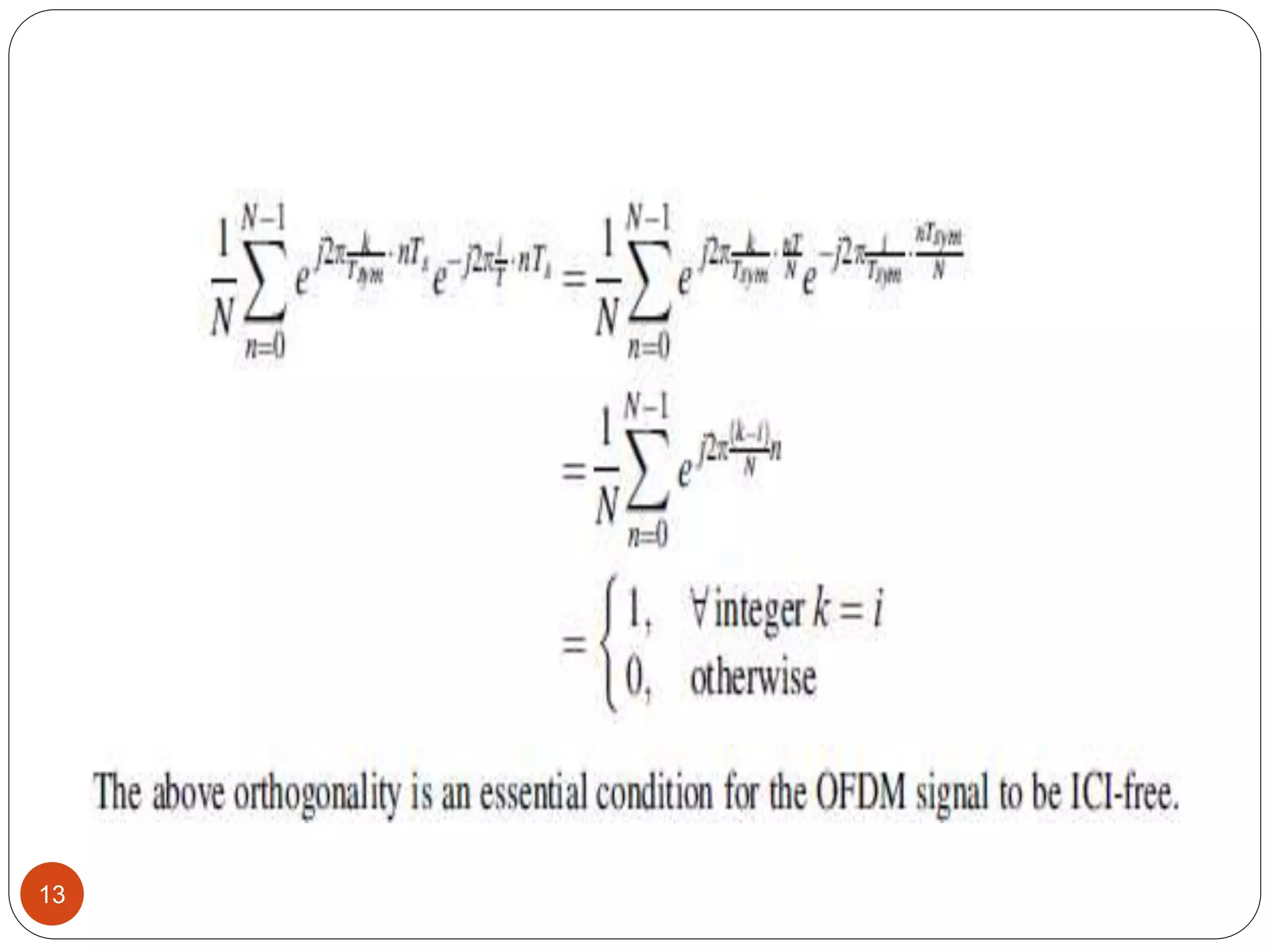
 Orthogonality
 Cyclic Prefix (CP)
 OFDM Modulation and Demodulation implemented
using IDFT/DFT
 Theoretical analysis OFDM system performance
 Introduction of Peak-to-average power ratio(PAPR)
 PAPR Reduction Techniques
 Simulation Results For, OFDM system and PAPR
reduction Techniques
 Conclusions
 References
2
3
PROJECT DESCRIPTION
 In this Dissertation we are discuses on ...
• Theoretical analysis of OFDM system
• Quantitative study of PAPR and
Nonlinear Distortion
• Simulate an OFDM-system
• Implement PAPR reduction techniques
Overview of OFDM
OFDM is a powerful spectrally efficient digital
modulation technique. which employs multiple carriers
that are mutually orthogonal to each other over a
given time interval.
OFDM is also called a multicarrier modulation
technology which is used in many new and emerging
broadband wireless communication systems like Wi-
MAX, DVB-T and future 4G/LTE systems because of
1. Immunity to frequency selective fading
channels
2. OFDM offer high spectral efficiency
3. Immune to the multipath delay
4. Low inter symbol interference (ISI)
5. High Power spectral Efficiency
Due to these merits OFDM is chosen as high data
4
Drawbacks:
1. The major drawback of OFDM is the high
PAPR of the transmitted signal. So system is
Sensitivity to nonlinear amplification.
Compensation techniques for
nonlinear effects
1. Linearization (digital predistortion).
2. Peak-to-average power ratio (PAPR)
reduction.
3. Post-processing.
PAPR-reduction techniques
1. Amplitude Clipping(AC) ,
2. Selected Mapping Technique(SLM) and
3. Partial Transmit Sequence (PTS),5
Single-Carrier vs. Multi-Carrier
Transmission
6
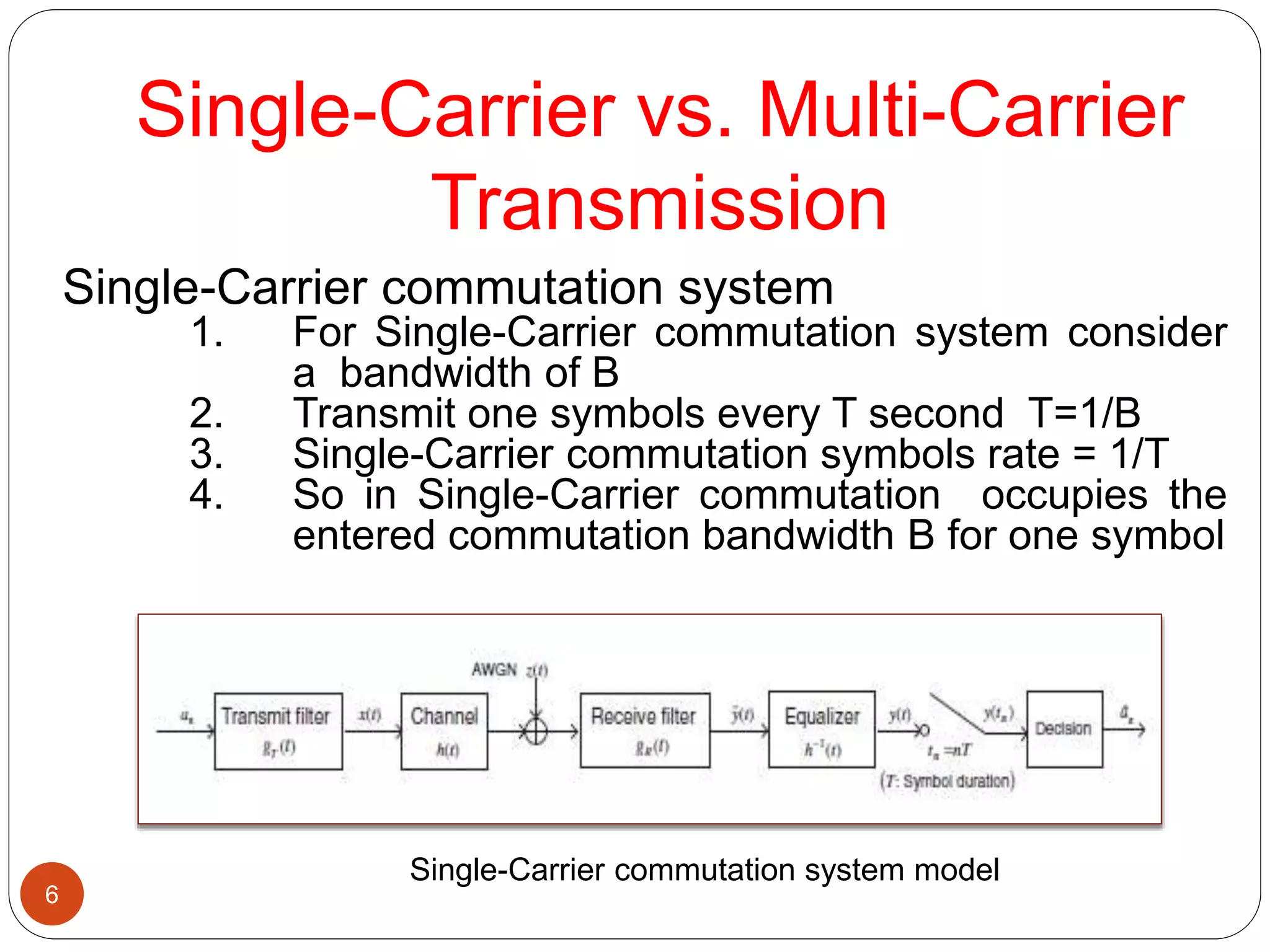
Single-Carrier commutation system
1. For Single-Carrier commutation system consider
a bandwidth of B
2. Transmit one symbols every T second T=1/B
3. Single-Carrier commutation symbols rate = 1/T
4. So in Single-Carrier commutation occupies the
entered commutation bandwidth B for one symbol
Single-Carrier commutation system model
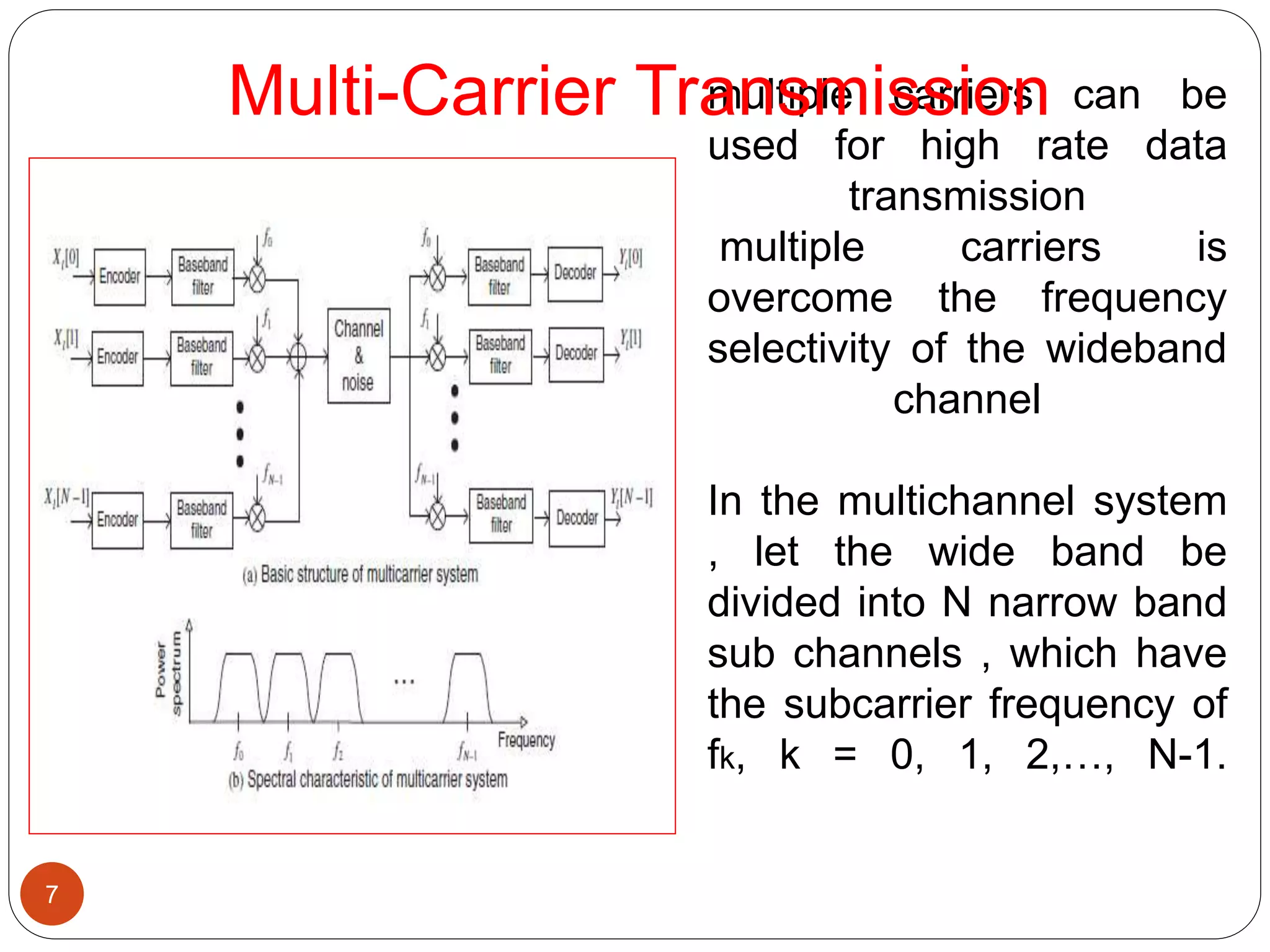
multiple carriers can be
used for high rate data
transmission
multiple carriers is
overcome the frequency
selectivity of the wideband
channel
In the multichannel system
, let the wide band be
divided into N narrow band
sub channels , which have
the subcarrier frequency of
fk, k = 0, 1, 2,…, N-1.
7
Multi-Carrier Transmission
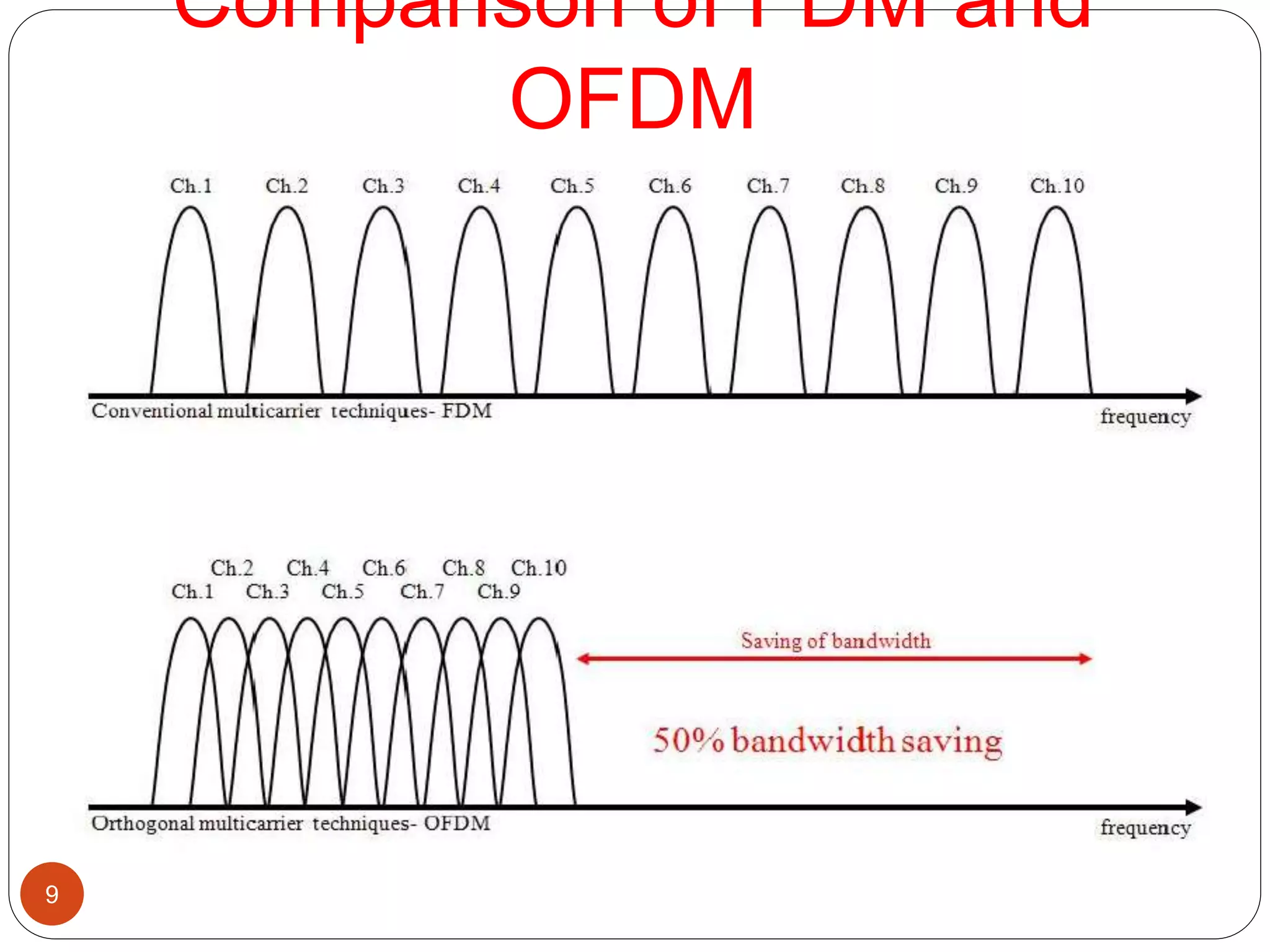
Comparison of FDM and OFDM
FDM OFDM
8
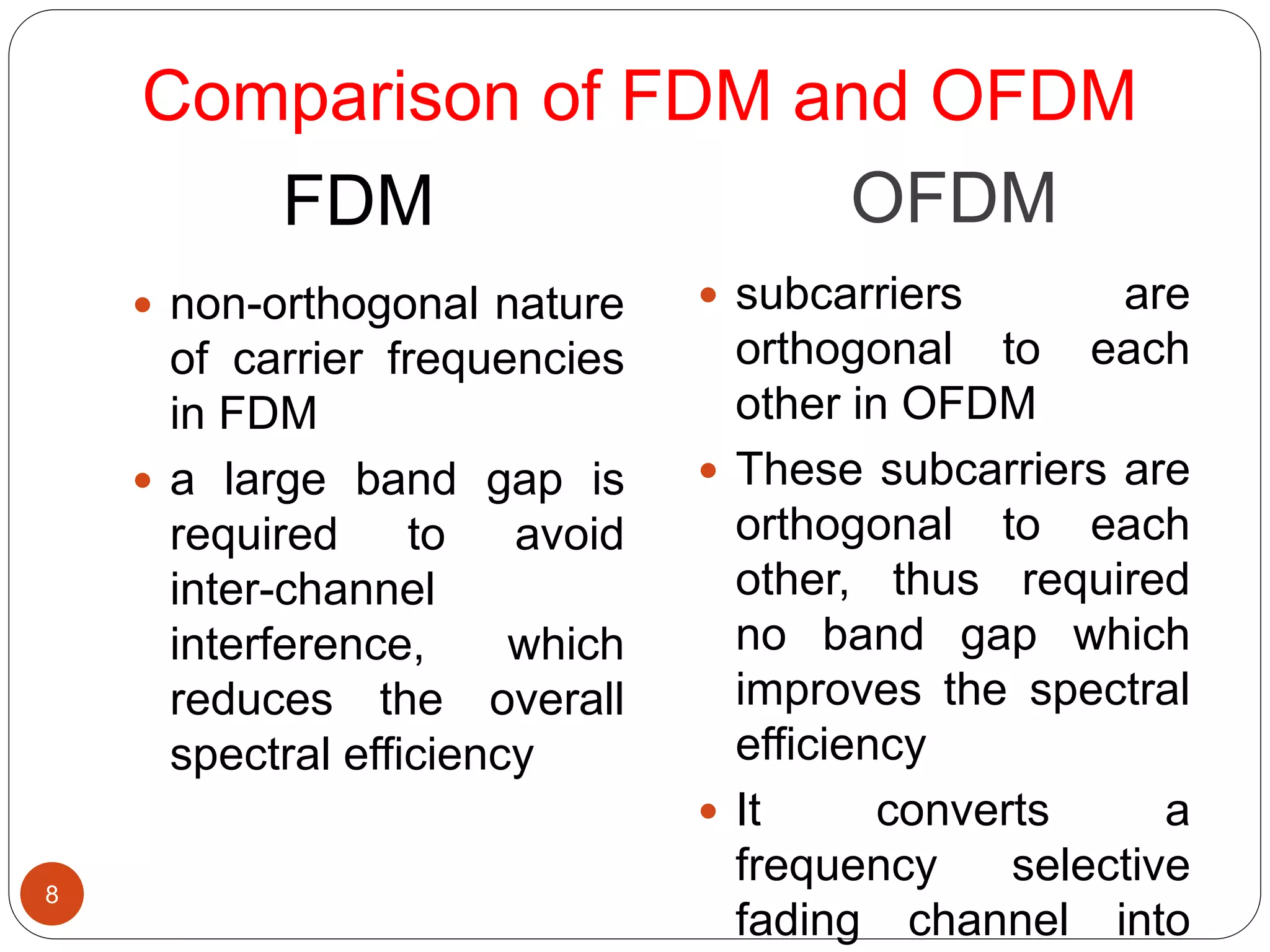
 non-orthogonal nature
of carrier frequencies
in FDM
 a large band gap is
required to avoid
inter-channel
interference, which
reduces the overall
spectral efficiency
 subcarriers are
orthogonal to each
other in OFDM
 These subcarriers are
orthogonal to each
other, thus required
no band gap which
improves the spectral
efficiency
 It converts a
frequency selective
fading channel into
Comparison of FDM and
OFDM
9
Basic Principles of
OFDM
10
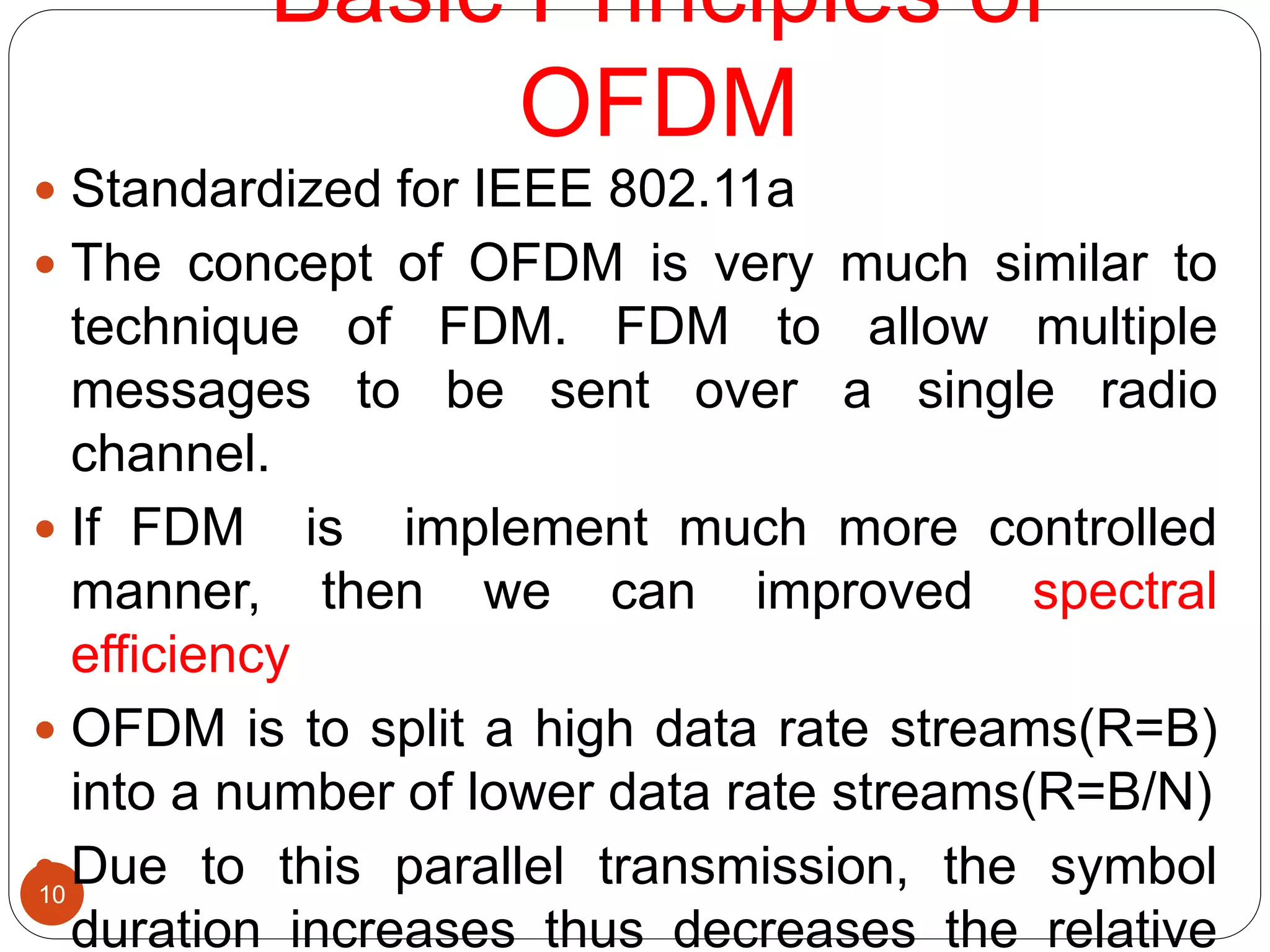
 Standardized for IEEE 802.11a
 The concept of OFDM is very much similar to
technique of FDM. FDM to allow multiple
messages to be sent over a single radio
channel.
 If FDM is implement much more controlled
manner, then we can improved spectral
efficiency
 OFDM is to split a high data rate streams(R=B)
into a number of lower data rate streams(R=B/N)
 Due to this parallel transmission, the symbol
duration increases thus decreases the relative
Orthogonality
11
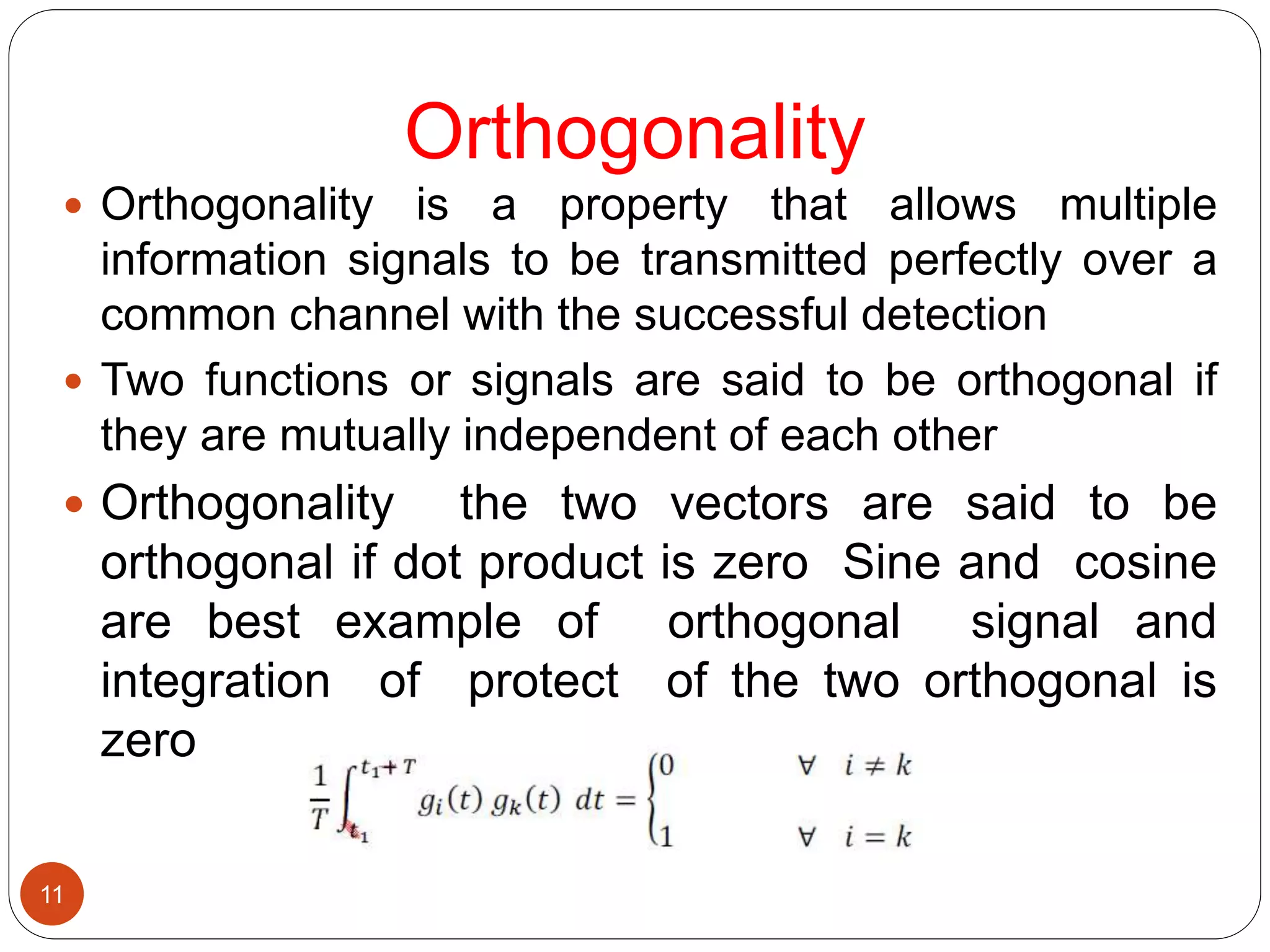
 Orthogonality is a property that allows multiple
information signals to be transmitted perfectly over a
common channel with the successful detection
 Two functions or signals are said to be orthogonal if
they are mutually independent of each other
 Orthogonality the two vectors are said to be
orthogonal if dot product is zero Sine and cosine
are best example of orthogonal signal and
integration of protect of the two orthogonal is
zero
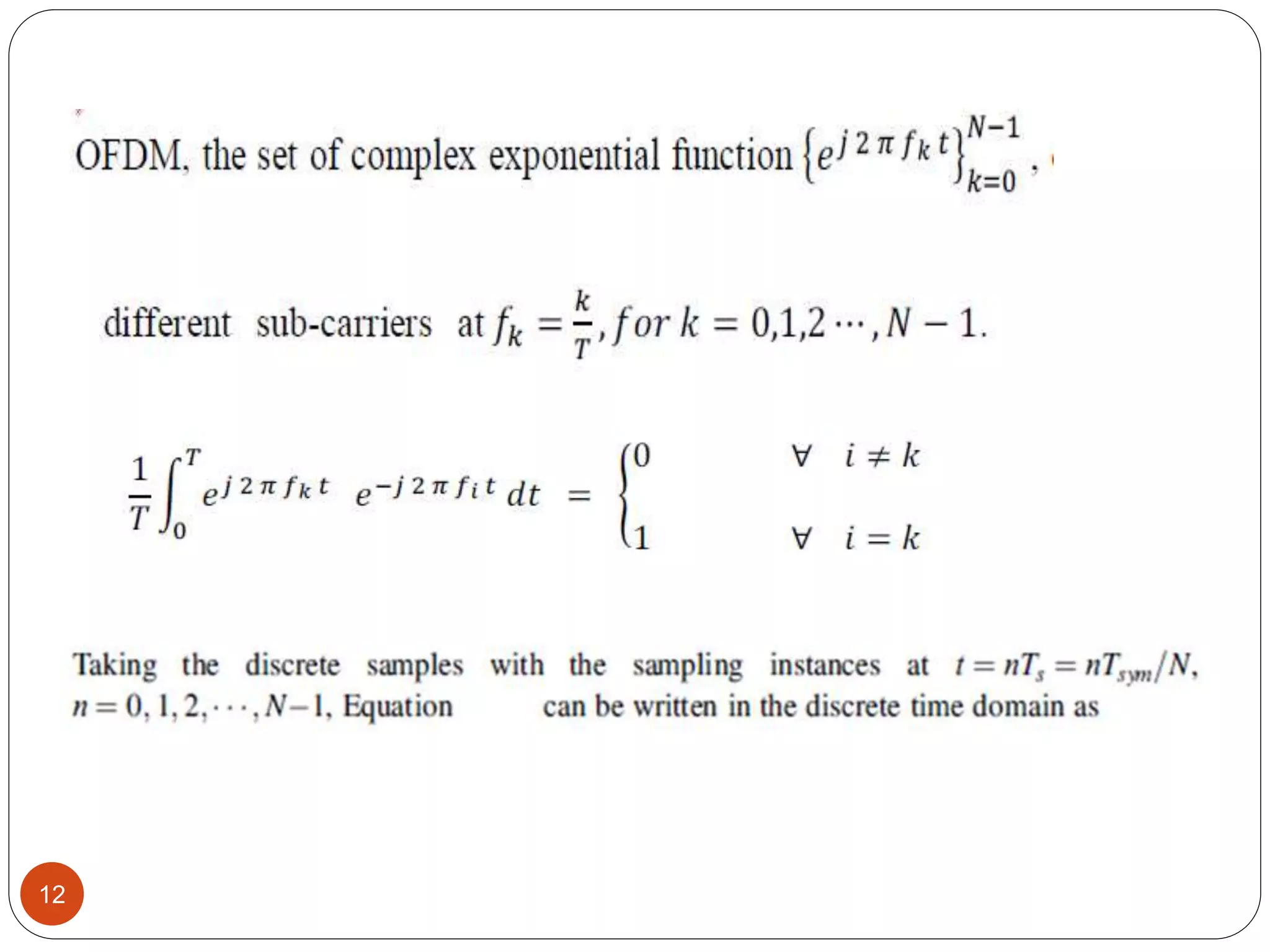
12
13
=
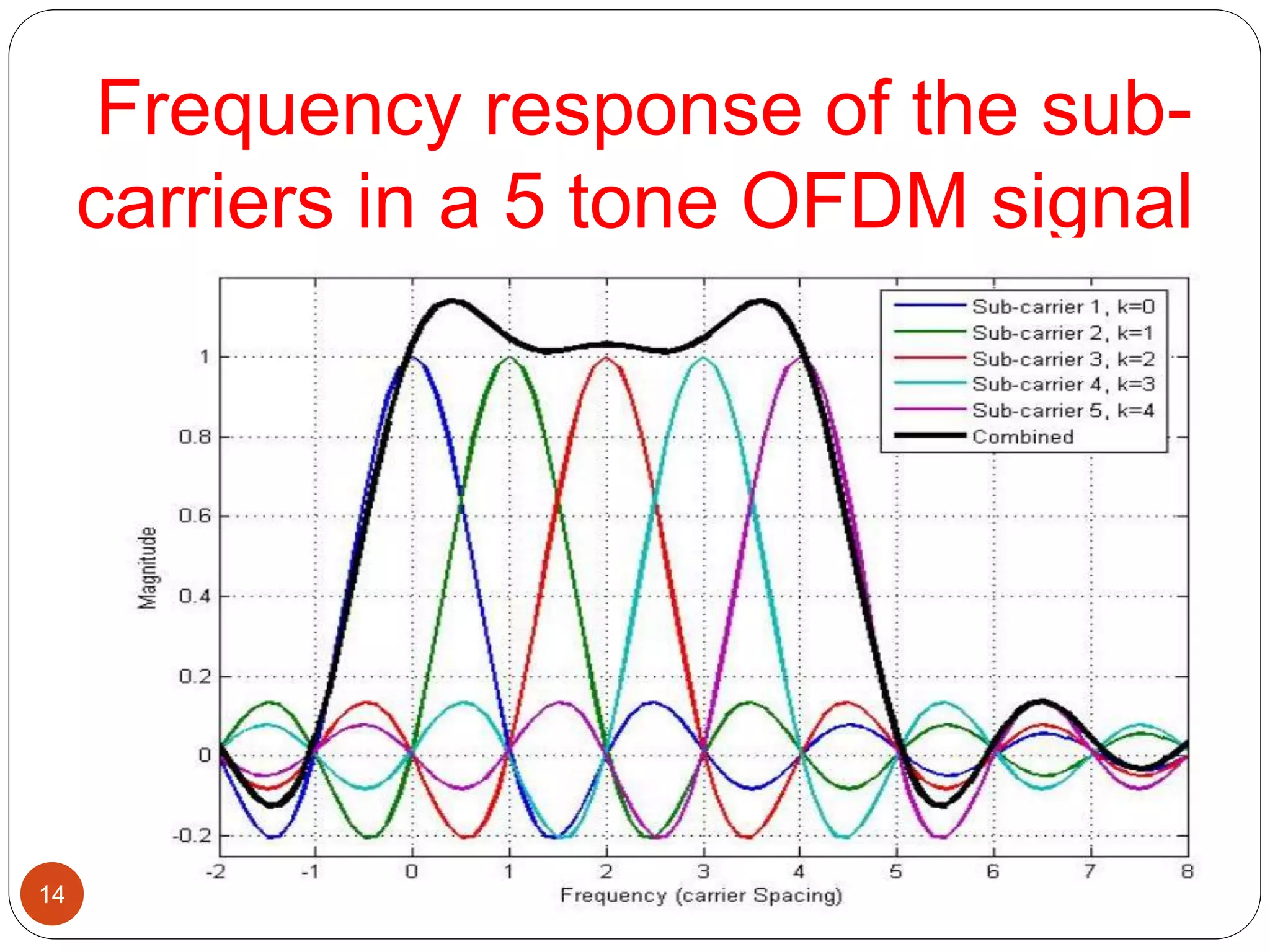
Frequency response of the sub-
carriers in a 5 tone OFDM signal
14
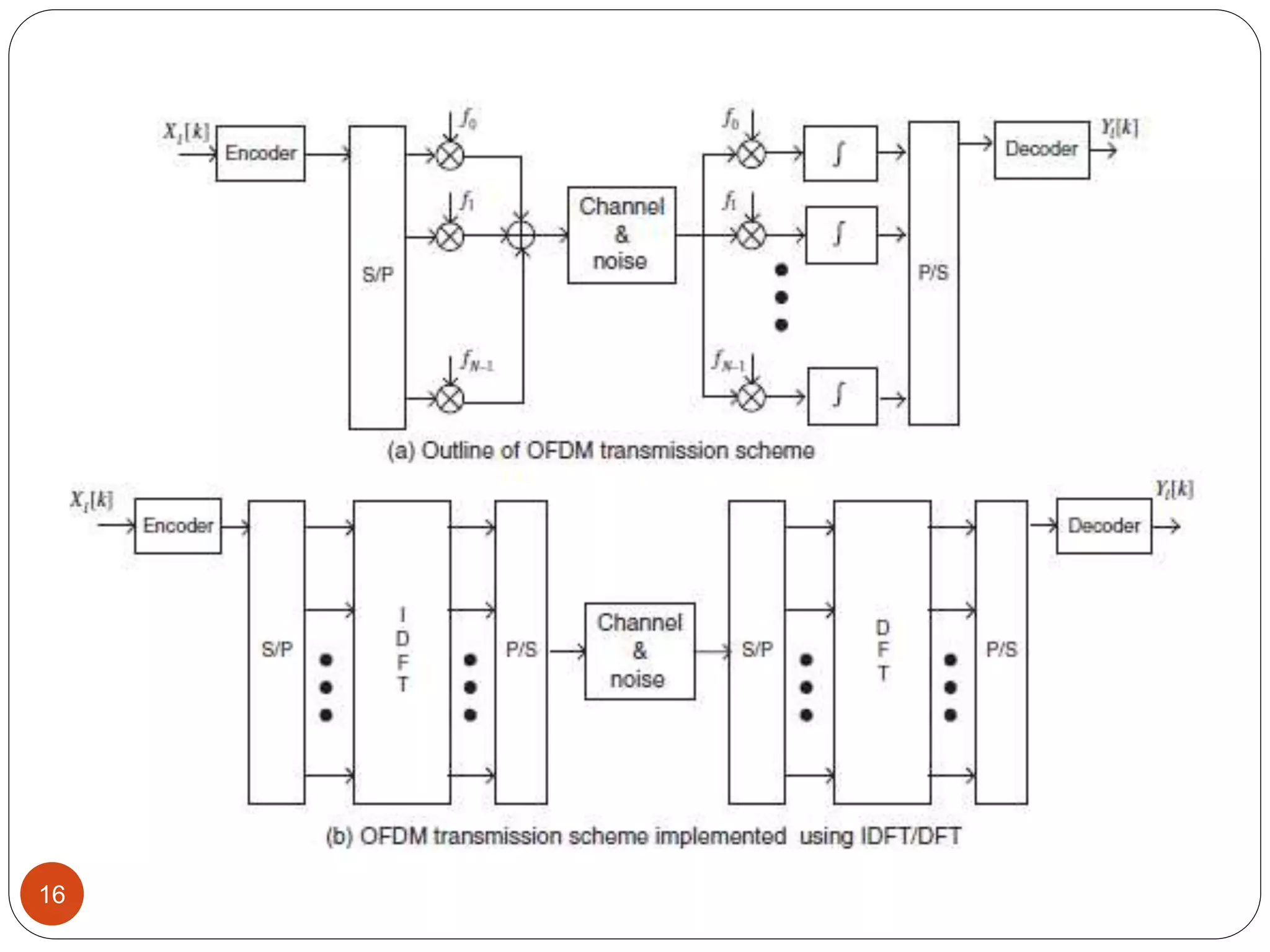
OFDM transmission scheme implemented using
IDFT/DFT
15
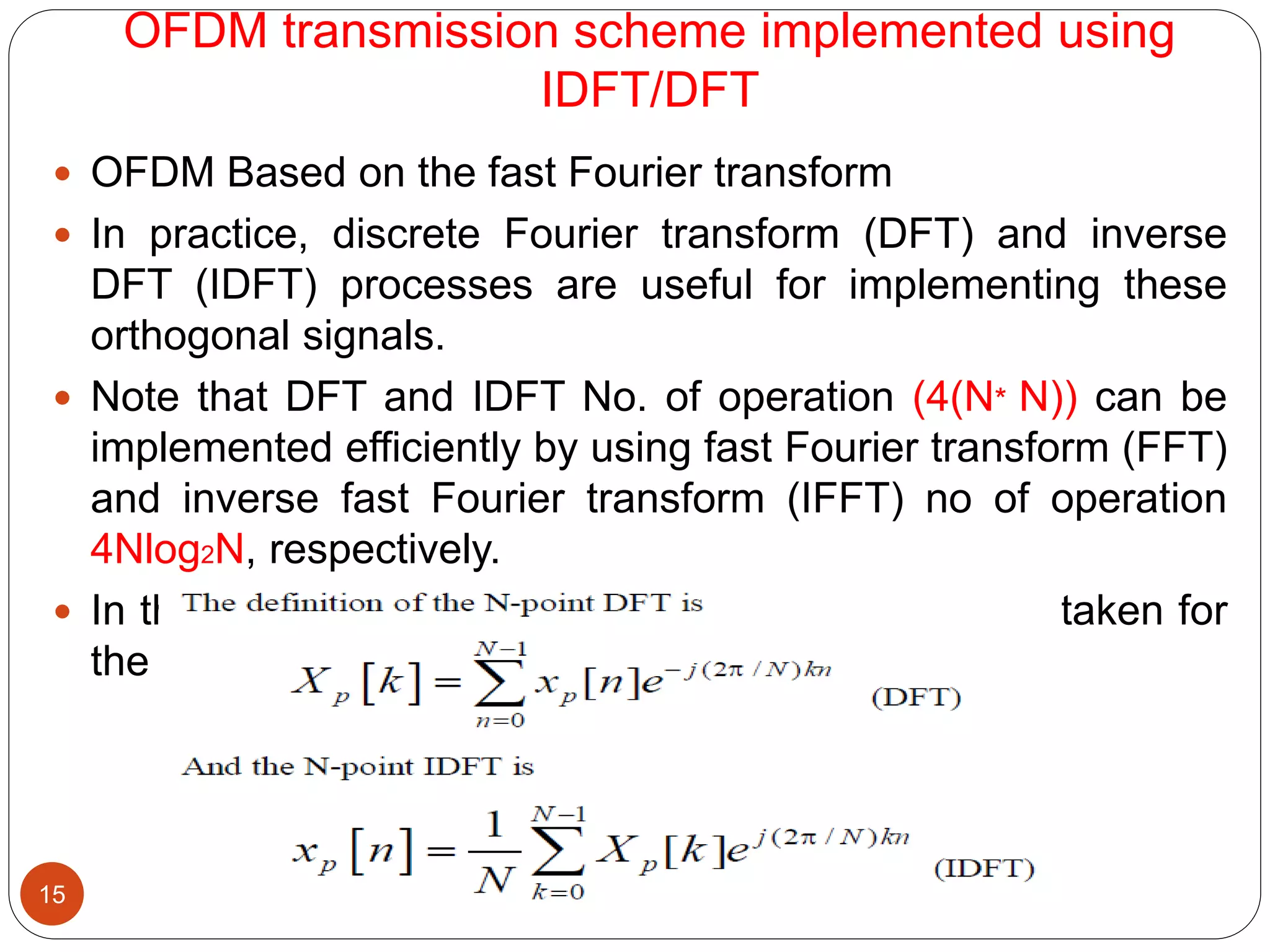
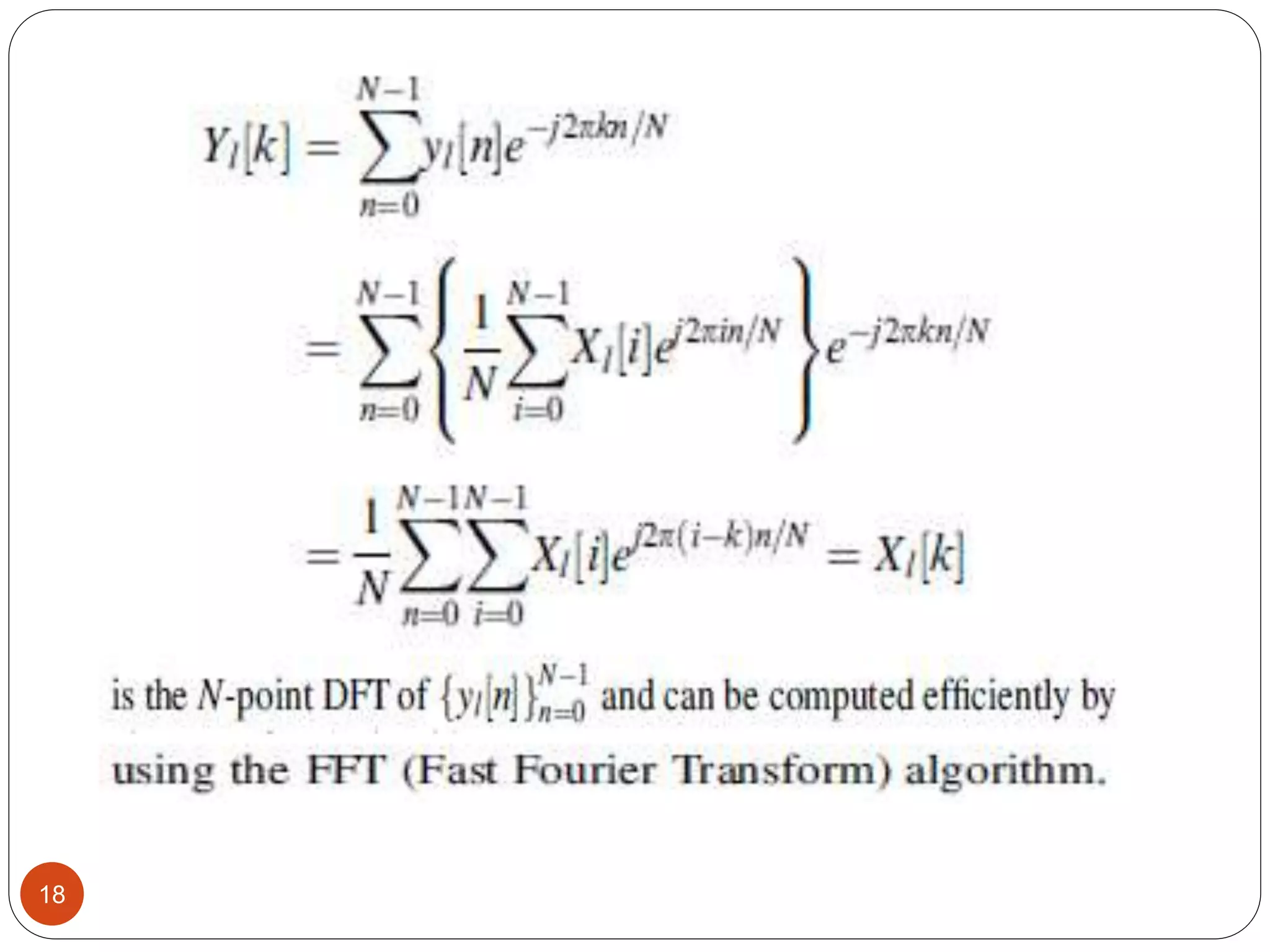
 OFDM Based on the fast Fourier transform
 In practice, discrete Fourier transform (DFT) and inverse
DFT (IDFT) processes are useful for implementing these
orthogonal signals.
 Note that DFT and IDFT No. of operation (4(N* N)) can be
implemented efficiently by using fast Fourier transform (FFT)
and inverse fast Fourier transform (IFFT) no of operation
4Nlog2N, respectively.
 In the OFDM transmission system, N-point IFFT is taken for
the transmitted symbols
16
OFDM Modulation and Demodulation
17
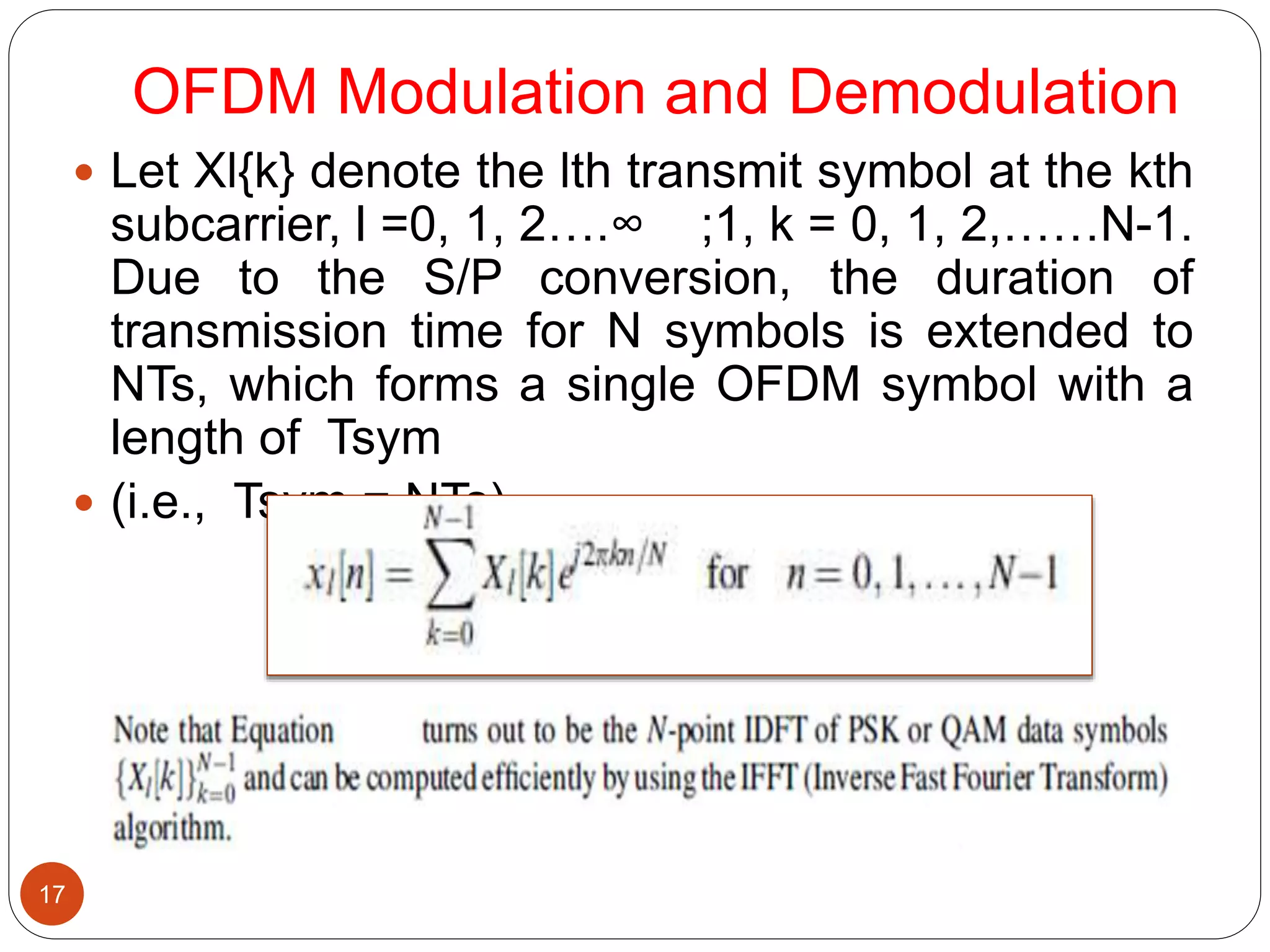
 Let Xl{k} denote the lth transmit symbol at the kth
subcarrier, l =0, 1, 2….∞ ;1, k = 0, 1, 2,……N-1.
Due to the S/P conversion, the duration of
transmission time for N symbols is extended to
NTs, which forms a single OFDM symbol with a
length of Tsym
 (i.e., Tsym = NTs).
18
19
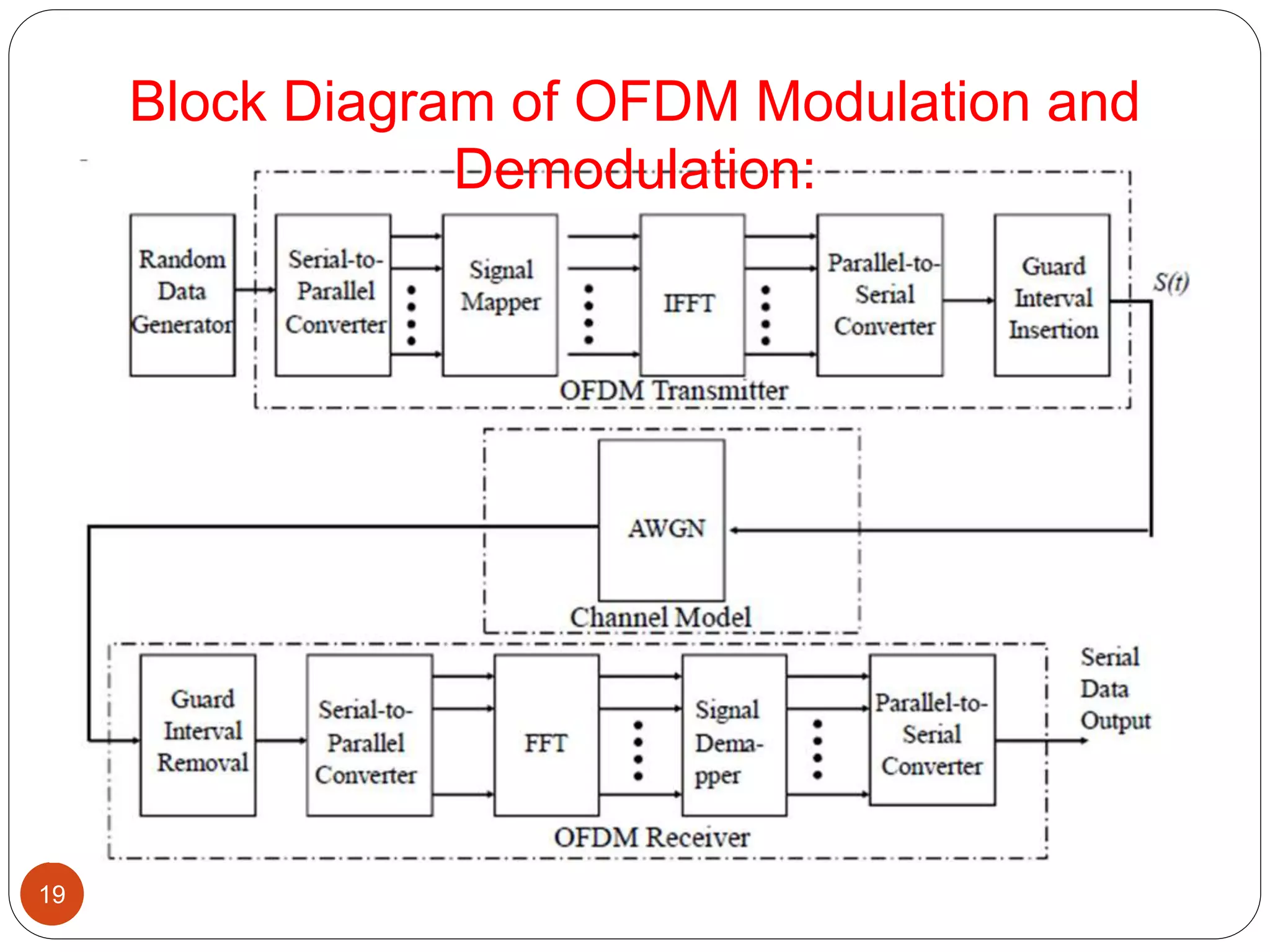
Block Diagram of OFDM Modulation and
Demodulation:
Cyclic Prefix (CP)
20
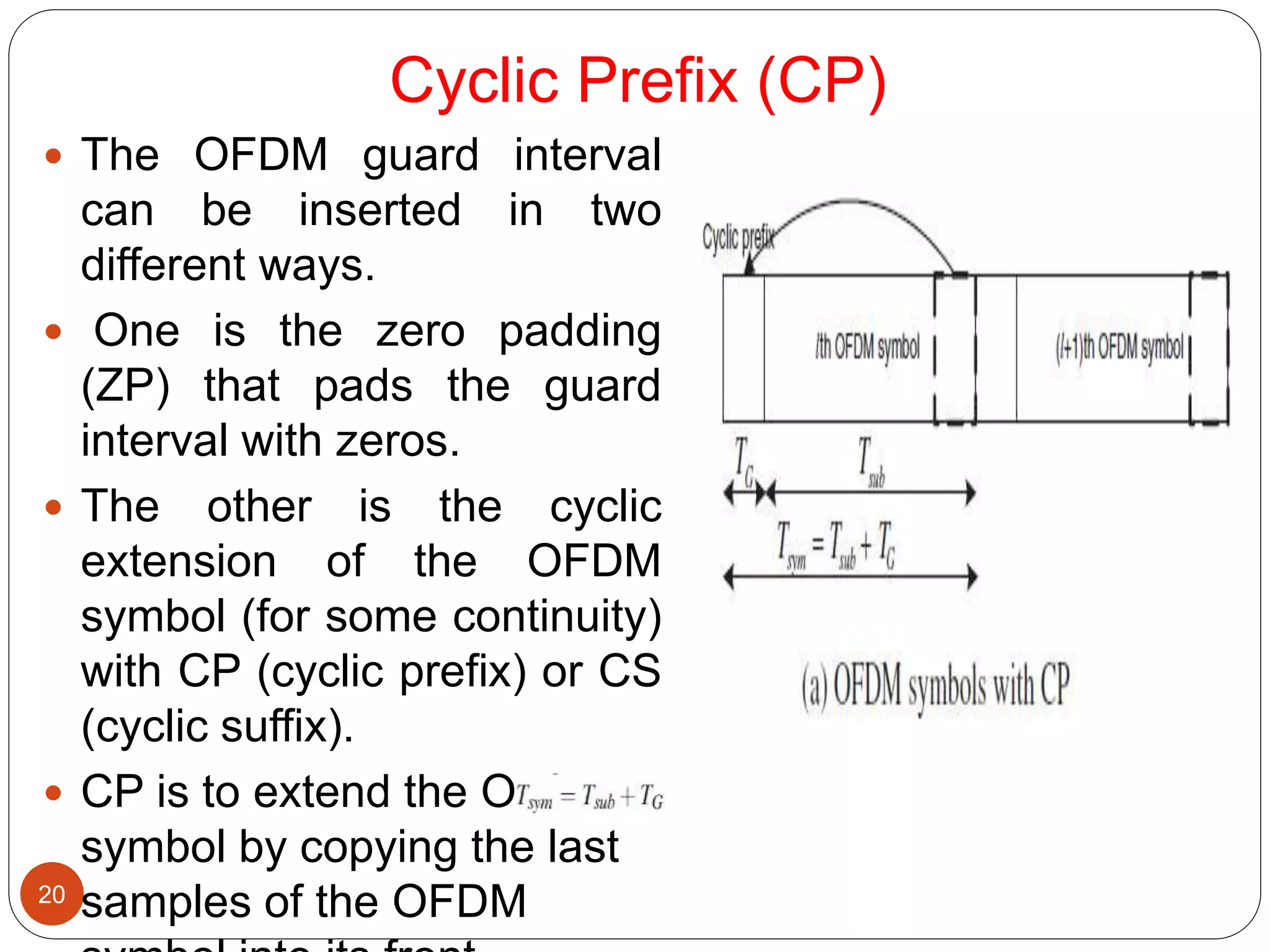
 The OFDM guard interval
can be inserted in two
different ways.
 One is the zero padding
(ZP) that pads the guard
interval with zeros.
 The other is the cyclic
extension of the OFDM
symbol (for some continuity)
with CP (cyclic prefix) or CS
(cyclic suffix).
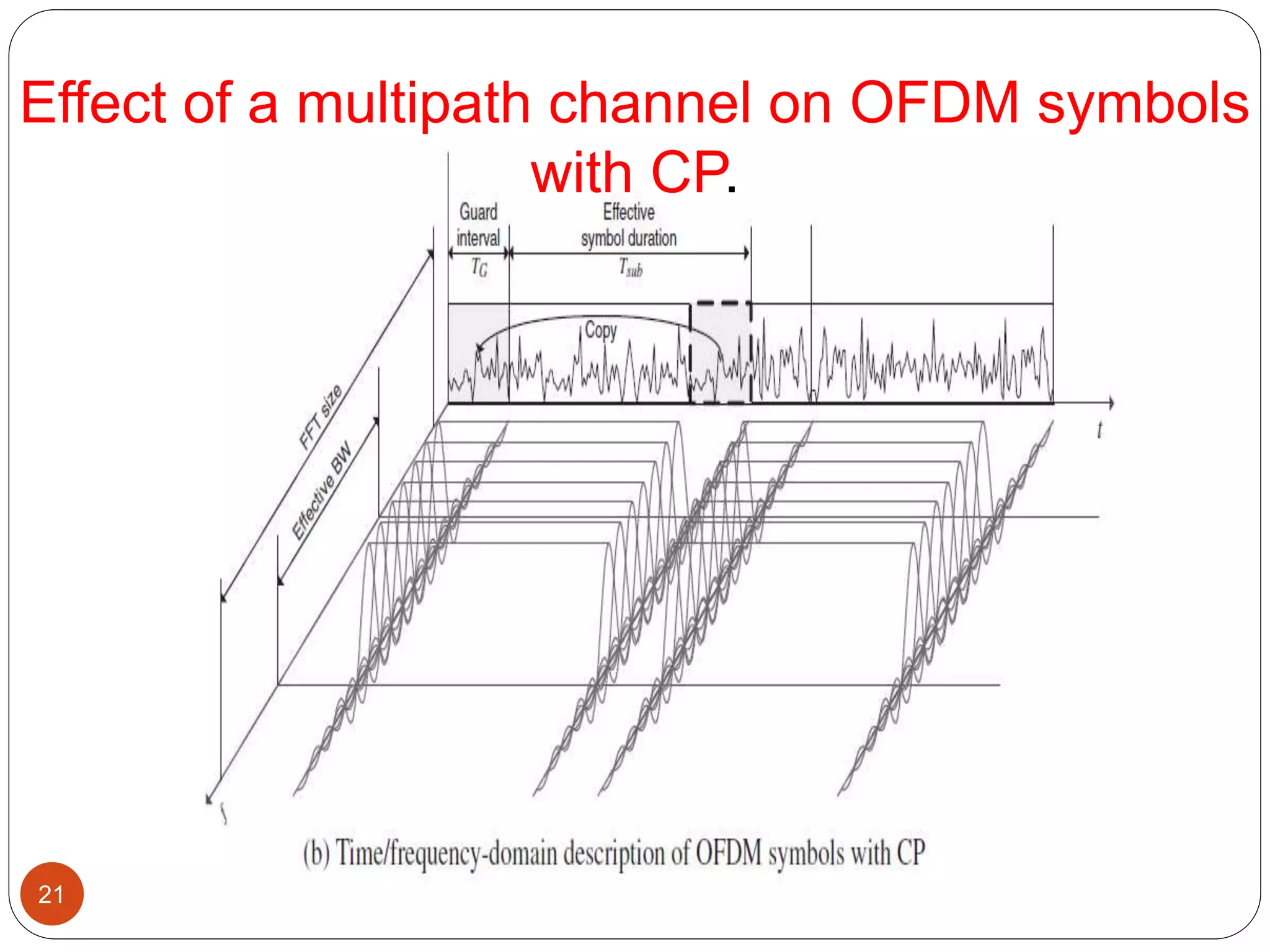
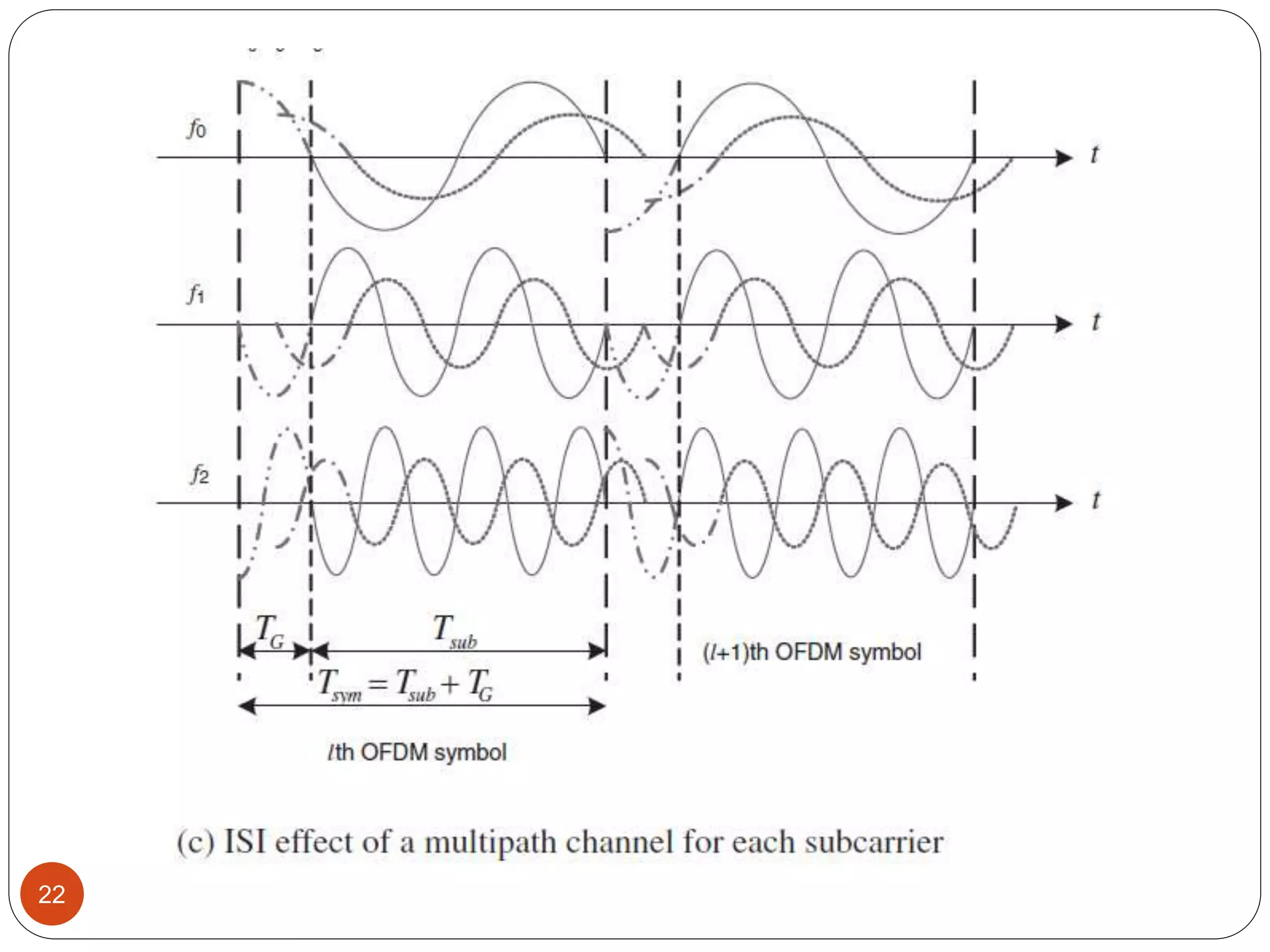
 CP is to extend the OFDM
symbol by copying the last
samples of the OFDM
21
Effect of a multipath channel on OFDM symbols
with CP.
22
Introduction of PAPR
23
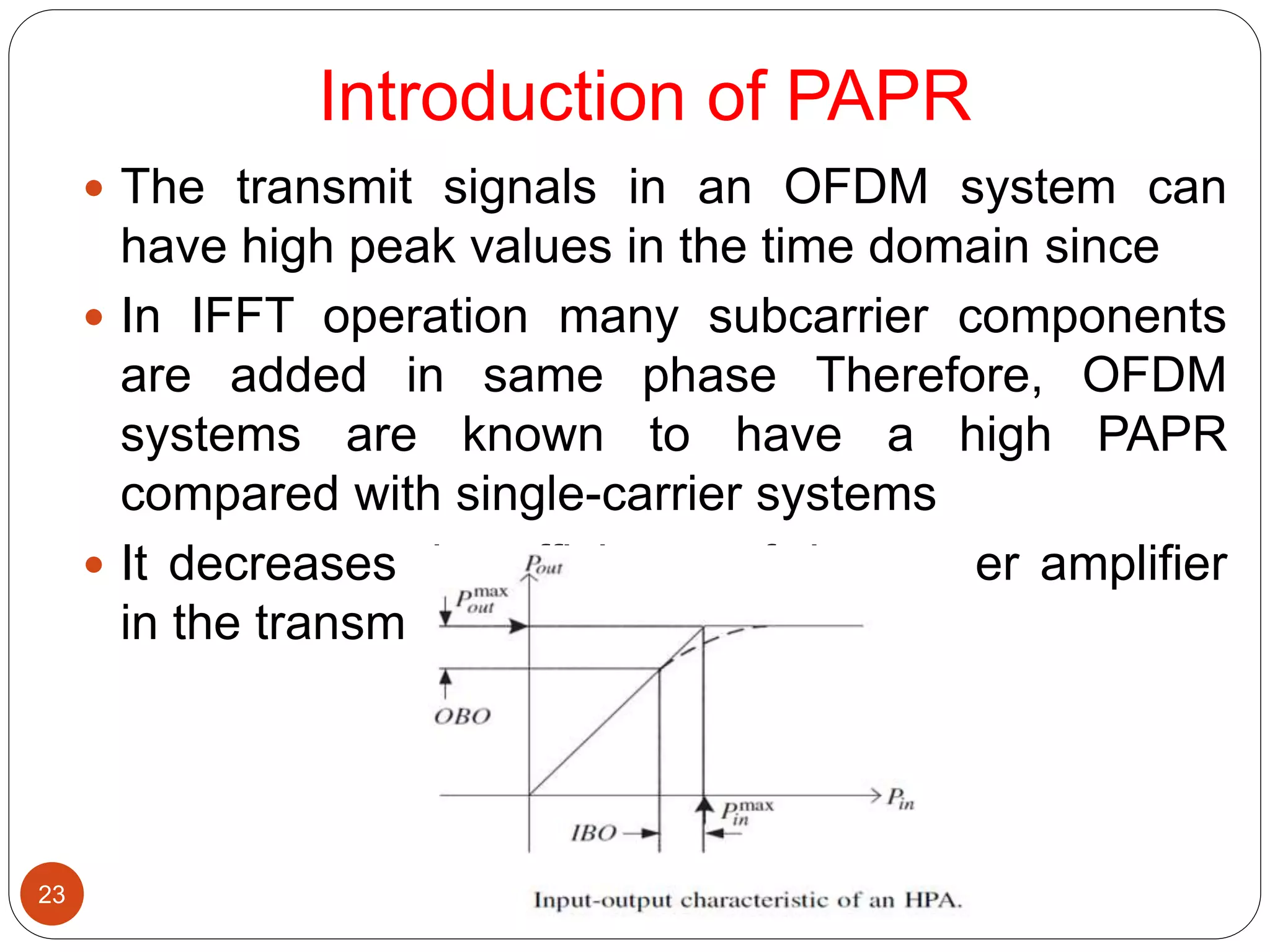
 The transmit signals in an OFDM system can
have high peak values in the time domain since
 In IFFT operation many subcarrier components
are added in same phase Therefore, OFDM
systems are known to have a high PAPR
compared with single-carrier systems
 It decreases the efficiency of the power amplifier
in the transmitter
PAPR Definition:
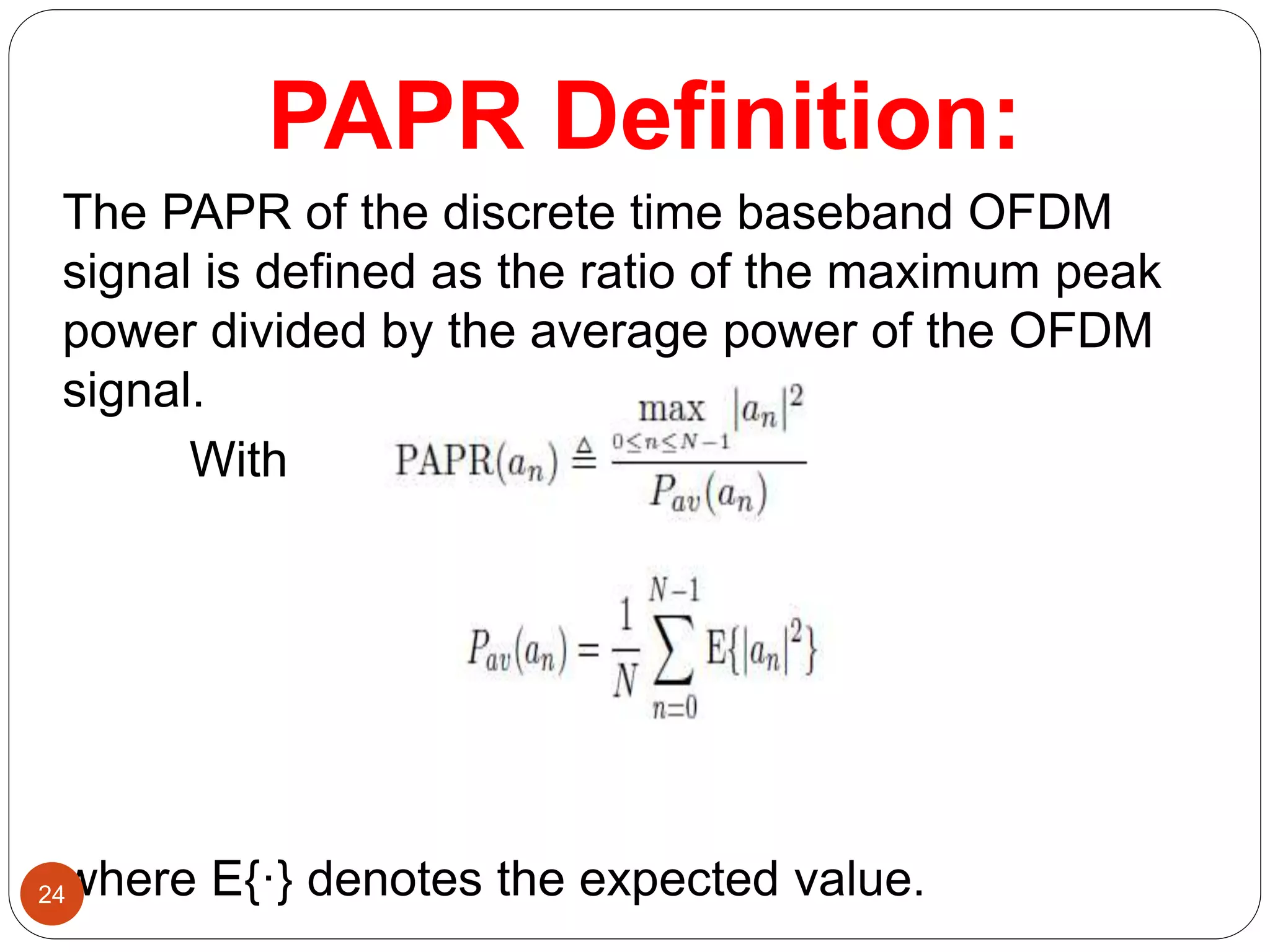
The PAPR of the discrete time baseband OFDM
signal is defined as the ratio of the maximum peak
power divided by the average power of the OFDM
signal.
With
where E{·} denotes the expected value.24
Distribution of PAPR in OFDM
System
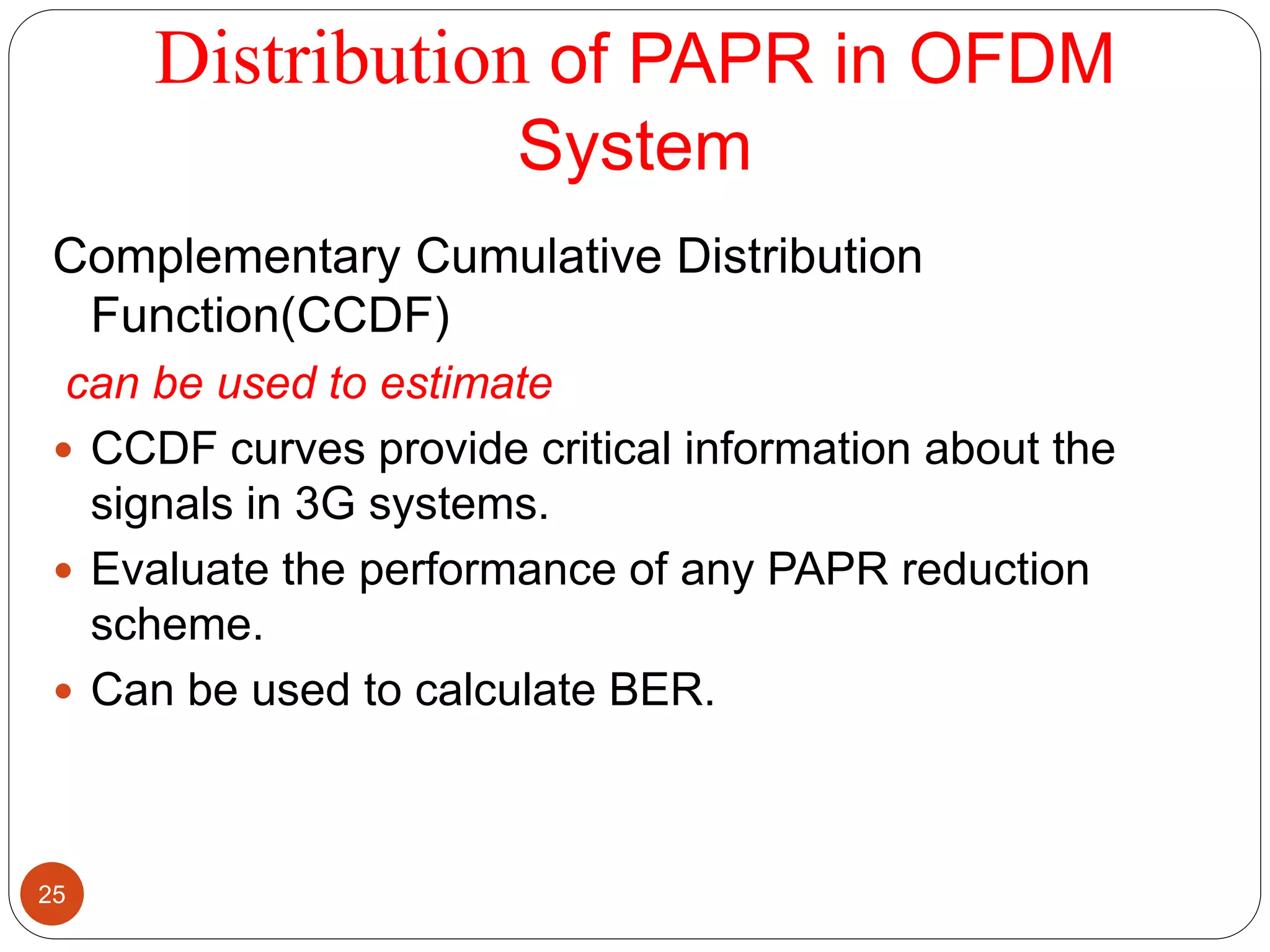
Complementary Cumulative Distribution
Function(CCDF)
can be used to estimate
 CCDF curves provide critical information about the
signals in 3G systems.
 Evaluate the performance of any PAPR reduction
scheme.
 Can be used to calculate BER.
25
What are CCDF curves?
26
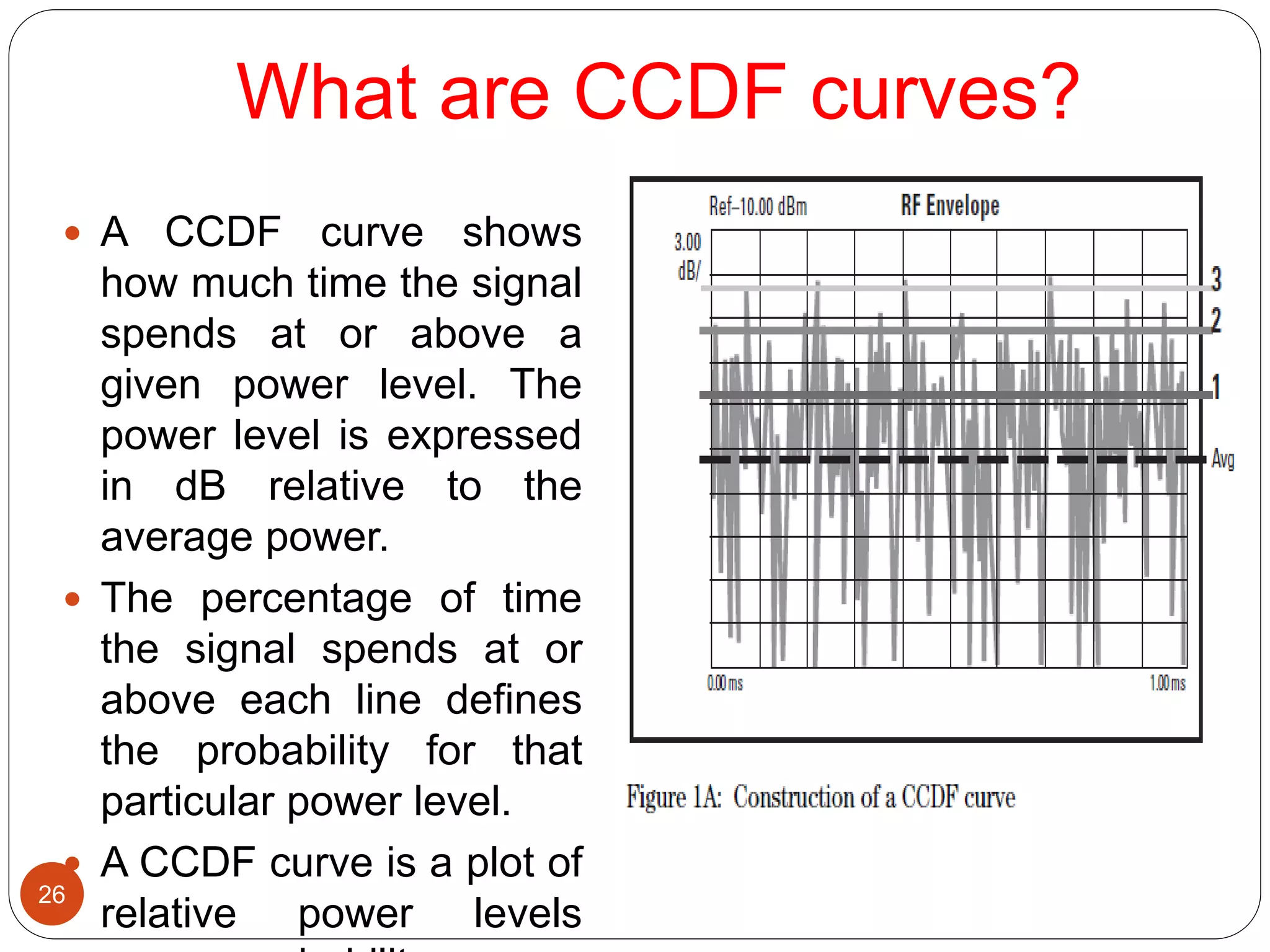
 A CCDF curve shows
how much time the signal
spends at or above a
given power level. The
power level is expressed
in dB relative to the
average power.
 The percentage of time
the signal spends at or
above each line defines
the probability for that
particular power level.
 A CCDF curve is a plot of
relative power levels
27
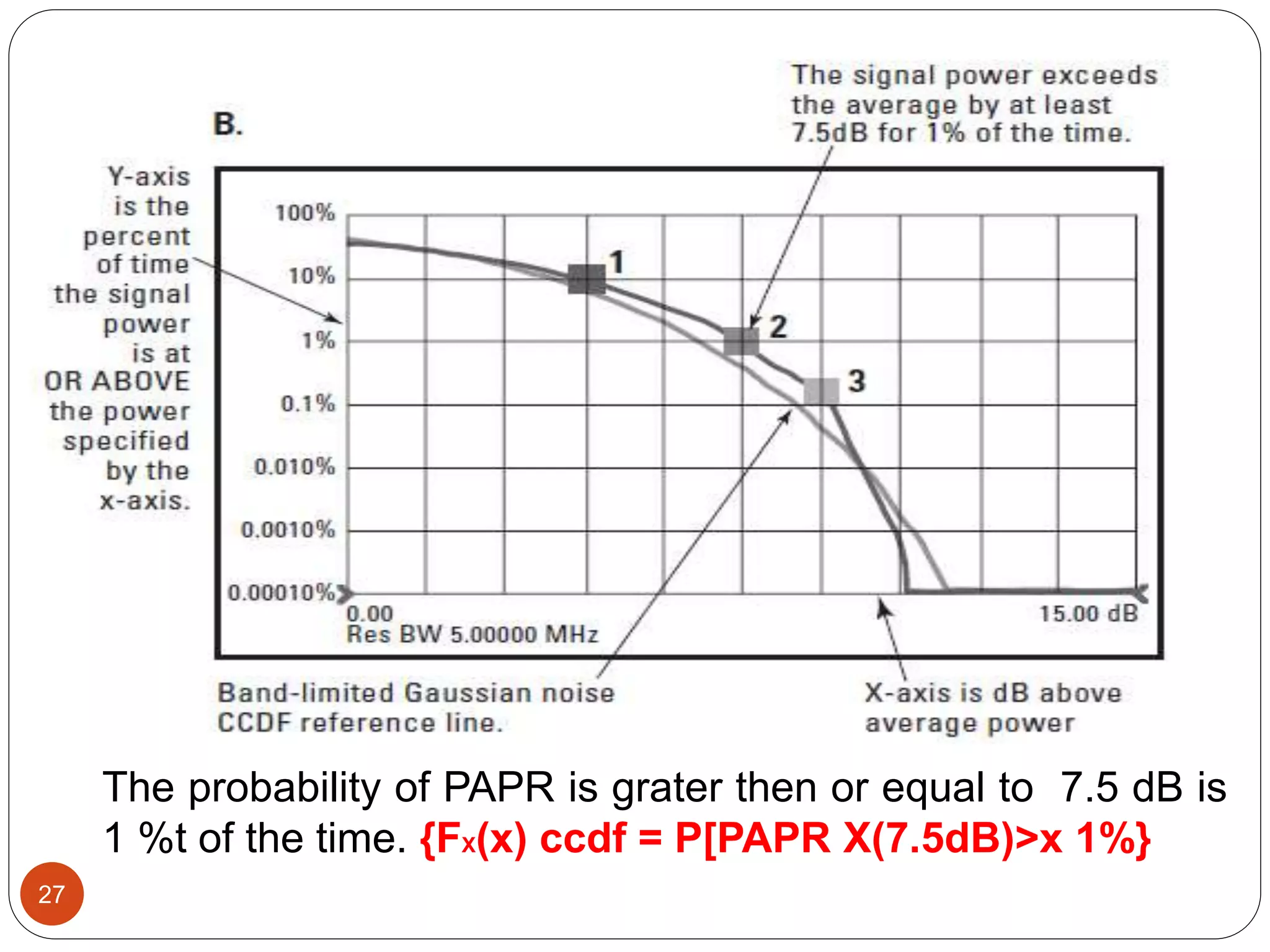
The probability of PAPR is grater then or equal to 7.5 dB is
1 %t of the time. {FX(x) ccdf = P[PAPR X(7.5dB)>x 1%}
28
29
 function [] = ccdf_log_plot(x)
 Th = 20*log10([0.1:0.1:10]);
 kk = 1;
 th_current = Th(1);
 rms = sqrt(mean((x.^2)));
 w = 20*log10(x/rms);
 z = sort(w);
 L = -inf*ones(1, length(Th));
 for ii = 1:(length(z)-1)
 if (z(ii) > th_current)
 L(kk) = ii - 1;
 kk = kk + 1;
 th_current = Th(kk);
 end
 end
 CCDF = (length(z) - L)/length(z);
 semilogy(Th, CCDF);
 grid on;
PAPR Reduction Techniques
PAPR reduction techniques are
classified into the different approaches
Clipping
Partial Transmission Sequence(PTS)
Selective Mapping(SLM)
30
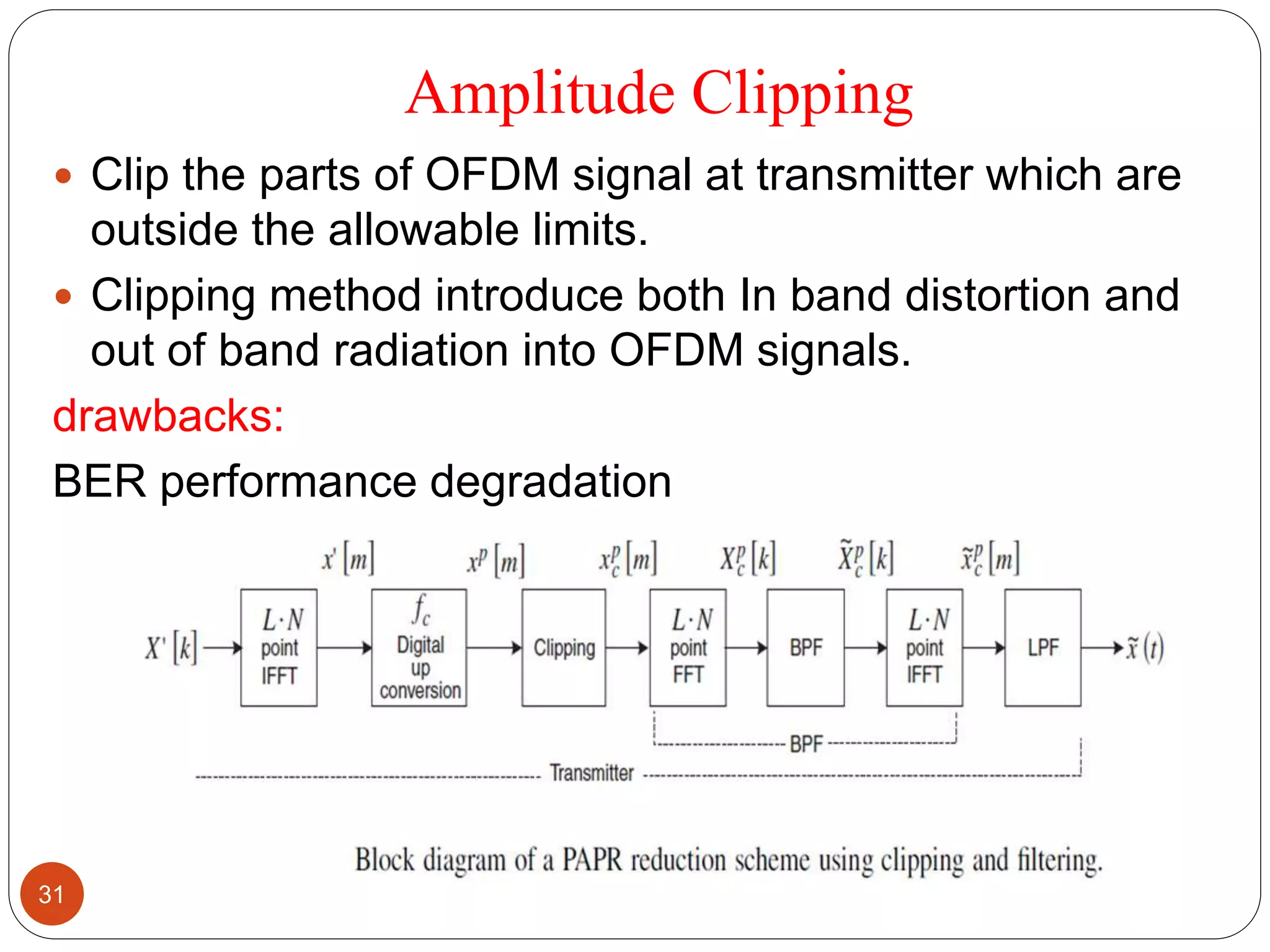
Amplitude Clipping
 Clip the parts of OFDM signal at transmitter which are
outside the allowable limits.
 Clipping method introduce both In band distortion and
out of band radiation into OFDM signals.
drawbacks:
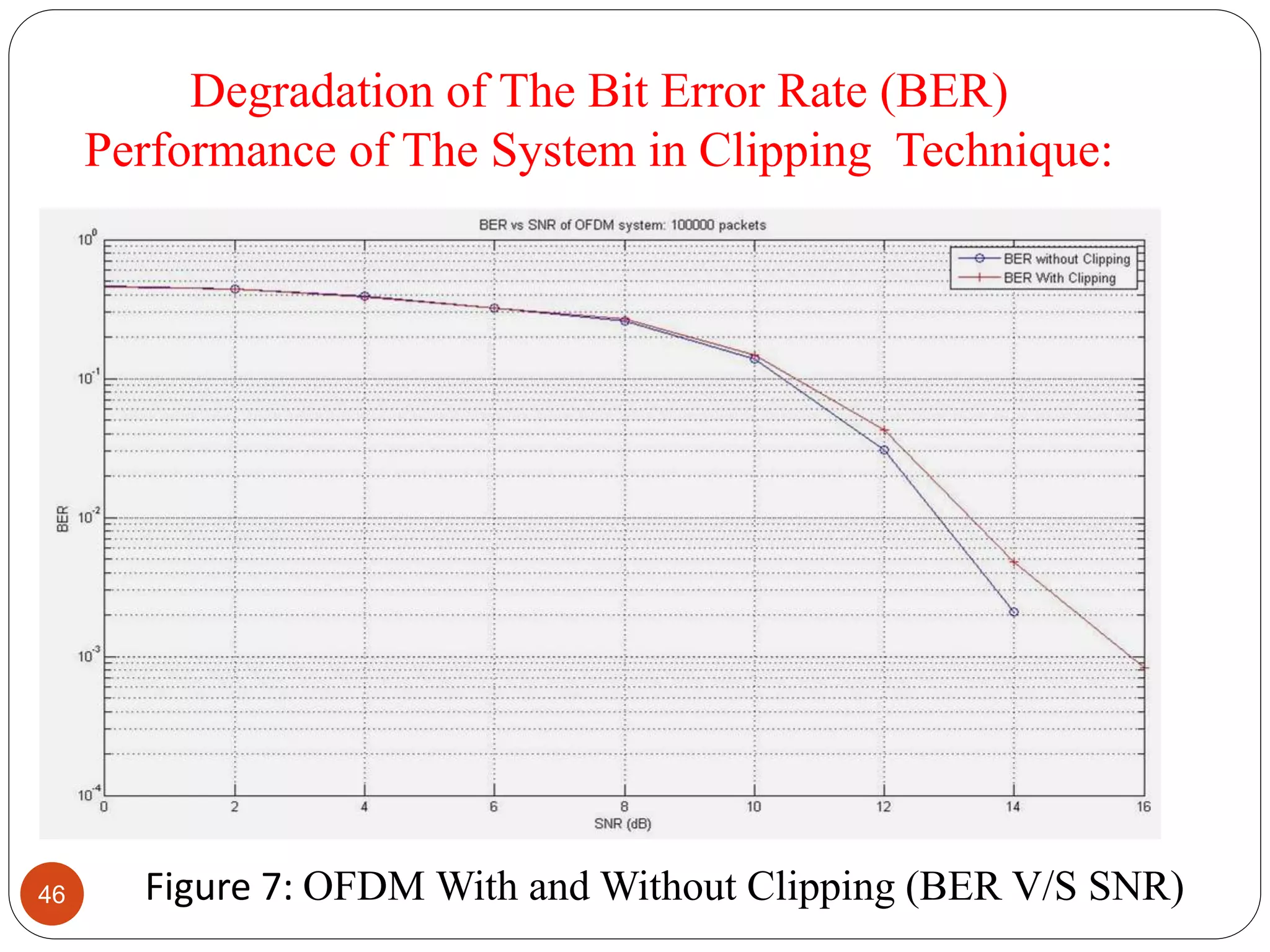
BER performance degradation
31
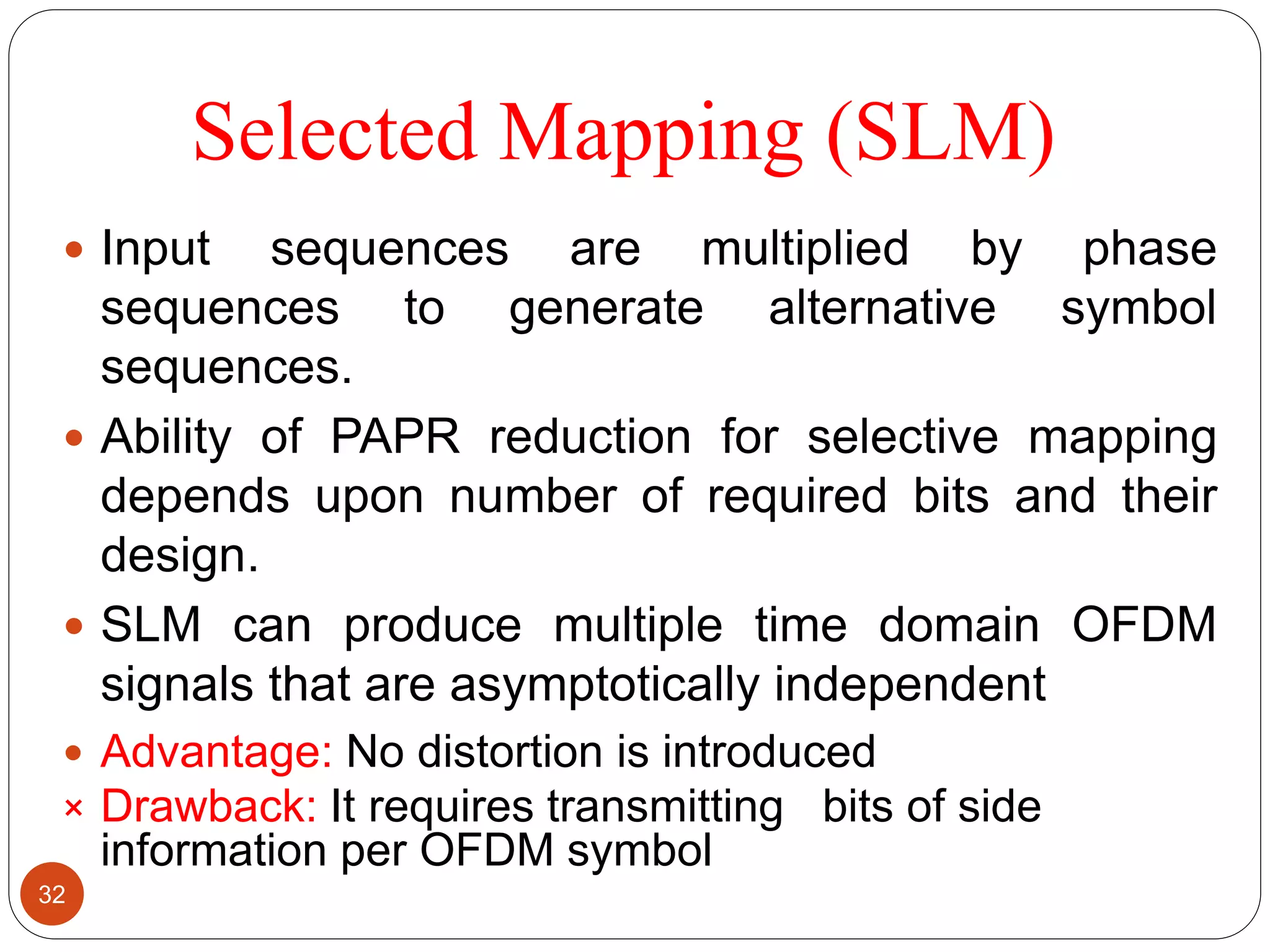
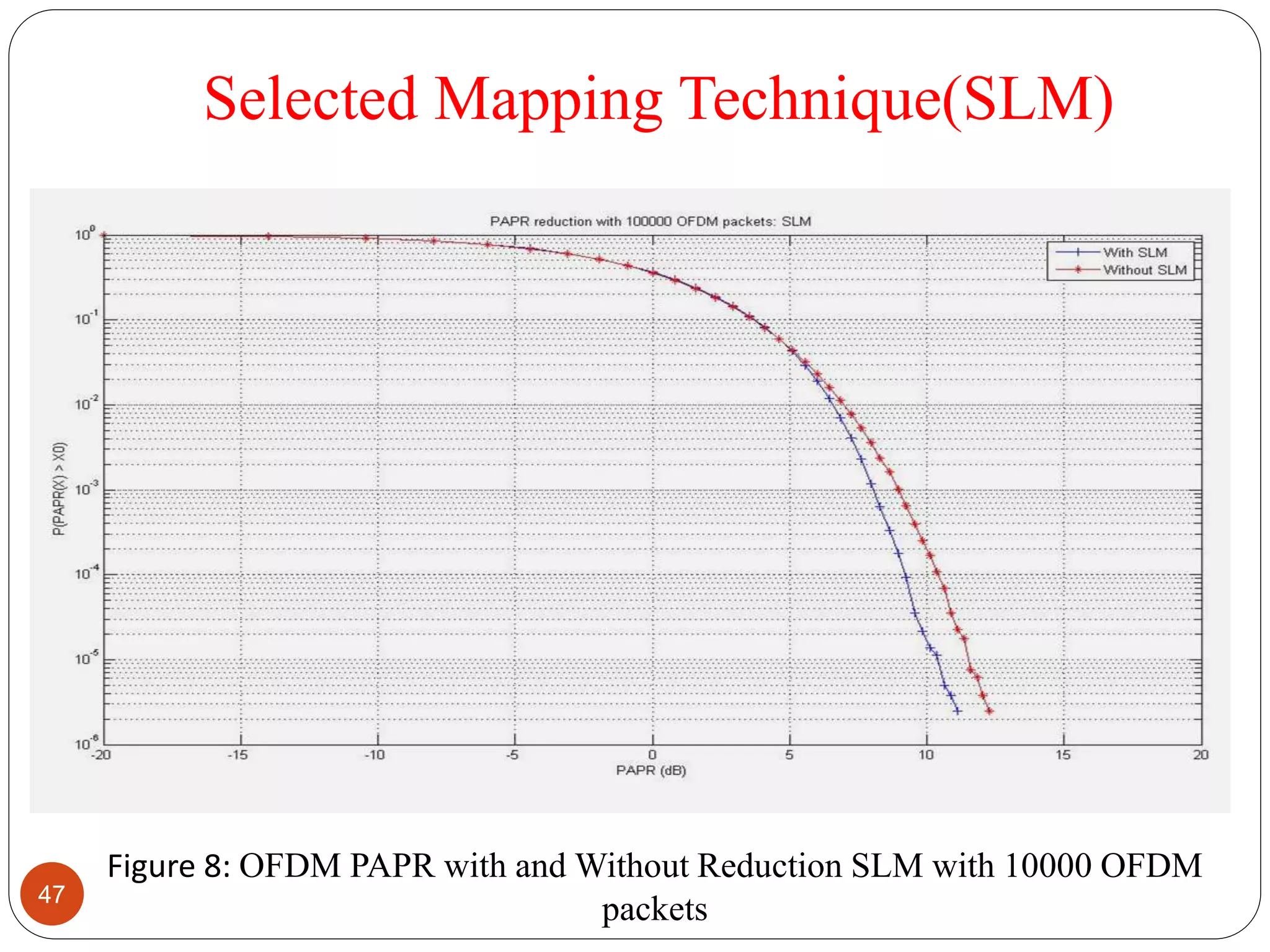
Selected Mapping (SLM)
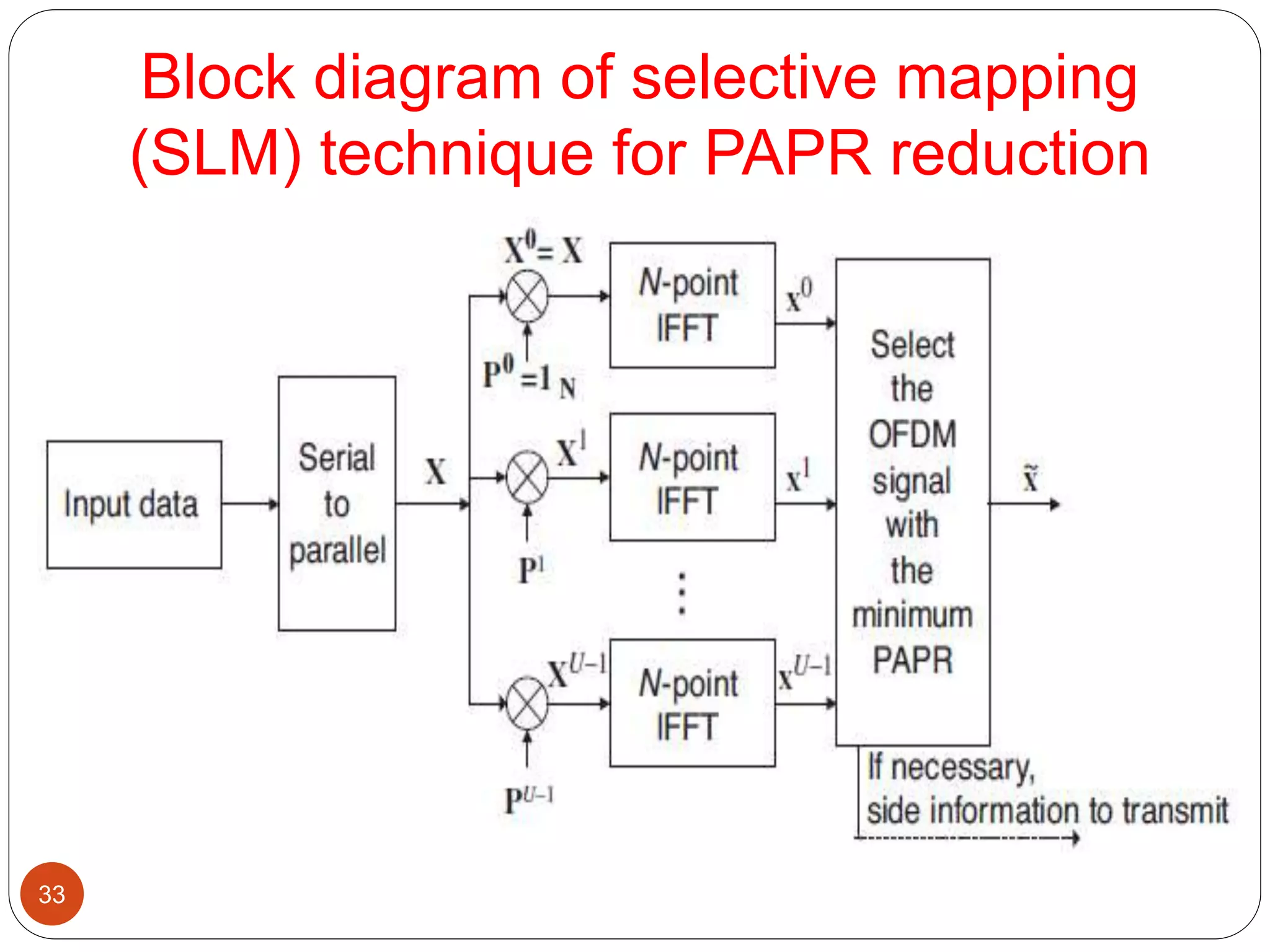
 Input sequences are multiplied by phase
sequences to generate alternative symbol
sequences.
 Ability of PAPR reduction for selective mapping
depends upon number of required bits and their
design.
 SLM can produce multiple time domain OFDM
signals that are asymptotically independent
 Advantage: No distortion is introduced
× Drawback: It requires transmitting bits of side
information per OFDM symbol
32
Block diagram of selective mapping
(SLM) technique for PAPR reduction
33
Partial Transmit Sequences
(PTS)
34
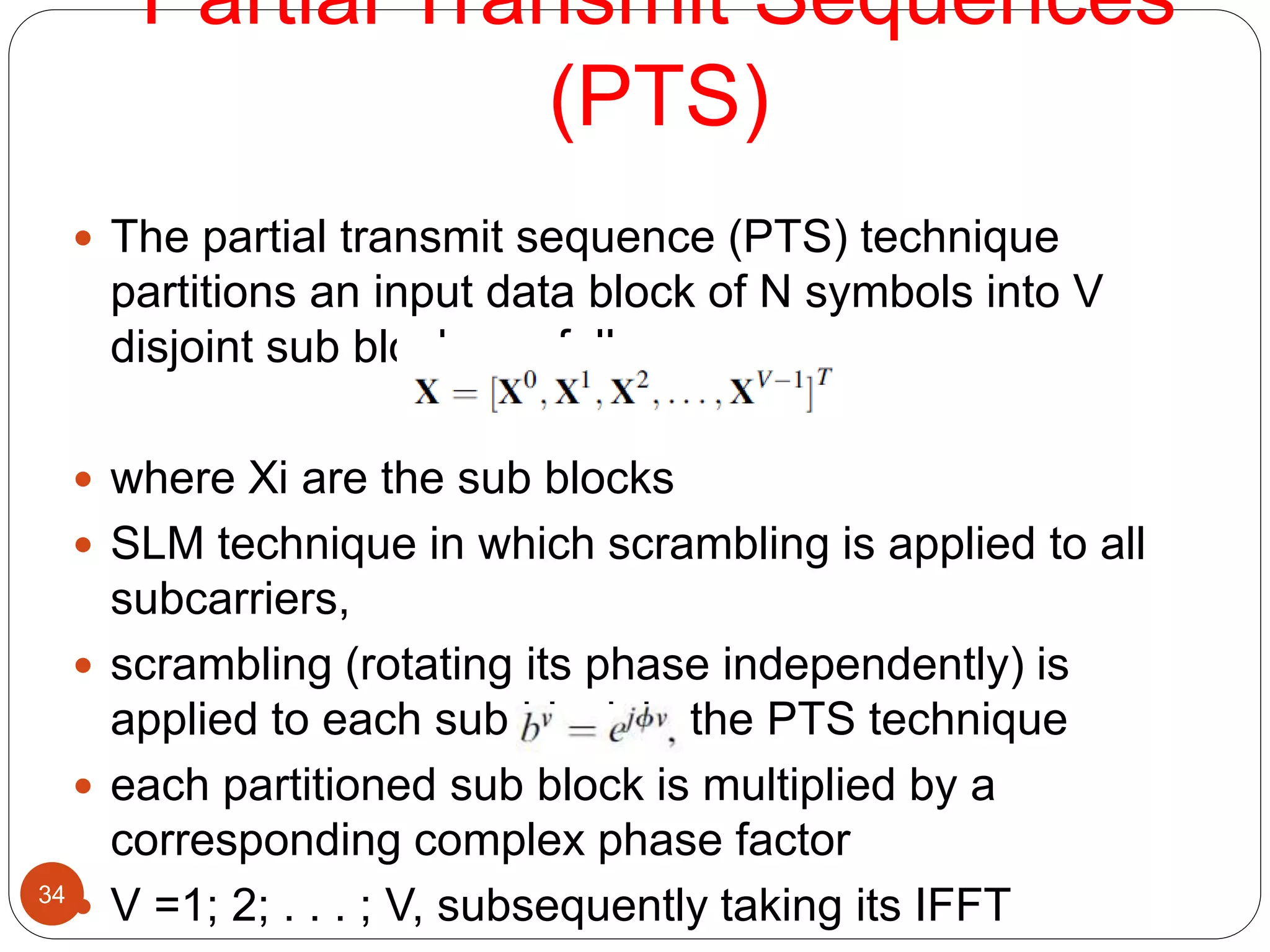
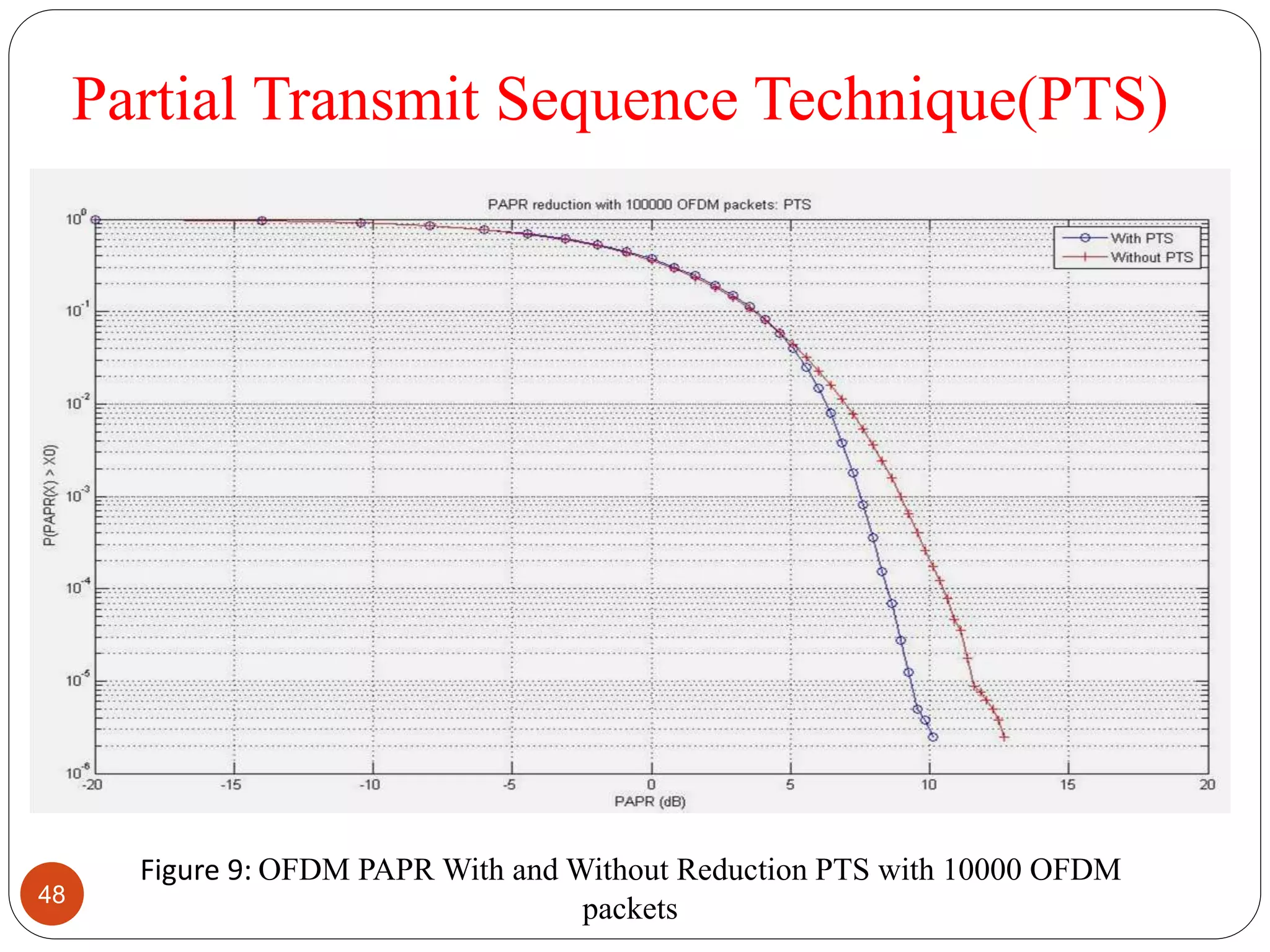
 The partial transmit sequence (PTS) technique
partitions an input data block of N symbols into V
disjoint sub blocks as follows:
 where Xi are the sub blocks
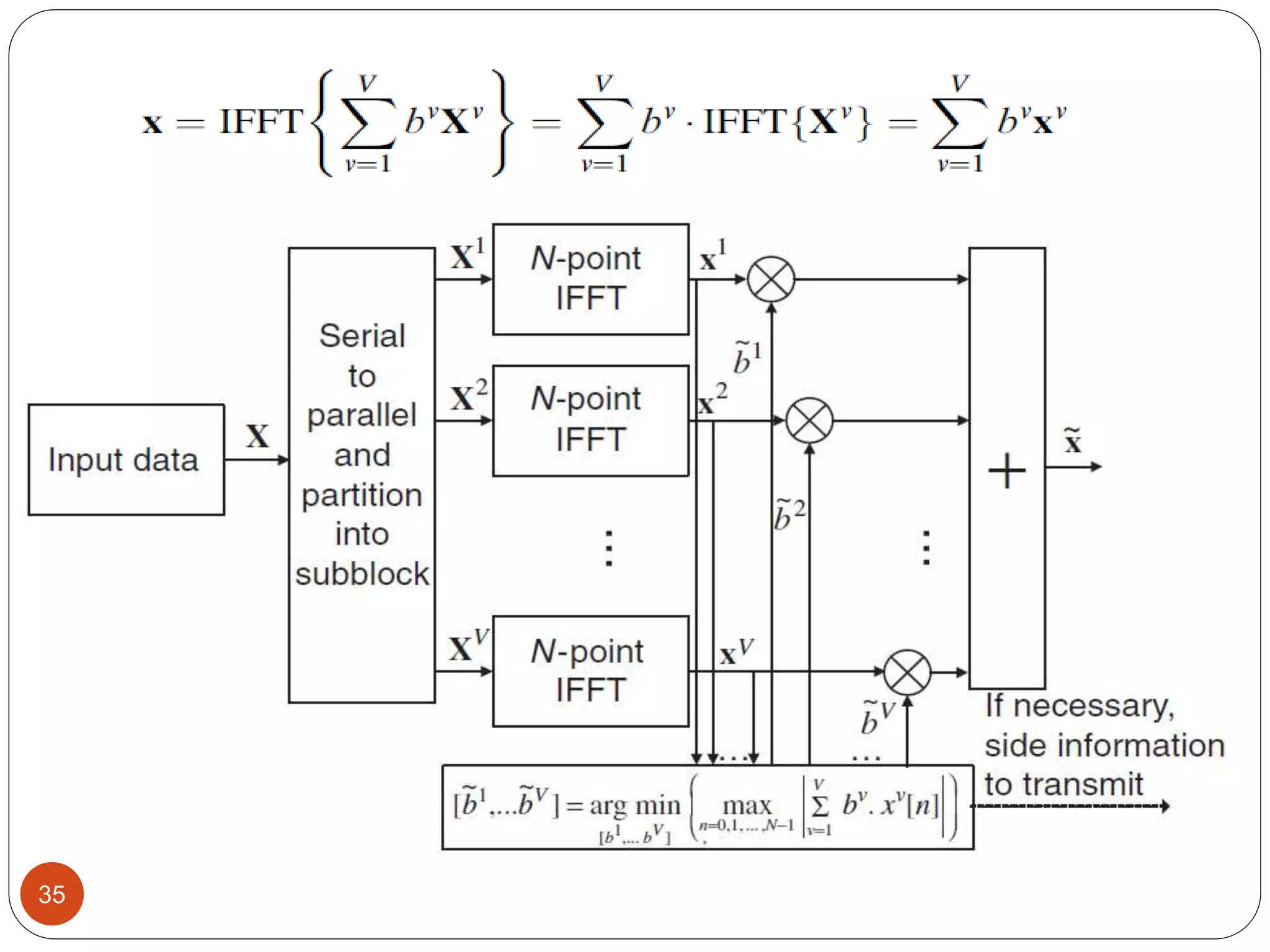
 SLM technique in which scrambling is applied to all
subcarriers,
 scrambling (rotating its phase independently) is
applied to each sub block in the PTS technique
 each partitioned sub block is multiplied by a
corresponding complex phase factor
 V =1; 2; . . . ; V, subsequently taking its IFFT
35
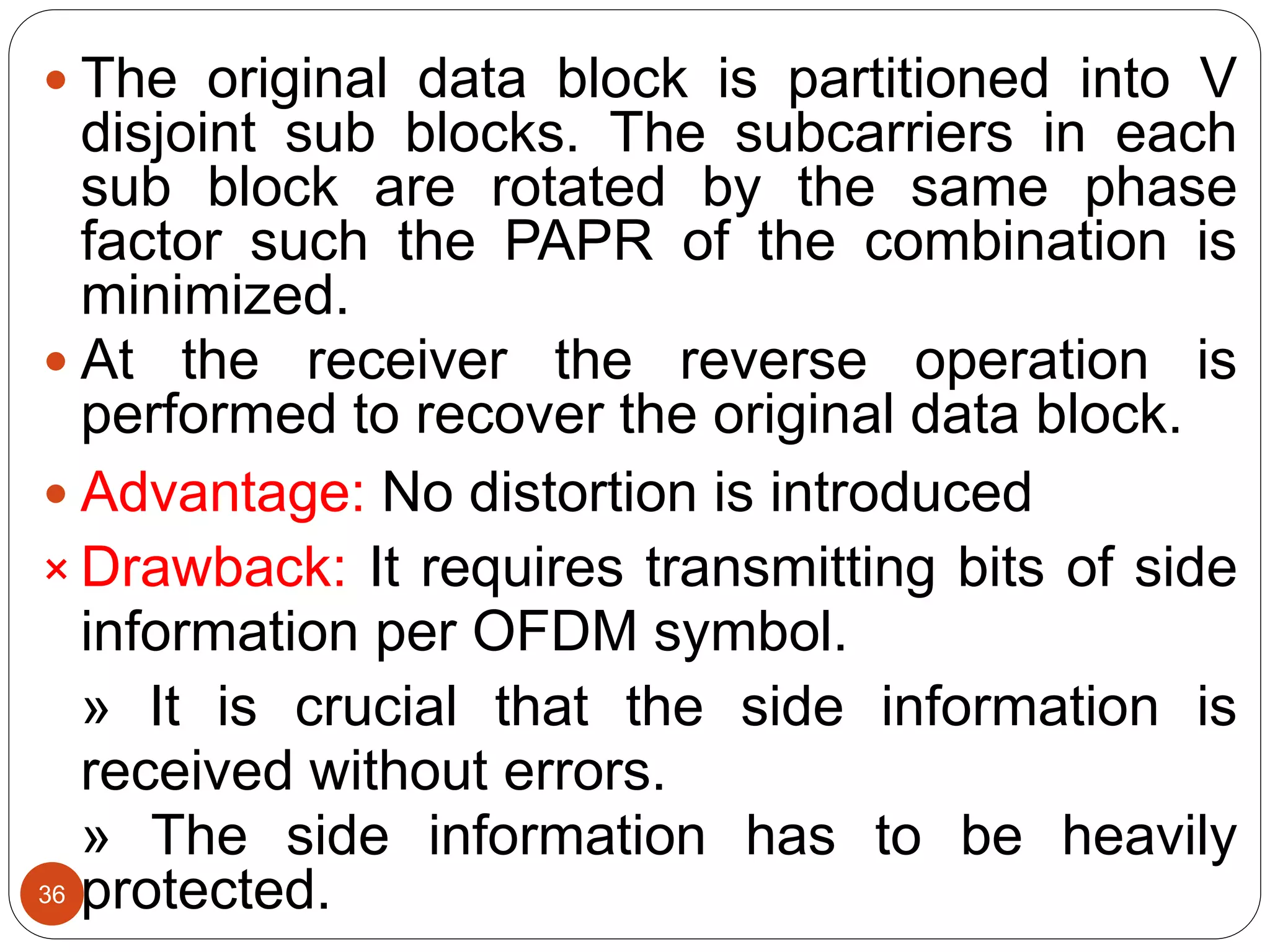
 The original data block is partitioned into V
disjoint sub blocks. The subcarriers in each
sub block are rotated by the same phase
factor such the PAPR of the combination is
minimized.
 At the receiver the reverse operation is
performed to recover the original data block.
 Advantage: No distortion is introduced
× Drawback: It requires transmitting bits of side
information per OFDM symbol.
» It is crucial that the side information is
received without errors.
» The side information has to be heavily
protected.36
37
SIMULATION
RESULTS
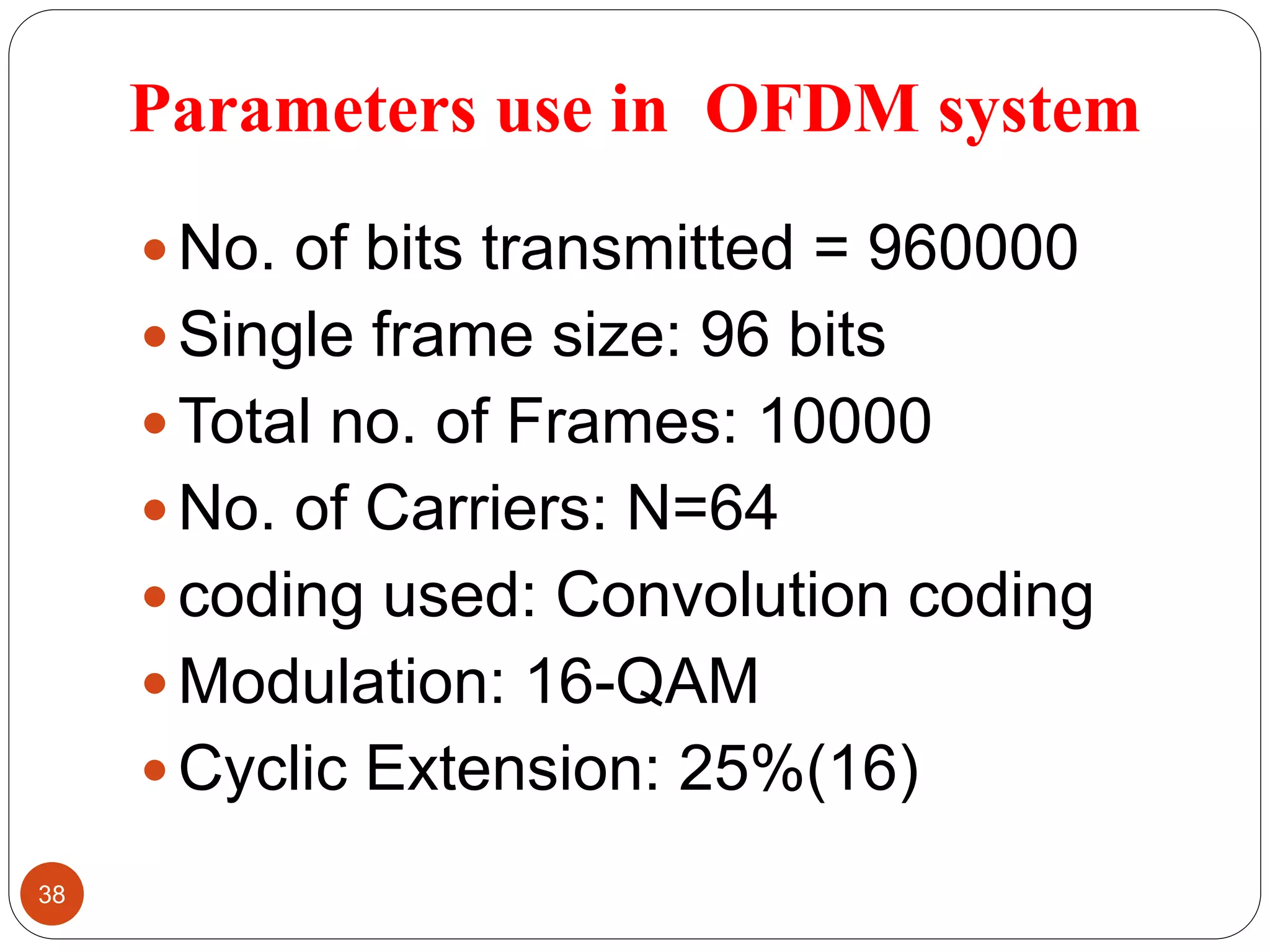
Parameters use in OFDM system
 No. of bits transmitted = 960000
 Single frame size: 96 bits
 Total no. of Frames: 10000
 No. of Carriers: N=64
 coding used: Convolution coding
 Modulation: 16-QAM
 Cyclic Extension: 25%(16)
38
39
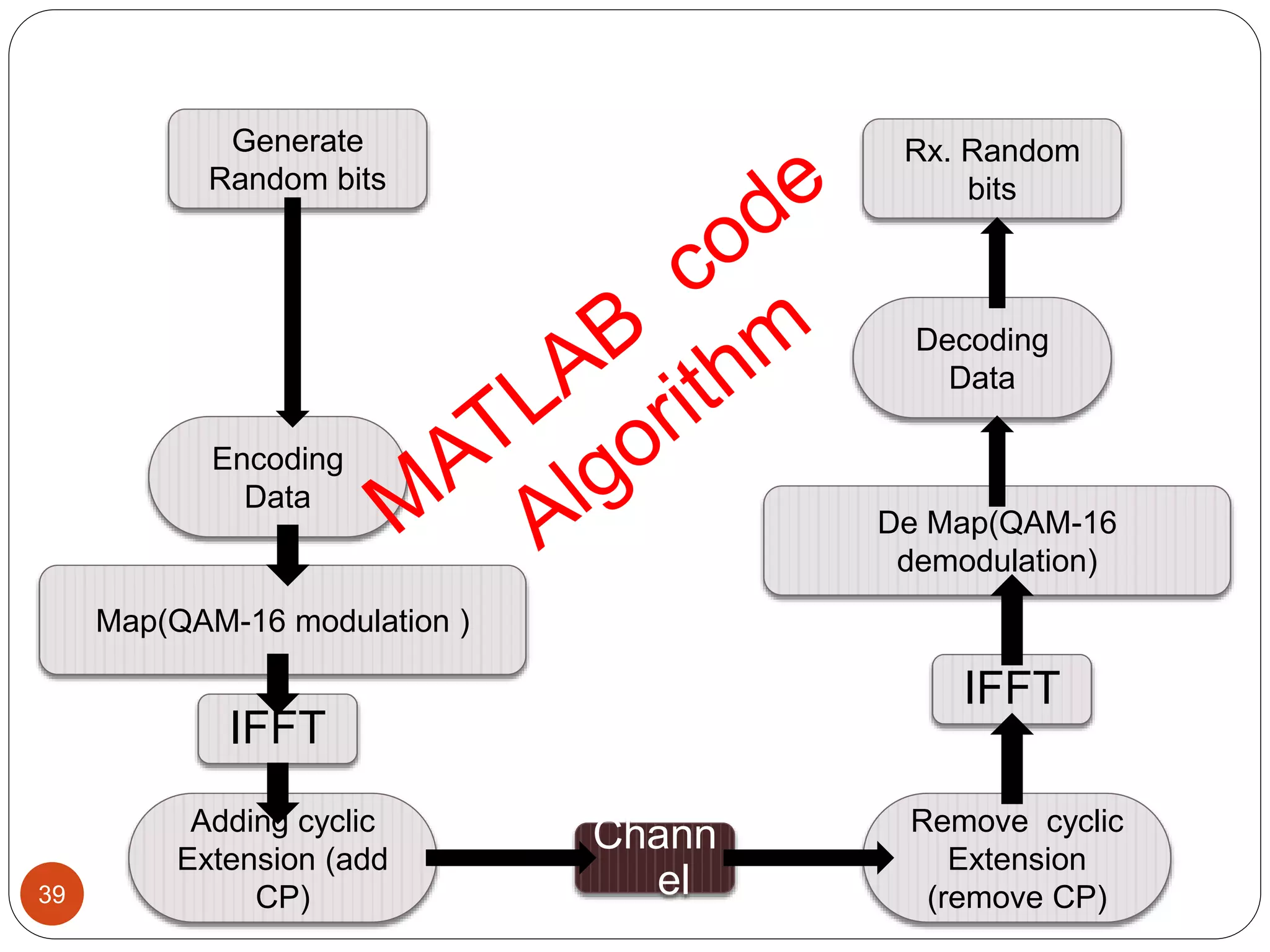
Generate
Random bits
Map(QAM-16 modulation )
Encoding
Data
IFFT
Adding cyclic
Extension (add
CP)
Chann
el
IFFT
Remove cyclic
Extension
(remove CP)
De Map(QAM-16
demodulation)
Decoding
Data
Rx. Random
bits
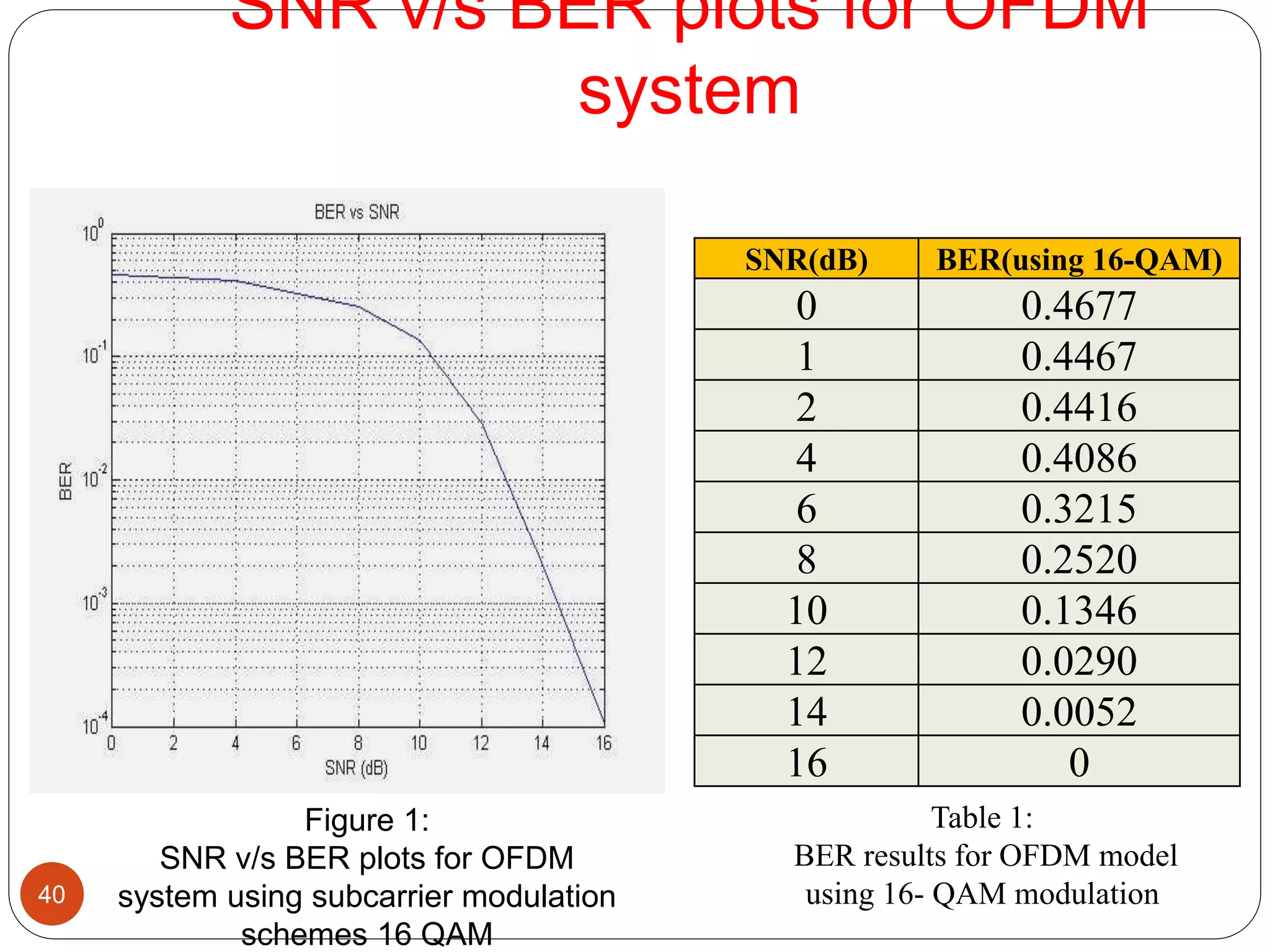
SNR(dB) BER(using 16-QAM)
0 0.4677
1 0.4467
2 0.4416
4 0.4086
6 0.3215
8 0.2520
10 0.1346
12 0.0290
14 0.0052
16 0
Table 1:
BER results for OFDM model
using 16- QAM modulation40
Figure 1:
SNR v/s BER plots for OFDM
system using subcarrier modulation
schemes 16 QAM
SNR v/s BER plots for OFDM
system
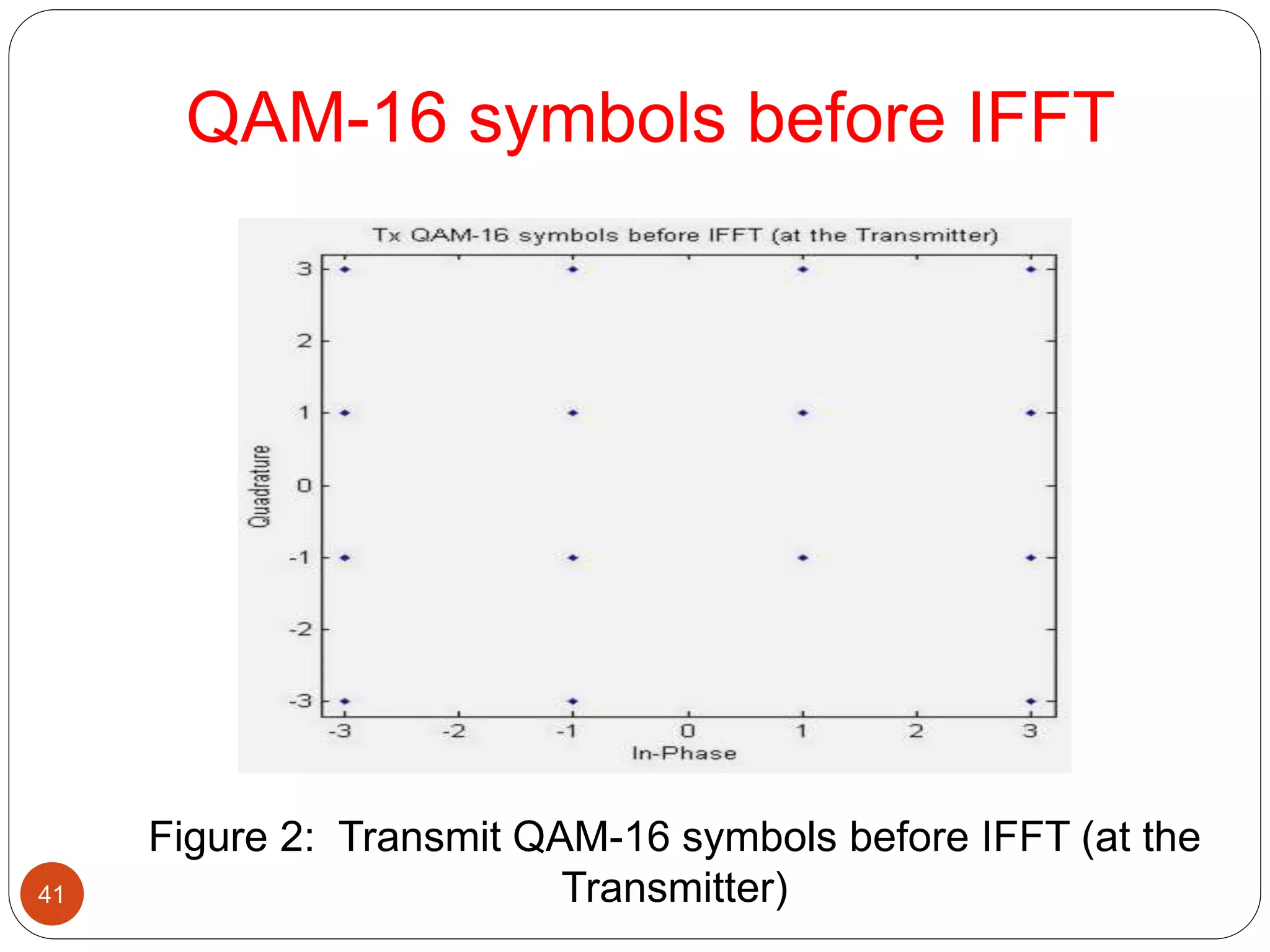
QAM-16 symbols before IFFT
Figure 2: Transmit QAM-16 symbols before IFFT (at the
Transmitter)41
42
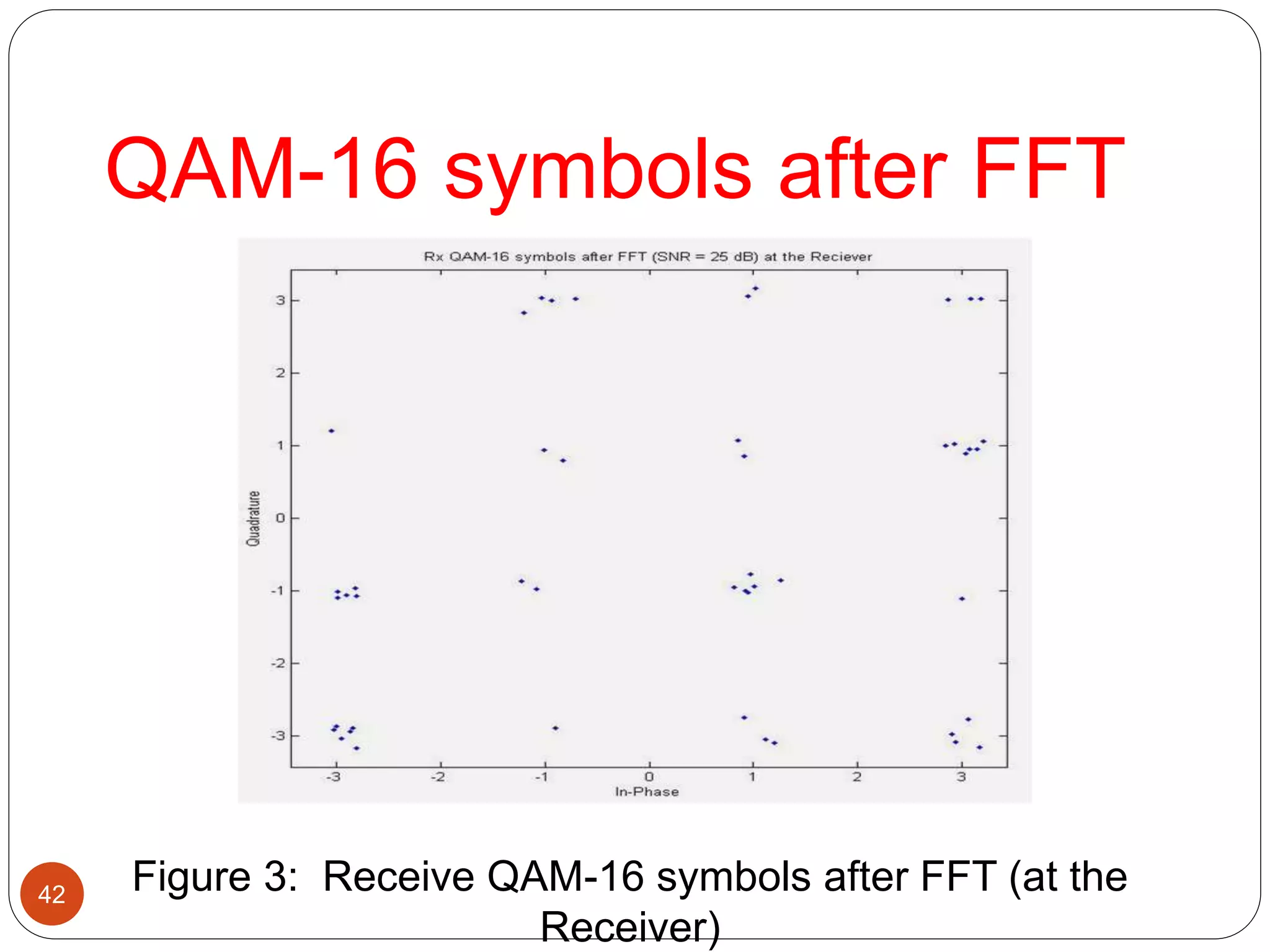
Figure 3: Receive QAM-16 symbols after FFT (at the
Receiver)
QAM-16 symbols after FFT
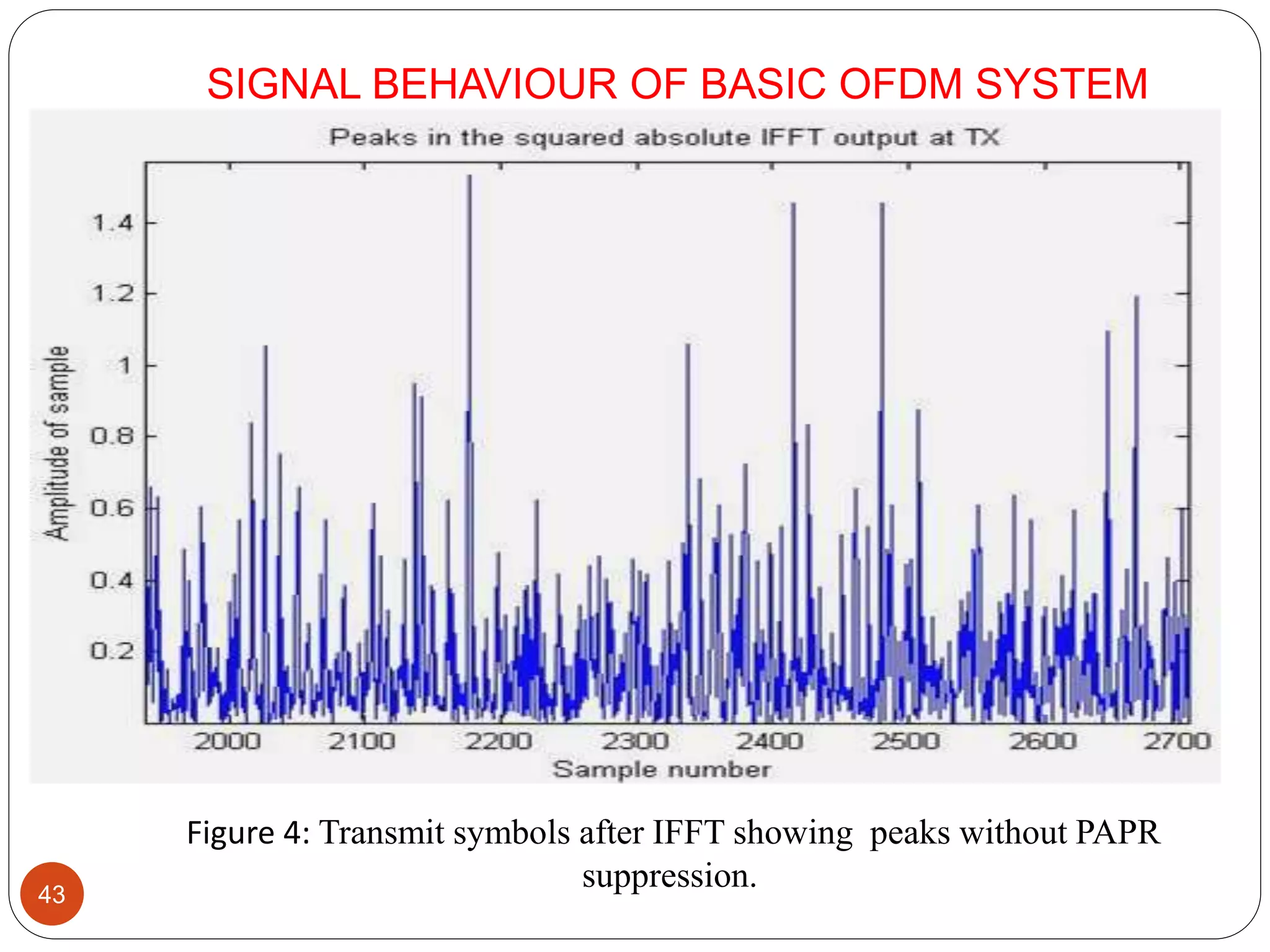
Figure 4: Transmit symbols after IFFT showing peaks without PAPR
suppression.43
SIGNAL BEHAVIOUR OF BASIC OFDM SYSTEM
44
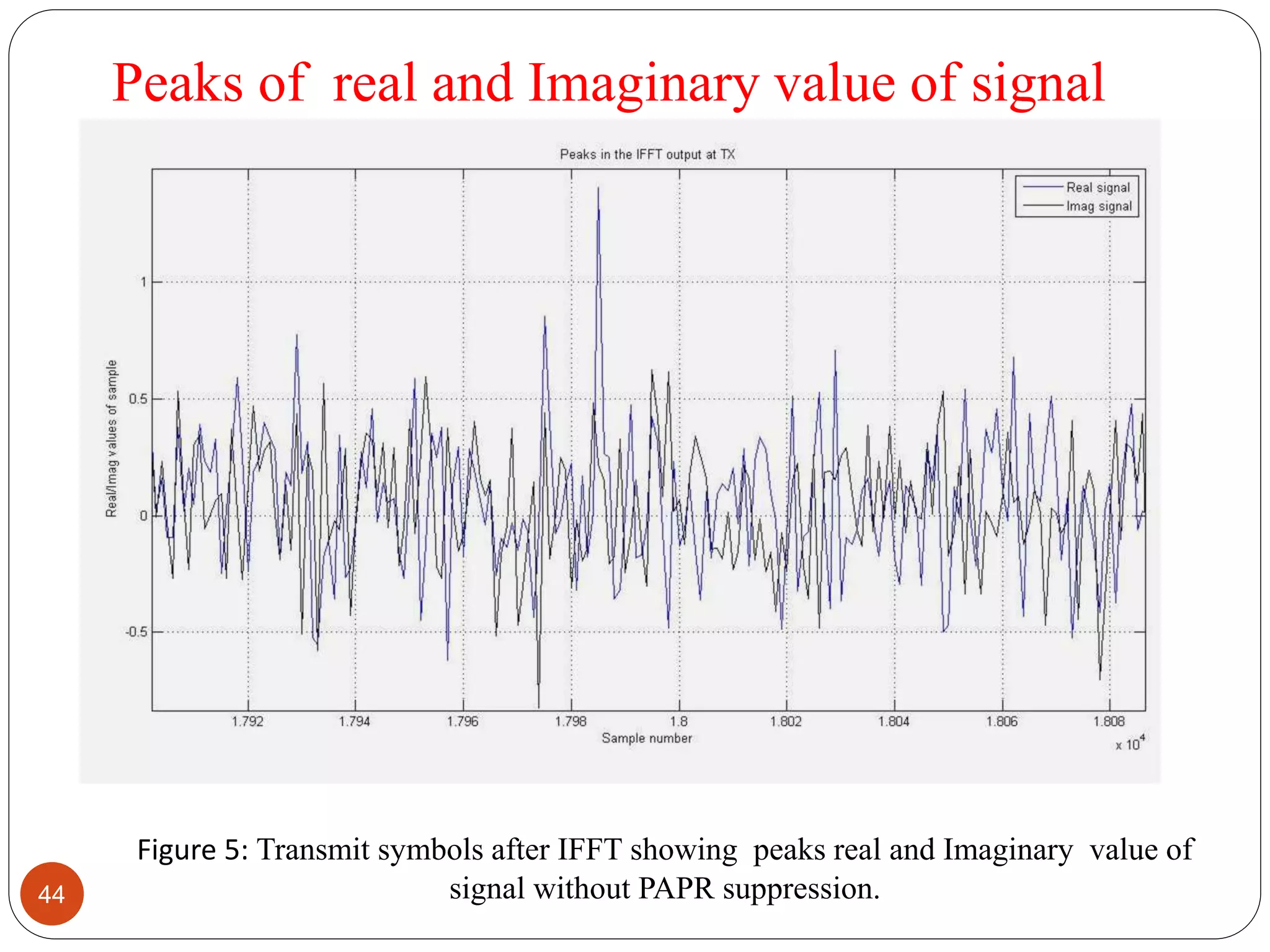
Figure 5: Transmit symbols after IFFT showing peaks real and Imaginary value of
signal without PAPR suppression.
Peaks of real and Imaginary value of signal
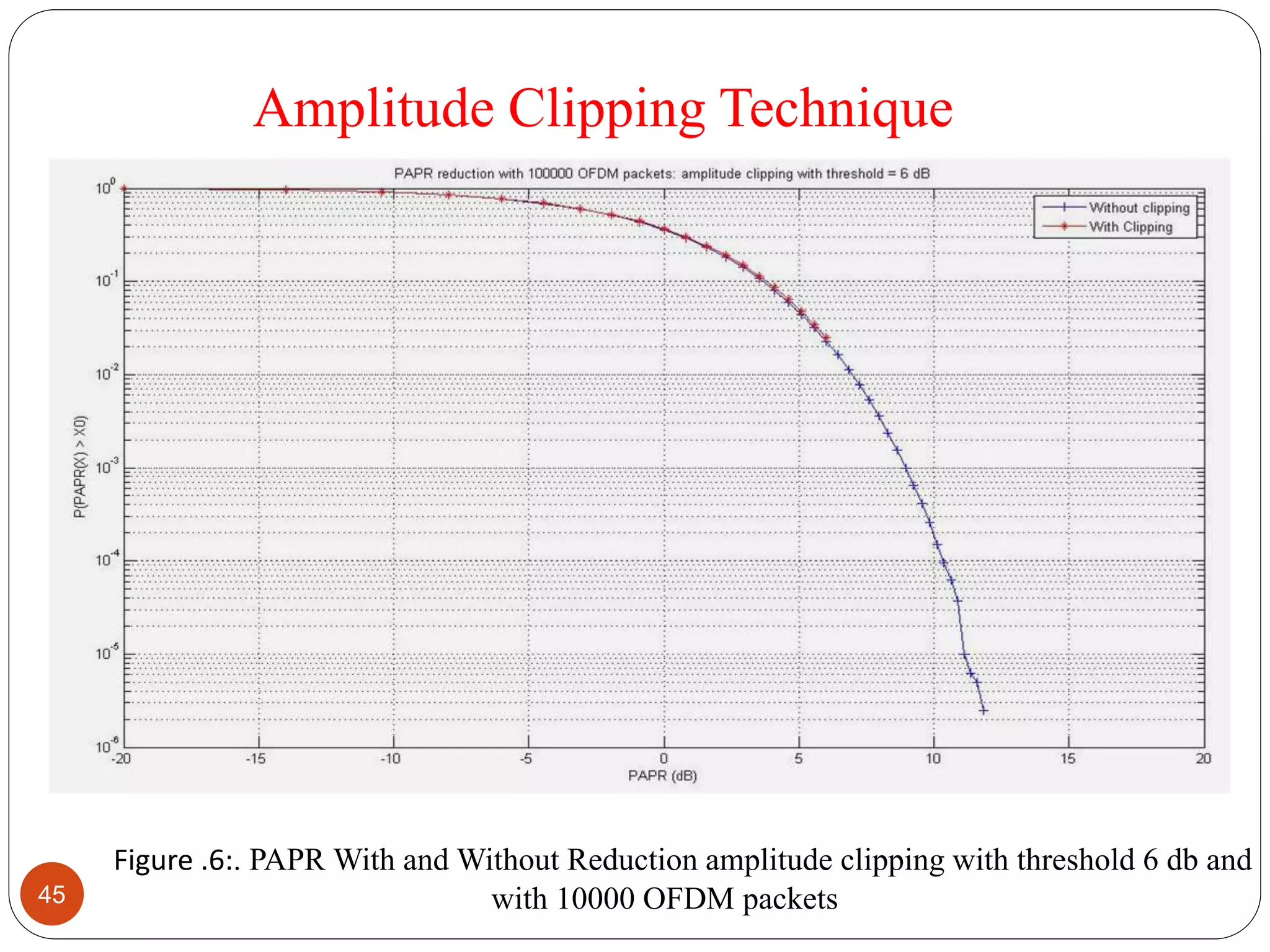
Amplitude Clipping Technique
Figure .6:. PAPR With and Without Reduction amplitude clipping with threshold 6 db and
with 10000 OFDM packets45
Degradation of The Bit Error Rate (BER)
Performance of The System in Clipping Technique:
Figure 7: OFDM With and Without Clipping (BER V/S SNR)46
Selected Mapping Technique(SLM)
Figure 8: OFDM PAPR with and Without Reduction SLM with 10000 OFDM
packets47
Partial Transmit Sequence Technique(PTS)
Figure 9: OFDM PAPR With and Without Reduction PTS with 10000 OFDM
packets48
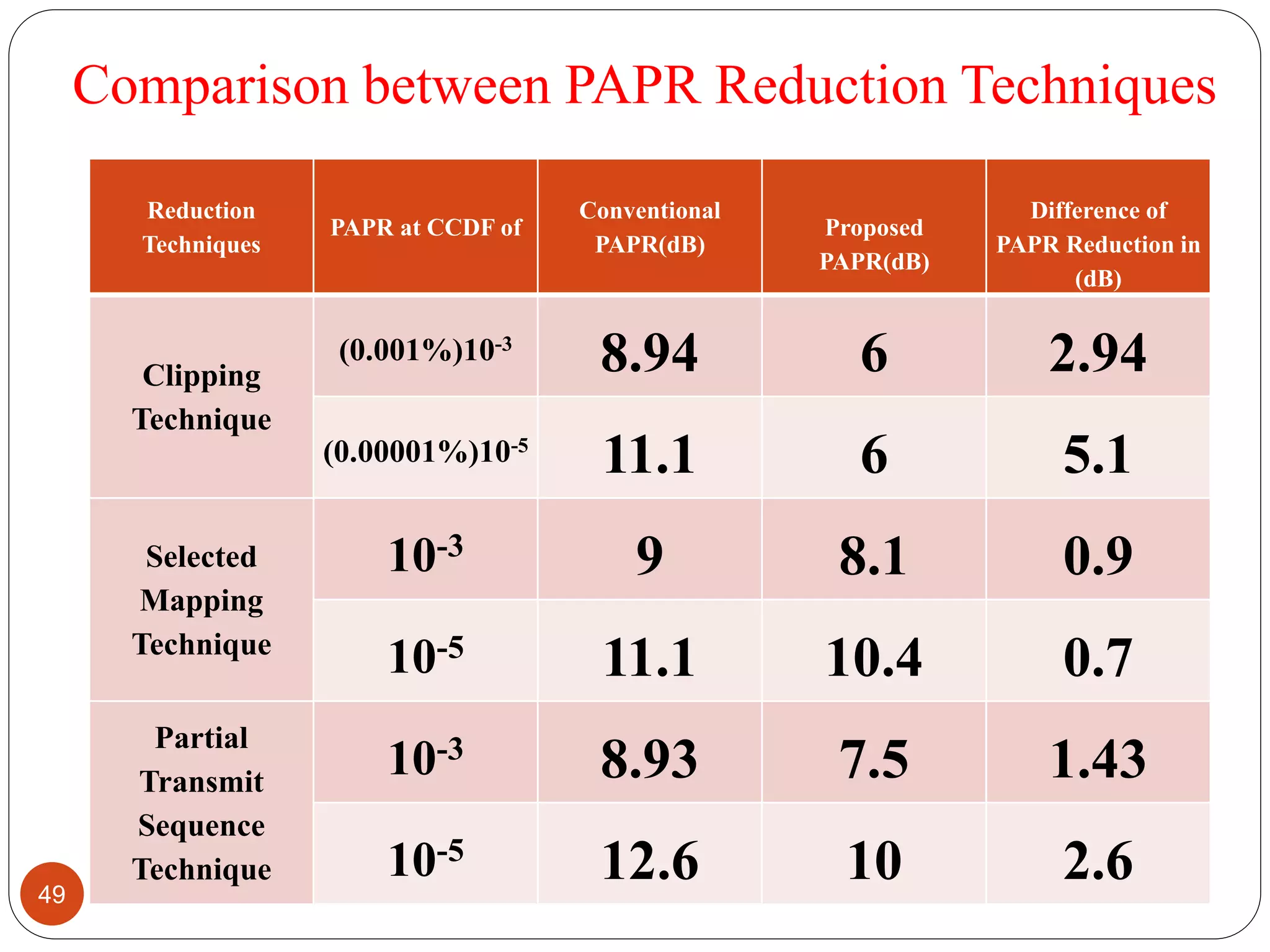
Comparison between PAPR Reduction Techniques
Reduction
Techniques
PAPR at CCDF of
Conventional
PAPR(dB)
Proposed
PAPR(dB)
Difference of
PAPR Reduction in
(dB)
Clipping
Technique
(0.001%)10-3
8.94 6 2.94
(0.00001%)10-5
11.1 6 5.1
Selected
Mapping
Technique
10-3
9 8.1 0.9
10-5
11.1 10.4 0.7
Partial
Transmit
Sequence
Technique
10-3
8.93 7.5 1.43
10-5
12.6 10 2.649
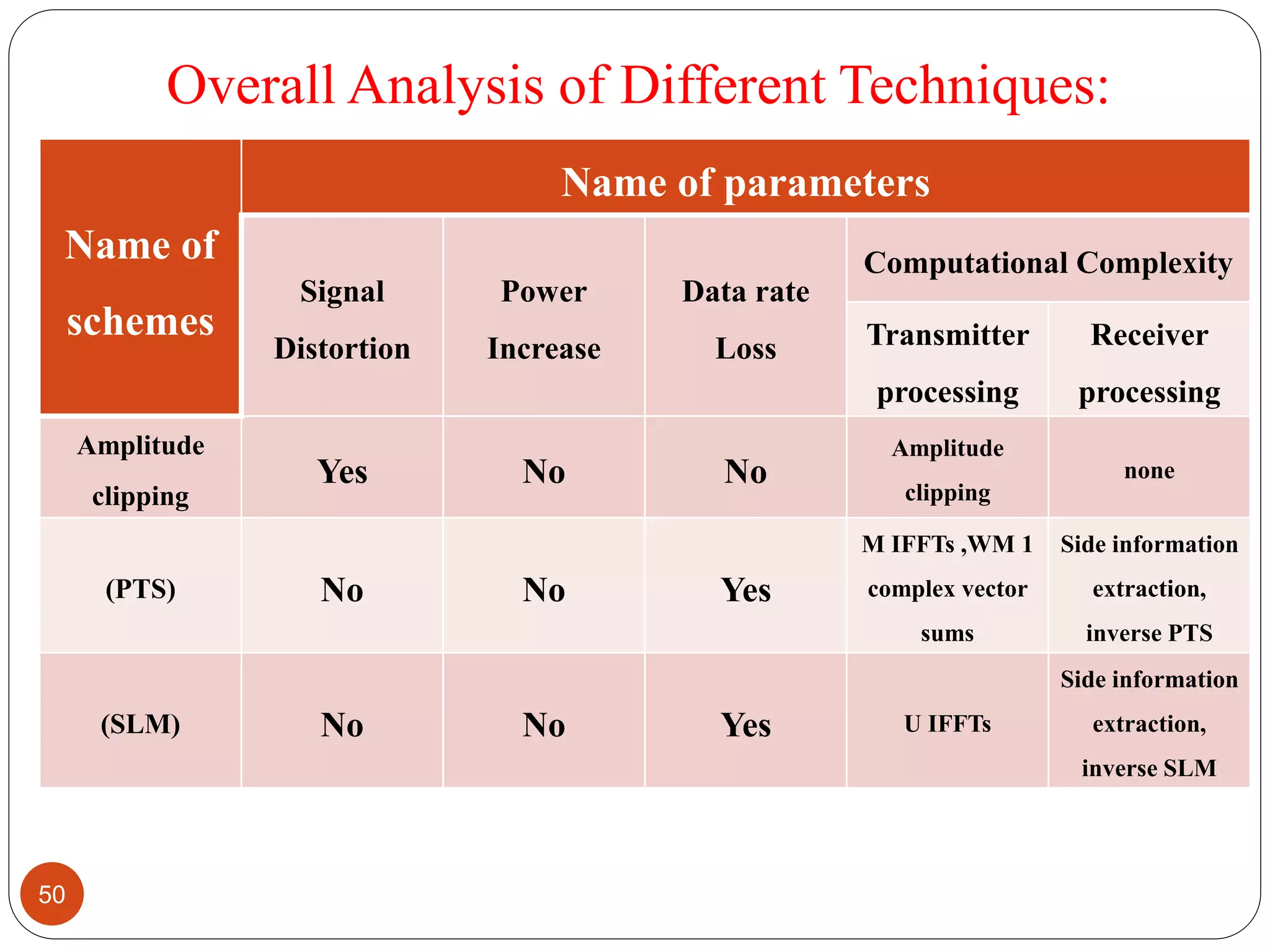
Overall Analysis of Different Techniques:
Name of
schemes
Name of parameters
Signal
Distortion
Power
Increase
Data rate
Loss
Computational Complexity
Transmitter
processing
Receiver
processing
Amplitude
clipping
Yes No No
Amplitude
clipping
none
(PTS) No No Yes
M IFFTs ,WM 1
complex vector
sums
Side information
extraction,
inverse PTS
(SLM) No No Yes U IFFTs
Side information
extraction,
inverse SLM
50
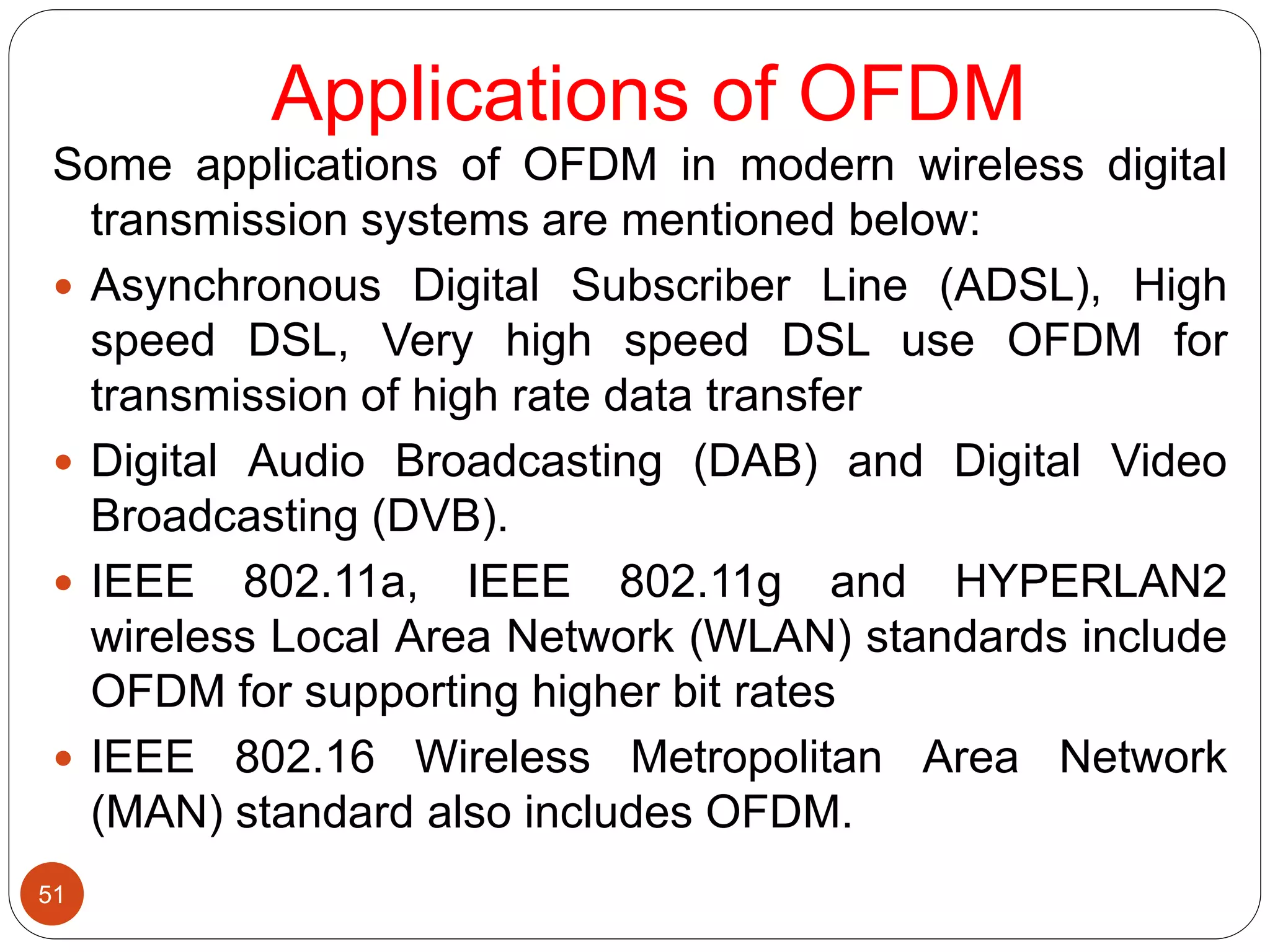
Applications of OFDM
51
Some applications of OFDM in modern wireless digital
transmission systems are mentioned below:
 Asynchronous Digital Subscriber Line (ADSL), High
speed DSL, Very high speed DSL use OFDM for
transmission of high rate data transfer
 Digital Audio Broadcasting (DAB) and Digital Video
Broadcasting (DVB).
 IEEE 802.11a, IEEE 802.11g and HYPERLAN2
wireless Local Area Network (WLAN) standards include
OFDM for supporting higher bit rates
 IEEE 802.16 Wireless Metropolitan Area Network
(MAN) standard also includes OFDM.
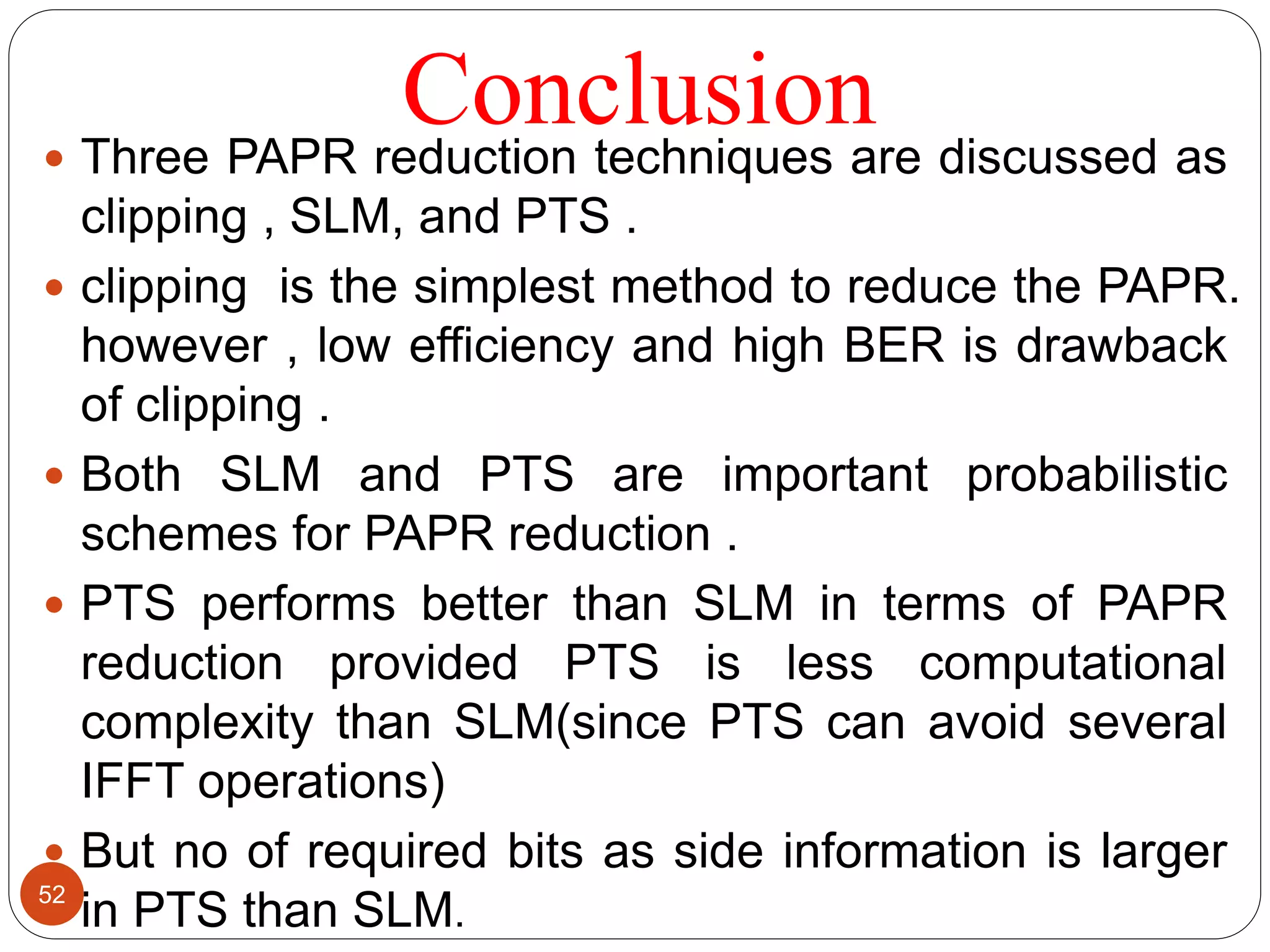
Conclusion Three PAPR reduction techniques are discussed as
clipping , SLM, and PTS .
 clipping is the simplest method to reduce the PAPR.
however , low efficiency and high BER is drawback
of clipping .
 Both SLM and PTS are important probabilistic
schemes for PAPR reduction .
 PTS performs better than SLM in terms of PAPR
reduction provided PTS is less computational
complexity than SLM(since PTS can avoid several
IFFT operations)
 But no of required bits as side information is larger
in PTS than SLM.
52
References
1. Y.Wu and W. Y. Zou, “Orthogonal frequency division multiplexing: A multi-carrier
modulation scheme,” IEEE Trans. Consumer Electronics, vol. 41, no. 3, pp.
392–399, Aug. 1995.
2. R. van Nee and A. deWild, “Reducing the peak to average power ratio of
OFDM,” in Proceedings of the 48th IEEE Semiannual Vehicular Technology
Conference, May 1998, vol. 3, pp. 2072–2076.
3. PAPR Reduction of OFDM Signals Using a Reduced Complexity PTS
Technique Seung Hee Han, Student Member, IEEE, and Jae Hong Lee, Senior
Member, IEEE
4. John G. Proakis and Masoud Salehi,”Digital Communications”, 5th Edition,
McGraw-Hill Higher Education 2008.
5. Tao Jiang and Yiyan Wu, “An Overview: Peak-to-Average power Ratio
Reduction Techniques for OFDM Signals”, IEEE Transactions on Broadcasting,
Vol. 54, NO.2, June 2008.
6. Taewon et al, “OFDM and its Wireless Applications: A survey”, IEEE
Transaction on Vehicular Technology, Vol. 58, NO.4, May 2009.
7. Dae-Woon Lim et al, “An Overview of Peak-to-Average Power Ratio Reduction
Schemes for OFDM Signals”, Journal of Communications and Networks, Vol.
53
Questions & Answers
Thanks
54

Design Ofdm System And Remove Nonlinear Distortion In OFDM Signal At Transmitter Systems Using (PAPR) Peak To Average Power Ratio Reduction TechniquesF f final ofdm dissertation

  • 1.
    Supervisor: Submitted By: Mr. AshokKumar Kajla Rupesh Sharma Associate Professr Enrolment No.: Design OFDM System and Overcome Nonlinear Distortion in OFDM Signal at Transmitter Using Peak To Average Power Ratio (PAPR) Reduction Techniques 1
  • 2.
    Outline Project Description Overview of OFDM  Single-Carrier vs. Multi-Carrier Transmission  Orthogonality  Cyclic Prefix (CP)  OFDM Modulation and Demodulation implemented using IDFT/DFT  Theoretical analysis OFDM system performance  Introduction of Peak-to-average power ratio(PAPR)  PAPR Reduction Techniques  Simulation Results For, OFDM system and PAPR reduction Techniques  Conclusions  References 2
  • 3.
    3 PROJECT DESCRIPTION  Inthis Dissertation we are discuses on ... • Theoretical analysis of OFDM system • Quantitative study of PAPR and Nonlinear Distortion • Simulate an OFDM-system • Implement PAPR reduction techniques
  • 4.
    Overview of OFDM OFDMis a powerful spectrally efficient digital modulation technique. which employs multiple carriers that are mutually orthogonal to each other over a given time interval. OFDM is also called a multicarrier modulation technology which is used in many new and emerging broadband wireless communication systems like Wi- MAX, DVB-T and future 4G/LTE systems because of 1. Immunity to frequency selective fading channels 2. OFDM offer high spectral efficiency 3. Immune to the multipath delay 4. Low inter symbol interference (ISI) 5. High Power spectral Efficiency Due to these merits OFDM is chosen as high data 4
  • 5.
    Drawbacks: 1. The majordrawback of OFDM is the high PAPR of the transmitted signal. So system is Sensitivity to nonlinear amplification. Compensation techniques for nonlinear effects 1. Linearization (digital predistortion). 2. Peak-to-average power ratio (PAPR) reduction. 3. Post-processing. PAPR-reduction techniques 1. Amplitude Clipping(AC) , 2. Selected Mapping Technique(SLM) and 3. Partial Transmit Sequence (PTS),5
  • 6.
    Single-Carrier vs. Multi-Carrier Transmission 6 Single-Carriercommutation system 1. For Single-Carrier commutation system consider a bandwidth of B 2. Transmit one symbols every T second T=1/B 3. Single-Carrier commutation symbols rate = 1/T 4. So in Single-Carrier commutation occupies the entered commutation bandwidth B for one symbol Single-Carrier commutation system model
  • 7.
    multiple carriers canbe used for high rate data transmission multiple carriers is overcome the frequency selectivity of the wideband channel In the multichannel system , let the wide band be divided into N narrow band sub channels , which have the subcarrier frequency of fk, k = 0, 1, 2,…, N-1. 7 Multi-Carrier Transmission
  • 8.
    Comparison of FDMand OFDM FDM OFDM 8  non-orthogonal nature of carrier frequencies in FDM  a large band gap is required to avoid inter-channel interference, which reduces the overall spectral efficiency  subcarriers are orthogonal to each other in OFDM  These subcarriers are orthogonal to each other, thus required no band gap which improves the spectral efficiency  It converts a frequency selective fading channel into
  • 9.
  • 10.
    Basic Principles of OFDM 10 Standardized for IEEE 802.11a  The concept of OFDM is very much similar to technique of FDM. FDM to allow multiple messages to be sent over a single radio channel.  If FDM is implement much more controlled manner, then we can improved spectral efficiency  OFDM is to split a high data rate streams(R=B) into a number of lower data rate streams(R=B/N)  Due to this parallel transmission, the symbol duration increases thus decreases the relative
  • 11.
    Orthogonality 11  Orthogonality isa property that allows multiple information signals to be transmitted perfectly over a common channel with the successful detection  Two functions or signals are said to be orthogonal if they are mutually independent of each other  Orthogonality the two vectors are said to be orthogonal if dot product is zero Sine and cosine are best example of orthogonal signal and integration of protect of the two orthogonal is zero
  • 12.
  • 13.
  • 14.
    Frequency response ofthe sub- carriers in a 5 tone OFDM signal 14
  • 15.
    OFDM transmission schemeimplemented using IDFT/DFT 15  OFDM Based on the fast Fourier transform  In practice, discrete Fourier transform (DFT) and inverse DFT (IDFT) processes are useful for implementing these orthogonal signals.  Note that DFT and IDFT No. of operation (4(N* N)) can be implemented efficiently by using fast Fourier transform (FFT) and inverse fast Fourier transform (IFFT) no of operation 4Nlog2N, respectively.  In the OFDM transmission system, N-point IFFT is taken for the transmitted symbols
  • 16.
  • 17.
    OFDM Modulation andDemodulation 17  Let Xl{k} denote the lth transmit symbol at the kth subcarrier, l =0, 1, 2….∞ ;1, k = 0, 1, 2,……N-1. Due to the S/P conversion, the duration of transmission time for N symbols is extended to NTs, which forms a single OFDM symbol with a length of Tsym  (i.e., Tsym = NTs).
  • 18.
  • 19.
    19 Block Diagram ofOFDM Modulation and Demodulation:
  • 20.
    Cyclic Prefix (CP) 20 The OFDM guard interval can be inserted in two different ways.  One is the zero padding (ZP) that pads the guard interval with zeros.  The other is the cyclic extension of the OFDM symbol (for some continuity) with CP (cyclic prefix) or CS (cyclic suffix).  CP is to extend the OFDM symbol by copying the last samples of the OFDM
  • 21.
    21 Effect of amultipath channel on OFDM symbols with CP.
  • 22.
  • 23.
    Introduction of PAPR 23 The transmit signals in an OFDM system can have high peak values in the time domain since  In IFFT operation many subcarrier components are added in same phase Therefore, OFDM systems are known to have a high PAPR compared with single-carrier systems  It decreases the efficiency of the power amplifier in the transmitter
  • 24.
    PAPR Definition: The PAPRof the discrete time baseband OFDM signal is defined as the ratio of the maximum peak power divided by the average power of the OFDM signal. With where E{·} denotes the expected value.24
  • 25.
    Distribution of PAPRin OFDM System Complementary Cumulative Distribution Function(CCDF) can be used to estimate  CCDF curves provide critical information about the signals in 3G systems.  Evaluate the performance of any PAPR reduction scheme.  Can be used to calculate BER. 25
  • 26.
    What are CCDFcurves? 26  A CCDF curve shows how much time the signal spends at or above a given power level. The power level is expressed in dB relative to the average power.  The percentage of time the signal spends at or above each line defines the probability for that particular power level.  A CCDF curve is a plot of relative power levels
  • 27.
    27 The probability ofPAPR is grater then or equal to 7.5 dB is 1 %t of the time. {FX(x) ccdf = P[PAPR X(7.5dB)>x 1%}
  • 28.
  • 29.
    29  function []= ccdf_log_plot(x)  Th = 20*log10([0.1:0.1:10]);  kk = 1;  th_current = Th(1);  rms = sqrt(mean((x.^2)));  w = 20*log10(x/rms);  z = sort(w);  L = -inf*ones(1, length(Th));  for ii = 1:(length(z)-1)  if (z(ii) > th_current)  L(kk) = ii - 1;  kk = kk + 1;  th_current = Th(kk);  end  end  CCDF = (length(z) - L)/length(z);  semilogy(Th, CCDF);  grid on;
  • 30.
    PAPR Reduction Techniques PAPRreduction techniques are classified into the different approaches Clipping Partial Transmission Sequence(PTS) Selective Mapping(SLM) 30
  • 31.
    Amplitude Clipping  Clipthe parts of OFDM signal at transmitter which are outside the allowable limits.  Clipping method introduce both In band distortion and out of band radiation into OFDM signals. drawbacks: BER performance degradation 31
  • 32.
    Selected Mapping (SLM) Input sequences are multiplied by phase sequences to generate alternative symbol sequences.  Ability of PAPR reduction for selective mapping depends upon number of required bits and their design.  SLM can produce multiple time domain OFDM signals that are asymptotically independent  Advantage: No distortion is introduced × Drawback: It requires transmitting bits of side information per OFDM symbol 32
  • 33.
    Block diagram ofselective mapping (SLM) technique for PAPR reduction 33
  • 34.
    Partial Transmit Sequences (PTS) 34 The partial transmit sequence (PTS) technique partitions an input data block of N symbols into V disjoint sub blocks as follows:  where Xi are the sub blocks  SLM technique in which scrambling is applied to all subcarriers,  scrambling (rotating its phase independently) is applied to each sub block in the PTS technique  each partitioned sub block is multiplied by a corresponding complex phase factor  V =1; 2; . . . ; V, subsequently taking its IFFT
  • 35.
  • 36.
     The originaldata block is partitioned into V disjoint sub blocks. The subcarriers in each sub block are rotated by the same phase factor such the PAPR of the combination is minimized.  At the receiver the reverse operation is performed to recover the original data block.  Advantage: No distortion is introduced × Drawback: It requires transmitting bits of side information per OFDM symbol. » It is crucial that the side information is received without errors. » The side information has to be heavily protected.36
  • 37.
  • 38.
    Parameters use inOFDM system  No. of bits transmitted = 960000  Single frame size: 96 bits  Total no. of Frames: 10000  No. of Carriers: N=64  coding used: Convolution coding  Modulation: 16-QAM  Cyclic Extension: 25%(16) 38
  • 39.
    39 Generate Random bits Map(QAM-16 modulation) Encoding Data IFFT Adding cyclic Extension (add CP) Chann el IFFT Remove cyclic Extension (remove CP) De Map(QAM-16 demodulation) Decoding Data Rx. Random bits
  • 40.
    SNR(dB) BER(using 16-QAM) 00.4677 1 0.4467 2 0.4416 4 0.4086 6 0.3215 8 0.2520 10 0.1346 12 0.0290 14 0.0052 16 0 Table 1: BER results for OFDM model using 16- QAM modulation40 Figure 1: SNR v/s BER plots for OFDM system using subcarrier modulation schemes 16 QAM SNR v/s BER plots for OFDM system
  • 41.
    QAM-16 symbols beforeIFFT Figure 2: Transmit QAM-16 symbols before IFFT (at the Transmitter)41
  • 42.
    42 Figure 3: ReceiveQAM-16 symbols after FFT (at the Receiver) QAM-16 symbols after FFT
  • 43.
    Figure 4: Transmitsymbols after IFFT showing peaks without PAPR suppression.43 SIGNAL BEHAVIOUR OF BASIC OFDM SYSTEM
  • 44.
    44 Figure 5: Transmitsymbols after IFFT showing peaks real and Imaginary value of signal without PAPR suppression. Peaks of real and Imaginary value of signal
  • 45.
    Amplitude Clipping Technique Figure.6:. PAPR With and Without Reduction amplitude clipping with threshold 6 db and with 10000 OFDM packets45
  • 46.
    Degradation of TheBit Error Rate (BER) Performance of The System in Clipping Technique: Figure 7: OFDM With and Without Clipping (BER V/S SNR)46
  • 47.
    Selected Mapping Technique(SLM) Figure8: OFDM PAPR with and Without Reduction SLM with 10000 OFDM packets47
  • 48.
    Partial Transmit SequenceTechnique(PTS) Figure 9: OFDM PAPR With and Without Reduction PTS with 10000 OFDM packets48
  • 49.
    Comparison between PAPRReduction Techniques Reduction Techniques PAPR at CCDF of Conventional PAPR(dB) Proposed PAPR(dB) Difference of PAPR Reduction in (dB) Clipping Technique (0.001%)10-3 8.94 6 2.94 (0.00001%)10-5 11.1 6 5.1 Selected Mapping Technique 10-3 9 8.1 0.9 10-5 11.1 10.4 0.7 Partial Transmit Sequence Technique 10-3 8.93 7.5 1.43 10-5 12.6 10 2.649
  • 50.
    Overall Analysis ofDifferent Techniques: Name of schemes Name of parameters Signal Distortion Power Increase Data rate Loss Computational Complexity Transmitter processing Receiver processing Amplitude clipping Yes No No Amplitude clipping none (PTS) No No Yes M IFFTs ,WM 1 complex vector sums Side information extraction, inverse PTS (SLM) No No Yes U IFFTs Side information extraction, inverse SLM 50
  • 51.
    Applications of OFDM 51 Someapplications of OFDM in modern wireless digital transmission systems are mentioned below:  Asynchronous Digital Subscriber Line (ADSL), High speed DSL, Very high speed DSL use OFDM for transmission of high rate data transfer  Digital Audio Broadcasting (DAB) and Digital Video Broadcasting (DVB).  IEEE 802.11a, IEEE 802.11g and HYPERLAN2 wireless Local Area Network (WLAN) standards include OFDM for supporting higher bit rates  IEEE 802.16 Wireless Metropolitan Area Network (MAN) standard also includes OFDM.
  • 52.
    Conclusion Three PAPRreduction techniques are discussed as clipping , SLM, and PTS .  clipping is the simplest method to reduce the PAPR. however , low efficiency and high BER is drawback of clipping .  Both SLM and PTS are important probabilistic schemes for PAPR reduction .  PTS performs better than SLM in terms of PAPR reduction provided PTS is less computational complexity than SLM(since PTS can avoid several IFFT operations)  But no of required bits as side information is larger in PTS than SLM. 52
  • 53.
    References 1. Y.Wu andW. Y. Zou, “Orthogonal frequency division multiplexing: A multi-carrier modulation scheme,” IEEE Trans. Consumer Electronics, vol. 41, no. 3, pp. 392–399, Aug. 1995. 2. R. van Nee and A. deWild, “Reducing the peak to average power ratio of OFDM,” in Proceedings of the 48th IEEE Semiannual Vehicular Technology Conference, May 1998, vol. 3, pp. 2072–2076. 3. PAPR Reduction of OFDM Signals Using a Reduced Complexity PTS Technique Seung Hee Han, Student Member, IEEE, and Jae Hong Lee, Senior Member, IEEE 4. John G. Proakis and Masoud Salehi,”Digital Communications”, 5th Edition, McGraw-Hill Higher Education 2008. 5. Tao Jiang and Yiyan Wu, “An Overview: Peak-to-Average power Ratio Reduction Techniques for OFDM Signals”, IEEE Transactions on Broadcasting, Vol. 54, NO.2, June 2008. 6. Taewon et al, “OFDM and its Wireless Applications: A survey”, IEEE Transaction on Vehicular Technology, Vol. 58, NO.4, May 2009. 7. Dae-Woon Lim et al, “An Overview of Peak-to-Average Power Ratio Reduction Schemes for OFDM Signals”, Journal of Communications and Networks, Vol. 53
  • 54.