Chapter 3 
Pulsed radar system & phase processing 
MTI
Pulsed radar system 
 The time-delay between the transmission of each 
pulse and the reception of the echo of the same 
pulse is proportional to the target range. 
 The phase of the echo also depends on the target 
range. And can be used to extract information 
from it, if the phase of the transmitted signal is 
stable from pulse to pulse.
Pulsed radar system 
 Coherence 
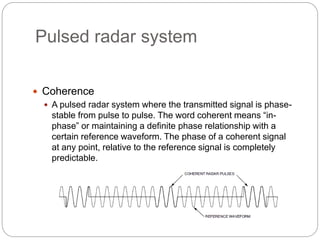
 A pulsed radar system where the transmitted signal is phase-stable 
from pulse to pulse. The word coherent means “in-phase” 
or maintaining a definite phase relationship with a 
certain reference waveform. The phase of a coherent signal 
at any point, relative to the reference signal is completely 
predictable.
Pulsed radar system 
 Non-coherence 
 The phases of the transmitted signal are random from pulse to 
pulse. The phases of their echoes cannot be used to predict 
the range of the target. 
 Conclusion: 
 Coherent radar system: can use the round-trip time or the 
echoes phases to detect the target range (the speed of the 
target). 
 No-coherent radar system: use only the round-trip time to 
detect the target range.
Non-coherent radar 
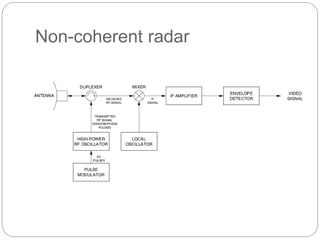
 The pulsed transmitted is usually high-power RF 
oscillator, which is keyed on and off by a pulse 
modulator. 
 The phase relationship between successive 
pulses in the transmitted signal is completely 
random. 
 The received RF signal is mixing with a local 
oscillator to shift the RF signal down to the 
intermediate frequency IF.
Non-coherent radar
Non-coherent radar 
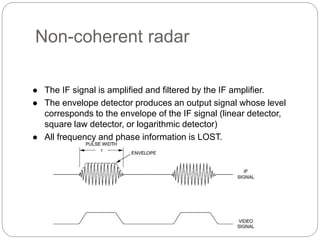
 The IF signal is amplified and filtered by the IF amplifier. 
 The envelope detector produces an output signal whose level 
corresponds to the envelope of the IF signal (linear detector, 
square law detector, or logarithmic detector) 
 All frequency and phase information is LOST.
Non-coherent radar 
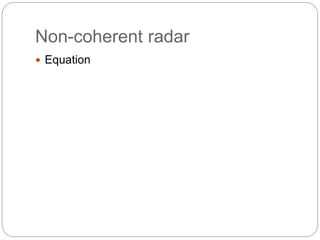
 Equation
Coherent pulsed radar 
 Superheterodyne receiver 
 Homodyne receiver
Coherent pulsed radar- Superheterodyne 
receiver
Coherent pulsed radar- Superheterodyne 
receiver 
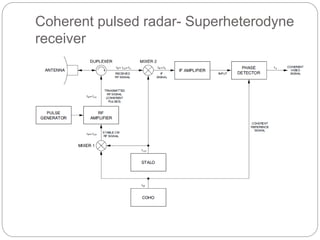
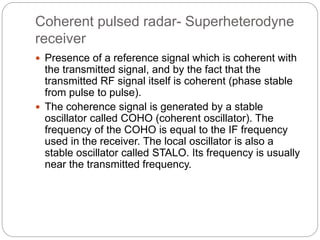
 Presence of a reference signal which is coherent with 
the transmitted signal, and by the fact that the 
transmitted RF signal itself is coherent (phase stable 
from pulse to pulse). 
 The coherence signal is generated by a stable 
oscillator called COHO (coherent oscillator). The 
frequency of the COHO is equal to the IF frequency 
used in the receiver. The local oscillator is also a 
stable oscillator called STALO. Its frequency is usually 
near the transmitted frequency.
Coherent pulsed radar- Superheterodyne 
receiver 
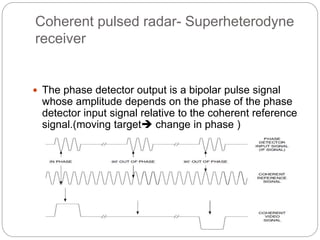
 The phase detector output is a bipolar pulse signal 
whose amplitude depends on the phase of the phase 
detector input signal relative to the coherent reference 
signal.(moving target change in phase )
Coherent pulsed radar- Homodyne 
receiver 
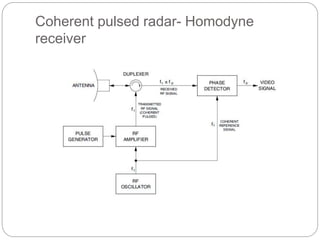
 Superheterodyne are commonly used in a radar 
because it is usually more convenient to perform 
phase detection at a relatively low IF frequency 
than at the RF frequency. 
 If    large bandwidth of the IF amplifier, 
requires the using of higher intermediate 
frequency: Impractical, circuit losses and 
instability.
Coherent pulsed radar- Homodyne 
receiver 
 Equations……
Coherent pulsed radar- Homodyne 
receiver
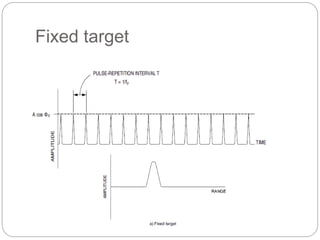
Fixed target
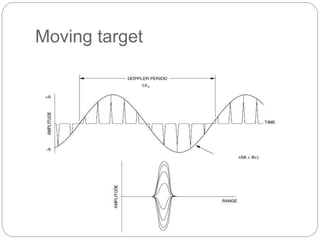
Moving target
Limitations 
 Blind phases…. 
 Blind speeds….
Phase processing MTI 
 The Doppler frequency shift can be used to allow the 
radar to reject fixed targets (clutter) and detect only 
moving targets. This type of signal processing is 
called moving-target indication (MTI). 
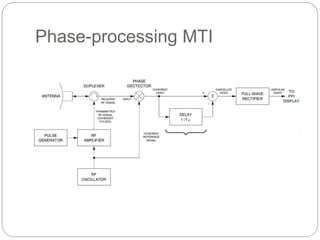
 One way of accomplishing moving-target indication is 
to use the pulse-to-pulse change in amplitude at the 
output of the phase detector to differentiate between 
fixed and moving targets. This is called phase-processing 
MTI and is implemented using a delay-line 
canceller.
Phase-processing MTI
Phase-processing MTI 
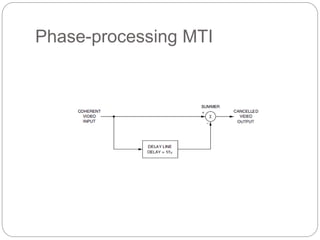
 The delay line canceller consists of a delay line and a summer. The 
delay line delays the video signal by a time equal to the pulse-repetition 
interval (sometimes called the PRF period) T=1/fp. The delay line 
operates by sampling the video input signal at a high rate and storing 
each sample for the required time. The delayed video signal is 
subtracted from the undelayed video signal by the summer. 
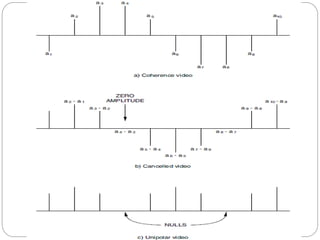
 The output of the delay-line canceller consists of the differences between 
successive pulses in the video signal. If the target is not moving, the 
amplitude of each pulse is the same as that of the previous pulse. 
 The result of the subtraction is zero. If the target is moving, however, the 
pulse amplitude changes from pulse to pulse. The result of the 
subtraction is not zero; a residue remains in the form of a bipolar pulse 
train. The bipolar pulse train is usually full-wave rectified before it is sent 
to a PPI display. Since only moving targets produce a residue at the 
canceller output, only these targets will be visible on the radar display.
Phase-processing MTI 
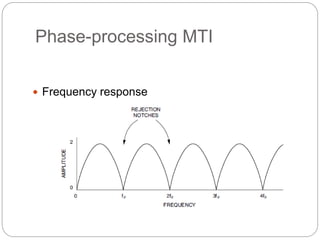
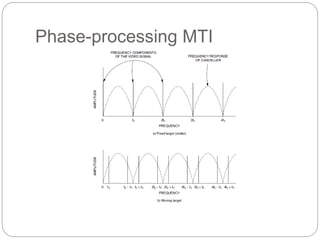
 Frequency response
Phase-processing MTI
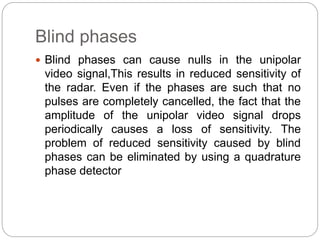
Blind phases 
 Blind phases can cause nulls in the unipolar 
video signal,This results in reduced sensitivity of 
the radar. Even if the phases are such that no 
pulses are completely cancelled, the fact that the 
amplitude of the unipolar video signal drops 
periodically causes a loss of sensitivity. The 
problem of reduced sensitivity caused by blind 
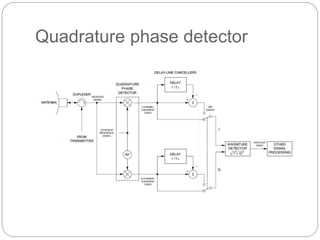
phases can be eliminated by using a quadrature 
phase detector
Quadrature phase detector
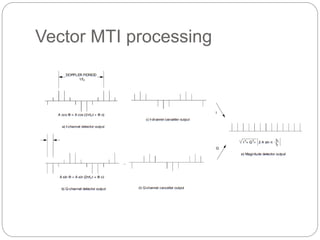
Vector MTI processing

Chapter 3- pulsed radar system and MTI

  • 1.
    Chapter 3 Pulsedradar system & phase processing MTI
  • 2.
    Pulsed radar system  The time-delay between the transmission of each pulse and the reception of the echo of the same pulse is proportional to the target range.  The phase of the echo also depends on the target range. And can be used to extract information from it, if the phase of the transmitted signal is stable from pulse to pulse.
  • 3.
    Pulsed radar system  Coherence  A pulsed radar system where the transmitted signal is phase-stable from pulse to pulse. The word coherent means “in-phase” or maintaining a definite phase relationship with a certain reference waveform. The phase of a coherent signal at any point, relative to the reference signal is completely predictable.
  • 4.
    Pulsed radar system  Non-coherence  The phases of the transmitted signal are random from pulse to pulse. The phases of their echoes cannot be used to predict the range of the target.  Conclusion:  Coherent radar system: can use the round-trip time or the echoes phases to detect the target range (the speed of the target).  No-coherent radar system: use only the round-trip time to detect the target range.
  • 5.
    Non-coherent radar The pulsed transmitted is usually high-power RF oscillator, which is keyed on and off by a pulse modulator.  The phase relationship between successive pulses in the transmitted signal is completely random.  The received RF signal is mixing with a local oscillator to shift the RF signal down to the intermediate frequency IF.
  • 6.
  • 7.
    Non-coherent radar The IF signal is amplified and filtered by the IF amplifier.  The envelope detector produces an output signal whose level corresponds to the envelope of the IF signal (linear detector, square law detector, or logarithmic detector)  All frequency and phase information is LOST.
  • 8.
  • 9.
    Coherent pulsed radar  Superheterodyne receiver  Homodyne receiver
  • 10.
    Coherent pulsed radar-Superheterodyne receiver
  • 11.
    Coherent pulsed radar-Superheterodyne receiver  Presence of a reference signal which is coherent with the transmitted signal, and by the fact that the transmitted RF signal itself is coherent (phase stable from pulse to pulse).  The coherence signal is generated by a stable oscillator called COHO (coherent oscillator). The frequency of the COHO is equal to the IF frequency used in the receiver. The local oscillator is also a stable oscillator called STALO. Its frequency is usually near the transmitted frequency.
  • 12.
    Coherent pulsed radar-Superheterodyne receiver  The phase detector output is a bipolar pulse signal whose amplitude depends on the phase of the phase detector input signal relative to the coherent reference signal.(moving target change in phase )
  • 13.
    Coherent pulsed radar-Homodyne receiver  Superheterodyne are commonly used in a radar because it is usually more convenient to perform phase detection at a relatively low IF frequency than at the RF frequency.  If    large bandwidth of the IF amplifier, requires the using of higher intermediate frequency: Impractical, circuit losses and instability.
  • 14.
    Coherent pulsed radar-Homodyne receiver  Equations……
  • 15.
    Coherent pulsed radar-Homodyne receiver
  • 16.
  • 17.
  • 18.
    Limitations  Blindphases….  Blind speeds….
  • 19.
    Phase processing MTI  The Doppler frequency shift can be used to allow the radar to reject fixed targets (clutter) and detect only moving targets. This type of signal processing is called moving-target indication (MTI).  One way of accomplishing moving-target indication is to use the pulse-to-pulse change in amplitude at the output of the phase detector to differentiate between fixed and moving targets. This is called phase-processing MTI and is implemented using a delay-line canceller.
  • 20.
  • 21.
    Phase-processing MTI The delay line canceller consists of a delay line and a summer. The delay line delays the video signal by a time equal to the pulse-repetition interval (sometimes called the PRF period) T=1/fp. The delay line operates by sampling the video input signal at a high rate and storing each sample for the required time. The delayed video signal is subtracted from the undelayed video signal by the summer.  The output of the delay-line canceller consists of the differences between successive pulses in the video signal. If the target is not moving, the amplitude of each pulse is the same as that of the previous pulse.  The result of the subtraction is zero. If the target is moving, however, the pulse amplitude changes from pulse to pulse. The result of the subtraction is not zero; a residue remains in the form of a bipolar pulse train. The bipolar pulse train is usually full-wave rectified before it is sent to a PPI display. Since only moving targets produce a residue at the canceller output, only these targets will be visible on the radar display.
  • 22.
    Phase-processing MTI Frequency response
  • 23.
  • 24.
  • 26.
    Blind phases Blind phases can cause nulls in the unipolar video signal,This results in reduced sensitivity of the radar. Even if the phases are such that no pulses are completely cancelled, the fact that the amplitude of the unipolar video signal drops periodically causes a loss of sensitivity. The problem of reduced sensitivity caused by blind phases can be eliminated by using a quadrature phase detector
  • 27.
  • 28.