MICROWAVE ENGINEERING
B.Tech VI-I Semester
Faculty: G Udaykiran Bhargava
They are used in many applications such as oscillators, filters, frequency
meters, tuned amplifiers and the like.
 A microwave resonator is a metallic enclosure that confines electromagnetic
energy and stores it inside a cavity that determines its equivalent capacitance
and inductance and from the energy dissipated due to finite conductive walls
we can determine the equivalent resistance.
The resonator has finite number of resonating modes and each mode
corresponds to a particular resonant frequency.
When the frequency of input signal equals to the resonant frequency,
maximum amplitude of standing wave occurs and the peak energy stored in
the electric and magnetic field are calculated.
MICROWAVE RESONATOR:
RECTANGULAR WAVEGUIDE CAVITY RESONATOR
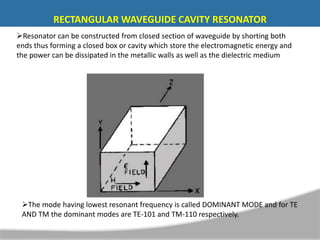
Resonator can be constructed from closed section of waveguide by shorting both
ends thus forming a closed box or cavity which store the electromagnetic energy and
the power can be dissipated in the metallic walls as well as the dielectric medium
The mode having lowest resonant frequency is called DOMINANT MODE and for TE
AND TM the dominant modes are TE-101 and TM-110 respectively.
Cavity Resonators
Cavity Resonators
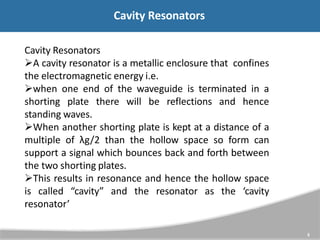
A cavity resonator is a metallic enclosure that confines
the electromagnetic energy i.e.
when one end of the waveguide is terminated in a
shorting plate there will be reflections and hence
standing waves.
When another shorting plate is kept at a distance of a
multiple of λg/2 than the hollow space so form can
support a signal which bounces back and forth between
the two shorting plates.
This results in resonance and hence the hollow space
is called “cavity” and the resonator as the ‘cavity
resonator’
5
.
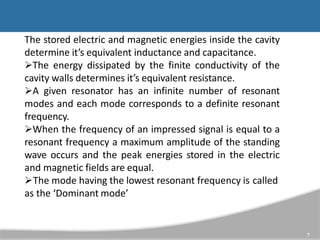
The waveguide section can be rectangular or circular.
The microwave cavity resonator is similar to a tuned circuit
at low frequencies having a resonant frequency
f0= 1 /2𝜋√𝐿𝐶
The cavity resonator can resonate at only one particular
frequency like a parallel resonant circuit.
Rectangular Cavity resonator
6
Cirular Cavity resonator
The stored electric and magnetic energies inside the cavity
determine it’s equivalent inductance and capacitance.
The energy dissipated by the finite conductivity of the
cavity walls determines it’s equivalent resistance.
A given resonator has an infinite number of resonant
modes and each mode corresponds to a definite resonant
frequency.
When the frequency of an impressed signal is equal to a
resonant frequency a maximum amplitude of the standing
wave occurs and the peak energies stored in the electric
and magnetic fields are equal.
The mode having the lowest resonant frequency is called
as the ‘Dominant mode’
7
Rectangular cavity Resonator The electromagnetic field inside
the cavity should satisfy Maxwell’s equations subject to the
boundary conditions that the electric field tangential to and
the magnetic field normal to the metal walls must vanish.
The wave equations in the rectangular resonator should satisfy
the boundary condition of the zero tangential ‘E’ At four of the
walls.
8
Coupling mechanisms
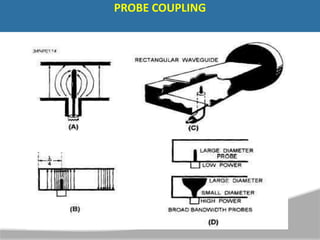
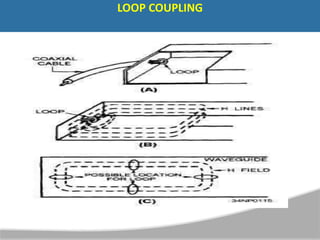
Probe coupling & Loop coupling: Probes & Loops are metallic
wires used to couple coaxial line to a waveguide resonator to
feed or extract microwave signal.
When a short antenna in the form of a probe or a loop inserted
into a waveguide, it will radiate and if it is placed correctly, the
wanted mode will be set up. The correct positioning of the
coupling probes for launching dominant mode.
Coupling mechanisms
• The probe is placed at a distance of from the shorted end of the
waveguide and the centre of broader dimension of the
waveguide because at that point electric field is maximum. This
probe will now act as an antenna which is polarized in the plane
parallel to that of electric field.
• The coupling loop placed at the centre of shorted end plate of
the waveguide can also be used to launch mode i.e, coupling is
achieved by means of a loop antenna located in a plane
perpendicular to the electric field and loops to a magnetic field
but in each case both are set up because electric and magnetic
fields are in seperable.
•
PROBE COUPLING
LOOP COUPLING
Waveguide discontinuities
Waveguide irises, tuning screws and posts.
Waveguide irises:
In any waveguide system, when there is a mismatch there will be
reflections.
In transmission lines, in order to overcome this mismatch lumped
impedances or stubs of required value are placed at precalculated
points. In waveguides too, some discontinuities are made use for
matching purposes.
Any susceptances appearing across the guide, causing mismatch (
production of standing waves) needs to be cancelled by introducing
another susceptance of the same magnitude but of opposite
nature.
Irises (also called windows, apertures or diaphragms) are made use
of for the purpose.
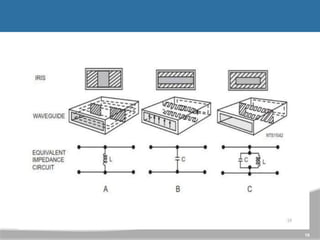
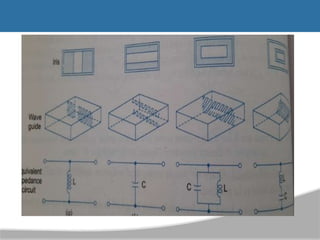
An inductive iris allows a current to flow where none flowed
before. The iris is placed in a position where the magnetic field is
strong (or where electric field is relatively weak).
Since the plane of polarization of electric field is parallel to the
plane of iris, the current flow due to iris causes a magnetic field to
be set up.
In capacitive iris, it is seen that the potential which existed
between the top and bottom walls of the waveguide now exists
between surfaces which are closer.
The capacitive iris is placed in a position where the electric field is
strong.
14
 In parallel resonant iris, the inductive and capacitive irises are
combined.
 For the dominant mode, the iris presents a high impedance and
the shunting effect for this mode will be negligible. Parallel
resonant iris acts as a band pass filter to suppress unwanted
modes.
 A series resonant iris which supported by a non metallic material
and it is transparent to the flow of microwave energy.
15
16
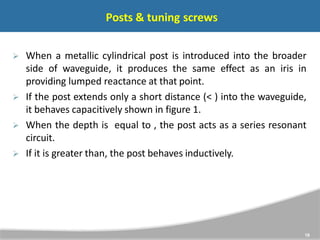
Posts & tuning screws
18
 When a metallic cylindrical post is introduced into the broader
side of waveguide, it produces the same effect as an iris in
providing lumped reactance at that point.
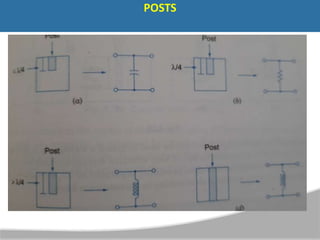
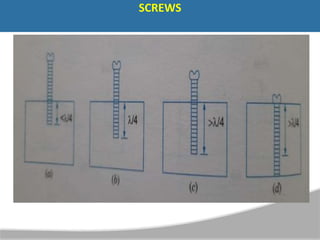
 If the post extends only a short distance (< ) into the waveguide,
it behaves capacitively shown in figure 1.
 When the depth is equal to , the post acts as a series resonant
circuit.
 If it is greater than, the post behaves inductively.
POSTS
SCREWS
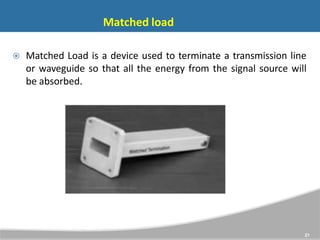
Matched load
 Matched Load is a device used to terminate a transmission line
or waveguide so that all the energy from the signal source will
be absorbed.
21
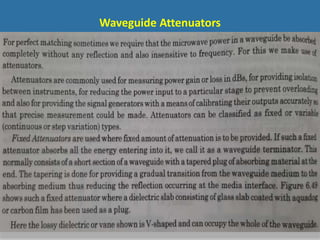
Waveguide Attenuators
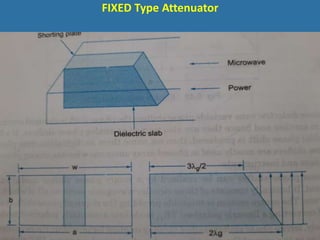
FIXED Type Attenuator
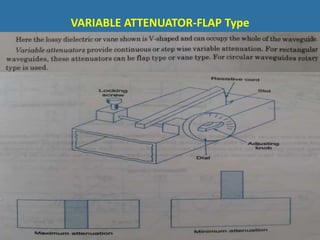
VARIABLE ATTENUATOR-FLAP Type
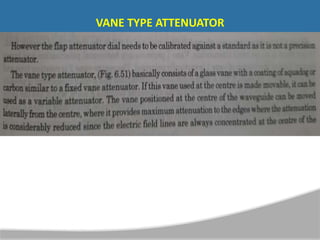
VANE TYPE ATTENUATOR
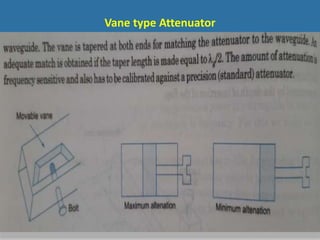
Vane type Attenuator
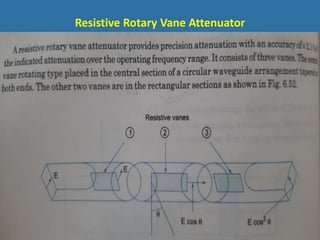
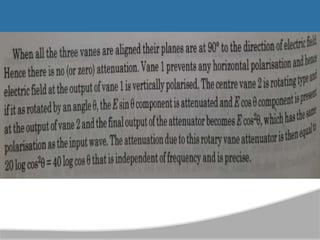
Resistive Rotary Vane Attenuator
WAVEGUIDE JUNCTION
Waveguide junctions are used when power in a waveguide needs to be split or
some extracted.
There are a number of different types of waveguide junction that can be use,
each type having different properties - the different types of waveguide junction
affect the energy contained within the waveguide in different ways.
When selecting a waveguide junction balances between performance and cost
need to be made and therefore an understanding of the different types of
waveguide junction is useful.
MICROWAVE T JUNCTIONS
`
There are different types of waveguide junctions:
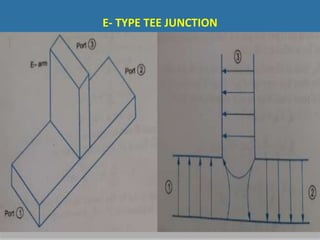
E-Type TEE Junction: This form of waveguide junction gains its name as an E-
type T junction because the top of the "T" extends from the main waveguide in
the same plane as the electric field in the waveguide.
It is also known as Voltage junction.
It is also called as series junction.
H-type TEE Junction: This type of waveguide junction gains its name because
top of the "T" in the T junction is parallel to the plane of the magnetic field, H
lines in the waveguide.
It is also known as current junction.
It is also called as Parallel
Magic TEE waveguide junction: The magic T waveguide junction is effectively a
combination of the E-type and H-type waveguide junctions. It is also known as
Hybrid Junction.
MICROWAVE TEE JUNCTION TYPES
E- TYPE TEE JUNCTION
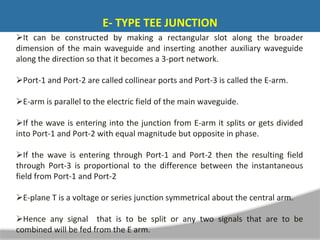
It can be constructed by making a rectangular slot along the broader
dimension of the main waveguide and inserting another auxiliary waveguide
along the direction so that it becomes a 3-port network.
Port-1 and Port-2 are called collinear ports and Port-3 is called the E-arm.
E-arm is parallel to the electric field of the main waveguide.
If the wave is entering into the junction from E-arm it splits or gets divided
into Port-1 and Port-2 with equal magnitude but opposite in phase.
If the wave is entering through Port-1 and Port-2 then the resulting field
through Port-3 is proportional to the difference between the instantaneous
field from Port-1 and Port-2
E-plane T is a voltage or series junction symmetrical about the central arm.
Hence any signal that is to be split or any two signals that are to be
combined will be fed from the E arm.
E- TYPE TEE JUNCTION
H- TYPE TEE JUNCTION
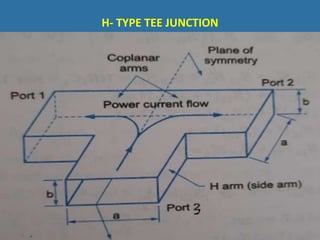
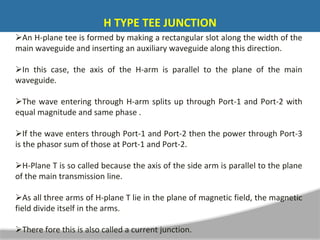
An H-plane tee is formed by making a rectangular slot along the width of the
main waveguide and inserting an auxiliary waveguide along this direction.
In this case, the axis of the H-arm is parallel to the plane of the main
waveguide.
The wave entering through H-arm splits up through Port-1 and Port-2 with
equal magnitude and same phase .
If the wave enters through Port-1 and Port-2 then the power through Port-3
is the phasor sum of those at Port-1 and Port-2.
H-Plane T is so called because the axis of the side arm is parallel to the plane
of the main transmission line.
As all three arms of H-plane T lie in the plane of magnetic field, the magnetic
field divide itself in the arms.
There fore this is also called a current junction.
H TYPE TEE JUNCTION
E-H TYPE or MAGIC TEE JUNCTION
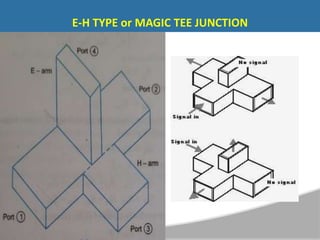
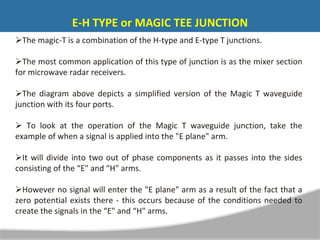
The magic-T is a combination of the H-type and E-type T junctions.
The most common application of this type of junction is as the mixer section
for microwave radar receivers.
The diagram above depicts a simplified version of the Magic T waveguide
junction with its four ports.
 To look at the operation of the Magic T waveguide junction, take the
example of when a signal is applied into the "E plane" arm.
It will divide into two out of phase components as it passes into the sides
consisting of the “E" and “H" arms.
However no signal will enter the "E plane" arm as a result of the fact that a
zero potential exists there - this occurs because of the conditions needed to
create the signals in the “E" and “H" arms.
E-H TYPE or MAGIC TEE JUNCTION
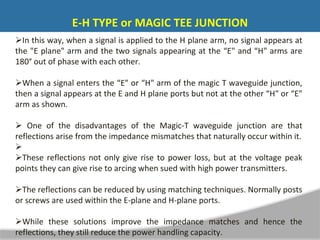
In this way, when a signal is applied to the H plane arm, no signal appears at
the "E plane" arm and the two signals appearing at the “E" and “H" arms are
180° out of phase with each other.
When a signal enters the “E" or “H" arm of the magic T waveguide junction,
then a signal appears at the E and H plane ports but not at the other “H" or “E"
arm as shown.
 One of the disadvantages of the Magic-T waveguide junction are that
reflections arise from the impedance mismatches that naturally occur within it.

These reflections not only give rise to power loss, but at the voltage peak
points they can give rise to arcing when sued with high power transmitters.
The reflections can be reduced by using matching techniques. Normally posts
or screws are used within the E-plane and H-plane ports.
While these solutions improve the impedance matches and hence the
reflections, they still reduce the power handling capacity.
E-H TYPE or MAGIC TEE JUNCTION
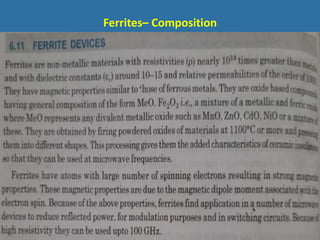
Ferrites– Composition
FARADAY ROTATION
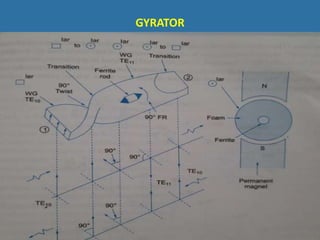
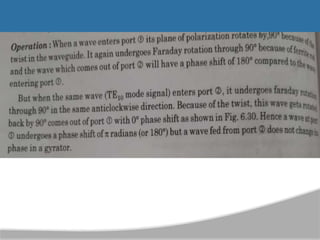
GYRATOR
GYRATOR
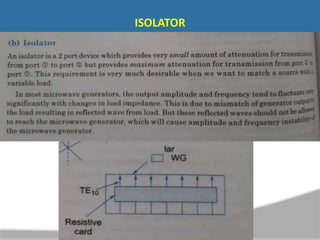
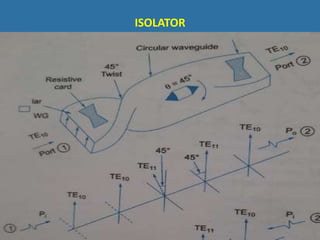
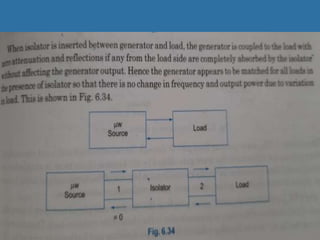
ISOLATOR
ISOLATOR
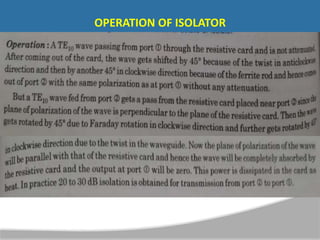
OPERATION OF ISOLATOR
CIRCUALTOR
47
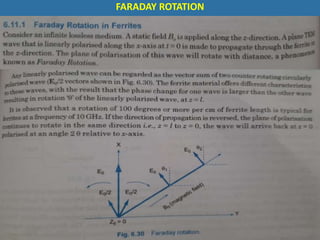
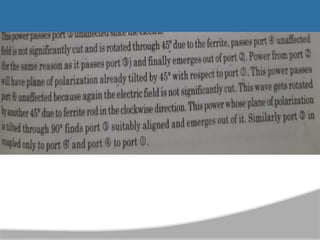
 Both microwave circulators and isolators are non reciprocal
transmission devices that use the property of Faraday rotation in
the ferrite material.
 A non reciprocal phase shifter consists of thin slab of ferrite
placed in a rectangular waveguide at a point where the dc
magnetic field of the incident wave mode is circularly polarized.
 When a piece of ferrite is affected by a dc magnetic field the
ferrite exhibits Faraday rotation. It does so because the ferrite is
nonlinear material and its permeability is an asymmetric tensor.
CIRCULATOR
48
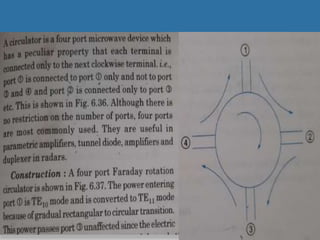
 A microwave circulator is a multiport waveguide junction in
which the wave can flow only from the nth port to the (n + I)th
port in one direction Although there is no restriction on the
number of ports, the four-port microwave circulator is the most
common.
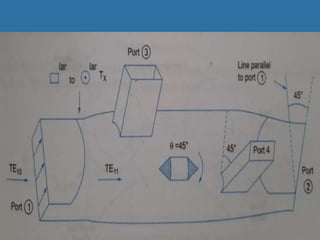
 One type of four-port microwave circulator is a combination of
two 3-dB side hole directional couplers and a rectangular
waveguide with two non reciprocal phase shifters.
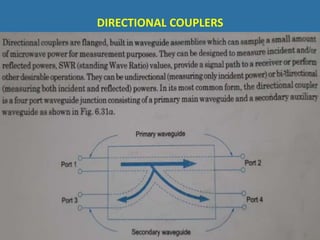
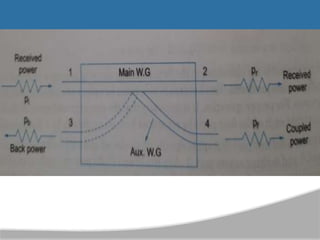
DIRECTIONAL COUPLERS
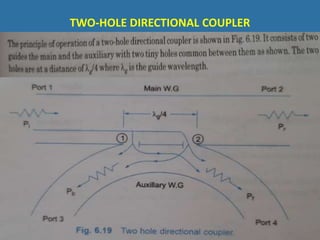
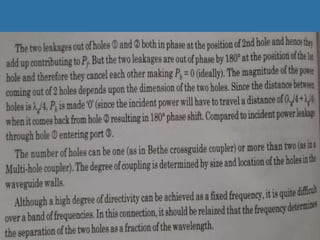
TWO-HOLE DIRECTIONAL COUPLER
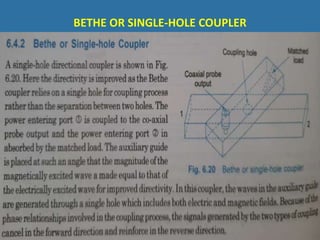
BETHE OR SINGLE-HOLE COUPLER
244

3rd UNIT Microwave Engineering PPT.pptx

  • 1.
    MICROWAVE ENGINEERING B.Tech VI-ISemester Faculty: G Udaykiran Bhargava
  • 2.
    They are usedin many applications such as oscillators, filters, frequency meters, tuned amplifiers and the like.  A microwave resonator is a metallic enclosure that confines electromagnetic energy and stores it inside a cavity that determines its equivalent capacitance and inductance and from the energy dissipated due to finite conductive walls we can determine the equivalent resistance. The resonator has finite number of resonating modes and each mode corresponds to a particular resonant frequency. When the frequency of input signal equals to the resonant frequency, maximum amplitude of standing wave occurs and the peak energy stored in the electric and magnetic field are calculated. MICROWAVE RESONATOR:
  • 3.
    RECTANGULAR WAVEGUIDE CAVITYRESONATOR Resonator can be constructed from closed section of waveguide by shorting both ends thus forming a closed box or cavity which store the electromagnetic energy and the power can be dissipated in the metallic walls as well as the dielectric medium The mode having lowest resonant frequency is called DOMINANT MODE and for TE AND TM the dominant modes are TE-101 and TM-110 respectively.
  • 5.
    Cavity Resonators Cavity Resonators Acavity resonator is a metallic enclosure that confines the electromagnetic energy i.e. when one end of the waveguide is terminated in a shorting plate there will be reflections and hence standing waves. When another shorting plate is kept at a distance of a multiple of λg/2 than the hollow space so form can support a signal which bounces back and forth between the two shorting plates. This results in resonance and hence the hollow space is called “cavity” and the resonator as the ‘cavity resonator’ 5
  • 6.
    . The waveguide sectioncan be rectangular or circular. The microwave cavity resonator is similar to a tuned circuit at low frequencies having a resonant frequency f0= 1 /2𝜋√𝐿𝐶 The cavity resonator can resonate at only one particular frequency like a parallel resonant circuit. Rectangular Cavity resonator 6 Cirular Cavity resonator
  • 7.
    The stored electricand magnetic energies inside the cavity determine it’s equivalent inductance and capacitance. The energy dissipated by the finite conductivity of the cavity walls determines it’s equivalent resistance. A given resonator has an infinite number of resonant modes and each mode corresponds to a definite resonant frequency. When the frequency of an impressed signal is equal to a resonant frequency a maximum amplitude of the standing wave occurs and the peak energies stored in the electric and magnetic fields are equal. The mode having the lowest resonant frequency is called as the ‘Dominant mode’ 7
  • 8.
    Rectangular cavity ResonatorThe electromagnetic field inside the cavity should satisfy Maxwell’s equations subject to the boundary conditions that the electric field tangential to and the magnetic field normal to the metal walls must vanish. The wave equations in the rectangular resonator should satisfy the boundary condition of the zero tangential ‘E’ At four of the walls. 8
  • 9.
    Coupling mechanisms Probe coupling& Loop coupling: Probes & Loops are metallic wires used to couple coaxial line to a waveguide resonator to feed or extract microwave signal. When a short antenna in the form of a probe or a loop inserted into a waveguide, it will radiate and if it is placed correctly, the wanted mode will be set up. The correct positioning of the coupling probes for launching dominant mode.
  • 10.
    Coupling mechanisms • Theprobe is placed at a distance of from the shorted end of the waveguide and the centre of broader dimension of the waveguide because at that point electric field is maximum. This probe will now act as an antenna which is polarized in the plane parallel to that of electric field. • The coupling loop placed at the centre of shorted end plate of the waveguide can also be used to launch mode i.e, coupling is achieved by means of a loop antenna located in a plane perpendicular to the electric field and loops to a magnetic field but in each case both are set up because electric and magnetic fields are in seperable. •
  • 11.
  • 12.
  • 13.
    Waveguide discontinuities Waveguide irises,tuning screws and posts. Waveguide irises: In any waveguide system, when there is a mismatch there will be reflections. In transmission lines, in order to overcome this mismatch lumped impedances or stubs of required value are placed at precalculated points. In waveguides too, some discontinuities are made use for matching purposes. Any susceptances appearing across the guide, causing mismatch ( production of standing waves) needs to be cancelled by introducing another susceptance of the same magnitude but of opposite nature. Irises (also called windows, apertures or diaphragms) are made use of for the purpose.
  • 14.
    An inductive irisallows a current to flow where none flowed before. The iris is placed in a position where the magnetic field is strong (or where electric field is relatively weak). Since the plane of polarization of electric field is parallel to the plane of iris, the current flow due to iris causes a magnetic field to be set up. In capacitive iris, it is seen that the potential which existed between the top and bottom walls of the waveguide now exists between surfaces which are closer. The capacitive iris is placed in a position where the electric field is strong. 14
  • 15.
     In parallelresonant iris, the inductive and capacitive irises are combined.  For the dominant mode, the iris presents a high impedance and the shunting effect for this mode will be negligible. Parallel resonant iris acts as a band pass filter to suppress unwanted modes.  A series resonant iris which supported by a non metallic material and it is transparent to the flow of microwave energy. 15
  • 16.
  • 18.
    Posts & tuningscrews 18  When a metallic cylindrical post is introduced into the broader side of waveguide, it produces the same effect as an iris in providing lumped reactance at that point.  If the post extends only a short distance (< ) into the waveguide, it behaves capacitively shown in figure 1.  When the depth is equal to , the post acts as a series resonant circuit.  If it is greater than, the post behaves inductively.
  • 19.
  • 20.
  • 21.
    Matched load  MatchedLoad is a device used to terminate a transmission line or waveguide so that all the energy from the signal source will be absorbed. 21
  • 22.
  • 23.
  • 24.
  • 25.
  • 26.
  • 27.
  • 29.
    WAVEGUIDE JUNCTION Waveguide junctionsare used when power in a waveguide needs to be split or some extracted. There are a number of different types of waveguide junction that can be use, each type having different properties - the different types of waveguide junction affect the energy contained within the waveguide in different ways. When selecting a waveguide junction balances between performance and cost need to be made and therefore an understanding of the different types of waveguide junction is useful. MICROWAVE T JUNCTIONS
  • 30.
    ` There are differenttypes of waveguide junctions: E-Type TEE Junction: This form of waveguide junction gains its name as an E- type T junction because the top of the "T" extends from the main waveguide in the same plane as the electric field in the waveguide. It is also known as Voltage junction. It is also called as series junction. H-type TEE Junction: This type of waveguide junction gains its name because top of the "T" in the T junction is parallel to the plane of the magnetic field, H lines in the waveguide. It is also known as current junction. It is also called as Parallel Magic TEE waveguide junction: The magic T waveguide junction is effectively a combination of the E-type and H-type waveguide junctions. It is also known as Hybrid Junction. MICROWAVE TEE JUNCTION TYPES
  • 31.
    E- TYPE TEEJUNCTION
  • 32.
    It can beconstructed by making a rectangular slot along the broader dimension of the main waveguide and inserting another auxiliary waveguide along the direction so that it becomes a 3-port network. Port-1 and Port-2 are called collinear ports and Port-3 is called the E-arm. E-arm is parallel to the electric field of the main waveguide. If the wave is entering into the junction from E-arm it splits or gets divided into Port-1 and Port-2 with equal magnitude but opposite in phase. If the wave is entering through Port-1 and Port-2 then the resulting field through Port-3 is proportional to the difference between the instantaneous field from Port-1 and Port-2 E-plane T is a voltage or series junction symmetrical about the central arm. Hence any signal that is to be split or any two signals that are to be combined will be fed from the E arm. E- TYPE TEE JUNCTION
  • 33.
    H- TYPE TEEJUNCTION
  • 34.
    An H-plane teeis formed by making a rectangular slot along the width of the main waveguide and inserting an auxiliary waveguide along this direction. In this case, the axis of the H-arm is parallel to the plane of the main waveguide. The wave entering through H-arm splits up through Port-1 and Port-2 with equal magnitude and same phase . If the wave enters through Port-1 and Port-2 then the power through Port-3 is the phasor sum of those at Port-1 and Port-2. H-Plane T is so called because the axis of the side arm is parallel to the plane of the main transmission line. As all three arms of H-plane T lie in the plane of magnetic field, the magnetic field divide itself in the arms. There fore this is also called a current junction. H TYPE TEE JUNCTION
  • 35.
    E-H TYPE orMAGIC TEE JUNCTION
  • 36.
    The magic-T isa combination of the H-type and E-type T junctions. The most common application of this type of junction is as the mixer section for microwave radar receivers. The diagram above depicts a simplified version of the Magic T waveguide junction with its four ports.  To look at the operation of the Magic T waveguide junction, take the example of when a signal is applied into the "E plane" arm. It will divide into two out of phase components as it passes into the sides consisting of the “E" and “H" arms. However no signal will enter the "E plane" arm as a result of the fact that a zero potential exists there - this occurs because of the conditions needed to create the signals in the “E" and “H" arms. E-H TYPE or MAGIC TEE JUNCTION
  • 37.
    In this way,when a signal is applied to the H plane arm, no signal appears at the "E plane" arm and the two signals appearing at the “E" and “H" arms are 180° out of phase with each other. When a signal enters the “E" or “H" arm of the magic T waveguide junction, then a signal appears at the E and H plane ports but not at the other “H" or “E" arm as shown.  One of the disadvantages of the Magic-T waveguide junction are that reflections arise from the impedance mismatches that naturally occur within it.  These reflections not only give rise to power loss, but at the voltage peak points they can give rise to arcing when sued with high power transmitters. The reflections can be reduced by using matching techniques. Normally posts or screws are used within the E-plane and H-plane ports. While these solutions improve the impedance matches and hence the reflections, they still reduce the power handling capacity. E-H TYPE or MAGIC TEE JUNCTION
  • 38.
  • 39.
  • 40.
  • 41.
  • 43.
  • 44.
  • 45.
  • 47.
    CIRCUALTOR 47  Both microwavecirculators and isolators are non reciprocal transmission devices that use the property of Faraday rotation in the ferrite material.  A non reciprocal phase shifter consists of thin slab of ferrite placed in a rectangular waveguide at a point where the dc magnetic field of the incident wave mode is circularly polarized.  When a piece of ferrite is affected by a dc magnetic field the ferrite exhibits Faraday rotation. It does so because the ferrite is nonlinear material and its permeability is an asymmetric tensor.
  • 48.
    CIRCULATOR 48  A microwavecirculator is a multiport waveguide junction in which the wave can flow only from the nth port to the (n + I)th port in one direction Although there is no restriction on the number of ports, the four-port microwave circulator is the most common.  One type of four-port microwave circulator is a combination of two 3-dB side hole directional couplers and a rectangular waveguide with two non reciprocal phase shifters.
  • 52.
  • 56.
  • 58.
  • 59.