“BER Analysis and Performance of MIMO-OFDM System using BPSK Modulation Scheme 
For Next Generation Communication Systems” 
Presented by: Mr. NIMAY CHANDRA GIRI 
Dept. of ECE
CONTENTS 
OBJECTIVE 
INTRODUCTION 
LITERATURE REVIEW 
MIMO TRANSMITTER & RECIEVER WITH RESULTS 
BPSK SYSTEM 
OFDM TECHNIQUE WITH RESULTS 
MIMO-OFDM SYSTEM 
SINGLE-CARRIER VS. MULTI-CARRIERS 
ADVANTAGES 
APPLICATION 
CONCLUSION 
FUTURE SCOPE 
REFERENCES 
PUBLICATION 
12/13/2014 
2 
SOET, CUTM, JATNI CAMPUS
OBJECTIVE 
•MIMOSystem:highdatarates&increasedcapacityofthesystem 
•OFDMTechnique:reducedMultipathfading,ICIandISI& provideMulti-carrierOrthogonalSignals. 
•BPSKModulation:Longdistancetransmission&usedineachblockofIDFT/IFFTofMIMO-OFDMmodelformappingdatastreams. 
•InthisthesisWork,IcomparetheBERvs.SNRofMIMO-OFDMSystemusingBPSKmodulation,andperformanceofMIMO- OFDMsystemfor4Gnetworks. 
12/13/2014 
3 
SOET, CUTM, JATNI CAMPUS
INTRODUCTION 
MIMO-OFDMisahottopicintodaymodernwirelesscommunicationsinceallwirelesstechnologieslikePAN,LAN,W-LAN,MAN,W-MAN&WAN. 
Inthe1980s,MIMO-OFDMhasbeenstudiedforhigh-speedtransmission. 
MIMOSystemhavemultipleinputsandmultipleoutputsantennas. 
•MultiplexingGain=>Spectralefficiencyincreases 
•DiversityGain=>CombatsFading 
•InterferenceReductionGain=>Capacityincreases 
oOFDM=OrthogonalFDM(ItwasinventedduringWorldWar-II,1939-194580Hzoffrequencyused) 
oOFDMisacombinationofModulation&Multiplexingtechniques. 
•OFDM is a multicarrier block transmission system. 
•Block of ‘N’ symbols are grouped and sent parallely. 
•No interference among the data symbols sent in a block. 
MIMOSystemandOFDMModulationTechnique 
•Air-interface(ICI&ISI)solutions 
•MoreFlexibility,Capacity&Efficiency 
•More numbers of carriers 
•Increase data rates and SNR with reducing BER. 
12/13/2014 
4 
SOET, CUTM, JATNI CAMPUS
LITERATURE REVIEW 
12/13/2014 
5 
SOET, CUTM, JATNI CAMPUS 
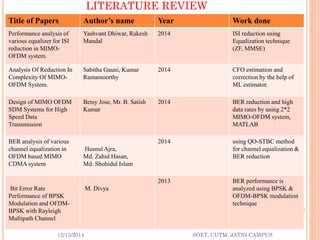
Titleof Papers 
Author’s name 
Year 
Work done 
Performance analysis of various equalizer for ISI reduction in MIMO- OFDM system. 
Yashvant Dhiwar, Rakesh Mandal 
2014 
ISI reduction using Equalizationtechnique (ZF, MMSE) 
Analysis Of Reduction In 
Complexity Of MIMO- OFDM System. 
Sabitha Gauni, Kumar Ramamoorthy 
2014 
CFO estimation and correction by the help of ML estimator. 
Design of MIMO OFDM SDM Systems for High Speed Data 
Transmission 
Betsy Jose, Mr. B. Satish Kumar 
2014 
BERreduction and high data rates by using 2*2 MIMO-OFDM system, MATLAB 
BER analysis of various channel equalization in OFDM based MIMO CDMA system 
Husnul Ajra, 
Md. Zahid Hasan, 
Md. Shohidul Islam 
2014 
using QO-STBC method forchannel equalization & BER reduction 
Bit Error Rate Performance of BPSK Modulation and OFDM- BPSK with Rayleigh Multipath Channel 
M. Divya 
2013 
BERperformance is analyzed using BPSK & OFDM-BPSK modulation technique
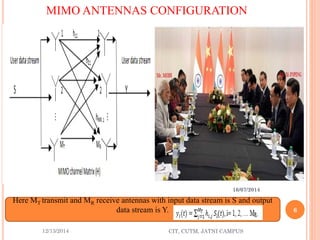
MIMO ANTENNAS CONFIGURATION 
12/13/2014 CIT, CUTM, JATNI CAMPUS 
6 
Here MT transmit and MRreceive antennas with input data stream is S and output data stream is Y. 
16/07/2014
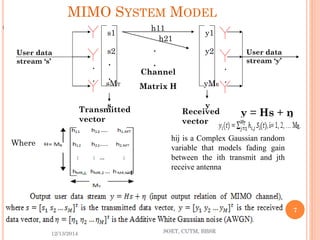
MIMO SYSTEMMODEL 
y= Hs+ ŋ 
User data stream ‘y’ 
. 
. 
User data stream ‘s’ 
. 
. 
. 
. 
Channel 
Matrix H 
s1 
s2 
sMT 
s 
y1 
y2 
yMR 
y 
Transmitted vector 
Received vector 
. 
. 
h11 
h21 
Where 
hijisaComplexGaussianrandomvariablethatmodelsfadinggainbetweentheithtransmitandjthreceiveantenna 
12/13/2014 
7 
SOET, CUTM, BBSR 
j
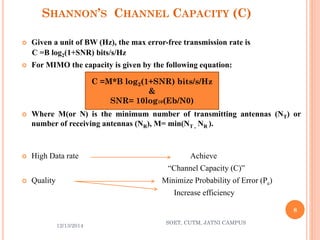
SHANNON’SCHANNELCAPACITY(C) 
GivenaunitofBW(Hz),themaxerror-freetransmissionrateis 
C=Blog2(1+SNR)bits/s/Hz 
ForMIMOthecapacityisgivenbythefollowingequation: 
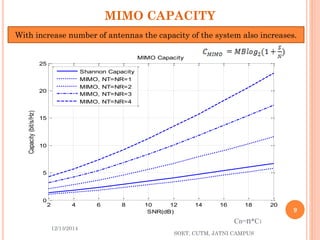
WhereM(orN)istheminimumnumberoftransmittingantennas(NT)ornumberofreceivingantennas(NR),M=min(NT,NR). 
HighDatarateAchieve 
“ChannelCapacity(C)” 
QualityMinimizeProbabilityofError(Pe) 
Increaseefficiency 
12/13/2014 
8 
SOET, CUTM, JATNI CAMPUS 
C =M*B log2(1+SNR) bits/s/Hz 
& 
SNR= 10log10(Eb/N0)
MIMO CAPACITY 
With increase number of antennas the capacity of the system also increases. 
12/13/2014 
9 
SOET, CUTM, JATNI CAMPUS 
2 4 6 8 10 12 14 16 18 20 
0 
5 
10 
15 
20 
25 
SNR(dB) 
Capacity (bit/s/Hz) 
MIMO Capacity 
Shannon Capacity 
MIMO, NT=NR=1 
MIMO, NT=NR=2 
MIMO, NT=NR=3 
MIMO, NT=NR=4 
Cn=n*C1
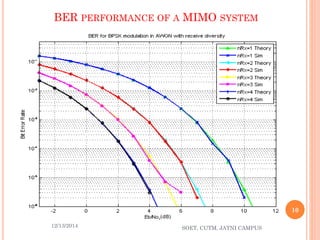
BER PERFORMANCEOFAMIMO SYSTEM 
12/13/2014 
10 
SOET, CUTM, JATNI CAMPUS
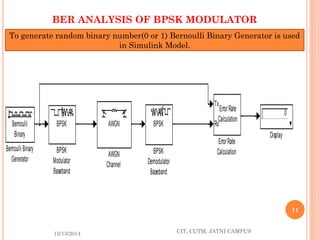
BER ANALYSIS OF BPSK MODULATOR 
Error Rate 
Calculation 
Tx 
Rx 
Error Rate 
Calculation 
0 
0 
Display 
Bernoulli 
Binary 
Bernoulli Binary 
Generator 
BPSK 
BPSK 
Modulator 
Baseband 
BPSK 
BPSK 
Demodulator 
Baseband 
AWGN 
AWGN 
Channel 
To generate random binary number(0 or 1) Bernoulli Binary Generator is used 
in Simulink Model. 
12/13/2014 
11 
CIT, CUTM, JATNI CAMPUS
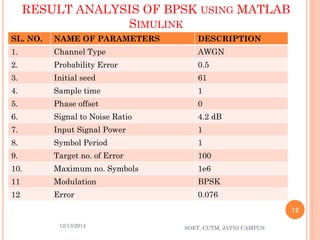
RESULT ANALYSIS OF BPSK USINGMATLAB SIMULINK 
SL. NO. 
NAME OF PARAMETERS 
DESCRIPTION 
1. 
Channel Type 
AWGN 
2. 
ProbabilityError 
0.5 
3. 
Initial seed 
61 
4. 
Sample time 
1 
5. 
Phase offset 
0 
6. 
Signal to Noise Ratio 
4.2 dB 
7. 
Input Signal Power 
1 
8. 
Symbol Period 
1 
9. 
Targetno. of Error 
100 
10. 
Maximum no.Symbols 
1e6 
11 
Modulation 
BPSK 
12 
Error 
0.076 
12/13/2014 
12 
SOET, CUTM, JATNI CAMPUS
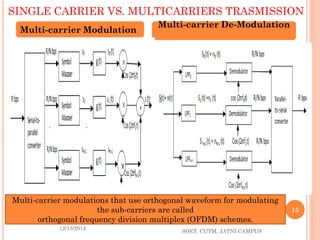
SINGLE CARRIER VS. MULTICARRIERS TRASMISSION 
12/13/2014 
SOET, CUTM, JATNI CAMPUS 
13 
Multi-carrier Modulation 
Multi-carrier De-Modulation 
Multi-carrier modulations that use orthogonal waveform for modulating the sub-carriers are called 
orthogonal frequency division multiplex (OFDM) schemes.
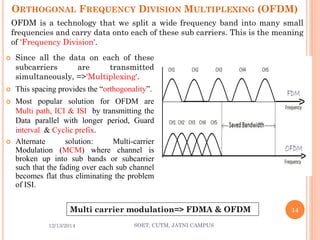
ORTHOGONALFREQUENCYDIVISIONMULTIPLEXING(OFDM) 
Sinceallthedataoneachofthesesubcarriersaretransmittedsimultaneously,=>'Multiplexing'. 
Thisspacingprovidesthe“orthogonality”. 
MostpopularsolutionforOFDMareMultipath,ICI&ISIbytransmittingtheDataparallelwithlongerperiod,Guardinterval&Cyclicprefix. 
Alternatesolution:Multi-carrierModulation(MCM)wherechannelisbrokenupintosubbandsorsubcarriersuchthatthefadingovereachsubchannelbecomesflatthuseliminatingtheproblemofISI. 
Multi carrier modulation=> FDMA & OFDM 
12/13/2014 
14 
SOET, CUTM, JATNI CAMPUS 
OFDMisatechnologythatwesplitawidefrequencybandintomanysmallfrequenciesandcarrydataontoeachofthesesubcarriers.Thisisthemeaningof'FrequencyDivision'.
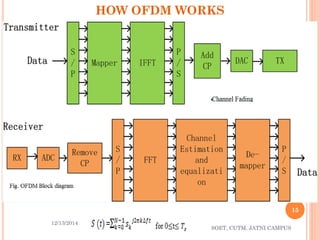
HOW OFDM WORKS 
12/13/2014 
15 
SOET, CUTM, JATNI CAMPUS
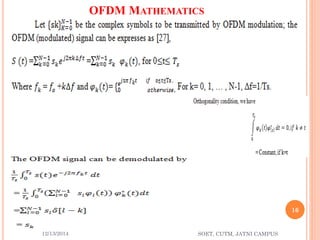
OFDM MATHEMATICS 
12/13/2014 
16 
SOET, CUTM, JATNI CAMPUS
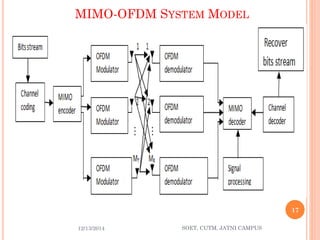
MIMO-OFDM SYSTEMMODEL 
12/13/2014 
17 
SOET, CUTM, JATNI CAMPUS
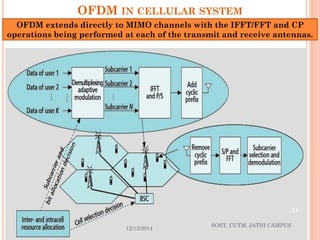
OFDM INCELLULARSYSTEM 
OFDM extends directly to MIMO channels with the IFFT/FFT and CP operations being performed at each of the transmit and receive antennas. 
12/13/2014 
18 
SOET, CUTM, JATNI CAMPUS
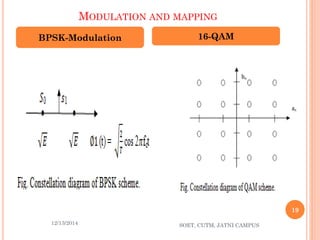
MODULATIONANDMAPPING 
BPSK-Modulation 
16-QAM 
12/13/2014 
19 
SOET, CUTM, JATNI CAMPUS
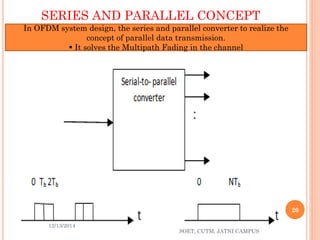
SERIES AND PARALLEL CONCEPT 
In OFDM system design, the series and parallel converter to realize the concept of parallel data transmission. 
It solves the Multipath Fading in the channel 
12/13/2014 
20 
SOET, CUTM, JATNI CAMPUS
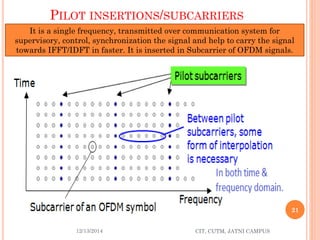
PILOTINSERTIONS/SUBCARRIERS 
12/13/2014 
21 
CIT, CUTM, JATNI CAMPUS 
It is a single frequency, transmitted over communication system for supervisory, control, synchronization the signal and help to carry the signal towards IFFT/IDFT in faster. It is inserted in Subcarrier of OFDM signals.
INTERFERENCES 
12/13/2014 SOET, CUTM, JATNI CAMPUS 
22 
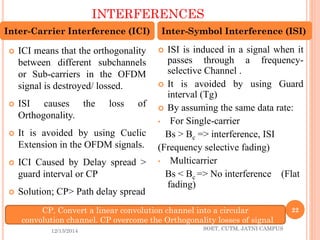
ICImeansthattheorthogonalitybetweendifferentsubchannelsorSub-carriersintheOFDMsignalisdestroyed/lossed. 
ISIcausesthelossofOrthogonality. 
ItisavoidedbyusingCuclicExtensionintheOFDMsignals. 
ICICausedbyDelayspread> guardintervalorCP 
Solution;CP>Pathdelayspread 
ISIisinducedinasignalwhenitpassesthroughafrequency- selectiveChannel. 
ItisavoidedbyusingGuardinterval(Tg) 
By assuming the same data rate: 
•For Single-carrier 
Bs > Bc=> interference, ISI 
(Frequency selective fading) 
•Multicarrier 
Bs < Bc => No interference (Flat fading) 
Inter-Carrier Interference (ICI) 
Inter-Symbol Interference (ISI) 
CP, Convert a linear convolution channel into a circular 
convolution channel. CP overcome the Orthogonality losses of signal
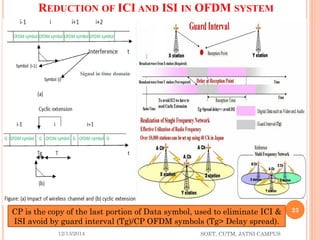
REDUCTIONOFICI ANDISI INOFDM SYSTEM 
12/13/2014 SOET, CUTM, JATNI CAMPUS 
23 
CP is the copy of the last portion of Data symbol, used to eliminate ICI & ISI avoid by guard interval (Tg)/CP OFDM symbols (Tg> Delay spread). 
Signal in time domain
IFFT & FFT OPERATION 
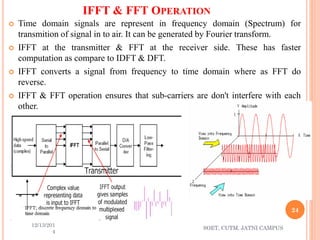
Timedomainsignalsarerepresentinfrequencydomain(Spectrum)fortransmitionofsignalintoair.ItcanbegeneratedbyFouriertransform. 
IFFTatthetransmitter&FFTatthereceiverside.ThesehasfastercomputationascomparetoIDFT&DFT. 
IFFTconvertsasignalfromfrequencytotimedomainwhereasFFTdoreverse. 
IFFT&FFToperationensuresthatsub-carriersaredon'tinterferewitheachother. 
12/13/201 
4 
24 
SOET, CUTM, JATNI CAMPUS
ORTHOGONALITY 
12/13/2014 
25 
SOET, CUTM, JATNI CAMPUS 
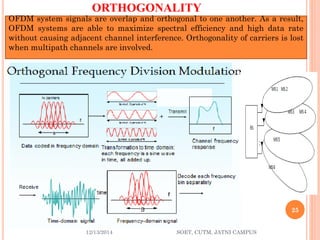
OFDMsystemsignalsareoverlapandorthogonaltooneanother.Asaresult, OFDMsystemsareabletomaximizespectralefficiencyandhighdataratewithoutcausingadjacentchannelinterference.Orthogonalityofcarriersislostwhenmultipathchannelsareinvolved.
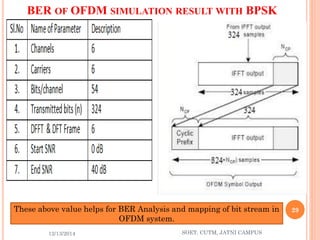
BER ANALYSIS AND MAPPING OF OFDM TECHNIQUE 
0 50 100 150 200 250 300 350 
-1 
-0.8 
-0.6 
-0.4 
-0.2 
0 
0.2 
0.4 
0.6 
0.8 
1 
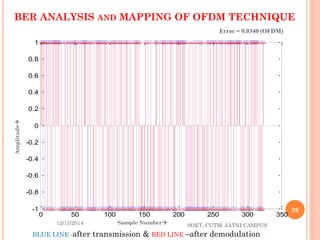
BLUE LINE -after transmission & RED LINE –after demodulation 
12/13/2014 
26 
SOET, CUTM, JATNI CAMPUS 
Sample Number 
Amplitude 
Error = 0.0340 (OFDM)
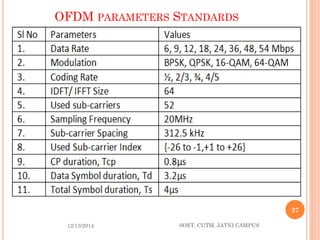
OFDM PARAMETERSSTANDARDS 
12/13/2014 
27 
SOET, CUTM, JATNI CAMPUS
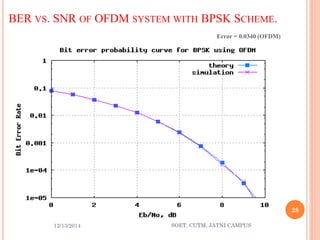
BERVS.SNROFOFDMSYSTEMWITHBPSKSCHEME. 
12/13/2014 
28 
SOET, CUTM, JATNI CAMPUS 
Error= 0.0340 (OFDM)
BER OFOFDM SIMULATIONRESULTWITHBPSK 
12/13/2014 
29 
SOET, CUTM, JATNI CAMPUS 
These above value helps for BER Analysis and mapping of bit stream in OFDM system.
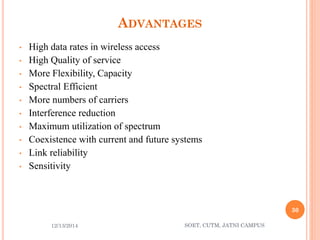
ADVANTAGES 
•High data rates in wireless access 
•High Quality of service 
•More Flexibility, Capacity 
•Spectral Efficient 
•More numbers of carriers 
•Interference reduction 
•Maximum utilization of spectrum 
•Coexistence with current and future systems 
•Link reliability 
•Sensitivity 
12/13/2014 
30 
SOET, CUTM, JATNI CAMPUS
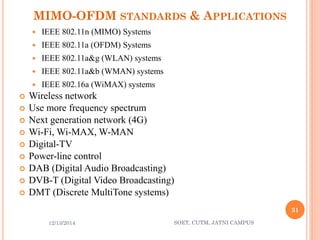
MIMO-OFDM STANDARDS& APPLICATIONS 
IEEE 802.11n (MIMO) Systems 
IEEE 802.11a (OFDM) Systems 
IEEE 802.11a&g (WLAN) systems 
IEEE 802.11a&b (WMAN) systems 
IEEE 802.16a (WiMAX) systems 
Wireless network 
Use more frequency spectrum 
Next generation network (4G) 
Wi-Fi, Wi-MAX, W-MAN 
Digital-TV 
Power-line control 
DAB (Digital Audio Broadcasting) 
DVB-T (Digital Video Broadcasting) 
DMT (Discrete MultiTone systems) 
12/13/2014 
31 
SOET, CUTM, JATNI CAMPUS
CONCLUSION 
Inthisthesiswork,thebasicconceptsofaMIMO-OFDMsystemwithrelevantdesignandperformanceparametersintheoretical&practicalarestudied.ThegeneralizedblockdiagramofabasicMIMO-OFDMsystemwhichincludesanumberoftransmittingandreceivingantennasatthebothendstomaximizedataratesandefficiencyofthesystemhasbeenexplainedinbrief.Further,theBERisreducedandperformanceanalysisofMIMO-OFDMsystemswithBPSKmodulationhasbeencoveredinthisthesis. 
12/13/2014 
32 
SOET, CUTM, JATNI CAMPUS
FUTURE SCOPE 
TheBERperformanceofMIMO-OFDMsystemwithvariousequalizerscanbeoptimizedwithdifferentbio-inspiredoptimizationtechniques. 
TheBERPerformanceofMIMO-OFDMsystemcanbeanalyzedbyusingChannelEstimation(LMS,RLSandRLMS) Algorithm. 
PerformanceofMIMO-OFDMsystemcanbeapplicableinVideoBroadcasting,RadioProcessingandSpeechProcessinginWirelesscommunicationSystem. 
MIMO-OFDMfor4GnetworkusingLTE,AdvancedLTE, Timespacecoding,MIMO-WiMAX,MIMO-OFDMLi-Fi… 
12/13/2014 
33 
SOET, CUTM, JATNI CAMPUS
REFERENCES 
[1]YashvantDhiwarandRakeshMandal,“PerformanceAnalysisofVariousEqualizersforISIreductioninMIMO-OFDMSystem,”InternationalJournalofResearchinAdventTechnology(IJRAT),vol.2,no.3,pp.16-20,March.2014. 
[2]SabitaGauniandKumarRamamoorthy,“AnalysisofReductioninComplexityofMIMO-OFDMSystemswithFrequencyOffsetEstimationandcorrection,”JournalofComputerScience(JCS),Vol.10,No.2,pp.198-209,2014. 
[3]BetsyJoseandMr.B.SatishKumar,“DesignofMIMO-OFDMSDMSystemsforHighSpeedDataTransmission,” InternationalJournalofInformation&ComputationTechnology(IJICT),Vol.4,No.1,pp.1-8,2014. 
[4]H.Ajra,Md.ZahidHasan,andMd.ShohidulIslam,“BERAnalysisofVariousChannelEqualizationSchemesofaQO- STBCEncodedOFDMbasedMIMOCDMASystem,“InternationalJournalComputerNetworkandInformationSecurity(IJCNIS),Vol.3,No.4,pp.30-36,2014. 
[5]Mr.AtulSubghKushwah,“PerformanceAnalysisof2*4MIMO-MC-CDMAinRayleighFadingChannelZF-decoder,” InternationalJournalofEngineeringTrendsandTechnology(IJETT),Vol.8,Issue4,pp.1-4,Feb.2014. 
[6]Mr.SivanagarajuandDr.Siddaiah,”ComprehensiveAnalysisofBERandSNRinOFDMSystems,“InternationalJournalofInnovativeResearchinComputerandCommunicationEngineering(IJIRCCE),Vol.2,Issue2,pp.3059- 3065,Feb.2014. 
[7]N.Achra,G.Mathur,andR.P.Yadav,”PerformanceAnalysisofMIMO-OFDMSystemforDifferentModulationSchemesunderVariousFadingChannels,“InternationalJournalofAdvancedResearchinComputerandCommunicationEngineering(IJARCCE),Vol.2,Issue5,pp.2098-2103,May.2013. 
[8]S.KumarandDeepakKedia,”StudyandPerformanceAnalysisofaGeneralMIMO-OFDMSystemforNextGenerationCommunicationSystems,”InternationalJournalofElectronicsCommunicationandComputerTechnology(IJECCT),Vol.3,Issue5,pp.460-463,Sept.2013. 
12/13/2014 
34 
SOET, CUTM, JATNI CAMPUS
REFERENCES 
[9]M.Divya,“BERperformanceofBPSKmodulationandOFDM-BPSKwithRayleinghmultipathchannel,”IJEAT,vol.2, Issue4,pp.623-626,April.2013. 
[10]P.WadhwaandG.Gupta,“BERAnalysis&ComparisonofDifferentEqualizationTechniquesforMIMO-OFDMSystem,”InternationalJournalofAdvancedResearchinComputerScienceandSoftwareEngineering(IJARCSE),Vol.3, Issue6,pp.1682-1688,June2013. 
[11]M.AbuFaisal,M.HossainandShaikhE.Ulaah,“PerfomanceEvaluationofaAntennaMC-CDMASystemonColorImageTransmissionunderImplementationofVariousSignalDetectionTechniques,”InternationalJournalofAdvancedScienceandTechnology(IJAST),Vol.41,pp.71-82,April.2012. 
[12]N.Sood,A.K.Sharma,andM.Uddin,“BERPerformanceofOFDM-BPSKandQPSKOverGeneralizedGammaFadingChannel,”InternationalJournalofComputerApplications(IJCA),Vol.3,No.6,pp.13-16,June2010. 
[13]AmitavaGhoshandTimThomas,“LTE-Advanced:Nextgenerationwirelessbroadbandtechnology,”IEEETrans. commun.,pp.10-22,June2010. 
[14]K.BenLetaiefandYingJun,“Dynamicmultiuserresourceallocationandadaptationforwirelesssystems,”IEEETrans. Commun.,vol.57,pp.38-47,Aug.2006. 
[15]WeiZhangandXiangGenXia,“Space-time/frequencycodingforMIMO-OFDMinNextgenerationbroadbandwirelesssystems,”IEEEWirelessCommun.,pp.32-43,Aug.2007. 
[16]HelmutBolcskelandETHZurich,”MIMO-OFDMwirelesssystems,”IEEEwirelesscommun.Vol.64,pp.31-37,Aug. 2006. 
12/13/2014 
35 
SOET, CUTM, JATNI CAMPUS
PUBLICATION 
NimayCh.Giri,RupanitaDasandSKMohammedAli,“BERAnalysisAndPerformanceOfMimo-ofdmSystemUsingBPSKModulationSchemeForNextGenerationCommunicationSystems,”InternationalJournalofEngineeringSciences&ResearchTechnology(IJESRT),Vol.3,Issue3,pp.1622-1629,March2014. 
NimayChandraGiri,ShanazAmanandDebarajRana,“BERandPerformanceofMIMOSystemforWirelessCommunication,”EmergentTrendsinComputingandCommunication(ETCC),Vol.4,May2014. 
NimayCh.Giri1,AnweshaSahoo2,J.R.Swain3,P.Kumar4,A.Nayak5,P. Debogoswami6“Capacity&PerformanceComparisonofSISOandMIMOSystemforNextGenerationNetwork(NGN),”IJARCET,Vol.3, Issue9,Sept.2014. 
12/13/2014 
36 
SOET, CUTM, JATNI CAMPUS
THANK YOU 
12/13/2014 
37 
SOET, CUTM, JATNI CAMPUS
ANY QUERY ? 
12/13/2014 
38 
SOET, CUTM, JATNI CAMPUS

MIMO-OFDM for 4G network

  • 1.
    “BER Analysis andPerformance of MIMO-OFDM System using BPSK Modulation Scheme For Next Generation Communication Systems” Presented by: Mr. NIMAY CHANDRA GIRI Dept. of ECE
  • 2.
    CONTENTS OBJECTIVE INTRODUCTION LITERATURE REVIEW MIMO TRANSMITTER & RECIEVER WITH RESULTS BPSK SYSTEM OFDM TECHNIQUE WITH RESULTS MIMO-OFDM SYSTEM SINGLE-CARRIER VS. MULTI-CARRIERS ADVANTAGES APPLICATION CONCLUSION FUTURE SCOPE REFERENCES PUBLICATION 12/13/2014 2 SOET, CUTM, JATNI CAMPUS
  • 3.
    OBJECTIVE •MIMOSystem:highdatarates&increasedcapacityofthesystem •OFDMTechnique:reducedMultipathfading,ICIandISI&provideMulti-carrierOrthogonalSignals. •BPSKModulation:Longdistancetransmission&usedineachblockofIDFT/IFFTofMIMO-OFDMmodelformappingdatastreams. •InthisthesisWork,IcomparetheBERvs.SNRofMIMO-OFDMSystemusingBPSKmodulation,andperformanceofMIMO- OFDMsystemfor4Gnetworks. 12/13/2014 3 SOET, CUTM, JATNI CAMPUS
  • 4.
    INTRODUCTION MIMO-OFDMisahottopicintodaymodernwirelesscommunicationsinceallwirelesstechnologieslikePAN,LAN,W-LAN,MAN,W-MAN&WAN. Inthe1980s,MIMO-OFDMhasbeenstudiedforhigh-speedtransmission. MIMOSystemhavemultipleinputsandmultipleoutputsantennas. •MultiplexingGain=>Spectralefficiencyincreases •DiversityGain=>CombatsFading •InterferenceReductionGain=>Capacityincreases oOFDM=OrthogonalFDM(ItwasinventedduringWorldWar-II,1939-194580Hzoffrequencyused) oOFDMisacombinationofModulation&Multiplexingtechniques. •OFDM is a multicarrier block transmission system. •Block of ‘N’ symbols are grouped and sent parallely. •No interference among the data symbols sent in a block. MIMOSystemandOFDMModulationTechnique •Air-interface(ICI&ISI)solutions •MoreFlexibility,Capacity&Efficiency •More numbers of carriers •Increase data rates and SNR with reducing BER. 12/13/2014 4 SOET, CUTM, JATNI CAMPUS
  • 5.
    LITERATURE REVIEW 12/13/2014 5 SOET, CUTM, JATNI CAMPUS Titleof Papers Author’s name Year Work done Performance analysis of various equalizer for ISI reduction in MIMO- OFDM system. Yashvant Dhiwar, Rakesh Mandal 2014 ISI reduction using Equalizationtechnique (ZF, MMSE) Analysis Of Reduction In Complexity Of MIMO- OFDM System. Sabitha Gauni, Kumar Ramamoorthy 2014 CFO estimation and correction by the help of ML estimator. Design of MIMO OFDM SDM Systems for High Speed Data Transmission Betsy Jose, Mr. B. Satish Kumar 2014 BERreduction and high data rates by using 2*2 MIMO-OFDM system, MATLAB BER analysis of various channel equalization in OFDM based MIMO CDMA system Husnul Ajra, Md. Zahid Hasan, Md. Shohidul Islam 2014 using QO-STBC method forchannel equalization & BER reduction Bit Error Rate Performance of BPSK Modulation and OFDM- BPSK with Rayleigh Multipath Channel M. Divya 2013 BERperformance is analyzed using BPSK & OFDM-BPSK modulation technique
  • 6.
    MIMO ANTENNAS CONFIGURATION 12/13/2014 CIT, CUTM, JATNI CAMPUS 6 Here MT transmit and MRreceive antennas with input data stream is S and output data stream is Y. 16/07/2014
  • 7.
    MIMO SYSTEMMODEL y=Hs+ ŋ User data stream ‘y’ . . User data stream ‘s’ . . . . Channel Matrix H s1 s2 sMT s y1 y2 yMR y Transmitted vector Received vector . . h11 h21 Where hijisaComplexGaussianrandomvariablethatmodelsfadinggainbetweentheithtransmitandjthreceiveantenna 12/13/2014 7 SOET, CUTM, BBSR j
  • 8.
    SHANNON’SCHANNELCAPACITY(C) GivenaunitofBW(Hz),themaxerror-freetransmissionrateis C=Blog2(1+SNR)bits/s/Hz ForMIMOthecapacityisgivenbythefollowingequation: WhereM(orN)istheminimumnumberoftransmittingantennas(NT)ornumberofreceivingantennas(NR),M=min(NT,NR). HighDatarateAchieve “ChannelCapacity(C)” QualityMinimizeProbabilityofError(Pe) Increaseefficiency 12/13/2014 8 SOET, CUTM, JATNI CAMPUS C =M*B log2(1+SNR) bits/s/Hz & SNR= 10log10(Eb/N0)
  • 9.
    MIMO CAPACITY Withincrease number of antennas the capacity of the system also increases. 12/13/2014 9 SOET, CUTM, JATNI CAMPUS 2 4 6 8 10 12 14 16 18 20 0 5 10 15 20 25 SNR(dB) Capacity (bit/s/Hz) MIMO Capacity Shannon Capacity MIMO, NT=NR=1 MIMO, NT=NR=2 MIMO, NT=NR=3 MIMO, NT=NR=4 Cn=n*C1
  • 10.
    BER PERFORMANCEOFAMIMO SYSTEM 12/13/2014 10 SOET, CUTM, JATNI CAMPUS
  • 11.
    BER ANALYSIS OFBPSK MODULATOR Error Rate Calculation Tx Rx Error Rate Calculation 0 0 Display Bernoulli Binary Bernoulli Binary Generator BPSK BPSK Modulator Baseband BPSK BPSK Demodulator Baseband AWGN AWGN Channel To generate random binary number(0 or 1) Bernoulli Binary Generator is used in Simulink Model. 12/13/2014 11 CIT, CUTM, JATNI CAMPUS
  • 12.
    RESULT ANALYSIS OFBPSK USINGMATLAB SIMULINK SL. NO. NAME OF PARAMETERS DESCRIPTION 1. Channel Type AWGN 2. ProbabilityError 0.5 3. Initial seed 61 4. Sample time 1 5. Phase offset 0 6. Signal to Noise Ratio 4.2 dB 7. Input Signal Power 1 8. Symbol Period 1 9. Targetno. of Error 100 10. Maximum no.Symbols 1e6 11 Modulation BPSK 12 Error 0.076 12/13/2014 12 SOET, CUTM, JATNI CAMPUS
  • 13.
    SINGLE CARRIER VS.MULTICARRIERS TRASMISSION 12/13/2014 SOET, CUTM, JATNI CAMPUS 13 Multi-carrier Modulation Multi-carrier De-Modulation Multi-carrier modulations that use orthogonal waveform for modulating the sub-carriers are called orthogonal frequency division multiplex (OFDM) schemes.
  • 14.
    ORTHOGONALFREQUENCYDIVISIONMULTIPLEXING(OFDM) Sinceallthedataoneachofthesesubcarriersaretransmittedsimultaneously,=>'Multiplexing'. Thisspacingprovidesthe“orthogonality”. MostpopularsolutionforOFDMareMultipath,ICI&ISIbytransmittingtheDataparallelwithlongerperiod,Guardinterval&Cyclicprefix. Alternatesolution:Multi-carrierModulation(MCM)wherechannelisbrokenupintosubbandsorsubcarriersuchthatthefadingovereachsubchannelbecomesflatthuseliminatingtheproblemofISI. Multi carrier modulation=> FDMA & OFDM 12/13/2014 14 SOET, CUTM, JATNI CAMPUS OFDMisatechnologythatwesplitawidefrequencybandintomanysmallfrequenciesandcarrydataontoeachofthesesubcarriers.Thisisthemeaningof'FrequencyDivision'.
  • 15.
    HOW OFDM WORKS 12/13/2014 15 SOET, CUTM, JATNI CAMPUS
  • 16.
    OFDM MATHEMATICS 12/13/2014 16 SOET, CUTM, JATNI CAMPUS
  • 17.
    MIMO-OFDM SYSTEMMODEL 12/13/2014 17 SOET, CUTM, JATNI CAMPUS
  • 18.
    OFDM INCELLULARSYSTEM OFDMextends directly to MIMO channels with the IFFT/FFT and CP operations being performed at each of the transmit and receive antennas. 12/13/2014 18 SOET, CUTM, JATNI CAMPUS
  • 19.
    MODULATIONANDMAPPING BPSK-Modulation 16-QAM 12/13/2014 19 SOET, CUTM, JATNI CAMPUS
  • 20.
    SERIES AND PARALLELCONCEPT In OFDM system design, the series and parallel converter to realize the concept of parallel data transmission. It solves the Multipath Fading in the channel 12/13/2014 20 SOET, CUTM, JATNI CAMPUS
  • 21.
    PILOTINSERTIONS/SUBCARRIERS 12/13/2014 21 CIT, CUTM, JATNI CAMPUS It is a single frequency, transmitted over communication system for supervisory, control, synchronization the signal and help to carry the signal towards IFFT/IDFT in faster. It is inserted in Subcarrier of OFDM signals.
  • 22.
    INTERFERENCES 12/13/2014 SOET,CUTM, JATNI CAMPUS 22 ICImeansthattheorthogonalitybetweendifferentsubchannelsorSub-carriersintheOFDMsignalisdestroyed/lossed. ISIcausesthelossofOrthogonality. ItisavoidedbyusingCuclicExtensionintheOFDMsignals. ICICausedbyDelayspread> guardintervalorCP Solution;CP>Pathdelayspread ISIisinducedinasignalwhenitpassesthroughafrequency- selectiveChannel. ItisavoidedbyusingGuardinterval(Tg) By assuming the same data rate: •For Single-carrier Bs > Bc=> interference, ISI (Frequency selective fading) •Multicarrier Bs < Bc => No interference (Flat fading) Inter-Carrier Interference (ICI) Inter-Symbol Interference (ISI) CP, Convert a linear convolution channel into a circular convolution channel. CP overcome the Orthogonality losses of signal
  • 23.
    REDUCTIONOFICI ANDISI INOFDMSYSTEM 12/13/2014 SOET, CUTM, JATNI CAMPUS 23 CP is the copy of the last portion of Data symbol, used to eliminate ICI & ISI avoid by guard interval (Tg)/CP OFDM symbols (Tg> Delay spread). Signal in time domain
  • 24.
    IFFT & FFTOPERATION Timedomainsignalsarerepresentinfrequencydomain(Spectrum)fortransmitionofsignalintoair.ItcanbegeneratedbyFouriertransform. IFFTatthetransmitter&FFTatthereceiverside.ThesehasfastercomputationascomparetoIDFT&DFT. IFFTconvertsasignalfromfrequencytotimedomainwhereasFFTdoreverse. IFFT&FFToperationensuresthatsub-carriersaredon'tinterferewitheachother. 12/13/201 4 24 SOET, CUTM, JATNI CAMPUS
  • 25.
    ORTHOGONALITY 12/13/2014 25 SOET, CUTM, JATNI CAMPUS OFDMsystemsignalsareoverlapandorthogonaltooneanother.Asaresult, OFDMsystemsareabletomaximizespectralefficiencyandhighdataratewithoutcausingadjacentchannelinterference.Orthogonalityofcarriersislostwhenmultipathchannelsareinvolved.
  • 26.
    BER ANALYSIS ANDMAPPING OF OFDM TECHNIQUE 0 50 100 150 200 250 300 350 -1 -0.8 -0.6 -0.4 -0.2 0 0.2 0.4 0.6 0.8 1 BLUE LINE -after transmission & RED LINE –after demodulation 12/13/2014 26 SOET, CUTM, JATNI CAMPUS Sample Number Amplitude Error = 0.0340 (OFDM)
  • 27.
    OFDM PARAMETERSSTANDARDS 12/13/2014 27 SOET, CUTM, JATNI CAMPUS
  • 28.
    BERVS.SNROFOFDMSYSTEMWITHBPSKSCHEME. 12/13/2014 28 SOET, CUTM, JATNI CAMPUS Error= 0.0340 (OFDM)
  • 29.
    BER OFOFDM SIMULATIONRESULTWITHBPSK 12/13/2014 29 SOET, CUTM, JATNI CAMPUS These above value helps for BER Analysis and mapping of bit stream in OFDM system.
  • 30.
    ADVANTAGES •High datarates in wireless access •High Quality of service •More Flexibility, Capacity •Spectral Efficient •More numbers of carriers •Interference reduction •Maximum utilization of spectrum •Coexistence with current and future systems •Link reliability •Sensitivity 12/13/2014 30 SOET, CUTM, JATNI CAMPUS
  • 31.
    MIMO-OFDM STANDARDS& APPLICATIONS IEEE 802.11n (MIMO) Systems IEEE 802.11a (OFDM) Systems IEEE 802.11a&g (WLAN) systems IEEE 802.11a&b (WMAN) systems IEEE 802.16a (WiMAX) systems Wireless network Use more frequency spectrum Next generation network (4G) Wi-Fi, Wi-MAX, W-MAN Digital-TV Power-line control DAB (Digital Audio Broadcasting) DVB-T (Digital Video Broadcasting) DMT (Discrete MultiTone systems) 12/13/2014 31 SOET, CUTM, JATNI CAMPUS
  • 32.
  • 33.
    FUTURE SCOPE TheBERperformanceofMIMO-OFDMsystemwithvariousequalizerscanbeoptimizedwithdifferentbio-inspiredoptimizationtechniques. TheBERPerformanceofMIMO-OFDMsystemcanbeanalyzedbyusingChannelEstimation(LMS,RLSandRLMS) Algorithm. PerformanceofMIMO-OFDMsystemcanbeapplicableinVideoBroadcasting,RadioProcessingandSpeechProcessinginWirelesscommunicationSystem. MIMO-OFDMfor4GnetworkusingLTE,AdvancedLTE, Timespacecoding,MIMO-WiMAX,MIMO-OFDMLi-Fi… 12/13/2014 33 SOET, CUTM, JATNI CAMPUS
  • 34.
    REFERENCES [1]YashvantDhiwarandRakeshMandal,“PerformanceAnalysisofVariousEqualizersforISIreductioninMIMO-OFDMSystem,”InternationalJournalofResearchinAdventTechnology(IJRAT),vol.2,no.3,pp.16-20,March.2014. [2]SabitaGauniandKumarRamamoorthy,“AnalysisofReductioninComplexityofMIMO-OFDMSystemswithFrequencyOffsetEstimationandcorrection,”JournalofComputerScience(JCS),Vol.10,No.2,pp.198-209,2014. [3]BetsyJoseandMr.B.SatishKumar,“DesignofMIMO-OFDMSDMSystemsforHighSpeedDataTransmission,” InternationalJournalofInformation&ComputationTechnology(IJICT),Vol.4,No.1,pp.1-8,2014. [4]H.Ajra,Md.ZahidHasan,andMd.ShohidulIslam,“BERAnalysisofVariousChannelEqualizationSchemesofaQO- STBCEncodedOFDMbasedMIMOCDMASystem,“InternationalJournalComputerNetworkandInformationSecurity(IJCNIS),Vol.3,No.4,pp.30-36,2014. [5]Mr.AtulSubghKushwah,“PerformanceAnalysisof2*4MIMO-MC-CDMAinRayleighFadingChannelZF-decoder,” InternationalJournalofEngineeringTrendsandTechnology(IJETT),Vol.8,Issue4,pp.1-4,Feb.2014. [6]Mr.SivanagarajuandDr.Siddaiah,”ComprehensiveAnalysisofBERandSNRinOFDMSystems,“InternationalJournalofInnovativeResearchinComputerandCommunicationEngineering(IJIRCCE),Vol.2,Issue2,pp.3059- 3065,Feb.2014. [7]N.Achra,G.Mathur,andR.P.Yadav,”PerformanceAnalysisofMIMO-OFDMSystemforDifferentModulationSchemesunderVariousFadingChannels,“InternationalJournalofAdvancedResearchinComputerandCommunicationEngineering(IJARCCE),Vol.2,Issue5,pp.2098-2103,May.2013. [8]S.KumarandDeepakKedia,”StudyandPerformanceAnalysisofaGeneralMIMO-OFDMSystemforNextGenerationCommunicationSystems,”InternationalJournalofElectronicsCommunicationandComputerTechnology(IJECCT),Vol.3,Issue5,pp.460-463,Sept.2013. 12/13/2014 34 SOET, CUTM, JATNI CAMPUS
  • 35.
    REFERENCES [9]M.Divya,“BERperformanceofBPSKmodulationandOFDM-BPSKwithRayleinghmultipathchannel,”IJEAT,vol.2, Issue4,pp.623-626,April.2013. [10]P.WadhwaandG.Gupta,“BERAnalysis&ComparisonofDifferentEqualizationTechniquesforMIMO-OFDMSystem,”InternationalJournalofAdvancedResearchinComputerScienceandSoftwareEngineering(IJARCSE),Vol.3, Issue6,pp.1682-1688,June2013. [11]M.AbuFaisal,M.HossainandShaikhE.Ulaah,“PerfomanceEvaluationofaAntennaMC-CDMASystemonColorImageTransmissionunderImplementationofVariousSignalDetectionTechniques,”InternationalJournalofAdvancedScienceandTechnology(IJAST),Vol.41,pp.71-82,April.2012. [12]N.Sood,A.K.Sharma,andM.Uddin,“BERPerformanceofOFDM-BPSKandQPSKOverGeneralizedGammaFadingChannel,”InternationalJournalofComputerApplications(IJCA),Vol.3,No.6,pp.13-16,June2010. [13]AmitavaGhoshandTimThomas,“LTE-Advanced:Nextgenerationwirelessbroadbandtechnology,”IEEETrans. commun.,pp.10-22,June2010. [14]K.BenLetaiefandYingJun,“Dynamicmultiuserresourceallocationandadaptationforwirelesssystems,”IEEETrans. Commun.,vol.57,pp.38-47,Aug.2006. [15]WeiZhangandXiangGenXia,“Space-time/frequencycodingforMIMO-OFDMinNextgenerationbroadbandwirelesssystems,”IEEEWirelessCommun.,pp.32-43,Aug.2007. [16]HelmutBolcskelandETHZurich,”MIMO-OFDMwirelesssystems,”IEEEwirelesscommun.Vol.64,pp.31-37,Aug. 2006. 12/13/2014 35 SOET, CUTM, JATNI CAMPUS
  • 36.
  • 37.
    THANK YOU 12/13/2014 37 SOET, CUTM, JATNI CAMPUS
  • 38.
    ANY QUERY ? 12/13/2014 38 SOET, CUTM, JATNI CAMPUS