CONTENTS
 Multicarrier Modulation
 OFDM
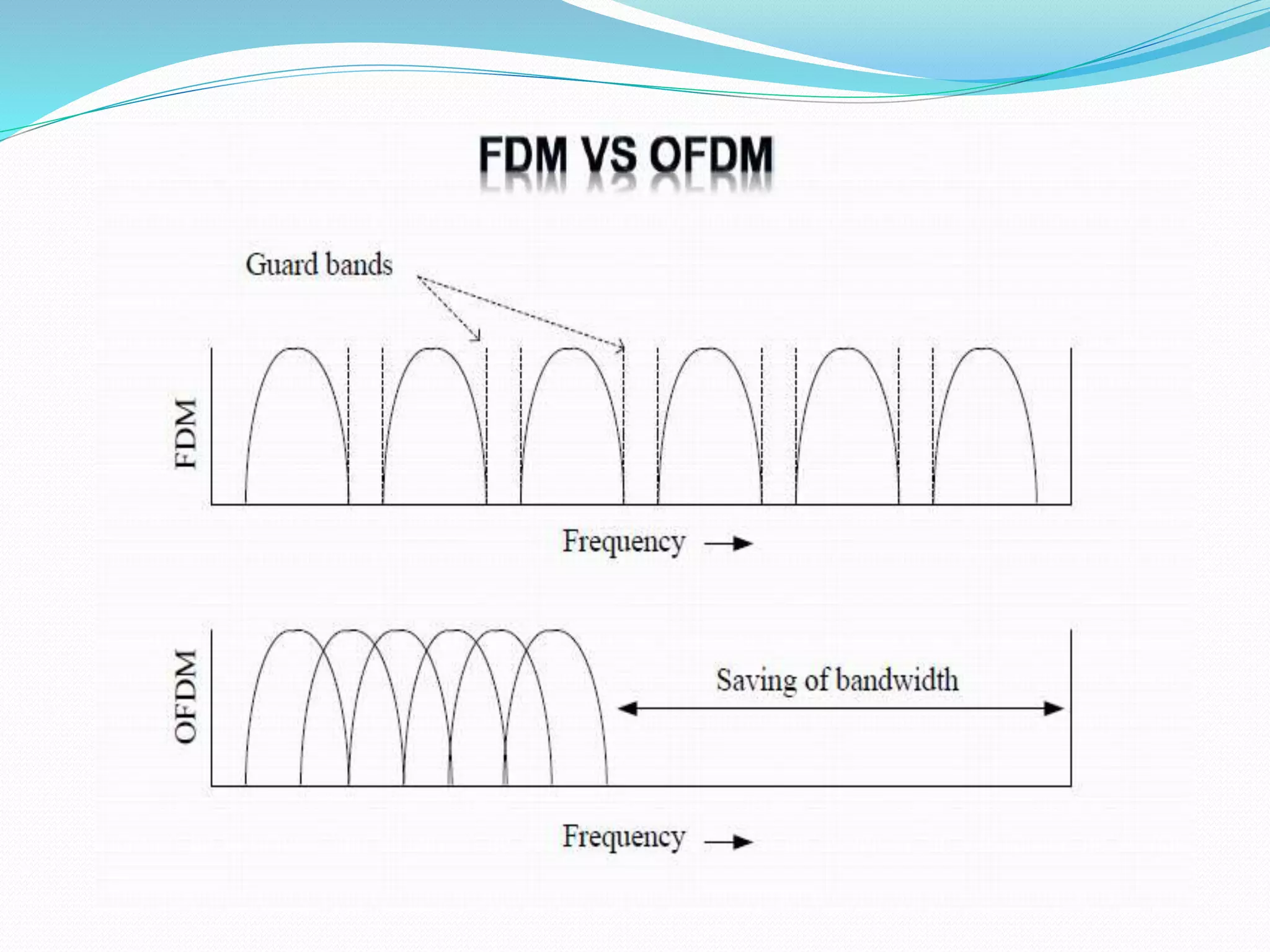
 OFDM vs. FDM
 OFDM Advantages
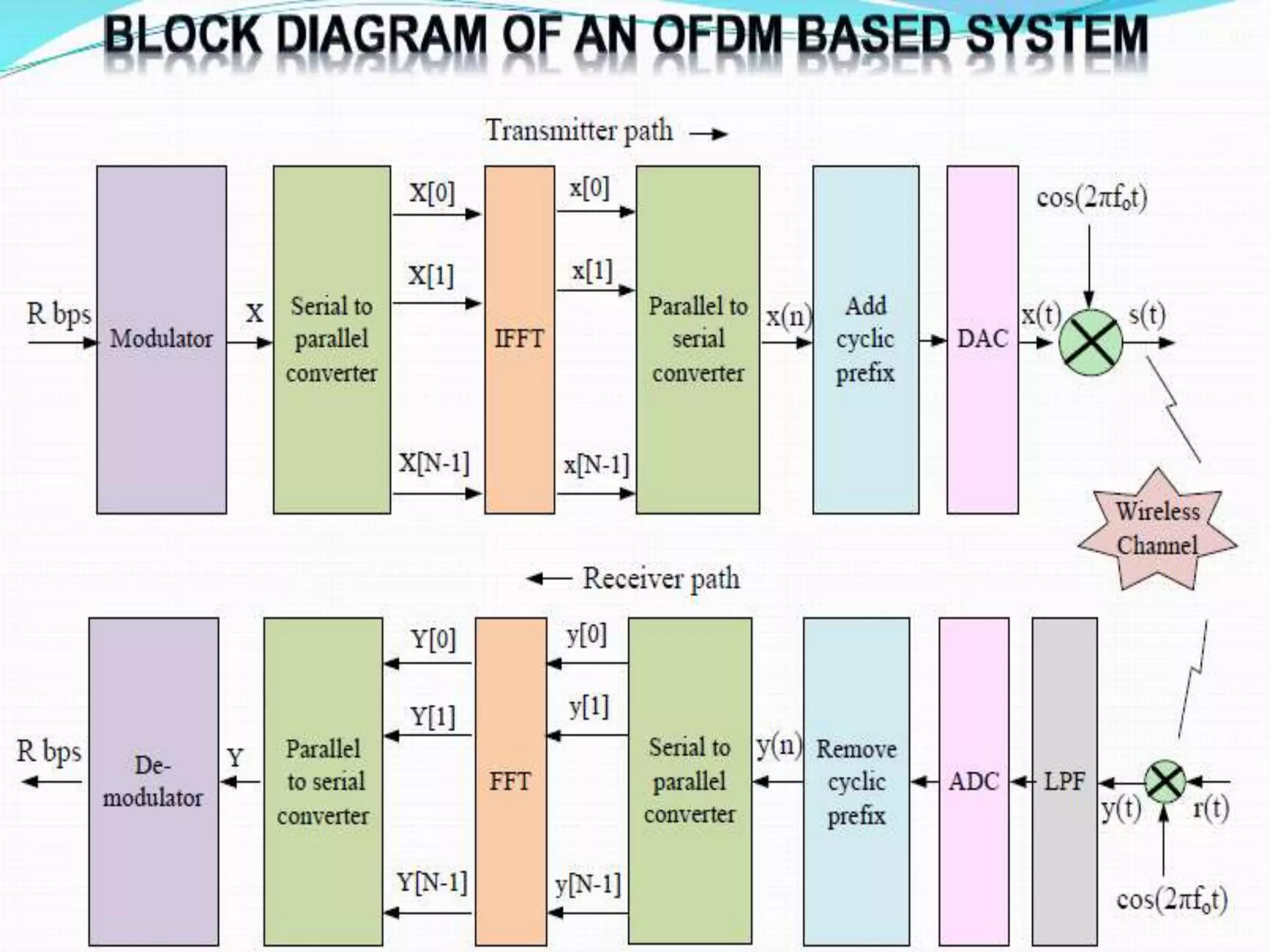
 Block diagram
 Cyclic prefix
 OFDM Disadvantages
 Conclusion
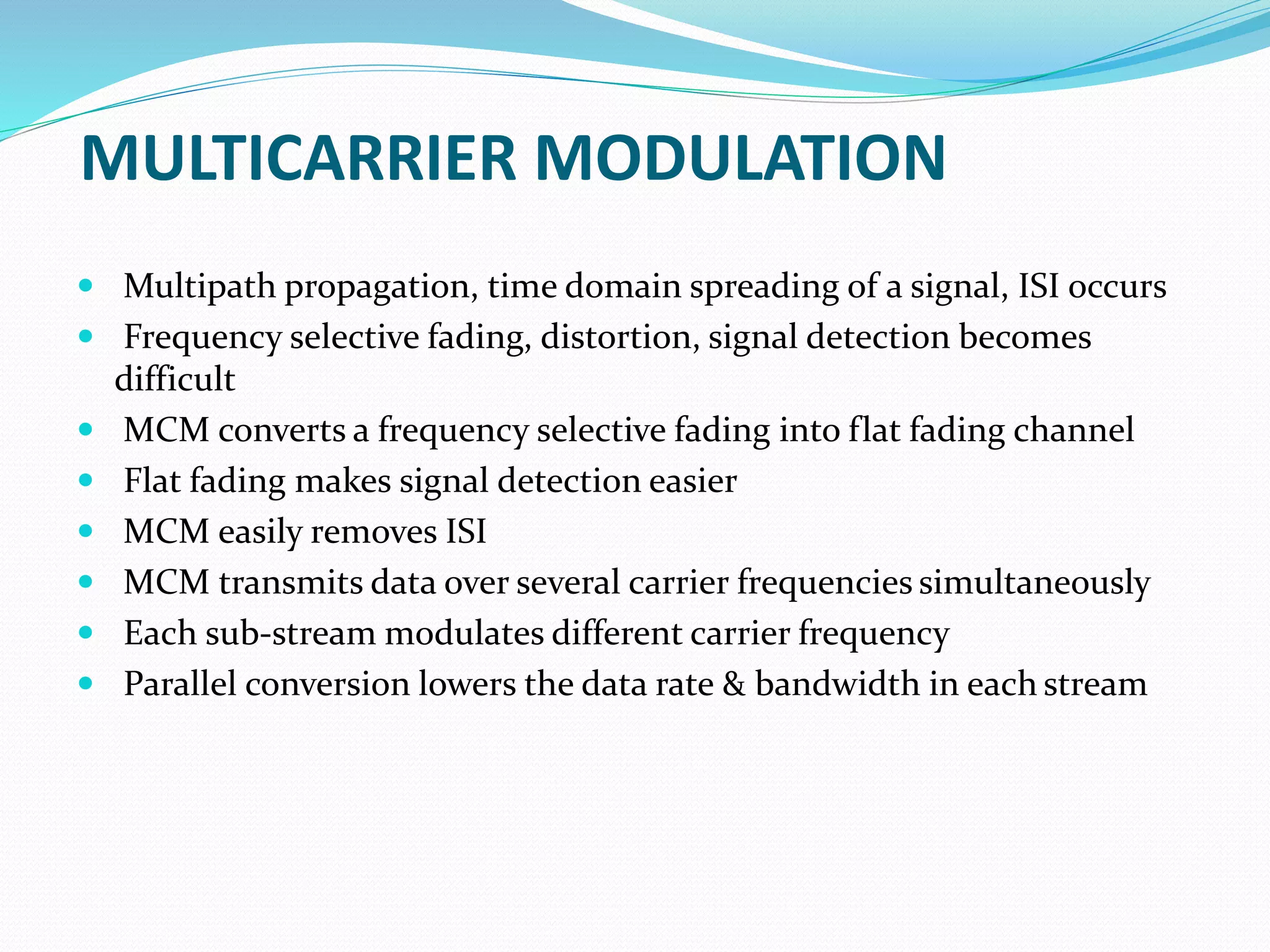
MULTICARRIER MODULATION
 Multipath propagation, time domain spreading of a signal, ISI occurs
 Frequency selective fading, distortion, signal detection becomes
difficult
 MCM converts a frequency selective fading into flat fading channel
 Flat fading makes signal detection easier
 MCM easily removes ISI
 MCM transmits data over several carrier frequencies simultaneously
 Each sub-stream modulates different carrier frequency
 Parallel conversion lowers the data rate & bandwidth in each stream
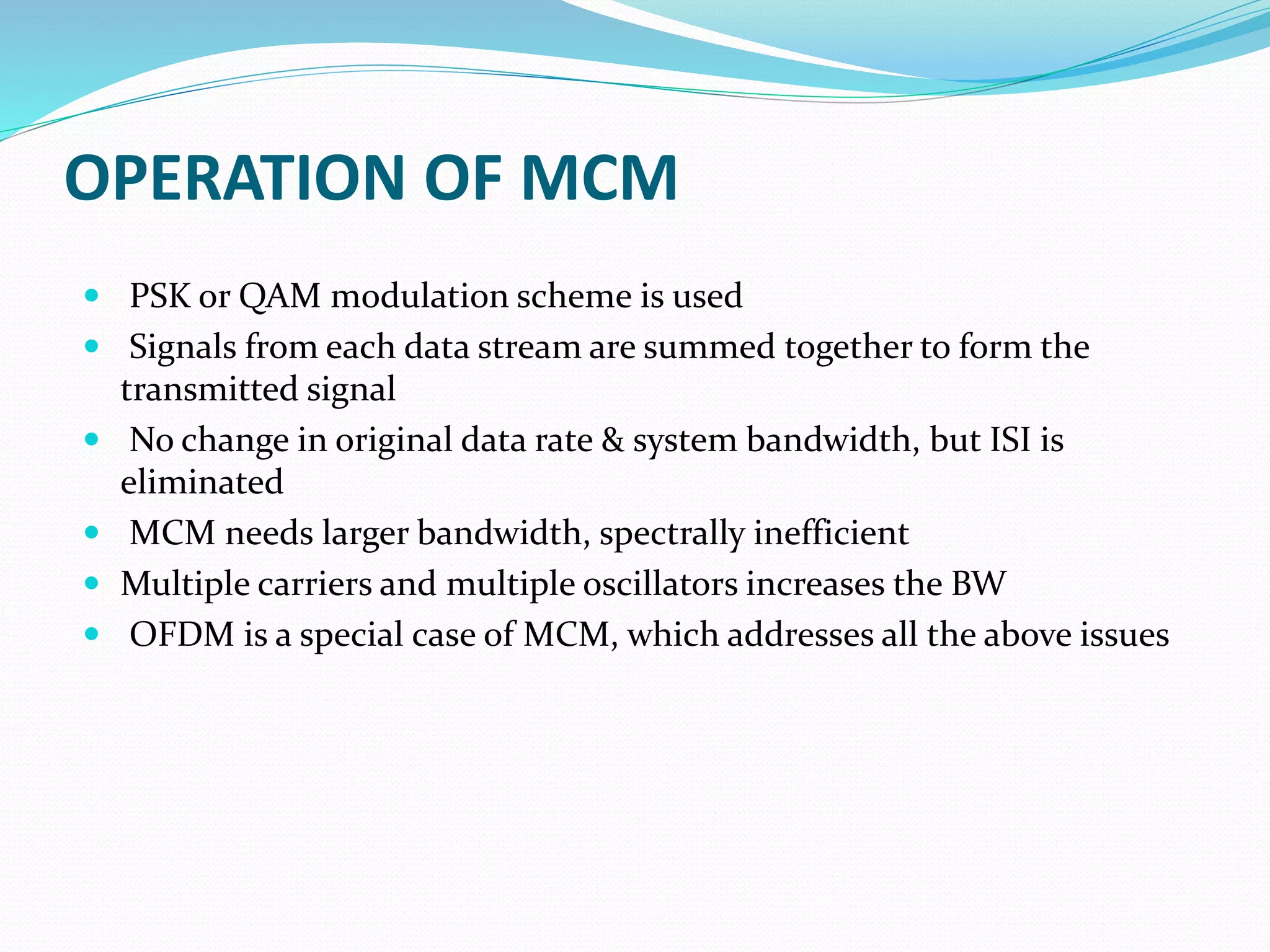
OPERATION OF MCM
 PSK or QAM modulation scheme is used
 Signals from each data stream are summed together to form the
transmitted signal
 No change in original data rate & system bandwidth, but ISI is
eliminated
 MCM needs larger bandwidth, spectrally inefficient
 Multiple carriers and multiple oscillators increases the BW
 OFDM is a special case of MCM, which addresses all the above issues
OFDM CONCEPT
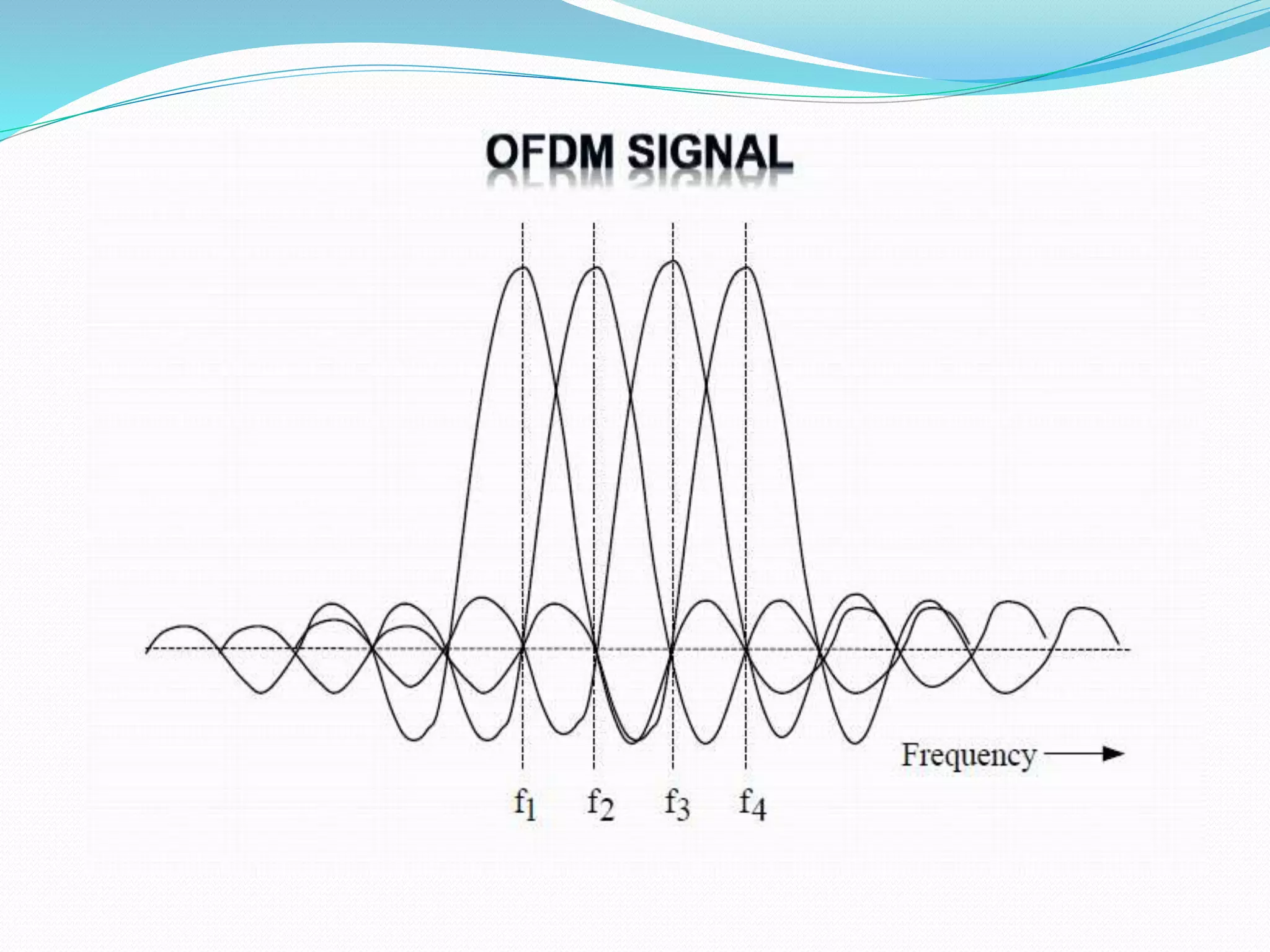
 System bandwidth is divided into a set of parallel overlapping, yet
orthogonal sub-bands independent to each other
 Data is first split into independent streams, which modulate different
sub-carriers
 Then are multiplexed to create OFDM signal
 OFDM is a special case of FDM
 Significantly improves spectral efficiency
 Avoid the need for steep band pass filters
 Avoids the need of a bank of oscillators, since can be implanted
digitally
OFDM ADVANTAGES
 Permits densely packed & overlapping sub-carriers
 Offers spectrally efficient transmission scheme
 Can be digitally implemented using, fast & efficient signal processing
 Permits flexible use of spectrum
 Supports different modulation schemes based on channel conditions
 Almost completely avoids the need for an equalizer
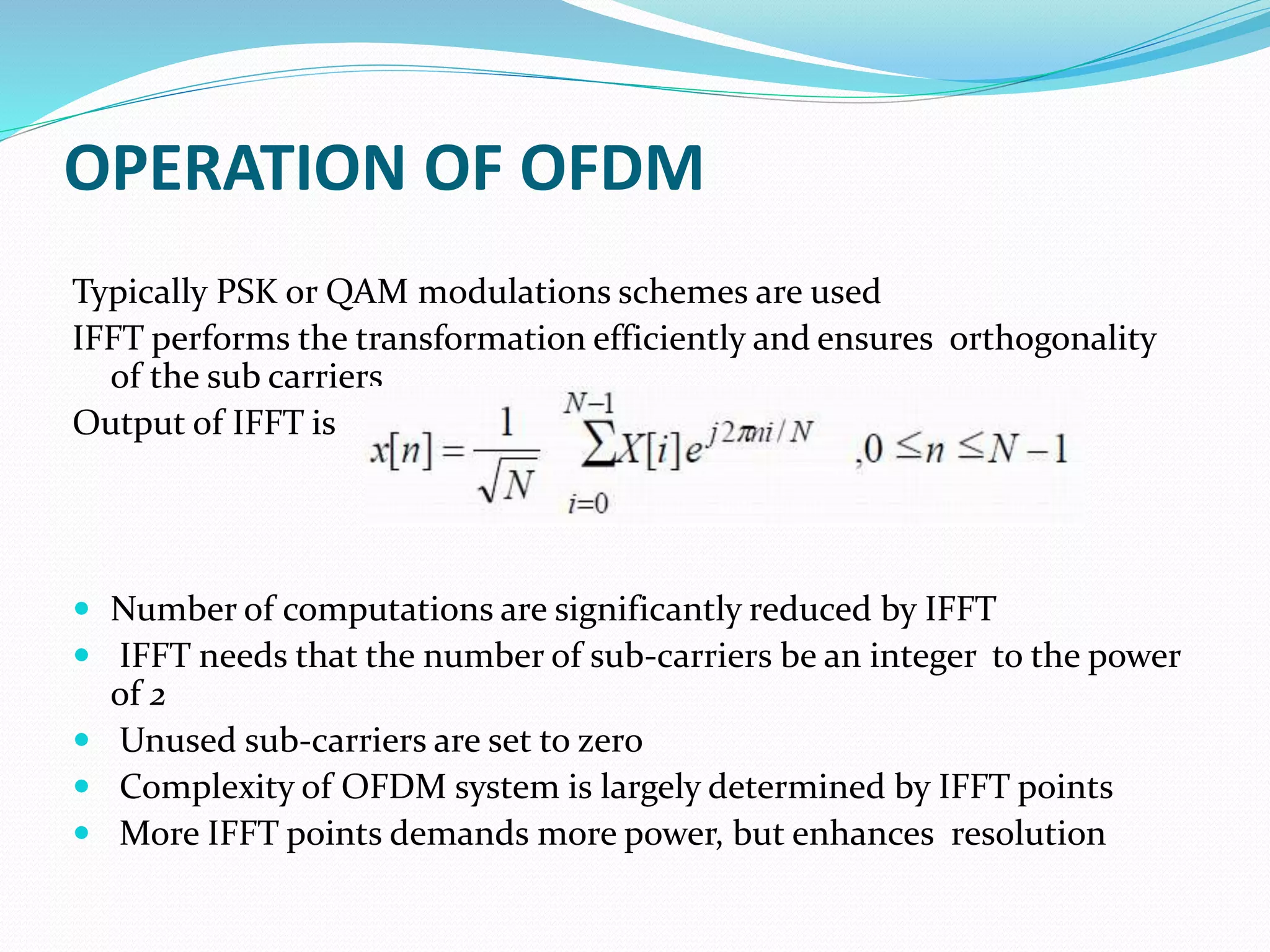
OPERATION OF OFDM
Typically PSK or QAM modulations schemes are used
IFFT performs the transformation efficiently and ensures orthogonality
of the sub carriers
Output of IFFT is
 Number of computations are significantly reduced by IFFT
 IFFT needs that the number of sub-carriers be an integer to the power
of 2
 Unused sub-carriers are set to zero
 Complexity of OFDM system is largely determined by IFFT points
 More IFFT points demands more power, but enhances resolution
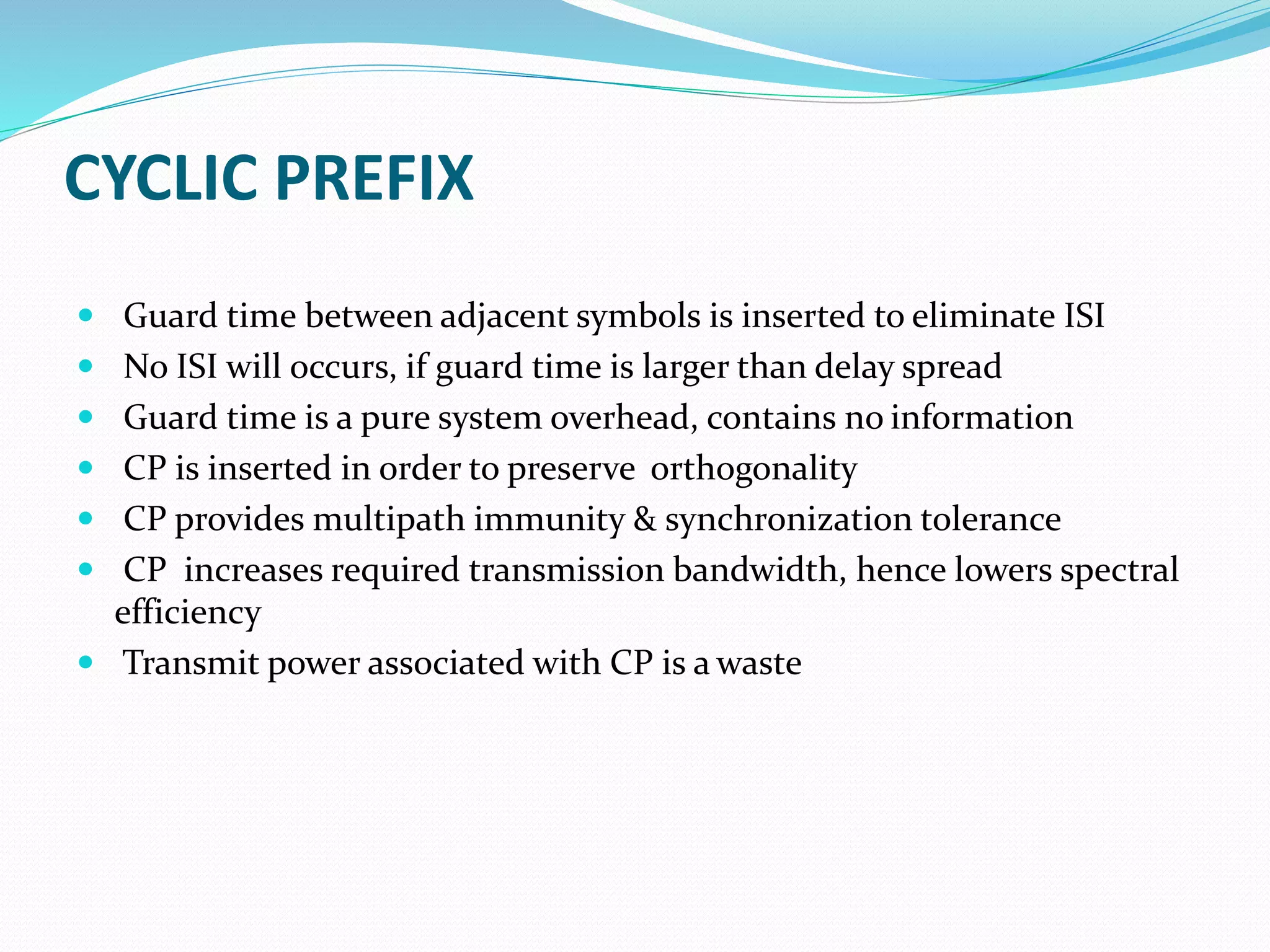
CYCLIC PREFIX
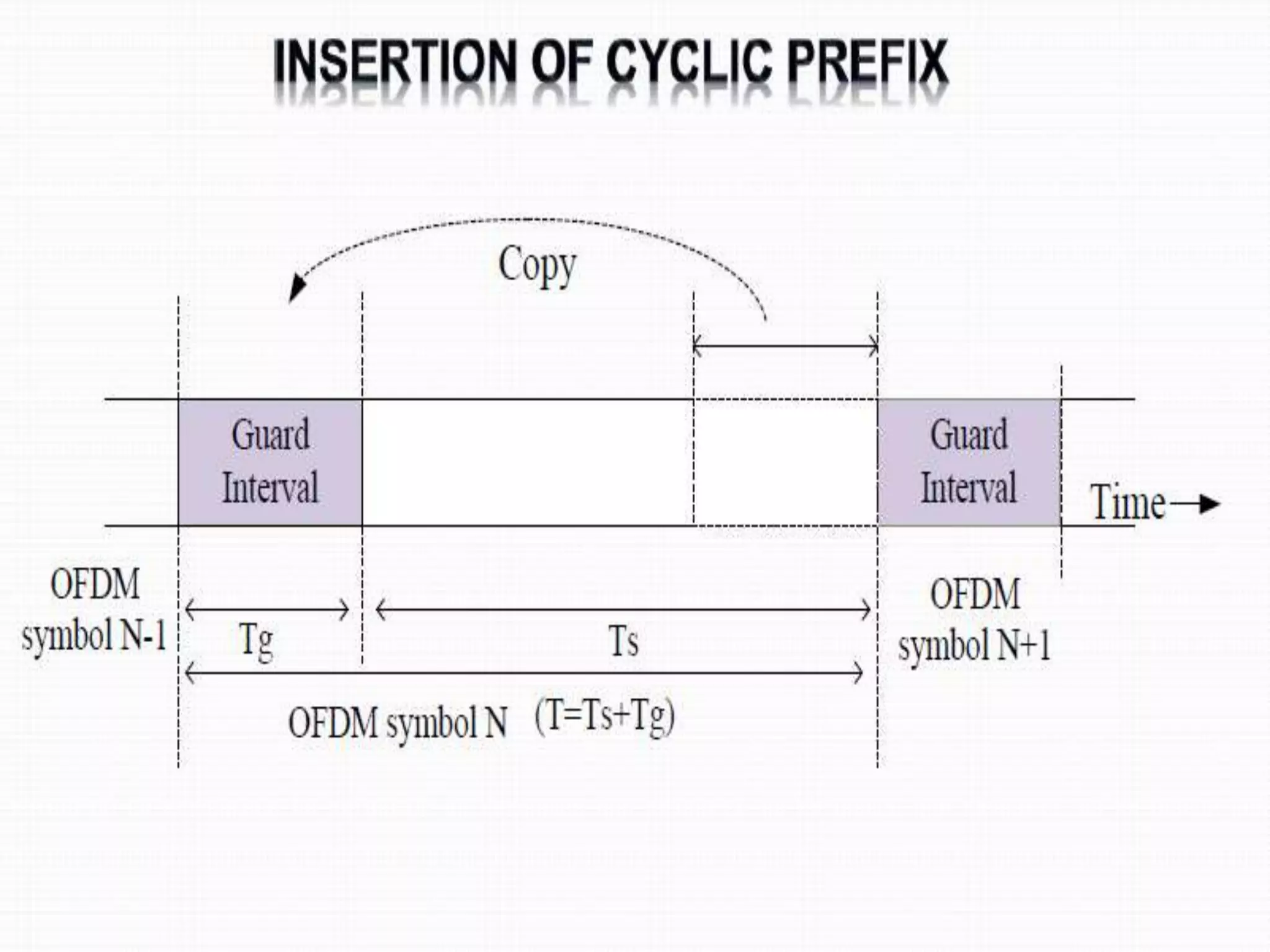
 Guard time between adjacent symbols is inserted to eliminate ISI
 No ISI will occurs, if guard time is larger than delay spread
 Guard time is a pure system overhead, contains no information
 CP is inserted in order to preserve orthogonality
 CP provides multipath immunity & synchronization tolerance
 CP increases required transmission bandwidth, hence lowers spectral
efficiency
 Transmit power associated with CP is a waste
OFDM DISADVANTAGES
HIGH PAPR
 A number of independently modulated sub-carriers result in HIGH PAPR
 Non-linear power amplifier, efficient, but cannot be used
 Causing performance degradation due to high distortion & out of band
radiations
 High PAPR also increases complexity of ADC & DAC
FREQUENCY OFFSET
 Sub-carriers are very close and overlapping
 Even a small frequency offset will result in ISI
 Causes of frequency offset:
Frequency mismatch in local oscillators of transmitter & receiver
Doppler shift
Phase noise caused in the channel
TIMING OFFSET
 OFDM is slightly more tolerant to time offset, compared to frequency
offset
 Causes lack of precision in symbol boundaries, resulting in ISI
 ISI occur only when time offset differs from CP duration
 Causes phase change & may also result in frequency offset
OFDM demands strict synchronization in frequency & time to
preserve orthogonality
CONCLUSION
 Hence synchronization is necessary in OFDM because it minimizes
performance degradation
 Synchronization Methods
Several approaches to estimate jointly or individually, used iteratively
or in one step
1. Data aided method (pilot based)
2. Non-data aided method (blind)
3. Hybrid method
REFRENCES
 webe.org - 2GHz BAS Relocation Tech-Fair, COFDM Technology
Basics. 2007-03-02
 Robertson, P.; Kaiser, S. "The effects of Doppler spreads in
OFDM(A) mobile radio systems", Vehicular Technology
Conference, 1999. VTC 1999 - Fall. IEEE VTS. Link
 Haas, R.; Belfiore, J.C. (1997). "A Time-Frequency Well-localized
Pulse for Multiple Carrier Transmission". Wireless Personal
Communications 5 (1): 1–18. doi:10.1023/A:1008859809455..
 Roque, D.; Siclet, C. (2013). "Performances of Weighted Cyclic Prefix
OFDM with Low-Complexity Equalization". IEEE Communications
Letters 17 (3): 439–442. doi:10.1109/LCOMM.2013.011513.121997..
 Jeon, W.G.; Chang, K.H.; Cho, Y.S. (1999). "An equalization
technique for orthogonal frequency-division multiplexing systems
in time-variant multipath channels". IEEE Transactions on
Communications 47 (1): 27–32. doi:10.1109/26.747810..
OFDM

OFDM

  • 2.
    CONTENTS  Multicarrier Modulation OFDM  OFDM vs. FDM  OFDM Advantages  Block diagram  Cyclic prefix  OFDM Disadvantages  Conclusion
  • 3.
    MULTICARRIER MODULATION  Multipathpropagation, time domain spreading of a signal, ISI occurs  Frequency selective fading, distortion, signal detection becomes difficult  MCM converts a frequency selective fading into flat fading channel  Flat fading makes signal detection easier  MCM easily removes ISI  MCM transmits data over several carrier frequencies simultaneously  Each sub-stream modulates different carrier frequency  Parallel conversion lowers the data rate & bandwidth in each stream
  • 4.
    OPERATION OF MCM PSK or QAM modulation scheme is used  Signals from each data stream are summed together to form the transmitted signal  No change in original data rate & system bandwidth, but ISI is eliminated  MCM needs larger bandwidth, spectrally inefficient  Multiple carriers and multiple oscillators increases the BW  OFDM is a special case of MCM, which addresses all the above issues
  • 5.
    OFDM CONCEPT  Systembandwidth is divided into a set of parallel overlapping, yet orthogonal sub-bands independent to each other  Data is first split into independent streams, which modulate different sub-carriers  Then are multiplexed to create OFDM signal  OFDM is a special case of FDM  Significantly improves spectral efficiency  Avoid the need for steep band pass filters  Avoids the need of a bank of oscillators, since can be implanted digitally
  • 8.
    OFDM ADVANTAGES  Permitsdensely packed & overlapping sub-carriers  Offers spectrally efficient transmission scheme  Can be digitally implemented using, fast & efficient signal processing  Permits flexible use of spectrum  Supports different modulation schemes based on channel conditions  Almost completely avoids the need for an equalizer
  • 9.
    OPERATION OF OFDM TypicallyPSK or QAM modulations schemes are used IFFT performs the transformation efficiently and ensures orthogonality of the sub carriers Output of IFFT is  Number of computations are significantly reduced by IFFT  IFFT needs that the number of sub-carriers be an integer to the power of 2  Unused sub-carriers are set to zero  Complexity of OFDM system is largely determined by IFFT points  More IFFT points demands more power, but enhances resolution
  • 11.
    CYCLIC PREFIX  Guardtime between adjacent symbols is inserted to eliminate ISI  No ISI will occurs, if guard time is larger than delay spread  Guard time is a pure system overhead, contains no information  CP is inserted in order to preserve orthogonality  CP provides multipath immunity & synchronization tolerance  CP increases required transmission bandwidth, hence lowers spectral efficiency  Transmit power associated with CP is a waste
  • 13.
    OFDM DISADVANTAGES HIGH PAPR A number of independently modulated sub-carriers result in HIGH PAPR  Non-linear power amplifier, efficient, but cannot be used  Causing performance degradation due to high distortion & out of band radiations  High PAPR also increases complexity of ADC & DAC FREQUENCY OFFSET  Sub-carriers are very close and overlapping  Even a small frequency offset will result in ISI  Causes of frequency offset: Frequency mismatch in local oscillators of transmitter & receiver Doppler shift Phase noise caused in the channel
  • 14.
    TIMING OFFSET  OFDMis slightly more tolerant to time offset, compared to frequency offset  Causes lack of precision in symbol boundaries, resulting in ISI  ISI occur only when time offset differs from CP duration  Causes phase change & may also result in frequency offset OFDM demands strict synchronization in frequency & time to preserve orthogonality
  • 15.
    CONCLUSION  Hence synchronizationis necessary in OFDM because it minimizes performance degradation  Synchronization Methods Several approaches to estimate jointly or individually, used iteratively or in one step 1. Data aided method (pilot based) 2. Non-data aided method (blind) 3. Hybrid method
  • 16.
    REFRENCES  webe.org -2GHz BAS Relocation Tech-Fair, COFDM Technology Basics. 2007-03-02  Robertson, P.; Kaiser, S. "The effects of Doppler spreads in OFDM(A) mobile radio systems", Vehicular Technology Conference, 1999. VTC 1999 - Fall. IEEE VTS. Link  Haas, R.; Belfiore, J.C. (1997). "A Time-Frequency Well-localized Pulse for Multiple Carrier Transmission". Wireless Personal Communications 5 (1): 1–18. doi:10.1023/A:1008859809455..  Roque, D.; Siclet, C. (2013). "Performances of Weighted Cyclic Prefix OFDM with Low-Complexity Equalization". IEEE Communications Letters 17 (3): 439–442. doi:10.1109/LCOMM.2013.011513.121997..  Jeon, W.G.; Chang, K.H.; Cho, Y.S. (1999). "An equalization technique for orthogonal frequency-division multiplexing systems in time-variant multipath channels". IEEE Transactions on Communications 47 (1): 27–32. doi:10.1109/26.747810..