OFDM
INTRODUCTION
   Orthogonal frequency-division multiplexing (OFDM) is a frequency-
    division multiplexing (FDM) scheme used as a digital multi-carrier
    modulation method.
   A large number of closely-spaced orthogonal sub-carriers are used to carry
    data.
   The data is divided into several parallel data streams or channels, one for
    each sub-carrier.
   Each sub-carrier is modulated with a conventional modulation scheme
    (such as QAM or PSK) at a low symbol rate, maintaining total data rates
    similar to conventional single-carrier modulation schemes in the same
    bandwidth.
   OFDM has developed into a popular scheme used in applications such as
    digital video and audio broadcasting, wireless networking and WIMAX.
WHY OFDM?
   Can easily adapt to severe channel conditions without complex time-
    domain equalization.
   Robust against narrow-band co-channel interference.
   Robust against inter-symbol interference (ISI) and fading caused by
    multipath propagation.
   High spectral efficiency as compared to conventional modulation schemes,
    spread spectrum, etc.
   Efficient implementation using Fast Fourier Transform (FFT).
   Low sensitivity to time synchronization errors.
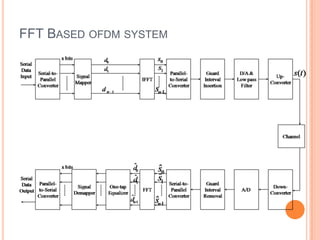
FFT BASED OFDM SYSTEM
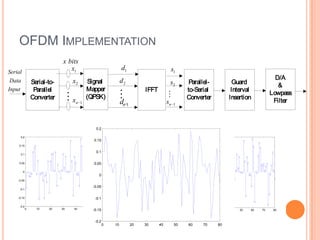
OFDM IMPLEMENTATION
                      x bits
                         x1                 d1              s1
Serial
                                                                                               D/A
 Data    Serial-to-      x2        Signal   d2              s2       Parallel-     Guard
                                                                                                &
Input     Parallel                Mapper           IFFT             to-Serial     Interval
                                                                                           Lowpass
         Converter     x   n 1
                                  (QPSK)
                                            dn 1           sn   1
                                                                    Converter    Insertion
                                                                                              Filter


 x= [1,0,1,1,0,0…]                    x1=[1,0]        d1=[-1]

                                      x2=[1,1]        d2=[-i]

                                      x3=[0,0]        d3=[1]

                                       ……..               ……..
OFDM IMPLEMENTATION
                              x bits
                                 x1                                      d1                       s1
Serial
                                                                                                                                                                  D/A
 Data            Serial-to-         x2         Signal                    d2                       s2                    Parallel-             Guard
                                                                                                                                                                   &
Input             Parallel                    Mapper                                 IFFT                              to-Serial             Interval
                                                                                                                                                              Lowpass
                 Converter         x   n 1
                                              (QPSK)
                                                                         dn 1                    sn   1
                                                                                                                       Converter            Insertion
                                                                                                                                                                 Filter


                                                     0.2

     0.2                                                                                                    0.2
                                                   0.15
    0.15                                                                                                   0.15

                                                     0.1
     0.1                                                                                                    0.1


    0.05                                           0.05                                                    0.05

         0                                                                                                    0
                                                      0
    -0.05                                                                                                  -0.05

                                                   -0.05
     -0.1                                                                                                   -0.1

    -0.15                                           -0.1                                                   -0.15

     -0.2                                                                                                   -0.2
             0     10   20    30    40        50       60
                                                   -0.15       70                                                  0        10    20   30   40   50   60   70    80


                                                    -0.2
                                                           0        10          20   30     40        50               60        70    80
HOW?
   Discrete Fourier transform (DFT) and inverse DFT (IDFT) processes are
    useful for implementing these orthogonal signals.
    Note that DFT and IDFT can be implemented efficiently by using fast
    Fourier transform (FFT) and inverse fast Fourier transform (IFFT),
    respectively.
    In the OFDM transmission system, N-point IFFT is taken for the transmitted
    symbols           , so as to generate           , the samples for the sum
    of N orthogonal subcarrier signals.
   Let y[n] denote the received sample that corresponds to x[n] with the
    additive noise w[n] (i.e., y[n] =x[n]+w[n]).
   Taking the N-point FFT of the received samples,           , the noisy
    version of transmitted symbols            can be obtained in the receiver.
ORTHOGONALITY


    Two conditions must be considered                 for   the
     orthogonality between the subcarriers.

        Each subcarrier has exactly an integer number of cycles
         in the FFT interval.

        The number of cycles between adjacent subcarriers
         differs by exactly one.
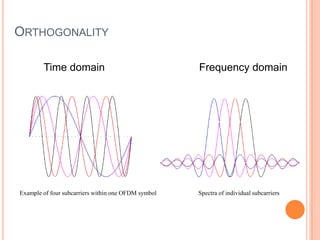
ORTHOGONALITY

        Time domain                                  Frequency domain


Example of four subcarriers within one OFDM symbol   Spectra of individual subcarriers
GUARD INTERVAL AND CYCLIC EXTENSION
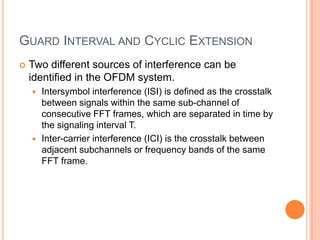
   Two different sources of interference can be
    identified in the OFDM system.
     Intersymbol interference (ISI) is defined as the crosstalk
      between signals within the same sub-channel of
      consecutive FFT frames, which are separated in time by
      the signaling interval T.
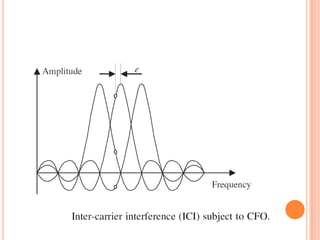
     Inter-carrier interference (ICI) is the crosstalk between
      adjacent subchannels or frequency bands of the same
      FFT frame.
GUARD INTERVAL AND CYCLIC EXTENSION
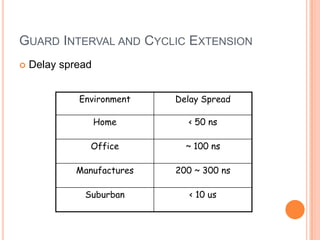
   Delay spread


             Environment    Delay Spread

                   Home       < 50 ns

                Office        ~ 100 ns

             Manufactures   200 ~ 300 ns

              Suburban         < 10 us
GUARD INTERVAL AND CYCLIC EXTENSION
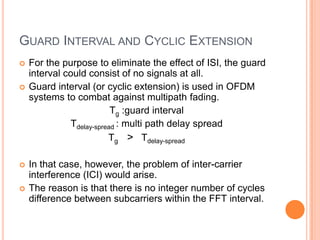
   For the purpose to eliminate the effect of ISI, the guard
    interval could consist of no signals at all.
   Guard interval (or cyclic extension) is used in OFDM
    systems to combat against multipath fading.
                           Tg :guard interval
               Tdelay-spread : multi path delay spread
                          Tg > Tdelay-spread

   In that case, however, the problem of inter-carrier
    interference (ICI) would arise.
   The reason is that there is no integer number of cycles
    difference between subcarriers within the FFT interval.
GUARD INTERVAL AND CYCLIC EXTENSION

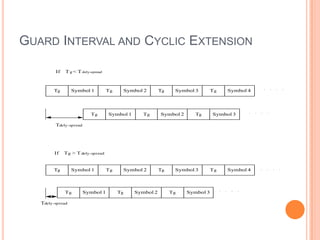
         If   T g < T dely-spread


        Tg        Symbol 1          Tg        Symbol 2      Tg    Symbol 3        Tg           Symbol 4             ﹒       ﹒       ﹒       ﹒


                           Tg       Symbol 1        Tg      Symbol 2      Tg      Symbol 3              ﹒   ﹒   ﹒       ﹒

         Tdely-spread


         If   T g > T dely-spread


        Tg        Symbol 1          Tg        Symbol 2      Tg    Symbol 3        Tg           Symbol 4         ﹒       ﹒       ﹒       ﹒


              Tg        Symbol 1         Tg      Symbol 2        Tg    Symbol 3        ﹒   ﹒    ﹒   ﹒

   Tdely-spread
GUARD INTERVAL AND CYCLIC EXTENSION
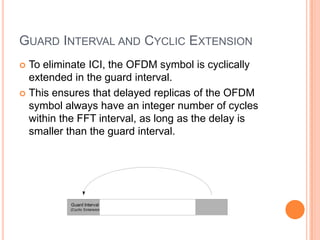
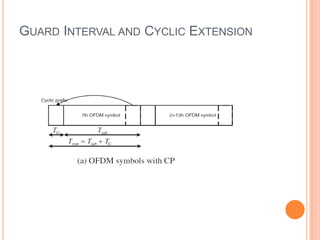
 To eliminate ICI, the OFDM symbol is cyclically
  extended in the guard interval.
 This ensures that delayed replicas of the OFDM
  symbol always have an integer number of cycles
  within the FFT interval, as long as the delay is
  smaller than the guard interval.


          Guard Interval
          (Cyclic Extension)
GUARD INTERVAL AND CYCLIC EXTENSION
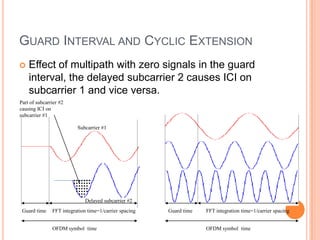
   Effect of multipath with zero signals in the guard
    interval, the delayed subcarrier 2 causes ICI on
    subcarrier 1 and vice versa.
Part of subcarrier #2
causing ICI on
subcarrier #1

                          Subcarrier #1


                             Delayed subcarrier #2
 Guard time    FFT integration time=1/carrier spacing   Guard time   FFT integration time=1/carrier spacing


               OFDM symbol time                                      OFDM symbol time
GUARD INTERVAL AND CYCLIC EXTENSION
CFO
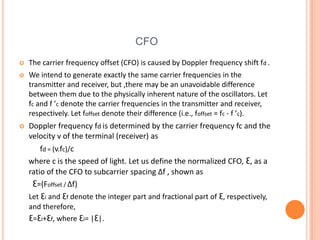
   The carrier frequency offset (CFO) is caused by Doppler frequency shift fd .
   We intend to generate exactly the same carrier frequencies in the
    transmitter and receiver, but ,there may be an unavoidable difference
    between them due to the physically inherent nature of the oscillators. Let
    fc and f ’c denote the carrier frequencies in the transmitter and receiver,
    respectively. Let foffset denote their difference (i.e., foffset = fc - f ’c).
   Doppler frequency fd is determined by the carrier frequency fc and the
    velocity v of the terminal (receiver) as
        fd = (v.fc)/c
    where c is the speed of light. Let us define the normalized CFO, Ɛ, as a
    ratio of the CFO to subcarrier spacing Δf , shown as
     Ɛ=(Foffset / Δf)
    Let Ɛi and Ɛf denote the integer part and fractional part of Ɛ, respectively,
    and therefore,
    Ɛ=Ɛi+Ɛf, where Ɛi= |Ɛ|.
EFFECT OF INTEGER CARRIER FREQUENCY
OFFSET(IFO)
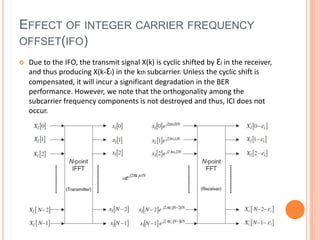
   Due to the IFO, the transmit signal X(k) is cyclic shifted by Ɛi in the receiver,
    and thus producing X(k-Ɛi) in the kth subcarrier. Unless the cyclic shift is
    compensated, it will incur a significant degradation in the BER
    performance. However, we note that the orthogonality among the
    subcarrier frequency components is not destroyed and thus, ICI does not
    occur.
EFFECT OF FRACTIONAL CARRIER FREQUENCY
OFFSET(FFO)
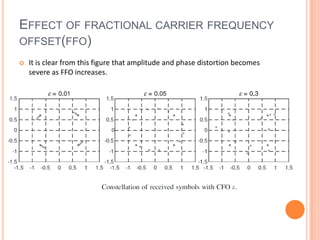
   It is clear from this figure that amplitude and phase distortion becomes
    severe as FFO increases.
CFO ESTIMATION TECHNIQUES
   CFO can be estimated in time domain and frequency domain. There are
    different techniques for both cases. The most popular being Moose for
    frequency domain and Schmidl for time domain.
   Moose’s Method
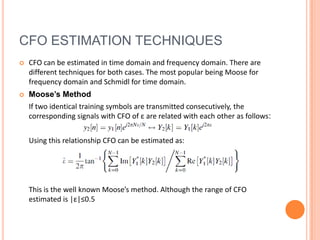
    If two identical training symbols are transmitted consecutively, the
    corresponding signals with CFO of ε are related with each other as follows:


    Using this relationship CFO can be estimated as:


    This is the well known Moose’s method. Although the range of CFO
    estimated is |ε|≤0.5
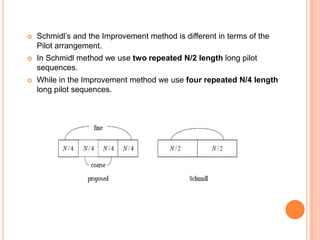
   Schmidl’s and the Improvement method is different in terms of the
    Pilot arrangement.
   In Schmidl method we use two repeated N/2 length long pilot
    sequences.
   While in the Improvement method we use four repeated N/4 length
    long pilot sequences.
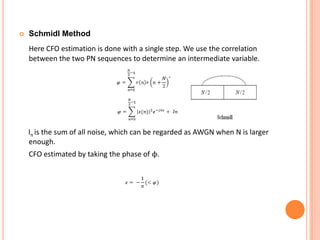
   Schmidl Method
    Here CFO estimation is done with a single step. We use the correlation
    between the two PN sequences to determine an intermediate variable.


    In is the sum of all noise, which can be regarded as AWGN when N is larger
    enough.
    CFO estimated by taking the phase of ϕ.
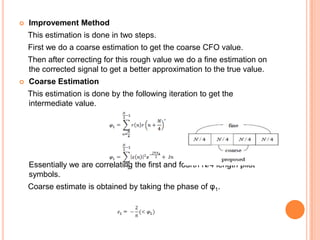
   Improvement Method
    This estimation is done in two steps.
    First we do a coarse estimation to get the coarse CFO value.
    Then after correcting for this rough value we do a fine estimation on
    the corrected signal to get a better approximation to the true value.
   Coarse Estimation
    This estimation is done by the following iteration to get the
    intermediate value.


    Essentially we are correlating the first and fourth N/4 length pilot
    symbols.
    Coarse estimate is obtained by taking the phase of φ1.
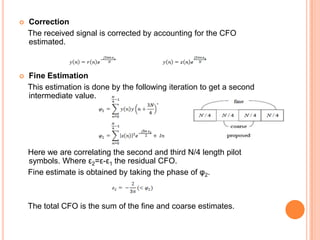
   Correction
    The received signal is corrected by accounting for the CFO
    estimated.


   Fine Estimation
    This estimation is done by the following iteration to get a second
    intermediate value.


    Here we are correlating the second and third N/4 length pilot
    symbols. Where ε2=ε-ε1 the residual CFO.
    Fine estimate is obtained by taking the phase of φ2.


    The total CFO is the sum of the fine and coarse estimates.
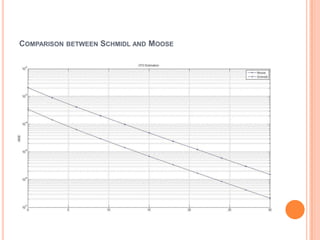
COMPARISON BETWEEN SCHMIDL AND MOOSE
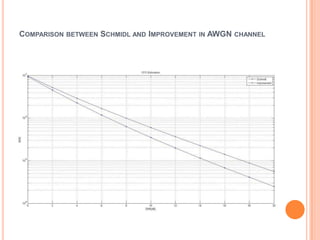
COMPARISON BETWEEN SCHMIDL AND IMPROVEMENT IN AWGN CHANNEL
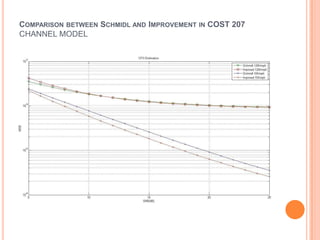
COMPARISON BETWEEN SCHMIDL AND IMPROVEMENT IN COST 207
CHANNEL MODEL

Ofdm final

  • 1.
  • 2.
    INTRODUCTION  Orthogonal frequency-division multiplexing (OFDM) is a frequency- division multiplexing (FDM) scheme used as a digital multi-carrier modulation method.  A large number of closely-spaced orthogonal sub-carriers are used to carry data.  The data is divided into several parallel data streams or channels, one for each sub-carrier.  Each sub-carrier is modulated with a conventional modulation scheme (such as QAM or PSK) at a low symbol rate, maintaining total data rates similar to conventional single-carrier modulation schemes in the same bandwidth.  OFDM has developed into a popular scheme used in applications such as digital video and audio broadcasting, wireless networking and WIMAX.
  • 3.
    WHY OFDM?  Can easily adapt to severe channel conditions without complex time- domain equalization.  Robust against narrow-band co-channel interference.  Robust against inter-symbol interference (ISI) and fading caused by multipath propagation.  High spectral efficiency as compared to conventional modulation schemes, spread spectrum, etc.  Efficient implementation using Fast Fourier Transform (FFT).  Low sensitivity to time synchronization errors.
  • 4.
  • 5.
    OFDM IMPLEMENTATION x bits x1 d1 s1 Serial D/A Data Serial-to- x2 Signal d2 s2 Parallel- Guard & Input Parallel Mapper IFFT to-Serial Interval   Lowpass Converter x n 1 (QPSK) dn 1 sn 1 Converter Insertion Filter x= [1,0,1,1,0,0…] x1=[1,0] d1=[-1] x2=[1,1] d2=[-i] x3=[0,0] d3=[1] …….. ……..
  • 6.
    OFDM IMPLEMENTATION x bits x1 d1 s1 Serial D/A Data Serial-to- x2 Signal d2 s2 Parallel- Guard & Input Parallel Mapper IFFT to-Serial Interval   Lowpass Converter x n 1 (QPSK) dn 1 sn 1 Converter Insertion Filter 0.2 0.2 0.2 0.15 0.15 0.15 0.1 0.1 0.1 0.05 0.05 0.05 0 0 0 -0.05 -0.05 -0.05 -0.1 -0.1 -0.15 -0.1 -0.15 -0.2 -0.2 0 10 20 30 40 50 60 -0.15 70 0 10 20 30 40 50 60 70 80 -0.2 0 10 20 30 40 50 60 70 80
  • 7.
    HOW?  Discrete Fourier transform (DFT) and inverse DFT (IDFT) processes are useful for implementing these orthogonal signals.  Note that DFT and IDFT can be implemented efficiently by using fast Fourier transform (FFT) and inverse fast Fourier transform (IFFT), respectively.  In the OFDM transmission system, N-point IFFT is taken for the transmitted symbols , so as to generate , the samples for the sum of N orthogonal subcarrier signals.  Let y[n] denote the received sample that corresponds to x[n] with the additive noise w[n] (i.e., y[n] =x[n]+w[n]).  Taking the N-point FFT of the received samples, , the noisy version of transmitted symbols can be obtained in the receiver.
  • 8.
    ORTHOGONALITY  Two conditions must be considered for the orthogonality between the subcarriers.  Each subcarrier has exactly an integer number of cycles in the FFT interval.  The number of cycles between adjacent subcarriers differs by exactly one.
  • 9.
    ORTHOGONALITY Time domain Frequency domain Example of four subcarriers within one OFDM symbol Spectra of individual subcarriers
  • 10.
    GUARD INTERVAL ANDCYCLIC EXTENSION  Two different sources of interference can be identified in the OFDM system.  Intersymbol interference (ISI) is defined as the crosstalk between signals within the same sub-channel of consecutive FFT frames, which are separated in time by the signaling interval T.  Inter-carrier interference (ICI) is the crosstalk between adjacent subchannels or frequency bands of the same FFT frame.
  • 11.
    GUARD INTERVAL ANDCYCLIC EXTENSION  Delay spread Environment Delay Spread Home < 50 ns Office ~ 100 ns Manufactures 200 ~ 300 ns Suburban < 10 us
  • 12.
    GUARD INTERVAL ANDCYCLIC EXTENSION  For the purpose to eliminate the effect of ISI, the guard interval could consist of no signals at all.  Guard interval (or cyclic extension) is used in OFDM systems to combat against multipath fading. Tg :guard interval Tdelay-spread : multi path delay spread Tg > Tdelay-spread  In that case, however, the problem of inter-carrier interference (ICI) would arise.  The reason is that there is no integer number of cycles difference between subcarriers within the FFT interval.
  • 13.
    GUARD INTERVAL ANDCYCLIC EXTENSION If T g < T dely-spread Tg Symbol 1 Tg Symbol 2 Tg Symbol 3 Tg Symbol 4 ﹒ ﹒ ﹒ ﹒ Tg Symbol 1 Tg Symbol 2 Tg Symbol 3 ﹒ ﹒ ﹒ ﹒ Tdely-spread If T g > T dely-spread Tg Symbol 1 Tg Symbol 2 Tg Symbol 3 Tg Symbol 4 ﹒ ﹒ ﹒ ﹒ Tg Symbol 1 Tg Symbol 2 Tg Symbol 3 ﹒ ﹒ ﹒ ﹒ Tdely-spread
  • 14.
    GUARD INTERVAL ANDCYCLIC EXTENSION  To eliminate ICI, the OFDM symbol is cyclically extended in the guard interval.  This ensures that delayed replicas of the OFDM symbol always have an integer number of cycles within the FFT interval, as long as the delay is smaller than the guard interval. Guard Interval (Cyclic Extension)
  • 15.
    GUARD INTERVAL ANDCYCLIC EXTENSION  Effect of multipath with zero signals in the guard interval, the delayed subcarrier 2 causes ICI on subcarrier 1 and vice versa. Part of subcarrier #2 causing ICI on subcarrier #1 Subcarrier #1 Delayed subcarrier #2 Guard time FFT integration time=1/carrier spacing Guard time FFT integration time=1/carrier spacing OFDM symbol time OFDM symbol time
  • 16.
    GUARD INTERVAL ANDCYCLIC EXTENSION
  • 17.
    CFO  The carrier frequency offset (CFO) is caused by Doppler frequency shift fd .  We intend to generate exactly the same carrier frequencies in the transmitter and receiver, but ,there may be an unavoidable difference between them due to the physically inherent nature of the oscillators. Let fc and f ’c denote the carrier frequencies in the transmitter and receiver, respectively. Let foffset denote their difference (i.e., foffset = fc - f ’c).  Doppler frequency fd is determined by the carrier frequency fc and the velocity v of the terminal (receiver) as fd = (v.fc)/c where c is the speed of light. Let us define the normalized CFO, Ɛ, as a ratio of the CFO to subcarrier spacing Δf , shown as Ɛ=(Foffset / Δf) Let Ɛi and Ɛf denote the integer part and fractional part of Ɛ, respectively, and therefore, Ɛ=Ɛi+Ɛf, where Ɛi= |Ɛ|.
  • 18.
    EFFECT OF INTEGERCARRIER FREQUENCY OFFSET(IFO)  Due to the IFO, the transmit signal X(k) is cyclic shifted by Ɛi in the receiver, and thus producing X(k-Ɛi) in the kth subcarrier. Unless the cyclic shift is compensated, it will incur a significant degradation in the BER performance. However, we note that the orthogonality among the subcarrier frequency components is not destroyed and thus, ICI does not occur.
  • 19.
    EFFECT OF FRACTIONALCARRIER FREQUENCY OFFSET(FFO)  It is clear from this figure that amplitude and phase distortion becomes severe as FFO increases.
  • 21.
    CFO ESTIMATION TECHNIQUES  CFO can be estimated in time domain and frequency domain. There are different techniques for both cases. The most popular being Moose for frequency domain and Schmidl for time domain.  Moose’s Method If two identical training symbols are transmitted consecutively, the corresponding signals with CFO of ε are related with each other as follows: Using this relationship CFO can be estimated as: This is the well known Moose’s method. Although the range of CFO estimated is |ε|≤0.5
  • 22.
    Schmidl’s and the Improvement method is different in terms of the Pilot arrangement.  In Schmidl method we use two repeated N/2 length long pilot sequences.  While in the Improvement method we use four repeated N/4 length long pilot sequences.
  • 23.
    Schmidl Method Here CFO estimation is done with a single step. We use the correlation between the two PN sequences to determine an intermediate variable. In is the sum of all noise, which can be regarded as AWGN when N is larger enough. CFO estimated by taking the phase of ϕ.
  • 24.
    Improvement Method This estimation is done in two steps. First we do a coarse estimation to get the coarse CFO value. Then after correcting for this rough value we do a fine estimation on the corrected signal to get a better approximation to the true value.  Coarse Estimation This estimation is done by the following iteration to get the intermediate value. Essentially we are correlating the first and fourth N/4 length pilot symbols. Coarse estimate is obtained by taking the phase of φ1.
  • 25.
    Correction The received signal is corrected by accounting for the CFO estimated.  Fine Estimation This estimation is done by the following iteration to get a second intermediate value. Here we are correlating the second and third N/4 length pilot symbols. Where ε2=ε-ε1 the residual CFO. Fine estimate is obtained by taking the phase of φ2. The total CFO is the sum of the fine and coarse estimates.
  • 26.
  • 27.
    COMPARISON BETWEEN SCHMIDLAND IMPROVEMENT IN AWGN CHANNEL
  • 28.
    COMPARISON BETWEEN SCHMIDLAND IMPROVEMENT IN COST 207 CHANNEL MODEL