RAKE Receiver
Marcel Bautista
February 12, 2004
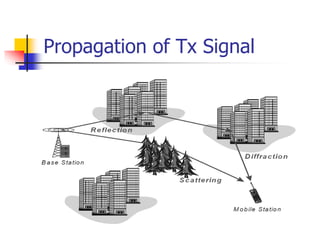
Propagation of Tx Signal
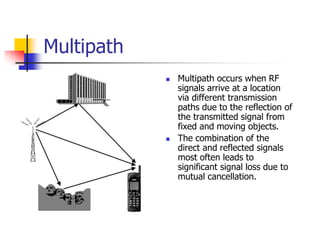
Multipath
 Multipath occurs when RF
signals arrive at a location
via different transmission
paths due to the reflection of
the transmitted signal from
fixed and moving objects.
 The combination of the
direct and reflected signals
most often leads to
significant signal loss due to
mutual cancellation.
RAKE Receiver: Basic Idea
 The RAKE receiver was designed to
equalize the effects of multipath.
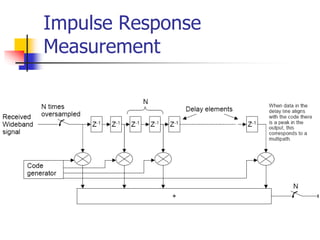
 It uses a combination of correlators,
code generators, and delays, or
“fingers”, to spread out the individual
echo signals of the multipath.
 Each signal is then delayed according to
peaks found in the received signal.
Impulse Response
Measurement
RAKE Receiver Continued
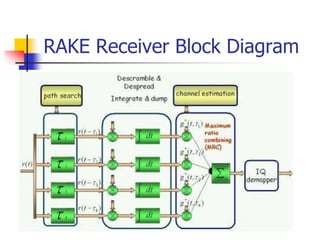
 The same symbols obtained via different
paths are then combined together using the
corresponding channel information using a
combining scheme like maximum ratio
combining (MRC).
 The combined outputs are then sent to a
simple decision device to decide on the
transmitted bits.
RAKE Receiver Block Diagram
Another Block Diagram
Maximum Ratio Combining of
Symbols
 MRC corrects channel
phase rotation and weighs
components with channel
amplitude estimate.
 The correlator outputs are
weighted so that the
correlators responding to
strong paths in the
multipath environment
have their contributions
accented, while the
correlators not
synchronizing with any
significant path are
suppressed.
End Result of RAKE Receiver
 By simulating a multipath environment
through a parallel combination of
correlators and delays, the output
behaves as if there existed a single
propogation path between the
transmitter and receiver.
Gaussian Minimum Shift
Keying
Gaussian Minimum Shift
Keying
 GMSK is based on minimum shift keying which is a
special form of frequency shift keying.
 Minimum shift keying (MSK) is generated as
follows:
Gaussian Minimum Shift
Keying
 GMSK is similar to MSK except it
incorporates a premodulation Gaussian
LPF
 Used extensively in 2nd generation
digital cellular and cordless telephone
apps. such as GSM
GMSK Block Diagram
 h( ): Gaussian impulse response
 b( ): rectangular pulse train
 p( ): smoothed (Gaussian filtered)
pulse train
GMSK: Impulse Response,
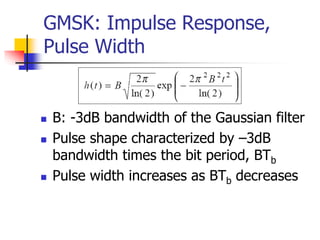
Pulse Width
 B: -3dB bandwidth of the Gaussian filter
 Pulse shape characterized by –3dB
bandwidth times the bit period, BTb
 Pulse width increases as BTb decreases
GMSK Example
GMSK Improvement
 Achieves smooth phase transitions
between signal states which can
significantly reduce bandwidth
requirements
GMSK Tradeoffs
 There are no well-defined phase
transitions to detect for bit
synchronization at the receiving end.
 With smoother phase transitions, there
is an increased chance in intersymbol
interference which increases the
complexity of the receiver.
GMSK Tradeoffs Continued
 A compromise between spectral
efficiency and time-domain
performance must be made.

Rake Receiver

  • 1.
  • 2.
  • 3.
    Multipath  Multipath occurswhen RF signals arrive at a location via different transmission paths due to the reflection of the transmitted signal from fixed and moving objects.  The combination of the direct and reflected signals most often leads to significant signal loss due to mutual cancellation.
  • 4.
    RAKE Receiver: BasicIdea  The RAKE receiver was designed to equalize the effects of multipath.  It uses a combination of correlators, code generators, and delays, or “fingers”, to spread out the individual echo signals of the multipath.  Each signal is then delayed according to peaks found in the received signal.
  • 5.
  • 6.
    RAKE Receiver Continued The same symbols obtained via different paths are then combined together using the corresponding channel information using a combining scheme like maximum ratio combining (MRC).  The combined outputs are then sent to a simple decision device to decide on the transmitted bits.
  • 7.
  • 8.
  • 9.
    Maximum Ratio Combiningof Symbols  MRC corrects channel phase rotation and weighs components with channel amplitude estimate.  The correlator outputs are weighted so that the correlators responding to strong paths in the multipath environment have their contributions accented, while the correlators not synchronizing with any significant path are suppressed.
  • 10.
    End Result ofRAKE Receiver  By simulating a multipath environment through a parallel combination of correlators and delays, the output behaves as if there existed a single propogation path between the transmitter and receiver.
  • 11.
  • 12.
    Gaussian Minimum Shift Keying GMSK is based on minimum shift keying which is a special form of frequency shift keying.  Minimum shift keying (MSK) is generated as follows:
  • 13.
    Gaussian Minimum Shift Keying GMSK is similar to MSK except it incorporates a premodulation Gaussian LPF  Used extensively in 2nd generation digital cellular and cordless telephone apps. such as GSM
  • 14.
    GMSK Block Diagram h( ): Gaussian impulse response  b( ): rectangular pulse train  p( ): smoothed (Gaussian filtered) pulse train
  • 15.
    GMSK: Impulse Response, PulseWidth  B: -3dB bandwidth of the Gaussian filter  Pulse shape characterized by –3dB bandwidth times the bit period, BTb  Pulse width increases as BTb decreases
  • 16.
  • 17.
    GMSK Improvement  Achievessmooth phase transitions between signal states which can significantly reduce bandwidth requirements
  • 18.
    GMSK Tradeoffs  Thereare no well-defined phase transitions to detect for bit synchronization at the receiving end.  With smoother phase transitions, there is an increased chance in intersymbol interference which increases the complexity of the receiver.
  • 19.
    GMSK Tradeoffs Continued A compromise between spectral efficiency and time-domain performance must be made.