‫ر‬َ‫ـد‬ْ‫ق‬‫ِـ‬‫ن‬،،،‫لما‬‫اننا‬ ‫نصدق‬ْْ‫ق‬ِ‫ن‬‫ر‬َ‫د‬
LECTURE (7)
Discrete-Time IIR Filter Design from
Continuous-Time Filters
Assist. Prof. Amr E. Mohamed
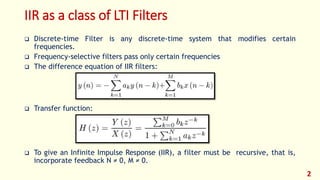
IIR as a class of LTI Filters
 Discrete-time Filter is any discrete-time system that modifies certain
frequencies.
 Frequency-selective filters pass only certain frequencies
 The difference equation of IIR filters:
 Transfer function:
 To give an Infinite Impulse Response (IIR), a filter must be recursive, that is,
incorporate feedback N ≠ 0, M ≠ 0.
2
3
Filter Design Techniques
 Filter Design Steps:
 Specification
• Problem or application specific
 Approximation of specification with a discrete-time system
• Our focus is to go from specifications to discrete-time system
 Implementation
• Realization of discrete-time systems depends on target technology
 We already studied the use of discrete-time systems to implement a
continuous-time system.
 If our specifications are given in continuous time we can use
D/C𝑥 𝑐 𝑡 𝑦𝑟(𝑡)C/D H(ej)
 nx  ny
    
 /TjHeH c
j
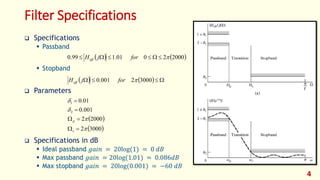
Filter Specifications
 Specifications
 Passband
 Stopband
 Parameters
 Specifications in dB
 Ideal passband 𝑔𝑎𝑖𝑛 = 20log(1) = 0 𝑑𝐵
 Max passband 𝑔𝑎𝑖𝑛 = 20log(1.01) = 0.086𝑑𝐵
 Max stopband 𝑔𝑎𝑖𝑛 = 20log(0.001) = −60 𝑑𝐵
4
   20002001.199.0  forjHeff
     30002001.0 forjHeff
 
 30002
20002
001.0
01.0
2
1








s
p
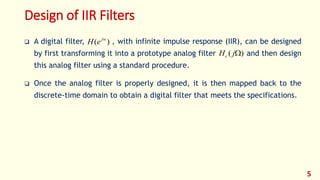
Design of IIR Filters
 A digital filter, , with infinite impulse response (IIR), can be designed
by first transforming it into a prototype analog filter and then design
this analog filter using a standard procedure.
 Once the analog filter is properly designed, it is then mapped back to the
discrete-time domain to obtain a digital filter that meets the specifications.
5
)( jw
eH
)( jHc
Design of IIR Filters
 The commonly used analog filters are
1. Butterworth filters: no ripples at all,
2. Chebyshev filters: ripples in the passband OR in the stopband, and
3. Elliptical filters: ripples in BOTH the pass and stop bands.
 A disadvantage of IIR filters is that they usually have nonlinear phase.
Some minor signal distortion is a result.
 There are two main techniques used to design IIR filters:
1. The Impulse Invariant method,
2. Matched z-transform method, and
3. The Bilinear transformation method.
6
7
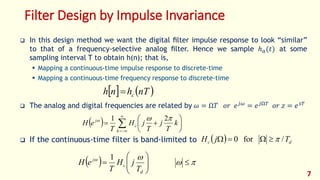
Filter Design by Impulse Invariance
 In this design method we want the digital filter impulse response to look “similar”
to that of a frequency-selective analog filter. Hence we sample ℎ 𝑎(𝑡) at some
sampling interval T to obtain h(n); that is,
 Mapping a continuous-time impulse response to discrete-time
 Mapping a continuous-time frequency response to discrete-time
 The analog and digital frequencies are related by 𝜔 = Ω𝑇 𝑜𝑟 𝑒 𝑗𝜔 = 𝑒 𝑗Ω𝑇 𝑜𝑟 𝑧 = 𝑒 𝑠𝑇
 If the continuous-time filter is band-limited to
   nThnh c
  









k
c
j
k
T
j
T
jH
T
eH
 21
  








1
d
c
j
T
jH
T
eH
  dc TjH /for0 
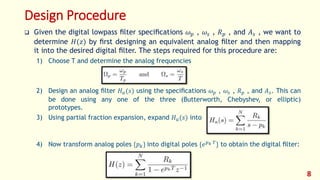
Design Procedure
 Given the digital lowpass filter specifications 𝜔 𝑝 , 𝜔𝑠 , 𝑅 𝑝 , and 𝐴 𝑠 , we want to
determine 𝐻(𝑧) by first designing an equivalent analog filter and then mapping
it into the desired digital filter. The steps required for this procedure are:
1) Choose T and determine the analog frequencies
2) Design an analog filter 𝐻 𝑎(𝑠) using the specifications 𝜔 𝑝 , 𝜔𝑠 , 𝑅 𝑝 , and 𝐴 𝑠. This can
be done using any one of the three (Butterworth, Chebyshev, or elliptic)
prototypes.
3) Using partial fraction expansion, expand 𝐻 𝑎(𝑠) into
4) Now transform analog poles {𝑝 𝑘} into digital poles {𝑒 𝑝 𝑘 𝑇} to obtain the digital filter:
8
9
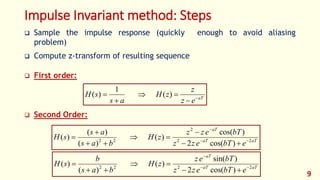
Impulse Invariant method: Steps
 Sample the impulse response (quickly enough to avoid aliasing
problem)
 Compute z-transform of resulting sequence
 First order:
 Second Order:
aT
ez
z
zH
as
sH 



 )(
1
)(
aTaT
aT
ebTezz
bTezz
zH
bas
as
sH 22
2
22
)cos(2
)cos(
)(
)(
)(
)( 







aTaT
aT
ebTezz
bTez
zH
bas
b
sH 2222
)cos(2
)sin(
)(
)(
)( 





10
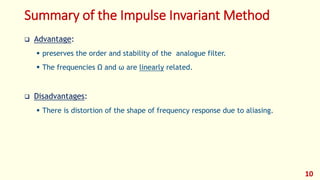
Summary of the Impulse Invariant Method
 Advantage:
 preserves the order and stability of the analogue filter.
 The frequencies Ω and ω are linearly related.
 Disadvantages:
 There is distortion of the shape of frequency response due to aliasing.
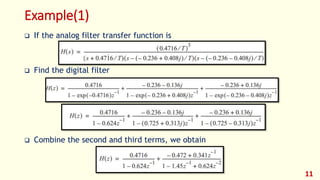
Example(1)
 If the analog filter transfer function is
 Find the digital filter
 Combine the second and third terms, we obtain
11
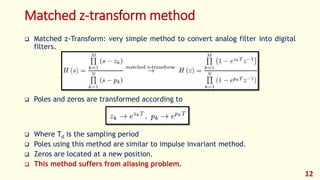
Matched z-transform method
 Matched z-Transform: very simple method to convert analog filter into digital
filters.
 Poles and zeros are transformed according to
 Where Td is the sampling period
 Poles using this method are similar to impulse invariant method.
 Zeros are located at a new position.
 This method suffers from aliasing problem.
12
13
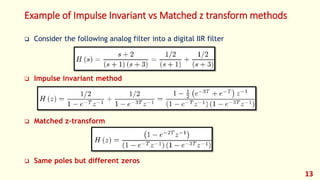
Example of Impulse Invariant vs Matched z transform methods
 Consider the following analog filter into a digital IIR filter
 Impulse invariant method
 Matched z-transform
 Same poles but different zeros
14
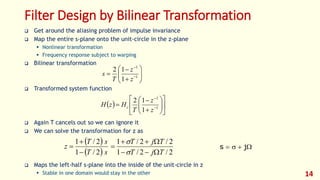
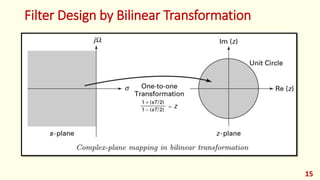
Filter Design by Bilinear Transformation
 Get around the aliasing problem of impulse invariance
 Map the entire s-plane onto the unit-circle in the z-plane
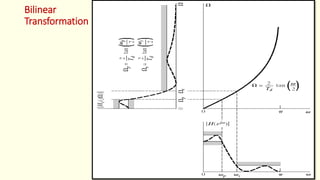
 Nonlinear transformation
 Frequency response subject to warping
 Bilinear transformation
 Transformed system function
 Again T cancels out so we can ignore it
 We can solve the transformation for z as
 Maps the left-half s-plane into the inside of the unit-circle in z
 Stable in one domain would stay in the other








 

1
1
1
12
z
z
T
s
  













 

1
1
1
12
z
z
T
HzH c
 
  2/2/1
2/2/1
2/1
2/1
TjT
TjT
sT
sT
z








 js
15
Filter Design by Bilinear Transformation
16
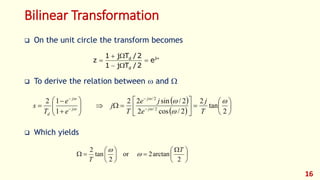
Bilinear Transformation
 On the unit circle the transform becomes
 To derive the relation between  and 
 Which yields




 j
d
d
e
2/Tj1
2/Tj1
z
 
 




















 



2
tan
2
2/cos2
2/sin22
1
12
2/
2/







T
j
e
je
T
j
e
e
T
s j
j
j
j
d





 







2
arctan2or
2
tan
2 T
T


17
Bilinear
Transformation
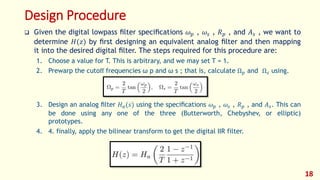
Design Procedure
 Given the digital lowpass filter specifications 𝜔 𝑝 , 𝜔𝑠 , 𝑅 𝑝 , and 𝐴 𝑠 , we want to
determine 𝐻(𝑧) by first designing an equivalent analog filter and then mapping
it into the desired digital filter. The steps required for this procedure are:
1. Choose a value for T. This is arbitrary, and we may set T = 1.
2. Prewarp the cutoff frequencies ω p and ω s ; that is, calculate Ω 𝑝 and Ω 𝑠 using.
3. Design an analog filter 𝐻 𝑎(𝑠) using the specifications 𝜔 𝑝 , 𝜔𝑠 , 𝑅 𝑝 , and 𝐴 𝑠. This can
be done using any one of the three (Butterworth, Chebyshev, or elliptic)
prototypes.
4. 4. finally, apply the bilinear transform to get the digital IIR filter.
18
Example: Application of Bilinear Transform
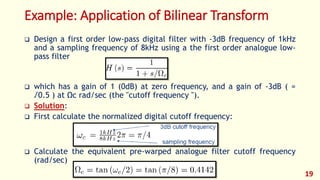
 Design a first order low-pass digital filter with -3dB frequency of 1kHz
and a sampling frequency of 8kHz using a the first order analogue low-
pass filter
 which has a gain of 1 (0dB) at zero frequency, and a gain of -3dB ( =
√0.5 ) at Ωc rad/sec (the "cutoff frequency ").
 Solution:
 First calculate the normalized digital cutoff frequency:
 Calculate the equivalent pre-warped analogue filter cutoff frequency
(rad/sec)
19
Example: Application of Bilinear Transform
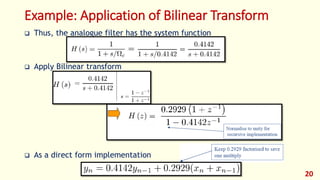
 Thus, the analogue filter has the system function
 Apply Bilinear transform
 As a direct form implementation
20
Example: Magnitude Frequency Response
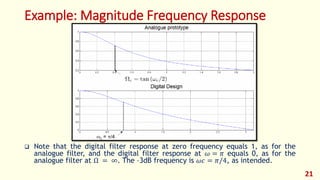
 Note that the digital filter response at zero frequency equals 1, as for the
analogue filter, and the digital filter response at 𝜔 = 𝜋 equals 0, as for the
analogue filter at Ω = ∞. The –3dB frequency is 𝜔𝑐 = 𝜋/4, as intended.
21
Example:
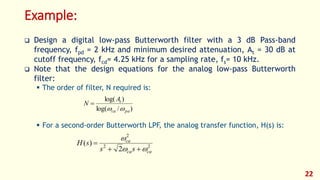
 Design a digital low-pass Butterworth filter with a 3 dB Pass-band
frequency, fpd = 2 kHz and minimum desired attenuation, At = 30 dB at
cutoff frequency, fcd= 4.25 kHz for a sampling rate, fs= 10 kHz.
 Note that the design equations for the analog low-pass Butterworth
filter:
 The order of filter, N required is:
 For a second-order Butterworth LPF, the analog transfer function, H(s) is:
22
)/log(
)log(
paca
tA
N


22
2
2
)(
caca
ca
ss
sH




Solution:
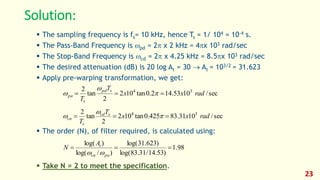
 The sampling frequency is fs= 10 kHz, hence Ts = 1/ 104 = 10-4 s.
 The Pass-Band Frequency is pd = 2 x 2 kHz = 4x 103 rad/sec
 The Stop-Band Frequency is cd = 2 x 4.25 kHz = 8.5x 103 rad/sec
 The desired attenuation (dB) is 20 log At = 30  At = 103/2 = 31.623
 Apply pre-warping transformation, we get:
 The order (N), of filter required, is calculated using:
 Take N = 2 to meet the specification.
23
sec/1053.142.0tan102
2
tan
2 34
radxx
T
T
spd
s
pa  


sec/1031.83425.0tan102
2
tan
2 34
radxx
T
T
scd
s
ca  


98.1
)53.14/31.83log(
)623.31log(
)/log(
)log(

paca
tA
N

Solution:
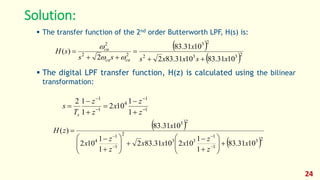
 The transfer function of the 2nd order Butterworth LPF, H(s) is:
 The digital LPF transfer function, H(z) is calculated using the bilinear
transformation:
24
 
 2332
23
22
2
1031.831031.832
1031.83
2
)(
xsxxs
x
ss
sH
caca
ca






1
1
4
1
1
1
1
102
1
12










z
z
x
z
z
T
s
s
 
 23
1
1
33
2
1
1
4
23
1031.83
1
1
1021031.832
1
1
102
1031.83
)(
x
z
z
xxx
z
z
x
x
zH





















Solution:
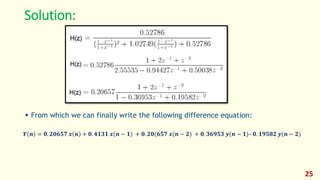
 From which we can finally write the following difference equation:
𝒀 𝒏 = 𝟎. 𝟐𝟎𝟔𝟓𝟕 𝒙 𝒏 + 𝟎. 𝟒𝟏𝟑𝟏 𝒙(𝒏 − 𝟏) + 𝟎. 𝟐𝟎(𝟔𝟓𝟕 𝒙(𝒏 − 𝟐) + 𝟎. 𝟑𝟔𝟗𝟓𝟑 𝒚(𝒏 − 𝟏)– 𝟎. 𝟏𝟗𝟓𝟖𝟐 𝒚(𝒏 − 𝟐)
25
Solution:
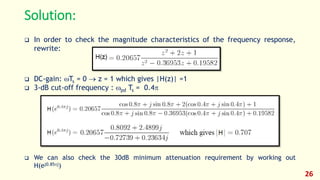
 In order to check the magnitude characteristics of the frequency response,
rewrite:
 DC-gain: Ts = 0  z = 1 which gives |H(z)| =1
 3-dB cut-off frequency : pd Ts = 0.4
 We can also check the 30dB minimum attenuation requirement by working out
H(ej0.85j)
26
27

DSP_2018_FOEHU - Lec 07 - IIR Filter Design

  • 1.
  • 2.
    IIR as aclass of LTI Filters  Discrete-time Filter is any discrete-time system that modifies certain frequencies.  Frequency-selective filters pass only certain frequencies  The difference equation of IIR filters:  Transfer function:  To give an Infinite Impulse Response (IIR), a filter must be recursive, that is, incorporate feedback N ≠ 0, M ≠ 0. 2
  • 3.
    3 Filter Design Techniques Filter Design Steps:  Specification • Problem or application specific  Approximation of specification with a discrete-time system • Our focus is to go from specifications to discrete-time system  Implementation • Realization of discrete-time systems depends on target technology  We already studied the use of discrete-time systems to implement a continuous-time system.  If our specifications are given in continuous time we can use D/C𝑥 𝑐 𝑡 𝑦𝑟(𝑡)C/D H(ej)  nx  ny       /TjHeH c j
  • 4.
    Filter Specifications  Specifications Passband  Stopband  Parameters  Specifications in dB  Ideal passband 𝑔𝑎𝑖𝑛 = 20log(1) = 0 𝑑𝐵  Max passband 𝑔𝑎𝑖𝑛 = 20log(1.01) = 0.086𝑑𝐵  Max stopband 𝑔𝑎𝑖𝑛 = 20log(0.001) = −60 𝑑𝐵 4    20002001.199.0  forjHeff      30002001.0 forjHeff    30002 20002 001.0 01.0 2 1         s p
  • 5.
    Design of IIRFilters  A digital filter, , with infinite impulse response (IIR), can be designed by first transforming it into a prototype analog filter and then design this analog filter using a standard procedure.  Once the analog filter is properly designed, it is then mapped back to the discrete-time domain to obtain a digital filter that meets the specifications. 5 )( jw eH )( jHc
  • 6.
    Design of IIRFilters  The commonly used analog filters are 1. Butterworth filters: no ripples at all, 2. Chebyshev filters: ripples in the passband OR in the stopband, and 3. Elliptical filters: ripples in BOTH the pass and stop bands.  A disadvantage of IIR filters is that they usually have nonlinear phase. Some minor signal distortion is a result.  There are two main techniques used to design IIR filters: 1. The Impulse Invariant method, 2. Matched z-transform method, and 3. The Bilinear transformation method. 6
  • 7.
    7 Filter Design byImpulse Invariance  In this design method we want the digital filter impulse response to look “similar” to that of a frequency-selective analog filter. Hence we sample ℎ 𝑎(𝑡) at some sampling interval T to obtain h(n); that is,  Mapping a continuous-time impulse response to discrete-time  Mapping a continuous-time frequency response to discrete-time  The analog and digital frequencies are related by 𝜔 = Ω𝑇 𝑜𝑟 𝑒 𝑗𝜔 = 𝑒 𝑗Ω𝑇 𝑜𝑟 𝑧 = 𝑒 𝑠𝑇  If the continuous-time filter is band-limited to    nThnh c             k c j k T j T jH T eH  21            1 d c j T jH T eH   dc TjH /for0 
  • 8.
    Design Procedure  Giventhe digital lowpass filter specifications 𝜔 𝑝 , 𝜔𝑠 , 𝑅 𝑝 , and 𝐴 𝑠 , we want to determine 𝐻(𝑧) by first designing an equivalent analog filter and then mapping it into the desired digital filter. The steps required for this procedure are: 1) Choose T and determine the analog frequencies 2) Design an analog filter 𝐻 𝑎(𝑠) using the specifications 𝜔 𝑝 , 𝜔𝑠 , 𝑅 𝑝 , and 𝐴 𝑠. This can be done using any one of the three (Butterworth, Chebyshev, or elliptic) prototypes. 3) Using partial fraction expansion, expand 𝐻 𝑎(𝑠) into 4) Now transform analog poles {𝑝 𝑘} into digital poles {𝑒 𝑝 𝑘 𝑇} to obtain the digital filter: 8
  • 9.
    9 Impulse Invariant method:Steps  Sample the impulse response (quickly enough to avoid aliasing problem)  Compute z-transform of resulting sequence  First order:  Second Order: aT ez z zH as sH      )( 1 )( aTaT aT ebTezz bTezz zH bas as sH 22 2 22 )cos(2 )cos( )( )( )( )(         aTaT aT ebTezz bTez zH bas b sH 2222 )cos(2 )sin( )( )( )(      
  • 10.
    10 Summary of theImpulse Invariant Method  Advantage:  preserves the order and stability of the analogue filter.  The frequencies Ω and ω are linearly related.  Disadvantages:  There is distortion of the shape of frequency response due to aliasing.
  • 11.
    Example(1)  If theanalog filter transfer function is  Find the digital filter  Combine the second and third terms, we obtain 11
  • 12.
    Matched z-transform method Matched z-Transform: very simple method to convert analog filter into digital filters.  Poles and zeros are transformed according to  Where Td is the sampling period  Poles using this method are similar to impulse invariant method.  Zeros are located at a new position.  This method suffers from aliasing problem. 12
  • 13.
    13 Example of ImpulseInvariant vs Matched z transform methods  Consider the following analog filter into a digital IIR filter  Impulse invariant method  Matched z-transform  Same poles but different zeros
  • 14.
    14 Filter Design byBilinear Transformation  Get around the aliasing problem of impulse invariance  Map the entire s-plane onto the unit-circle in the z-plane  Nonlinear transformation  Frequency response subject to warping  Bilinear transformation  Transformed system function  Again T cancels out so we can ignore it  We can solve the transformation for z as  Maps the left-half s-plane into the inside of the unit-circle in z  Stable in one domain would stay in the other            1 1 1 12 z z T s                    1 1 1 12 z z T HzH c     2/2/1 2/2/1 2/1 2/1 TjT TjT sT sT z          js
  • 15.
    15 Filter Design byBilinear Transformation
  • 16.
    16 Bilinear Transformation  Onthe unit circle the transform becomes  To derive the relation between  and   Which yields      j d d e 2/Tj1 2/Tj1 z                              2 tan 2 2/cos2 2/sin22 1 12 2/ 2/        T j e je T j e e T s j j j j d               2 arctan2or 2 tan 2 T T  
  • 17.
  • 18.
    Design Procedure  Giventhe digital lowpass filter specifications 𝜔 𝑝 , 𝜔𝑠 , 𝑅 𝑝 , and 𝐴 𝑠 , we want to determine 𝐻(𝑧) by first designing an equivalent analog filter and then mapping it into the desired digital filter. The steps required for this procedure are: 1. Choose a value for T. This is arbitrary, and we may set T = 1. 2. Prewarp the cutoff frequencies ω p and ω s ; that is, calculate Ω 𝑝 and Ω 𝑠 using. 3. Design an analog filter 𝐻 𝑎(𝑠) using the specifications 𝜔 𝑝 , 𝜔𝑠 , 𝑅 𝑝 , and 𝐴 𝑠. This can be done using any one of the three (Butterworth, Chebyshev, or elliptic) prototypes. 4. 4. finally, apply the bilinear transform to get the digital IIR filter. 18
  • 19.
    Example: Application ofBilinear Transform  Design a first order low-pass digital filter with -3dB frequency of 1kHz and a sampling frequency of 8kHz using a the first order analogue low- pass filter  which has a gain of 1 (0dB) at zero frequency, and a gain of -3dB ( = √0.5 ) at Ωc rad/sec (the "cutoff frequency ").  Solution:  First calculate the normalized digital cutoff frequency:  Calculate the equivalent pre-warped analogue filter cutoff frequency (rad/sec) 19
  • 20.
    Example: Application ofBilinear Transform  Thus, the analogue filter has the system function  Apply Bilinear transform  As a direct form implementation 20
  • 21.
    Example: Magnitude FrequencyResponse  Note that the digital filter response at zero frequency equals 1, as for the analogue filter, and the digital filter response at 𝜔 = 𝜋 equals 0, as for the analogue filter at Ω = ∞. The –3dB frequency is 𝜔𝑐 = 𝜋/4, as intended. 21
  • 22.
    Example:  Design adigital low-pass Butterworth filter with a 3 dB Pass-band frequency, fpd = 2 kHz and minimum desired attenuation, At = 30 dB at cutoff frequency, fcd= 4.25 kHz for a sampling rate, fs= 10 kHz.  Note that the design equations for the analog low-pass Butterworth filter:  The order of filter, N required is:  For a second-order Butterworth LPF, the analog transfer function, H(s) is: 22 )/log( )log( paca tA N   22 2 2 )( caca ca ss sH    
  • 23.
    Solution:  The samplingfrequency is fs= 10 kHz, hence Ts = 1/ 104 = 10-4 s.  The Pass-Band Frequency is pd = 2 x 2 kHz = 4x 103 rad/sec  The Stop-Band Frequency is cd = 2 x 4.25 kHz = 8.5x 103 rad/sec  The desired attenuation (dB) is 20 log At = 30  At = 103/2 = 31.623  Apply pre-warping transformation, we get:  The order (N), of filter required, is calculated using:  Take N = 2 to meet the specification. 23 sec/1053.142.0tan102 2 tan 2 34 radxx T T spd s pa     sec/1031.83425.0tan102 2 tan 2 34 radxx T T scd s ca     98.1 )53.14/31.83log( )623.31log( )/log( )log(  paca tA N 
  • 24.
    Solution:  The transferfunction of the 2nd order Butterworth LPF, H(s) is:  The digital LPF transfer function, H(z) is calculated using the bilinear transformation: 24    2332 23 22 2 1031.831031.832 1031.83 2 )( xsxxs x ss sH caca ca       1 1 4 1 1 1 1 102 1 12           z z x z z T s s    23 1 1 33 2 1 1 4 23 1031.83 1 1 1021031.832 1 1 102 1031.83 )( x z z xxx z z x x zH                     
  • 25.
    Solution:  From whichwe can finally write the following difference equation: 𝒀 𝒏 = 𝟎. 𝟐𝟎𝟔𝟓𝟕 𝒙 𝒏 + 𝟎. 𝟒𝟏𝟑𝟏 𝒙(𝒏 − 𝟏) + 𝟎. 𝟐𝟎(𝟔𝟓𝟕 𝒙(𝒏 − 𝟐) + 𝟎. 𝟑𝟔𝟗𝟓𝟑 𝒚(𝒏 − 𝟏)– 𝟎. 𝟏𝟗𝟓𝟖𝟐 𝒚(𝒏 − 𝟐) 25
  • 26.
    Solution:  In orderto check the magnitude characteristics of the frequency response, rewrite:  DC-gain: Ts = 0  z = 1 which gives |H(z)| =1  3-dB cut-off frequency : pd Ts = 0.4  We can also check the 30dB minimum attenuation requirement by working out H(ej0.85j) 26
  • 27.