Kashif Sultan, Hazrat Ali, Zhongshan Zhang
Presentation by
Dr. Hazrat Ali
COMSATS Institute of Information Technology
Joint SLM and Modified
Clipping Technique
for PAPR Reduction
14 Jan, 2016 IBCAST 2016 1
 Orthogonal Frequency Division Multiplexing
 Peak-to-Average Power Ratio
 Effect on Power Amplifier
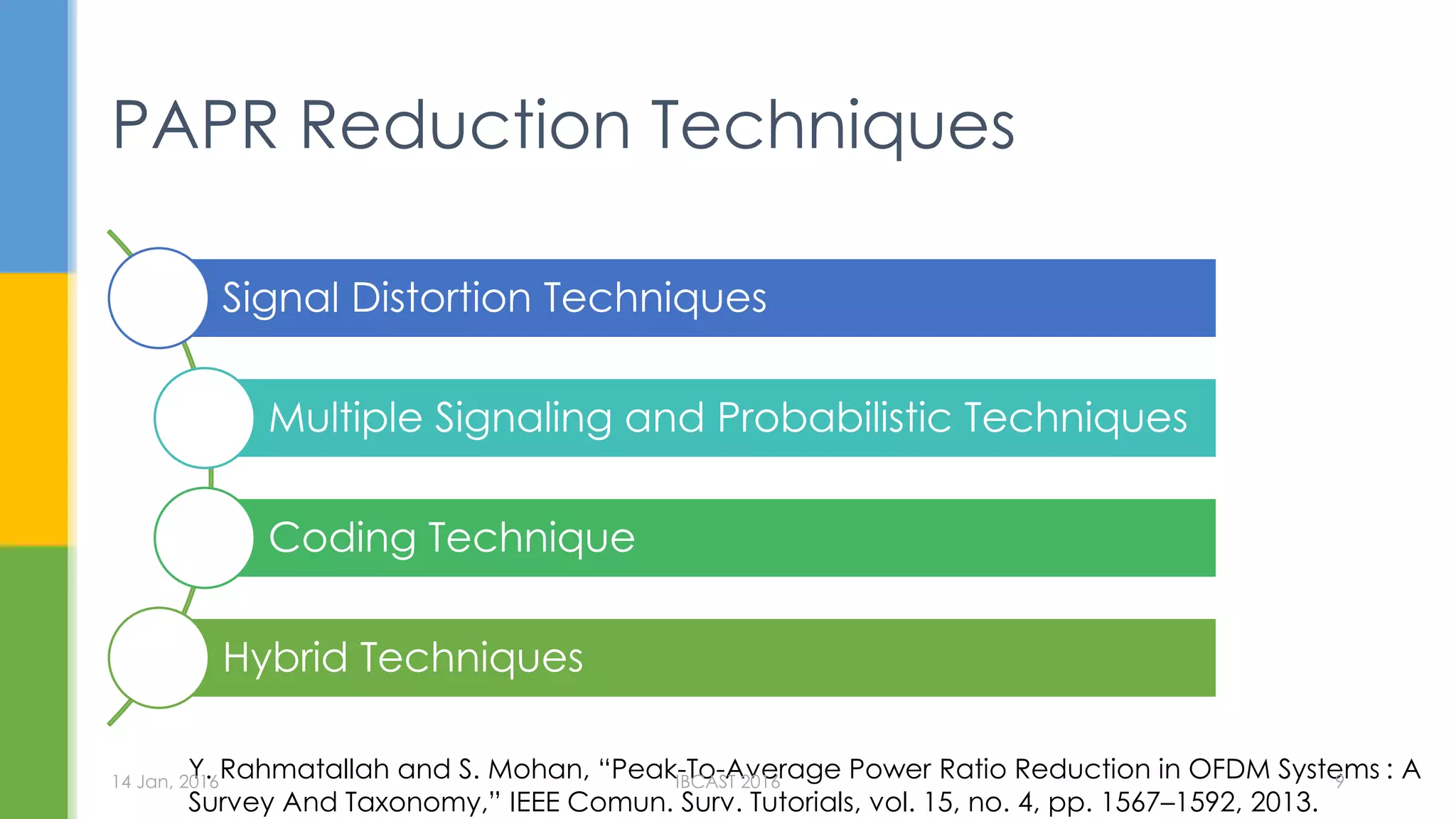
 PAPR Reduction Techniques
 Selective Mapping
 Conventional Clipping
 Proposed Scheme
 Modified Clipping
 Joint SLM and Modified Clipping
Contents
14 Jan, 2016 IBCAST 2016 2
 OFDM forms the basis for 4G (fourth generation wireless
communication)
 It is revolutionary technology in wireless communication
 Long Term Evoultion (LTE) – the 4G cellular standard
 LTE is based on two key technologies
 OFDM
 WiMax
 OFDM is a key broadband wireless technology which
supports data rates in excess of 100 Mbps
 WLAN standard 802.11a/g/n are also based on OFDM.
Orthogonal Frequency Division
Multiplexing (OFDM)
14 Jan, 2016 IBCAST 2016 3
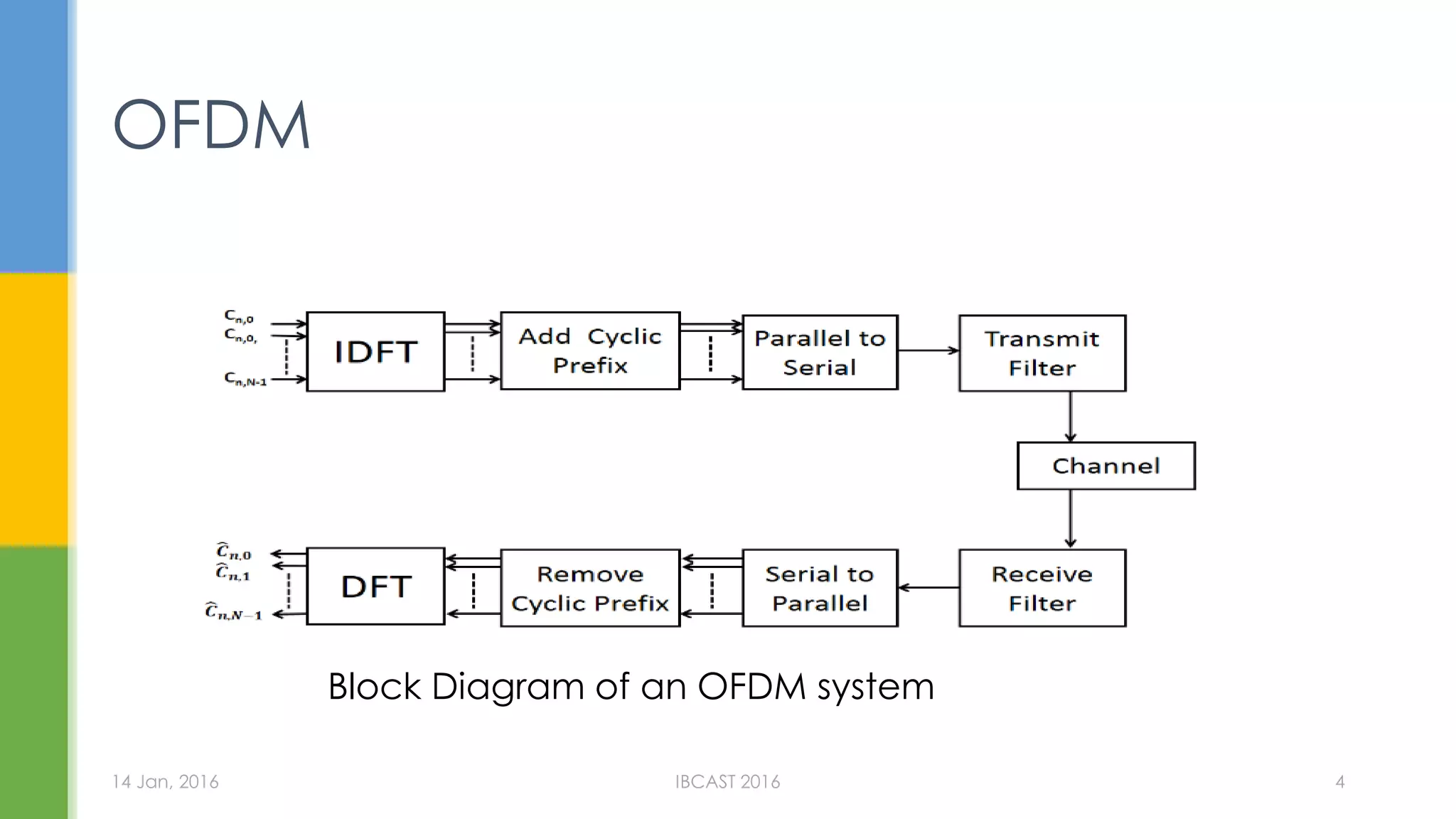
OFDM
Block Diagram of an OFDM system
14 Jan, 2016 IBCAST 2016 4
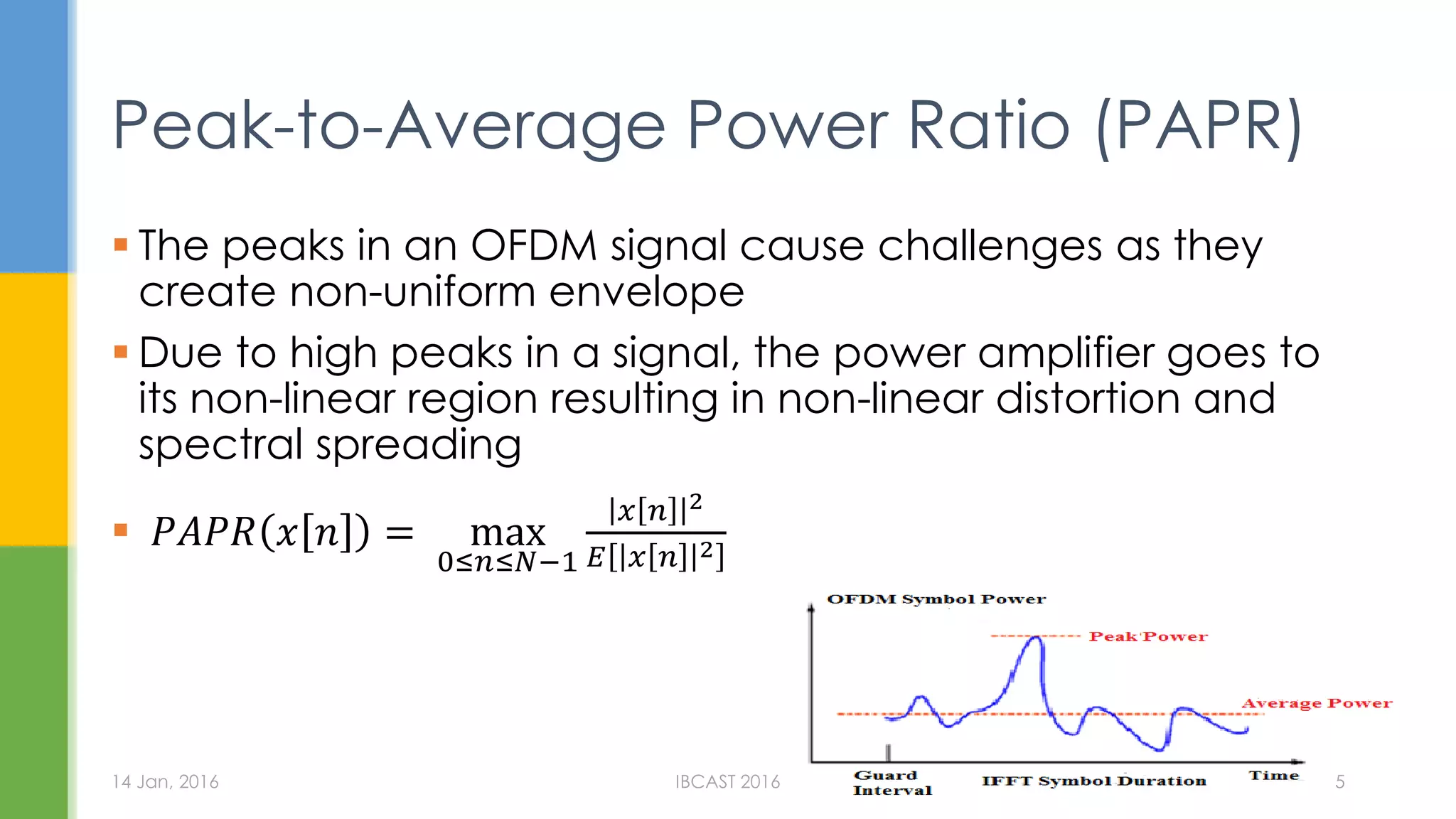
 The peaks in an OFDM signal cause challenges as they
create non-uniform envelope
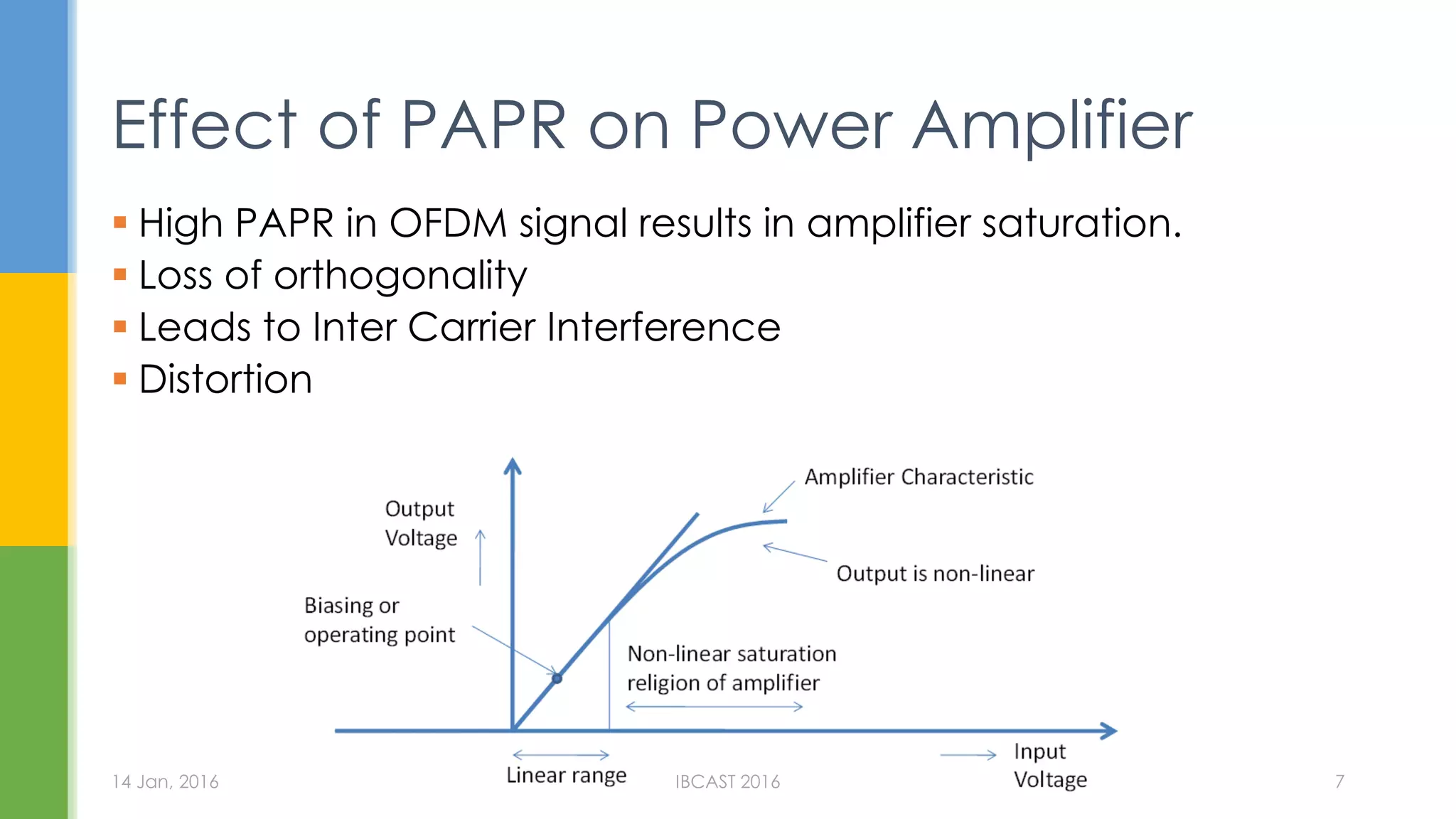
 Due to high peaks in a signal, the power amplifier goes to
its non-linear region resulting in non-linear distortion and
spectral spreading
 𝑃𝐴𝑃𝑅 𝑥 𝑛 = max
0≤𝑛≤𝑁−1
𝑥 𝑛 2
𝐸 𝑥 𝑛 2
Peak-to-Average Power Ratio (PAPR)
14 Jan, 2016 IBCAST 2016 5
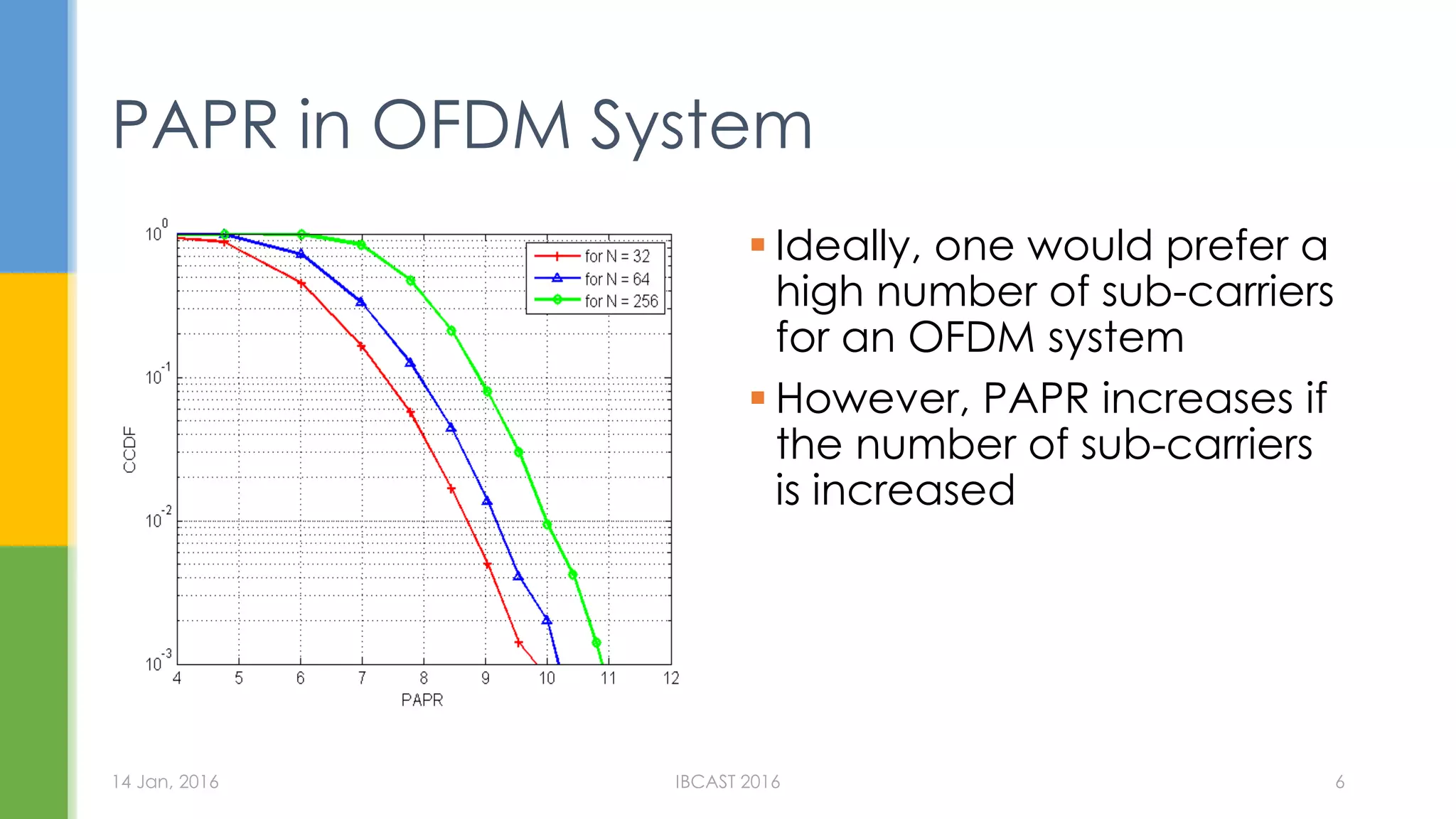
 Ideally, one would prefer a
high number of sub-carriers
for an OFDM system
 However, PAPR increases if
the number of sub-carriers
is increased
PAPR in OFDM System
14 Jan, 2016 IBCAST 2016 6
Effect of PAPR on Power Amplifier
 High PAPR in OFDM signal results in amplifier saturation.
 Loss of orthogonality
 Leads to Inter Carrier Interference
 Distortion
14 Jan, 2016 IBCAST 2016 7
PAPR Reduction Techniques
14 Jan, 2016 IBCAST 2016 8
PAPR Reduction Techniques
Signal Distortion Techniques
Multiple Signaling and Probabilistic Techniques
Coding Technique
Hybrid Techniques
Y. Rahmatallah and S. Mohan, “Peak-To-Average Power Ratio Reduction in OFDM Systems : A
Survey And Taxonomy,” IEEE Comun. Surv. Tutorials, vol. 15, no. 4, pp. 1567–1592, 2013.
14 Jan, 2016 IBCAST 2016 9
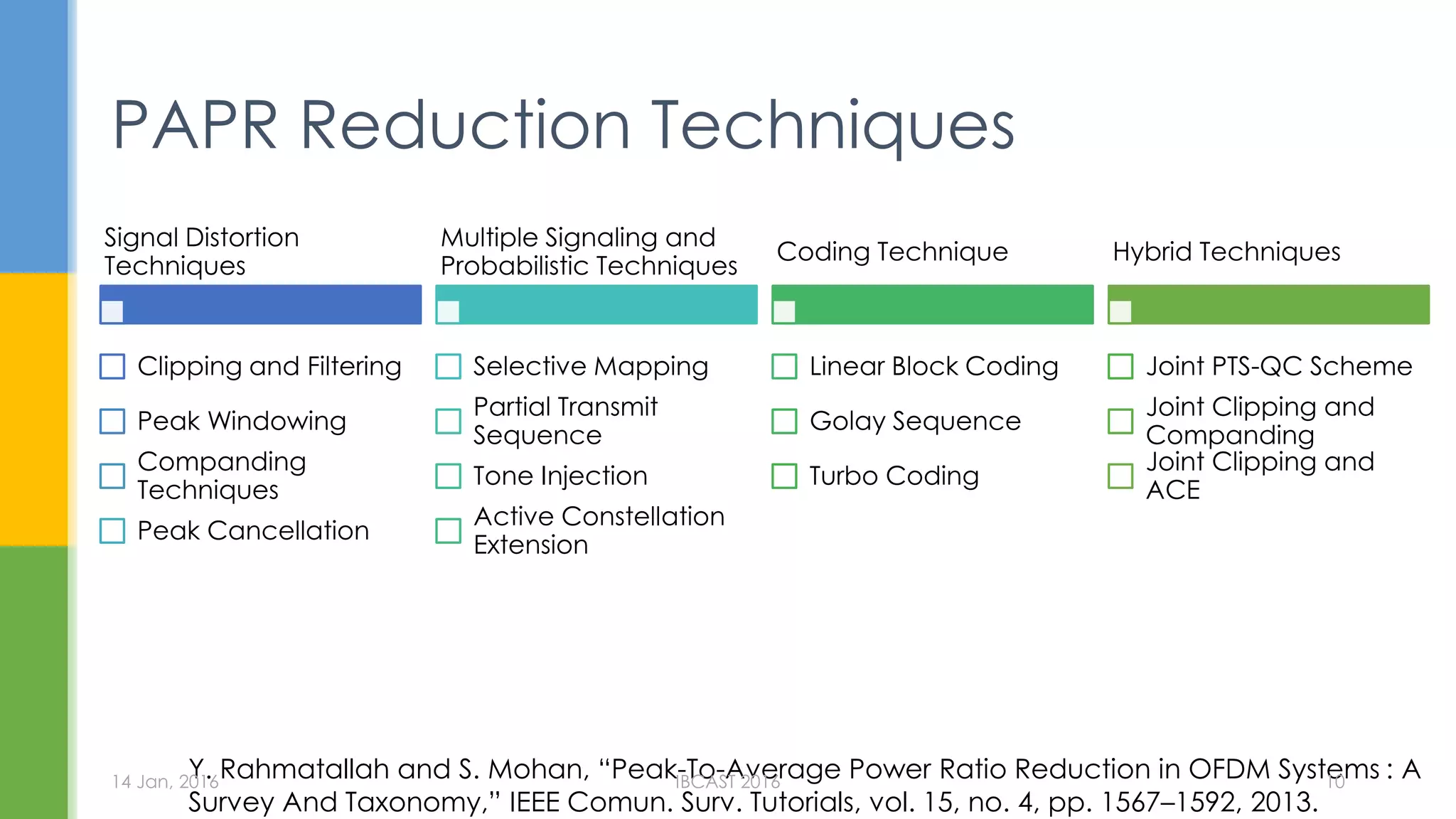
PAPR Reduction Techniques
Signal Distortion
Techniques
Clipping and Filtering
Peak Windowing
Companding
Techniques
Peak Cancellation
Multiple Signaling and
Probabilistic Techniques
Selective Mapping
Partial Transmit
Sequence
Tone Injection
Active Constellation
Extension
Coding Technique
Linear Block Coding
Golay Sequence
Turbo Coding
Hybrid Techniques
Joint PTS-QC Scheme
Joint Clipping and
Companding
Joint Clipping and
ACE
Y. Rahmatallah and S. Mohan, “Peak-To-Average Power Ratio Reduction in OFDM Systems : A
Survey And Taxonomy,” IEEE Comun. Surv. Tutorials, vol. 15, no. 4, pp. 1567–1592, 2013.
14 Jan, 2016 IBCAST 2016 10
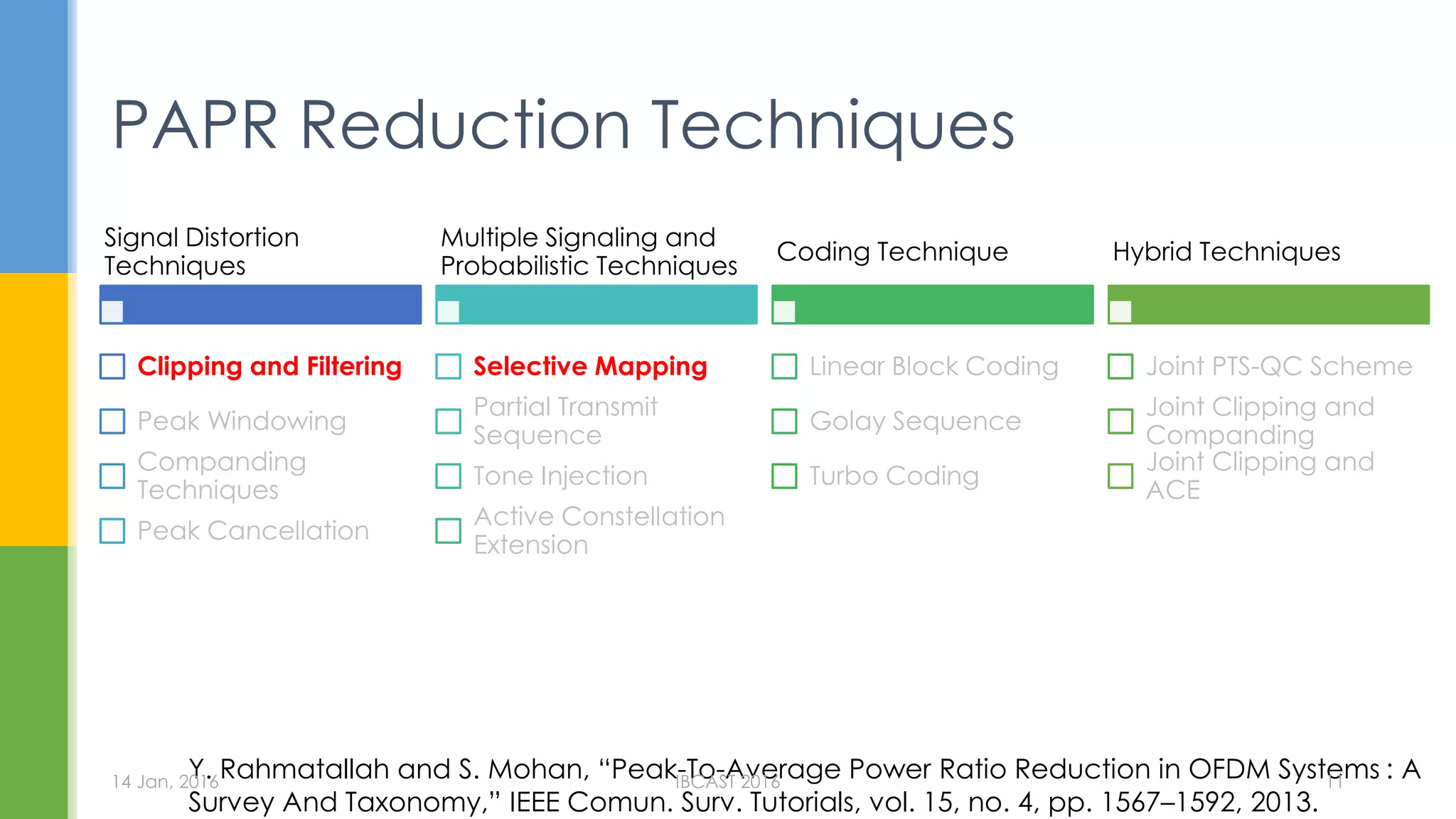
PAPR Reduction Techniques
Signal Distortion
Techniques
Clipping and Filtering
Peak Windowing
Companding
Techniques
Peak Cancellation
Multiple Signaling and
Probabilistic Techniques
Selective Mapping
Partial Transmit
Sequence
Tone Injection
Active Constellation
Extension
Coding Technique
Linear Block Coding
Golay Sequence
Turbo Coding
Hybrid Techniques
Joint PTS-QC Scheme
Joint Clipping and
Companding
Joint Clipping and
ACE
Y. Rahmatallah and S. Mohan, “Peak-To-Average Power Ratio Reduction in OFDM Systems : A
Survey And Taxonomy,” IEEE Comun. Surv. Tutorials, vol. 15, no. 4, pp. 1567–1592, 2013.
14 Jan, 2016 IBCAST 2016 11
Selective Mapping
14 Jan, 2016 IBCAST 2016 12
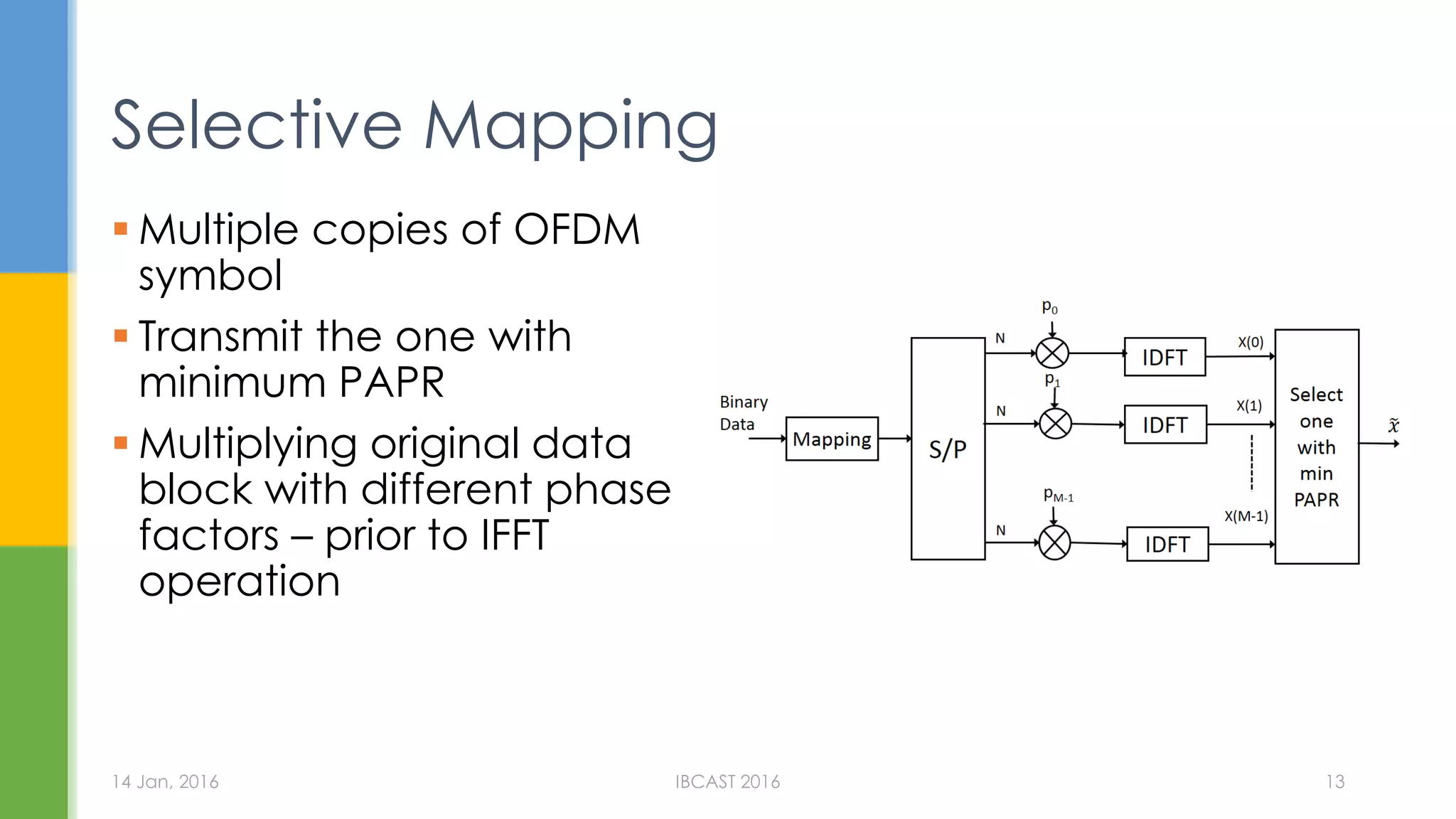
Selective Mapping
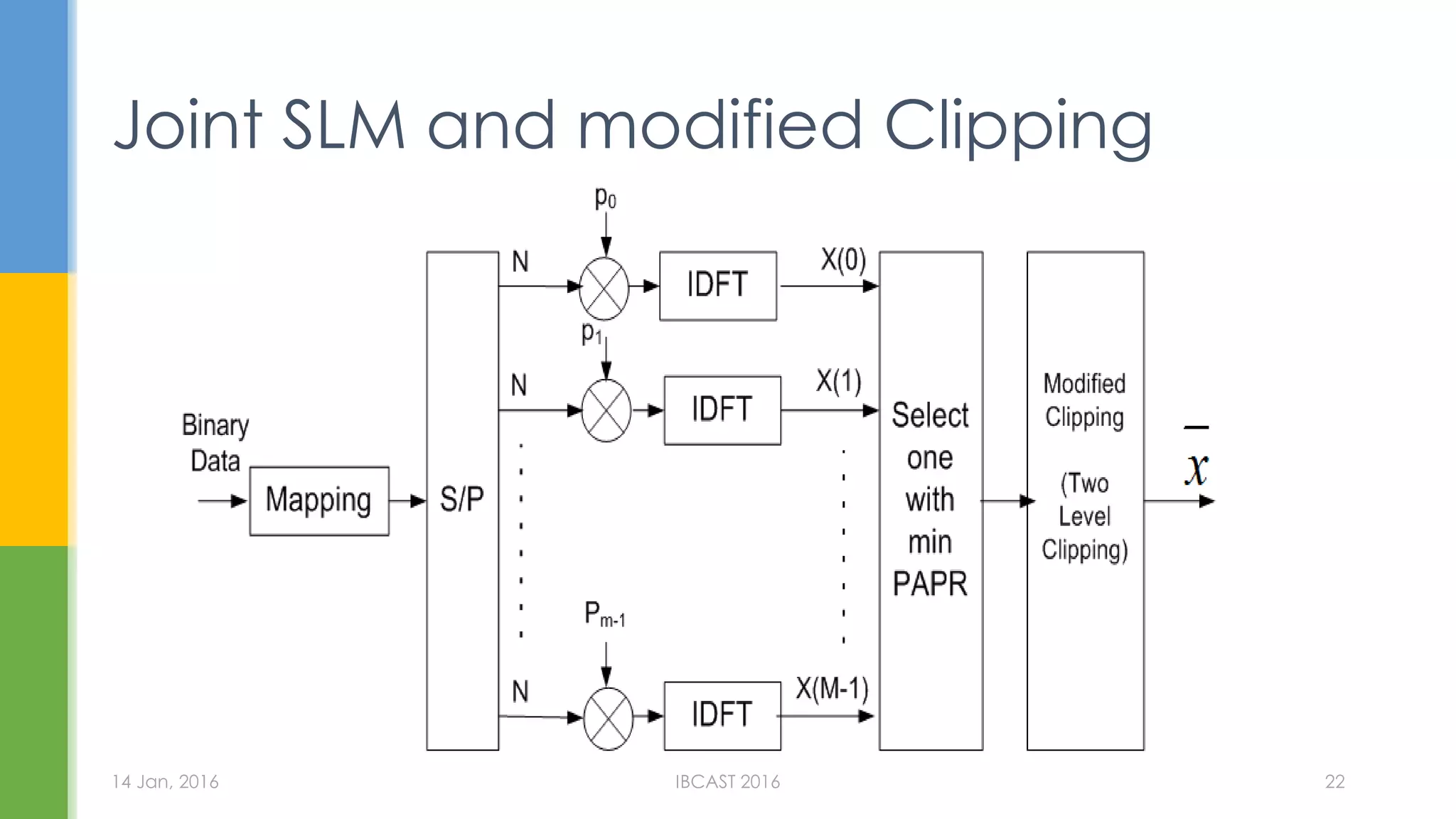
 Multiple copies of OFDM
symbol
 Transmit the one with
minimum PAPR
 Multiplying original data
block with different phase
factors – prior to IFFT
operation
14 Jan, 2016 IBCAST 2016 13
Conventional Clipping
14 Jan, 2016 IBCAST 2016 14
Conventional Clipping
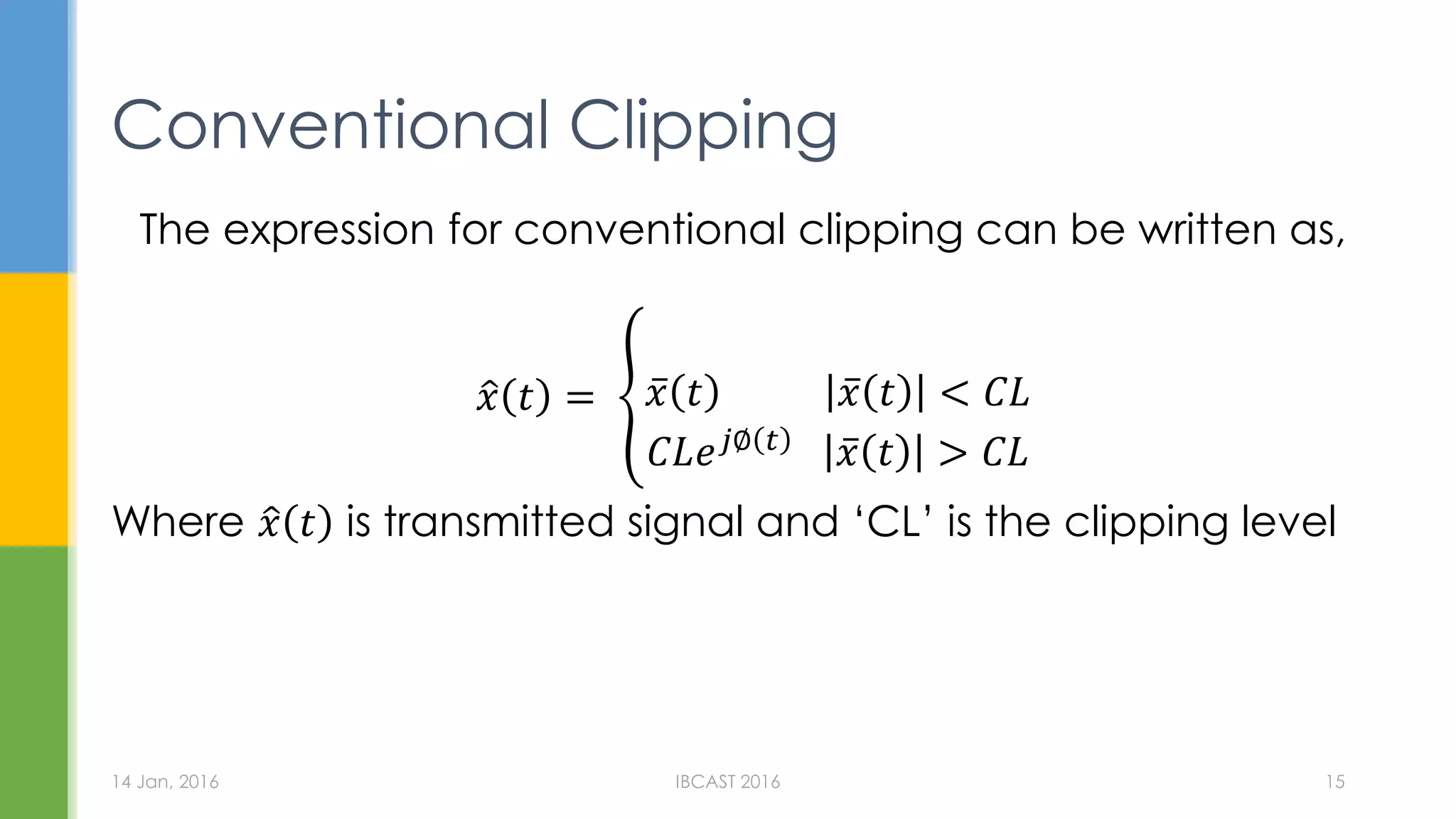
The expression for conventional clipping can be written as,
𝑥 𝑡 = 𝑥 𝑡 𝑥 𝑡 < 𝐶𝐿
𝐶𝐿𝑒 𝑗∅ 𝑡
𝑥 𝑡 > 𝐶𝐿
Where 𝑥 𝑡 is transmitted signal and ‘CL’ is the clipping level
14 Jan, 2016 IBCAST 2016 15
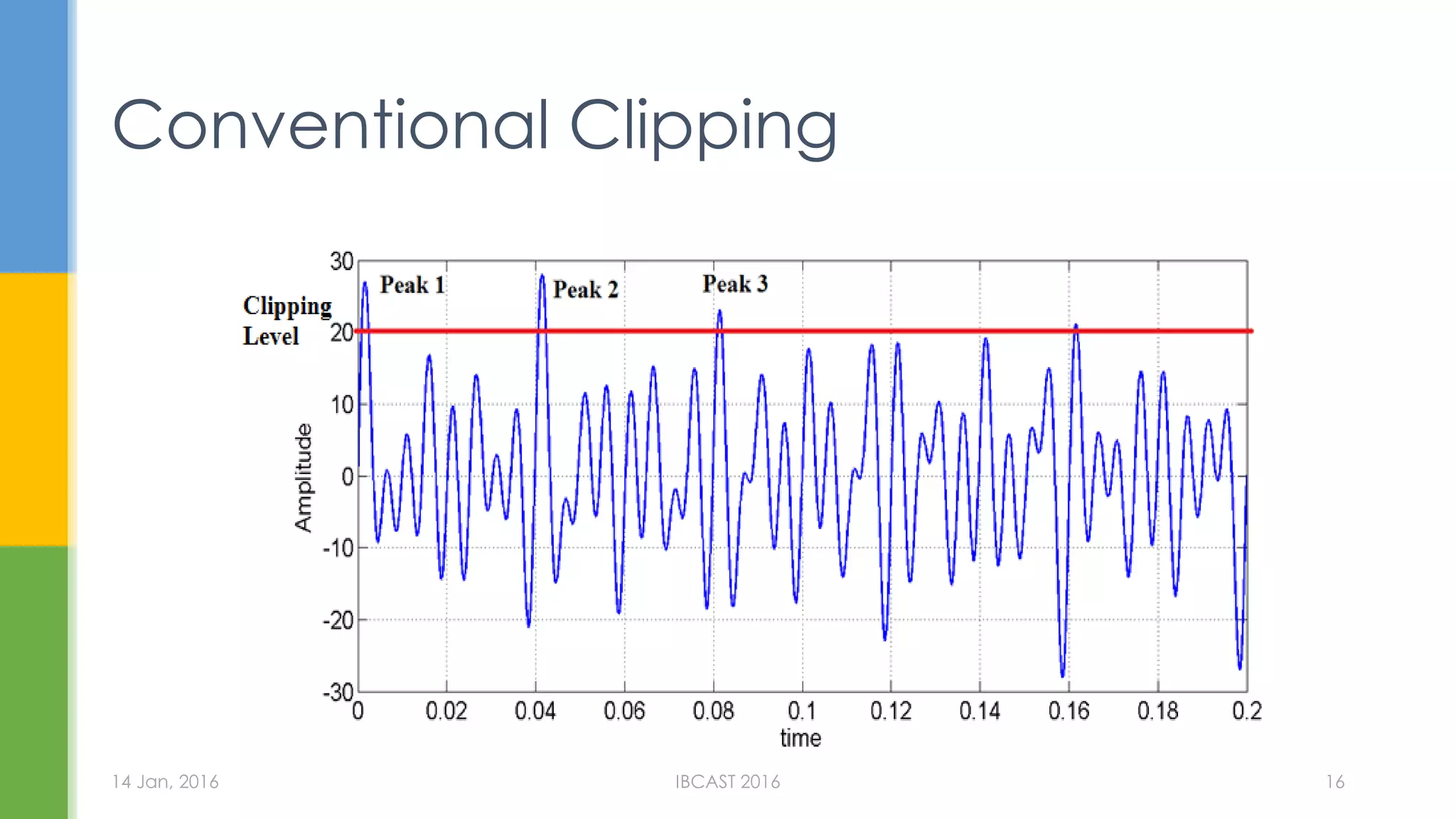
Conventional Clipping
14 Jan, 2016 IBCAST 2016 16
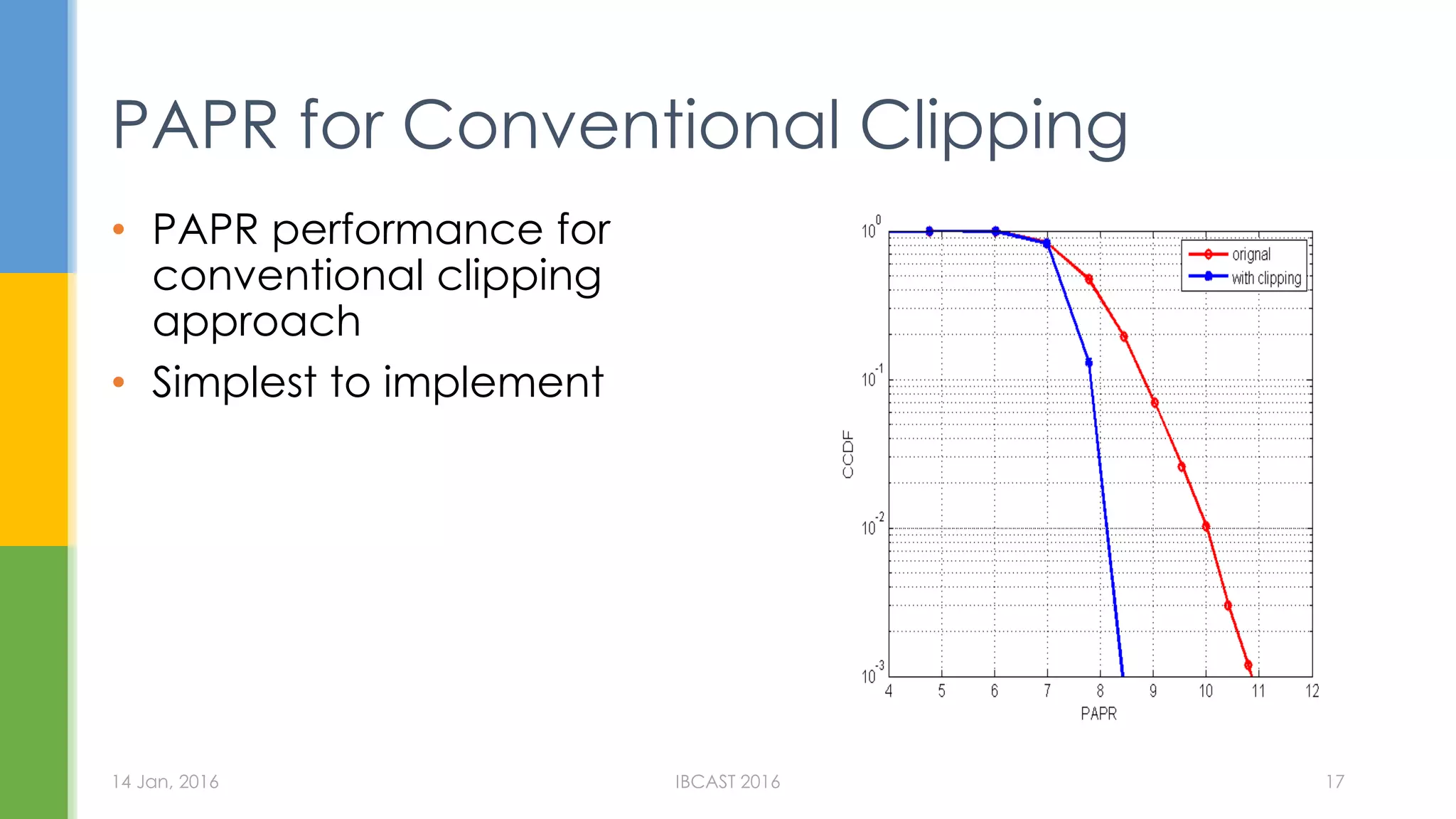
PAPR for Conventional Clipping
• PAPR performance for
conventional clipping
approach
• Simplest to implement
14 Jan, 2016 IBCAST 2016 17
Joint SLM and modified
Clipping
(Proposed Approach)
14 Jan, 2016 IBCAST 2016 18
Joint SLM and modified Clipping
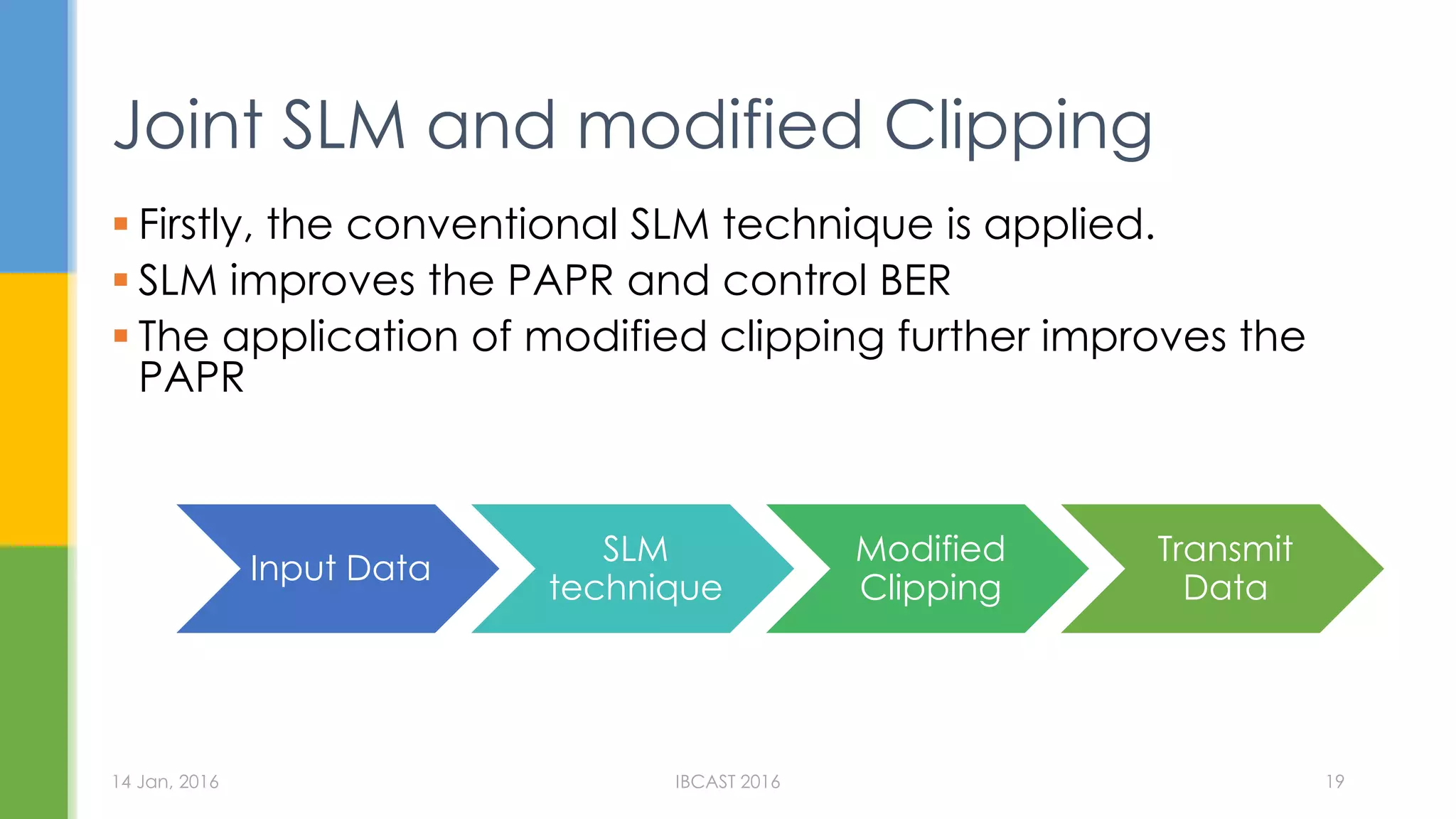
 Firstly, the conventional SLM technique is applied.
 SLM improves the PAPR and control BER
 The application of modified clipping further improves the
PAPR
14 Jan, 2016 IBCAST 2016 19
Input Data
SLM
technique
Modified
Clipping
Transmit
Data
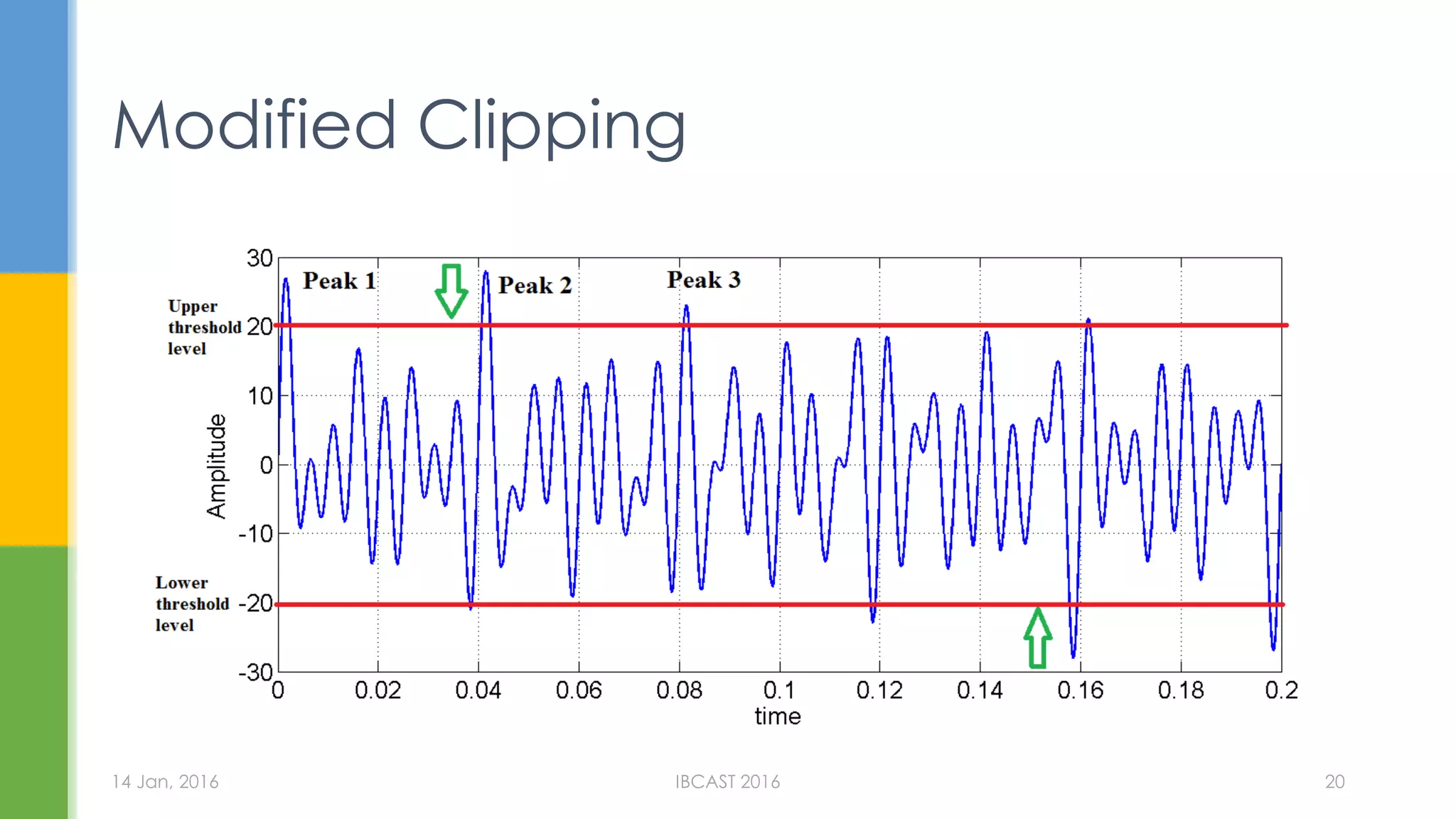
Modified Clipping
14 Jan, 2016 IBCAST 2016 20
Modified Clipping
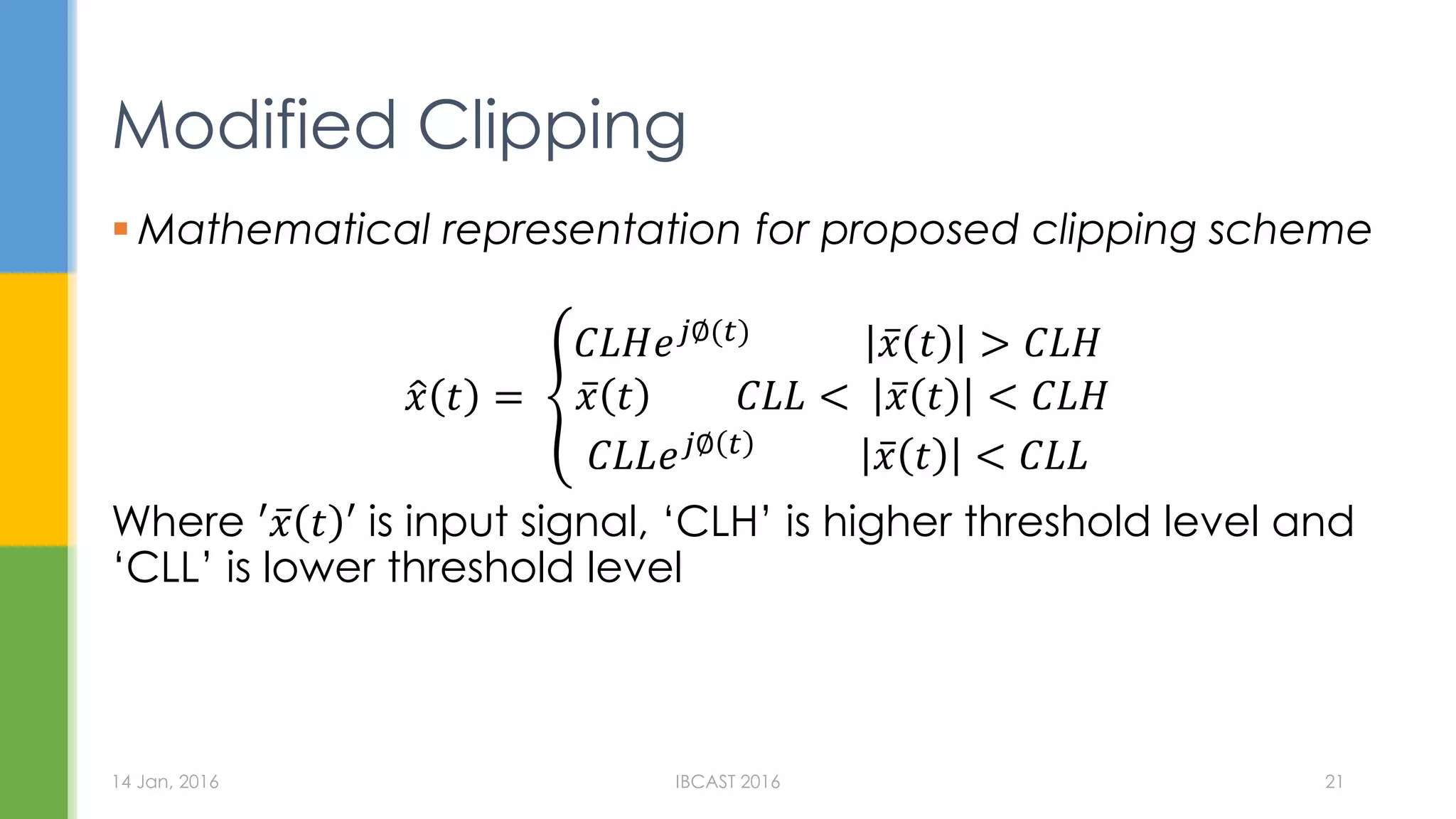
 Mathematical representation for proposed clipping scheme
𝑥 𝑡 =
𝐶𝐿𝐻𝑒 𝑗∅(𝑡) 𝑥 𝑡 > 𝐶𝐿𝐻
𝑥 𝑡 𝐶𝐿𝐿 < 𝑥 𝑡 < 𝐶𝐿𝐻
𝐶𝐿𝐿𝑒 𝑗∅ 𝑡
𝑥 𝑡 < 𝐶𝐿𝐿
Where ′ 𝑥 𝑡 ′ is input signal, ‘CLH’ is higher threshold level and
‘CLL’ is lower threshold level
14 Jan, 2016 IBCAST 2016 21
Joint SLM and modified Clipping
14 Jan, 2016 IBCAST 2016 22
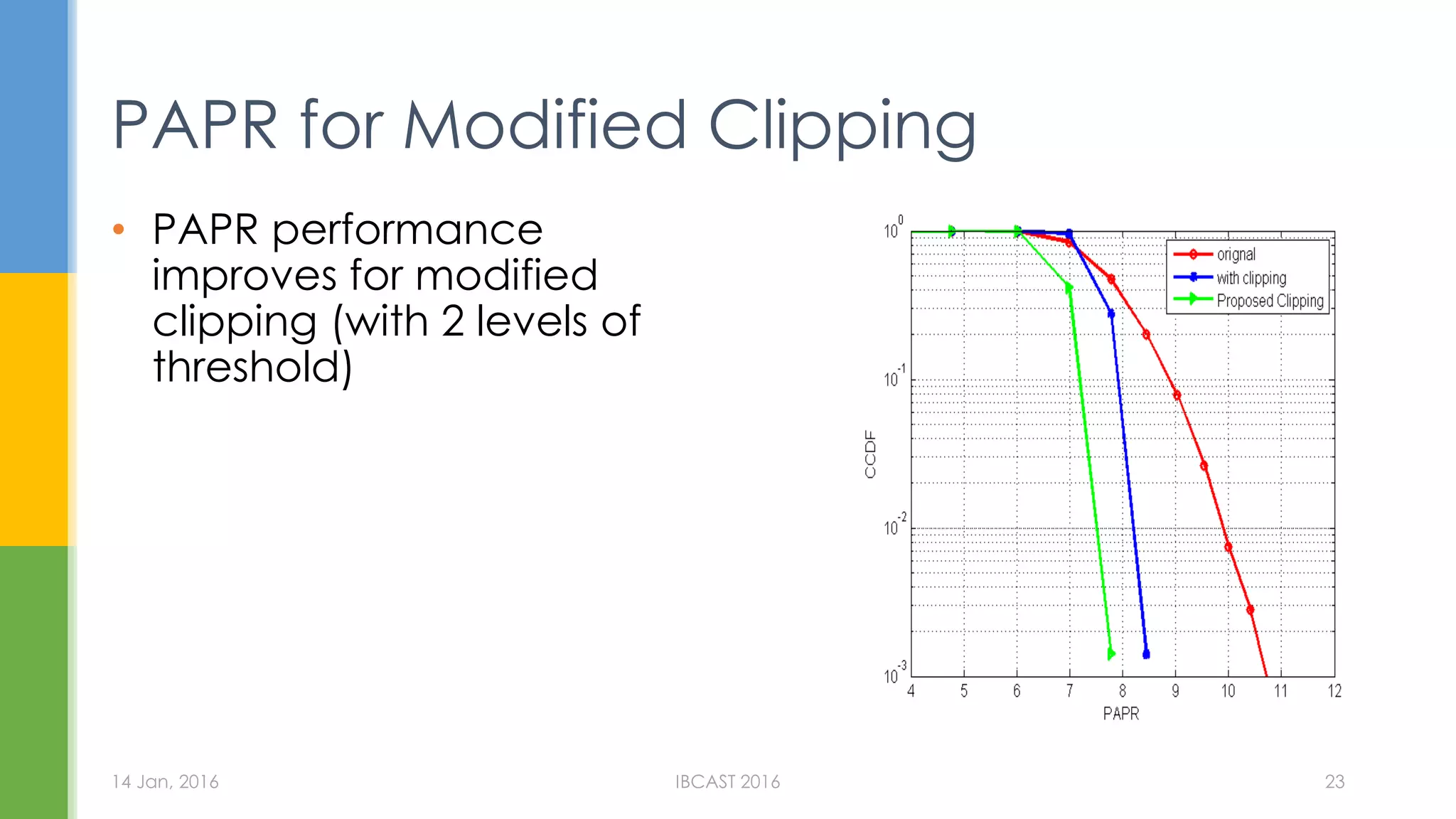
PAPR for Modified Clipping
• PAPR performance
improves for modified
clipping (with 2 levels of
threshold)
14 Jan, 2016 IBCAST 2016 23
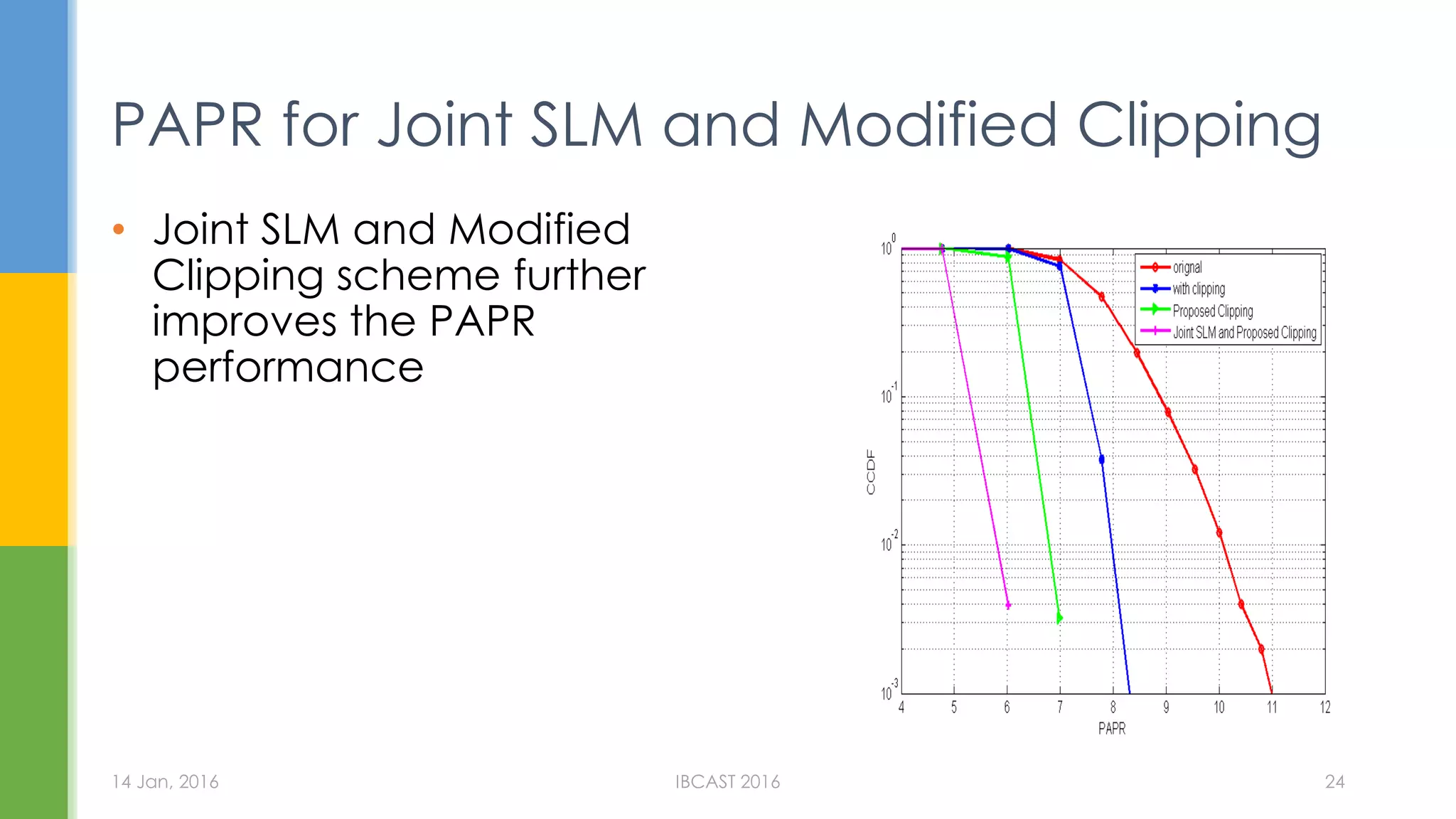
PAPR for Joint SLM and Modified Clipping
• Joint SLM and Modified
Clipping scheme further
improves the PAPR
performance
14 Jan, 2016 IBCAST 2016 24
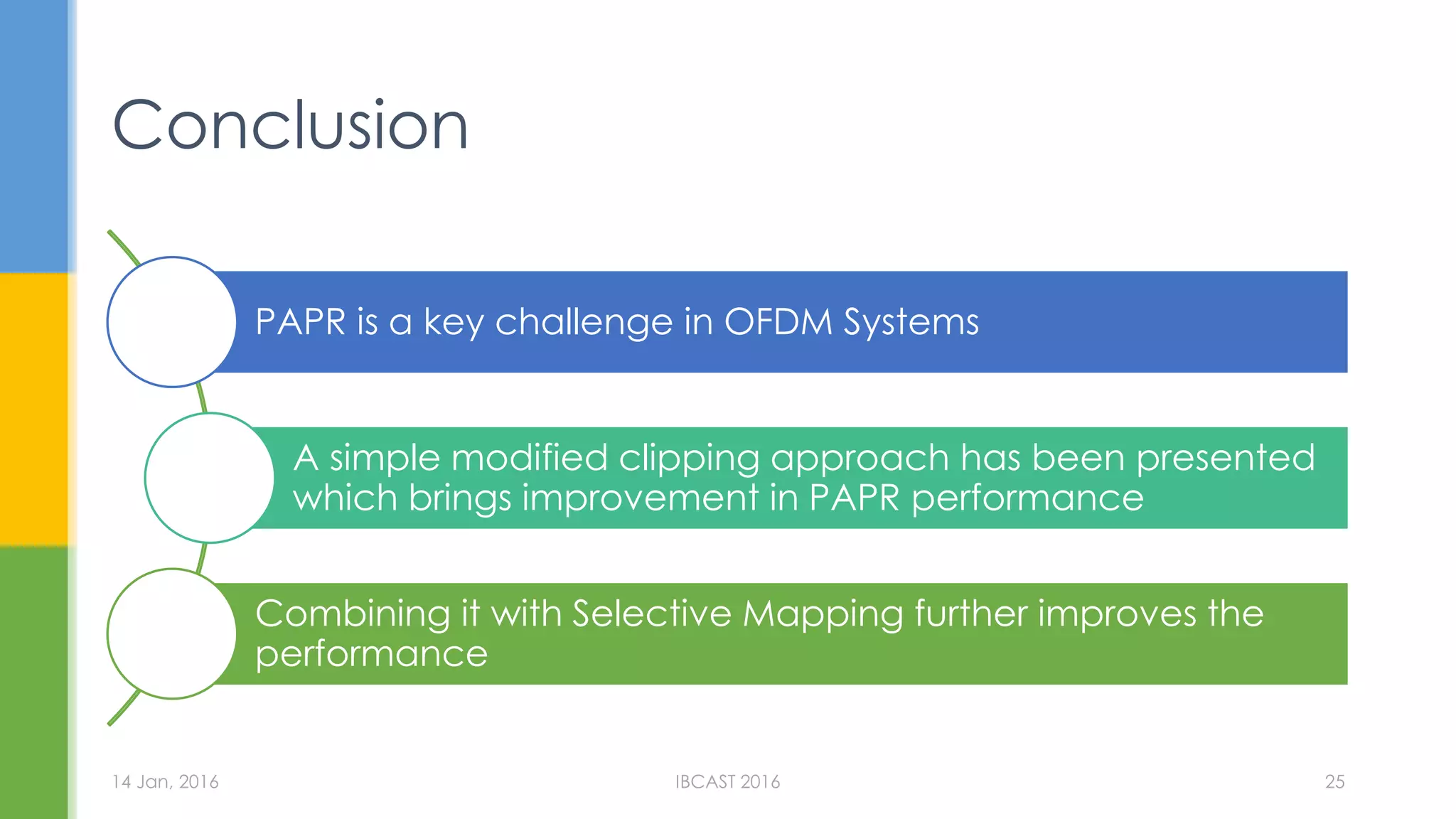
Conclusion
PAPR is a key challenge in OFDM Systems
A simple modified clipping approach has been presented
which brings improvement in PAPR performance
Combining it with Selective Mapping further improves the
performance
14 Jan, 2016 IBCAST 2016 25
Thank you
14 Jan, 2016 IBCAST 2016 26

Joint SLM and Modified Clipping Technique for PAPR Reduction

  • 1.
    Kashif Sultan, HazratAli, Zhongshan Zhang Presentation by Dr. Hazrat Ali COMSATS Institute of Information Technology Joint SLM and Modified Clipping Technique for PAPR Reduction 14 Jan, 2016 IBCAST 2016 1
  • 2.
     Orthogonal FrequencyDivision Multiplexing  Peak-to-Average Power Ratio  Effect on Power Amplifier  PAPR Reduction Techniques  Selective Mapping  Conventional Clipping  Proposed Scheme  Modified Clipping  Joint SLM and Modified Clipping Contents 14 Jan, 2016 IBCAST 2016 2
  • 3.
     OFDM formsthe basis for 4G (fourth generation wireless communication)  It is revolutionary technology in wireless communication  Long Term Evoultion (LTE) – the 4G cellular standard  LTE is based on two key technologies  OFDM  WiMax  OFDM is a key broadband wireless technology which supports data rates in excess of 100 Mbps  WLAN standard 802.11a/g/n are also based on OFDM. Orthogonal Frequency Division Multiplexing (OFDM) 14 Jan, 2016 IBCAST 2016 3
  • 4.
    OFDM Block Diagram ofan OFDM system 14 Jan, 2016 IBCAST 2016 4
  • 5.
     The peaksin an OFDM signal cause challenges as they create non-uniform envelope  Due to high peaks in a signal, the power amplifier goes to its non-linear region resulting in non-linear distortion and spectral spreading  𝑃𝐴𝑃𝑅 𝑥 𝑛 = max 0≤𝑛≤𝑁−1 𝑥 𝑛 2 𝐸 𝑥 𝑛 2 Peak-to-Average Power Ratio (PAPR) 14 Jan, 2016 IBCAST 2016 5
  • 6.
     Ideally, onewould prefer a high number of sub-carriers for an OFDM system  However, PAPR increases if the number of sub-carriers is increased PAPR in OFDM System 14 Jan, 2016 IBCAST 2016 6
  • 7.
    Effect of PAPRon Power Amplifier  High PAPR in OFDM signal results in amplifier saturation.  Loss of orthogonality  Leads to Inter Carrier Interference  Distortion 14 Jan, 2016 IBCAST 2016 7
  • 8.
    PAPR Reduction Techniques 14Jan, 2016 IBCAST 2016 8
  • 9.
    PAPR Reduction Techniques SignalDistortion Techniques Multiple Signaling and Probabilistic Techniques Coding Technique Hybrid Techniques Y. Rahmatallah and S. Mohan, “Peak-To-Average Power Ratio Reduction in OFDM Systems : A Survey And Taxonomy,” IEEE Comun. Surv. Tutorials, vol. 15, no. 4, pp. 1567–1592, 2013. 14 Jan, 2016 IBCAST 2016 9
  • 10.
    PAPR Reduction Techniques SignalDistortion Techniques Clipping and Filtering Peak Windowing Companding Techniques Peak Cancellation Multiple Signaling and Probabilistic Techniques Selective Mapping Partial Transmit Sequence Tone Injection Active Constellation Extension Coding Technique Linear Block Coding Golay Sequence Turbo Coding Hybrid Techniques Joint PTS-QC Scheme Joint Clipping and Companding Joint Clipping and ACE Y. Rahmatallah and S. Mohan, “Peak-To-Average Power Ratio Reduction in OFDM Systems : A Survey And Taxonomy,” IEEE Comun. Surv. Tutorials, vol. 15, no. 4, pp. 1567–1592, 2013. 14 Jan, 2016 IBCAST 2016 10
  • 11.
    PAPR Reduction Techniques SignalDistortion Techniques Clipping and Filtering Peak Windowing Companding Techniques Peak Cancellation Multiple Signaling and Probabilistic Techniques Selective Mapping Partial Transmit Sequence Tone Injection Active Constellation Extension Coding Technique Linear Block Coding Golay Sequence Turbo Coding Hybrid Techniques Joint PTS-QC Scheme Joint Clipping and Companding Joint Clipping and ACE Y. Rahmatallah and S. Mohan, “Peak-To-Average Power Ratio Reduction in OFDM Systems : A Survey And Taxonomy,” IEEE Comun. Surv. Tutorials, vol. 15, no. 4, pp. 1567–1592, 2013. 14 Jan, 2016 IBCAST 2016 11
  • 12.
    Selective Mapping 14 Jan,2016 IBCAST 2016 12
  • 13.
    Selective Mapping  Multiplecopies of OFDM symbol  Transmit the one with minimum PAPR  Multiplying original data block with different phase factors – prior to IFFT operation 14 Jan, 2016 IBCAST 2016 13
  • 14.
    Conventional Clipping 14 Jan,2016 IBCAST 2016 14
  • 15.
    Conventional Clipping The expressionfor conventional clipping can be written as, 𝑥 𝑡 = 𝑥 𝑡 𝑥 𝑡 < 𝐶𝐿 𝐶𝐿𝑒 𝑗∅ 𝑡 𝑥 𝑡 > 𝐶𝐿 Where 𝑥 𝑡 is transmitted signal and ‘CL’ is the clipping level 14 Jan, 2016 IBCAST 2016 15
  • 16.
    Conventional Clipping 14 Jan,2016 IBCAST 2016 16
  • 17.
    PAPR for ConventionalClipping • PAPR performance for conventional clipping approach • Simplest to implement 14 Jan, 2016 IBCAST 2016 17
  • 18.
    Joint SLM andmodified Clipping (Proposed Approach) 14 Jan, 2016 IBCAST 2016 18
  • 19.
    Joint SLM andmodified Clipping  Firstly, the conventional SLM technique is applied.  SLM improves the PAPR and control BER  The application of modified clipping further improves the PAPR 14 Jan, 2016 IBCAST 2016 19 Input Data SLM technique Modified Clipping Transmit Data
  • 20.
    Modified Clipping 14 Jan,2016 IBCAST 2016 20
  • 21.
    Modified Clipping  Mathematicalrepresentation for proposed clipping scheme 𝑥 𝑡 = 𝐶𝐿𝐻𝑒 𝑗∅(𝑡) 𝑥 𝑡 > 𝐶𝐿𝐻 𝑥 𝑡 𝐶𝐿𝐿 < 𝑥 𝑡 < 𝐶𝐿𝐻 𝐶𝐿𝐿𝑒 𝑗∅ 𝑡 𝑥 𝑡 < 𝐶𝐿𝐿 Where ′ 𝑥 𝑡 ′ is input signal, ‘CLH’ is higher threshold level and ‘CLL’ is lower threshold level 14 Jan, 2016 IBCAST 2016 21
  • 22.
    Joint SLM andmodified Clipping 14 Jan, 2016 IBCAST 2016 22
  • 23.
    PAPR for ModifiedClipping • PAPR performance improves for modified clipping (with 2 levels of threshold) 14 Jan, 2016 IBCAST 2016 23
  • 24.
    PAPR for JointSLM and Modified Clipping • Joint SLM and Modified Clipping scheme further improves the PAPR performance 14 Jan, 2016 IBCAST 2016 24
  • 25.
    Conclusion PAPR is akey challenge in OFDM Systems A simple modified clipping approach has been presented which brings improvement in PAPR performance Combining it with Selective Mapping further improves the performance 14 Jan, 2016 IBCAST 2016 25
  • 26.
    Thank you 14 Jan,2016 IBCAST 2016 26