The Effect of Signal Distortion
Techniques for PAPR Reduction on
the BER Performance of Turbo and
LDPC Coded OFDM System
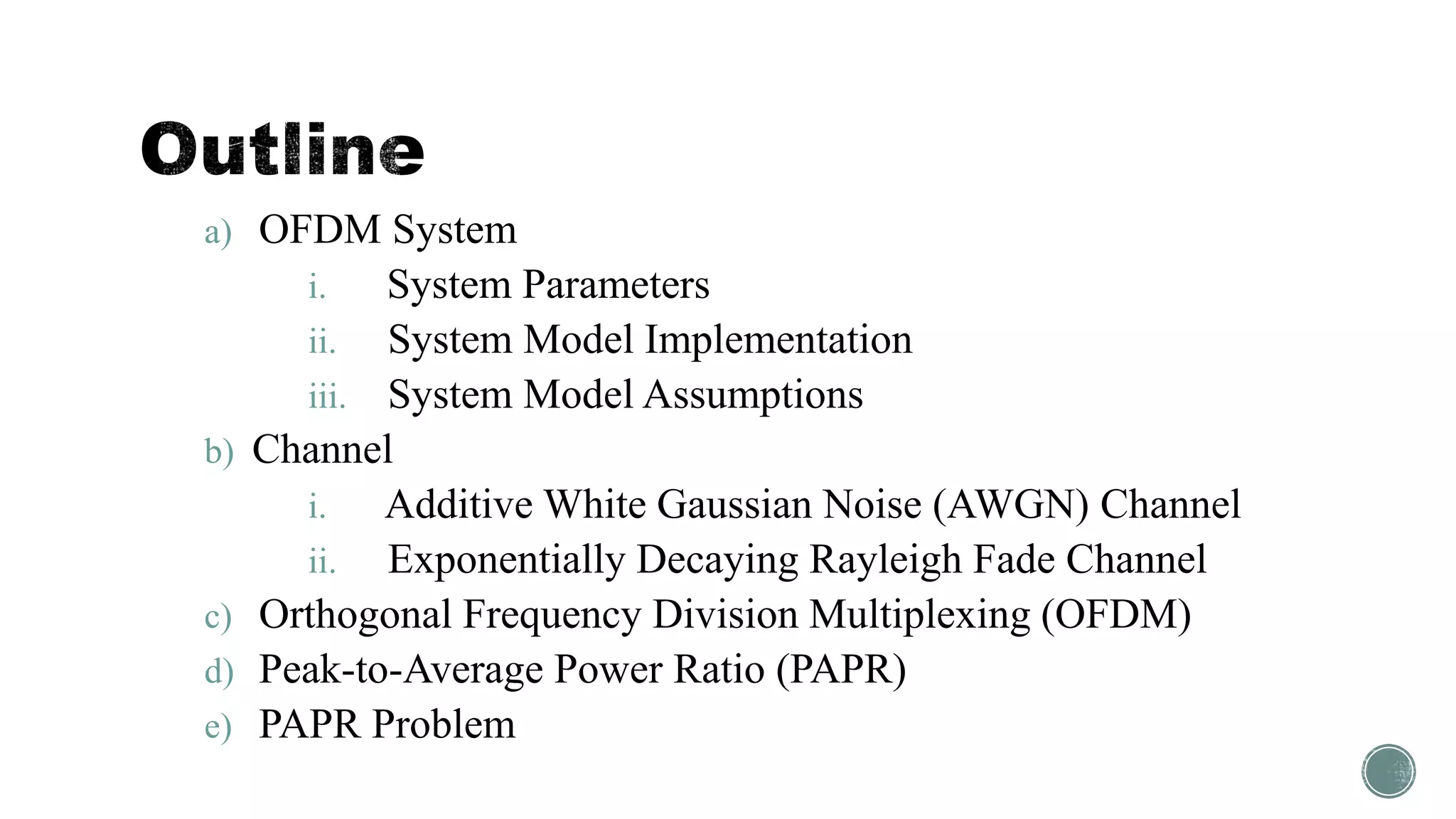
a) OFDM System
i. System Parameters
ii. System Model Implementation
iii. System Model Assumptions
b) Channel
i. Additive White Gaussian Noise (AWGN) Channel
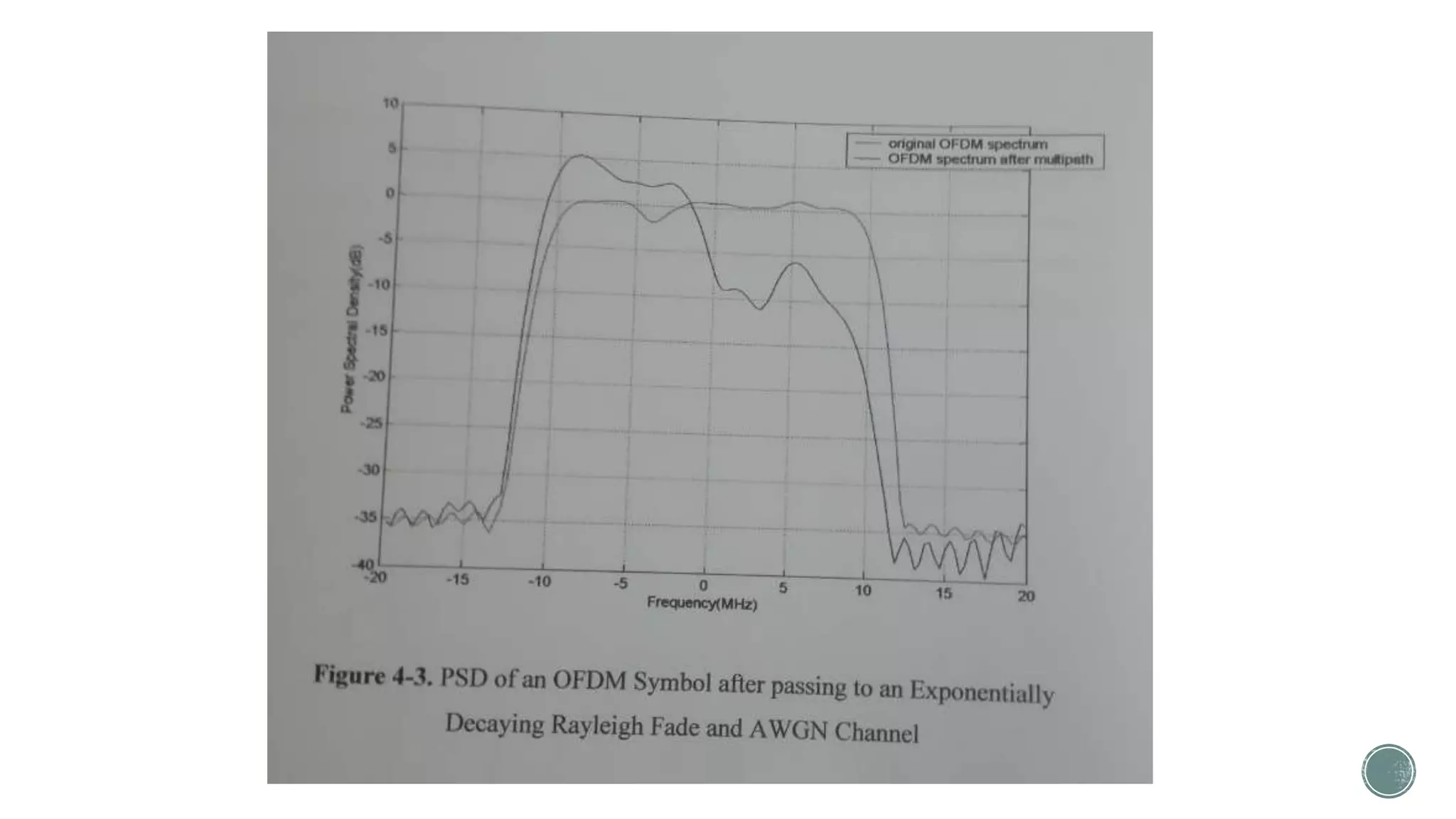
ii. Exponentially Decaying Rayleigh Fade Channel
c) Orthogonal Frequency Division Multiplexing (OFDM)
d) Peak-to-Average Power Ratio (PAPR)
e) PAPR Problem
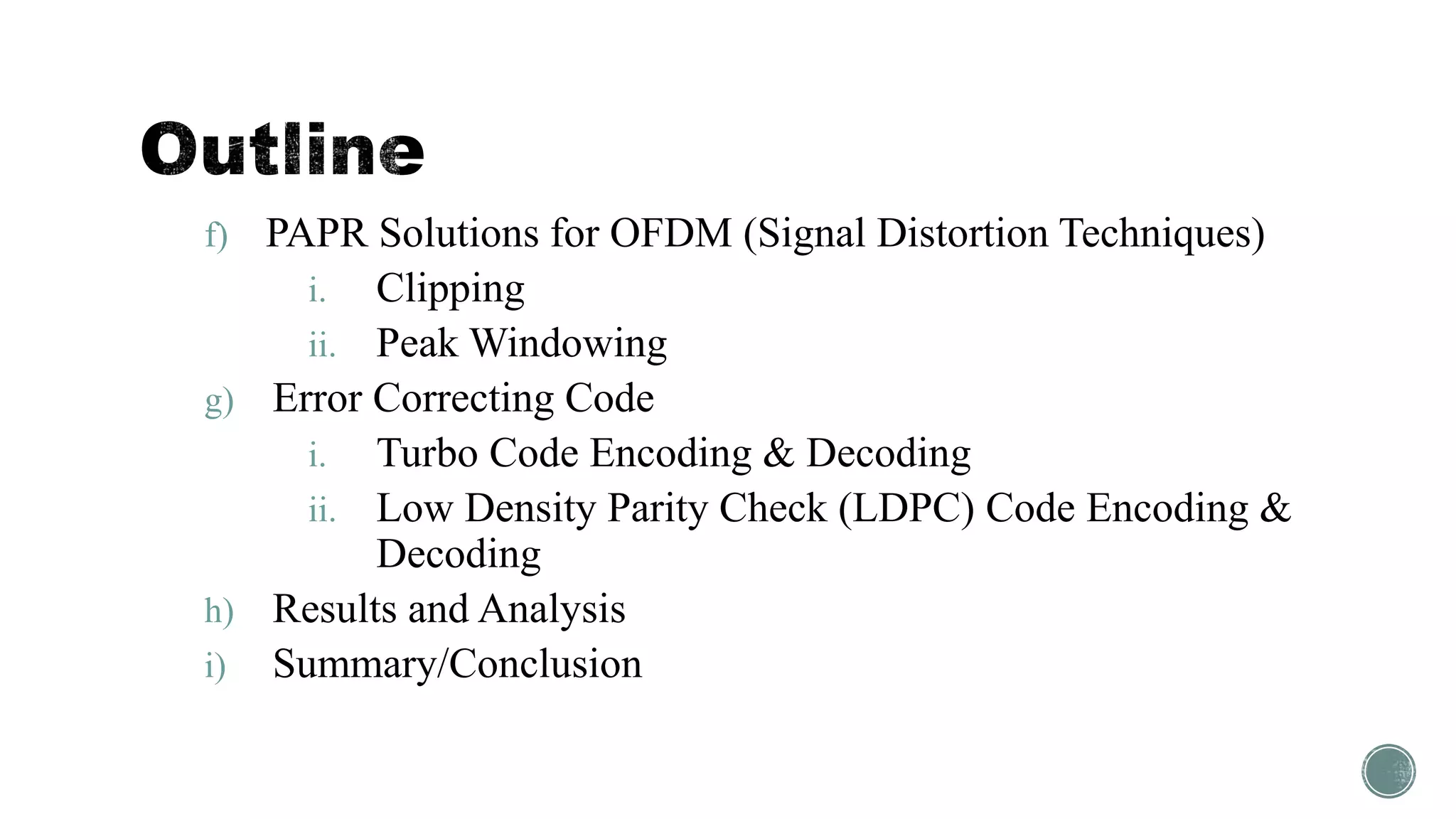
f) PAPR Solutions for OFDM (Signal Distortion Techniques)
i. Clipping
ii. Peak Windowing
g) Error Correcting Code
i. Turbo Code Encoding & Decoding
ii. Low Density Parity Check (LDPC) Code Encoding &
Decoding
h) Results and Analysis
i) Summary/Conclusion
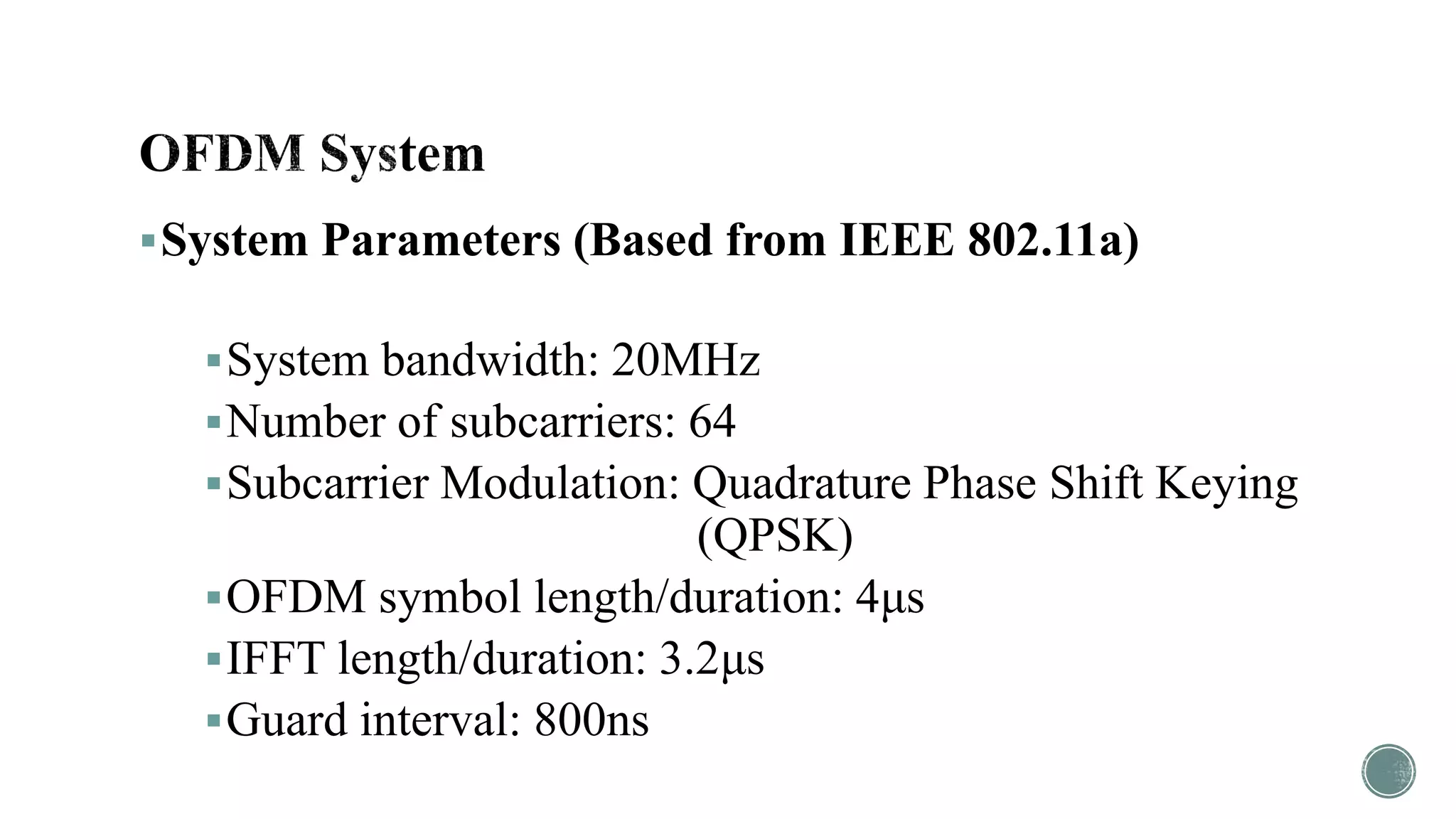
System Parameters (Based from IEEE 802.11a)
System bandwidth: 20MHz
Number of subcarriers: 64
Subcarrier Modulation: Quadrature Phase Shift Keying
(QPSK)
OFDM symbol length/duration: 4μs
IFFT length/duration: 3.2μs
Guard interval: 800ns
System Parameters (Based from IEEE 802.11a)
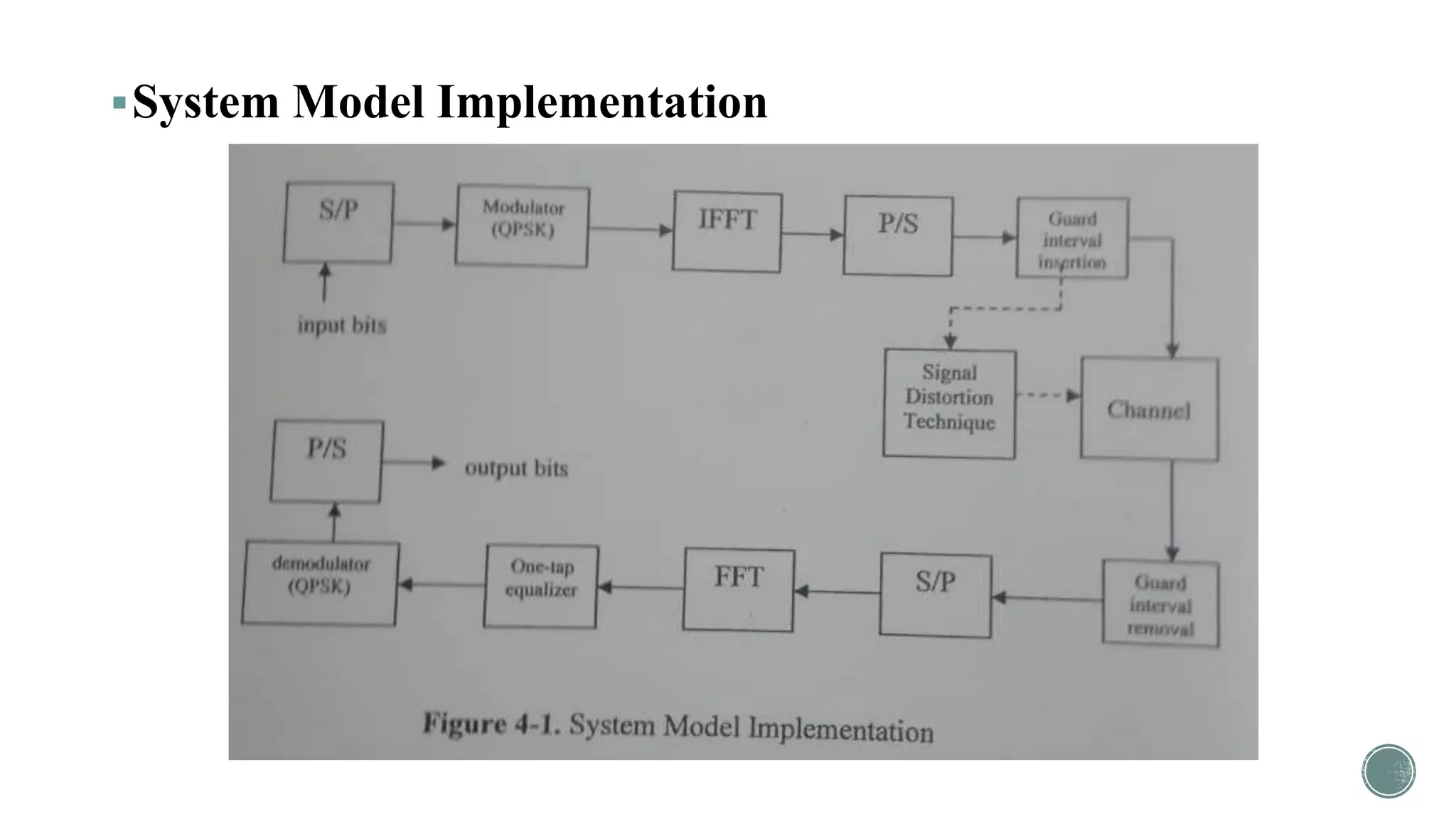
Coding scheme: Turbo & LDPC
Code rate: ½
Signal distortion technique: Clipping & Peak windowing
Window (Peak windowing): Hamming
Maximum amplitude: 8 square root of number of subcarriers
Channel Model: AWGN channel & Exponentially Decaying
Rayleigh Fade model
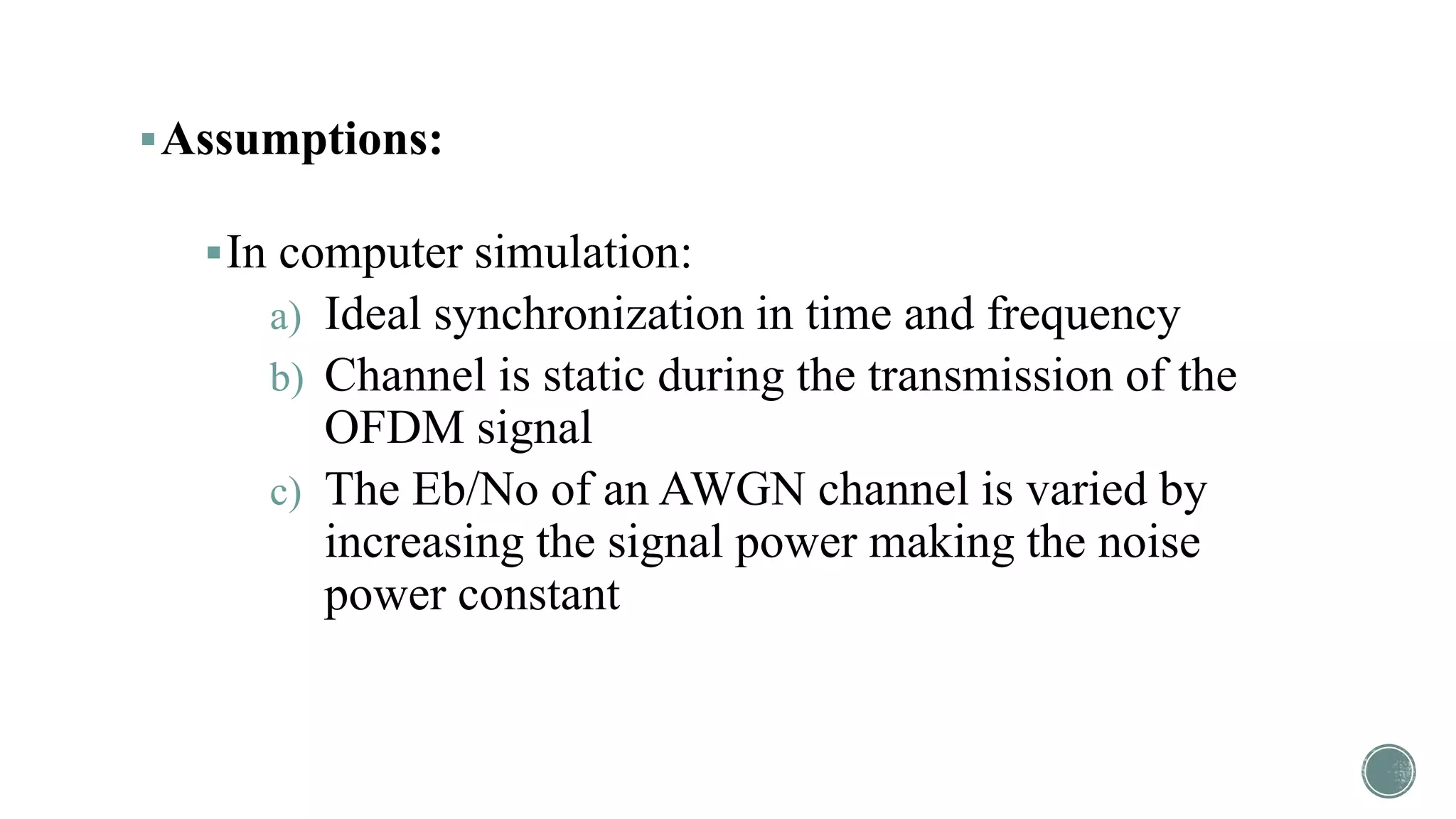
System Model Implementation
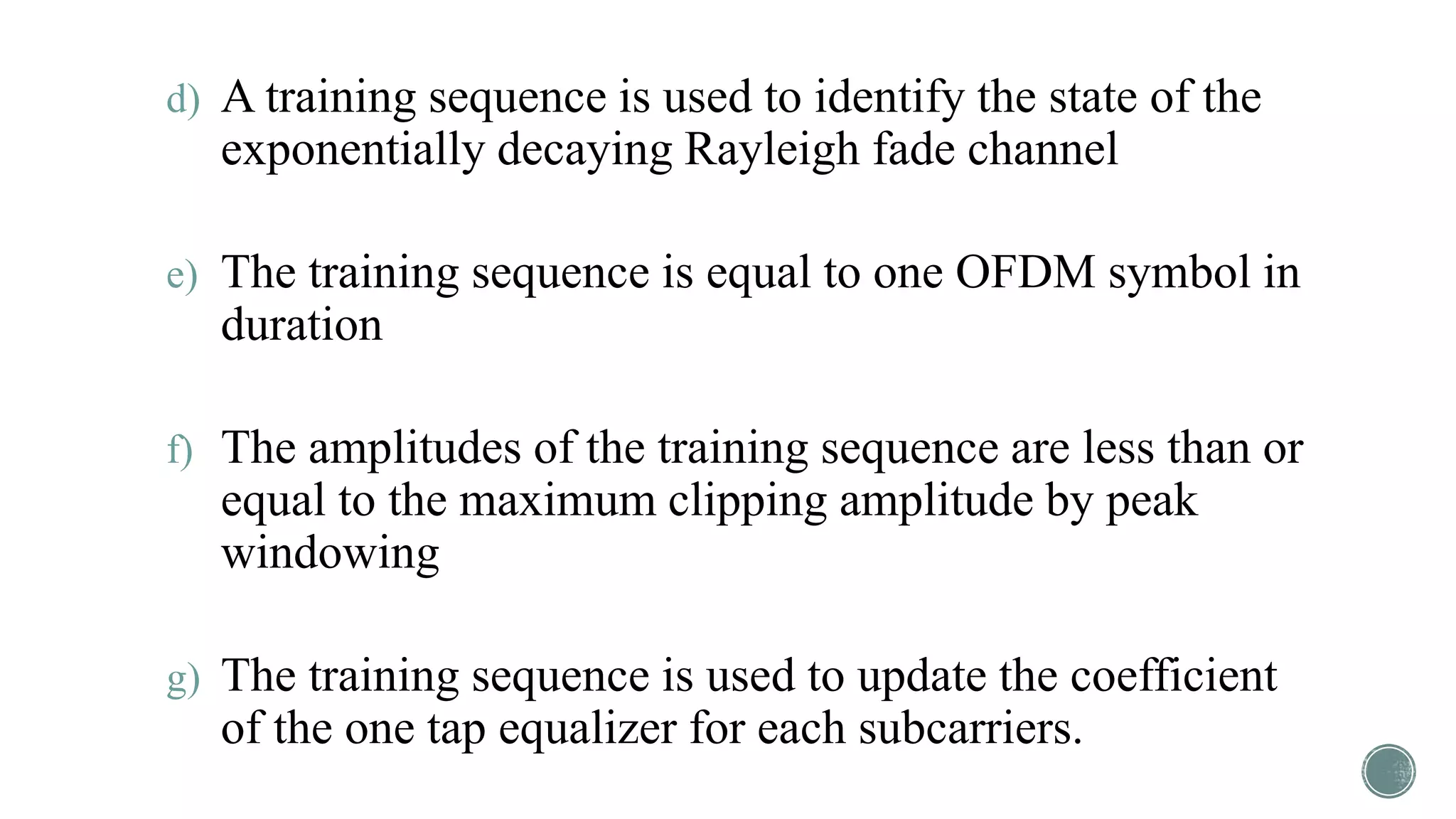
Assumptions:
In computer simulation:
a) Ideal synchronization in time and frequency
b) Channel is static during the transmission of the
OFDM signal
c) The Eb/No of an AWGN channel is varied by
increasing the signal power making the noise
power constant
d) A training sequence is used to identify the state of the
exponentially decaying Rayleigh fade channel
e) The training sequence is equal to one OFDM symbol in
duration
f) The amplitudes of the training sequence are less than or
equal to the maximum clipping amplitude by peak
windowing
g) The training sequence is used to update the coefficient
of the one tap equalizer for each subcarriers.
Additive White Gaussian Noise (AWGN)
In this study, the proposed channel model is an AWGN channel
with a mean of zero and a variance of 1.
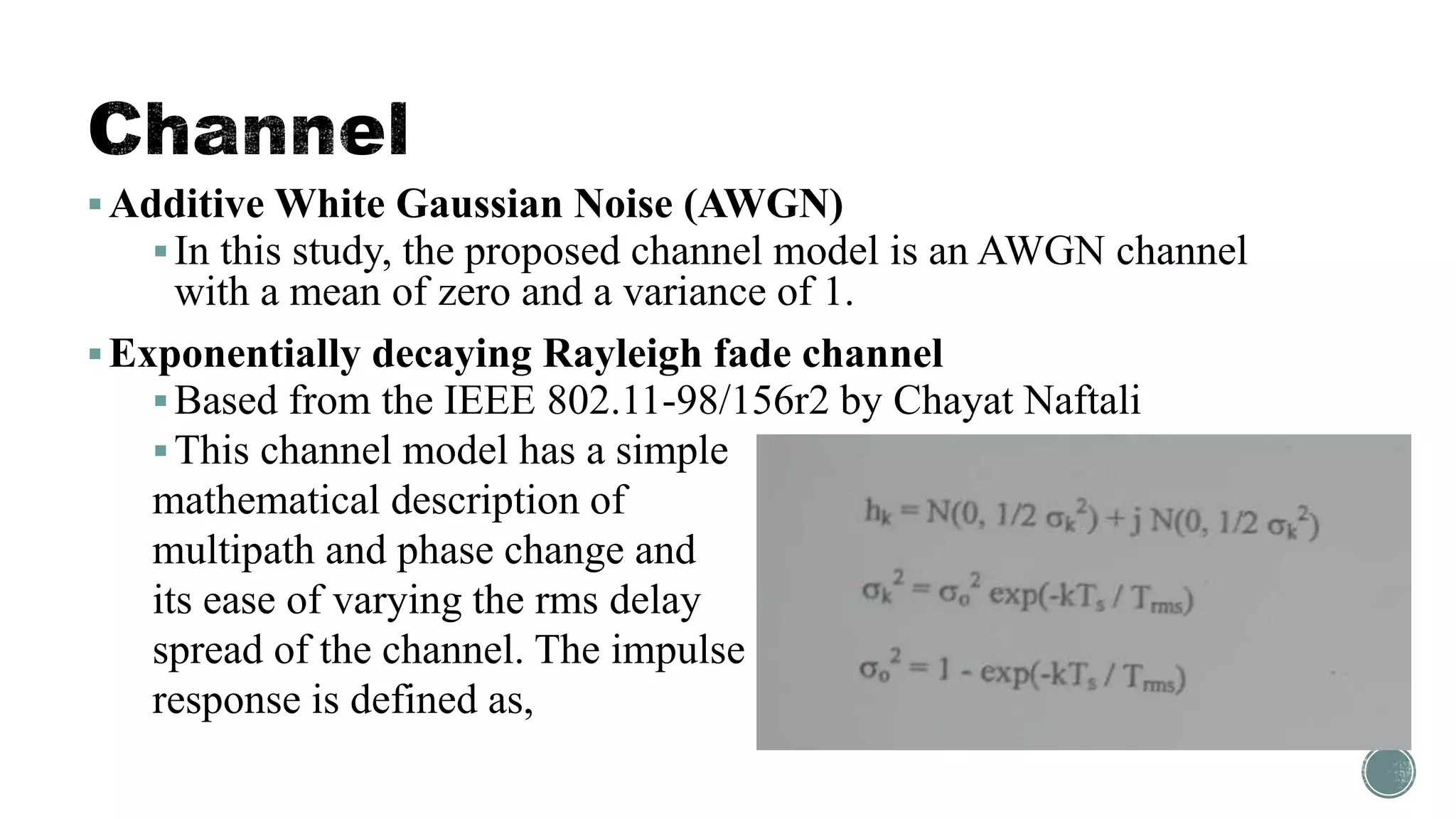
Exponentially decaying Rayleigh fade channel
Based from the IEEE 802.11-98/156r2 by Chayat Naftali
This channel model has a simple
mathematical description of
multipath and phase change and
its ease of varying the rms delay
spread of the channel. The impulse
response is defined as,
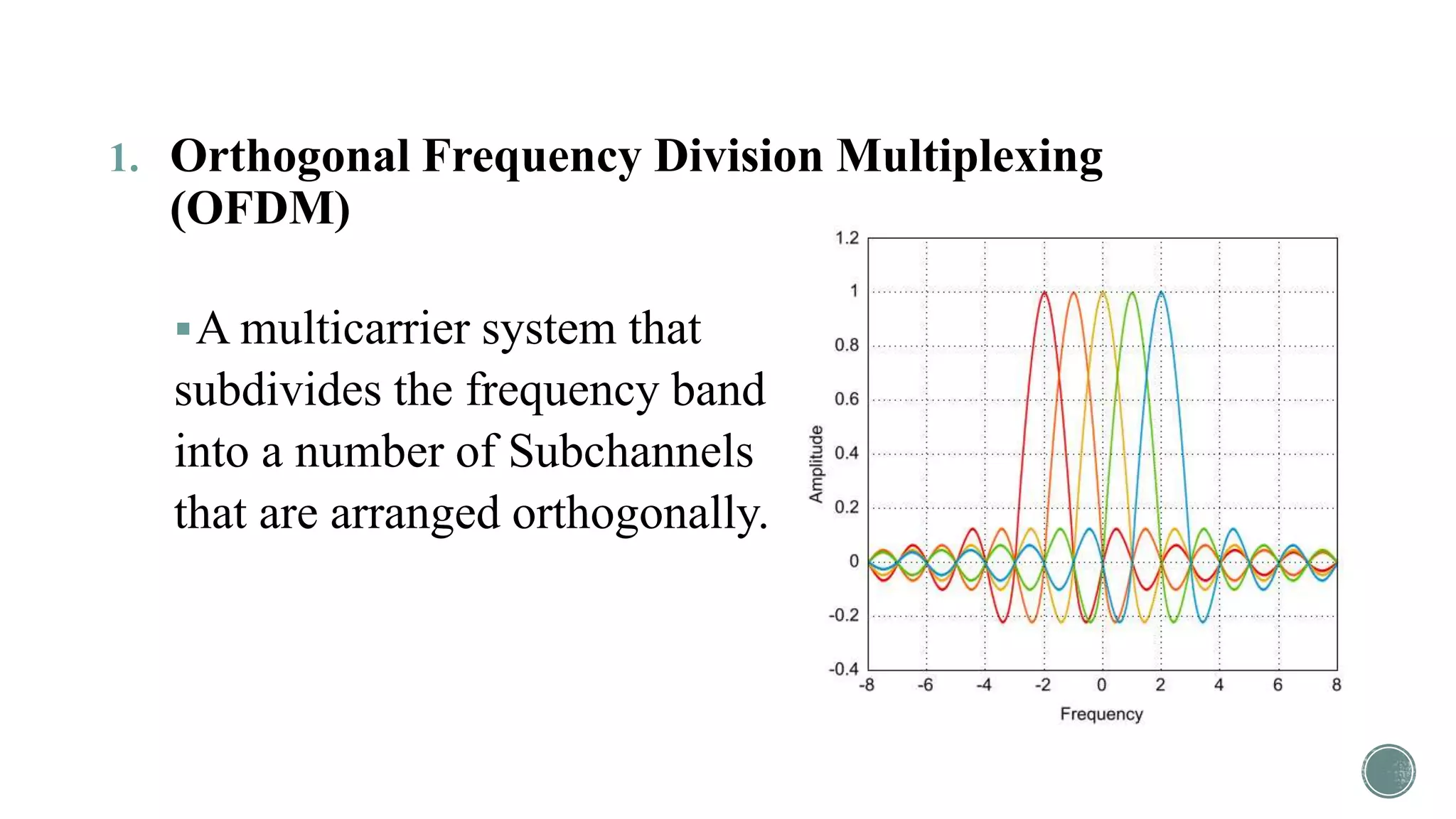
1. Orthogonal Frequency Division Multiplexing
(OFDM)
A multicarrier system that
subdivides the frequency band
into a number of Subchannels
that are arranged orthogonally.
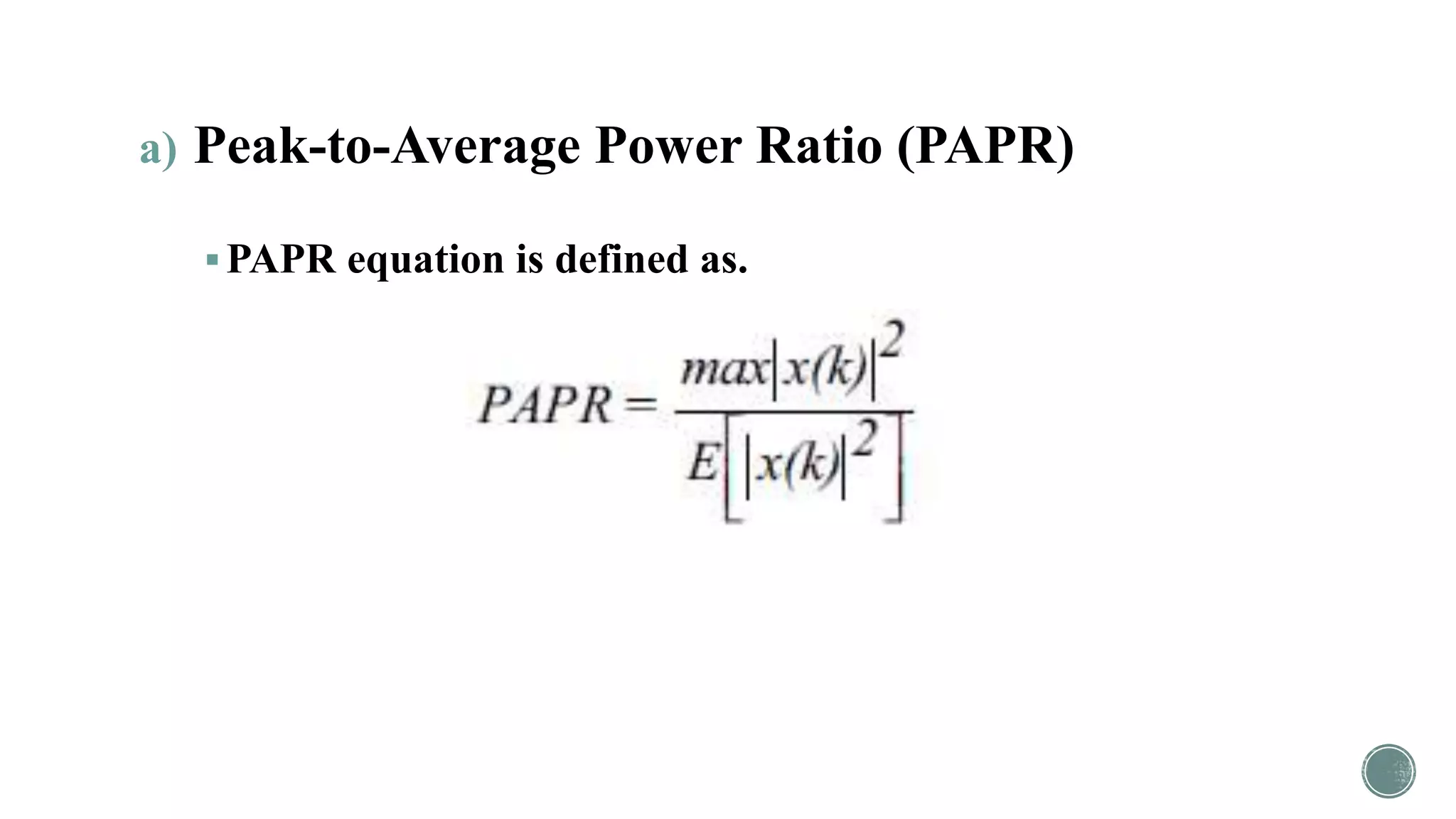
a) Peak-to-Average Power Ratio (PAPR)
PAPR equation is defined as.
b) PAPR Problem
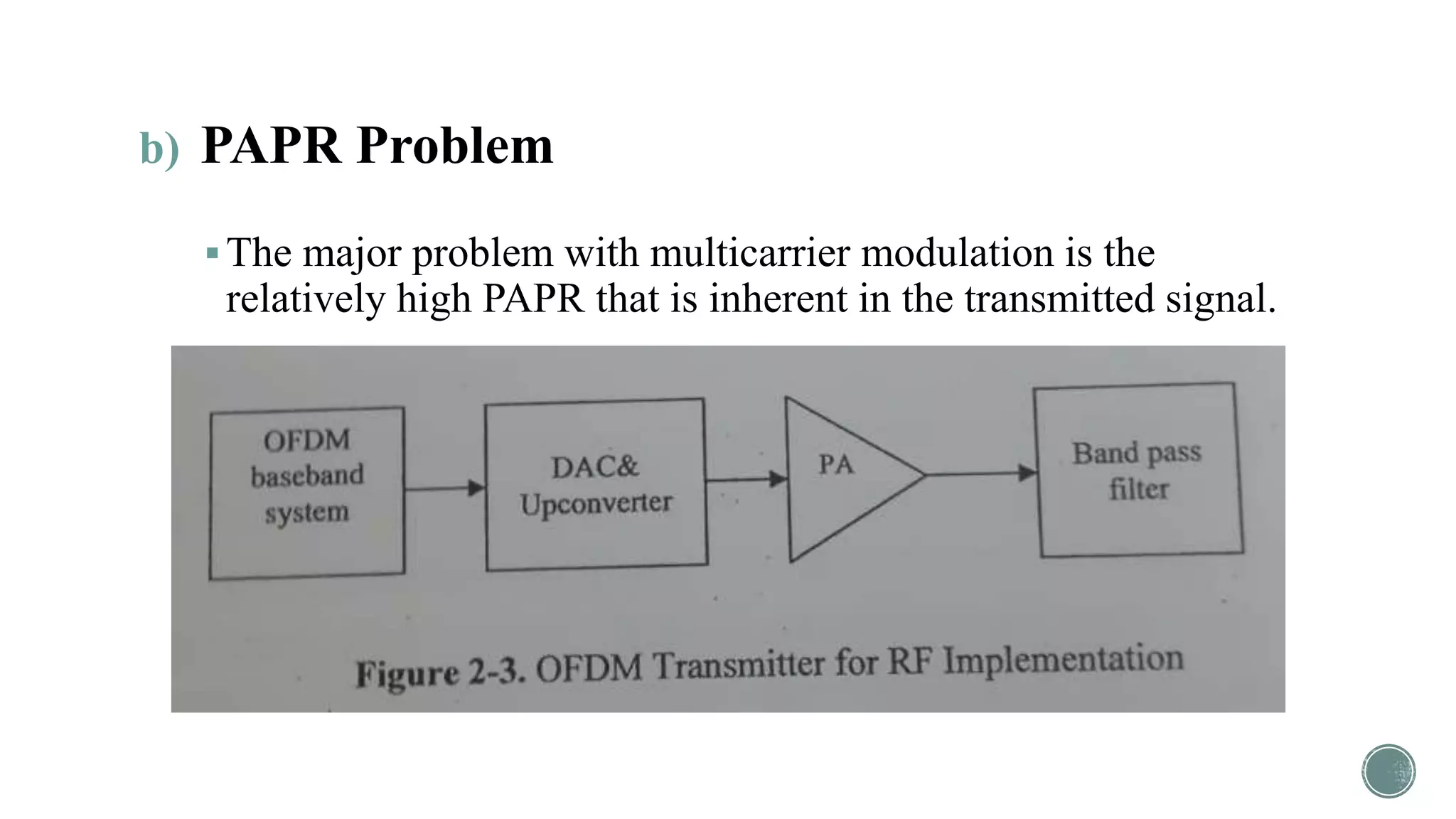
The major problem with multicarrier modulation is the
relatively high PAPR that is inherent in the transmitted signal.
b) PAPR Problem
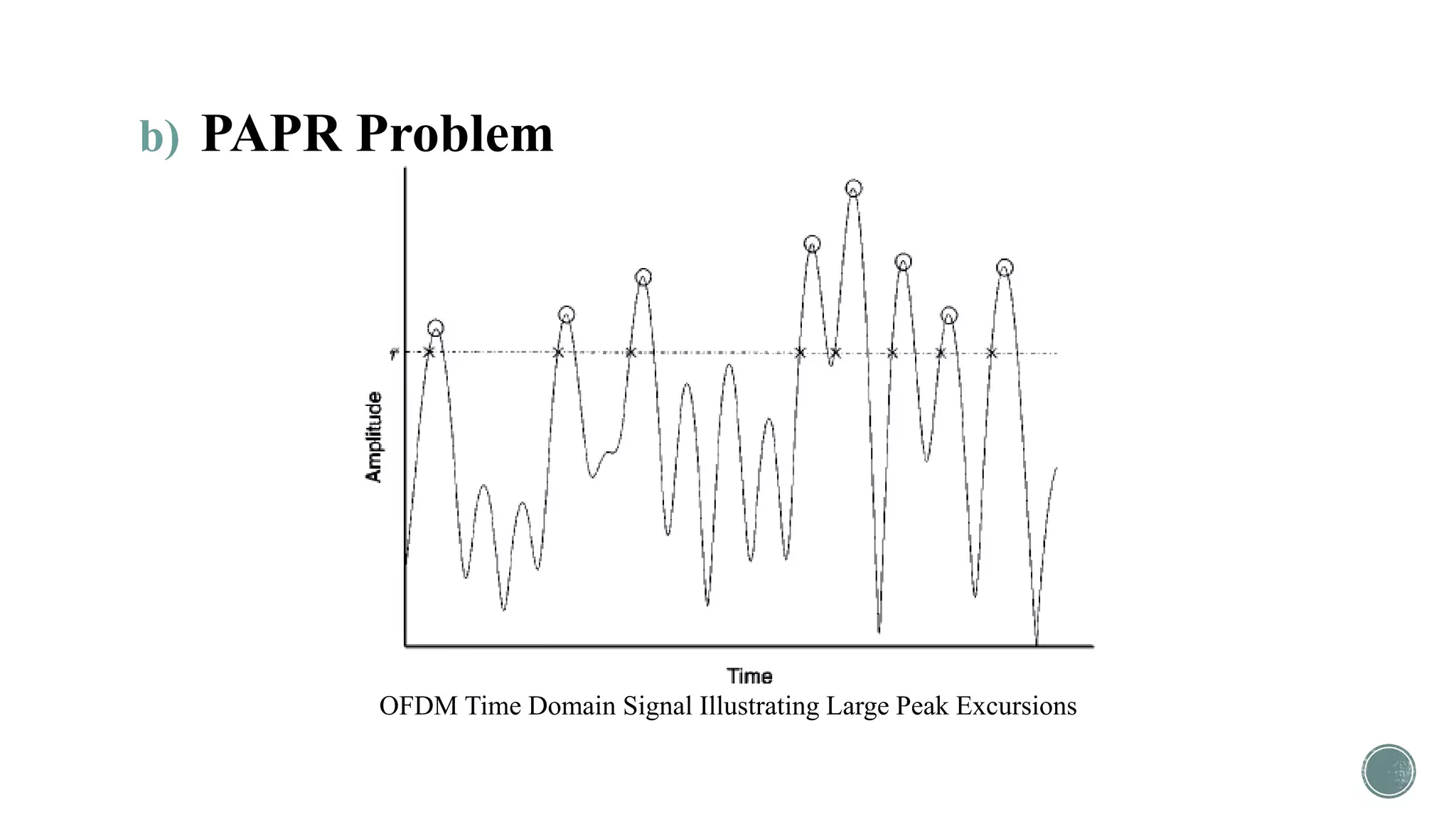
OFDM Time Domain Signal Illustrating Large Peak Excursions
c) PAPR Solutions for OFDM
i. Signal Distortion Techniques: Clipping & Peak
Windowing
Clipping and Peak Windowing are the simplest
method that clips the output to a certain level.
These techniques are actually forcing peaks greater
than the clipping amplitude/level (CL) to be at the
level of the clipping amplitude.
The clipping level (CL) for this study must not
exceed to square root of the number of subcarriers
of OFDM system.
i. Clipping
Clips the part of the OFDM signal at transmitter
which are outside the allowable limit.
Clipping Method introduces both in-band
distortion and out-of-band distortion into OFDM
signals.
Drawback: Bit Error Rate (BER) performance
degradation.
ii. Peak Windowing
Large signal peak is multiplied with a
certain window.
Like clipping, it also introduces both in-
band distortion and out-of-band distortion
into OFDM signals.
To remedy the out-of-band distortion
problem in clipping.
d) Coded OFDM (COFDM)
a system in which the error control coding and
OFDM modulation processes work closely
together.
COFDM systems are able to achieve excellent
performance on frequency selective channels
because of the combined benefits of multicarrier
modulation and coding.
2. Error Correcting Codes
techniques that enable reliable delivery of
digital data over unreliable communication
channels.
the error correcting codes used in this study for
simulation are Turbo and Low Density Parity
Check (LDPC) Code.
2. Error Correcting Code
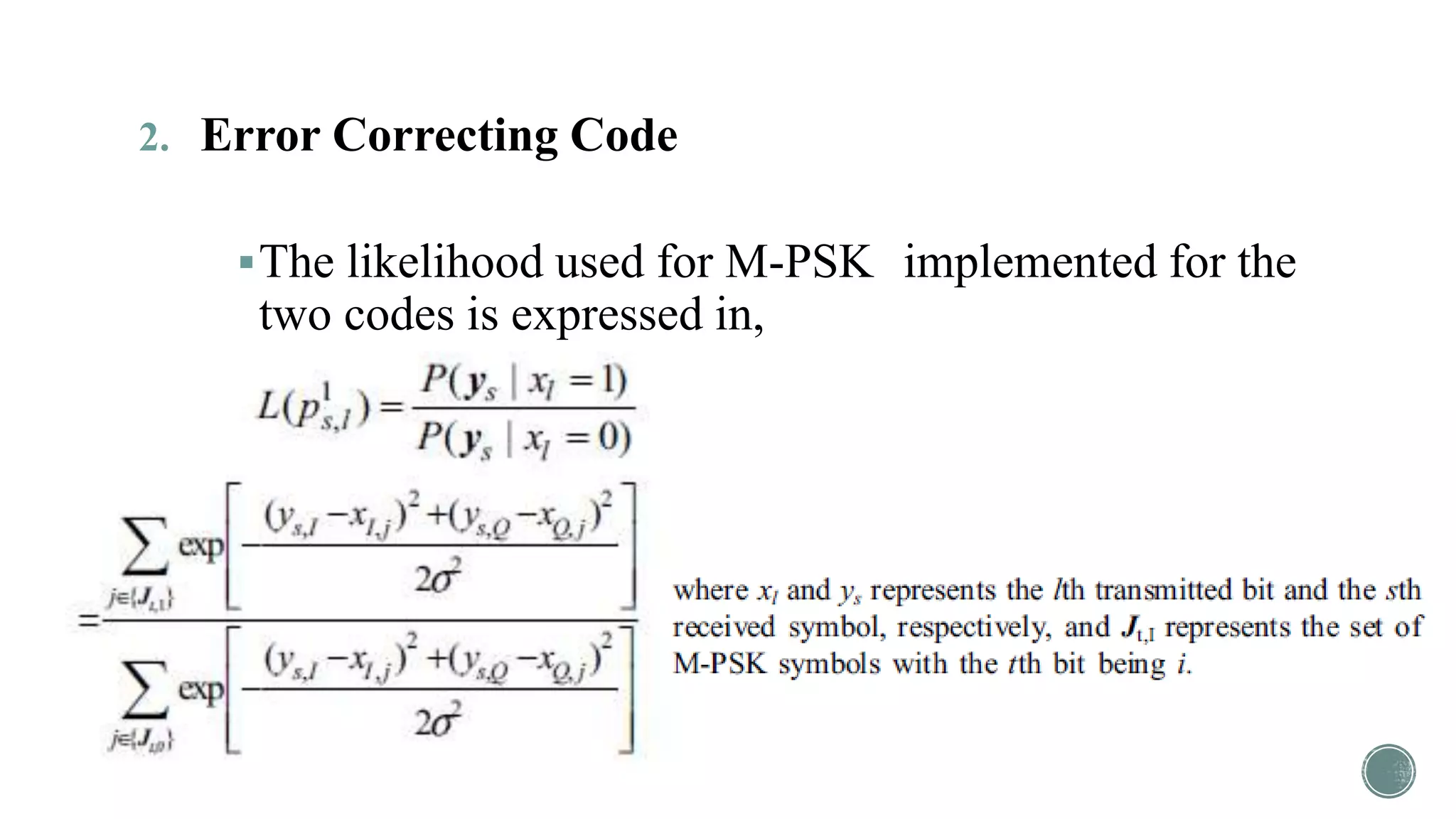
The likelihood used for M-PSK implemented for the
two codes is expressed in,
2. Error Correcting Code
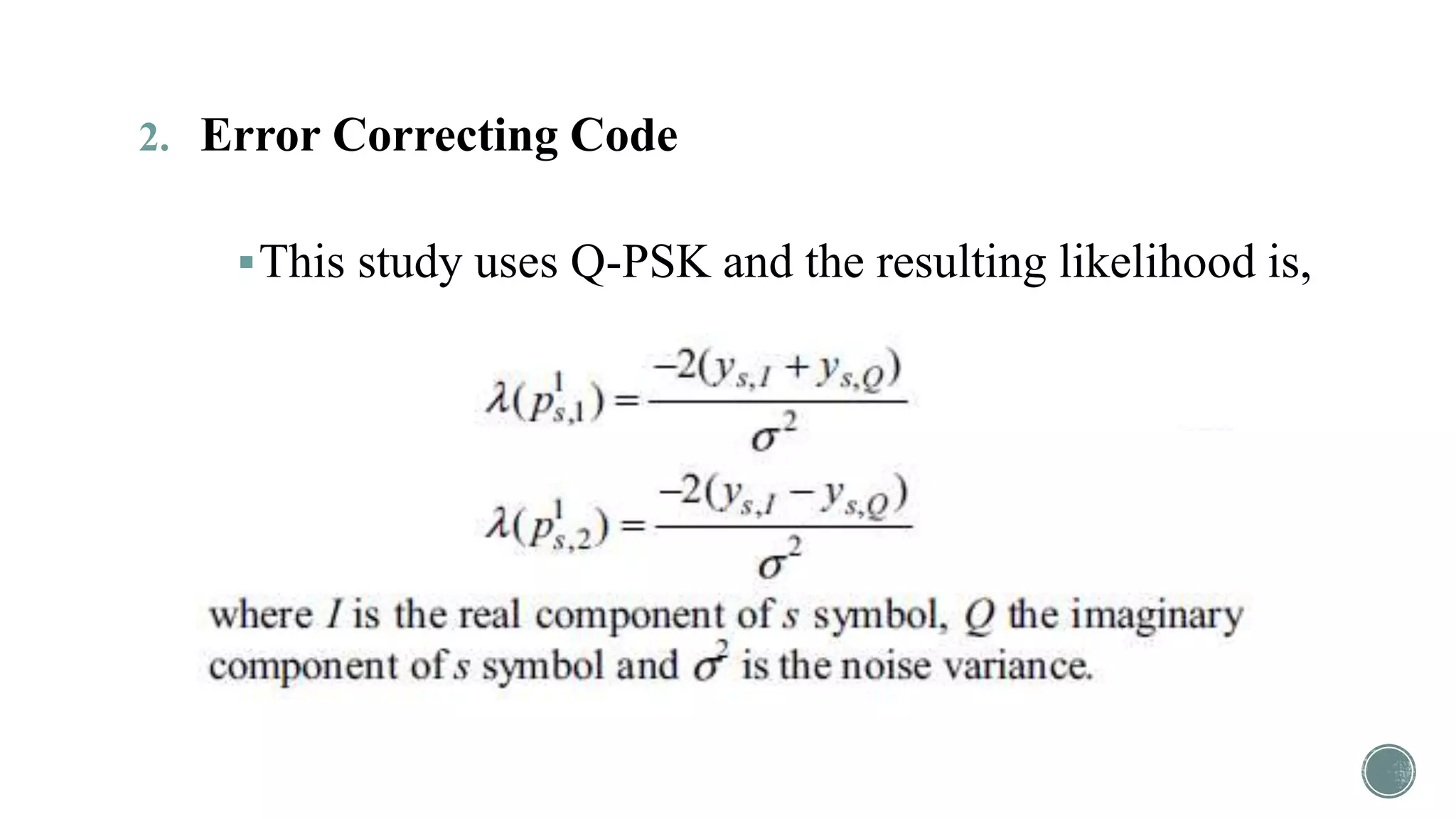
This study uses Q-PSK and the resulting likelihood is,
a) Turbo Code Encoding
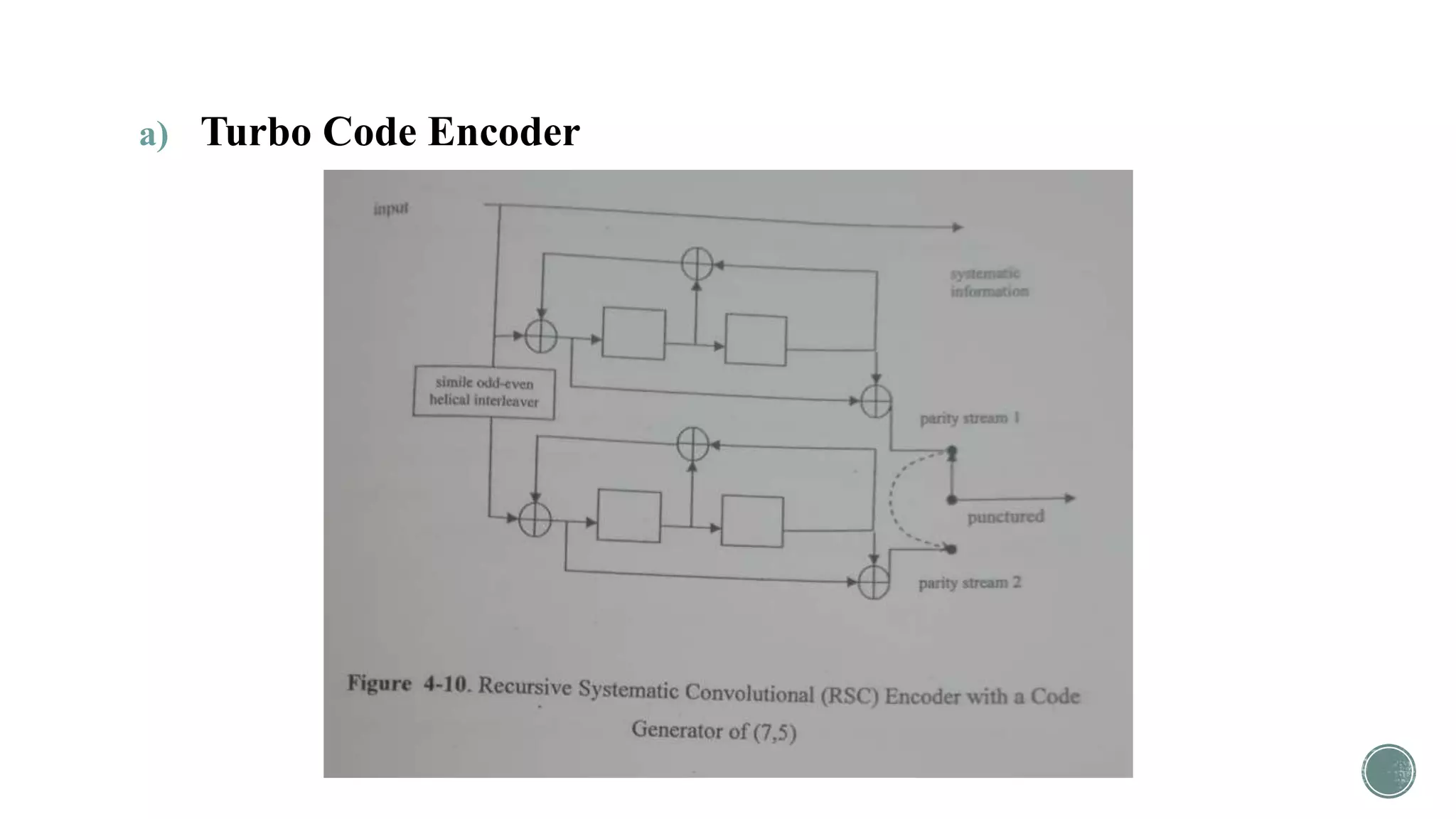
The turbo code encoder used in the simulation has a
code generator of (7,5) for both recursive systematic
convolutional encoder.
a 552 Interleaver length from which simile odd-even
helical interleaver (23 rows and 24 columns) is used.
a) Turbo Code Encoder
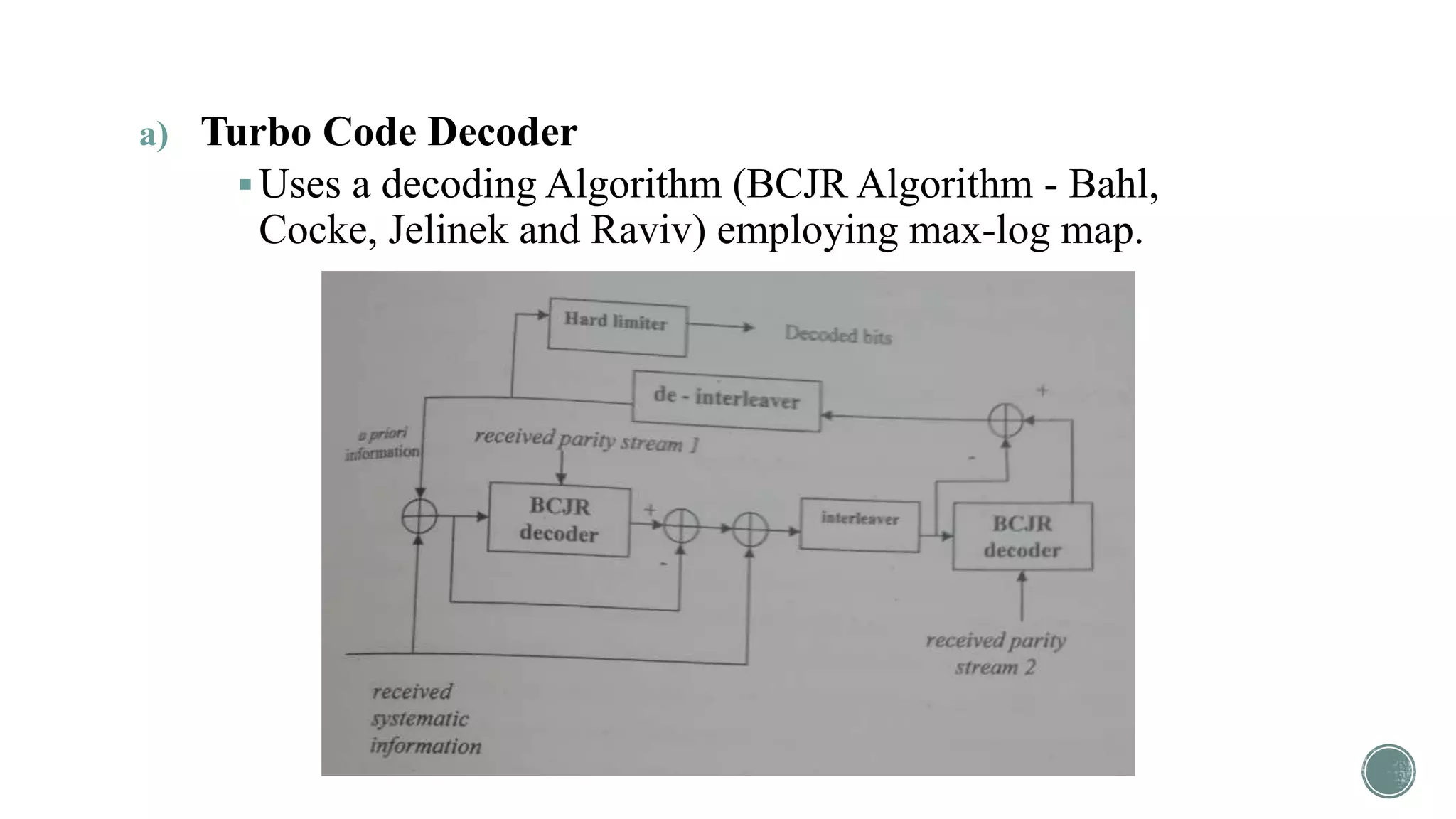
a) Turbo Code Decoder
Uses a decoding Algorithm (BCJR Algorithm - Bahl,
Cocke, Jelinek and Raviv) employing max-log map.
b) LDPC Code Encoder & Decoder
For the encoding, parity check matrix is used.
A 1104, 522 code with a characteristic of an irregular
LDPC Code.
Uses a decoding algorithm that is based from belief
propagation.
The produced parity check matrix H=[A:B] was
rearranged so that A is non-singular.
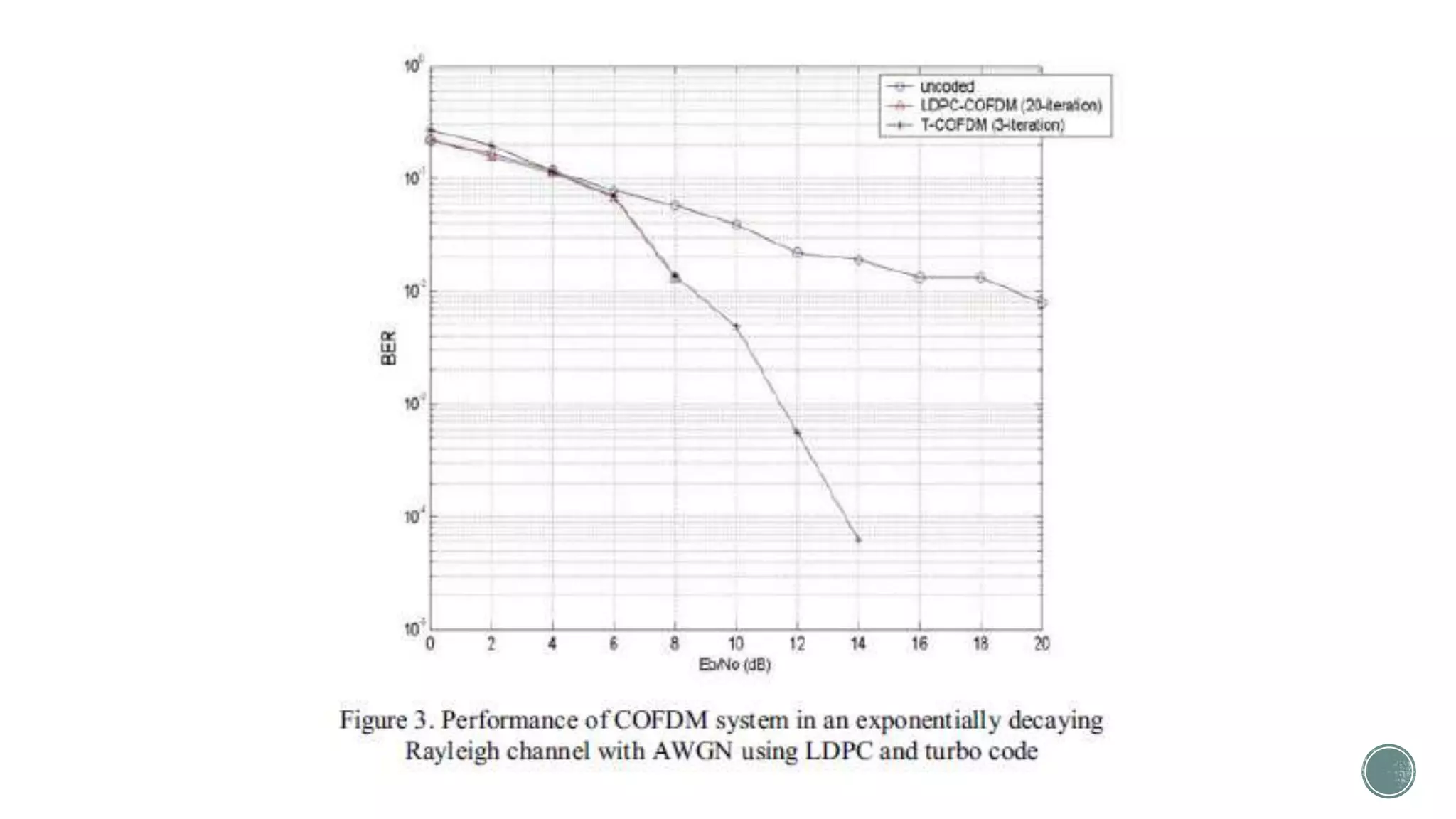
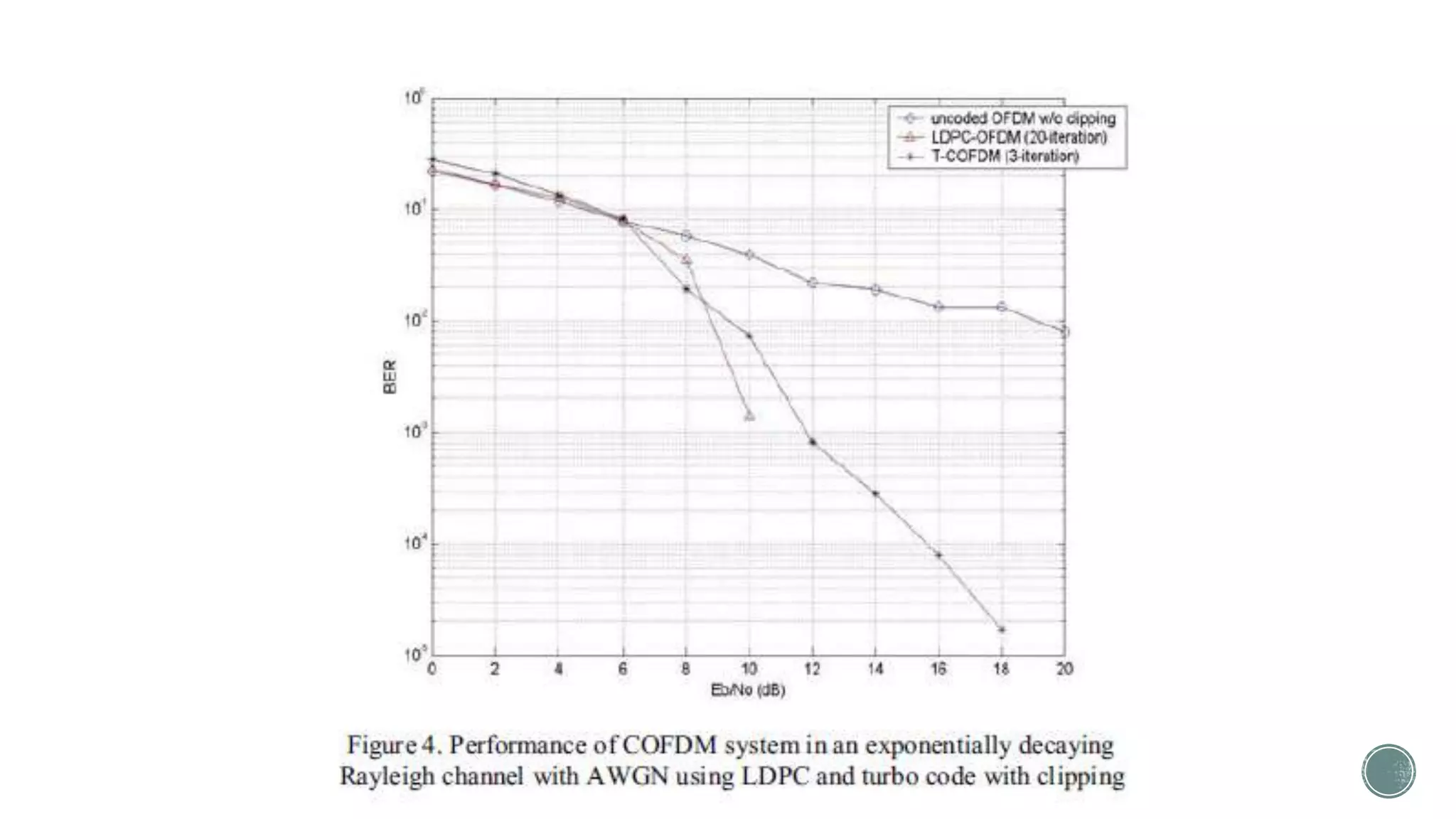
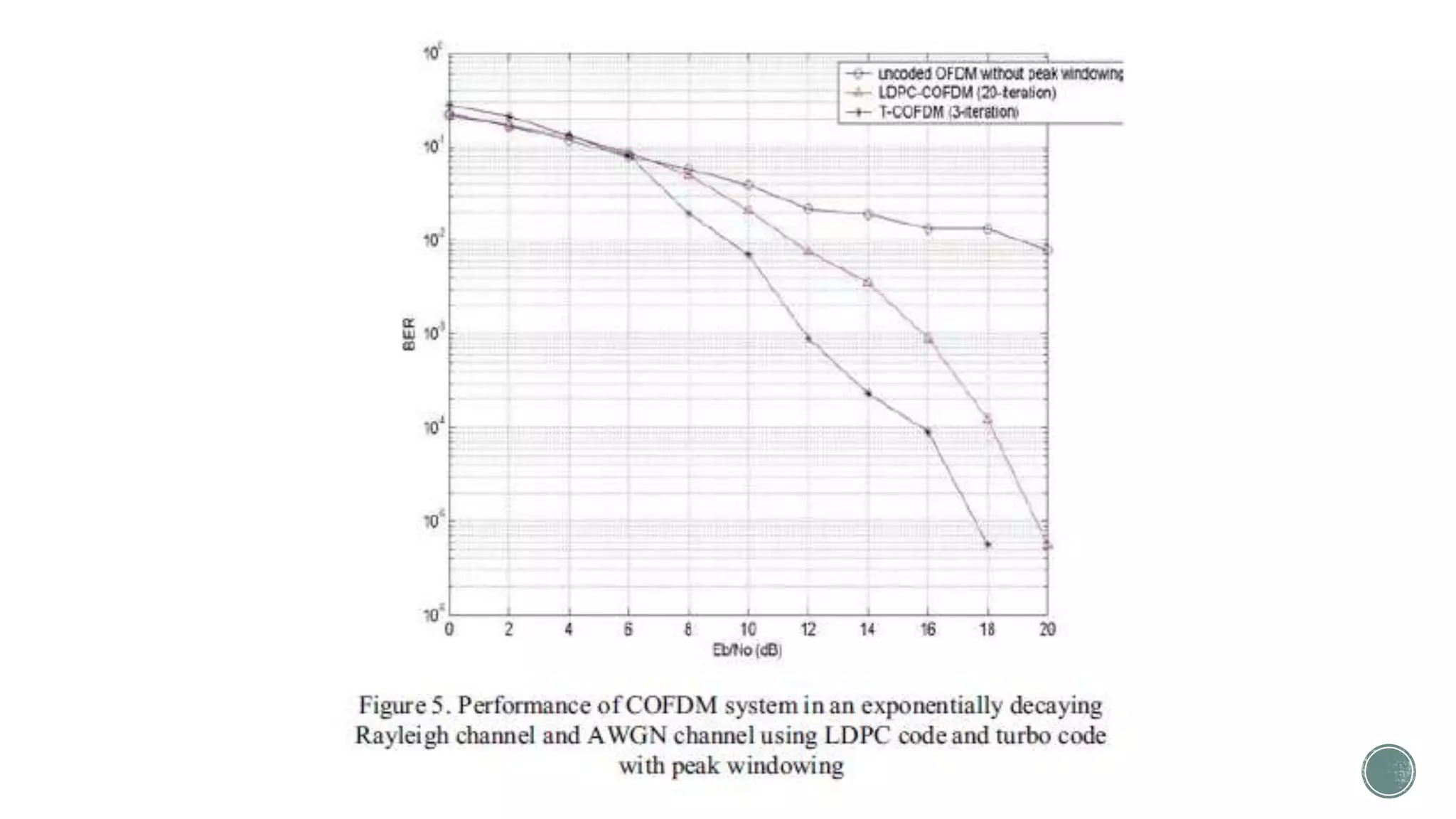
LDPC-COFDM is better than T-COFDM in an
exponentially decaying Rayleigh fade channel and AWGN
channel. This is also true even with the application of
clipping. The system that performs well in a multipath
channel with the application of peak windowing is the T-
COFDM. T-COFDM performs well in peak windowing
because it only suffers a minimal loss.
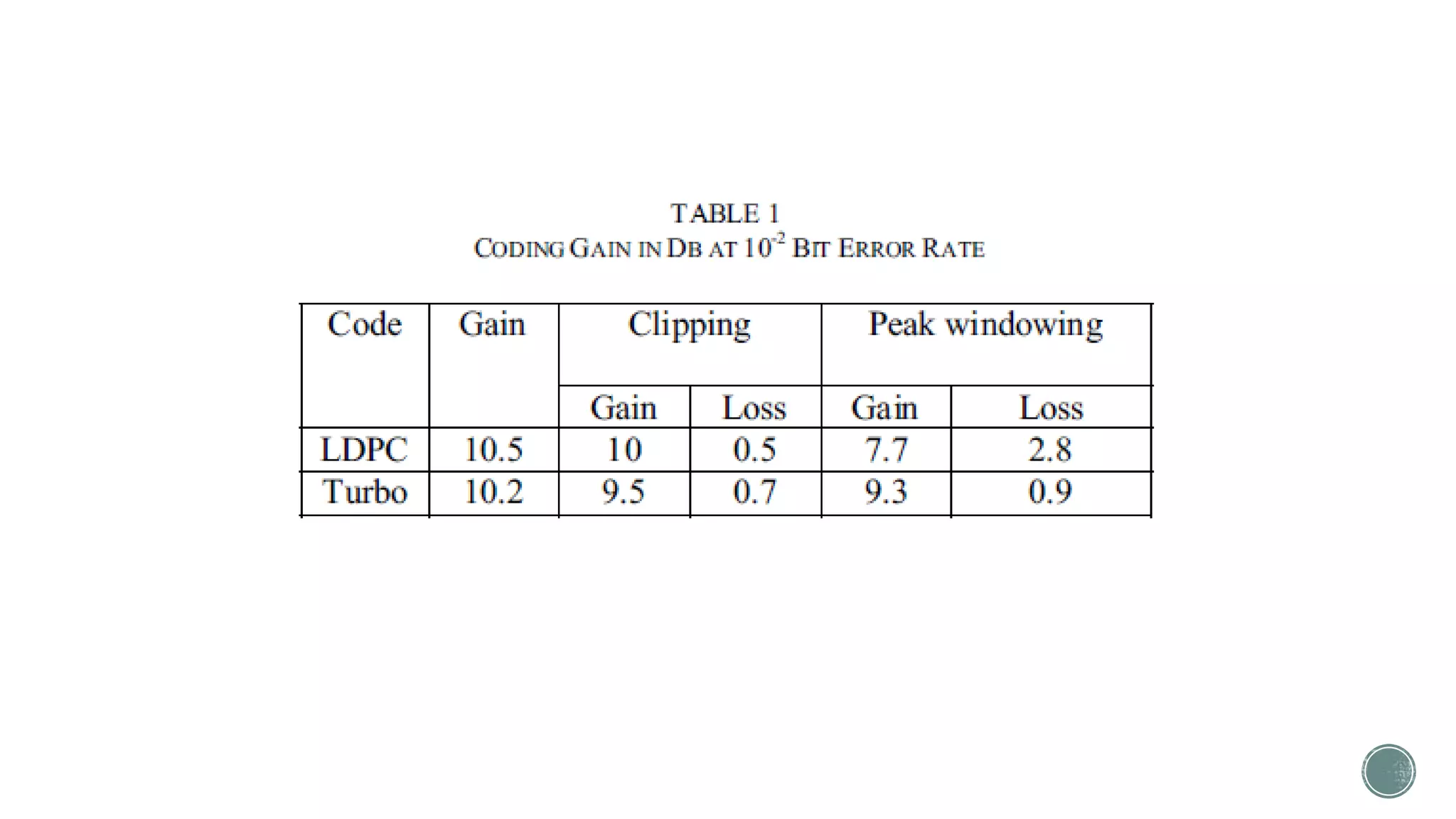
Among the signal distortion techniques, clipping gives less
performance degradation or peak windowing gives higher
performance degradation to COFDM system.
With the application of peak windowing, the LDPC-
COFDM suffers greater loss than T-COFDM. A 2.8dB loss
is experienced by the LDPC-COFDM whereas only 0.9dB
loss for the T-COFDM.
Signal Distortion Techniques
results to an in-band and out-
of-band distortion which is an
additional impairment.

Signal Distortion Techniques for PAPR Reduction in OFDM systems

  • 1.
    The Effect ofSignal Distortion Techniques for PAPR Reduction on the BER Performance of Turbo and LDPC Coded OFDM System
  • 2.
    a) OFDM System i.System Parameters ii. System Model Implementation iii. System Model Assumptions b) Channel i. Additive White Gaussian Noise (AWGN) Channel ii. Exponentially Decaying Rayleigh Fade Channel c) Orthogonal Frequency Division Multiplexing (OFDM) d) Peak-to-Average Power Ratio (PAPR) e) PAPR Problem
  • 3.
    f) PAPR Solutionsfor OFDM (Signal Distortion Techniques) i. Clipping ii. Peak Windowing g) Error Correcting Code i. Turbo Code Encoding & Decoding ii. Low Density Parity Check (LDPC) Code Encoding & Decoding h) Results and Analysis i) Summary/Conclusion
  • 4.
    System Parameters (Basedfrom IEEE 802.11a) System bandwidth: 20MHz Number of subcarriers: 64 Subcarrier Modulation: Quadrature Phase Shift Keying (QPSK) OFDM symbol length/duration: 4μs IFFT length/duration: 3.2μs Guard interval: 800ns
  • 5.
    System Parameters (Basedfrom IEEE 802.11a) Coding scheme: Turbo & LDPC Code rate: ½ Signal distortion technique: Clipping & Peak windowing Window (Peak windowing): Hamming Maximum amplitude: 8 square root of number of subcarriers Channel Model: AWGN channel & Exponentially Decaying Rayleigh Fade model
  • 6.
  • 7.
    Assumptions: In computer simulation: a)Ideal synchronization in time and frequency b) Channel is static during the transmission of the OFDM signal c) The Eb/No of an AWGN channel is varied by increasing the signal power making the noise power constant
  • 8.
    d) A trainingsequence is used to identify the state of the exponentially decaying Rayleigh fade channel e) The training sequence is equal to one OFDM symbol in duration f) The amplitudes of the training sequence are less than or equal to the maximum clipping amplitude by peak windowing g) The training sequence is used to update the coefficient of the one tap equalizer for each subcarriers.
  • 9.
    Additive White GaussianNoise (AWGN) In this study, the proposed channel model is an AWGN channel with a mean of zero and a variance of 1. Exponentially decaying Rayleigh fade channel Based from the IEEE 802.11-98/156r2 by Chayat Naftali This channel model has a simple mathematical description of multipath and phase change and its ease of varying the rms delay spread of the channel. The impulse response is defined as,
  • 11.
    1. Orthogonal FrequencyDivision Multiplexing (OFDM) A multicarrier system that subdivides the frequency band into a number of Subchannels that are arranged orthogonally.
  • 12.
    a) Peak-to-Average PowerRatio (PAPR) PAPR equation is defined as.
  • 13.
    b) PAPR Problem Themajor problem with multicarrier modulation is the relatively high PAPR that is inherent in the transmitted signal.
  • 14.
    b) PAPR Problem OFDMTime Domain Signal Illustrating Large Peak Excursions
  • 15.
    c) PAPR Solutionsfor OFDM i. Signal Distortion Techniques: Clipping & Peak Windowing Clipping and Peak Windowing are the simplest method that clips the output to a certain level. These techniques are actually forcing peaks greater than the clipping amplitude/level (CL) to be at the level of the clipping amplitude. The clipping level (CL) for this study must not exceed to square root of the number of subcarriers of OFDM system.
  • 16.
    i. Clipping Clips thepart of the OFDM signal at transmitter which are outside the allowable limit. Clipping Method introduces both in-band distortion and out-of-band distortion into OFDM signals. Drawback: Bit Error Rate (BER) performance degradation.
  • 17.
    ii. Peak Windowing Largesignal peak is multiplied with a certain window. Like clipping, it also introduces both in- band distortion and out-of-band distortion into OFDM signals. To remedy the out-of-band distortion problem in clipping.
  • 20.
    d) Coded OFDM(COFDM) a system in which the error control coding and OFDM modulation processes work closely together. COFDM systems are able to achieve excellent performance on frequency selective channels because of the combined benefits of multicarrier modulation and coding.
  • 21.
    2. Error CorrectingCodes techniques that enable reliable delivery of digital data over unreliable communication channels. the error correcting codes used in this study for simulation are Turbo and Low Density Parity Check (LDPC) Code.
  • 22.
    2. Error CorrectingCode The likelihood used for M-PSK implemented for the two codes is expressed in,
  • 23.
    2. Error CorrectingCode This study uses Q-PSK and the resulting likelihood is,
  • 24.
    a) Turbo CodeEncoding The turbo code encoder used in the simulation has a code generator of (7,5) for both recursive systematic convolutional encoder. a 552 Interleaver length from which simile odd-even helical interleaver (23 rows and 24 columns) is used.
  • 25.
  • 26.
    a) Turbo CodeDecoder Uses a decoding Algorithm (BCJR Algorithm - Bahl, Cocke, Jelinek and Raviv) employing max-log map.
  • 27.
    b) LDPC CodeEncoder & Decoder For the encoding, parity check matrix is used. A 1104, 522 code with a characteristic of an irregular LDPC Code. Uses a decoding algorithm that is based from belief propagation. The produced parity check matrix H=[A:B] was rearranged so that A is non-singular.
  • 33.
    LDPC-COFDM is betterthan T-COFDM in an exponentially decaying Rayleigh fade channel and AWGN channel. This is also true even with the application of clipping. The system that performs well in a multipath channel with the application of peak windowing is the T- COFDM. T-COFDM performs well in peak windowing because it only suffers a minimal loss.
  • 34.
    Among the signaldistortion techniques, clipping gives less performance degradation or peak windowing gives higher performance degradation to COFDM system. With the application of peak windowing, the LDPC- COFDM suffers greater loss than T-COFDM. A 2.8dB loss is experienced by the LDPC-COFDM whereas only 0.9dB loss for the T-COFDM.
  • 35.
    Signal Distortion Techniques resultsto an in-band and out- of-band distortion which is an additional impairment.

Editor's Notes

  • #7 The OFDM transmitter block includes the S/P conversion. Modulator in baseband using QPSK, IFFT operation, followed by the P/S conversion, and guard interval. The OFDM receiver block includes guard interval removal, S/P conversion, FFT operation, one-tap equalizer (a gain delay line for equalization) for each subchannel, demodulator and again P/S conversion.
  • #8 (1st) coordination of events to operate a system in unison
  • #10 B4 “in this study” read below: Additive : Because the noise will get added to your transmitted signal not multiplied.  So, the received signal y(t) = x(t) + n(t) , where x(t) was the original clean transmitted signal, and n(t) is the noise or disturbance in the channel. White: Because it is an analogy to the color white, which has the same power for all frequencies. Which means that this noise is equally present with the same power at all the frequencies. So, in frequency domain, the noise level is flat throughout at every frequencies. Gaussian: Because the noise samples have normal/Gaussian distribution Where Ts is the sampling time, Trms is the delay spread of the channel model and Kmax is 10 times Ts/Trms. N(0, ½ …) is a zero mean Gaussian random variable with variance … which is produced from generating a normal distribution random variable with a mean of zero and a variance of 1 then multiplied by ../sqr of 2 times …o = 1-e …. Is chosen so that the summation of … = 1. to ensure same power.
  • #11 This is the PSD of an OFDM system after passing the AWGN and Exponentially decaying Rayleigh fade channel. This is the original OFDM spectrum (point it) and this is the OFDM spectrum after multipath (point it again).
  • #12 (Problem) This is due to a number of independently modulated subcarriers when added coherently.
  • #13 Where x(k) are OFDM symbols at the transmitter. From the title, this study uses SDT to reduce PAPR Numerator – Peak signal power Denominator – average Signal Power How did this became a problem?
  • #14 The PAPR problem happens when large signal peaks are passed to the PA and DAC & Upconverter for its conversion to RF power. Because of PAPR, there is loss of orthogonality and it leads to ICI and distortion. The large signal peaks occur when the signal in many of the various sub channels add constructively. (See nxt image then explain again.)
  • #15 These large peaks requires high dynamic range (the range of acceptable or possible volumes of sound) which is not possible for a high PA because of its limited DR. For the PA to have high DR, this will compromise the cost of RF components. A limited DR for a PA will result to clipping of the signal voltage generating harmonics thus causing intermodulation distortion. To avoid this, we have to reduce the PAPR.
  • #16 (1st) However, despite of its simplicity, these SDT result to a larger error rate due to in-band distortion and increases the out-of-band spectral components.
  • #17 (1st) However, after clipping of the signal, spectral leakage happens. (2nd) However, clipping has lesser in-band distortion but has a larger out-of-band distortion. (3rd) BER is the rate at which errors occur in the transmission of digital data.
  • #18  (1st) And this study uses 17-window length hamming window. And also the window should be narrowband and not be too long in the time domain. (2nd) However, unlike clipping, peak windowing has larger in-band distortion but has a lesser out-of-band distortion which is exactly the opposite of clipping.
  • #21 An important step in a COFDM system is to interleave and code the bits prior to the IFFT. This step serves the purpose of taking adjacent bits in the source data and spreading them out across multiple subcarriers.
  • #22 (1st) Many communication channels are subject to channel noise, and thus errors may be introduced during transmission from the source to a receiver. Error detection techniques allow detecting such errors, while error correction enables reconstruction of the original data in many cases.
  • #23 (1st) M is the number of points in the signal constellation. The M-PSK uses gray mapping, a binary numeral system where two successive values differ in only one bit (binary digit)
  • #25 (1st) (which corresponds to the 552 interleaver length) simile odd-even interleaver is a designed block interleaver that makes the state of the two convolutional encoder the same, the purpose of which is to use the same tail bits so that the state of both encoder will be terminated. In short, it is designed for puncturing to ensure that a bit is represented in decoding.
  • #26 This shows the diagram of the turbo encoder , where the square represents a memory element and the circle represents a modulo-2 addition.
  • #27 (1st ) BCJR Algorithm is a forward-backward algorithm or Maximum a Posteriori (MAP) algorithm. This is used to minimize the bit error probability by maximizing posteriori probability kaya tinawag din syang Maximum Posteriori Probability decoder (MAP). There are actually 2 decoding stage. Initially, the a priori information for the intrinsic information for the first stage BCJR is zero. For Iterative decoding, the a priori information makes use of the de-interleaved extrinsic information taken from the second decoding stage. Then, the output of the entire turbo decoding in binary is taken from the sign of resulting information from stage 2. (-) means the output is zero, (+) means the output is 1.
  • #28 (1st) The parity check matrix for LDPC has no specified column weight and row weight but maintains its property of being sparse (2nd) Characteristic: having no constrains on the column weight or row weight but maintain its property of being sparse (scattered). (3nd)  Belief Propagation also known as sum-product message passing, is a message passing algorithm for performing inference on graphical models, such as Bayesian networks and Markov random fields. (4th) Rearranging is done in terms of column so that the sparseness is not affected.
  • #30 The codes were iterated for several times to determine the maximum number of iteration that produces a significant gain. Here the 20 iterations LDPC code is sufficient considering the performance of the code. The 3-iteration Turbo code was chosen because it has the least number of iterations that gives a maximum gain. This figure shows that at 10^-2 BER the LDPC-COFDM performs better that T-COFDM system. The performance of the two systems are almost the same at 10^-2 BER. However, beyond 8dB of the Eb/No, T-COFDM still produces errors.
  • #31 Upon the application of clipping, the LDPC-COFDM system has a better performance than the T-COFDM. It has a difference of 0.5dB over the LDPC-COFDM. Also, the T-CODM still produces error beyond 10dB.
  • #32 Upon the application of peak windowing, the T-COFDM system has a better performance than the LDPC-COFDM. It has an advantage of 1.6dB gain over the LDPC-COFDM system.