The Evidence for
   Evolution
Evidence Supporting Darwin
  1) Fossil records
  2) Anatomy
  3) DNA
  4) Embryology
1) Fossils
 Footprints of
  dead organisms
 Tracks
 Insects trapped
  in tree sap
 Impressions of
  skin
 Traces of dead
  organisms.
Conditions to create fossils
   Must be buried by sediments
   Swamps, mud, tar pits, ocean
    bottoms
   Hard stuff most likely to be
    fossilized.
How are Fossils Dated?
 Scientists determine the age of fossils by
  measuring the amounts of radioactive
  decay.
 Half-life describes how long it takes for one-
  half of the radioactive atoms in a sample to
  decay.
 The rate of radioactive decay is constant
 Scientists can use the amount of radioactive
  element remaining in a rock or fossil to
  determine its age. This technique is
2) Anatomy
 Transitional Species
   – Evolutionary transitions/ intermediate
     forms of the organism.
  Whales-
   – Are descendants of 4 legged land
     animals that are also ancestors of
     horses and cows.
 35 mya


 42 mya

 50 mya

 60 mya
Whales- Vestigial Structures
                    -Remnants of an organisms
 Hind limbs
                    evolutionary past.
  became
  smaller
 Eventually lost
 Modern whales
  have a pelvis
  but, no rear
  limbs.
Structural Evidence cont.
 Vestigial
  Structures:
  Remnants of an
  organisms
  evolutionary
  past. Structures
  reduce in size
  and have no
  present function.
Comparative Anatomy
Structural Evidence
 Comparing the way
  two organisms are
  put together.
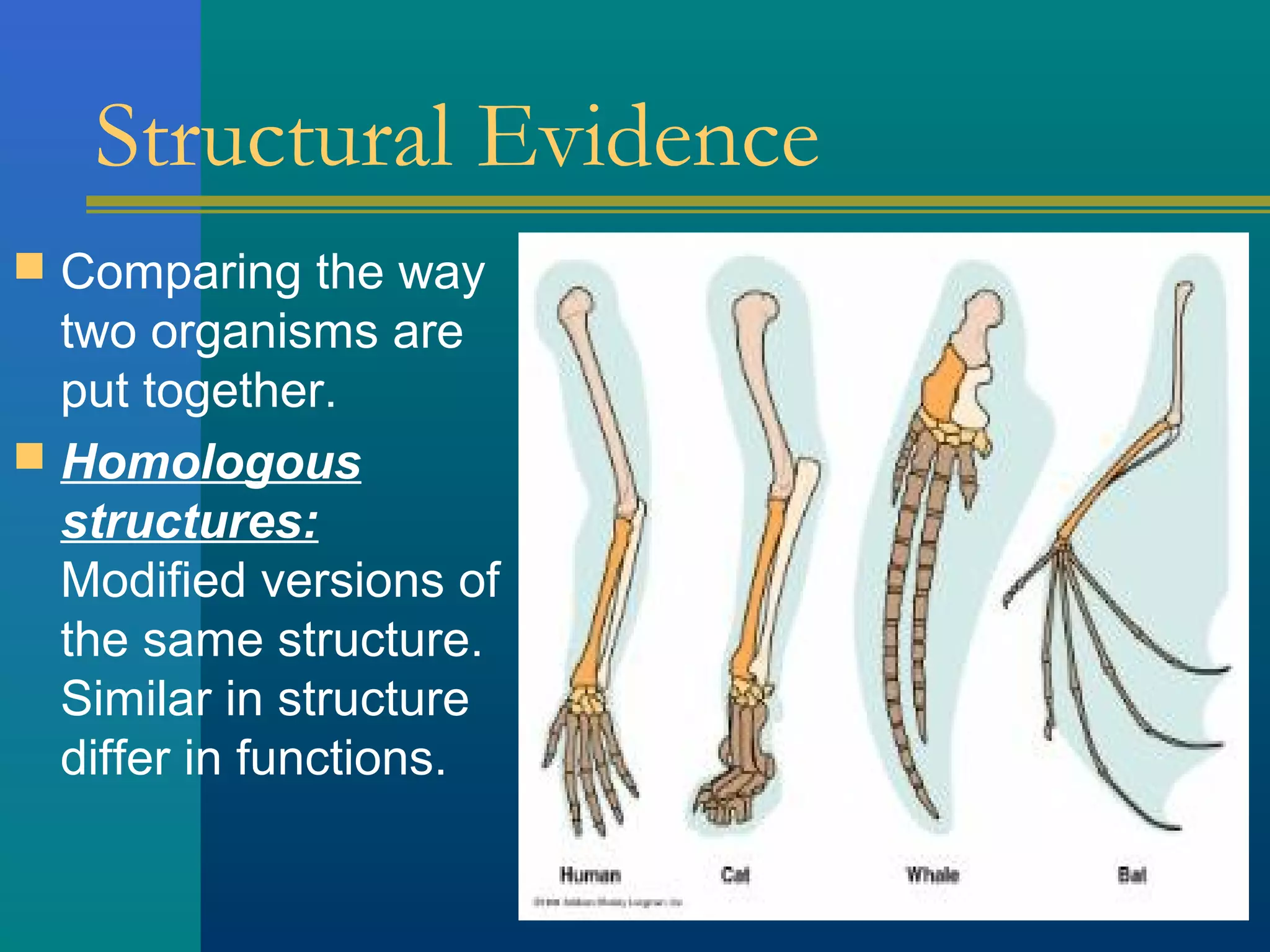
 Homologous
  structures:
  Modified versions of
  the same structure.
  Similar in structure
  differ in functions.
3) DNA Evidence
  Structural, fossils, and developmental
   evidence still posed many questions.
  DNA evidence supports the other three.
  If species change over time, their DNA
   will also change.
  Similar organisms = similar DNA
  Genes accumulate more alterations in
   their nucleotide sequence over time.
DNA Evidence con’t
  Compare: chimp, dog, rattlesnake,
   human
  Protein- look at amino acid sequence.
  When comparing a.a. sequences
   chimps vs. humans 0 a.a. differences
    – Dog vs human 13 a.a. differences
    – Rattlesnake vs. human 20 a.a.
      difference
4) Embryology
  Early stages of development are similar
  between organisms.

Evidence of evolution

  • 1.
  • 2.
    Evidence Supporting Darwin  1) Fossil records  2) Anatomy  3) DNA  4) Embryology
  • 3.
    1) Fossils  Footprintsof dead organisms  Tracks  Insects trapped in tree sap  Impressions of skin  Traces of dead organisms.
  • 4.
    Conditions to createfossils  Must be buried by sediments  Swamps, mud, tar pits, ocean bottoms  Hard stuff most likely to be fossilized.
  • 5.
    How are FossilsDated?  Scientists determine the age of fossils by measuring the amounts of radioactive decay.  Half-life describes how long it takes for one- half of the radioactive atoms in a sample to decay.  The rate of radioactive decay is constant  Scientists can use the amount of radioactive element remaining in a rock or fossil to determine its age. This technique is
  • 6.
    2) Anatomy TransitionalSpecies – Evolutionary transitions/ intermediate forms of the organism.  Whales- – Are descendants of 4 legged land animals that are also ancestors of horses and cows.
  • 7.
     35 mya 42 mya  50 mya  60 mya
  • 8.
    Whales- Vestigial Structures -Remnants of an organisms  Hind limbs evolutionary past. became smaller  Eventually lost  Modern whales have a pelvis but, no rear limbs.
  • 9.
    Structural Evidence cont. Vestigial Structures: Remnants of an organisms evolutionary past. Structures reduce in size and have no present function.
  • 10.
  • 11.
    Structural Evidence  Comparingthe way two organisms are put together.  Homologous structures: Modified versions of the same structure. Similar in structure differ in functions.
  • 12.
    3) DNA Evidence  Structural, fossils, and developmental evidence still posed many questions.  DNA evidence supports the other three.  If species change over time, their DNA will also change.  Similar organisms = similar DNA  Genes accumulate more alterations in their nucleotide sequence over time.
  • 13.
    DNA Evidence con’t  Compare: chimp, dog, rattlesnake, human  Protein- look at amino acid sequence.  When comparing a.a. sequences chimps vs. humans 0 a.a. differences – Dog vs human 13 a.a. differences – Rattlesnake vs. human 20 a.a. difference
  • 14.
    4) Embryology Early stages of development are similar between organisms.