The Animal Kingdom
What is an animal?
• Multicellular
• Eukaryotic
• Heterotrophic
• No cell walls
• 95% of all animals are “invertebrates.”
Trends in Animal Evolution
• Our survey of the animal kingdom will
  start with simple animals and move to
  more complex ones.

• We will investigate “invertebrates” first
  and “vertebrates” later.

• Invertebrates- animals without a
  backbone
• Vertebrates- animals with a backbone
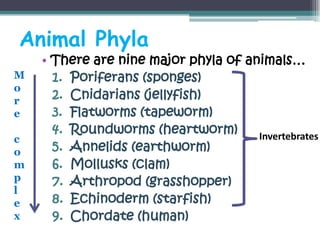
Animal Phyla
    • There are nine major phyla of animals…
M     1. Poriferans (sponges)
o
r     2. Cnidarians (jellyfish)
e     3. Flatworms (tapeworm)
      4. Roundworms (heartworm)       Invertebrates
c
o     5. Annelids (earthworm)
m     6. Mollusks (clam)
p     7. Arthropod (grasshopper)
l
e     8. Echinoderm (starfish)
x     9. Chordate (human)
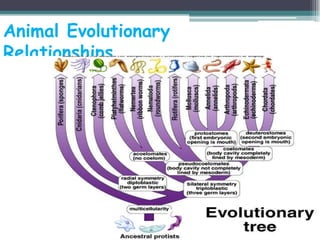
Animal Evolutionary
Relationships
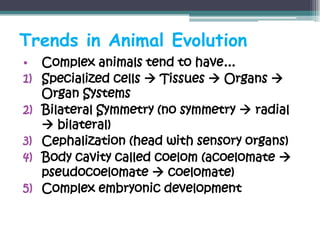
Trends in Animal Evolution
• Complex animals tend to have…
1) Specialized cells  Tissues  Organs 
   Organ Systems
2) Bilateral Symmetry (no symmetry  radial
    bilateral)
3) Cephalization (head with sensory organs)
4) Body cavity called coelom (acoelomate 
   pseudocoelomate  coelomate)
5) Complex embryonic development
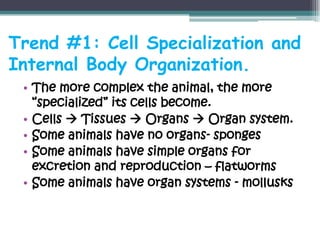
Trend #1: Cell Specialization and
Internal Body Organization.
 • The more complex the animal, the more
   “specialized” its cells become.
 • Cells  Tissues  Organs  Organ system.
 • Some animals have no organs- sponges
 • Some animals have simple organs for
   excretion and reproduction – flatworms
 • Some animals have organ systems - mollusks
Trend #2: Body Symmetry
• With the exception to sponges, every animal
  exhibits one of two types of body symmetry:
 1. Radial symmetry
 2. Bilateral symmetry
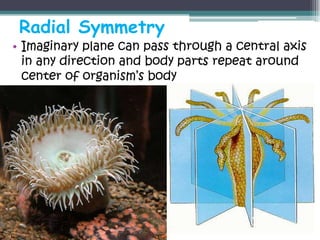
Radial Symmetry
• Imaginary plane can pass through a central axis
  in any direction and body parts repeat around
  center of organism’s body
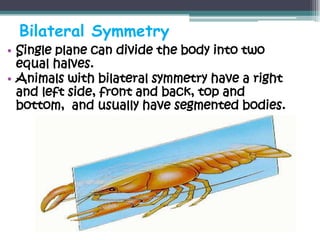
Bilateral Symmetry
• Single plane can divide the body into two
  equal halves.
• Animals with bilateral symmetry have a right
  and left side, front and back, top and
  bottom, and usually have segmented bodies.
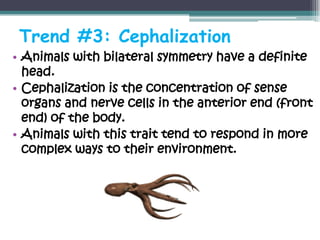
Trend #3: Cephalization
• Animals with bilateral symmetry have a definite
  head.
• Cephalization is the concentration of sense
  organs and nerve cells in the anterior end (front
  end) of the body.
• Animals with this trait tend to respond in more
  complex ways to their environment.
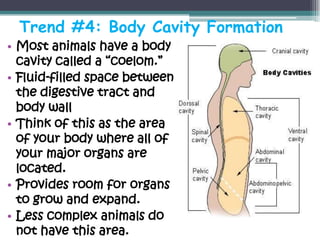
Trend #4: Body Cavity Formation
• Most animals have a body
  cavity called a “coelom.”
• Fluid-filled space between
  the digestive tract and
  body wall
• Think of this as the area
  of your body where all of
  your major organs are
  located.
• Provides room for organs
  to grow and expand.
• Less complex animals do
  not have this area.
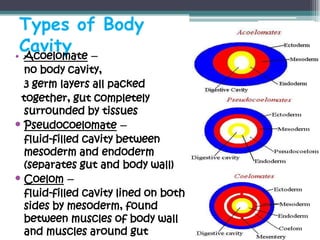
Types of Body
 Cavity –
• Acoelomate
  no body cavity,
  3 germ layers all packed
 together, gut completely
  surrounded by tissues
• Pseudocoelomate –
  fluid-filled cavity between
  mesoderm and endoderm
  (separates gut and body wall)
• Coelom –
  fluid-filled cavity lined on both
  sides by mesoderm, found
  between muscles of body wall
  and muscles around gut
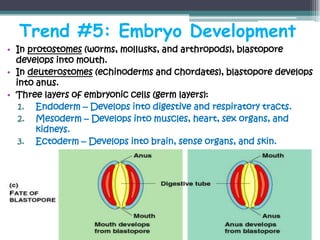
Trend #5: Embryo Development
• In protostomes (worms, mollusks, and arthropods), blastopore
  develops into mouth.
• In deuterostomes (echinoderms and chordates), blastopore develops
  into anus.
• Three layers of embryonic cells (germ layers):
   1. Endoderm – Develops into digestive and respiratory tracts.
   2. Mesoderm – Develops into muscles, heart, sex organs, and
       kidneys.
   3. Ectoderm – Develops into brain, sense organs, and skin.
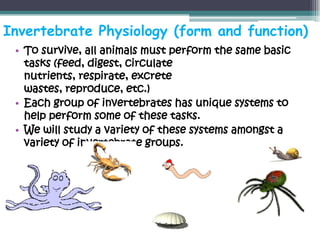
Invertebrate Physiology (form and function)
 • To survive, all animals must perform the same basic
   tasks (feed, digest, circulate
   nutrients, respirate, excrete
   wastes, reproduce, etc.)
 • Each group of invertebrates has unique systems to
   help perform some of these tasks.
 • We will study a variety of these systems amongst a
   variety of invertebrate groups.
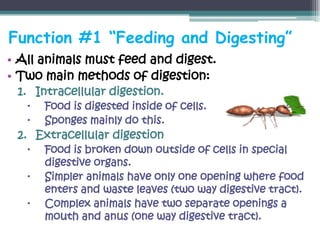
Function #1 “Feeding and Digesting”
• All animals must feed and digest.
• Two main methods of digestion:
 1. Intracellular digestion.
      Food is digested inside of cells.
      Sponges mainly do this.
 2. Extracellular digestion
      Food is broken down outside of cells in special
       digestive organs.
      Simpler animals have only one opening where food
       enters and waste leaves (two way digestive tract).
      Complex animals have two separate openings a
       mouth and anus (one way digestive tract).
Two way vs. One way digestive
tract


    Mouth/Anus
Function #2 “Respiration”
• All animals must exchange O2 and CO2 with
  the environment.
• Structures range from gills  lungs
• All respiratory organs have two basic
  features:
 1. Large surface area to come in contact with
    air or water (the larger the better).
 2. Organs must be moist (important for
    diffusion of gases across cells).
Function #3: “Circulation”
• All cells in an animal must take in
  oxygen/nutrients and give off CO2/waste.
• Simple animals do this through diffusion with
  their environment.
• Complex invertebrates have hearts and blood
  vessels.
• There are two types of circulatory systems:
 1. Open system
 2. Closed system
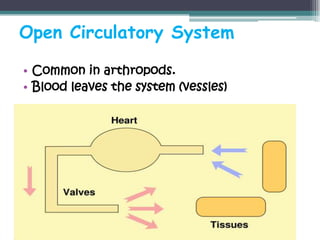
Open Circulatory System

• Common in arthropods.
• Blood leaves the system (vessles)
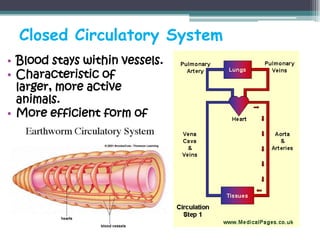
Closed Circulatory System
• Blood stays within vessels.
• Characteristic of
  larger, more active
  animals.
• More efficient form of
  circulation.
Function #4: “Excretion”
• All animals must control…
 1. The amount of water in their cells.
 2. The amount of ammonia (NH3) that builds
    up in the cells due to the breakdown of
    amino acids. Ammonia is poisonous to cells.
• The process of controlling these two things
  varies between aquatic and terrestrial
  invertebrates.
Excretion (cont.)

Aquatic Invertebrates       Terrestrial Invertebrates
• Sponge, cnidarians, and   • Can use a variety of
  some worms.                 specialized structures to
• Excess ammonia and          eliminate excess water and
  water is released through   waste from cells.
  diffusion.                • Ex.) Annelids = “Nephridia”
                              ▫ Nephridia converts
                                ammonia to urine.
Function #5: “Response”
• Invertebrates show three trends in the
  evolution of their nervous systems:
 1. Centralization
 2. Cephalization
 3. Specialization
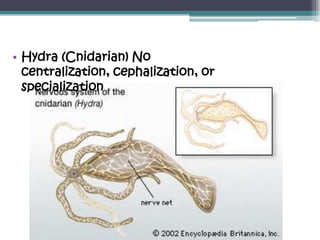
• Hydra (Cnidarian) No
  centralization, cephalization, or
  specialization
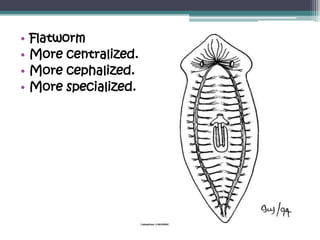
•   Flatworm
•   More centralized.
•   More cephalized.
•   More specialized.
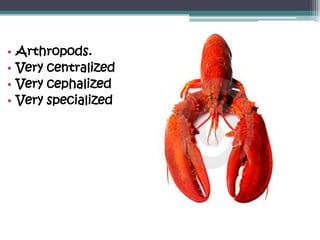
•   Arthropods.
•   Very centralized
•   Very cephalized
•   Very specialized
Function #6: “Movement and Support”
 • Most animals use muscles to move, pump
   blood, and perform other life functions.
 • Muscles usually work together with some kind
   of skeletal system (three different types);
  1. Hydrostatic skeletons – Muscles push water.
     Common in cnidarians and worms.
  2. Exoskeletons – Outer skeleton made of chitin.
     Common in arthropods.
  3. Endoskeletons – Inner skeleton. Common in
     echinoderms and vertebrates.
Function #7: “Reproduction”
• Some animals can reproduce asexually during
  part of their life.
 1. Binary fission (splitting in two).
 2. Budding
• Most animals reproduce sexually during at
  least part of their life (requires sperm and
  egg).
• Male must fertilize the female.
 1. External fertilization
 2. Internal fertilization

The animal kingdom.pptxrb[1]

  • 1.
  • 2.
    What is ananimal? • Multicellular • Eukaryotic • Heterotrophic • No cell walls • 95% of all animals are “invertebrates.”
  • 3.
    Trends in AnimalEvolution • Our survey of the animal kingdom will start with simple animals and move to more complex ones. • We will investigate “invertebrates” first and “vertebrates” later. • Invertebrates- animals without a backbone • Vertebrates- animals with a backbone
  • 4.
    Animal Phyla • There are nine major phyla of animals… M 1. Poriferans (sponges) o r 2. Cnidarians (jellyfish) e 3. Flatworms (tapeworm) 4. Roundworms (heartworm) Invertebrates c o 5. Annelids (earthworm) m 6. Mollusks (clam) p 7. Arthropod (grasshopper) l e 8. Echinoderm (starfish) x 9. Chordate (human)
  • 5.
  • 7.
    Trends in AnimalEvolution • Complex animals tend to have… 1) Specialized cells  Tissues  Organs  Organ Systems 2) Bilateral Symmetry (no symmetry  radial  bilateral) 3) Cephalization (head with sensory organs) 4) Body cavity called coelom (acoelomate  pseudocoelomate  coelomate) 5) Complex embryonic development
  • 8.
    Trend #1: CellSpecialization and Internal Body Organization. • The more complex the animal, the more “specialized” its cells become. • Cells  Tissues  Organs  Organ system. • Some animals have no organs- sponges • Some animals have simple organs for excretion and reproduction – flatworms • Some animals have organ systems - mollusks
  • 9.
    Trend #2: BodySymmetry • With the exception to sponges, every animal exhibits one of two types of body symmetry: 1. Radial symmetry 2. Bilateral symmetry
  • 10.
    Radial Symmetry • Imaginaryplane can pass through a central axis in any direction and body parts repeat around center of organism’s body
  • 11.
    Bilateral Symmetry • Singleplane can divide the body into two equal halves. • Animals with bilateral symmetry have a right and left side, front and back, top and bottom, and usually have segmented bodies.
  • 12.
    Trend #3: Cephalization •Animals with bilateral symmetry have a definite head. • Cephalization is the concentration of sense organs and nerve cells in the anterior end (front end) of the body. • Animals with this trait tend to respond in more complex ways to their environment.
  • 13.
    Trend #4: BodyCavity Formation • Most animals have a body cavity called a “coelom.” • Fluid-filled space between the digestive tract and body wall • Think of this as the area of your body where all of your major organs are located. • Provides room for organs to grow and expand. • Less complex animals do not have this area.
  • 14.
    Types of Body Cavity – • Acoelomate no body cavity, 3 germ layers all packed together, gut completely surrounded by tissues • Pseudocoelomate – fluid-filled cavity between mesoderm and endoderm (separates gut and body wall) • Coelom – fluid-filled cavity lined on both sides by mesoderm, found between muscles of body wall and muscles around gut
  • 15.
    Trend #5: EmbryoDevelopment • In protostomes (worms, mollusks, and arthropods), blastopore develops into mouth. • In deuterostomes (echinoderms and chordates), blastopore develops into anus. • Three layers of embryonic cells (germ layers): 1. Endoderm – Develops into digestive and respiratory tracts. 2. Mesoderm – Develops into muscles, heart, sex organs, and kidneys. 3. Ectoderm – Develops into brain, sense organs, and skin.
  • 17.
    Invertebrate Physiology (formand function) • To survive, all animals must perform the same basic tasks (feed, digest, circulate nutrients, respirate, excrete wastes, reproduce, etc.) • Each group of invertebrates has unique systems to help perform some of these tasks. • We will study a variety of these systems amongst a variety of invertebrate groups.
  • 18.
    Function #1 “Feedingand Digesting” • All animals must feed and digest. • Two main methods of digestion: 1. Intracellular digestion.  Food is digested inside of cells.  Sponges mainly do this. 2. Extracellular digestion  Food is broken down outside of cells in special digestive organs.  Simpler animals have only one opening where food enters and waste leaves (two way digestive tract).  Complex animals have two separate openings a mouth and anus (one way digestive tract).
  • 19.
    Two way vs.One way digestive tract Mouth/Anus
  • 20.
    Function #2 “Respiration” •All animals must exchange O2 and CO2 with the environment. • Structures range from gills  lungs • All respiratory organs have two basic features: 1. Large surface area to come in contact with air or water (the larger the better). 2. Organs must be moist (important for diffusion of gases across cells).
  • 21.
    Function #3: “Circulation” •All cells in an animal must take in oxygen/nutrients and give off CO2/waste. • Simple animals do this through diffusion with their environment. • Complex invertebrates have hearts and blood vessels. • There are two types of circulatory systems: 1. Open system 2. Closed system
  • 22.
    Open Circulatory System •Common in arthropods. • Blood leaves the system (vessles)
  • 23.
    Closed Circulatory System •Blood stays within vessels. • Characteristic of larger, more active animals. • More efficient form of circulation.
  • 24.
    Function #4: “Excretion” •All animals must control… 1. The amount of water in their cells. 2. The amount of ammonia (NH3) that builds up in the cells due to the breakdown of amino acids. Ammonia is poisonous to cells. • The process of controlling these two things varies between aquatic and terrestrial invertebrates.
  • 25.
    Excretion (cont.) Aquatic Invertebrates Terrestrial Invertebrates • Sponge, cnidarians, and • Can use a variety of some worms. specialized structures to • Excess ammonia and eliminate excess water and water is released through waste from cells. diffusion. • Ex.) Annelids = “Nephridia” ▫ Nephridia converts ammonia to urine.
  • 26.
    Function #5: “Response” •Invertebrates show three trends in the evolution of their nervous systems: 1. Centralization 2. Cephalization 3. Specialization
  • 27.
    • Hydra (Cnidarian)No centralization, cephalization, or specialization
  • 28.
    Flatworm • More centralized. • More cephalized. • More specialized.
  • 29.
    Arthropods. • Very centralized • Very cephalized • Very specialized
  • 30.
    Function #6: “Movementand Support” • Most animals use muscles to move, pump blood, and perform other life functions. • Muscles usually work together with some kind of skeletal system (three different types); 1. Hydrostatic skeletons – Muscles push water. Common in cnidarians and worms. 2. Exoskeletons – Outer skeleton made of chitin. Common in arthropods. 3. Endoskeletons – Inner skeleton. Common in echinoderms and vertebrates.
  • 31.
    Function #7: “Reproduction” •Some animals can reproduce asexually during part of their life. 1. Binary fission (splitting in two). 2. Budding • Most animals reproduce sexually during at least part of their life (requires sperm and egg). • Male must fertilize the female. 1. External fertilization 2. Internal fertilization