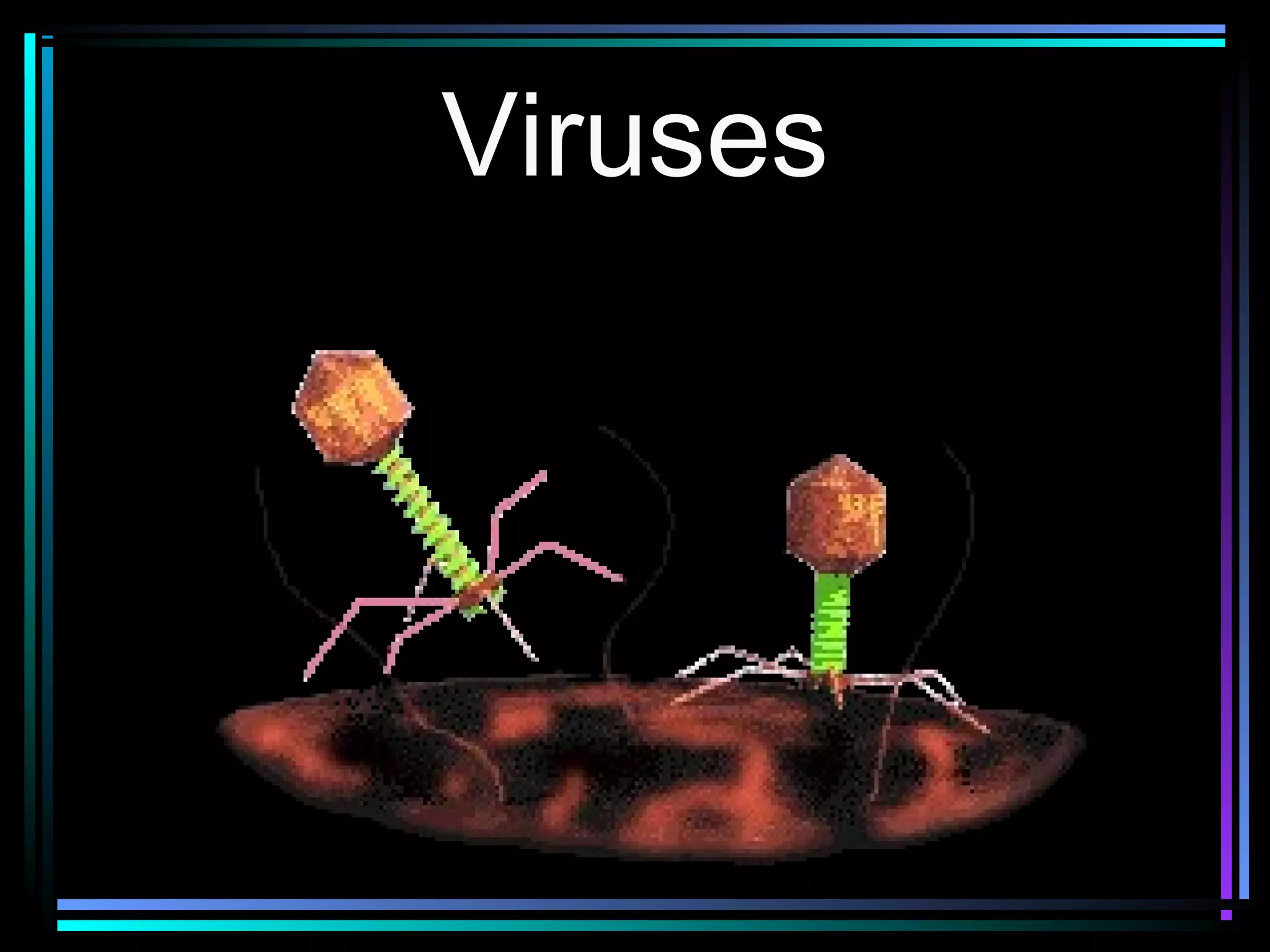
Viruses
Viruses-
 • Particles of nucleic acid, protein, &
   some lipids
 • Any of the microscopic particles
   that invade cells of plants, animals,
   fungi, & bacteria.
 • Often destroying the host cell.
 • Parasite
 • Virus= poison (Latin)
 • Examples: Colds, flu, and HIV
Inside A Virus
• A core of genetic material
• Capsid= A protein coat
  –Enables a virus to invade it’s
   host.
  –May be:
    • DNA
    • RNA
Living or Non-Living
 • Living-        • Non-Living
   – Have DNA &     – Crystallize
     RNA            – Not cells
   – Heredity       – Can’t make
   – Reproduce        proteins
   – Evolve         – Can’t
                      reproduce
                      w/out a host.
Structure Of A Virus
 • Core-
   –Nucleic acid
   –(DNA or
    RNA)
 • Capsid-
   –Protein coat
    surrounds
    core
Viral Reproduction
 • Steps in viral
   reproduction
    –Recognition
    –Attachment
    –Injection
    –Assembly
    –Lysis
Diseases Caused by Viruses
 • AIDS, Measles, Influenza
 • Pathogenic viruses are
   transmitted from host to host.
    –Air: Chicken pox
    –Water: Hepatitis
    –Insects: West Nile
    –See page 489
Fighting Viruses
 • Antibiotics can’t fight viruses
 • Drugs can’t destroy the virus
   w/out destroying the host
 • Viruses are fought with
   prevention using vaccines.
Vaccination
 • Only a healthy immune system
   can fight most viral diseases.
 • Vaccines build up immunity
Great Triumph’s
 • Eliminating small
   pox
 • 1796 vaccine
   discovered
 • 1949 last case in
   US
 • 1977 last case of
   small pox outside of
Filoviruses
 • Viruses that live without causing
   apparent harm
 • Causes disease only when
   infecting other animals
 • Among the most dangerous
   viruses
Filoviruses- cont
 • Cause
   –Hemorrhagic fever
   –Attack connective tissue
   –Massive bleeding
   –Morality rate 30- 90%
   –Ex: Ebola (1995) out break in
    Zaire
Vaccines DO NOT Protect Against
All Viral Diseases.
 • Vaccines are only effective
   against viruses w/non varying
   proteins on their surfaces.
 • Small pox, measles, & polio
   (same)
 • HIV, Cold, Flu (mutate)
Lysogenic Infections
 • Invades host & viral genetic material is
   injected & then fuses w/ host’s genetic
   material.
 • Results in many cells being infected
   with viral nucleic acid.
 • This type of virus has a “dormant
   period”
 • HIV is a Lysogenic virus.
Lysogenic
Infections
Lytic Infections
 • A virus enters a cell, makes copies of
   itself, and causes the cell to lysis.
 • Lysis= spreads the virus to other cells.
 • The cell can no longer tell its DNA from
   the virus’s DNA
 • Example Bacteriophage T4
Back To HIV           (Lysogenic Virus)
 • How is it contracted
   –   Sex (most common)
   –   Blood transmissions/products
   –   Drug use
   –   Tattoos/piercings
   –   Birth/breastfeeding
   –   Healthcare settings
Preventing HIV           (LIFE SKILL)
 •   Abstinence or safe sex
 •   Avoid drug & Alcohol use
 •   Use caution in healthcare settings
 •   Use caution when blood or other body
     fluids are spilled.

Virusppt

  • 1.
  • 2.
    Viruses- • Particlesof nucleic acid, protein, & some lipids • Any of the microscopic particles that invade cells of plants, animals, fungi, & bacteria. • Often destroying the host cell. • Parasite • Virus= poison (Latin) • Examples: Colds, flu, and HIV
  • 3.
    Inside A Virus •A core of genetic material • Capsid= A protein coat –Enables a virus to invade it’s host. –May be: • DNA • RNA
  • 4.
    Living or Non-Living • Living- • Non-Living – Have DNA & – Crystallize RNA – Not cells – Heredity – Can’t make – Reproduce proteins – Evolve – Can’t reproduce w/out a host.
  • 6.
    Structure Of AVirus • Core- –Nucleic acid –(DNA or RNA) • Capsid- –Protein coat surrounds core
  • 7.
    Viral Reproduction •Steps in viral reproduction –Recognition –Attachment –Injection –Assembly –Lysis
  • 8.
    Diseases Caused byViruses • AIDS, Measles, Influenza • Pathogenic viruses are transmitted from host to host. –Air: Chicken pox –Water: Hepatitis –Insects: West Nile –See page 489
  • 9.
    Fighting Viruses •Antibiotics can’t fight viruses • Drugs can’t destroy the virus w/out destroying the host • Viruses are fought with prevention using vaccines.
  • 10.
    Vaccination • Onlya healthy immune system can fight most viral diseases. • Vaccines build up immunity
  • 11.
    Great Triumph’s •Eliminating small pox • 1796 vaccine discovered • 1949 last case in US • 1977 last case of small pox outside of
  • 12.
    Filoviruses • Virusesthat live without causing apparent harm • Causes disease only when infecting other animals • Among the most dangerous viruses
  • 13.
    Filoviruses- cont •Cause –Hemorrhagic fever –Attack connective tissue –Massive bleeding –Morality rate 30- 90% –Ex: Ebola (1995) out break in Zaire
  • 14.
    Vaccines DO NOTProtect Against All Viral Diseases. • Vaccines are only effective against viruses w/non varying proteins on their surfaces. • Small pox, measles, & polio (same) • HIV, Cold, Flu (mutate)
  • 15.
    Lysogenic Infections •Invades host & viral genetic material is injected & then fuses w/ host’s genetic material. • Results in many cells being infected with viral nucleic acid. • This type of virus has a “dormant period” • HIV is a Lysogenic virus.
  • 16.
  • 17.
    Lytic Infections •A virus enters a cell, makes copies of itself, and causes the cell to lysis. • Lysis= spreads the virus to other cells. • The cell can no longer tell its DNA from the virus’s DNA • Example Bacteriophage T4
  • 18.
    Back To HIV (Lysogenic Virus) • How is it contracted – Sex (most common) – Blood transmissions/products – Drug use – Tattoos/piercings – Birth/breastfeeding – Healthcare settings
  • 19.
    Preventing HIV (LIFE SKILL) • Abstinence or safe sex • Avoid drug & Alcohol use • Use caution in healthcare settings • Use caution when blood or other body fluids are spilled.