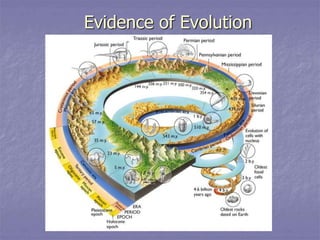
Evidence of Evolution
 EVOLUTION - genetic change in a
population of organisms over time
 4 Types of Evidence that scientists have
gathered in support of evolution
 Fossils
 Comparative Anatomy & Structures
 Embryology
 Biochemistry (Proteins & DNA)
Fossils
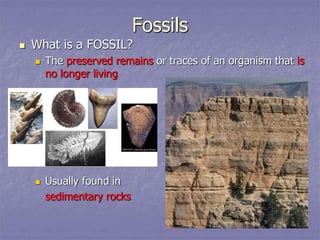
 What is a FOSSIL?
 The preserved remains or traces of an organism that is
no longer living
 Usually found in
sedimentary rocks
What can fossils show?
 Organisms have appeared and disappeared, and have
changed over time
 Extinction of species
 Transitional forms reveal links between groups:
Archaeopteryx: between reptiles & birds
Eustheopteron: amphibious fish
Seymouria: reptile-like amphibian
Also, mammal-like reptiles & whales with hind limbs
 Reveals ancient climate & environmental conditions
 Indicates development of life from simple to complex
 Indicates life began in water
Fossils
 Types of Fossils:
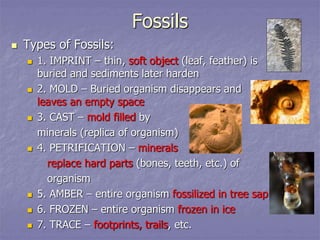
 1. IMPRINT – thin, soft object (leaf, feather) is
buried and sediments later harden
 2. MOLD – Buried organism disappears and
leaves an empty space
 3. CAST – mold filled by
minerals (replica of organism)
 4. PETRIFICATION – minerals
replace hard parts (bones, teeth, etc.) of
organism
 5. AMBER – entire organism fossilized in tree sap
 6. FROZEN – entire organism frozen in ice
 7. TRACE – footprints, trails, etc.
How can fossil age be determined?
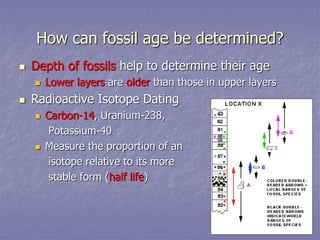
 Depth of fossils help to determine their age
 Lower layers are older than those in upper layers
 Radioactive Isotope Dating
 Carbon-14, Uranium-238,
Potassium-40
 Measure the proportion of an
isotope relative to its more
stable form (half life)
Why is the fossil record incomplete?
 1. Soft tissue rarely preserved
 2. Movement of the earth’s crust has
obliterated or covered many fossils
 3. Fossilization takes place only in certain
types of habitats and under favorable
conditions
 4. Paleontologists have not dug up every
place on earth
Comparative Anatomy
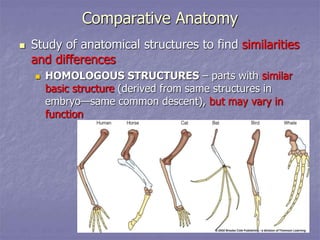
 Study of anatomical structures to find similarities
and differences
 HOMOLOGOUS STRUCTURES – parts with similar
basic structure (derived from same structures in
embryo—same common descent), but may vary in
function
Comparative Anatomy
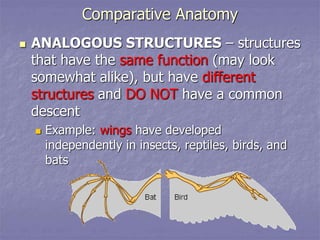
 ANALOGOUS STRUCTURES – structures
that have the same function (may look
somewhat alike), but have different
structures and DO NOT have a common
descent
 Example: wings have developed
independently in insects, reptiles, birds, and
bats
Comparative Anatomy
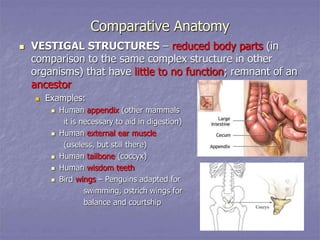
 VESTIGAL STRUCTURES – reduced body parts (in
comparison to the same complex structure in other
organisms) that have little to no function; remnant of an
ancestor
 Examples:
 Human appendix (other mammals
it is necessary to aid in digestion)
 Human external ear muscle
(useless, but still there)
 Human tailbone (coccyx)
 Human wisdom teeth
 Bird wings – Penguins adapted for
swimming, ostrich wings for
balance and courtship
Embryology
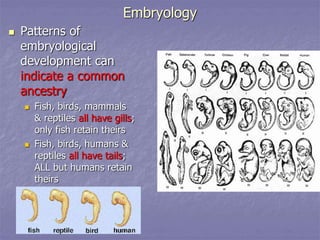
 Patterns of
embryological
development can
indicate a common
ancestry
 Fish, birds, mammals
& reptiles all have gills;
only fish retain theirs
 Fish, birds, humans &
reptiles all have tails;
ALL but humans retain
theirs
Biochemical Similarities
 Similarity of proteins, RNA & DNA molecules
 The more closely related organisms are, the
more similar is the biochemical makeup
 Indicates common ancestor
 Universality of genetic code – supports evolution
 Similar chemistry & structure of chromosomes
among Eukaryotes
 Chlorophyll is the same basic molecule in all
photosynthetic organisms

Evidence_of_Evolution.ppt

  • 1.
  • 2.
    Evidence of Evolution EVOLUTION - genetic change in a population of organisms over time  4 Types of Evidence that scientists have gathered in support of evolution  Fossils  Comparative Anatomy & Structures  Embryology  Biochemistry (Proteins & DNA)
  • 3.
    Fossils  What isa FOSSIL?  The preserved remains or traces of an organism that is no longer living  Usually found in sedimentary rocks
  • 4.
    What can fossilsshow?  Organisms have appeared and disappeared, and have changed over time  Extinction of species  Transitional forms reveal links between groups: Archaeopteryx: between reptiles & birds Eustheopteron: amphibious fish Seymouria: reptile-like amphibian Also, mammal-like reptiles & whales with hind limbs  Reveals ancient climate & environmental conditions  Indicates development of life from simple to complex  Indicates life began in water
  • 5.
    Fossils  Types ofFossils:  1. IMPRINT – thin, soft object (leaf, feather) is buried and sediments later harden  2. MOLD – Buried organism disappears and leaves an empty space  3. CAST – mold filled by minerals (replica of organism)  4. PETRIFICATION – minerals replace hard parts (bones, teeth, etc.) of organism  5. AMBER – entire organism fossilized in tree sap  6. FROZEN – entire organism frozen in ice  7. TRACE – footprints, trails, etc.
  • 6.
    How can fossilage be determined?  Depth of fossils help to determine their age  Lower layers are older than those in upper layers  Radioactive Isotope Dating  Carbon-14, Uranium-238, Potassium-40  Measure the proportion of an isotope relative to its more stable form (half life)
  • 7.
    Why is thefossil record incomplete?  1. Soft tissue rarely preserved  2. Movement of the earth’s crust has obliterated or covered many fossils  3. Fossilization takes place only in certain types of habitats and under favorable conditions  4. Paleontologists have not dug up every place on earth
  • 8.
    Comparative Anatomy  Studyof anatomical structures to find similarities and differences  HOMOLOGOUS STRUCTURES – parts with similar basic structure (derived from same structures in embryo—same common descent), but may vary in function
  • 9.
    Comparative Anatomy  ANALOGOUSSTRUCTURES – structures that have the same function (may look somewhat alike), but have different structures and DO NOT have a common descent  Example: wings have developed independently in insects, reptiles, birds, and bats
  • 10.
    Comparative Anatomy  VESTIGALSTRUCTURES – reduced body parts (in comparison to the same complex structure in other organisms) that have little to no function; remnant of an ancestor  Examples:  Human appendix (other mammals it is necessary to aid in digestion)  Human external ear muscle (useless, but still there)  Human tailbone (coccyx)  Human wisdom teeth  Bird wings – Penguins adapted for swimming, ostrich wings for balance and courtship
  • 11.
    Embryology  Patterns of embryological developmentcan indicate a common ancestry  Fish, birds, mammals & reptiles all have gills; only fish retain theirs  Fish, birds, humans & reptiles all have tails; ALL but humans retain theirs
  • 12.
    Biochemical Similarities  Similarityof proteins, RNA & DNA molecules  The more closely related organisms are, the more similar is the biochemical makeup  Indicates common ancestor  Universality of genetic code – supports evolution  Similar chemistry & structure of chromosomes among Eukaryotes  Chlorophyll is the same basic molecule in all photosynthetic organisms