Evidence of Evolution
Chapter 12
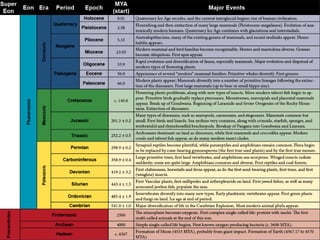
Geologic
Time Scale
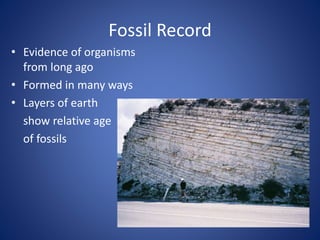
Fossil Record
• Evidence of organisms
from long ago
• Formed in many ways
• Layers of earth
show relative age
of fossils
Formation of Fossils
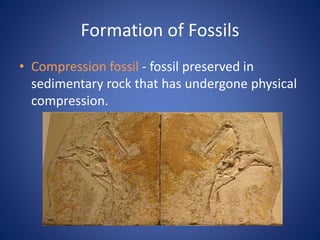
• Compression fossil - fossil preserved in
sedimentary rock that has undergone physical
compression.
Formation of Fossils
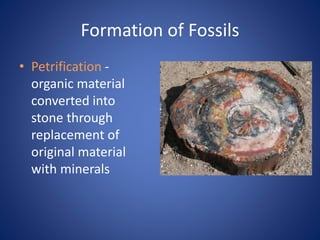
• Petrification -
organic material
converted into
stone through
replacement of
original material
with minerals
Formation of Fossils
• Impression – 2-
dimensional imprint
of organism without
any organic material
left
Formation of Fossils
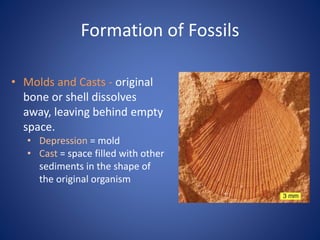
• Molds and Casts - original
bone or shell dissolves
away, leaving behind empty
space.
• Depression = mold
• Cast = space filled with other
sediments in the shape of
the original organism
Formation of Fossils
• Intact Preservation -
Oozing tree sap traps
insects and other
organisms
• Amber - When the
sap (or resin)
fossilizes
Dating Fossils
• Relative Dating - based on where in layers of
rock it is.
– Does NOT assign an exact age
• Absolute Dating - test fossil or sediment
around it to get a date range
– Radiometric Dating - uses radioactive isotopes
• Based on half life—amount of time it takes for half the
substance to decay
• Ex. Carbon-14
Carbon 14 Dating
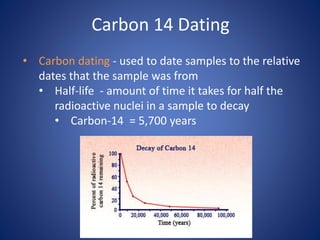
• Carbon dating - used to date samples to the relative
dates that the sample was from
• Half-life - amount of time it takes for half the
radioactive nuclei in a sample to decay
• Carbon-14 = 5,700 years
Biogeography
• Biogeography – the study of past and present
distributions of organisms
• Continental Drift – movement of major land
masses due to plate tectonics
Continental Drift
PANGEA
280 million years ago
Comparative Anatomy
• .
• Analogous structures - structures that look
similar, but have different origins (e.g. wings
in birds and insects).
Comparative Anatomy
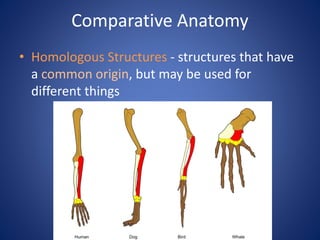
• Homologous Structures - structures that have
a common origin, but may be used for
different things
Comparative Anatomy
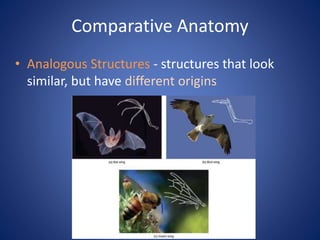
• Analogous Structures - structures that look
similar, but have different origins
Comparative Anatomy
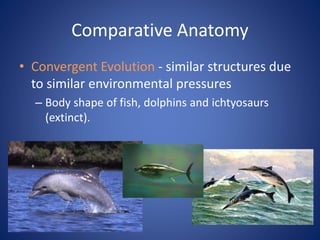
• Convergent Evolution - similar structures due
to similar environmental pressures
– Body shape of fish, dolphins and ichtyosaurs
(extinct).
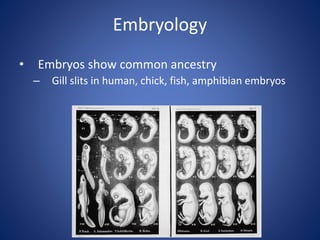
Embryology
• Embryos show common ancestry
– Gill slits in human, chick, fish, amphibian embryos
Biochemistry
• DNA/RNA - All organisms use DNA/RNA and
proteins as basis of inheritance
– Similar species have similar DNA
– Can use whole genomes or single/groups of
genes
– Mitochondrial DNA – does not degrade as
quickly as nuclear DNA
– Y Chromosome – accumulates changes more
slowly than X
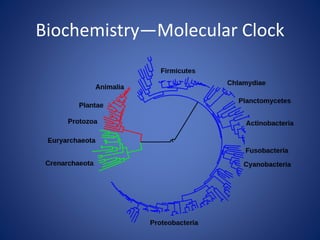
– Can use DNA as a molecular clock to estimate
when organisms diverged (became different)
Biochemistry—Molecular Clock
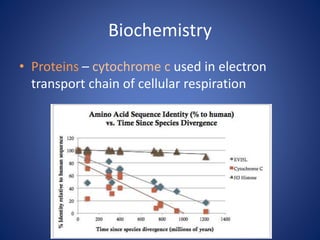
Biochemistry
• Proteins – cytochrome c used in electron
transport chain of cellular respiration

Evidence of evolution

  • 1.
  • 2.
  • 4.
    Fossil Record • Evidenceof organisms from long ago • Formed in many ways • Layers of earth show relative age of fossils
  • 5.
    Formation of Fossils •Compression fossil - fossil preserved in sedimentary rock that has undergone physical compression.
  • 6.
    Formation of Fossils •Petrification - organic material converted into stone through replacement of original material with minerals
  • 7.
    Formation of Fossils •Impression – 2- dimensional imprint of organism without any organic material left
  • 8.
    Formation of Fossils •Molds and Casts - original bone or shell dissolves away, leaving behind empty space. • Depression = mold • Cast = space filled with other sediments in the shape of the original organism
  • 9.
    Formation of Fossils •Intact Preservation - Oozing tree sap traps insects and other organisms • Amber - When the sap (or resin) fossilizes
  • 10.
    Dating Fossils • RelativeDating - based on where in layers of rock it is. – Does NOT assign an exact age • Absolute Dating - test fossil or sediment around it to get a date range – Radiometric Dating - uses radioactive isotopes • Based on half life—amount of time it takes for half the substance to decay • Ex. Carbon-14
  • 11.
    Carbon 14 Dating •Carbon dating - used to date samples to the relative dates that the sample was from • Half-life - amount of time it takes for half the radioactive nuclei in a sample to decay • Carbon-14 = 5,700 years
  • 12.
    Biogeography • Biogeography –the study of past and present distributions of organisms • Continental Drift – movement of major land masses due to plate tectonics
  • 13.
  • 14.
    Comparative Anatomy • . •Analogous structures - structures that look similar, but have different origins (e.g. wings in birds and insects).
  • 15.
    Comparative Anatomy • HomologousStructures - structures that have a common origin, but may be used for different things
  • 16.
    Comparative Anatomy • AnalogousStructures - structures that look similar, but have different origins
  • 17.
    Comparative Anatomy • ConvergentEvolution - similar structures due to similar environmental pressures – Body shape of fish, dolphins and ichtyosaurs (extinct).
  • 18.
    Embryology • Embryos showcommon ancestry – Gill slits in human, chick, fish, amphibian embryos
  • 19.
    Biochemistry • DNA/RNA -All organisms use DNA/RNA and proteins as basis of inheritance – Similar species have similar DNA – Can use whole genomes or single/groups of genes – Mitochondrial DNA – does not degrade as quickly as nuclear DNA – Y Chromosome – accumulates changes more slowly than X – Can use DNA as a molecular clock to estimate when organisms diverged (became different)
  • 20.
  • 21.
    Biochemistry • Proteins –cytochrome c used in electron transport chain of cellular respiration

Editor's Notes

  • #3 “Geologic Clock with events and periods” by Woudloper. Released into public domain by the copyright holder
  • #4 Geologic Time Scale, “Table of geologic time” https://en.wikipedia.org/wiki/Geologic_time_scale#Table_of_geologic_time. Converted into an image by Lumen Learning.
  • #5 Estimating the Age of Fossils. Provided by: Boundless. Located at: https://www.boundless.com/biology/textbooks/boundless-biology-textbook/evolution-and-the-origin-of-species-18/evidence-of-evolution-129/estimating-the-age-of-fossils-520-13098/images/sedimentary-layers/. License: CC BY-SA: Attribution-ShareAlike
  • #6 “Compression fossil” https://en.wikipedia.org/wiki/Compression_fossil “Pterodactylus Antiquus p and cp” by Ryan Somma. Licensed under a CC-BY-SA 2.0 Generic license. https://en.wikipedia.org/wiki/File:Pterodactylus_antiquus_p_and_cp.jpg
  • #7 “Petrification” https://en.wikipedia.org/wiki/Petrifaction “Petrified wood closeup 2” by Daniel Schwen. Licensed under a CC-BY-SA 3.0 Unported license. https://commons.wikimedia.org/wiki/File:Petrified_wood_closeup_2.jpg
  • #8 By Unknown or not provided (U.S. National Archives and Records Administration) [Public domain], via Wikimedia Commons
  • #9 Image and caption from Boundless
  • #10 Left: “Gouttes Drops Resin 2” by Emmanuel Boutet. Licensed under a CC-BY-SA 3.0 Unported license. https://en.wikipedia.org/wiki/File:Gouttes-drops-resine-2.jpg Right: “Amber 2” by Anders L. Damgaard. Licenced under a CC-BY-SA 3.0 Unported license. https://en.wikipedia.org/wiki/File:Amber2.jpg
  • #12 “Carbon-Dating-Flashcards,” by Zappys Technology Solutions. CC-BY. Image from Flikr: https://flic.kr/p/oHNNpJ.
  • #13 Public Domain – United States Geological Survey -
  • #14 Left: “Pangea” By Kieff. Licensed under a CC-BY-SA 3.0 Unported license. http://commons.wikimedia.org/wiki/File:Pangaea.png Right: “Laurasia-Gondwana” by Lenny Wikidata. Licensed under a CC-BY 3.0 Unported license. http://en.wikipedia.org/wiki/File:Laurasia-Gondwana.svg Bottom: “Eckert 4” by Ktrinko. Licensed under a CC0 1.0 Universal Public Domain Dedication. http://commons.wikimedia.org/wiki/File:Eckert4.jpg
  • #16 “Homology Vertebrates” by Волков Владислав Петрович. Licensed under a CC-0 license. https://en.wikipedia.org/wiki/File:Homology_vertebrates.svg
  • #17 Image from Boundless
  • #18 By Aude Steiner - Self-photographed, CC BY-SA 1.0, https://commons.wikimedia.org/w/index.php?curid=19212453 By Heinrich Harder (1858-1935) (The Wonderful Paleo Art of Heinrich Harder) [Public domain], via Wikimedia Commons By aes256 - http://photozou.jp/photo/photo_only/296250/118149451, CC BY 2.1 jp, https://commons.wikimedia.org/w/index.php?curid=19132968
  • #19 “Haeckel Anhropogenie 1874” by J. G. Bach of Leipzig. (Public Domain). http://commons.wikimedia.org/wiki/File:Haeckel_Anthropogenie_1874.jpg
  • #21 “Image: Evolutionary Tree” by Boundless, CC-By SA 4.0
  • #22 Image by Ahmed376, CC-By SA 3.0, available http://commons.wikimedia.org/wiki/File:Amino_acid_sequence_identity_vs_time_since_species_divergence_for_orthologs_of_EVI5L.png