Unit 1 Lesson 3 Evidence of Evolution
Essential Question: What evidence supports
the theory of evolution?
Copyright © Houghton Mifflin Harcourt Publishing Company
Big Idea: The types and characteristics of
organisms change over time
Unit 1 Lesson 3 Evidence of Evolution
Fossil Hunt
Copyright © Houghton Mifflin Harcourt Publishing Company
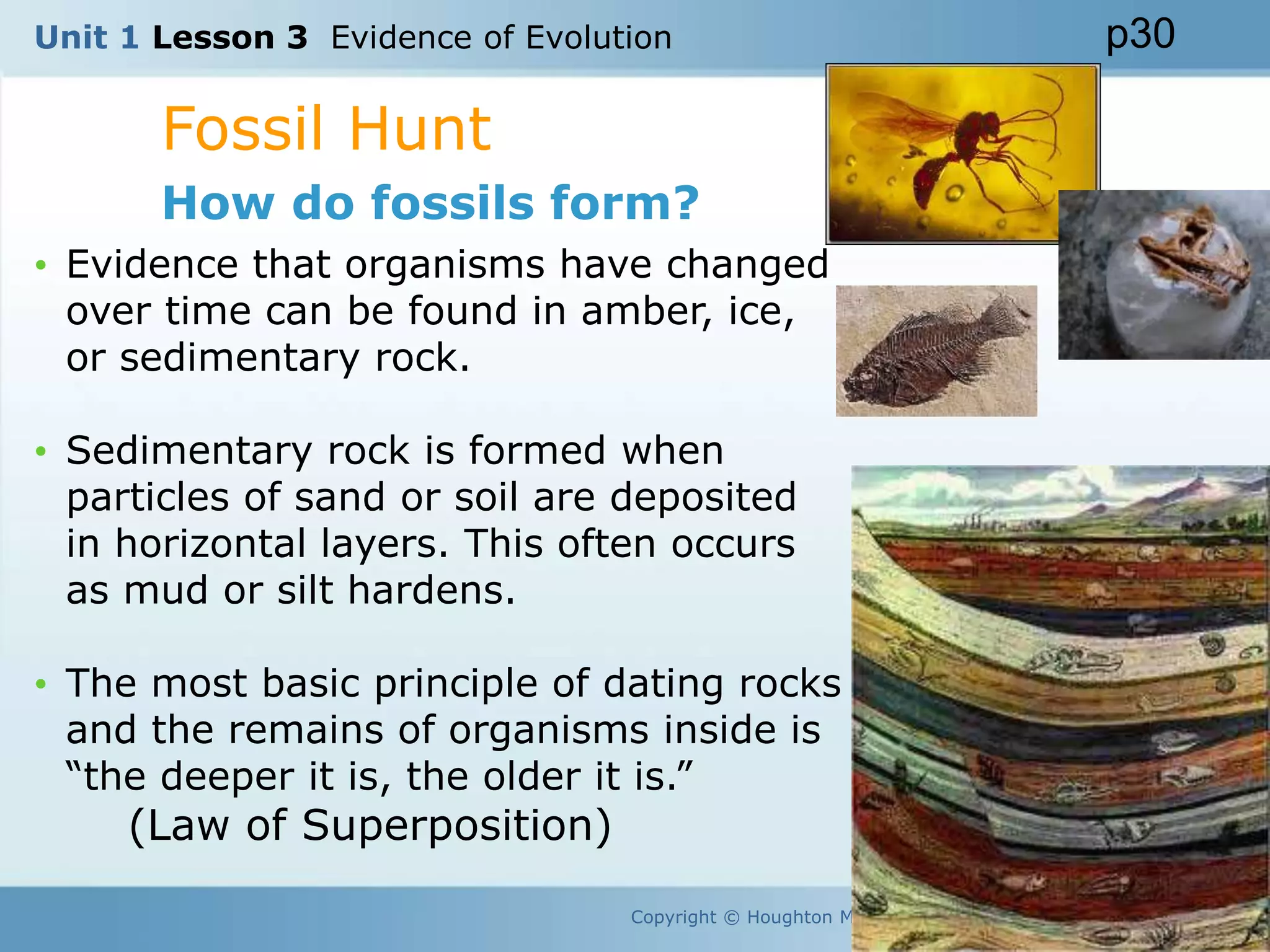
• Evidence that organisms have changed
over time can be found in amber, ice,
or sedimentary rock.
• Sedimentary rock is formed when
particles of sand or soil are deposited
in horizontal layers. This often occurs
as mud or silt hardens.
• The most basic principle of dating rocks
and the remains of organisms inside is
“the deeper it is, the older it is.”
(Law of Superposition)
How do fossils form?
p30
How do Fossils Form? Sequence Map
P30-31
Unit 1 Lesson 3 Evidence of Evolution
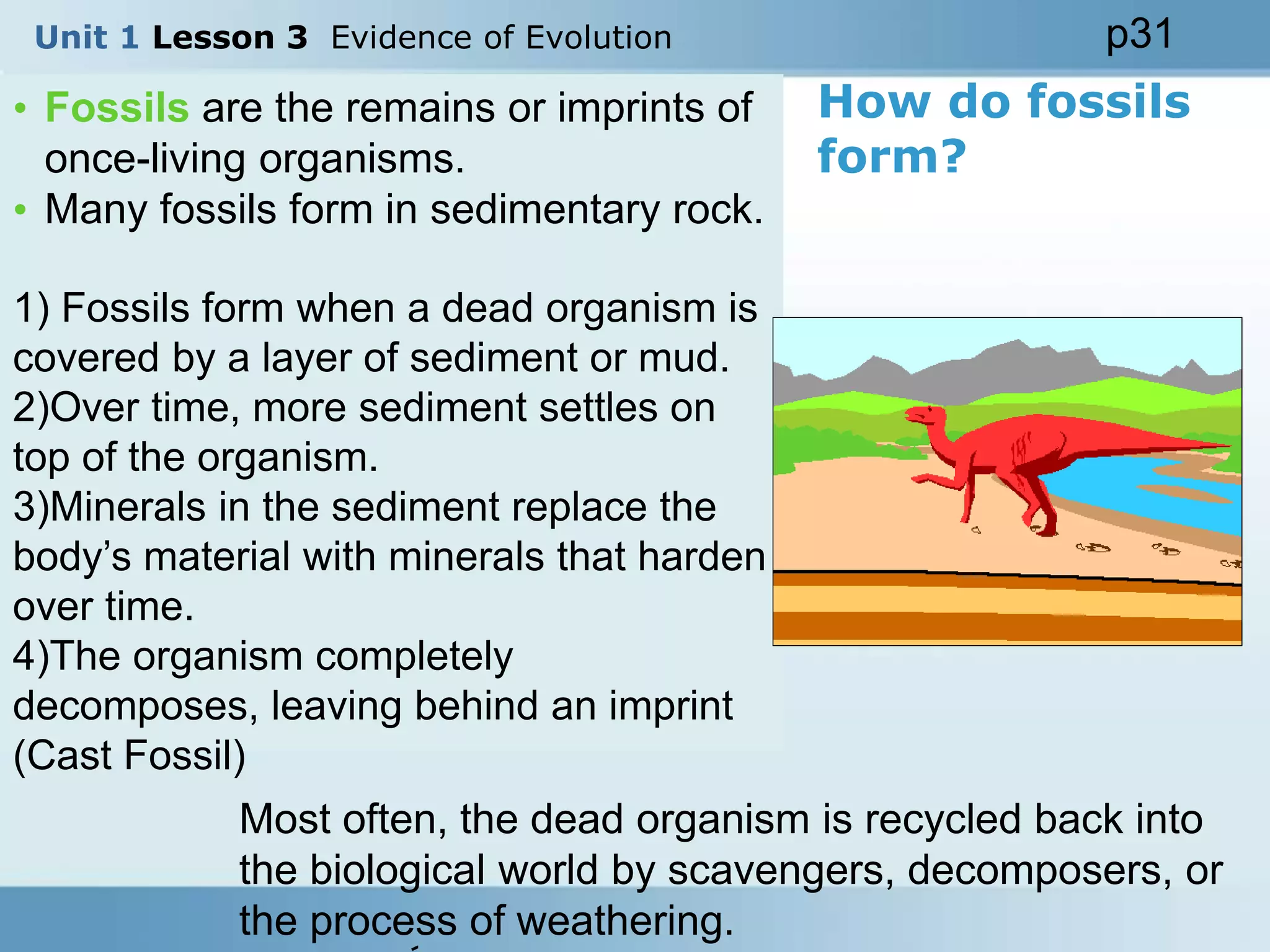
• Fossils are the remains or imprints of
once-living organisms.
• Many fossils form in sedimentary rock.
1) Fossils form when a dead organism is
covered by a layer of sediment or mud.
2)Over time, more sediment settles on
top of the organism.
3)Minerals in the sediment replace the
body’s material with minerals that harden
over time.
4)The organism completely
decomposes, leaving behind an imprint
(Cast Fossil)
How do fossils
form?
p31
Most often, the dead organism is recycled back into
the biological world by scavengers, decomposers, or
the process of weathering.
How do fossils show change over time?
• All of the fossils that have been discovered make up the
fossil record.
• By examining the fossil record, scientists can learn about
the history of life on Earth.
• There are gaps in the fossil record in which a fossil has not
been discovered.
• Fossils found in newer layers of Earth’s crust tend to have
physical or molecular similarities to present-day
organisms.
• Fossils that help fill in gaps in the fossil record are called
transitional fossils.
• Fossils from older layers are less similar to present-day
organisms.
Unit 1 Lesson 3 Evidence of Evolution p31
How do fossils show change over time?
Unit 1 Lesson 3 Evidence of Evolution
7) Identify
Organism lives on the
edge of a body of
water, and possible on
both land and water.
8) Infer
The organism has a
tail and fins like a fish,
but lives above water
like a four-legged
vertebrate
p31
What Evidence Supports Evolution?
Fossils
Common
structures
Similar DNA
Developmental
Similarities
P31-33
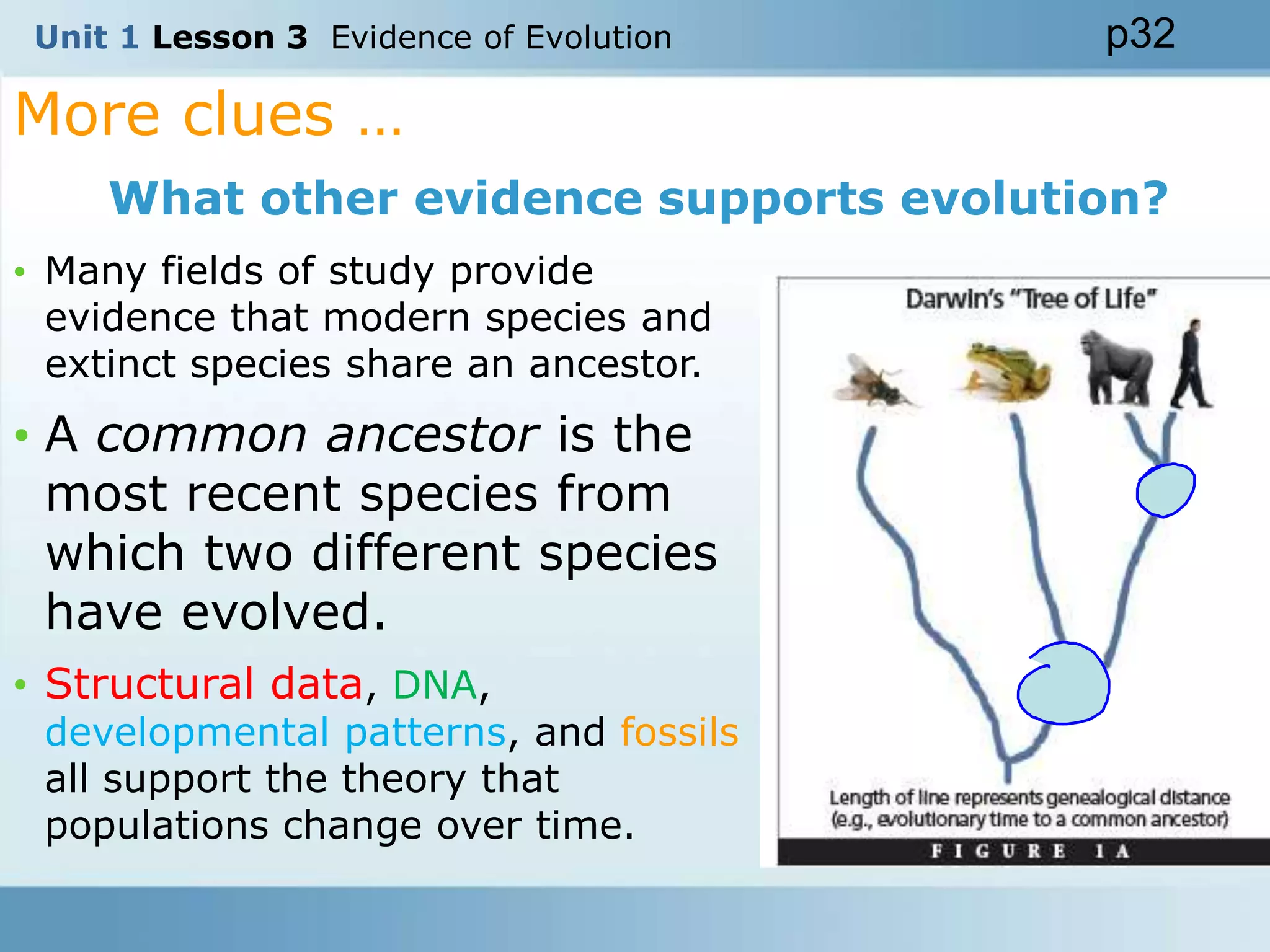
More clues …
What other evidence supports evolution?
• Many fields of study provide
evidence that modern species and
extinct species share an ancestor.
• A common ancestor is the
most recent species from
which two different species
have evolved.
• Structural data, DNA,
developmental patterns, and fossils
all support the theory that
populations change over time.
Unit 1 Lesson 3 Evidence of Evolution p32
Common Structures
• Related organisms share structural traits
• Structures may be reduced in size or have different
function.
P32-33
The leg of a frog and the wing of a bird serve very different
purposes, but the bones in their limbs are similar in structure.
What does this suggest about frogs and birds?
They had a common ancestor
Similar DNA
• Scientists compare amino acids that make up
cytochrome c proteins
• The greater number of similarities the more recently
the two species shared a common ancestor
P32-33
11) Infer The bullfrog and lamprey are the least closely
related to humans, because their cytochrome c
molecules differ the most.
Developmental Similarities
• Embryology – Embryos undergo many physical and
functional changes as they grow
• Scientists compare development of different species and
look for similar patterns and structures.
P32-33
What Evidence Supports Evolution?
Fossils
Trace or remains
of organisms that
were once living
Found in Amber,
Ice, Sedimentary
Rock
Transitional
Fossils – Help
bridge the gap in
the fossil record
Common
structures
Related
organisms share
structural traits
Structures may
be reduced in
size or have
different function.
Similar DNA
Scientists
compare amino
acids that make
up cytochrome c
proteins
The greater
number of
similarities the
more recently the
two species
shared a
common ancestor
Developmental
Similarities
Embryology –
Embryos undergo
many physical
and functional
changes as they
grow
Scientists
compare
development of
different species
and look for similar
patterns and
structures.
Copyright © Houghton Mifflin Harcourt Publishing Company
How do we know organisms are related?
• Fossils give evidence for how certain species changed
gradually over time.
• Fossil and DNA evidence support the hypothesis that
modern whales evolved from hoofed mammals that lived on
land.
• Scientists have examined transitional characters of extinct
species to see how changes happened.
• Fossil evidence and skeletons of fossils suggest how a land
mammal might have gradually changed to an aquatic
whale.
• Molecular evidence also shows that the DNA of whales and
hoofed mammals is very similar.
Unit 1 Lesson 3 Evidence of Evolution P34-
How do we know organisms are related?
• Fossil evidence and skeletons of fossils suggest how a land
mammal might have gradually changed to an aquatic
whale.
Unit 1 Lesson 3 Evidence of Evolution
Unused
Structures
Unused
Structures
40 mya – Dorudon
Present day - Whale
P34-35
13: Infer
The tiny bones are not involved
in the whale’s movement –
unused structures
14:Analyze
The modern whale appears to be best
adapted for swimming long distances under
water because it has fins to swim fast and
can hold its breath underwater for a long time
How do we know organisms are related?
Unit 1 Lesson 3 Evidence of Evolution
Species DNA Sequence
Hippopotamus
(even toed hoofed animal) TCC TGGCA GTCCA GTGGT
Humpback Whale CCC TGGCA GTGCA GTGCT
Circle the pairs of nitrogen bases (G,T,C,or A) that differ
p.35
Lets go to the lab…….
A = Adenine
T – Thymine
C – Cytosine
G - Guanine
Kingdom: Animal
Phylum: Chordata
Class: Mammalia
Order: Artiodactyla* (Even-toed hoofed animals: includes pigs, sheep goats, cattle, deer)
Family: Hippopotamidae
Genus: Choeropsis
Species: Choeropsis liberiensis (Pygmy Hippopotamus)
Subspecies: C. l. liberiensis
Subspecies: C. l. heslopi
Genus: Hippopotamus
Species: Hippopotamus amphibius (Common Hippopotamus)
Species: Hippopotamus madagascariensis (extinct dwarf hippo from
Madagascar)
Species: Hippopotamus lemerlei (extinct dwarf hippo from Madagascar)
*New anatomical and DNA evidence on the relationship between Artiodactyla
(even-toed ungulates) and Cetacea (whales and dolphins) recently led to a
merging of the two orders into a new group, Cetartiodactyla.
As of October 2012, experts had not agreed on whether to define
Cetartiodactyla as an official taxonomic order that would replace Artiodactyla
and Cetacea. Some continue to list hippopotamuses in the order Artiodactyla
or use the term Cetartiodactyla without defining it as an order.
(Boisserie 2008) (Boisserie et al 2005) (Harris et al. 2008) (Kingdon 1979) (Lihoreau et al 2006) (Meester & Setzer 1971)
(Stuenes 1989) (Wilson & Reeder 1992) Revised 2012

Evidence of Evolution (3).ppt

  • 1.
    Unit 1 Lesson3 Evidence of Evolution Essential Question: What evidence supports the theory of evolution? Copyright © Houghton Mifflin Harcourt Publishing Company Big Idea: The types and characteristics of organisms change over time
  • 2.
    Unit 1 Lesson3 Evidence of Evolution Fossil Hunt Copyright © Houghton Mifflin Harcourt Publishing Company • Evidence that organisms have changed over time can be found in amber, ice, or sedimentary rock. • Sedimentary rock is formed when particles of sand or soil are deposited in horizontal layers. This often occurs as mud or silt hardens. • The most basic principle of dating rocks and the remains of organisms inside is “the deeper it is, the older it is.” (Law of Superposition) How do fossils form? p30
  • 3.
    How do FossilsForm? Sequence Map P30-31
  • 4.
    Unit 1 Lesson3 Evidence of Evolution • Fossils are the remains or imprints of once-living organisms. • Many fossils form in sedimentary rock. 1) Fossils form when a dead organism is covered by a layer of sediment or mud. 2)Over time, more sediment settles on top of the organism. 3)Minerals in the sediment replace the body’s material with minerals that harden over time. 4)The organism completely decomposes, leaving behind an imprint (Cast Fossil) How do fossils form? p31 Most often, the dead organism is recycled back into the biological world by scavengers, decomposers, or the process of weathering.
  • 5.
    How do fossilsshow change over time? • All of the fossils that have been discovered make up the fossil record. • By examining the fossil record, scientists can learn about the history of life on Earth. • There are gaps in the fossil record in which a fossil has not been discovered. • Fossils found in newer layers of Earth’s crust tend to have physical or molecular similarities to present-day organisms. • Fossils that help fill in gaps in the fossil record are called transitional fossils. • Fossils from older layers are less similar to present-day organisms. Unit 1 Lesson 3 Evidence of Evolution p31
  • 6.
    How do fossilsshow change over time? Unit 1 Lesson 3 Evidence of Evolution 7) Identify Organism lives on the edge of a body of water, and possible on both land and water. 8) Infer The organism has a tail and fins like a fish, but lives above water like a four-legged vertebrate p31
  • 7.
    What Evidence SupportsEvolution? Fossils Common structures Similar DNA Developmental Similarities P31-33
  • 8.
    More clues … Whatother evidence supports evolution? • Many fields of study provide evidence that modern species and extinct species share an ancestor. • A common ancestor is the most recent species from which two different species have evolved. • Structural data, DNA, developmental patterns, and fossils all support the theory that populations change over time. Unit 1 Lesson 3 Evidence of Evolution p32
  • 9.
    Common Structures • Relatedorganisms share structural traits • Structures may be reduced in size or have different function. P32-33 The leg of a frog and the wing of a bird serve very different purposes, but the bones in their limbs are similar in structure. What does this suggest about frogs and birds? They had a common ancestor
  • 10.
    Similar DNA • Scientistscompare amino acids that make up cytochrome c proteins • The greater number of similarities the more recently the two species shared a common ancestor P32-33 11) Infer The bullfrog and lamprey are the least closely related to humans, because their cytochrome c molecules differ the most.
  • 11.
    Developmental Similarities • Embryology– Embryos undergo many physical and functional changes as they grow • Scientists compare development of different species and look for similar patterns and structures. P32-33
  • 12.
    What Evidence SupportsEvolution? Fossils Trace or remains of organisms that were once living Found in Amber, Ice, Sedimentary Rock Transitional Fossils – Help bridge the gap in the fossil record Common structures Related organisms share structural traits Structures may be reduced in size or have different function. Similar DNA Scientists compare amino acids that make up cytochrome c proteins The greater number of similarities the more recently the two species shared a common ancestor Developmental Similarities Embryology – Embryos undergo many physical and functional changes as they grow Scientists compare development of different species and look for similar patterns and structures.
  • 13.
    Copyright © HoughtonMifflin Harcourt Publishing Company How do we know organisms are related? • Fossils give evidence for how certain species changed gradually over time. • Fossil and DNA evidence support the hypothesis that modern whales evolved from hoofed mammals that lived on land. • Scientists have examined transitional characters of extinct species to see how changes happened. • Fossil evidence and skeletons of fossils suggest how a land mammal might have gradually changed to an aquatic whale. • Molecular evidence also shows that the DNA of whales and hoofed mammals is very similar. Unit 1 Lesson 3 Evidence of Evolution P34-
  • 14.
    How do weknow organisms are related? • Fossil evidence and skeletons of fossils suggest how a land mammal might have gradually changed to an aquatic whale. Unit 1 Lesson 3 Evidence of Evolution Unused Structures Unused Structures 40 mya – Dorudon Present day - Whale P34-35 13: Infer The tiny bones are not involved in the whale’s movement – unused structures 14:Analyze The modern whale appears to be best adapted for swimming long distances under water because it has fins to swim fast and can hold its breath underwater for a long time
  • 15.
    How do weknow organisms are related? Unit 1 Lesson 3 Evidence of Evolution Species DNA Sequence Hippopotamus (even toed hoofed animal) TCC TGGCA GTCCA GTGGT Humpback Whale CCC TGGCA GTGCA GTGCT Circle the pairs of nitrogen bases (G,T,C,or A) that differ p.35 Lets go to the lab……. A = Adenine T – Thymine C – Cytosine G - Guanine
  • 16.
    Kingdom: Animal Phylum: Chordata Class:Mammalia Order: Artiodactyla* (Even-toed hoofed animals: includes pigs, sheep goats, cattle, deer) Family: Hippopotamidae Genus: Choeropsis Species: Choeropsis liberiensis (Pygmy Hippopotamus) Subspecies: C. l. liberiensis Subspecies: C. l. heslopi Genus: Hippopotamus Species: Hippopotamus amphibius (Common Hippopotamus) Species: Hippopotamus madagascariensis (extinct dwarf hippo from Madagascar) Species: Hippopotamus lemerlei (extinct dwarf hippo from Madagascar) *New anatomical and DNA evidence on the relationship between Artiodactyla (even-toed ungulates) and Cetacea (whales and dolphins) recently led to a merging of the two orders into a new group, Cetartiodactyla. As of October 2012, experts had not agreed on whether to define Cetartiodactyla as an official taxonomic order that would replace Artiodactyla and Cetacea. Some continue to list hippopotamuses in the order Artiodactyla or use the term Cetartiodactyla without defining it as an order. (Boisserie 2008) (Boisserie et al 2005) (Harris et al. 2008) (Kingdon 1979) (Lihoreau et al 2006) (Meester & Setzer 1971) (Stuenes 1989) (Wilson & Reeder 1992) Revised 2012