Evolution Evidence
Overview
By:
Historical Sciences –
Reconstructing a Crime
• Discuss: When someone is accused of committing
a crime, how are they shown to be guilty or not
guilty?
• One thing we can not do is rewind time to repeat
the crime.
• We can, however, use evidence to draw the most
reasonable conclusion.
• We will use this same process used in a court
room to determine if evolution is historically
accurate.
Questions to Get You Thinking
• If evolution is true, what kind of evidence
might you suspect you would find in nature?
• If evolution is false, what kind of evidence
might you suspect you would find in nature?
• Is there any evidence to support the theory of
evolution?
• If so, what kind of evidence?
Evidence Overview
• Similarities between species showing
common ancestry
• Progressions of species changing over time
• Remnants of past generations within species
Similarities – Family Resemblance
• Discuss: Do people ever say that you look like
anyone else in your family? Why?
• In the same way that people in the same family
look alike, so species that are related also share
similarities inherited from common ancestors.
Examining the Evidence –
Similarities
• What might disprove evolution:
– species are totally unique, unlike each other.
• Strong evidence in support of evolution:
– Similarities from multiple disciplines agree –
genetics, anatomy, behavior, geography, etc.
– Species share greater number, intensity, and
variety of similarities the more recent they shared
a common ancestor
– The similarities shared between species are
arbitrary or harmful to have
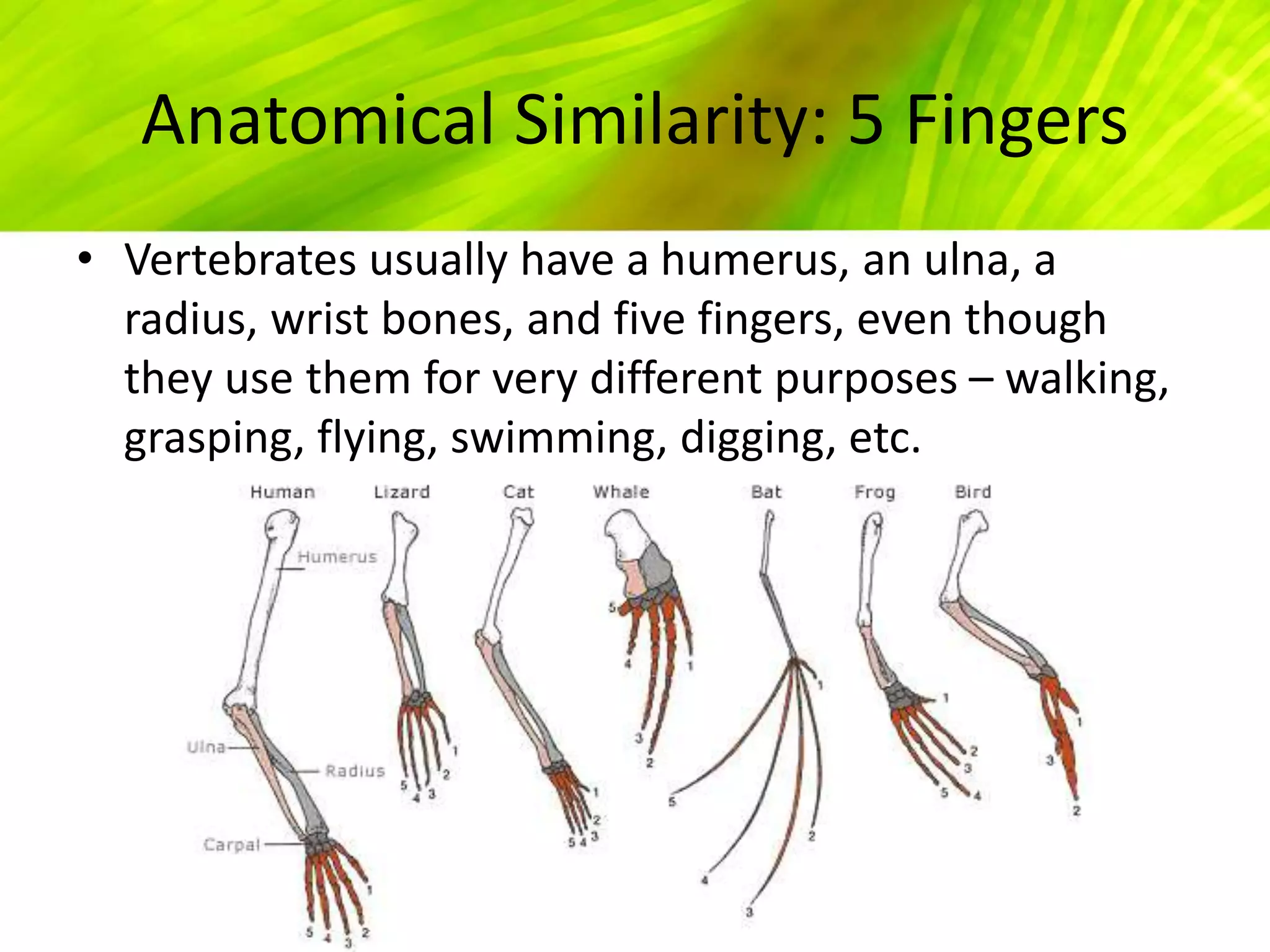
Anatomical Similarity: 5 Fingers
• Vertebrates usually have a humerus, an ulna, a
radius, wrist bones, and five fingers, even though
they use them for very different purposes – walking,
grasping, flying, swimming, digging, etc.
Anatomical Similarity: Neck Vertebrae
• Almost all mammals have 7 neck vertebrae,
even though they use them very differently
Similarity: Orchid Structure
• Orchids of incredible variety have the same
pattern of parts
Similarity: Number of Legs
• Though both groups are extremely diverse,
insects have 6 legs, while arachnids have 8.
Arachnids Insects
Examples of Similarities Between
Species
• Echinoderms, though very diverse, have 5
sides.
Biomolecular Similarities
• Species also share a number of molecular
similarities.
– Species share
• the same genetic language
• the same types of amino acids – L isomer
• The same kind of sugars – D isomer Sugars
Amino acids
Genetic Language
Gene Similarities
• Humans share
98% of our genes
with chimpanzees
• This picture graphically
represents a
comparison of one
gene, FOXP2, shared
by both humans and
chimps. The white
gaps are deletions or
insertions that differ
between humans and
chimps. The red spots
are significant genetic
differences between
humans and chimps.
The letters that form
the body of the chimp
are the shared
sequences.
Biogeographic Similarities
• Species that are related often come from the same
area. This is even true for fossil species.
– Almost all marsupials are in Australia – even fossil species
– Lemurs are found only on Madagascar today
Progressions of Change –
Putting the Frames of a Movie Together
• When we watch TV or a movie our brain puts
together individual frames into smooth movements.
• Evolutionary progressions also come in similar
"frame by frame" sequences.
Examining the Evidence –
Progressions
• What might disprove evolution:
– Species are shown to be unchangeable
– Species remains do not show progressions of change
• Strong evidence in support of evolution
– Modern dating techniques confirm the ages of fossils
within a progression
– Multiple traits are held in common by evolving species
showing they are related
– Multiple traits change over time within an evolving
species
Progressions
Examples of Progressions - Whales
• Modern day whales
evolved from land
dwelling relatives of
hippos
Examples of
Progressions -
Whales• The back legs of the whales
become reduced over time
• The nose of the whales
moves to the top of the
head
• As some whales
transitioned from eating
with teeth to eating with
baleen, some intermediate
fossil species had both
teeth and baleen
– bottom right photo is of a
toothed whale with baleen
blood vessels
Examples of Progressions - Horses
• Horses have evolved to become larger, have
fewer toes, and to eat grass.
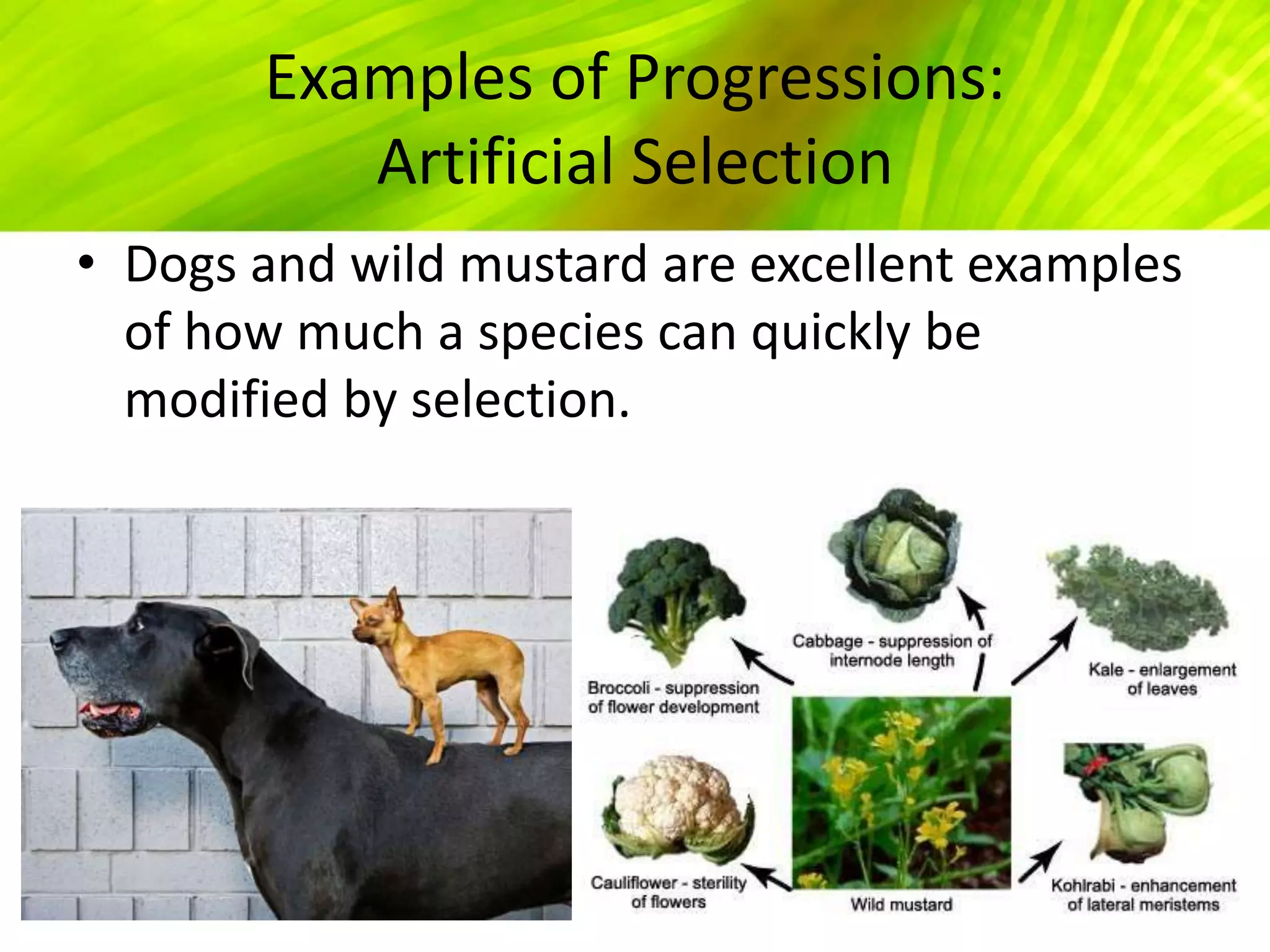
Examples of Progressions:
Artificial Selection
• Dogs and wild mustard are excellent examples
of how much a species can quickly be
modified by selection.
Progressions Across Geography:
Ring Species
• Ring species: As species spread across an area they
sometimes wrap around geographic obstacles, like mountains,
forming a ring. When the species meet on the far side of the
mountain range, they can no longer reproduce together. They
can, however, reproduce with the population that they most
recently came from.
Remnants – Signs of Origins
• Coins minted in the U.S. have letters
on them that tell which mint they
came from.
• Discussion: Has anyone ever said that
you have an accent? Do you think you
do? What can we tell about where
someone is from based on how they
speak?
• Similar to the above signs of origins,
we can look at species and tell a lot
about their evolutionary history.
Remnants – Whale Legs
• Whales and dolphins
have the vestigial legs
early in development
• All whales and
dolphins have the
remains of hips and
legs inside their body.
Remnants – Fibulas
• Horses have vestigial bones in
their legs called fibulas.
– These bones easily break
causing the horse great
discomfort. Race horses have
their legs wrapped to help
prevent breaks.
• Many other species also have
vestigial fibulas, chickens are
one example.
• Discussion: Have you seen
this bone while eating
chicken?
Remnants in You!
• Coccyx
• Wisdom teeth
• Ear muscles
• Goosebumps
• Nictitating eye
membrane
• Canine teeth
Genetic
Remnants
• Pseudogenes are genes that no longer
have their original function but are similar
to functional genes.
– Examples:
• humans can’t synthesize Vitamin C, but we
possess the pseudogene to.
• 51% of human scent genes have mutated into
pseudogenes
• Atavistic genes are genes are that are
typically pseudogenes but occasionally
mutate to be turned on again.
– Examples
• Toothless chickens and baleen whales can
grow teeth
• Whales grow hind legs
• Humans can grow tails
Thinking Evolutionarily
Knowing these patterns of evolution, you can now
ask 3 very important questions about any
species:
1. Does this species share any anatomical,
geographic, or biomolecular similarities with
any other species that are signs of their
common ancestry?
2. Is this species a part of a progression of change
seen in the fossil record, across geography, or in
recorded history?
3. Does this species have any remnants of past
generations within its anatomy or genome?

Evolution Evidence and Evolutionary Thinking - The 3 Patterns of Evolution - Similarities, Progressions, and Remnants - By EvolutionEvidence.org

  • 1.
  • 2.
    Historical Sciences – Reconstructinga Crime • Discuss: When someone is accused of committing a crime, how are they shown to be guilty or not guilty? • One thing we can not do is rewind time to repeat the crime. • We can, however, use evidence to draw the most reasonable conclusion. • We will use this same process used in a court room to determine if evolution is historically accurate.
  • 3.
    Questions to GetYou Thinking • If evolution is true, what kind of evidence might you suspect you would find in nature? • If evolution is false, what kind of evidence might you suspect you would find in nature? • Is there any evidence to support the theory of evolution? • If so, what kind of evidence?
  • 4.
    Evidence Overview • Similaritiesbetween species showing common ancestry • Progressions of species changing over time • Remnants of past generations within species
  • 5.
    Similarities – FamilyResemblance • Discuss: Do people ever say that you look like anyone else in your family? Why? • In the same way that people in the same family look alike, so species that are related also share similarities inherited from common ancestors.
  • 6.
    Examining the Evidence– Similarities • What might disprove evolution: – species are totally unique, unlike each other. • Strong evidence in support of evolution: – Similarities from multiple disciplines agree – genetics, anatomy, behavior, geography, etc. – Species share greater number, intensity, and variety of similarities the more recent they shared a common ancestor – The similarities shared between species are arbitrary or harmful to have
  • 7.
    Anatomical Similarity: 5Fingers • Vertebrates usually have a humerus, an ulna, a radius, wrist bones, and five fingers, even though they use them for very different purposes – walking, grasping, flying, swimming, digging, etc.
  • 8.
    Anatomical Similarity: NeckVertebrae • Almost all mammals have 7 neck vertebrae, even though they use them very differently
  • 9.
    Similarity: Orchid Structure •Orchids of incredible variety have the same pattern of parts
  • 10.
    Similarity: Number ofLegs • Though both groups are extremely diverse, insects have 6 legs, while arachnids have 8. Arachnids Insects
  • 11.
    Examples of SimilaritiesBetween Species • Echinoderms, though very diverse, have 5 sides.
  • 12.
    Biomolecular Similarities • Speciesalso share a number of molecular similarities. – Species share • the same genetic language • the same types of amino acids – L isomer • The same kind of sugars – D isomer Sugars Amino acids Genetic Language
  • 13.
    Gene Similarities • Humansshare 98% of our genes with chimpanzees • This picture graphically represents a comparison of one gene, FOXP2, shared by both humans and chimps. The white gaps are deletions or insertions that differ between humans and chimps. The red spots are significant genetic differences between humans and chimps. The letters that form the body of the chimp are the shared sequences.
  • 14.
    Biogeographic Similarities • Speciesthat are related often come from the same area. This is even true for fossil species. – Almost all marsupials are in Australia – even fossil species – Lemurs are found only on Madagascar today
  • 15.
    Progressions of Change– Putting the Frames of a Movie Together • When we watch TV or a movie our brain puts together individual frames into smooth movements. • Evolutionary progressions also come in similar "frame by frame" sequences.
  • 16.
    Examining the Evidence– Progressions • What might disprove evolution: – Species are shown to be unchangeable – Species remains do not show progressions of change • Strong evidence in support of evolution – Modern dating techniques confirm the ages of fossils within a progression – Multiple traits are held in common by evolving species showing they are related – Multiple traits change over time within an evolving species
  • 17.
  • 18.
    Examples of Progressions- Whales • Modern day whales evolved from land dwelling relatives of hippos
  • 19.
    Examples of Progressions - Whales•The back legs of the whales become reduced over time • The nose of the whales moves to the top of the head • As some whales transitioned from eating with teeth to eating with baleen, some intermediate fossil species had both teeth and baleen – bottom right photo is of a toothed whale with baleen blood vessels
  • 20.
    Examples of Progressions- Horses • Horses have evolved to become larger, have fewer toes, and to eat grass.
  • 21.
    Examples of Progressions: ArtificialSelection • Dogs and wild mustard are excellent examples of how much a species can quickly be modified by selection.
  • 22.
    Progressions Across Geography: RingSpecies • Ring species: As species spread across an area they sometimes wrap around geographic obstacles, like mountains, forming a ring. When the species meet on the far side of the mountain range, they can no longer reproduce together. They can, however, reproduce with the population that they most recently came from.
  • 23.
    Remnants – Signsof Origins • Coins minted in the U.S. have letters on them that tell which mint they came from. • Discussion: Has anyone ever said that you have an accent? Do you think you do? What can we tell about where someone is from based on how they speak? • Similar to the above signs of origins, we can look at species and tell a lot about their evolutionary history.
  • 24.
    Remnants – WhaleLegs • Whales and dolphins have the vestigial legs early in development • All whales and dolphins have the remains of hips and legs inside their body.
  • 25.
    Remnants – Fibulas •Horses have vestigial bones in their legs called fibulas. – These bones easily break causing the horse great discomfort. Race horses have their legs wrapped to help prevent breaks. • Many other species also have vestigial fibulas, chickens are one example. • Discussion: Have you seen this bone while eating chicken?
  • 26.
    Remnants in You! •Coccyx • Wisdom teeth • Ear muscles • Goosebumps • Nictitating eye membrane • Canine teeth
  • 27.
    Genetic Remnants • Pseudogenes aregenes that no longer have their original function but are similar to functional genes. – Examples: • humans can’t synthesize Vitamin C, but we possess the pseudogene to. • 51% of human scent genes have mutated into pseudogenes • Atavistic genes are genes are that are typically pseudogenes but occasionally mutate to be turned on again. – Examples • Toothless chickens and baleen whales can grow teeth • Whales grow hind legs • Humans can grow tails
  • 28.
    Thinking Evolutionarily Knowing thesepatterns of evolution, you can now ask 3 very important questions about any species: 1. Does this species share any anatomical, geographic, or biomolecular similarities with any other species that are signs of their common ancestry? 2. Is this species a part of a progression of change seen in the fossil record, across geography, or in recorded history? 3. Does this species have any remnants of past generations within its anatomy or genome?