Page 1 of 7
How Cells Harvest
Chemical Energy
Content Standards
The Learners demonstrate an understanding of the structure and
function of mitochondrion as the main organelle involved in
respiration
Performance Standards
Learning Competency
The learners should be able to recognize the basic features
and importance of cellular respiration
Specific Learning Outcomes
At the end of the lesson of the learners should be able to:
 Identify the different stages of cellular respiration
 Realize the role and importance of energy in biochemical
processes
 Organize the proper sequencing of the processes involved
in a biochemical pathway
LESSON OUTLINE
Before the Learner and Teacher Preparation
Lesson
Introduction/ Communicating Learning Objectives
Review
Motivation Video Clip
Instruction/ Collaborative Learning
Delivery Direct Instruction
Practice Oral Recitation
Enrichment Group Activity
Evaluation Activity Sheet and Exit Card
Materials Cut-outs, Whiteboard Marker, LCD Projector,
Tape, Card
Resources Please see the references at the end of the
lesson
CELLULAR RESPIRATION
Adapted from:
Private Education Assistance Committee (PEAC)
Page 2 of 7
Task for Learners:
1. As introduction/preparation to this lesson, give out an assignment to learners at least a week
before any of the following, whichever is appropriate:
I. Search the internet for any article/material about the different processes in a biochemical
pathway.
II. Study the different roles of enzymes in biochemical processes.
Task for Teacher:
1. Search the internet and download resources.
INTRODUCTION (2 mins)
1. Communicate Learning Objectives
a. Identify the different stages of cellular respiration
b. Realize the role and importance of energy in biochemical processes
c. Organize the proper sequencing of the processes involved in a biochemical pathway
REVIEW (3 mins)
1. Review topic on Photosynthesis
a. Raw materials and by products of photosynthesis.
MOTIVATION (5 mins)
1. Show a video clip of people who are doing strenuous or rigorous activities or extreme sports that
is related to the lesson about cellular respiration.
2. Provide some guide questions and process the answers of the learners.
INSTRUCTION/DELIVERY (25 mins)
I. CELLULAR RESPIRATION
A. Basic Concept
 Cellular respiration refers to the complex process by which energy in the form of ATP is
released from food molecules.
 The process by which glucose molecules are broken down to release energy.
 Is a series of chemical reactions which produces ATP.
 The formula for cellular respiration:
C6H12O6 + 602  6CO2 + 6H20
Page 3 of 7
 A catabolic pathway
 Oxygen is consumed as a reactant along with organic
compounds.
B. Two Types Of Cellular Respiration
 Aerobic Respiration is a metabolic pathway in which
oxygen is required to generate a large number of ATPs
with water and carbon dioxide as by-products. It involves
three stages: Glycolysis, Krebs Cycle (named after the
British biochemist Sir Hans Adolf Krebs), and Electron
Transport Chain.
 Anaerobic – a metabolic pathway in which it does not involve oxygen.
C. The Three Stages of Cellular Respiration
 Glycolysis
 Krebs Cycle
 Electron Transport Chain
II. STAGES OF CELLULAR RESPIRATION
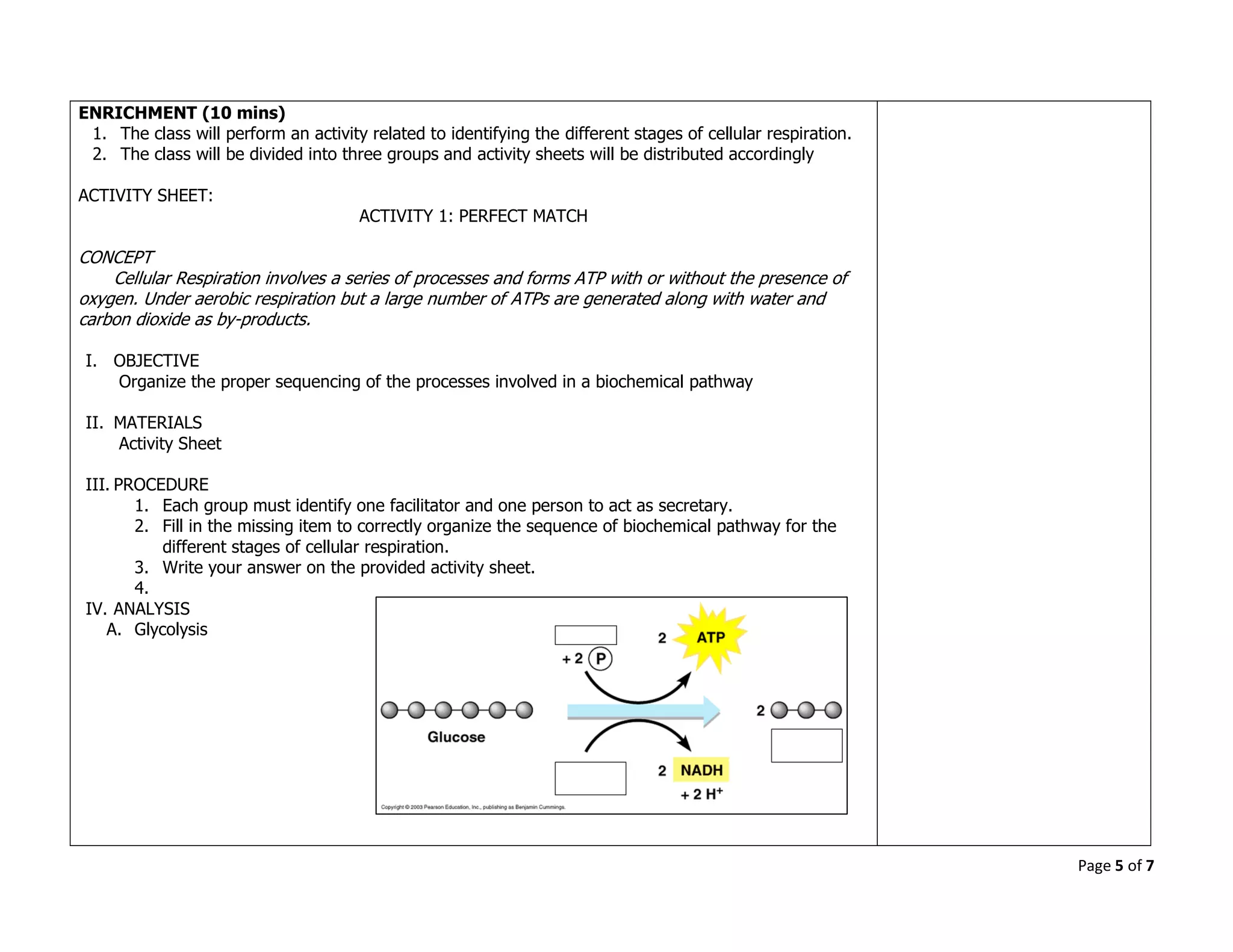
A. Glycolysis
 It is a series of reactions which
break the 6-carbon glucose
molecule down into two 3-carbon
molecules called pyruvate
 The Process is an ancient one-all
organisms from simple bacteria to
humans perform it the same way.
 The process yields 2 ATP molecules for every one glucose molecule broken down
 The process yields 2 NADH per glucose molecule which is needed in the production of
ATP
 It is an exergonic process which means most of the energy harnessed is conserved in the
high-energy electrons of NADH and in the phosphate bonds of ATP.
Page 4 of 7
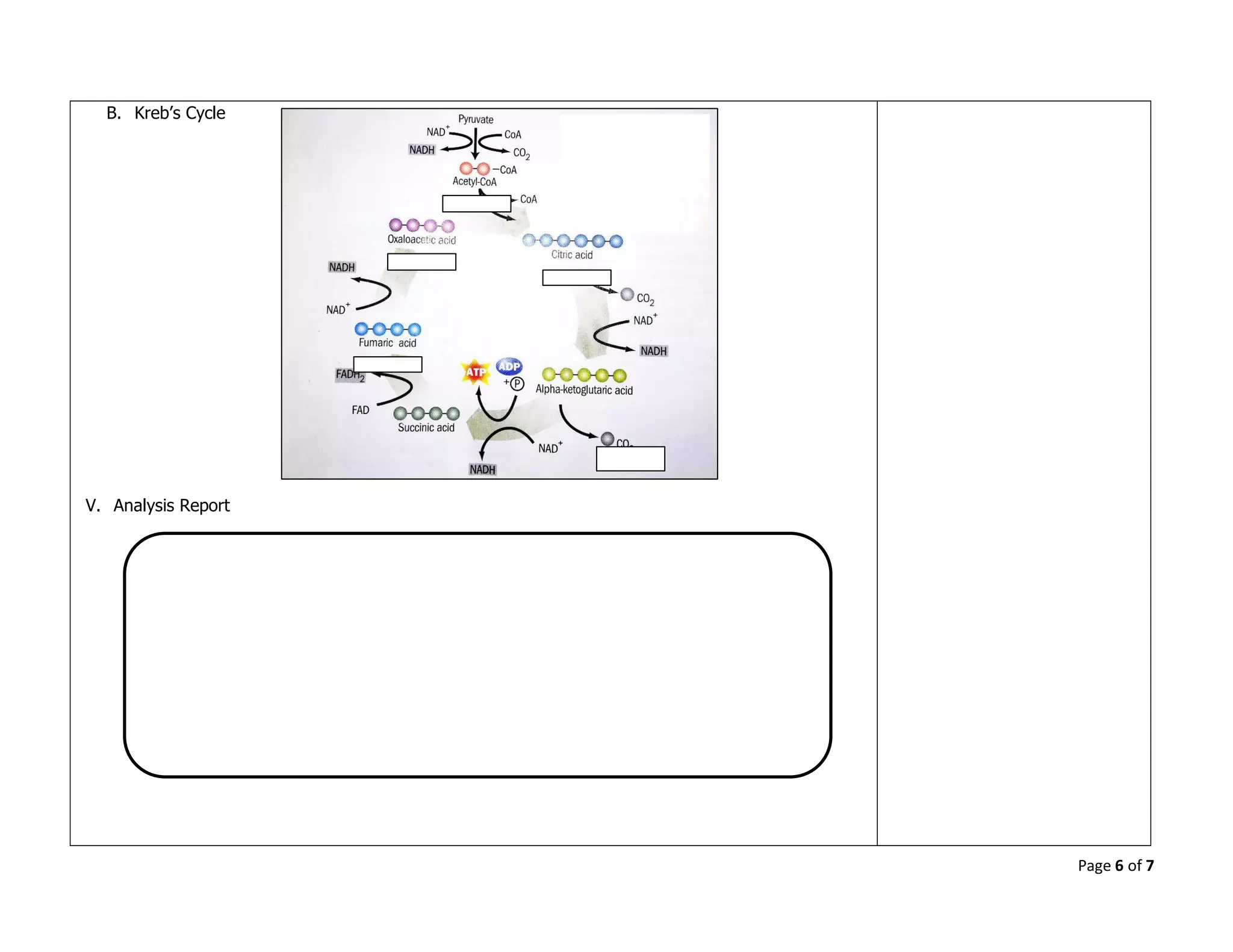
B. Krebs Cycle
 It is a cyclical series of oxidation
reactions that give off CO2 and
produce one ATP per cycle
 The reaction takes place in matrix
of the mitochondria.
 This reaction requires Oxygen
(Aerobic)
 The cycle turns twice per glucose
molecule
 The process produces two ATP.
The Formation of Acetyl Coenzyme A
 A process that is a junction between glycolysis and Krebs cycle
 Pyruvate, which is a product of glycolysis, is converted to acetyl CoA
which is needed to drive the second stage of cellular respiration.
 Pyruvate molecules are translocated from the cytosol into the
mitochondrion by a carrier protein in the mitochondrial membrane by
removing CO2 from it making a 2C compound.
 Coenzyme A is attached to the acetyl group.
Page 5 of 7
ENRICHMENT (10 mins)
1. The class will perform an activity related to identifying the different stages of cellular respiration.
2. The class will be divided into three groups and activity sheets will be distributed accordingly
ACTIVITY SHEET:
ACTIVITY 1: PERFECT MATCH
CONCEPT
Cellular Respiration involves a series of processes and forms ATP with or without the presence of
oxygen. Under aerobic respiration but a large number of ATPs are generated along with water and
carbon dioxide as by-products.
I. OBJECTIVE
Organize the proper sequencing of the processes involved in a biochemical pathway
II. MATERIALS
Activity Sheet
III. PROCEDURE
1. Each group must identify one facilitator and one person to act as secretary.
2. Fill in the missing item to correctly organize the sequence of biochemical pathway for the
different stages of cellular respiration.
3. Write your answer on the provided activity sheet.
4.
IV. ANALYSIS
A. Glycolysis
Page 6 of 7
B. Kreb’s Cycle
V. Analysis Report
Page 7 of 7
EVALUATION
The students will be assessed based on their responses on the activity sheet.
REFERENCES
Pavico, et.al. Exploring Life Through Science. Phoenix Publishing House.2014
Straus, et.al. Biology: The Web of Life. Addison Wesley Longman, Inc. 2000
Reece, et.al. Campbell Biology: Concepts and Connections. Pearson Education. 2012

Teaching guide on Cellular respiration

  • 1.
    Page 1 of7 How Cells Harvest Chemical Energy Content Standards The Learners demonstrate an understanding of the structure and function of mitochondrion as the main organelle involved in respiration Performance Standards Learning Competency The learners should be able to recognize the basic features and importance of cellular respiration Specific Learning Outcomes At the end of the lesson of the learners should be able to:  Identify the different stages of cellular respiration  Realize the role and importance of energy in biochemical processes  Organize the proper sequencing of the processes involved in a biochemical pathway LESSON OUTLINE Before the Learner and Teacher Preparation Lesson Introduction/ Communicating Learning Objectives Review Motivation Video Clip Instruction/ Collaborative Learning Delivery Direct Instruction Practice Oral Recitation Enrichment Group Activity Evaluation Activity Sheet and Exit Card Materials Cut-outs, Whiteboard Marker, LCD Projector, Tape, Card Resources Please see the references at the end of the lesson CELLULAR RESPIRATION Adapted from: Private Education Assistance Committee (PEAC)
  • 2.
    Page 2 of7 Task for Learners: 1. As introduction/preparation to this lesson, give out an assignment to learners at least a week before any of the following, whichever is appropriate: I. Search the internet for any article/material about the different processes in a biochemical pathway. II. Study the different roles of enzymes in biochemical processes. Task for Teacher: 1. Search the internet and download resources. INTRODUCTION (2 mins) 1. Communicate Learning Objectives a. Identify the different stages of cellular respiration b. Realize the role and importance of energy in biochemical processes c. Organize the proper sequencing of the processes involved in a biochemical pathway REVIEW (3 mins) 1. Review topic on Photosynthesis a. Raw materials and by products of photosynthesis. MOTIVATION (5 mins) 1. Show a video clip of people who are doing strenuous or rigorous activities or extreme sports that is related to the lesson about cellular respiration. 2. Provide some guide questions and process the answers of the learners. INSTRUCTION/DELIVERY (25 mins) I. CELLULAR RESPIRATION A. Basic Concept  Cellular respiration refers to the complex process by which energy in the form of ATP is released from food molecules.  The process by which glucose molecules are broken down to release energy.  Is a series of chemical reactions which produces ATP.  The formula for cellular respiration: C6H12O6 + 602  6CO2 + 6H20
  • 3.
    Page 3 of7  A catabolic pathway  Oxygen is consumed as a reactant along with organic compounds. B. Two Types Of Cellular Respiration  Aerobic Respiration is a metabolic pathway in which oxygen is required to generate a large number of ATPs with water and carbon dioxide as by-products. It involves three stages: Glycolysis, Krebs Cycle (named after the British biochemist Sir Hans Adolf Krebs), and Electron Transport Chain.  Anaerobic – a metabolic pathway in which it does not involve oxygen. C. The Three Stages of Cellular Respiration  Glycolysis  Krebs Cycle  Electron Transport Chain II. STAGES OF CELLULAR RESPIRATION A. Glycolysis  It is a series of reactions which break the 6-carbon glucose molecule down into two 3-carbon molecules called pyruvate  The Process is an ancient one-all organisms from simple bacteria to humans perform it the same way.  The process yields 2 ATP molecules for every one glucose molecule broken down  The process yields 2 NADH per glucose molecule which is needed in the production of ATP  It is an exergonic process which means most of the energy harnessed is conserved in the high-energy electrons of NADH and in the phosphate bonds of ATP.
  • 4.
    Page 4 of7 B. Krebs Cycle  It is a cyclical series of oxidation reactions that give off CO2 and produce one ATP per cycle  The reaction takes place in matrix of the mitochondria.  This reaction requires Oxygen (Aerobic)  The cycle turns twice per glucose molecule  The process produces two ATP. The Formation of Acetyl Coenzyme A  A process that is a junction between glycolysis and Krebs cycle  Pyruvate, which is a product of glycolysis, is converted to acetyl CoA which is needed to drive the second stage of cellular respiration.  Pyruvate molecules are translocated from the cytosol into the mitochondrion by a carrier protein in the mitochondrial membrane by removing CO2 from it making a 2C compound.  Coenzyme A is attached to the acetyl group.
  • 5.
    Page 5 of7 ENRICHMENT (10 mins) 1. The class will perform an activity related to identifying the different stages of cellular respiration. 2. The class will be divided into three groups and activity sheets will be distributed accordingly ACTIVITY SHEET: ACTIVITY 1: PERFECT MATCH CONCEPT Cellular Respiration involves a series of processes and forms ATP with or without the presence of oxygen. Under aerobic respiration but a large number of ATPs are generated along with water and carbon dioxide as by-products. I. OBJECTIVE Organize the proper sequencing of the processes involved in a biochemical pathway II. MATERIALS Activity Sheet III. PROCEDURE 1. Each group must identify one facilitator and one person to act as secretary. 2. Fill in the missing item to correctly organize the sequence of biochemical pathway for the different stages of cellular respiration. 3. Write your answer on the provided activity sheet. 4. IV. ANALYSIS A. Glycolysis
  • 6.
    Page 6 of7 B. Kreb’s Cycle V. Analysis Report
  • 7.
    Page 7 of7 EVALUATION The students will be assessed based on their responses on the activity sheet. REFERENCES Pavico, et.al. Exploring Life Through Science. Phoenix Publishing House.2014 Straus, et.al. Biology: The Web of Life. Addison Wesley Longman, Inc. 2000 Reece, et.al. Campbell Biology: Concepts and Connections. Pearson Education. 2012