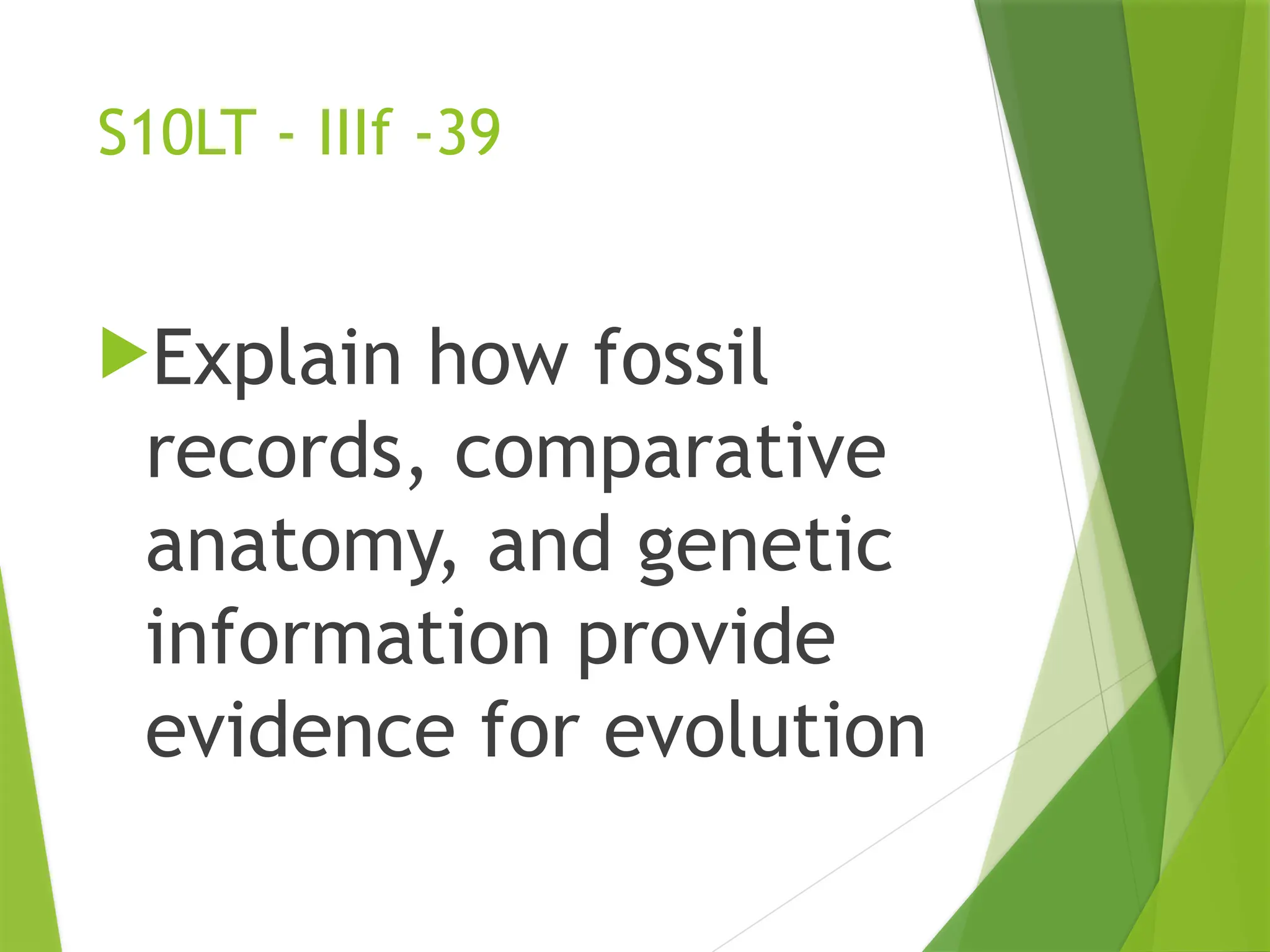
Fossil
Evolution
PREPARED BY: TYPE YOUR NAME HERE
S10LT - IIIf -39
Explain how fossil
records, comparative
anatomy, and genetic
information provide
evidence for evolution
How do species adapt to
changing environments
over time?
What do you think?
Before you begin, decide if you agree or
disagree with each of these statements.
As you view this presentation, see if you
change your mind about any of the
statements.
1. Original tissues can be preserved as
fossils.
2. Organisms become extinct only in mass
extinction events.
3. Environmental change causes
variations in populations.
Do you agree or disagree?
4. Variations can lead to adaptations.
5. Living species contain no evidence that
they are related to each other.
6. Plants and animals share similar genes.
Do you agree or disagree?
• How do fossils form?
• How do scientists date fossils?
• How are fossils evidence of biological
evolution?
Fossil Evidence of Evolution
SWBATA
• fossil record
• mold
• cast
• trace fossil
Fossil Evidence of Evolution
• geologic time
scale
• extinction
• biological
evolution
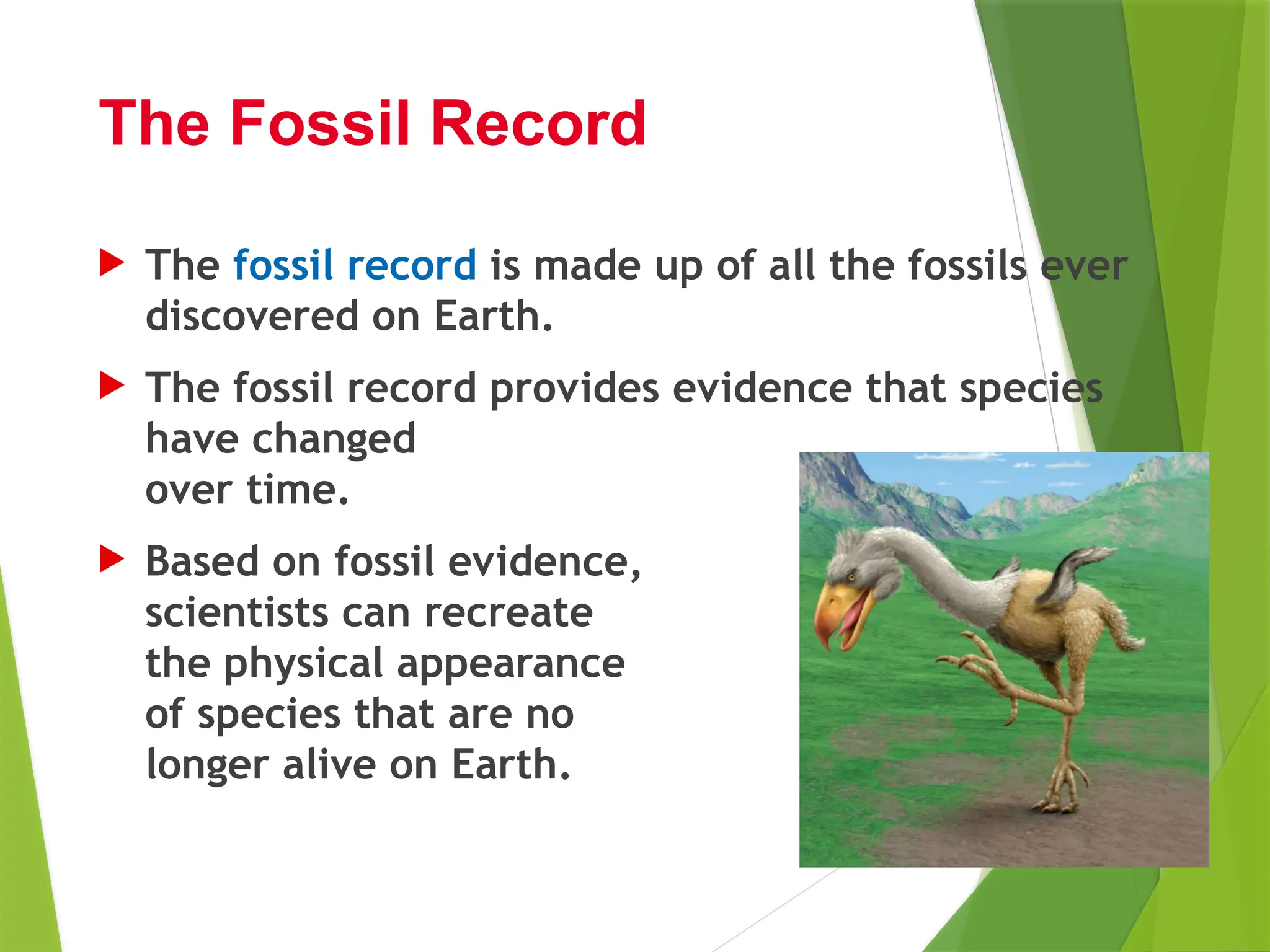
 The fossil record is made up of all the fossils ever
discovered on Earth.
 The fossil record provides evidence that species
have changed
over time.
 Based on fossil evidence,
scientists can recreate
the physical appearance
of species that are no
longer alive on Earth.
The Fossil Record
After an animal dies, any soft tissues animals do not eat
break down.
Fossil Formation
tissue
Science Use similar cells that
work together and perform a
function
Common Use a piece of soft,
absorbent paper
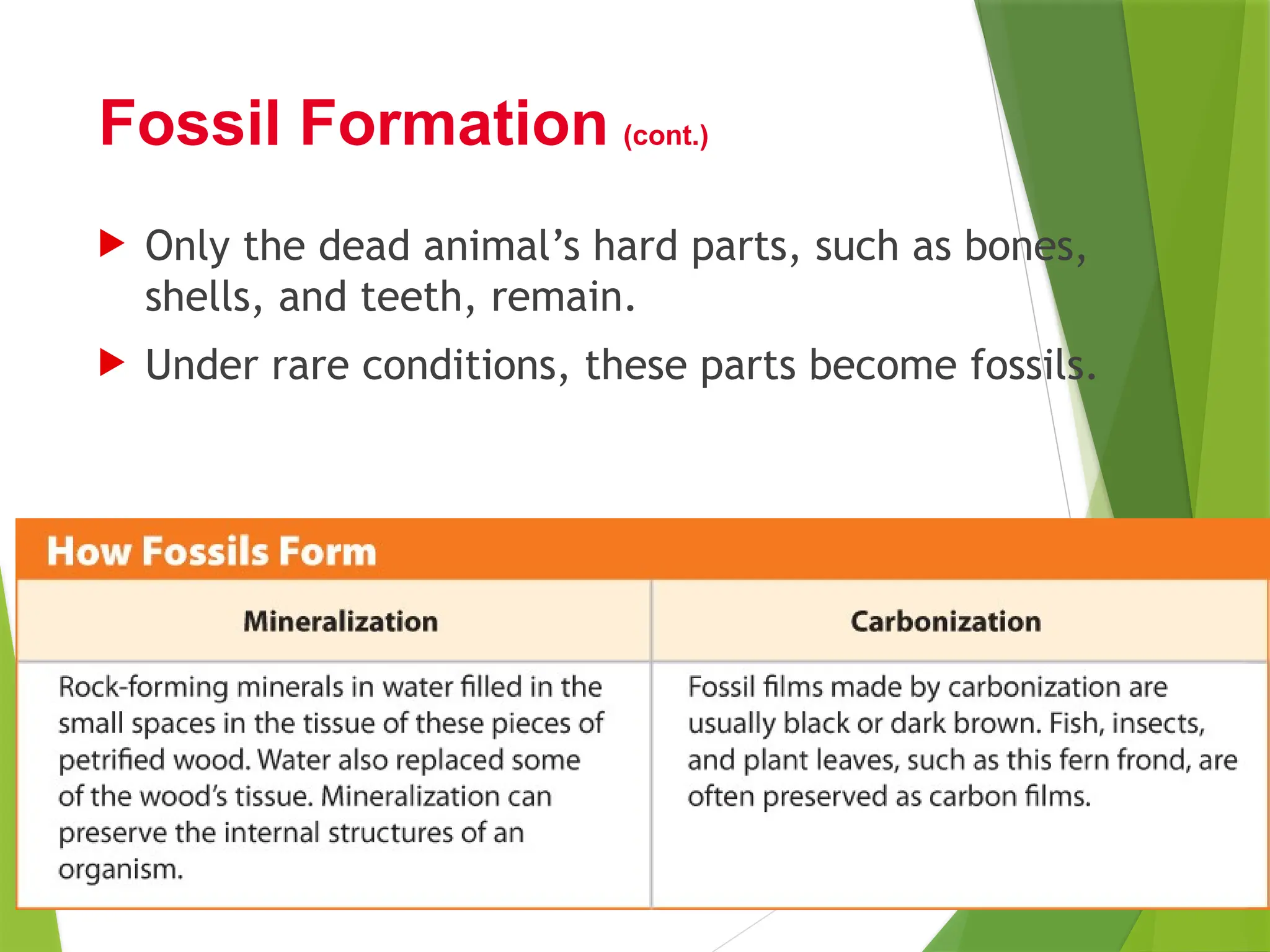
 Only the dead animal’s hard parts, such as bones,
shells, and teeth, remain.
 Under rare conditions, these parts become fossils.
Fossil Formation (cont.)
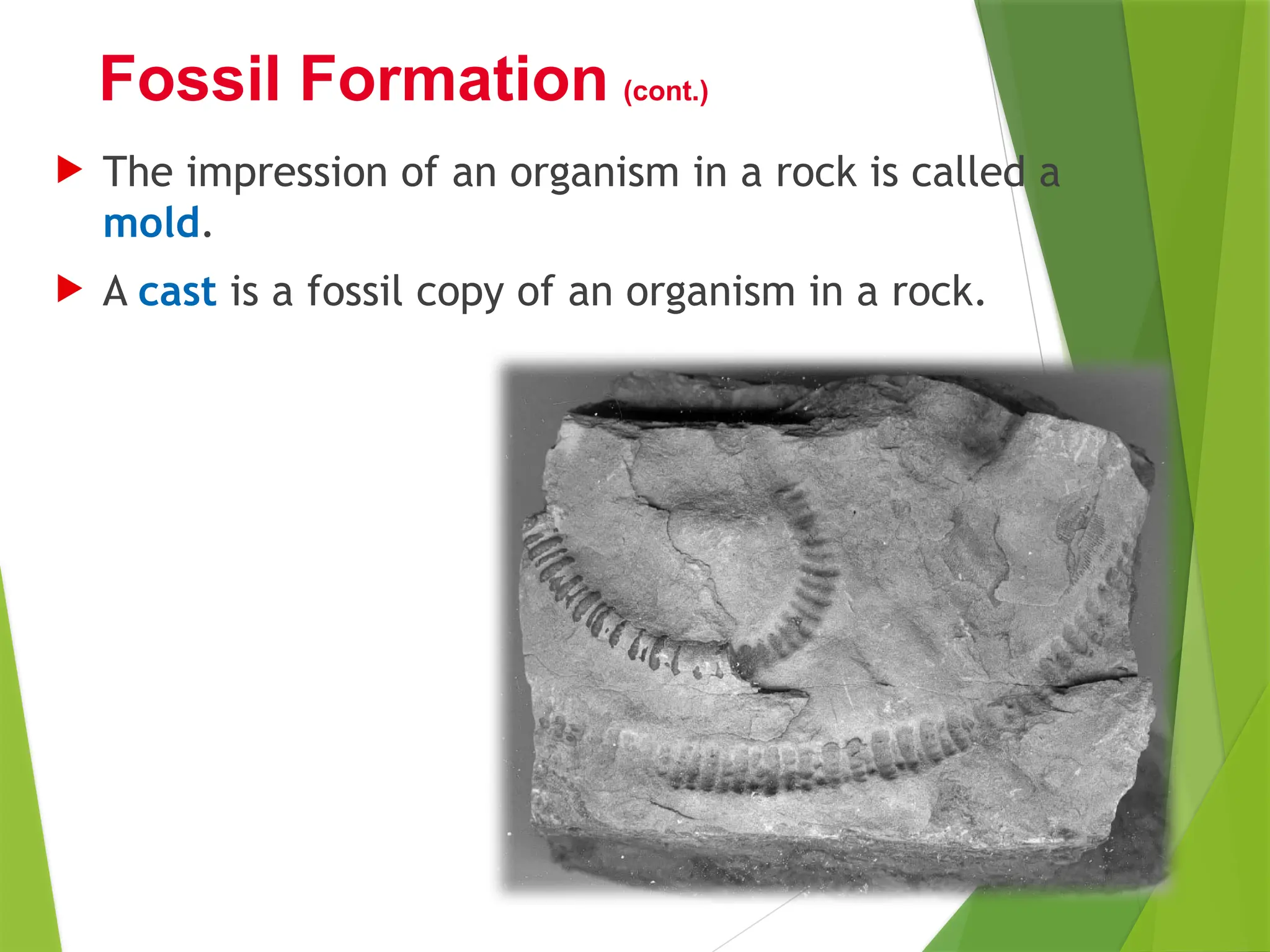
 The impression of an organism in a rock is called a
mold.
 A cast is a fossil copy of an organism in a rock.
Fossil Formation (cont.)
A trace fossil is the preserved evidence
of the activity of an organism.
Fossil Formation (cont.)
fossil
from Latin fossilis, means “to obtain
by digging”
 Instead of dating fossils directly, scientists date the
rocks the fossils are embedded inside.
 In relative-age dating, scientists determine the
relative order in which rock layers were deposited.
Determining a Fossil’s Age
 Scientists take advantage of radioactive decay, a
natural clocklike process in rocks, to learn a rock’s
absolute age, or its age in years.
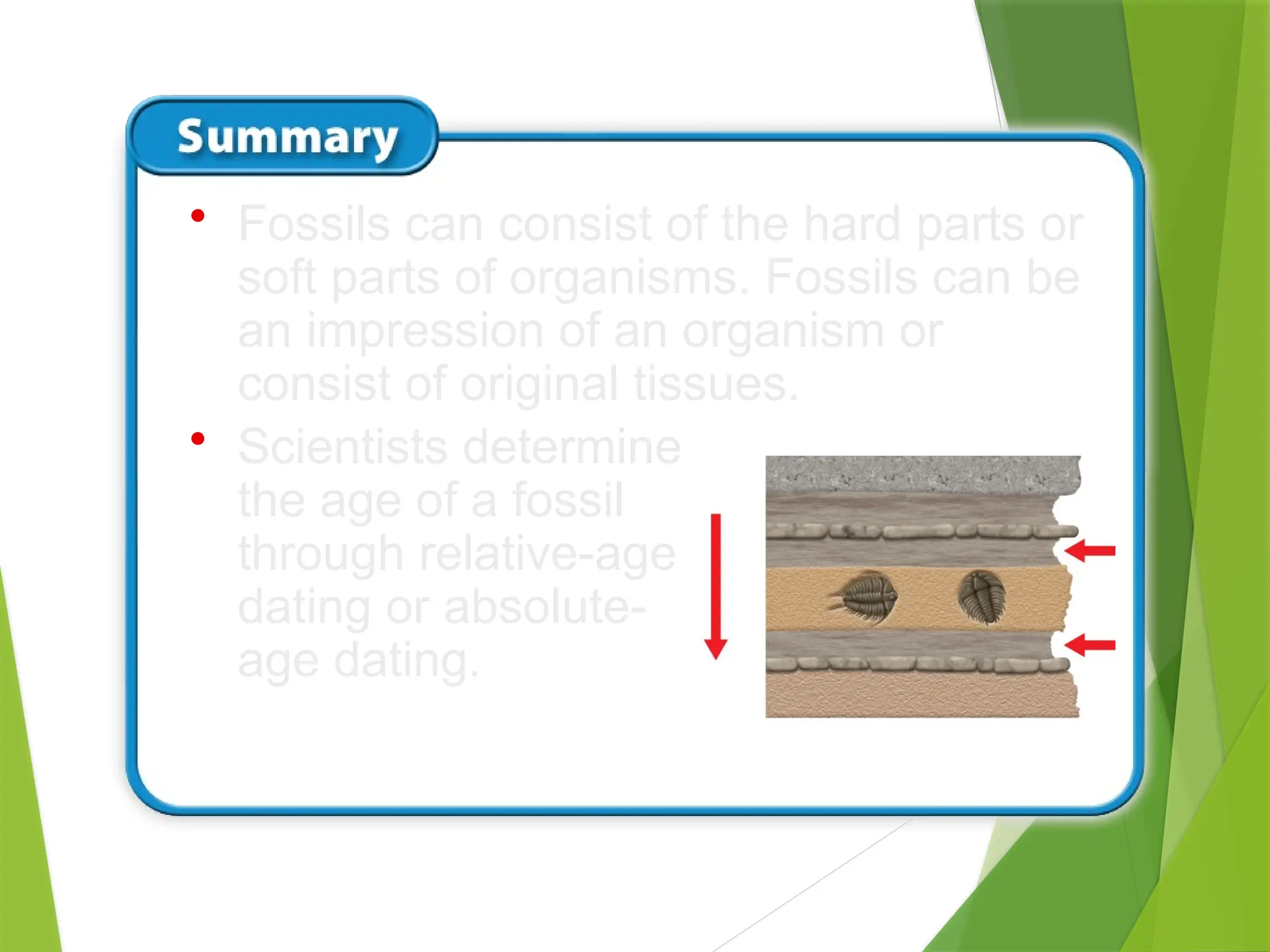
 To measure the age of sedimentary rock layers,
scientists calculate the ages of igneous layers above
and below them.
Determining a Fossil’s Age (cont.)
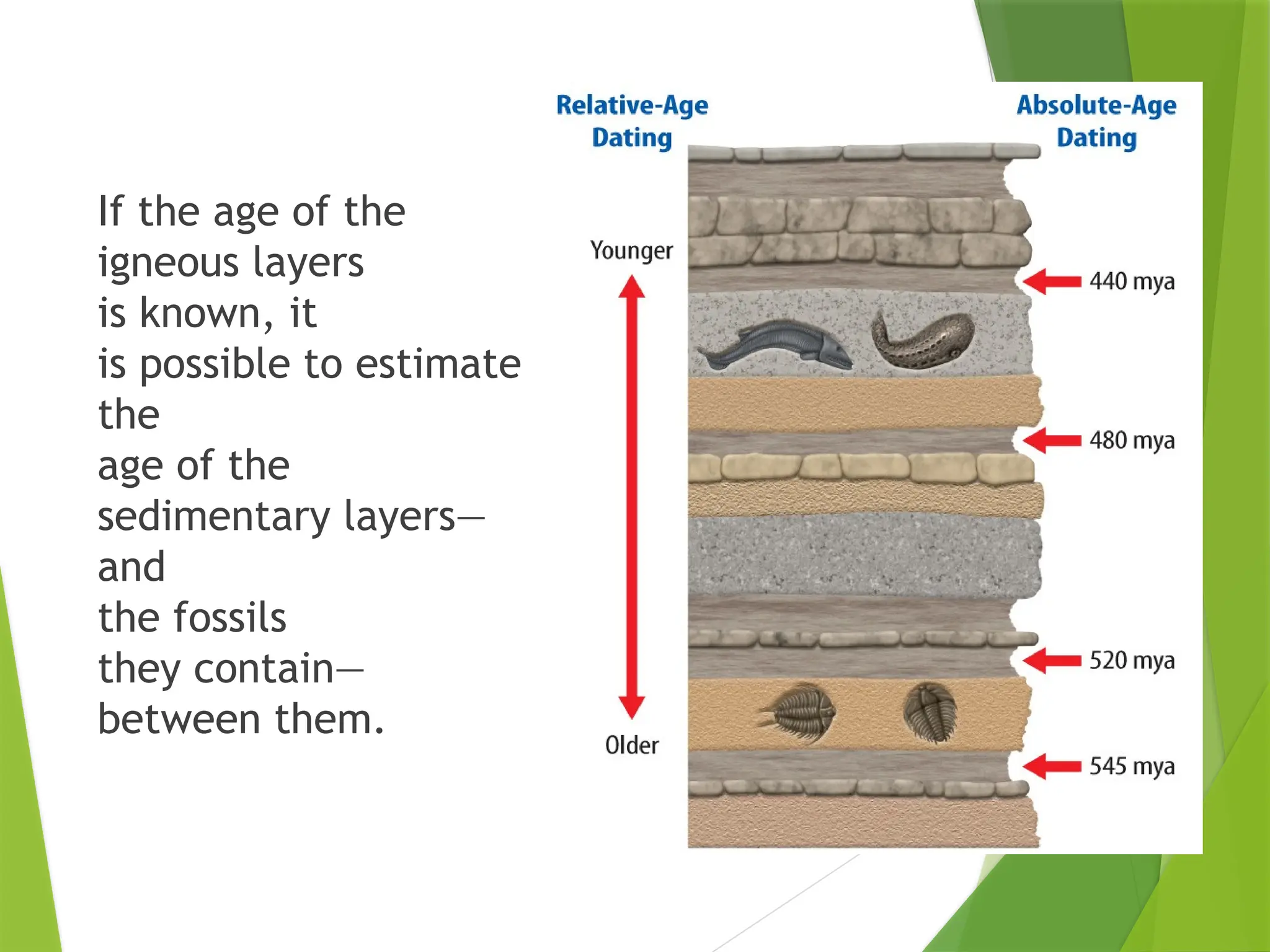
If the age of the
igneous layers
is known, it
is possible to estimate
the
age of the
sedimentary layers—
and
the fossils
they contain—
between them.
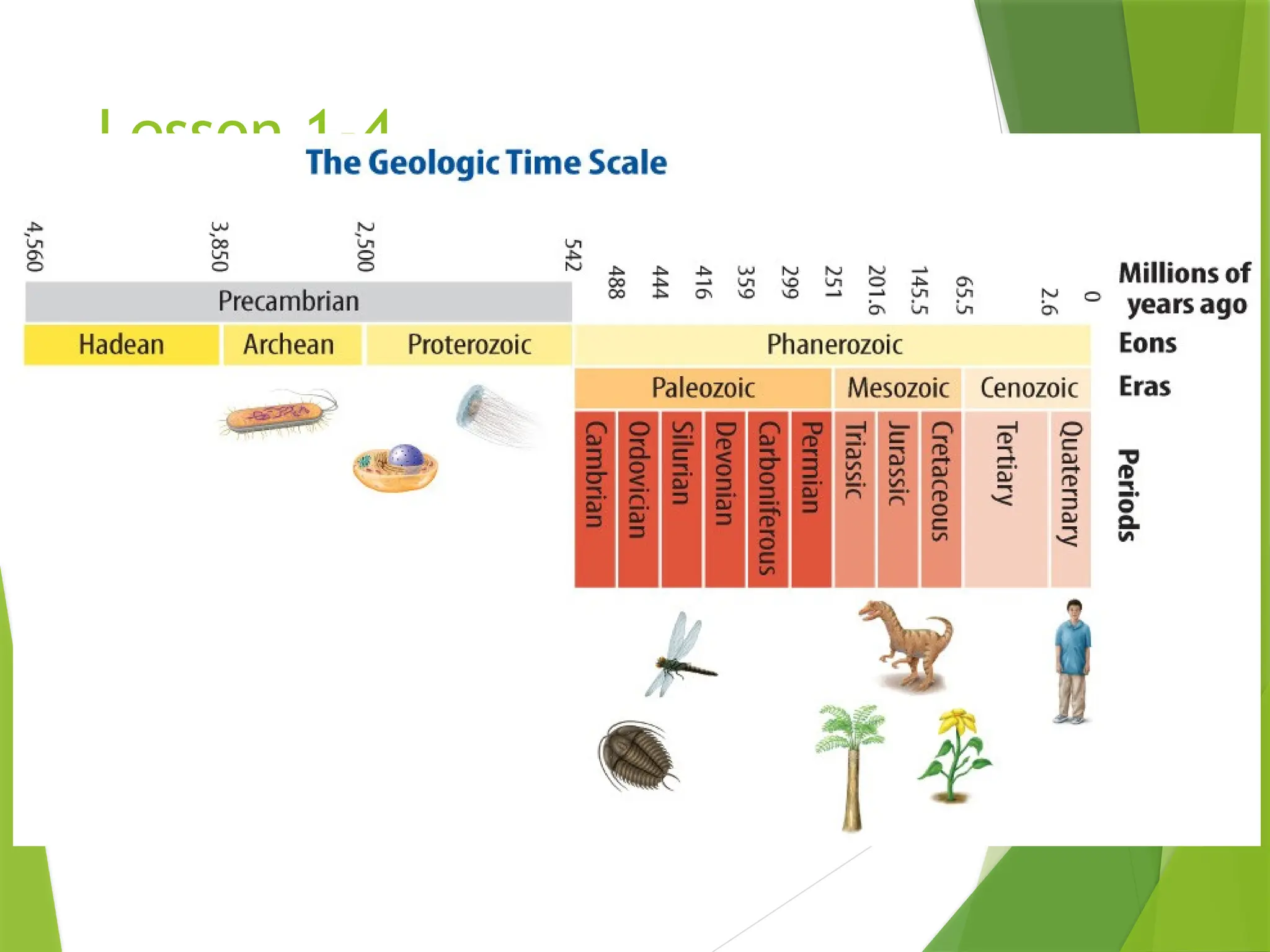
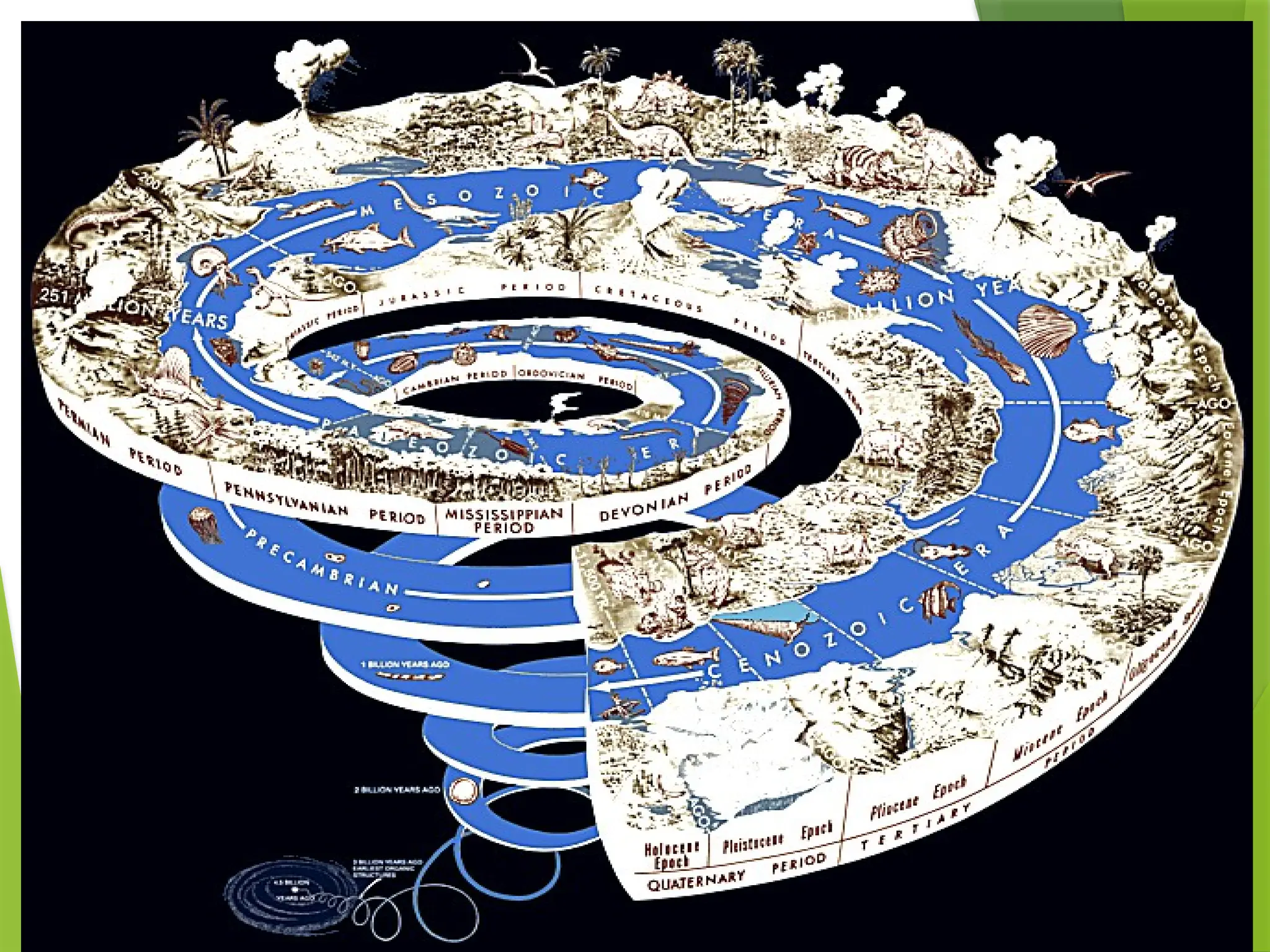
 The geologic time scale is a chart that
divides Earth’s history into different
time units.
 Earth’s history is divided into four eons
—the longest time units in the geologic
time scale.
Fossils over Time
Lesson 1-4
 Extinction occurs when the last individual
organism of a species dies.
 A mass extinction occurs when many species
become extinct within a few million years or
less.
 Extinctions can occur when environments
change.
Extinctions
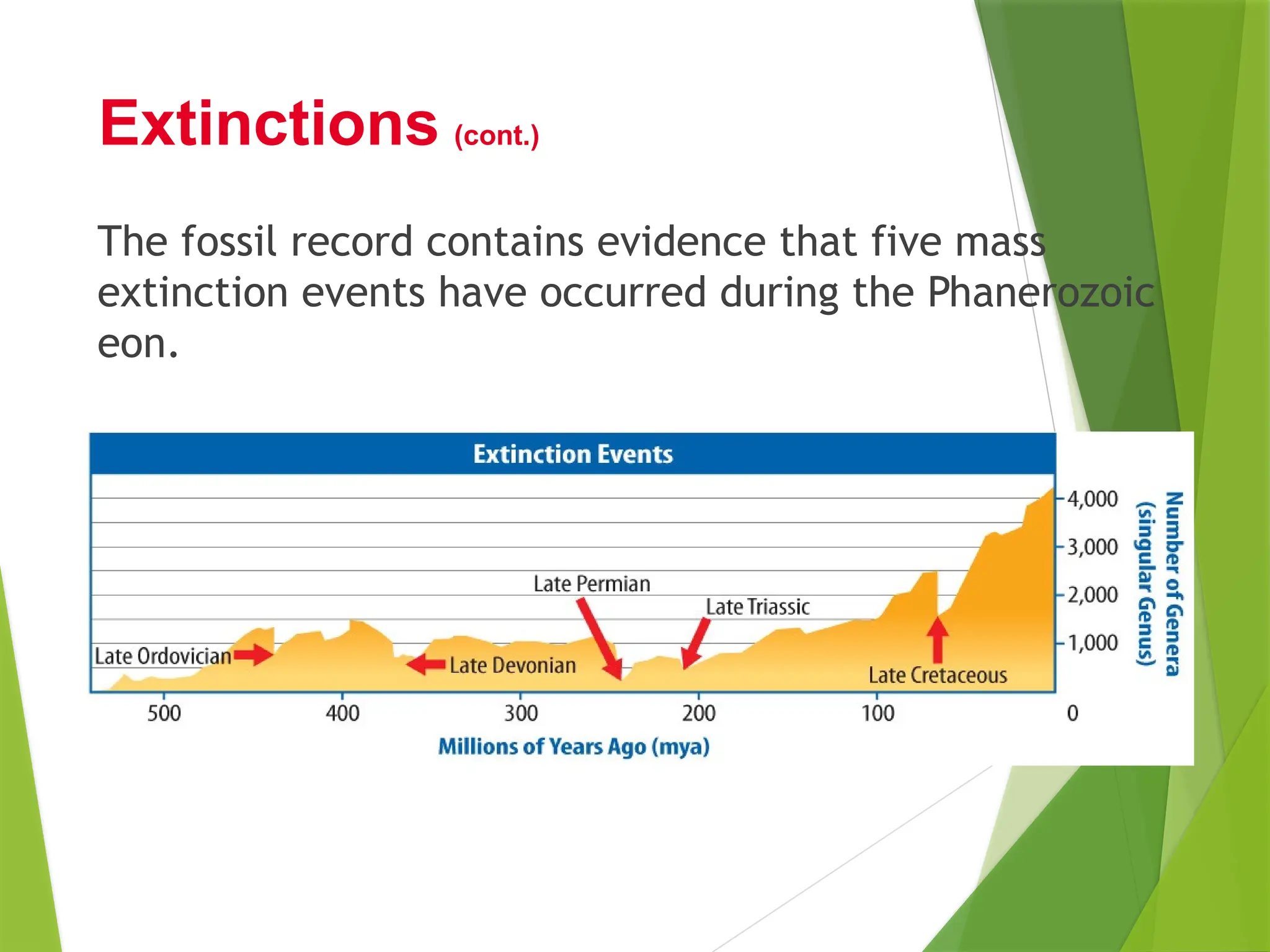
The fossil record contains evidence that five mass
extinction events have occurred during the Phanerozoic
eon.
Extinctions (cont.)
 The fossil record contains evidence of the
appearance of many new species over time.
 Biological evolution is the change over time
in populations of related organisms.
Extinctions (cont.)
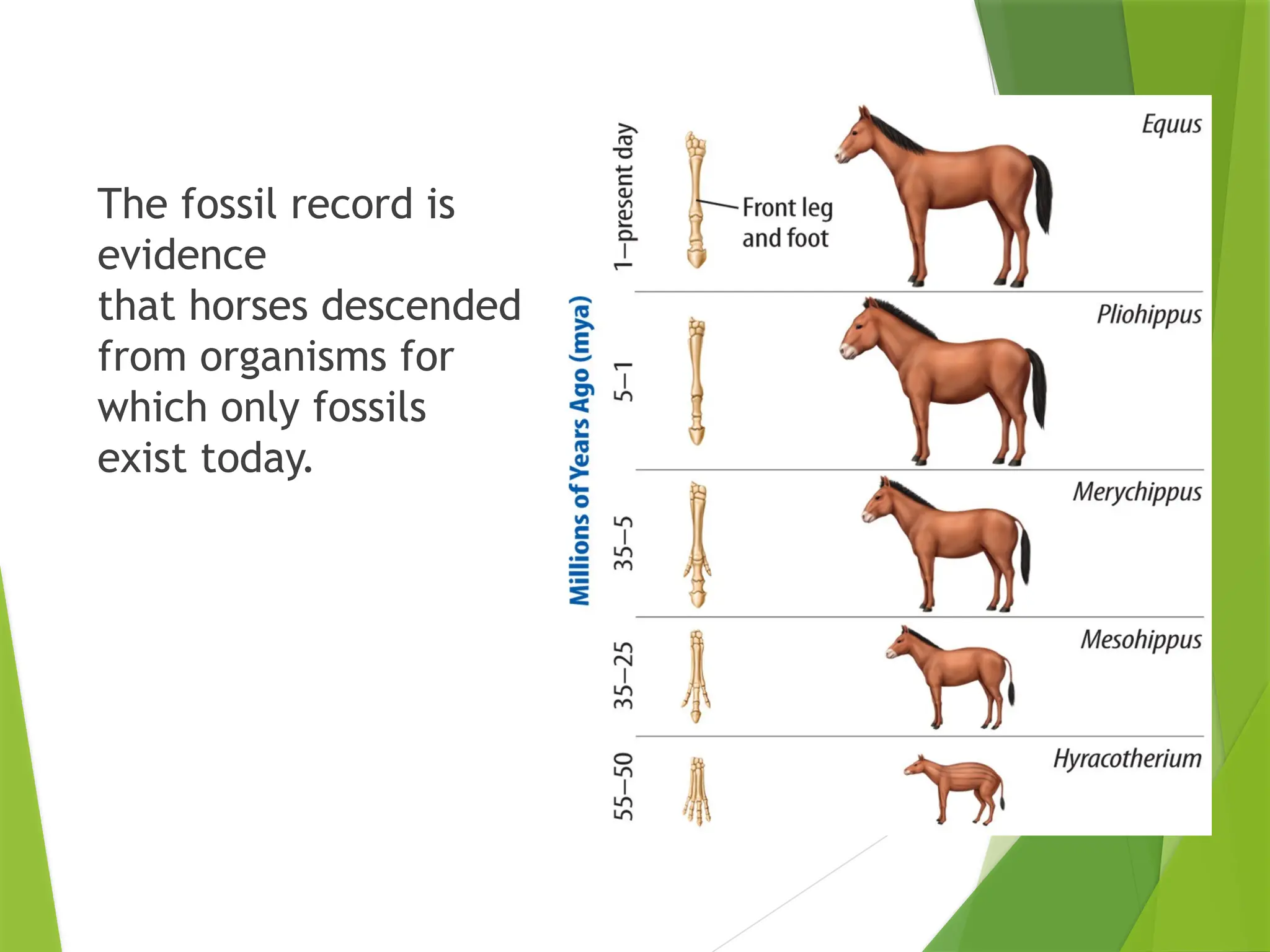
The fossil record is
evidence
that horses descended
from organisms for
which only fossils
exist today.
• Fossils can consist of the hard parts or
soft parts of organisms. Fossils can be
an impression of an organism or
consist of original tissues.
• Scientists determine
the age of a fossil
through relative-age
dating or absolute-
age dating.
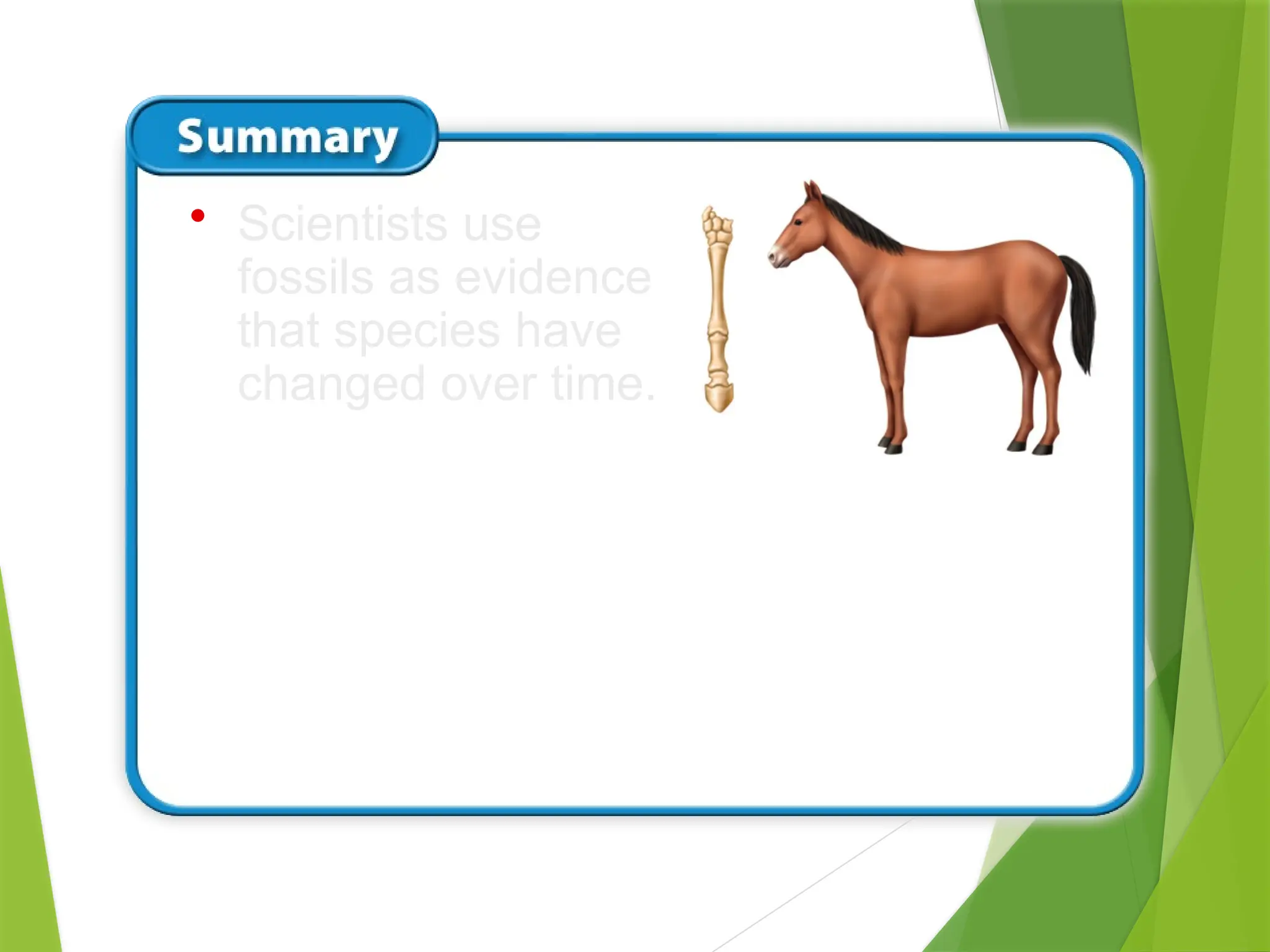
• Scientists use
fossils as evidence
that species have
changed over time.
Terms to Know…
• comparative anatomy
• homologous structure
• analogous structure
• vestigial structure
• embryology
• What evidence from living species
supports the theory that species
descended from other species over
time?
• How are Earth’s organisms related?
Biological Evidence of Evolution
SWBATA
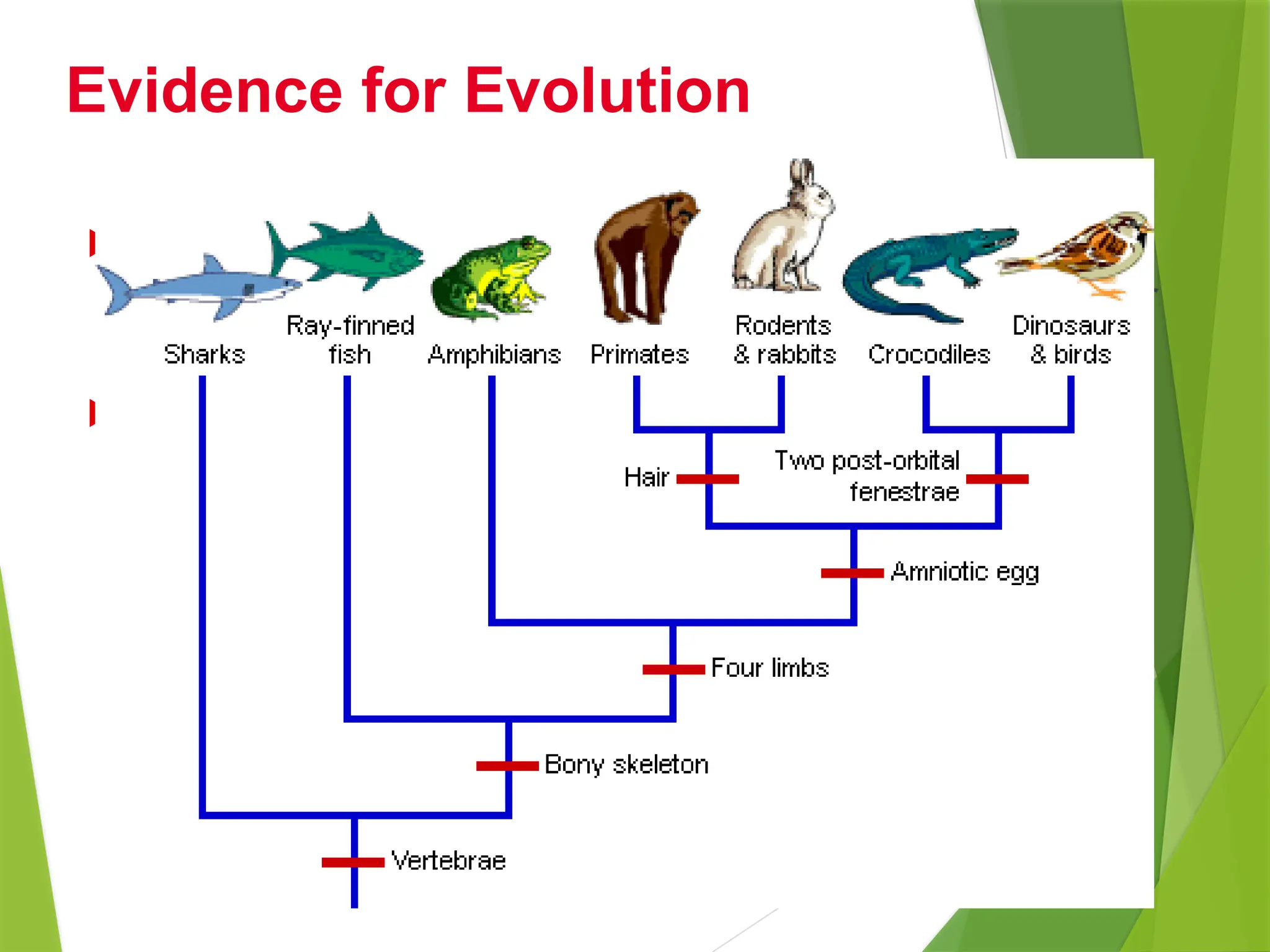
 The degree to which species are related depends on
how closely in time they diverged, or split, from their
common ancestor.
 Although the fossil record is incomplete, it contains
many examples of fossil sequences showing close
ancestral relationships.
Evidence for Evolution
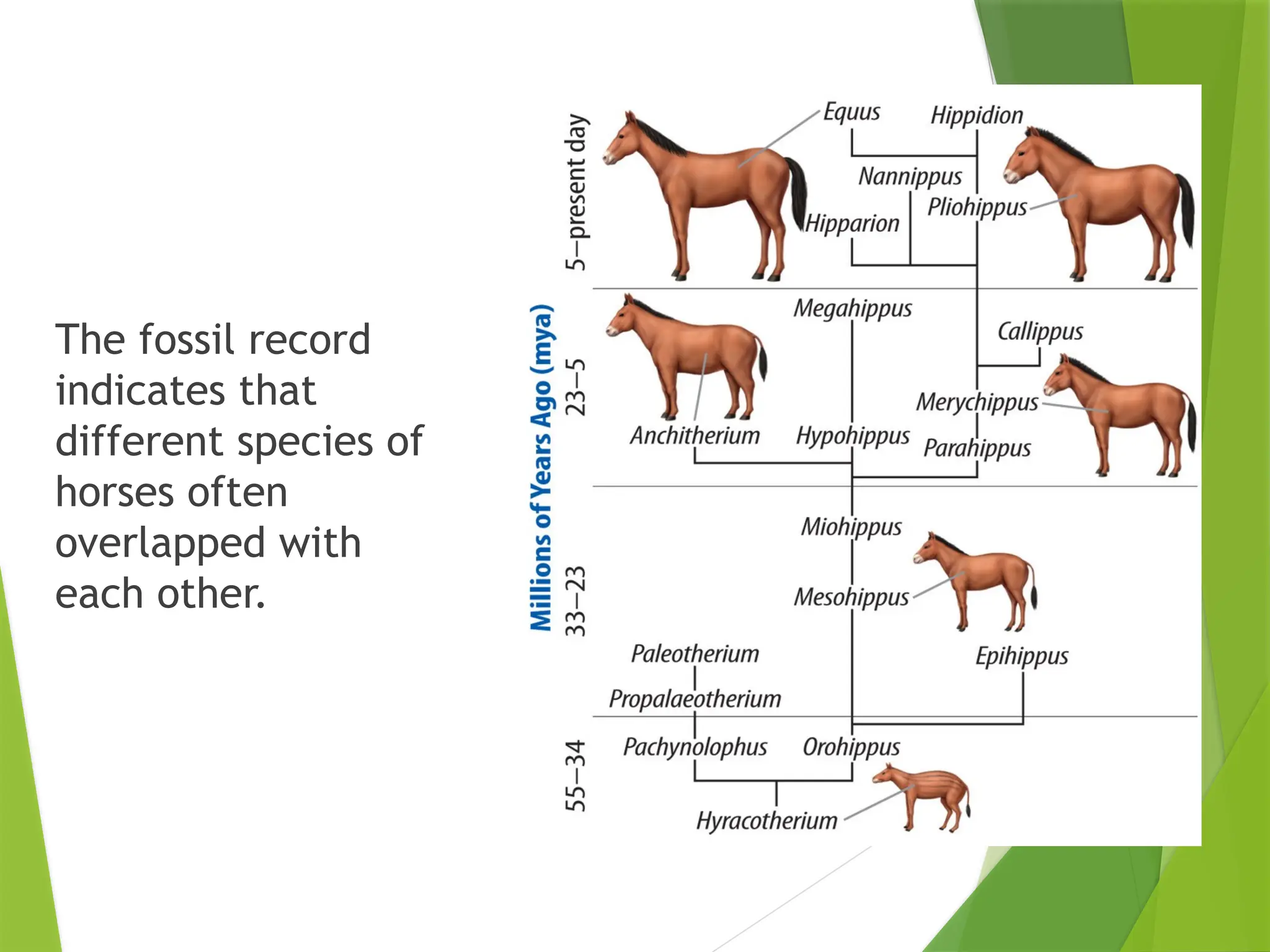
The fossil record
indicates that
different species of
horses often
overlapped with
each other.
 Comparative anatomy is the study of similarities and
differences among structures of living species.
( Comparing and Anatomy)
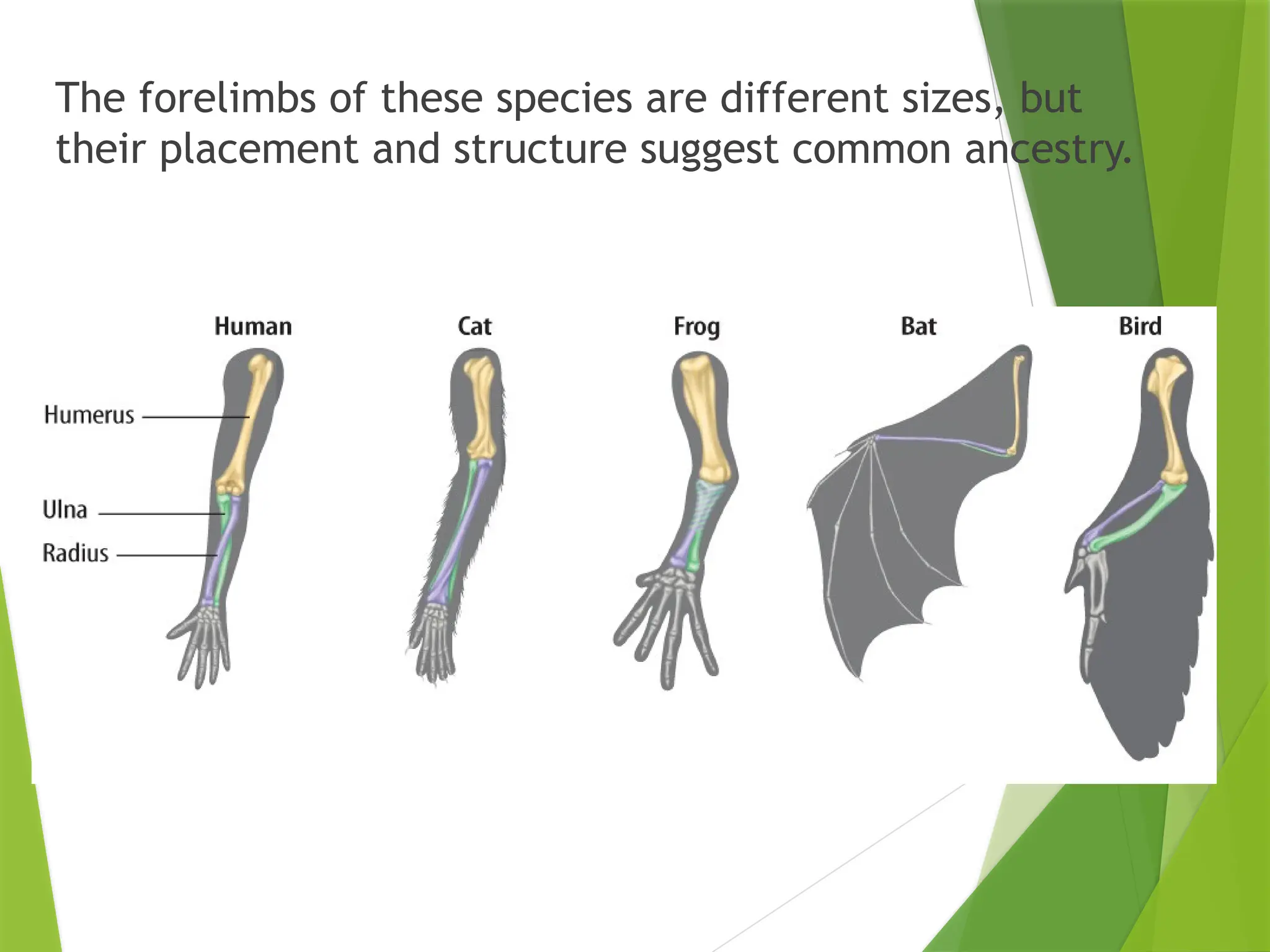
 Homologous structures are body parts of organisms
that are similar in structure and position but
different in function.
Evidence for Evolution (cont.)
The forelimbs of these species are different sizes, but
their placement and structure suggest common ancestry.
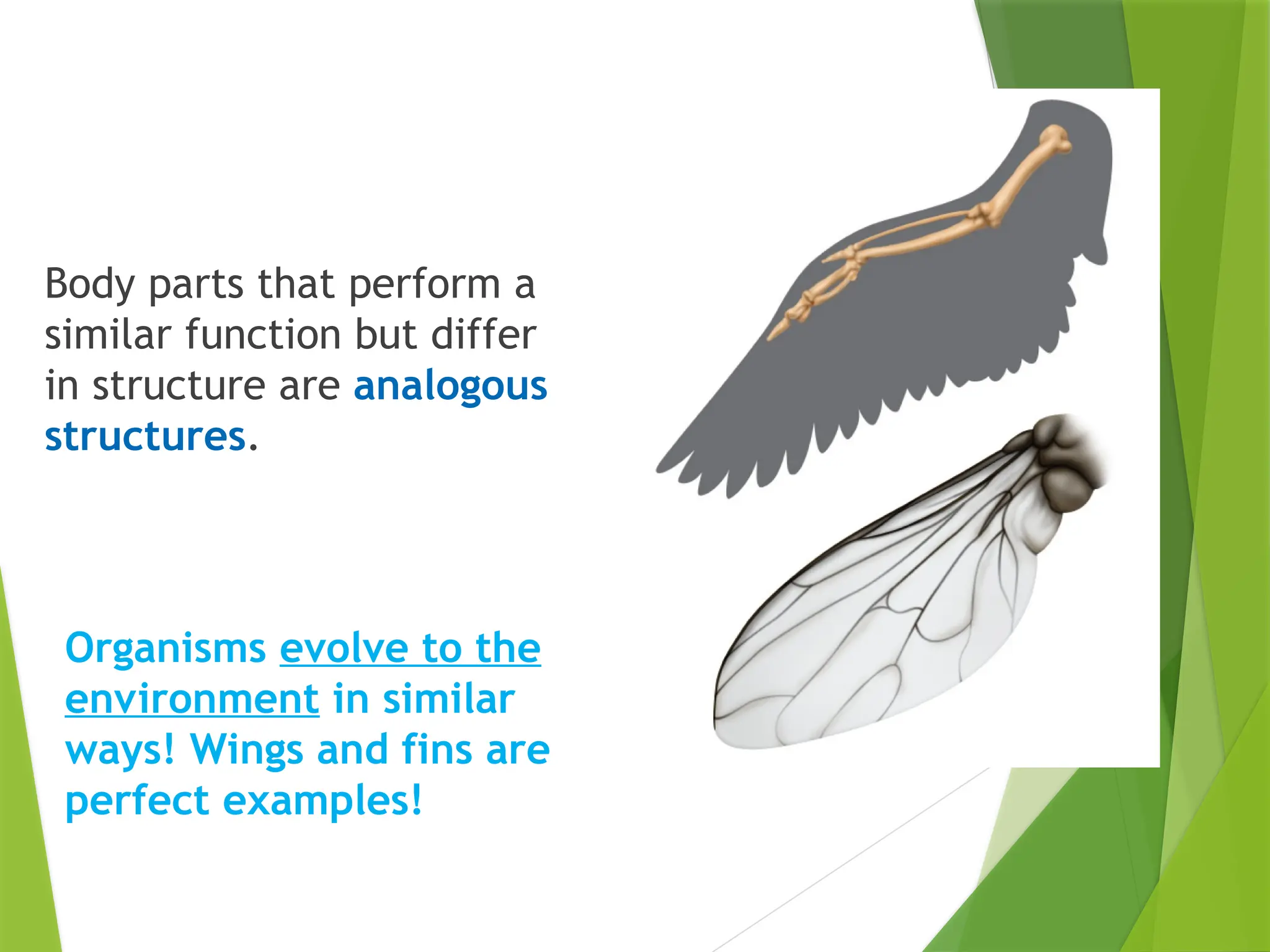
Body parts that perform a
similar function but differ
in structure are analogous
structures.
Organisms evolve to the
environment in similar
ways! Wings and fins are
perfect examples!
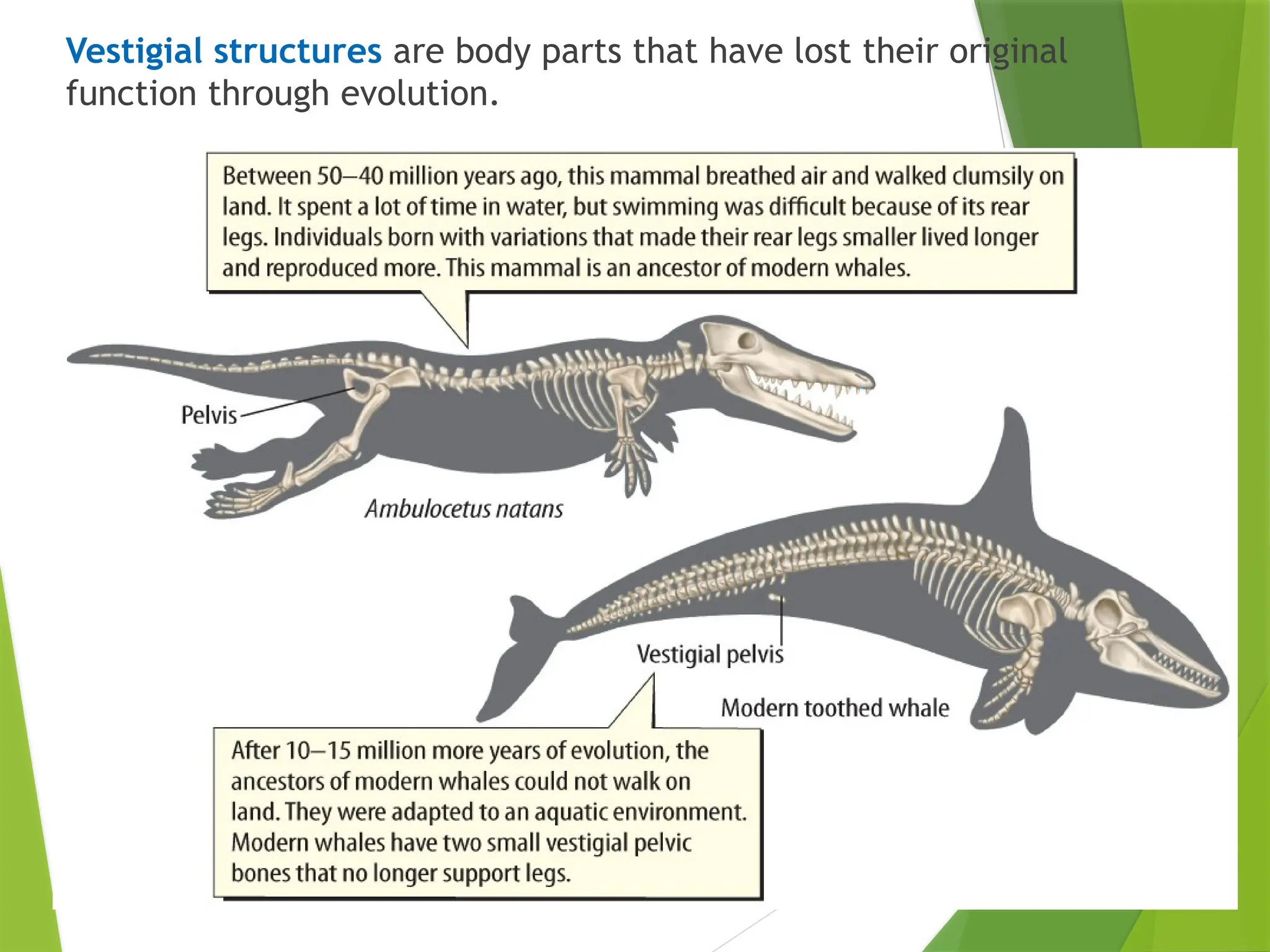
Vestigial structures are body parts that have lost their original
function through evolution.
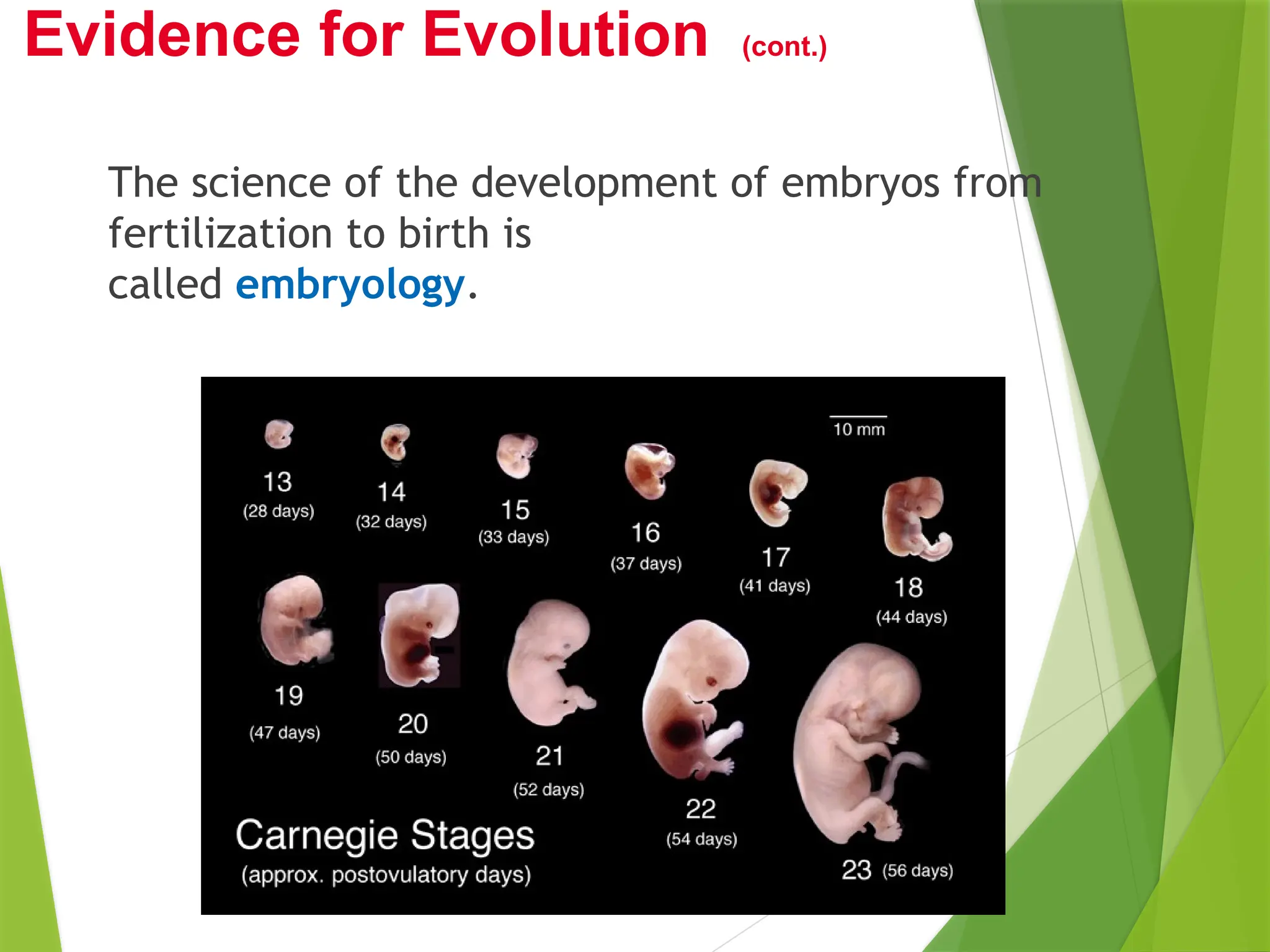
The science of the development of embryos from
fertilization to birth is
called embryology.
Evidence for Evolution (cont.)
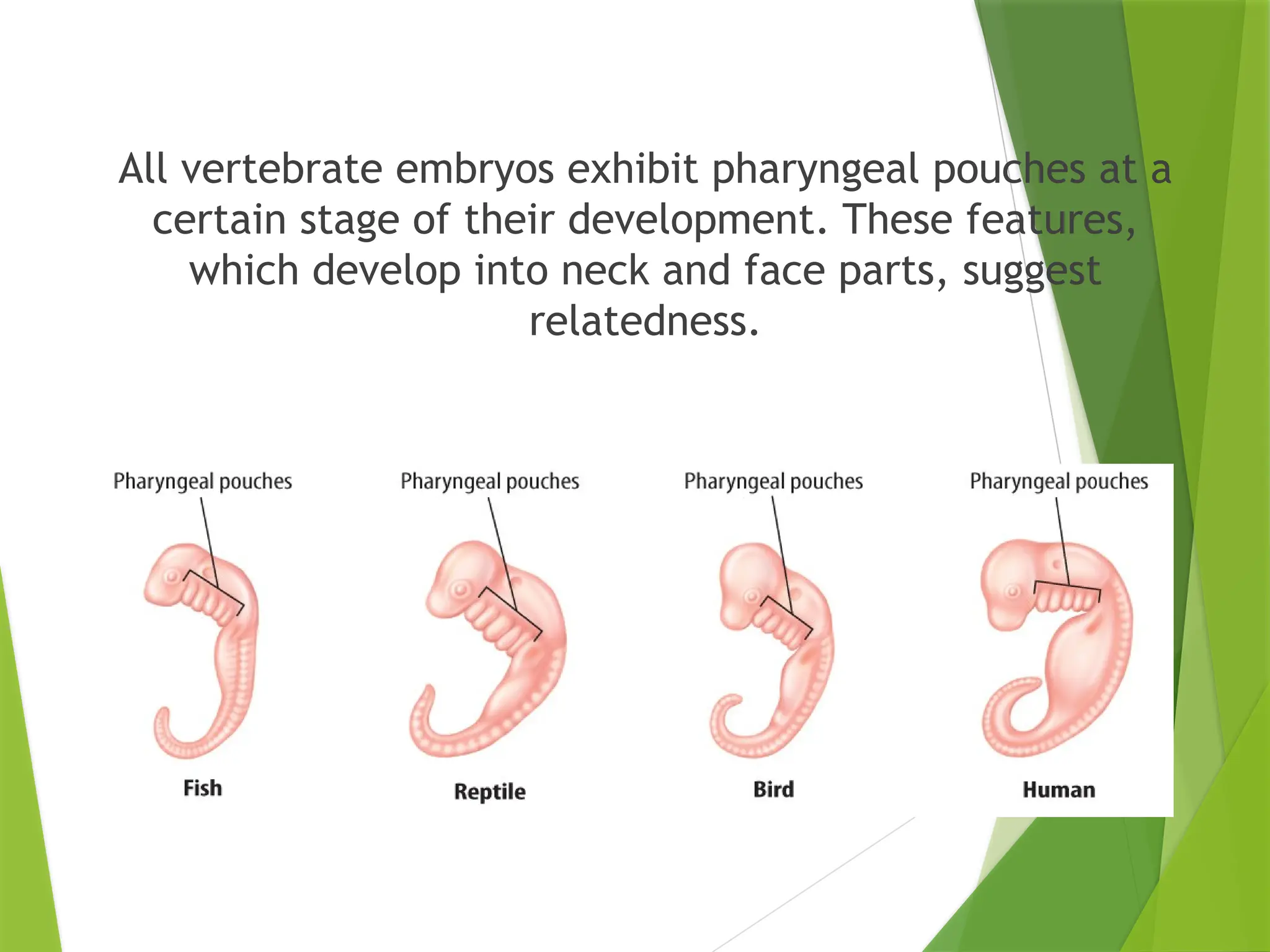
All vertebrate embryos exhibit pharyngeal pouches at a
certain stage of their development. These features,
which develop into neck and face parts, suggest
relatedness.
Review
 How do homologous structures provide
evidence for evolution?
 How are vestigial structures evidence of
descent from ancestral species?
 How do pharyngeal pouches provide evidence
of relationships among species?
 Molecular biology is the study of gene structure and
function.
 Discoveries have confirmed and extended much of
the data already collected about the theory of
evolution.
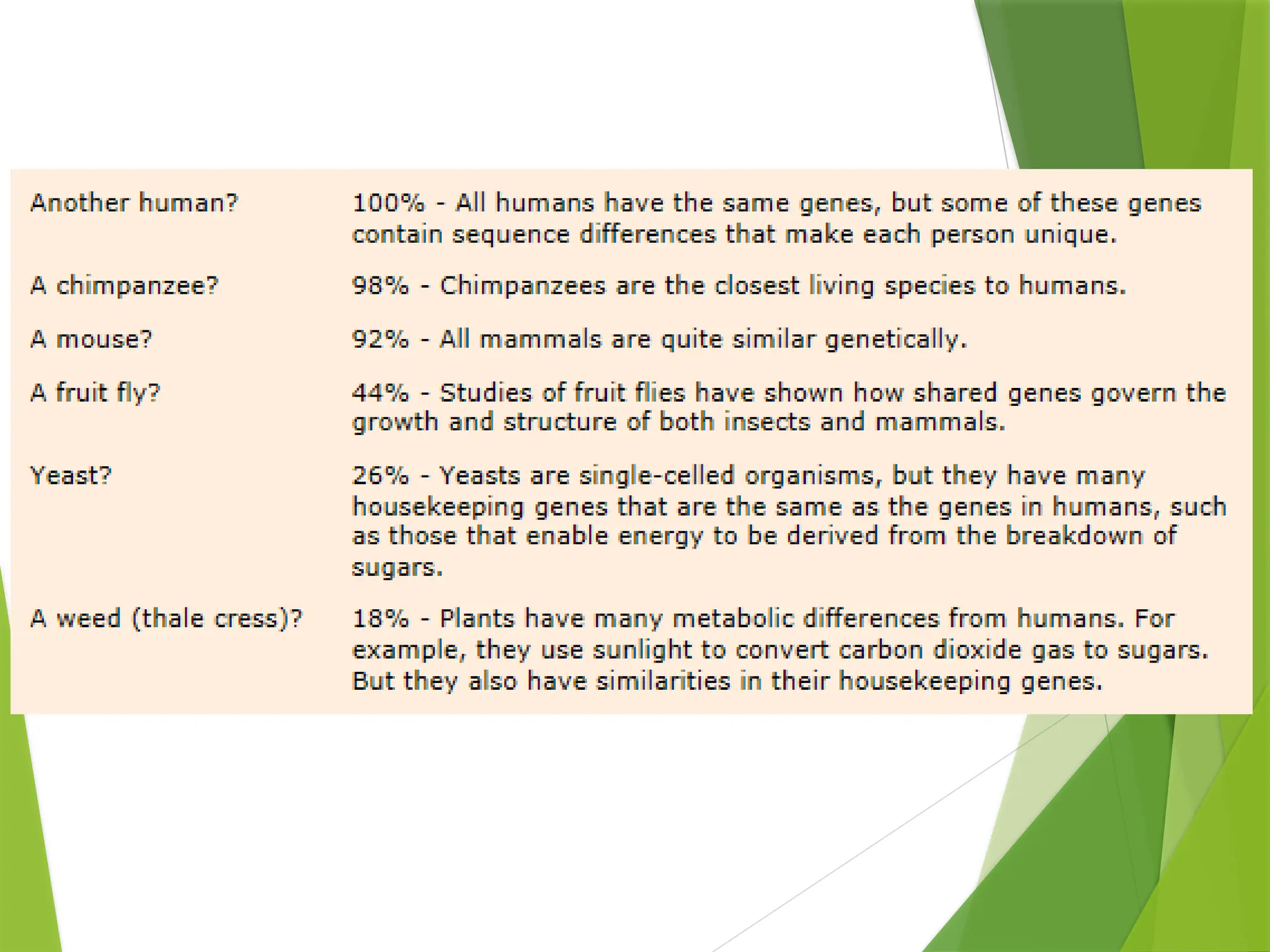
 Scientists can study relatedness of organisms by
comparing genes and proteins among living species.
Evidence for Evolution (cont.)
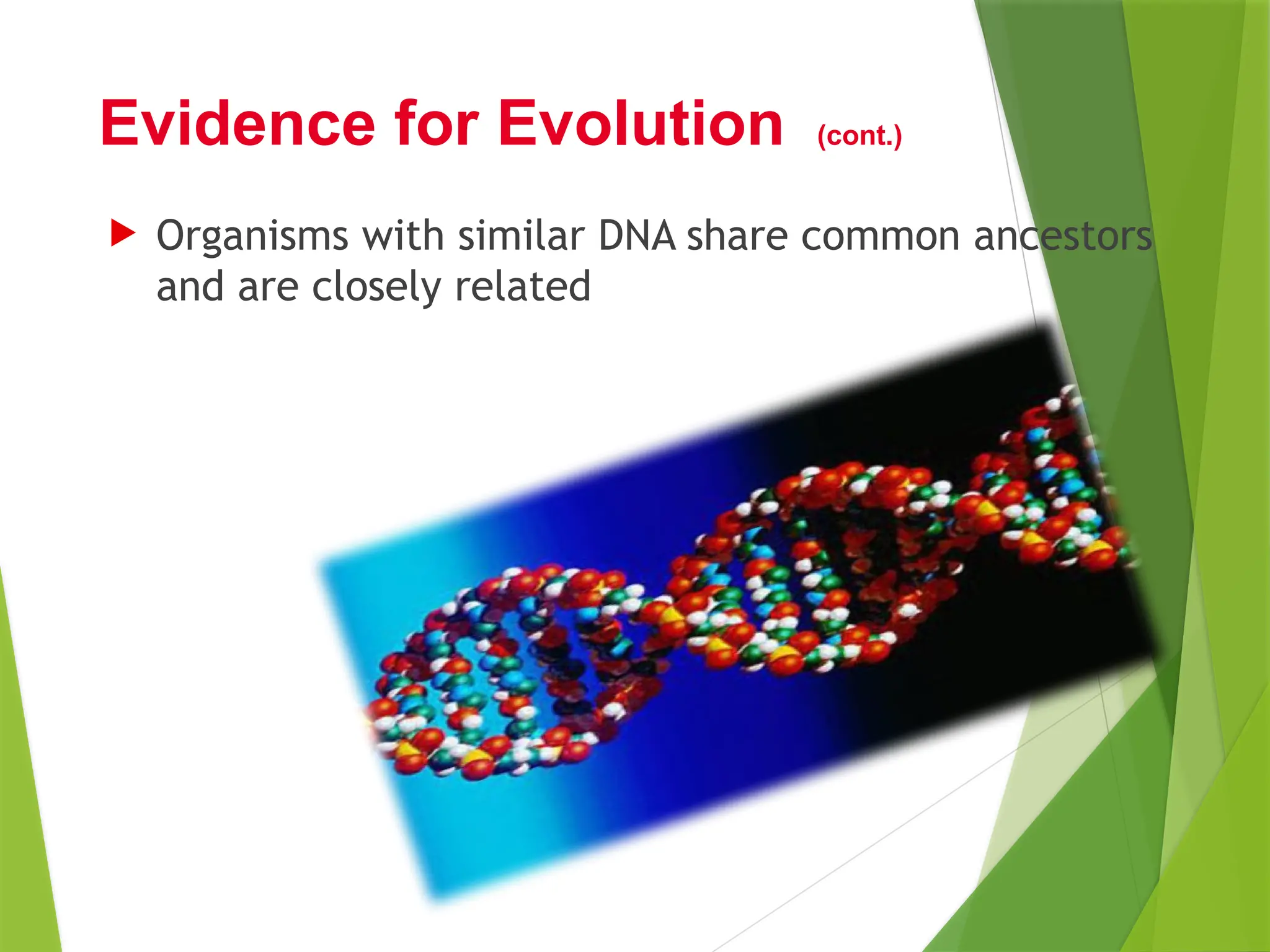
 Organisms with similar DNA share common ancestors
and are closely related
Evidence for Evolution (cont.)
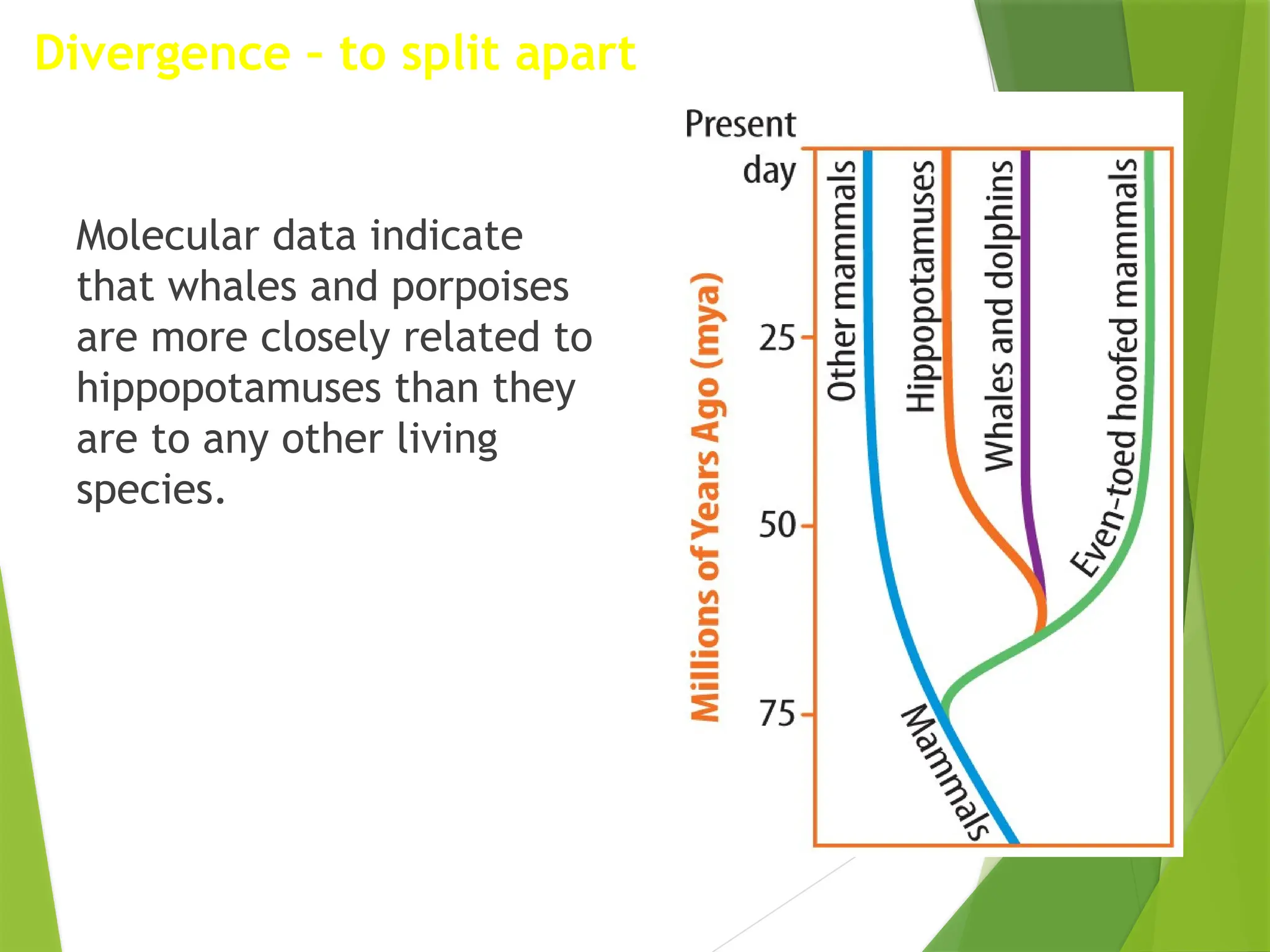
Molecular data indicate
that whales and porpoises
are more closely related to
hippopotamuses than they
are to any other living
species.
Divergence – to split apart
 New evidence supporting the theory
of evolution by natural selection is discovered nearly
every day, but scientists debate some of the details.
 New fossils that have features of species that lived both
before them and after them help scientists study more
details about the origin of new species.
The Study of Evolution Today
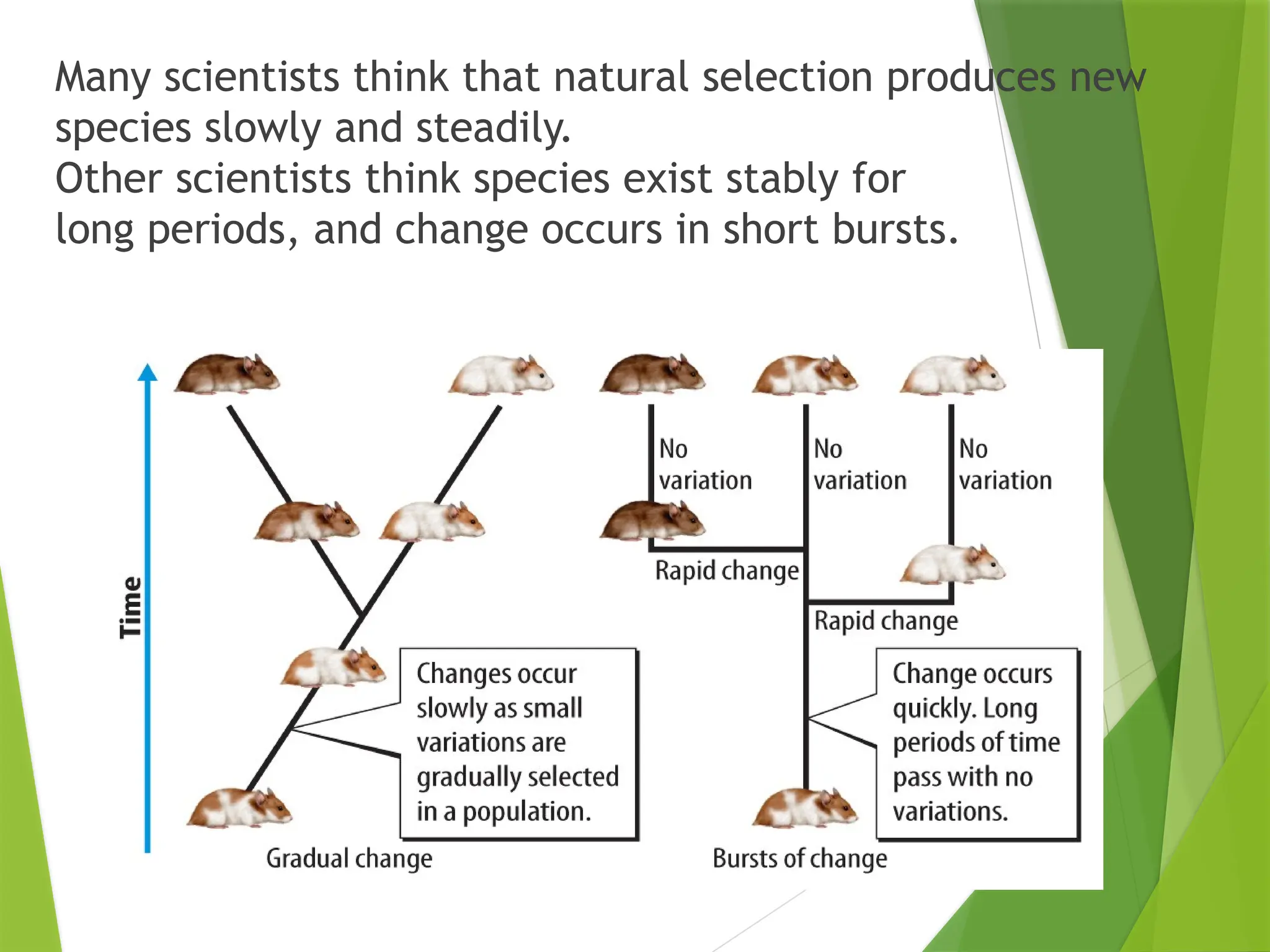
Many scientists think that natural selection produces new
species slowly and steadily.
Other scientists think species exist stably for
long periods, and change occurs in short bursts.
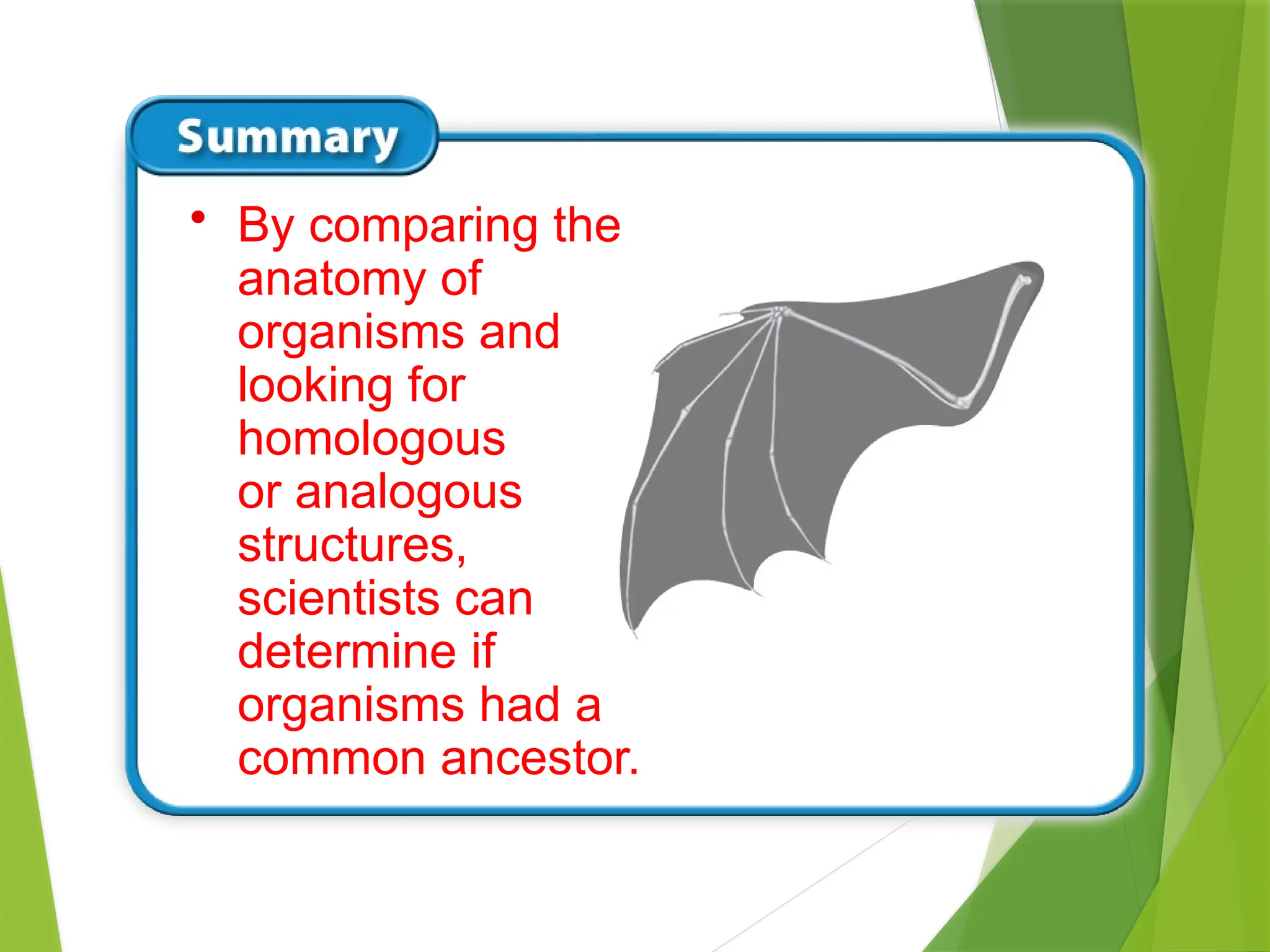
• By comparing the
anatomy of
organisms and
looking for
homologous
or analogous
structures,
scientists can
determine if
organisms had a
common ancestor.
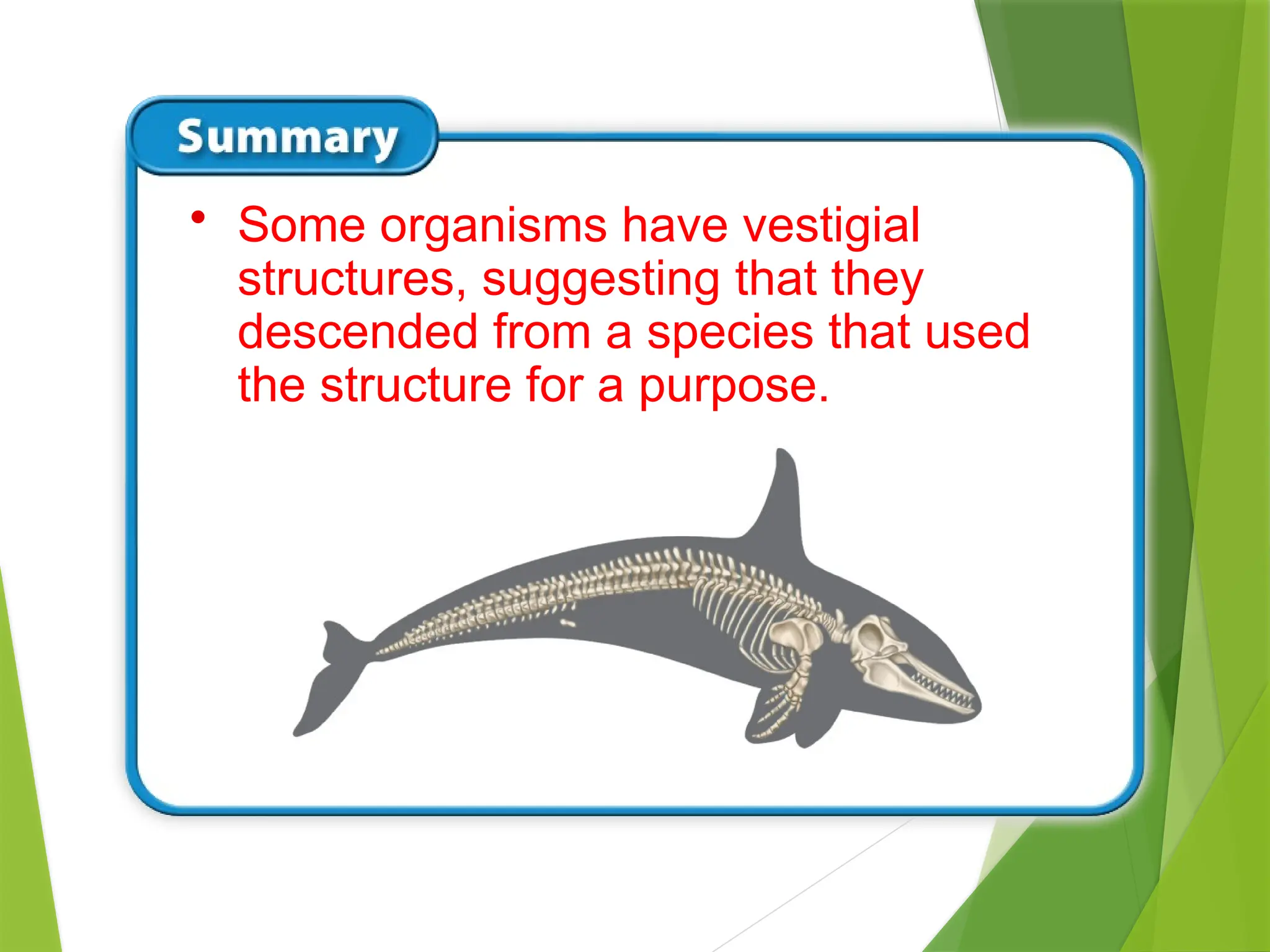
• Some organisms have vestigial
structures, suggesting that they
descended from a species that used
the structure for a purpose.
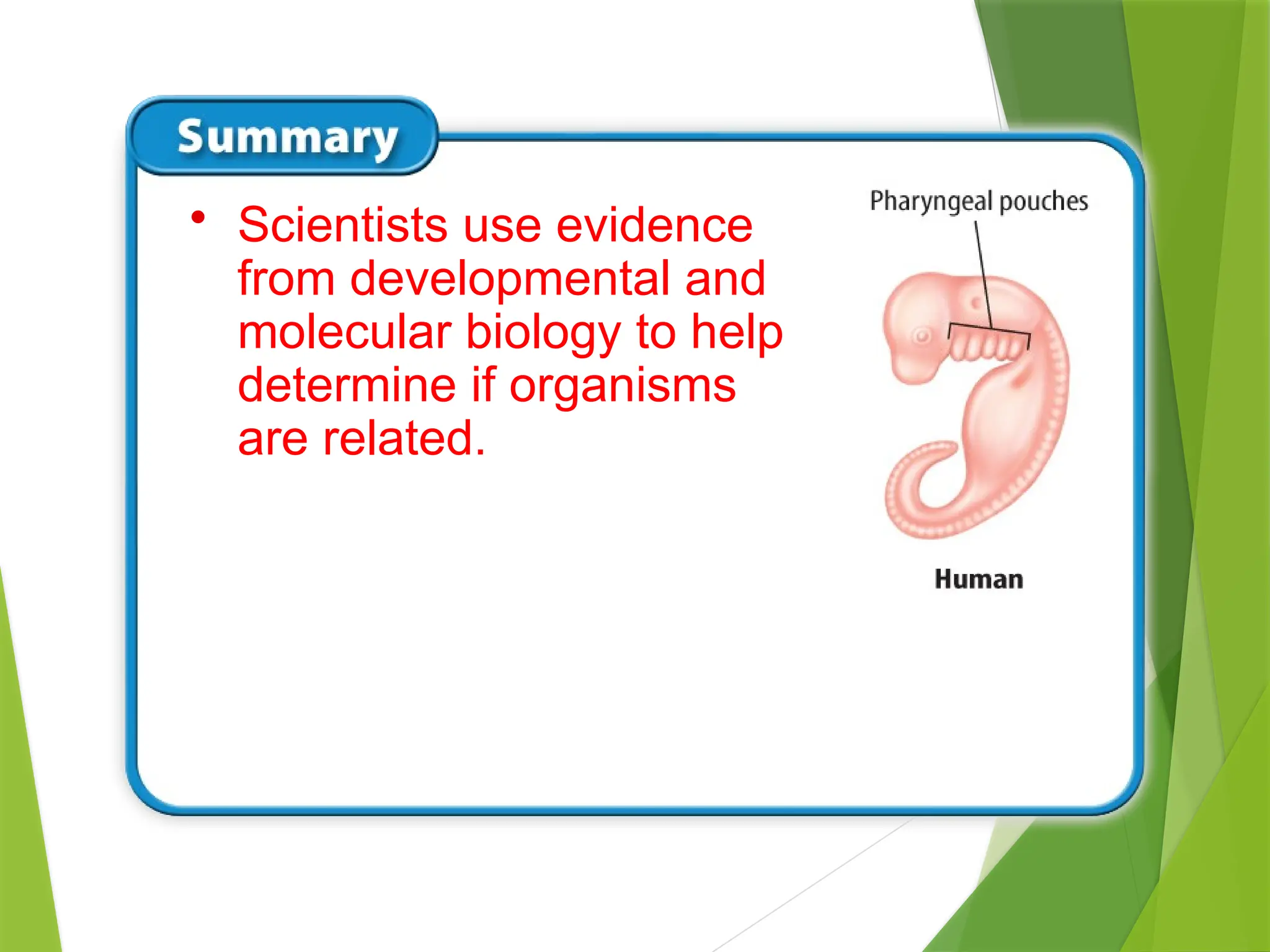
• Scientists use evidence
from developmental and
molecular biology to help
determine if organisms
are related.
The BIG Idea
Through natural selection,
species evolve as they
adapt
to Earth’s changing
environments.
Key Concepts 1
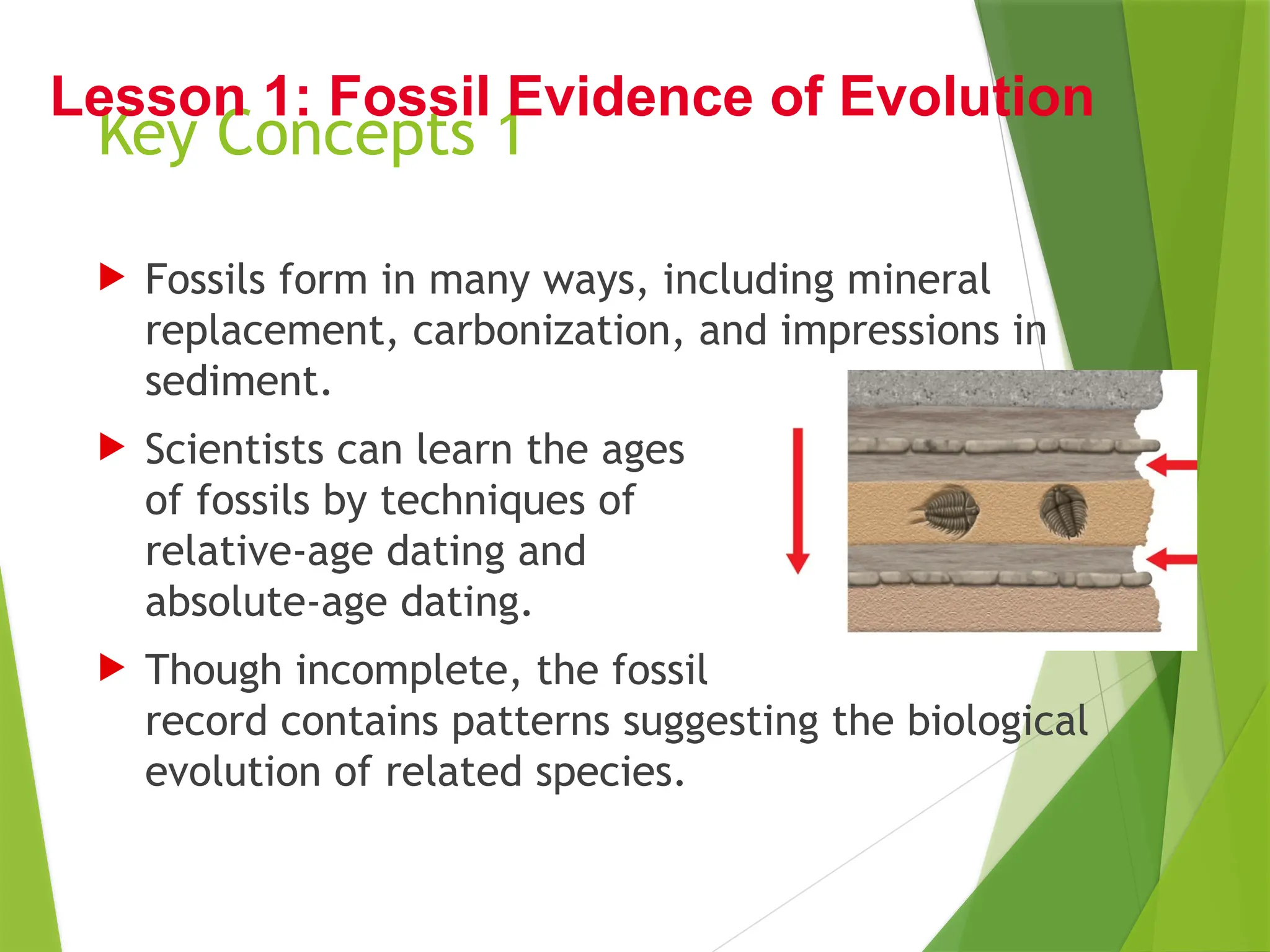
 Fossils form in many ways, including mineral
replacement, carbonization, and impressions in
sediment.
 Scientists can learn the ages
of fossils by techniques of
relative-age dating and
absolute-age dating.
 Though incomplete, the fossil
record contains patterns suggesting the biological
evolution of related species.
Lesson 1: Fossil Evidence of Evolution
 The 19th century naturalist Charles Darwin developed
a theory of evolution that is still studied today.
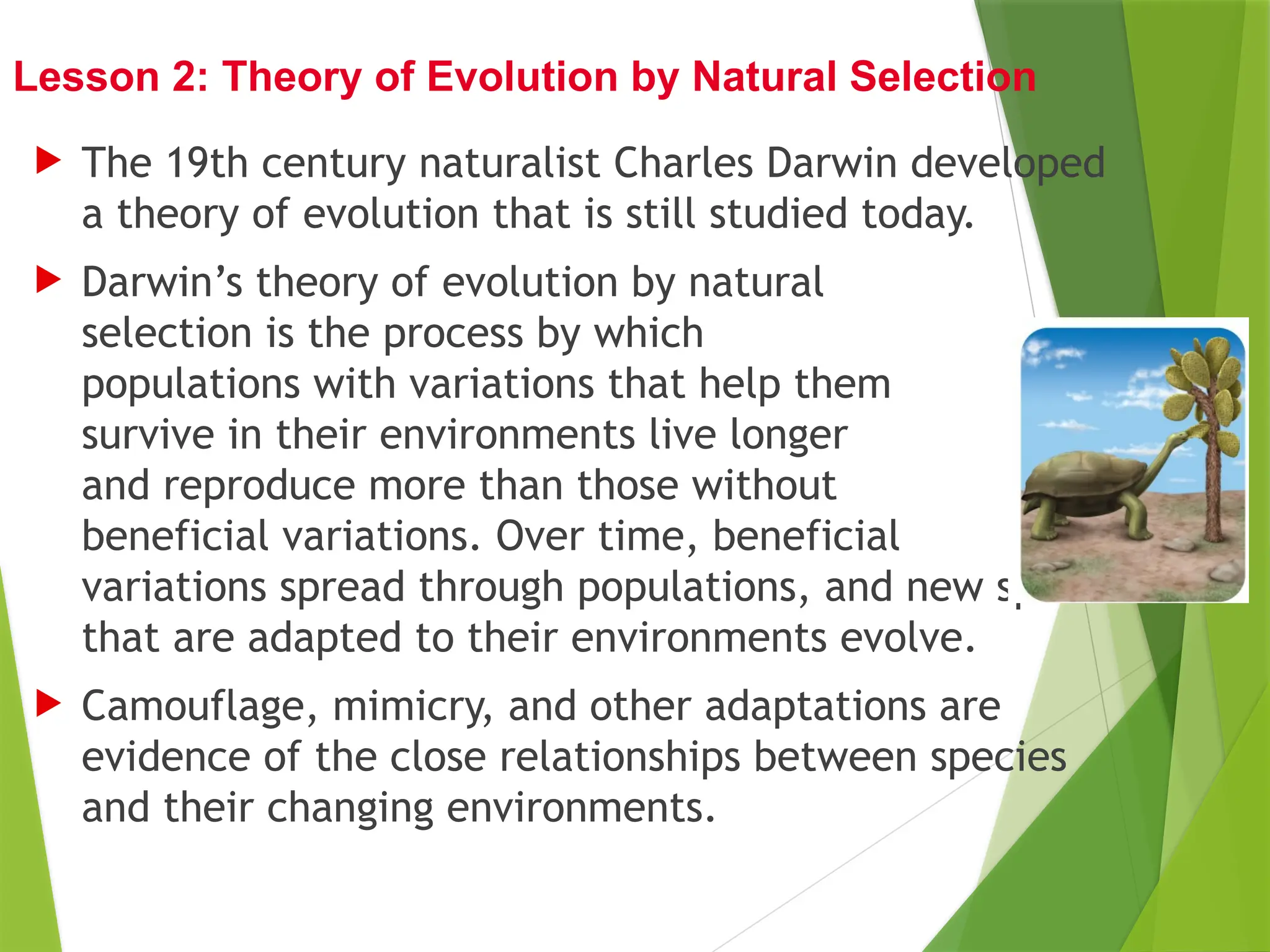
 Darwin’s theory of evolution by natural
selection is the process by which
populations with variations that help them
survive in their environments live longer
and reproduce more than those without
beneficial variations. Over time, beneficial
variations spread through populations, and new species
that are adapted to their environments evolve.
 Camouflage, mimicry, and other adaptations are
evidence of the close relationships between species
and their changing environments.
Lesson 2: Theory of Evolution by Natural Selection
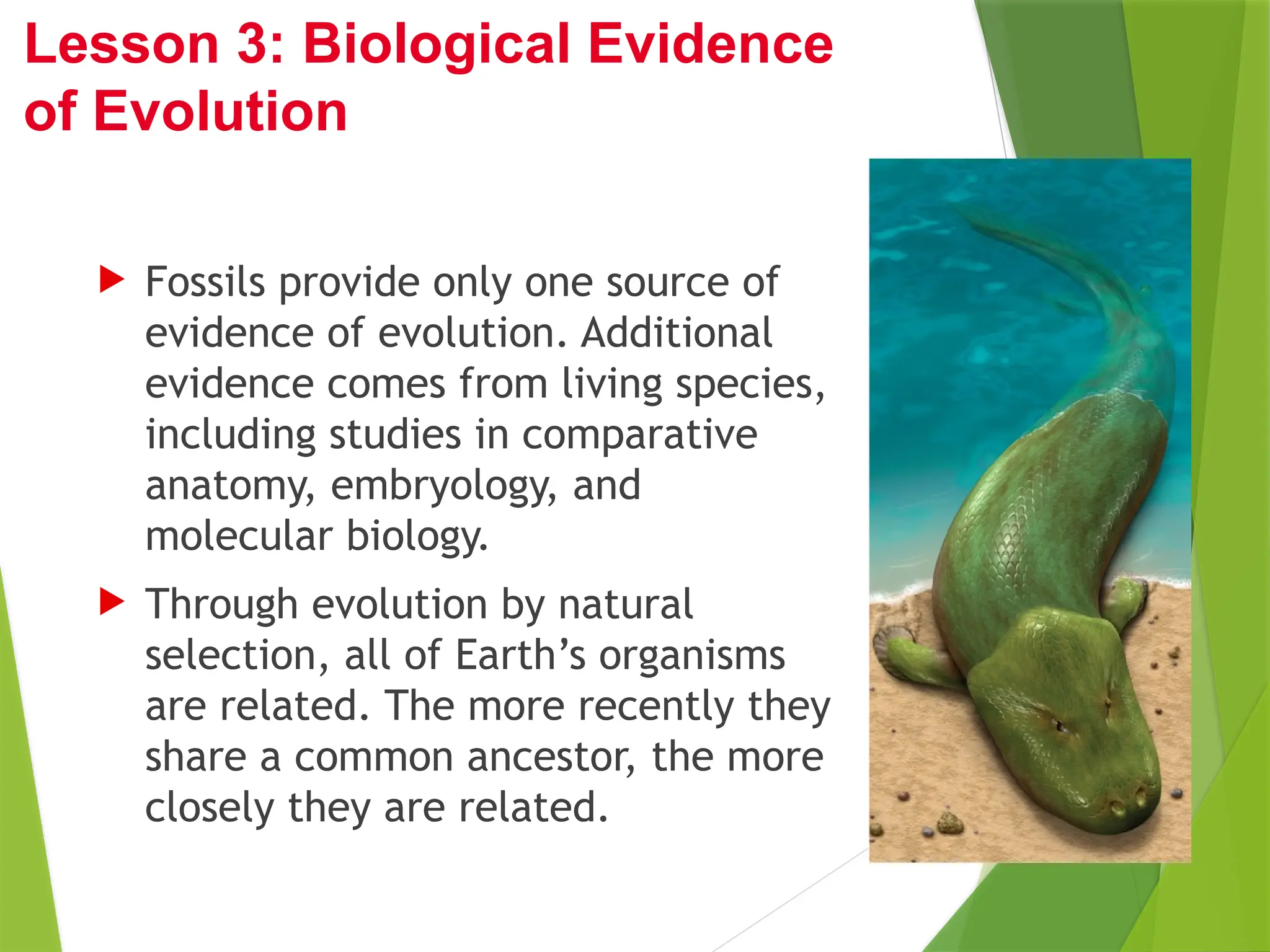
 Fossils provide only one source of
evidence of evolution. Additional
evidence comes from living species,
including studies in comparative
anatomy, embryology, and
molecular biology.
 Through evolution by natural
selection, all of Earth’s organisms
are related. The more recently they
share a common ancestor, the more
closely they are related.
Lesson 3: Biological Evidence
of Evolution
Content, images, text, etc. used belong to
the rightful owner. No copyright
infringement intended.

G10 Science Q3-Week 5- Fossil Evolution.pptx

  • 1.
  • 2.
    S10LT - IIIf-39 Explain how fossil records, comparative anatomy, and genetic information provide evidence for evolution
  • 3.
    How do speciesadapt to changing environments over time?
  • 4.
    What do youthink? Before you begin, decide if you agree or disagree with each of these statements. As you view this presentation, see if you change your mind about any of the statements.
  • 5.
    1. Original tissuescan be preserved as fossils. 2. Organisms become extinct only in mass extinction events. 3. Environmental change causes variations in populations. Do you agree or disagree?
  • 6.
    4. Variations canlead to adaptations. 5. Living species contain no evidence that they are related to each other. 6. Plants and animals share similar genes. Do you agree or disagree?
  • 7.
    • How dofossils form? • How do scientists date fossils? • How are fossils evidence of biological evolution? Fossil Evidence of Evolution SWBATA
  • 8.
    • fossil record •mold • cast • trace fossil Fossil Evidence of Evolution • geologic time scale • extinction • biological evolution
  • 9.
     The fossilrecord is made up of all the fossils ever discovered on Earth.  The fossil record provides evidence that species have changed over time.  Based on fossil evidence, scientists can recreate the physical appearance of species that are no longer alive on Earth. The Fossil Record
  • 10.
    After an animaldies, any soft tissues animals do not eat break down. Fossil Formation tissue Science Use similar cells that work together and perform a function Common Use a piece of soft, absorbent paper
  • 11.
     Only thedead animal’s hard parts, such as bones, shells, and teeth, remain.  Under rare conditions, these parts become fossils. Fossil Formation (cont.)
  • 12.
     The impressionof an organism in a rock is called a mold.  A cast is a fossil copy of an organism in a rock. Fossil Formation (cont.)
  • 13.
    A trace fossilis the preserved evidence of the activity of an organism. Fossil Formation (cont.) fossil from Latin fossilis, means “to obtain by digging”
  • 14.
     Instead ofdating fossils directly, scientists date the rocks the fossils are embedded inside.  In relative-age dating, scientists determine the relative order in which rock layers were deposited. Determining a Fossil’s Age
  • 15.
     Scientists takeadvantage of radioactive decay, a natural clocklike process in rocks, to learn a rock’s absolute age, or its age in years.  To measure the age of sedimentary rock layers, scientists calculate the ages of igneous layers above and below them. Determining a Fossil’s Age (cont.)
  • 16.
    If the ageof the igneous layers is known, it is possible to estimate the age of the sedimentary layers— and the fossils they contain— between them.
  • 17.
     The geologictime scale is a chart that divides Earth’s history into different time units.  Earth’s history is divided into four eons —the longest time units in the geologic time scale. Fossils over Time
  • 18.
  • 20.
     Extinction occurswhen the last individual organism of a species dies.  A mass extinction occurs when many species become extinct within a few million years or less.  Extinctions can occur when environments change. Extinctions
  • 21.
    The fossil recordcontains evidence that five mass extinction events have occurred during the Phanerozoic eon. Extinctions (cont.)
  • 22.
     The fossilrecord contains evidence of the appearance of many new species over time.  Biological evolution is the change over time in populations of related organisms. Extinctions (cont.)
  • 23.
    The fossil recordis evidence that horses descended from organisms for which only fossils exist today.
  • 24.
    • Fossils canconsist of the hard parts or soft parts of organisms. Fossils can be an impression of an organism or consist of original tissues. • Scientists determine the age of a fossil through relative-age dating or absolute- age dating.
  • 25.
    • Scientists use fossilsas evidence that species have changed over time.
  • 26.
    Terms to Know… •comparative anatomy • homologous structure • analogous structure • vestigial structure • embryology
  • 27.
    • What evidencefrom living species supports the theory that species descended from other species over time? • How are Earth’s organisms related? Biological Evidence of Evolution SWBATA
  • 28.
     The degreeto which species are related depends on how closely in time they diverged, or split, from their common ancestor.  Although the fossil record is incomplete, it contains many examples of fossil sequences showing close ancestral relationships. Evidence for Evolution
  • 29.
    The fossil record indicatesthat different species of horses often overlapped with each other.
  • 30.
     Comparative anatomyis the study of similarities and differences among structures of living species. ( Comparing and Anatomy)  Homologous structures are body parts of organisms that are similar in structure and position but different in function. Evidence for Evolution (cont.)
  • 31.
    The forelimbs ofthese species are different sizes, but their placement and structure suggest common ancestry.
  • 32.
    Body parts thatperform a similar function but differ in structure are analogous structures. Organisms evolve to the environment in similar ways! Wings and fins are perfect examples!
  • 33.
    Vestigial structures arebody parts that have lost their original function through evolution.
  • 34.
    The science ofthe development of embryos from fertilization to birth is called embryology. Evidence for Evolution (cont.)
  • 35.
    All vertebrate embryosexhibit pharyngeal pouches at a certain stage of their development. These features, which develop into neck and face parts, suggest relatedness.
  • 36.
    Review  How dohomologous structures provide evidence for evolution?  How are vestigial structures evidence of descent from ancestral species?  How do pharyngeal pouches provide evidence of relationships among species?
  • 37.
     Molecular biologyis the study of gene structure and function.  Discoveries have confirmed and extended much of the data already collected about the theory of evolution.  Scientists can study relatedness of organisms by comparing genes and proteins among living species. Evidence for Evolution (cont.)
  • 38.
     Organisms withsimilar DNA share common ancestors and are closely related Evidence for Evolution (cont.)
  • 40.
    Molecular data indicate thatwhales and porpoises are more closely related to hippopotamuses than they are to any other living species. Divergence – to split apart
  • 41.
     New evidencesupporting the theory of evolution by natural selection is discovered nearly every day, but scientists debate some of the details.  New fossils that have features of species that lived both before them and after them help scientists study more details about the origin of new species. The Study of Evolution Today
  • 42.
    Many scientists thinkthat natural selection produces new species slowly and steadily. Other scientists think species exist stably for long periods, and change occurs in short bursts.
  • 43.
    • By comparingthe anatomy of organisms and looking for homologous or analogous structures, scientists can determine if organisms had a common ancestor.
  • 44.
    • Some organismshave vestigial structures, suggesting that they descended from a species that used the structure for a purpose.
  • 45.
    • Scientists useevidence from developmental and molecular biology to help determine if organisms are related.
  • 46.
    The BIG Idea Throughnatural selection, species evolve as they adapt to Earth’s changing environments.
  • 47.
    Key Concepts 1 Fossils form in many ways, including mineral replacement, carbonization, and impressions in sediment.  Scientists can learn the ages of fossils by techniques of relative-age dating and absolute-age dating.  Though incomplete, the fossil record contains patterns suggesting the biological evolution of related species. Lesson 1: Fossil Evidence of Evolution
  • 48.
     The 19thcentury naturalist Charles Darwin developed a theory of evolution that is still studied today.  Darwin’s theory of evolution by natural selection is the process by which populations with variations that help them survive in their environments live longer and reproduce more than those without beneficial variations. Over time, beneficial variations spread through populations, and new species that are adapted to their environments evolve.  Camouflage, mimicry, and other adaptations are evidence of the close relationships between species and their changing environments. Lesson 2: Theory of Evolution by Natural Selection
  • 49.
     Fossils provideonly one source of evidence of evolution. Additional evidence comes from living species, including studies in comparative anatomy, embryology, and molecular biology.  Through evolution by natural selection, all of Earth’s organisms are related. The more recently they share a common ancestor, the more closely they are related. Lesson 3: Biological Evidence of Evolution
  • 50.
    Content, images, text,etc. used belong to the rightful owner. No copyright infringement intended.